
Koreanisch lernenis an engaging introduction to the Korean language,...
 Chinesisch6,117 views·Updated Jun 24, 2026·11 pages
Lerne Koreanisch: Grammatik, Sätze und Zahlen für Anfänger

Jenni@br00klyn





1 / 10
1
of 10
Lesson 1: The Korean Alphabet (Hangul)
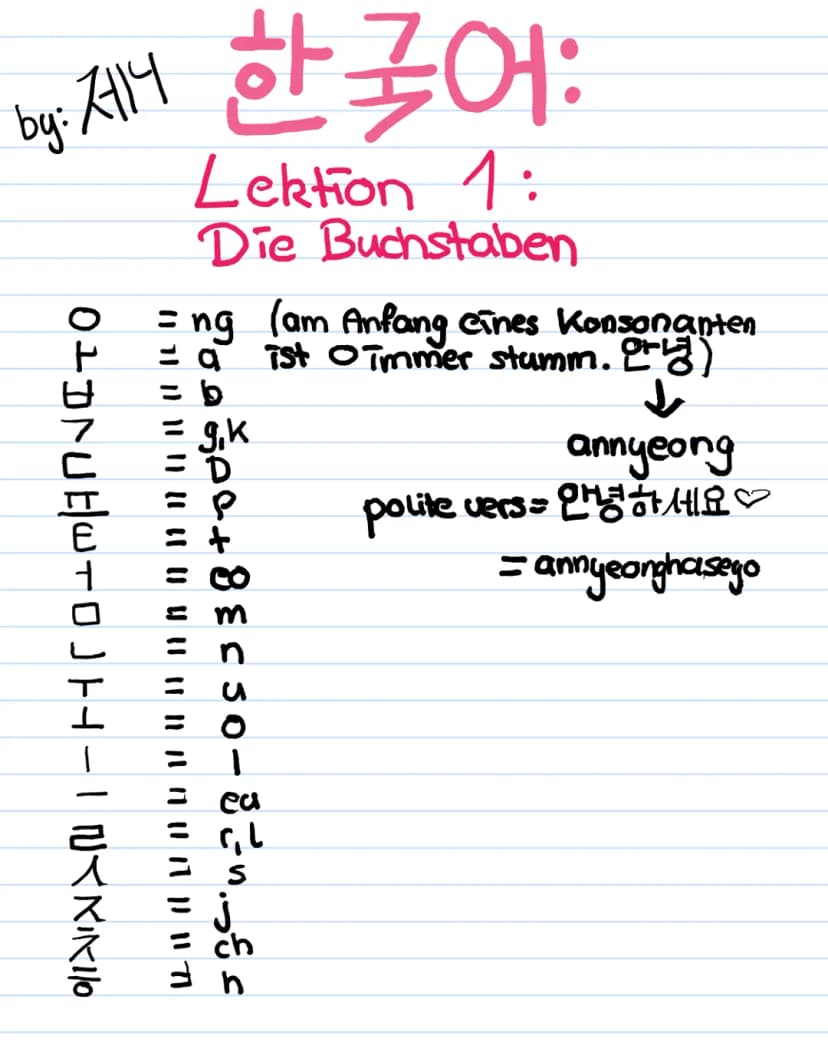
This section introduces the basics of the Koreanisches Alphabet, known as Hangul. It covers several key consonants and their pronunciations, providing a foundation for reading Korean.
Example: The letter ㅇ is explained as silent at the beginning of a syllable, but pronounced as "ng" at the end.
Highlight: The polite greeting "안녕하세요" (annyeonghaseyo) is introduced, demonstrating practical application of the alphabet.
2
of 10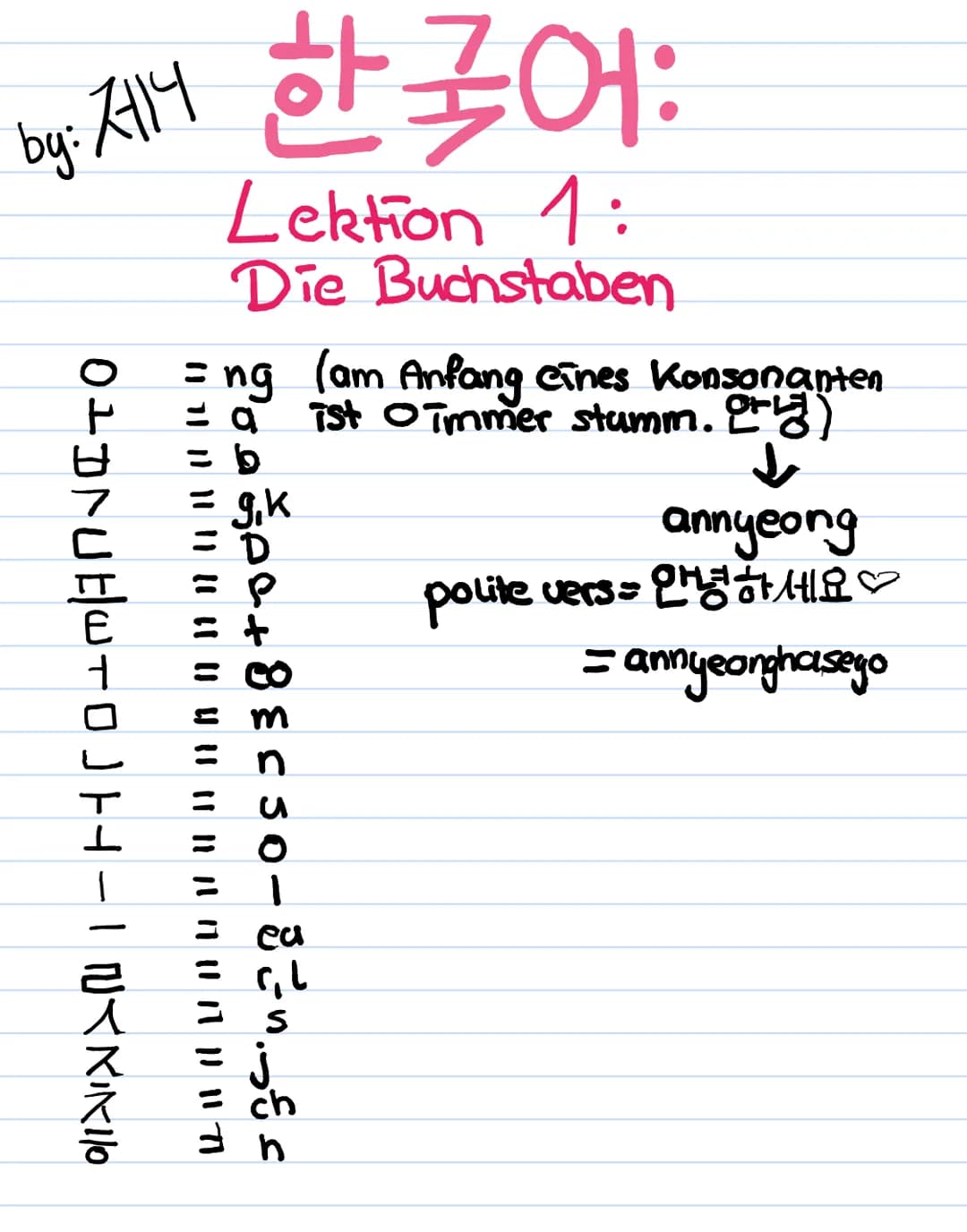
Writing Practice for Korean Letters
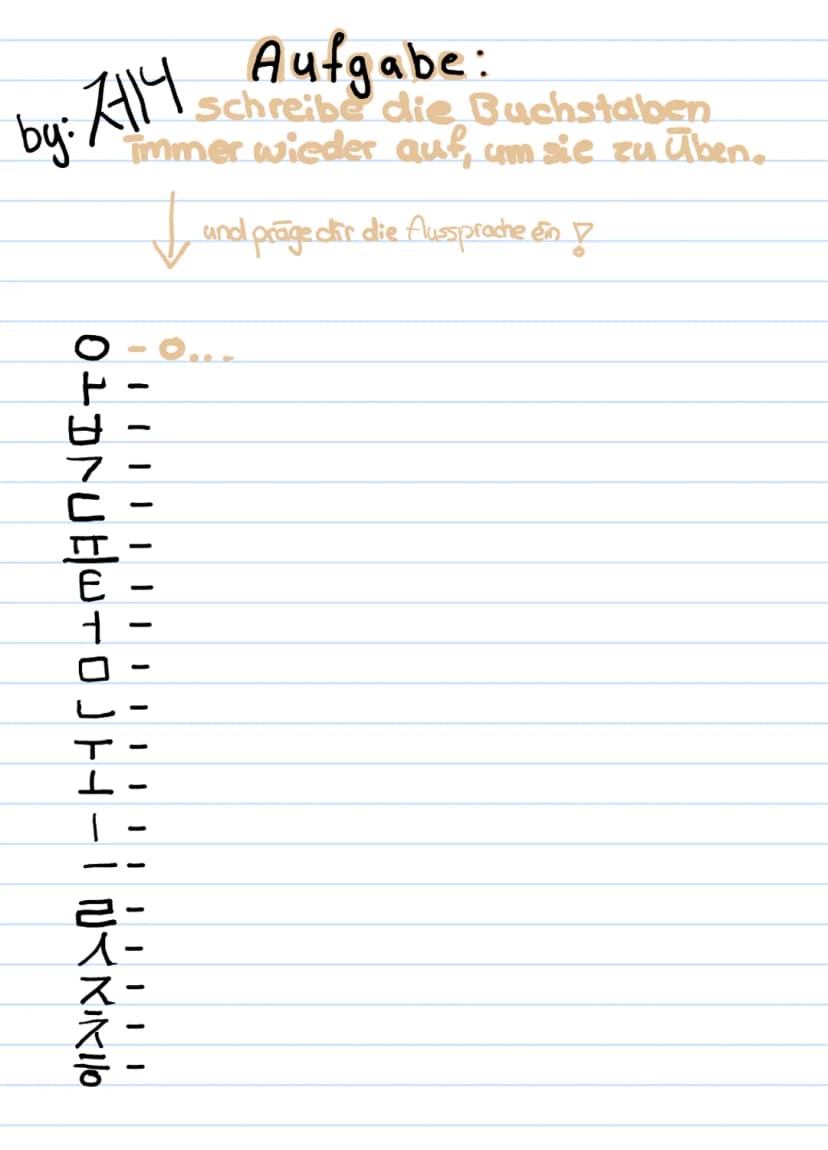
This page emphasizes the importance of practice in learning the Koreanisches Alphabet. It encourages learners to repeatedly write the letters to reinforce memory and improve handwriting skills.
Highlight: The guide stresses the importance of not only writing but also internalizing the pronunciation of each letter.
3
of 10
Lesson 2: Korean Numbers and Pronunciation
This section covers koreanische zahlen 1-10 and extends to numbers up to 18. It provides both the Korean characters and their romanized pronunciations.
Example: 하나 (hana) for one, 둘 (dul) for two, 셋 (set) for three, and so on.
Highlight: The lesson includes numbers 11-18, showing how Korean forms teens by combining ten (열) with single digits.
4
of 10
Lesson 3: Korean Vowel Combinations
This page introduces complex vowel combinations in the Koreanisches Alphabet, expanding on the basic vowels learned earlier. It showcases various diphthongs and their pronunciations.
Example: ㅐ (ae), ㅒ (yae), ㅚ (oe), ㅟ (wi), among others.
Highlight: The lesson provides a comprehensive list of vowel combinations, essential for proper Hangul Aussprache (Hangul pronunciation).
5
of 10
Lesson 4: Korean Consonants
This lesson delves deeper into Korean consonants, explaining their pronunciations and variations. It's crucial for understanding Koreanische Grammatik für Anfänger.
Example: ㄱ is described as a soft 'g/k' sound, while ㄴ is equivalent to 'n'.
Highlight: The lesson notes that some consonants can have multiple pronunciations or representations, such as ㅇ being silent at the start of a syllable or pronounced as 'ng' at the end.
6
of 10
Lesson 5: Double Consonants in Korean
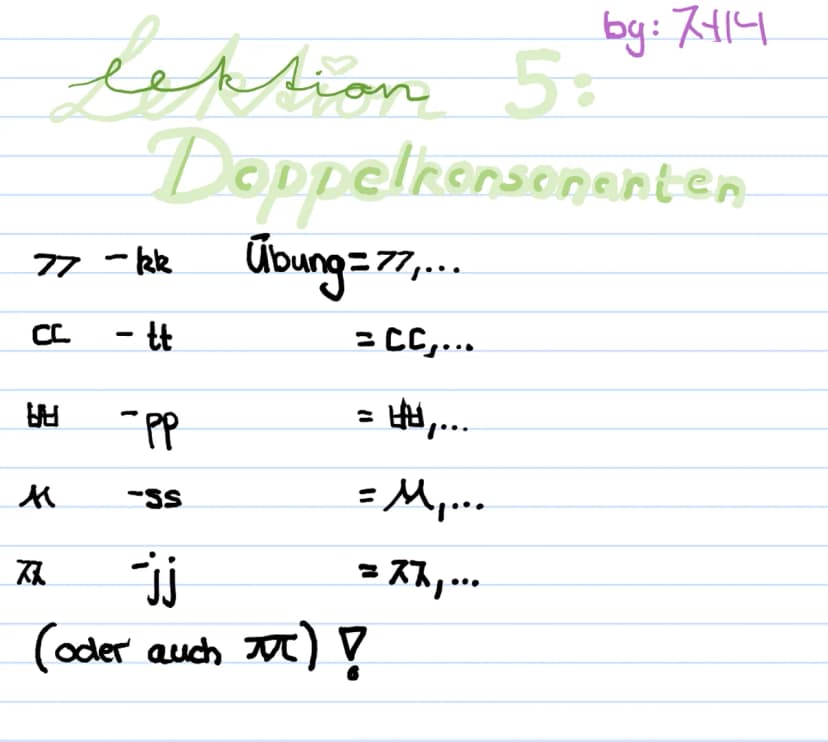
This page introduces double consonants in Korean, an important aspect of Koreanische Grammatik PDF resources. It explains how these affect pronunciation and provides practice exercises.
Example: ㄲ (kk), ㄸ (tt), ㅃ (pp), ㅆ (ss), ㅉ (jj)
Highlight: The lesson emphasizes the importance of practicing these double consonants to master their distinct sounds.
7
of 10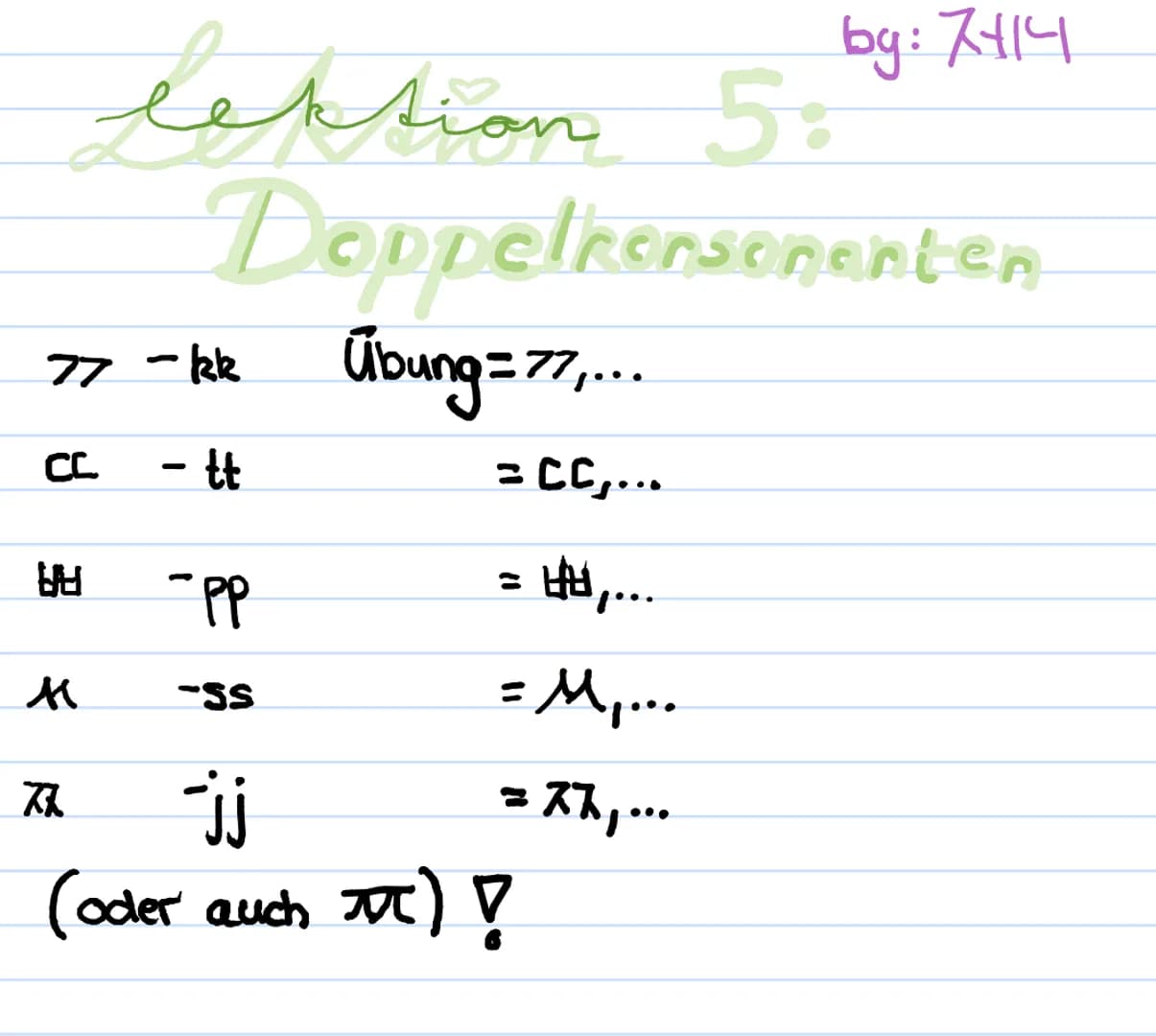
Lesson 6: Korean Vowels in Detail
This section provides a comprehensive overview of Korean vowels, essential for proper Hangul Aussprache. It includes both simple and complex vowel sounds.
Example: ㅏ , ㅓ , ㅗ , ㅜ
Highlight: The lesson distinguishes between long and short vowel sounds, crucial for correct pronunciation in Korean.
8
of 10
Korean Syllable Structure
This page explains the concept of syllable blocks in Korean writing, a fundamental aspect of Koreanische Grammatik für Anfänger. It describes how letters are arranged within an imaginary square to form syllables.
Definition: A Korean syllable consists of 2-4 letters, including vowels and consonants, arranged in a specific order.
Highlight: The lesson introduces the silent ㅇ (ng) used at the beginning of syllables when no other consonant is present.
9
of 10
Lesson 7: Korean Syllable Words
This section provides examples of both single-syllable and multi-syllable Korean words, helping learners practice Koreanische Texte zum Üben. It includes common words and their meanings.
Example: 김 , 문 , 말
Highlight: The lesson introduces compound words, demonstrating how Korean combines syllables to create more complex meanings, such as 한국말 .
10
of 10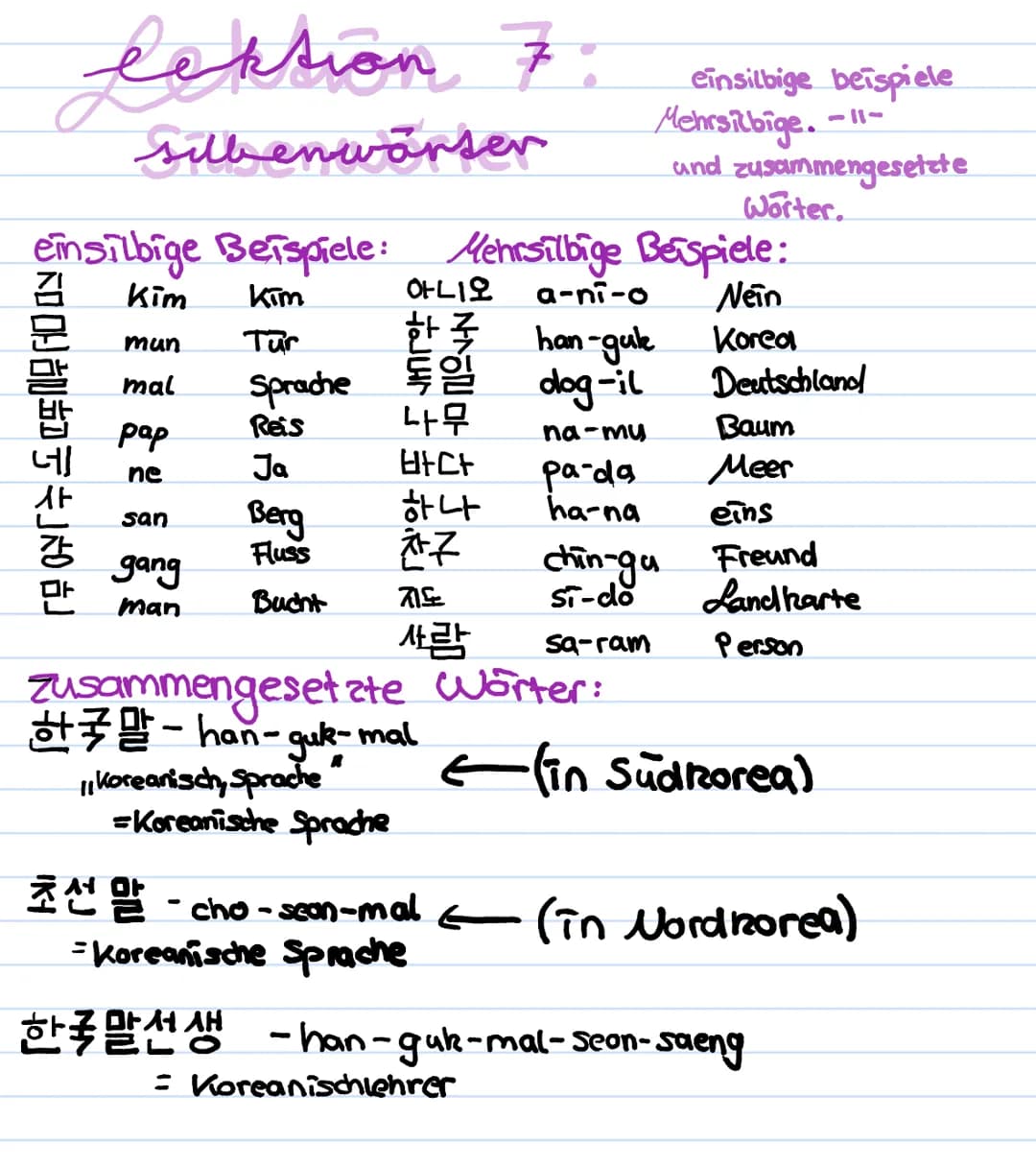
This final page appears to be blank or contains non-textual elements, so there is no summary to provide for it.
We thought you’d never ask...
What is the Knowunity AI companion?
Our AI companion is specifically built for the needs of students. Based on the millions of content pieces we have on the platform we can provide truly meaningful and relevant answers to students. But its not only about answers, the companion is even more about guiding students through their daily learning challenges, with personalised study plans, quizzes or content pieces in the chat and 100% personalisation based on the students skills and developments.
Where can I download the Knowunity app?
You can download the app in the Google Play Store and in the Apple App Store.
Is Knowunity really free of charge?
That's right! Enjoy free access to study content, connect with fellow students, and get instant help – all at your fingertips.
Similar Content
 Yabancı Dil
 Český jazyk a literatura
 Türkçe
Most popular content: Sprachenlernen
3 Latein
Alle Endungen von Verben - Latein
Aktiv & Passiv Endungen von allen Zeitformen
83679
 Russisch
Russisches Alphabet Lernen
Entdecken Sie das russische Alphabet mit Groß- und Kleinbuchstaben, Beispielwörtern und deren deutschen Übersetzungen. Diese Übersicht bietet auch die korrekte Aussprache für jedes Zeichen und Wort, um Ihnen beim Erlernen der russischen Sprache zu helfen. Ideal für Anfänger und Sprachinteressierte.
82,581126
 Französisch
Effektive Vokabelstrategien
Entdecke bewährte Methoden zum Vokabellernen für Schüler der Klassen 6-8. Diese Zusammenfassung bietet praktische Tipps zur Erstellung von Karteikarten, zur Visualisierung von Wörtern und zur Selbstüberprüfung. Ideal für das Erlernen von Fremdsprachen wie Englisch, Latein und Französisch.
62,311106
Most popular content in Chinesisch
2ChinesischFamilienmitglieder auf Koreanisch
Entdecken Sie die wichtigsten Begriffe für Familienmitglieder auf Koreanisch, einschließlich Vater, Mutter, Bruder und Schwester. Diese Zusammenstellung bietet eine klare Übersicht über die koreanischen Begriffe und deren Aussprachen, ideal für Sprachlerner und Kulturinteressierte.
51,11152
ChinesischHiragana und Dakuon
Entdecken Sie die Grundlagen der Hiragana-Schrift, einschließlich Dakuon und Kombinationssilben. Diese Zusammenfassung bietet eine klare Übersicht über die verschiedenen Hiragana-Zeichen und deren Aussprache, ideal für Anfänger im Japanischlernen.
91,11766
Most popular content
9 Deutsch
Der zerbrochene Krug
Szenenzusammenfassunfen, Figurenkonstellationen, Aufbau des Stücks, Sprache und Stilbesonderheiten, Aussageabsicht, Thematik, Interpretation
1148,034728
DeutschDer zerbrochene Krug von Heinrich von Kleist
Hier steht so ziemlich alles drinnen von Zusammenfassungen der einzelnen Auftritte bis hin zu den einzelnen Perosn und noch einiges mehr
1254,769921
DeutschDer zerbrochne Krug
Ausführliche Lernzettel zu: Basisdaten, Handlung, ausführliche Zusammenfassungen der Auftritte, zentrale Themen, Symbolische Bedeutung, Merkmale der Komödie
1214,327253
DeutschHeimsuchung_JennyErpenbeck_Abitur
Zusammenfassungen für jedes Kapitel, Analysen und Zitate
1314,076277
 Mathe
MatheZP10 Mathe Zusammenfassung NRW
Lernzettel für die ZP10 Mathe in NRW mit allen Themen außer Sinusfunktionen.
1061,9114,842
DeutschDer zerbrochene Krug: Analyse
Diese umfassende Analyse von 'Der zerbrochene Krug' von Heinrich von Kleist bietet eine detaillierte Kapitelzusammenfassung, Charakterisierungen, historische Kontexte, sowie den Aufbau und die sprachlichen Merkmale des Dramas. Ideal für Studierende, die sich auf Prüfungen vorbereiten oder tiefere Einblicke in Kleists Werk gewinnen möchten.
1199,8391,255
 Englisch
Englisch LK Abitur 2025
Komplette Englisch LK Abi Zusammenfassung 2025
1315,040394
DeutschSchreibkompetenzen Deutsch LK
Diese umfassende Zusammenstellung bereitet auf das Abitur 2024 vor und deckt alle relevanten Schreibkompetenzen ab: von der Analyse pragmatischer Texte über die Erörterung literarischer Werke bis hin zur Interpretation von Epik, Lyrik und Dramatik. Zudem werden Techniken des materialgestützten Schreibens, der Redeanalyse sowie journalistische Textsorten und rhetorische Mittel behandelt. Ideal für eine gezielte und effektive Prüfungsvorbereitung.
138,207165
DeutschJenny Erpenbeck "Heimsuchung"
Übersicht und Struktur des Romans
117,998168
Can't find what you're looking for? Explore other subjects.
Students love us — and so will you.
4.6/5App Store
4.7/5Google Play
The app is very easy to use and well designed. I have found everything I was looking for so far and have been able to learn a lot from the presentations! I will definitely use the app for a class assignment! And of course it also helps a lot as an inspiration.
Stefan SiOS user
This app is really great. There are so many study notes and help [...]. My problem subject is French, for example, and the app has so many options for help. Thanks to this app, I have improved my French. I would recommend it to anyone.
Samantha KlichAndroid user
Wow, I am really amazed. I just tried the app because I've seen it advertised many times and was absolutely stunned. This app is THE HELP you want for school and above all, it offers so many things, such as workouts and fact sheets, which have been VERY helpful to me personally.
AnnaiOS user
Chinesisch6,117 views·Updated Jun 24, 2026·11 pagesLerne Koreanisch: Grammatik, Sätze und Zahlen für Anfänger
Jenni@br00klyn
Koreanisch lernen is an engaging introduction to the Korean language, covering essential aspects like the alphabet, numbers, and basic grammar. This guide provides a solid foundation for beginners eager to explore Korean culture and communication.
- Introduces Hangul, the Korean alphabet,...
1
of 10
Sign up to see the content. It's free!
- Access to all documents
- Improve your grades
- Join milions of students
Lesson 1: The Korean Alphabet (Hangul)
This section introduces the basics of the Koreanisches Alphabet, known as Hangul. It covers several key consonants and their pronunciations, providing a foundation for reading Korean.
Example: The letter ㅇ is explained as silent at the beginning of a syllable, but pronounced as "ng" at the end.
Highlight: The polite greeting "안녕하세요" (annyeonghaseyo) is introduced, demonstrating practical application of the alphabet.
2
of 10Sign up to see the content. It's free!
- Access to all documents
- Improve your grades
- Join milions of students
Writing Practice for Korean Letters
This page emphasizes the importance of practice in learning the Koreanisches Alphabet. It encourages learners to repeatedly write the letters to reinforce memory and improve handwriting skills.
Highlight: The guide stresses the importance of not only writing but also internalizing the pronunciation of each letter.
3
of 10Sign up to see the content. It's free!
- Access to all documents
- Improve your grades
- Join milions of students
Lesson 2: Korean Numbers and Pronunciation
This section covers koreanische zahlen 1-10 and extends to numbers up to 18. It provides both the Korean characters and their romanized pronunciations.
Example: 하나 (hana) for one, 둘 (dul) for two, 셋 (set) for three, and so on.
Highlight: The lesson includes numbers 11-18, showing how Korean forms teens by combining ten (열) with single digits.
4
of 10Sign up to see the content. It's free!
- Access to all documents
- Improve your grades
- Join milions of students
Lesson 3: Korean Vowel Combinations
This page introduces complex vowel combinations in the Koreanisches Alphabet, expanding on the basic vowels learned earlier. It showcases various diphthongs and their pronunciations.
Example: ㅐ (ae), ㅒ (yae), ㅚ (oe), ㅟ (wi), among others.
Highlight: The lesson provides a comprehensive list of vowel combinations, essential for proper Hangul Aussprache (Hangul pronunciation).
5
of 10Sign up to see the content. It's free!
- Access to all documents
- Improve your grades
- Join milions of students
Lesson 4: Korean Consonants
This lesson delves deeper into Korean consonants, explaining their pronunciations and variations. It's crucial for understanding Koreanische Grammatik für Anfänger.
Example: ㄱ is described as a soft 'g/k' sound, while ㄴ is equivalent to 'n'.
Highlight: The lesson notes that some consonants can have multiple pronunciations or representations, such as ㅇ being silent at the start of a syllable or pronounced as 'ng' at the end.
6
of 10Sign up to see the content. It's free!
- Access to all documents
- Improve your grades
- Join milions of students
Lesson 5: Double Consonants in Korean
This page introduces double consonants in Korean, an important aspect of Koreanische Grammatik PDF resources. It explains how these affect pronunciation and provides practice exercises.
Example: ㄲ (kk), ㄸ (tt), ㅃ (pp), ㅆ (ss), ㅉ (jj)
Highlight: The lesson emphasizes the importance of practicing these double consonants to master their distinct sounds.
7
of 10Sign up to see the content. It's free!
- Access to all documents
- Improve your grades
- Join milions of students
Lesson 6: Korean Vowels in Detail
This section provides a comprehensive overview of Korean vowels, essential for proper Hangul Aussprache. It includes both simple and complex vowel sounds.
Example: ㅏ , ㅓ , ㅗ , ㅜ
Highlight: The lesson distinguishes between long and short vowel sounds, crucial for correct pronunciation in Korean.
8
of 10Sign up to see the content. It's free!
- Access to all documents
- Improve your grades
- Join milions of students
Korean Syllable Structure
This page explains the concept of syllable blocks in Korean writing, a fundamental aspect of Koreanische Grammatik für Anfänger. It describes how letters are arranged within an imaginary square to form syllables.
Definition: A Korean syllable consists of 2-4 letters, including vowels and consonants, arranged in a specific order.
Highlight: The lesson introduces the silent ㅇ (ng) used at the beginning of syllables when no other consonant is present.
9
of 10Sign up to see the content. It's free!
- Access to all documents
- Improve your grades
- Join milions of students
Lesson 7: Korean Syllable Words
This section provides examples of both single-syllable and multi-syllable Korean words, helping learners practice Koreanische Texte zum Üben. It includes common words and their meanings.
Example: 김 , 문 , 말
Highlight: The lesson introduces compound words, demonstrating how Korean combines syllables to create more complex meanings, such as 한국말 .
10
of 10Sign up to see the content. It's free!
- Access to all documents
- Improve your grades
- Join milions of students
This final page appears to be blank or contains non-textual elements, so there is no summary to provide for it.
We thought you’d never ask...
What is the Knowunity AI companion?
Our AI companion is specifically built for the needs of students. Based on the millions of content pieces we have on the platform we can provide truly meaningful and relevant answers to students. But its not only about answers, the companion is even more about guiding students through their daily learning challenges, with personalised study plans, quizzes or content pieces in the chat and 100% personalisation based on the students skills and developments.
Where can I download the Knowunity app?
You can download the app in the Google Play Store and in the Apple App Store.
Is Knowunity really free of charge?
That's right! Enjoy free access to study content, connect with fellow students, and get instant help – all at your fingertips.
Similar Content
Most popular content: Sprachenlernen
3LateinAlle Endungen von Verben - Latein
Aktiv & Passiv Endungen von allen Zeitformen
83679
RussischRussisches Alphabet Lernen
Entdecken Sie das russische Alphabet mit Groß- und Kleinbuchstaben, Beispielwörtern und deren deutschen Übersetzungen. Diese Übersicht bietet auch die korrekte Aussprache für jedes Zeichen und Wort, um Ihnen beim Erlernen der russischen Sprache zu helfen. Ideal für Anfänger und Sprachinteressierte.
82,581126
FranzösischEffektive Vokabelstrategien
Entdecke bewährte Methoden zum Vokabellernen für Schüler der Klassen 6-8. Diese Zusammenfassung bietet praktische Tipps zur Erstellung von Karteikarten, zur Visualisierung von Wörtern und zur Selbstüberprüfung. Ideal für das Erlernen von Fremdsprachen wie Englisch, Latein und Französisch.
62,311106
Most popular content in Chinesisch
2ChinesischFamilienmitglieder auf Koreanisch
Entdecken Sie die wichtigsten Begriffe für Familienmitglieder auf Koreanisch, einschließlich Vater, Mutter, Bruder und Schwester. Diese Zusammenstellung bietet eine klare Übersicht über die koreanischen Begriffe und deren Aussprachen, ideal für Sprachlerner und Kulturinteressierte.
51,11152
ChinesischHiragana und Dakuon
Entdecken Sie die Grundlagen der Hiragana-Schrift, einschließlich Dakuon und Kombinationssilben. Diese Zusammenfassung bietet eine klare Übersicht über die verschiedenen Hiragana-Zeichen und deren Aussprache, ideal für Anfänger im Japanischlernen.
91,11766
Most popular content
9DeutschDer zerbrochene Krug
Szenenzusammenfassunfen, Figurenkonstellationen, Aufbau des Stücks, Sprache und Stilbesonderheiten, Aussageabsicht, Thematik, Interpretation
1148,034728
DeutschDer zerbrochene Krug von Heinrich von Kleist
Hier steht so ziemlich alles drinnen von Zusammenfassungen der einzelnen Auftritte bis hin zu den einzelnen Perosn und noch einiges mehr
1254,769921
DeutschDer zerbrochne Krug
Ausführliche Lernzettel zu: Basisdaten, Handlung, ausführliche Zusammenfassungen der Auftritte, zentrale Themen, Symbolische Bedeutung, Merkmale der Komödie
1214,327253
DeutschHeimsuchung_JennyErpenbeck_Abitur
Zusammenfassungen für jedes Kapitel, Analysen und Zitate
1314,076277
MatheZP10 Mathe Zusammenfassung NRW
Lernzettel für die ZP10 Mathe in NRW mit allen Themen außer Sinusfunktionen.
1061,9114,842
DeutschDer zerbrochene Krug: Analyse
Diese umfassende Analyse von 'Der zerbrochene Krug' von Heinrich von Kleist bietet eine detaillierte Kapitelzusammenfassung, Charakterisierungen, historische Kontexte, sowie den Aufbau und die sprachlichen Merkmale des Dramas. Ideal für Studierende, die sich auf Prüfungen vorbereiten oder tiefere Einblicke in Kleists Werk gewinnen möchten.
1199,8391,255
EnglischEnglisch LK Abitur 2025
Komplette Englisch LK Abi Zusammenfassung 2025
1315,040394
DeutschSchreibkompetenzen Deutsch LK
Diese umfassende Zusammenstellung bereitet auf das Abitur 2024 vor und deckt alle relevanten Schreibkompetenzen ab: von der Analyse pragmatischer Texte über die Erörterung literarischer Werke bis hin zur Interpretation von Epik, Lyrik und Dramatik. Zudem werden Techniken des materialgestützten Schreibens, der Redeanalyse sowie journalistische Textsorten und rhetorische Mittel behandelt. Ideal für eine gezielte und effektive Prüfungsvorbereitung.
138,207165
DeutschJenny Erpenbeck "Heimsuchung"
Übersicht und Struktur des Romans
117,998168
Can't find what you're looking for? Explore other subjects.
Students love us — and so will you.
4.6/5App Store
4.7/5Google Play
The app is very easy to use and well designed. I have found everything I was looking for so far and have been able to learn a lot from the presentations! I will definitely use the app for a class assignment! And of course it also helps a lot as an inspiration.
Stefan SiOS user
This app is really great. There are so many study notes and help [...]. My problem subject is French, for example, and the app has so many options for help. Thanks to this app, I have improved my French. I would recommend it to anyone.
Samantha KlichAndroid user
Wow, I am really amazed. I just tried the app because I've seen it advertised many times and was absolutely stunned. This app is THE HELP you want for school and above all, it offers so many things, such as workouts and fact sheets, which have been VERY helpful to me personally.
AnnaiOS user