
Quando mischi due sostanze chimiche, cosa succede davvero? Alcune reazioni...
 Chimica1,647 views·Updated Jun 20, 2026·2 pages
Equilibrio Chimico: Spiegazione Facile e Completa

irene1@irene_12
1
of 2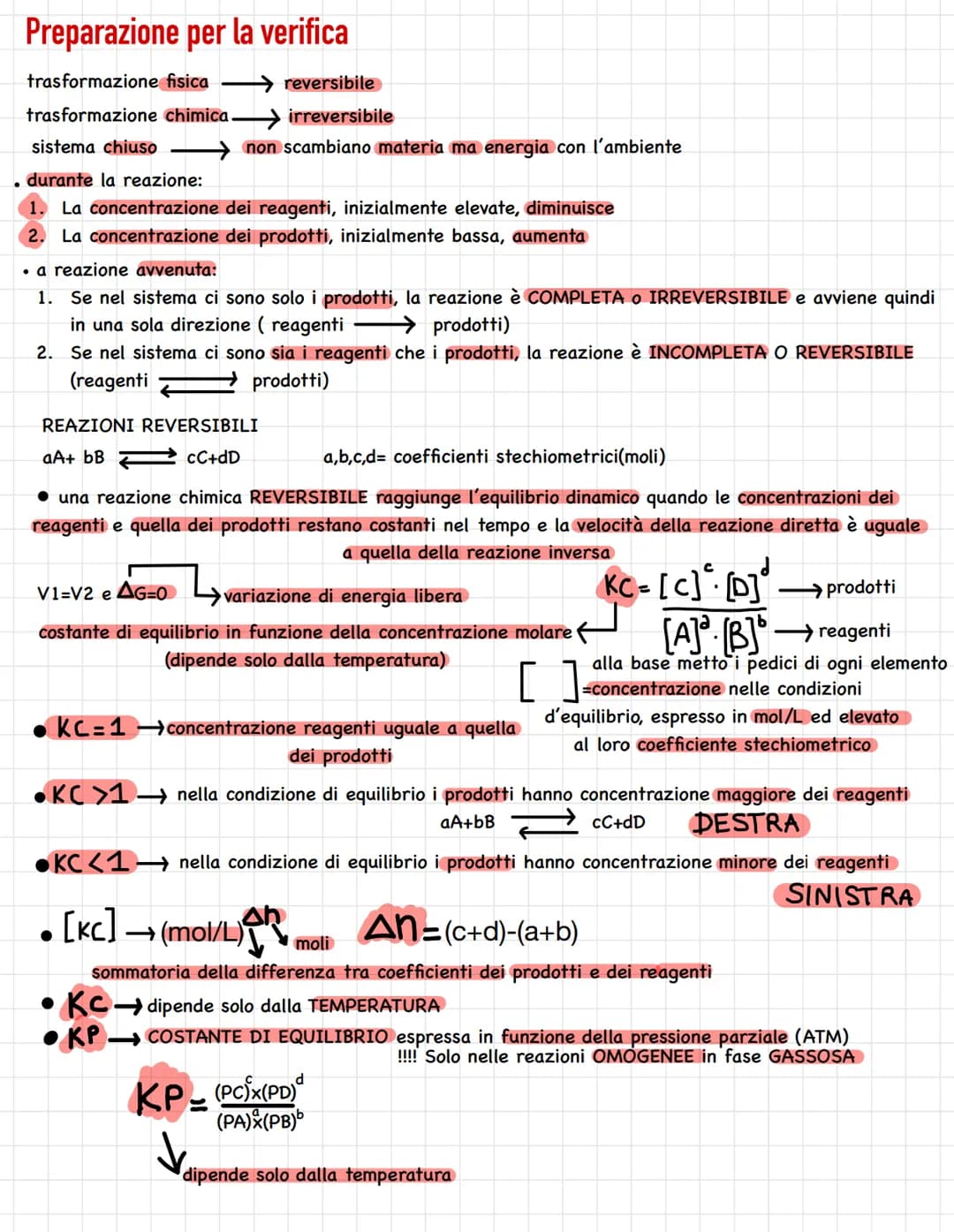
Reazioni Reversibili e Equilibrio Chimico
Immagina di versare del sale nell'acqua: si scioglie completamente, vero? Ecco, quella è una trasformazione fisica reversibile. Ma nelle reazioni chimiche le cose si complicano un po'.
Quando una reazione inizia, i reagenti (le sostanze di partenza) hanno concentrazioni alte che via via diminuiscono. Allo stesso tempo, i prodotti partono da zero e aumentano gradualmente.
Se alla fine trovi solo prodotti, la reazione è irreversibile - va in una direzione sola (A → B). Ma se trovi sia reagenti che prodotti, hai una reazione reversibile (A ⇌ B). Qui le cose diventano interessanti!
💡 Ricorda: In un sistema chiuso non entra né esce materia, ma l'energia può essere scambiata con l'ambiente.
L'equilibrio dinamico si raggiunge quando le concentrazioni restano costanti nel tempo. Non significa che la reazione si ferma - significa che la velocità in avanti è uguale a quella all'indietro .
La costante di equilibrio Kc ti dice chi "vince": se Kc > 1, prevalgono i prodotti; se Kc < 1, vincono i reagenti. Per la reazione aA + bB ⇌ cC + dD, si calcola come: Kc = [C]ᶜ[D]ᵈ/[A]ᵃ[B]ᵇ
2
of 2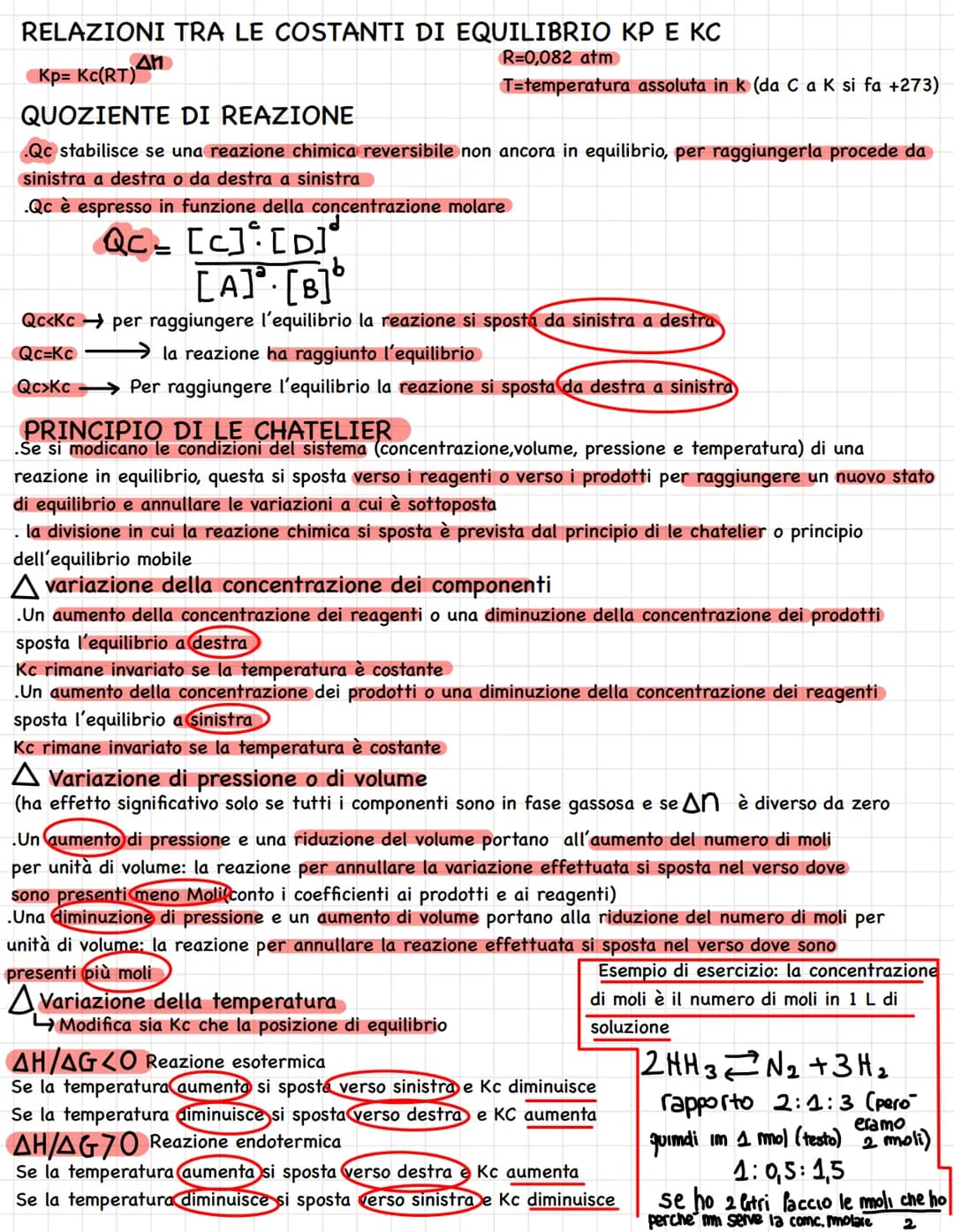
Come Controllare l'Equilibrio: Il Principio di Le Châtelier
Ti sei mai chiesto come i chimici "spingono" una reazione nella direzione che vogliono? La risposta è il principio di Le Châtelier: se disturbi un equilibrio, la reazione si sposta per "annullare" il disturbo.
Per le reazioni in fase gassosa, puoi anche usare Kp (basata sulla pressione) che si collega a Kc con la formula: Kp = Kc(RT)^Δn. Il quoziente di reazione Qc ti dice invece dove sta andando la reazione: se Qc < Kc va a destra, se Qc > Kc va a sinistra.
Ecco i "trucchi" per controllare l'equilibrio:
- Concentrazione: Aggiungi reagenti → vai a destra; aggiungi prodotti → vai a sinistra
- Pressione/Volume: Aumenti pressione → vai verso meno molecole gassose
- Temperatura: Nelle reazioni esotermiche (ΔH < 0), aumentare la temperatura sposta a sinistra; nelle endotermiche (ΔH > 0) sposta a destra
🔥 Trucco per gli esami: La temperatura è l'unica che cambia anche il valore di Kc, non solo la posizione dell'equilibrio!
Ricorda che Kc dipende solo dalla temperatura - è il tuo punto di riferimento fisso per capire dove "vuole" andare la reazione.
We thought you’d never ask...
What is the Knowunity AI companion?
Our AI companion is specifically built for the needs of students. Based on the millions of content pieces we have on the platform we can provide truly meaningful and relevant answers to students. But its not only about answers, the companion is even more about guiding students through their daily learning challenges, with personalised study plans, quizzes or content pieces in the chat and 100% personalisation based on the students skills and developments.
Where can I download the Knowunity app?
You can download the app in the Google Play Store and in the Apple App Store.
Is Knowunity really free of charge?
That's right! Enjoy free access to study content, connect with fellow students, and get instant help – all at your fingertips.
Similar Content
 Greco
GrecoMost popular content: Frase semplice
9Chimicai legami chimici
i legami chimici
1ªl21,473438
 Scienze
IL SISTEMA NERVOSO
schema sul sistema nervoso
3ªl3,20247
Chimical'atomo, la sua evoluzione e l'atomo di Bohr
L'atomo in generale + la sua evoluzione da Dalton, Thompson, Rutherford e Both + modello atomico dell'atomo di Bohr
1ªl4,22279
ChimicaTavola periodica
Proprietà periodiche, teoria di Lewis e legami
3ªl1,30726
ScienzeProteine
Appunti sulle proteine
1ªl21,800826
ChimicaEquilibrio chimico
Equilibrio dinamico, legge di azione della massa, principio di Châtelier
3ªl2,11357
Scienzecos’è l’atomo
l’atomo
1ªl6,809178
Chimicale soluzioni
le soluzioni, il processo di solubilizzazione e le proprietà collegative.
3ªl2,95366
ChimicaAcidi e basi
Comprende: proprietà acidi e basi, teoria di Arrhenius, teoria di Bronsted e Lowry, teoria di Lewis, prodotto ionico dell’acqua, pH, pOH, acidi forti e deboli, basi forti e deboli, soluzioni saline e soluzioni tampone.
4ªl1,69829
Most popular content in Chimica
9ChimicaNomenclatura
Nomenclatura chimica inorganica
2ªl17,866370
ScienzeLe biomolecole- Carboidrati, Lipidi, Proteine e Acidi Nucleici
Le biomolecole
4ªl3,74681
ScienzeAPPUNTI DNA ED RNA
Tutto il DNA con la duplicazione del DNA. Tutto l’RNA con trascrizione e traduzione
3ªl24,586804
Chimicai legami chimici
i legami chimici
1ªl21,473438
F
ChimicaFondamenti dei Legami Chimici Primari
Apprendere la regola dell'ottetto e il ruolo dell'elettronegatività nella classificazione dei legami chimici forti.
2ªl1,1090
ChimicaLe cellule 🧫
Cellula provariote, cellula eucariote animale e cellula eucariote vegetale.
2ªl3,51577
ChimicaProgramma chimica test professioni sanitarie
Materiale di chimica per test professioni sanitarie
Università4,733155
ScienzeIl Metabolismo
Appunti del metabolismo che comprendono: metabolismo del glucosio (glicolisi, respirazione cellulare e fermentazione), metabolismo degli zuccheri (Glicogenosintesi, Glicogenolisi), Gluconeogenesi, metabolismo dei lipidi, catabolismo degli amminoacidi
5ªl4,106104
ScienzeLe biomolecole
Appunti sulle biomolecole approfonditi: introduzione, carboidrati, lipidi, proteine e acidi nucleici
2ªl4,871130
Most popular content
9 Italiano
Riassunto patente B
Riassunto patente B - appunti presi a lezione
5ªl29,228943
 Altro
AltroTeoria patente b
Tutti gli argomenti per la patente
1ªl21,114685
 Ed. civ.
Teoria patente di guida B: Segnali stradali
Segnali stradali di pericolo, luminosi, di prescrizione, di indicazione, temporanei, complementari, pannelli integrativi, segnaletica orizzontale, segnalazioni agenti del traffico, distanza di visibilità per l‘arresto, minima di sicurezza.
5ªl40,0421,645
 Filosofia
Aristotele
Aristotele: vita, metafisica, fisica, etica e politica, retorica e poetica
3ªl7,623216
ItalianoI promessi sposi
Riassunti completi di tutti i 38 capitoli dei Promessi sposi.
2ªl14,090314
AltroPATENTE
schemi per esame teorico della patente
Università22,067756
S
ItalianoSintesi finale di Analisi logica
Esercitazione completa di analisi logica su frasi articolate per consolidare la conoscenza di tutti i complementi.
3ªm5,5290
P
 Inglese
Present Simple vs Present Continuous
Develop the ability to choose correctly between the Present Simple for habits and the Present Continuous for ongoing actions.
3ªm4,2120
G
ItalianoGabriele D'Annunzio e l'Estetismo
Domande sull'ideale del superuomo, il panismo e la concezione dell'arte come valore assoluto in D'Annunzio.
4ªl2,6740
Can't find what you're looking for? Explore other subjects.
Students love us — and so will you.
4.6/5App Store
4.7/5Google Play
The app is very easy to use and well designed. I have found everything I was looking for so far and have been able to learn a lot from the presentations! I will definitely use the app for a class assignment! And of course it also helps a lot as an inspiration.
Stefan SiOS user
This app is really great. There are so many study notes and help [...]. My problem subject is French, for example, and the app has so many options for help. Thanks to this app, I have improved my French. I would recommend it to anyone.
Samantha KlichAndroid user
Wow, I am really amazed. I just tried the app because I've seen it advertised many times and was absolutely stunned. This app is THE HELP you want for school and above all, it offers so many things, such as workouts and fact sheets, which have been VERY helpful to me personally.
AnnaiOS user
Chimica1,647 views·Updated Jun 20, 2026·2 pagesEquilibrio Chimico: Spiegazione Facile e Completa
irene1@irene_12
Quando mischi due sostanze chimiche, cosa succede davvero? Alcune reazioni vanno sempre nella stessa direzione, mentre altre possono "tornare indietro" creando un equilibrio dinamico. Capire questo equilibrio chimico ti aiuterà a prevedere come si comportano le reazioni e come controllarle.
1
of 2
Sign up to see the content. It's free!
- Access to all documents
- Improve your grades
- Join milions of students
Reazioni Reversibili e Equilibrio Chimico
Immagina di versare del sale nell'acqua: si scioglie completamente, vero? Ecco, quella è una trasformazione fisica reversibile. Ma nelle reazioni chimiche le cose si complicano un po'.
Quando una reazione inizia, i reagenti (le sostanze di partenza) hanno concentrazioni alte che via via diminuiscono. Allo stesso tempo, i prodotti partono da zero e aumentano gradualmente.
Se alla fine trovi solo prodotti, la reazione è irreversibile - va in una direzione sola (A → B). Ma se trovi sia reagenti che prodotti, hai una reazione reversibile (A ⇌ B). Qui le cose diventano interessanti!
💡 Ricorda: In un sistema chiuso non entra né esce materia, ma l'energia può essere scambiata con l'ambiente.
L'equilibrio dinamico si raggiunge quando le concentrazioni restano costanti nel tempo. Non significa che la reazione si ferma - significa che la velocità in avanti è uguale a quella all'indietro .
La costante di equilibrio Kc ti dice chi "vince": se Kc > 1, prevalgono i prodotti; se Kc < 1, vincono i reagenti. Per la reazione aA + bB ⇌ cC + dD, si calcola come: Kc = [C]ᶜ[D]ᵈ/[A]ᵃ[B]ᵇ
2
of 2Sign up to see the content. It's free!
- Access to all documents
- Improve your grades
- Join milions of students
Come Controllare l'Equilibrio: Il Principio di Le Châtelier
Ti sei mai chiesto come i chimici "spingono" una reazione nella direzione che vogliono? La risposta è il principio di Le Châtelier: se disturbi un equilibrio, la reazione si sposta per "annullare" il disturbo.
Per le reazioni in fase gassosa, puoi anche usare Kp (basata sulla pressione) che si collega a Kc con la formula: Kp = Kc(RT)^Δn. Il quoziente di reazione Qc ti dice invece dove sta andando la reazione: se Qc < Kc va a destra, se Qc > Kc va a sinistra.
Ecco i "trucchi" per controllare l'equilibrio:
- Concentrazione: Aggiungi reagenti → vai a destra; aggiungi prodotti → vai a sinistra
- Pressione/Volume: Aumenti pressione → vai verso meno molecole gassose
- Temperatura: Nelle reazioni esotermiche (ΔH < 0), aumentare la temperatura sposta a sinistra; nelle endotermiche (ΔH > 0) sposta a destra
🔥 Trucco per gli esami: La temperatura è l'unica che cambia anche il valore di Kc, non solo la posizione dell'equilibrio!
Ricorda che Kc dipende solo dalla temperatura - è il tuo punto di riferimento fisso per capire dove "vuole" andare la reazione.
We thought you’d never ask...
What is the Knowunity AI companion?
Our AI companion is specifically built for the needs of students. Based on the millions of content pieces we have on the platform we can provide truly meaningful and relevant answers to students. But its not only about answers, the companion is even more about guiding students through their daily learning challenges, with personalised study plans, quizzes or content pieces in the chat and 100% personalisation based on the students skills and developments.
Where can I download the Knowunity app?
You can download the app in the Google Play Store and in the Apple App Store.
Is Knowunity really free of charge?
That's right! Enjoy free access to study content, connect with fellow students, and get instant help – all at your fingertips.
Similar Content
Most popular content: Frase semplice
9Chimicai legami chimici
i legami chimici
1ªl21,473438
ScienzeIL SISTEMA NERVOSO
schema sul sistema nervoso
3ªl3,20247
Chimical'atomo, la sua evoluzione e l'atomo di Bohr
L'atomo in generale + la sua evoluzione da Dalton, Thompson, Rutherford e Both + modello atomico dell'atomo di Bohr
1ªl4,22279
ChimicaTavola periodica
Proprietà periodiche, teoria di Lewis e legami
3ªl1,30726
ScienzeProteine
Appunti sulle proteine
1ªl21,800826
ChimicaEquilibrio chimico
Equilibrio dinamico, legge di azione della massa, principio di Châtelier
3ªl2,11357
Scienzecos’è l’atomo
l’atomo
1ªl6,809178
Chimicale soluzioni
le soluzioni, il processo di solubilizzazione e le proprietà collegative.
3ªl2,95366
ChimicaAcidi e basi
Comprende: proprietà acidi e basi, teoria di Arrhenius, teoria di Bronsted e Lowry, teoria di Lewis, prodotto ionico dell’acqua, pH, pOH, acidi forti e deboli, basi forti e deboli, soluzioni saline e soluzioni tampone.
4ªl1,69829
Most popular content in Chimica
9ChimicaNomenclatura
Nomenclatura chimica inorganica
2ªl17,866370
ScienzeLe biomolecole- Carboidrati, Lipidi, Proteine e Acidi Nucleici
Le biomolecole
4ªl3,74681
ScienzeAPPUNTI DNA ED RNA
Tutto il DNA con la duplicazione del DNA. Tutto l’RNA con trascrizione e traduzione
3ªl24,586804
Chimicai legami chimici
i legami chimici
1ªl21,473438
F
ChimicaFondamenti dei Legami Chimici Primari
Apprendere la regola dell'ottetto e il ruolo dell'elettronegatività nella classificazione dei legami chimici forti.
2ªl1,1090
ChimicaLe cellule 🧫
Cellula provariote, cellula eucariote animale e cellula eucariote vegetale.
2ªl3,51577
ChimicaProgramma chimica test professioni sanitarie
Materiale di chimica per test professioni sanitarie
Università4,733155
ScienzeIl Metabolismo
Appunti del metabolismo che comprendono: metabolismo del glucosio (glicolisi, respirazione cellulare e fermentazione), metabolismo degli zuccheri (Glicogenosintesi, Glicogenolisi), Gluconeogenesi, metabolismo dei lipidi, catabolismo degli amminoacidi
5ªl4,106104
ScienzeLe biomolecole
Appunti sulle biomolecole approfonditi: introduzione, carboidrati, lipidi, proteine e acidi nucleici
2ªl4,871130
Most popular content
9ItalianoRiassunto patente B
Riassunto patente B - appunti presi a lezione
5ªl29,228943
AltroTeoria patente b
Tutti gli argomenti per la patente
1ªl21,114685
Ed. civ.Teoria patente di guida B: Segnali stradali
Segnali stradali di pericolo, luminosi, di prescrizione, di indicazione, temporanei, complementari, pannelli integrativi, segnaletica orizzontale, segnalazioni agenti del traffico, distanza di visibilità per l‘arresto, minima di sicurezza.
5ªl40,0421,645
FilosofiaAristotele
Aristotele: vita, metafisica, fisica, etica e politica, retorica e poetica
3ªl7,623216
ItalianoI promessi sposi
Riassunti completi di tutti i 38 capitoli dei Promessi sposi.
2ªl14,090314
AltroPATENTE
schemi per esame teorico della patente
Università22,067756
S
ItalianoSintesi finale di Analisi logica
Esercitazione completa di analisi logica su frasi articolate per consolidare la conoscenza di tutti i complementi.
3ªm5,5290
P
InglesePresent Simple vs Present Continuous
Develop the ability to choose correctly between the Present Simple for habits and the Present Continuous for ongoing actions.
3ªm4,2120
G
ItalianoGabriele D'Annunzio e l'Estetismo
Domande sull'ideale del superuomo, il panismo e la concezione dell'arte come valore assoluto in D'Annunzio.
4ªl2,6740
Can't find what you're looking for? Explore other subjects.
Students love us — and so will you.
4.6/5App Store
4.7/5Google Play
The app is very easy to use and well designed. I have found everything I was looking for so far and have been able to learn a lot from the presentations! I will definitely use the app for a class assignment! And of course it also helps a lot as an inspiration.
Stefan SiOS user
This app is really great. There are so many study notes and help [...]. My problem subject is French, for example, and the app has so many options for help. Thanks to this app, I have improved my French. I would recommend it to anyone.
Samantha KlichAndroid user
Wow, I am really amazed. I just tried the app because I've seen it advertised many times and was absolutely stunned. This app is THE HELP you want for school and above all, it offers so many things, such as workouts and fact sheets, which have been VERY helpful to me personally.
AnnaiOS user