
The Periodic Table is your roadmap to understanding chemical elements...
 Chemistry85 views·Updated Jun 17, 2026·3 pages
Understanding the Periodic Table and Element Trends
I
Isabella @isabella_vldz


1 / 3
1
of 3
Periodic Table Organization
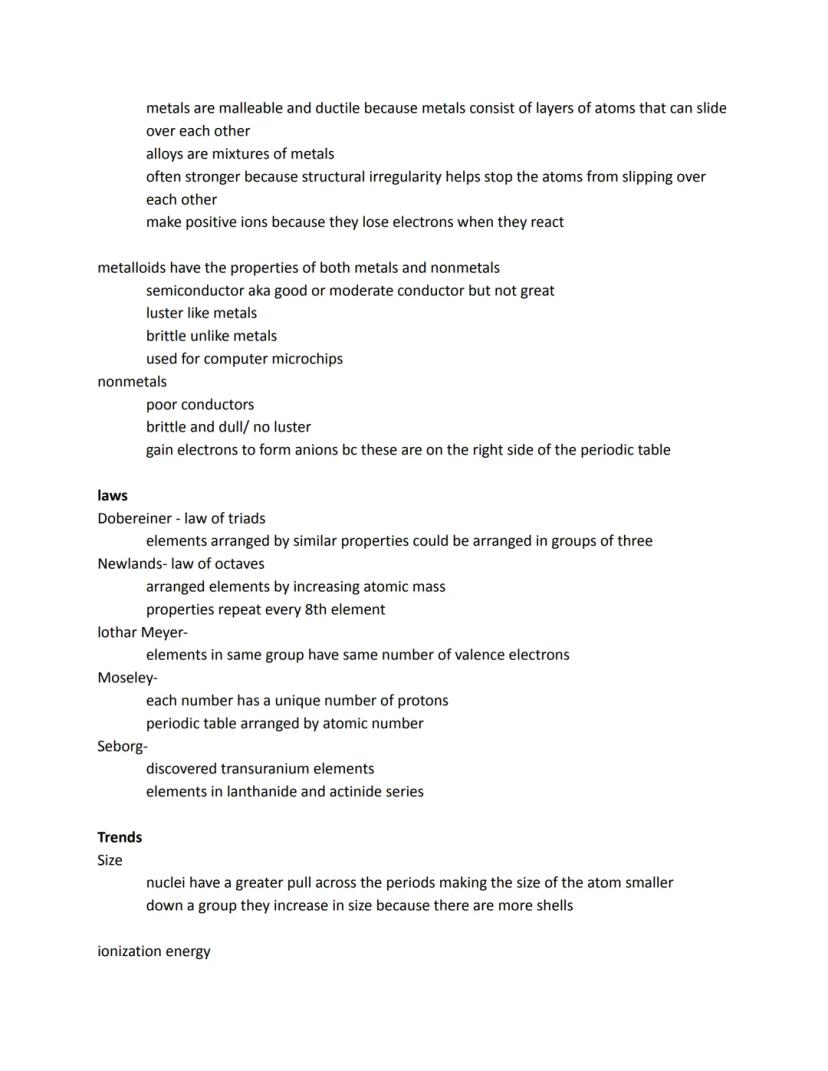
The Periodic Table organizes elements into groups (vertical columns) and periods (horizontal rows). Elements in the same group share similar chemical properties because they have the same number of valence electrons. As you move down a group, each element adds one energy level or shell, while moving across a period adds one proton to the nucleus and one electron to the valence shell.
The table divides into distinct families with unique properties. Alkali metals (Group 1) are highly reactive with water, form +1 ions, and aren't found alone in nature. Alkaline Earth Metals (Group 2) are also reactive. Transition metals can actually be found in nature, unlike many reactive elements. The halogens form salt compounds, while noble gases remain unreactive with stable octets.
Metals dominate the left side of the table and possess characteristic properties: they're malleable (can be hammered into sheets) and ductile (can be drawn into wires). These properties exist because metal atoms form layers that can slide over each other, allowing them to change shape without breaking.
Chemistry Hack: The position of an element on the periodic table tells you almost everything about its behavior! Elements in the same group (column) will react similarly because they have the same number of valence electrons.
2
of 3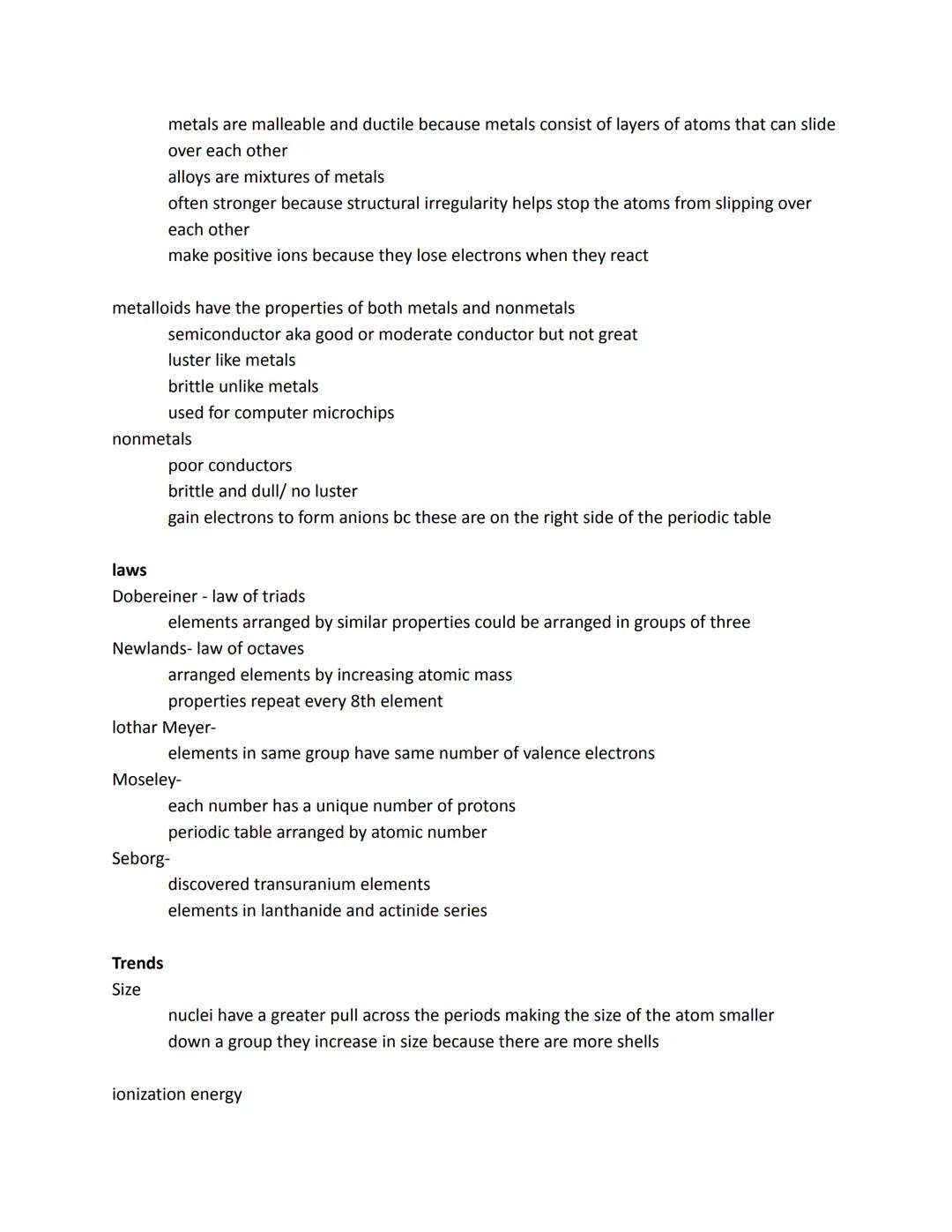
Element Classifications & Historical Development
Alloys are mixtures of metals that are often stronger than pure metals because their structural irregularities prevent atomic layers from slipping. Moving right across the table, we find metalloids (like silicon and boron) with properties of both metals and nonmetals. They're semiconductors with some metallic luster but are typically brittle. These elements are crucial for computer microchips.
Nonmetals occupy the upper right corner of the table (except noble gases). They're poor conductors, brittle, lack luster, and tend to gain electrons to form anions. This is because they're close to having a full valence shell, so gaining electrons is energetically favorable.
The periodic table we use today evolved through several scientific contributions. Dobereiner proposed the law of triads, grouping similar elements in threes. Newlands noticed properties repeating every eighth element (law of octaves). Meyer recognized elements in the same group have identical valence electrons. Moseley arranged elements by atomic number (protons), and Seaborg discovered transuranic elements.
Fun Fact: Silicon, a metalloid, forms the foundation of our digital world! Its semiconductor properties make it perfect for computer chips, which is why Silicon Valley got its name.
3
of 3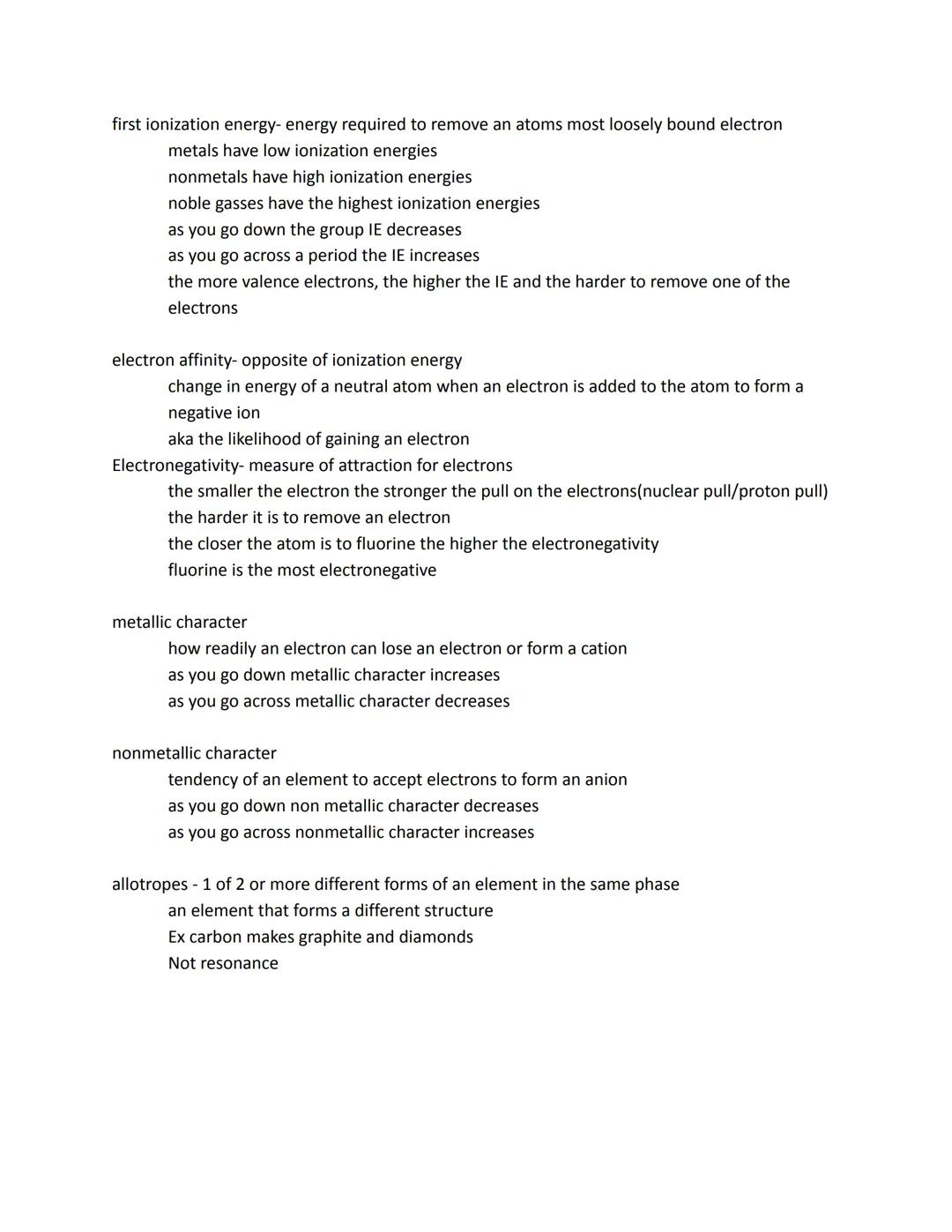
Periodic Trends
Atomic size follows clear patterns: atoms get smaller as you move across a period (left to right) because the increasing nuclear charge pulls electrons tighter. Moving down a group, atoms get larger because additional electron shells increase their radius.
Ionization energy measures how difficult it is to remove an electron from an atom. This value increases across periods (harder to remove electrons) and decreases down groups (easier to remove electrons). Metals have low ionization energies, while noble gases have the highest, making them extremely stable.
Electronegativity measures an atom's attraction for electrons in a chemical bond. Fluorine is the most electronegative element. This value increases across periods and decreases down groups. Similarly, metallic character (tendency to lose electrons) increases down groups and decreases across periods, while nonmetallic character (tendency to gain electrons) follows the opposite trend.
Some elements can form different structures in the same phase, called allotropes. Carbon is a famous example, forming both graphite (in pencils) and diamonds. These aren't different compounds – they're the same element arranged differently!
Test Tip: Remember this pattern for periodic trends - "Down and to the left gets bigger and more metallic." This applies to atomic radius and metallic character!
We thought you’d never ask...
What is the Knowunity AI companion?
Our AI companion is specifically built for the needs of students. Based on the millions of content pieces we have on the platform we can provide truly meaningful and relevant answers to students. But its not only about answers, the companion is even more about guiding students through their daily learning challenges, with personalised study plans, quizzes or content pieces in the chat and 100% personalisation based on the students skills and developments.
Where can I download the Knowunity app?
You can download the app in the Google Play Store and in the Apple App Store.
Is Knowunity really free of charge?
That's right! Enjoy free access to study content, connect with fellow students, and get instant help – all at your fingertips.
Similar Content
Most popular content in Chemistry
9ChemistryMass-to-Mass Stoichiometry: Calculating Grams to Grams
Learn how to perform mass-to-mass stoichiometric calculations. This guide covers the steps to convert grams of a reactant or product to grams of another substance using mole ratios and molar mass.
9th1993
I
ChemistryIntro to Chem - Test Review
Identifying elements, compounds, heterogeneous/homogeneous mixtures and chemical/physical change test review.
11th1973
ChemistryUnderstanding Atomic and Mass Numbers (Z and A)
Learn the definitions of atomic number (Z) and mass number (A). Understand how these numbers relate to protons, neutrons, and isotopes in an atom's nucleus.
9th522
ChemistryMolecular Geometry
Chemistry notes
10th1410
ChemistryPOGIL Stoichiometry
mole to mole, mole to mass, mass to mass, and volume conversions
10th4682
ChemistryThermochemistry Notes 🥵🔥
Unit 10 of Chemistry Honors (Inorganic)
10th87352
ChemistryChemistry: Atoms, Molecules, Ions
This is about atoms, molecules and ions.
9th1348
ChemistryAcids and Bases
This tackles the general properties of acids and bases, their examples and pH concept.
2611
ChemistryIsomerism
Structural and sterioisomers (geometric and optical)
11th821
Most popular content
9O
 AP US History
Origins and Dynamics of the Columbian Exchange
Analyze the ecological and economic motivations behind the initial transfer of goods, people, and diseases between the Old and New Worlds.
9th3,1280
I
AP US HistoryIntroduction to Early Cultural Interactions
Analyze the initial social and religious encounters between Europeans, Africans, and Indigenous peoples in the colonial Americas.
9th2,7730
O
 AP World History
Origins of Ancient River Civilizations
Analyze the environmental factors and technological innovations that led to the rise of early states in Mesopotamia, Egypt, and the Indus Valley.
9th3,1870
M
AP US HistoryMotivations for European Exploration
Analyze the economic, religious, and political factors that drove European powers to the Americas during the 15th and 16th centuries.
9th1,7780
F
 AP Psychology
Foundations of Ethical Guidelines in Research
Practice the core principles of the APA ethical code including informed consent, debriefing, and the role of Institutional Review Boards.
9th1,3360
I
AP US HistoryIntroduction to Native American Societies
Examine the diverse social, political, and economic structures of North American indigenous groups prior to European contact.
9th1,1100
I
 AP Biology
Introduction to Biological Elements of Life
Practice identifying the essential elements including carbon, nitrogen, phosphorus, and sulfur that compose biological macromolecules.
9th1,7390
I
AP US HistoryIntroduction to the Spanish Encomienda System
Explore the fundamental economic and social structures of the Spanish colonial system, focusing on the encomienda and the casta social hierarchy.
9th8890
O
AP World HistoryOrigins and Continuity of the Byzantine Empire
Analyze the political and cultural transitions from the Roman Empire to the Byzantine Empire, focusing on the reign of Justinian I and his code.
9th1,6320
Can't find what you're looking for? Explore other subjects.
Students love us — and so will you.
4.6/5App Store
4.7/5Google Play
The app is very easy to use and well designed. I have found everything I was looking for so far and have been able to learn a lot from the presentations! I will definitely use the app for a class assignment! And of course it also helps a lot as an inspiration.
Stefan SiOS user
This app is really great. There are so many study notes and help [...]. My problem subject is French, for example, and the app has so many options for help. Thanks to this app, I have improved my French. I would recommend it to anyone.
Samantha KlichAndroid user
Wow, I am really amazed. I just tried the app because I've seen it advertised many times and was absolutely stunned. This app is THE HELP you want for school and above all, it offers so many things, such as workouts and fact sheets, which have been VERY helpful to me personally.
AnnaiOS user
Chemistry85 views·Updated Jun 17, 2026·3 pagesUnderstanding the Periodic Table and Element Trends
I
Isabella @isabella_vldz
The Periodic Table is your roadmap to understanding chemical elements and their properties. It organizes elements based on their atomic structure, helping predict how they'll behave in chemical reactions. This fundamental tool is essential for mastering chemistry and understanding the...
1
of 3
Sign up to see the content. It's free!
- Access to all documents
- Improve your grades
- Join milions of students
Periodic Table Organization
The Periodic Table organizes elements into groups (vertical columns) and periods (horizontal rows). Elements in the same group share similar chemical properties because they have the same number of valence electrons. As you move down a group, each element adds one energy level or shell, while moving across a period adds one proton to the nucleus and one electron to the valence shell.
The table divides into distinct families with unique properties. Alkali metals (Group 1) are highly reactive with water, form +1 ions, and aren't found alone in nature. Alkaline Earth Metals (Group 2) are also reactive. Transition metals can actually be found in nature, unlike many reactive elements. The halogens form salt compounds, while noble gases remain unreactive with stable octets.
Metals dominate the left side of the table and possess characteristic properties: they're malleable (can be hammered into sheets) and ductile (can be drawn into wires). These properties exist because metal atoms form layers that can slide over each other, allowing them to change shape without breaking.
Chemistry Hack: The position of an element on the periodic table tells you almost everything about its behavior! Elements in the same group (column) will react similarly because they have the same number of valence electrons.
2
of 3Sign up to see the content. It's free!
- Access to all documents
- Improve your grades
- Join milions of students
Element Classifications & Historical Development
Alloys are mixtures of metals that are often stronger than pure metals because their structural irregularities prevent atomic layers from slipping. Moving right across the table, we find metalloids (like silicon and boron) with properties of both metals and nonmetals. They're semiconductors with some metallic luster but are typically brittle. These elements are crucial for computer microchips.
Nonmetals occupy the upper right corner of the table (except noble gases). They're poor conductors, brittle, lack luster, and tend to gain electrons to form anions. This is because they're close to having a full valence shell, so gaining electrons is energetically favorable.
The periodic table we use today evolved through several scientific contributions. Dobereiner proposed the law of triads, grouping similar elements in threes. Newlands noticed properties repeating every eighth element (law of octaves). Meyer recognized elements in the same group have identical valence electrons. Moseley arranged elements by atomic number (protons), and Seaborg discovered transuranic elements.
Fun Fact: Silicon, a metalloid, forms the foundation of our digital world! Its semiconductor properties make it perfect for computer chips, which is why Silicon Valley got its name.
3
of 3Sign up to see the content. It's free!
- Access to all documents
- Improve your grades
- Join milions of students
Periodic Trends
Atomic size follows clear patterns: atoms get smaller as you move across a period (left to right) because the increasing nuclear charge pulls electrons tighter. Moving down a group, atoms get larger because additional electron shells increase their radius.
Ionization energy measures how difficult it is to remove an electron from an atom. This value increases across periods (harder to remove electrons) and decreases down groups (easier to remove electrons). Metals have low ionization energies, while noble gases have the highest, making them extremely stable.
Electronegativity measures an atom's attraction for electrons in a chemical bond. Fluorine is the most electronegative element. This value increases across periods and decreases down groups. Similarly, metallic character (tendency to lose electrons) increases down groups and decreases across periods, while nonmetallic character (tendency to gain electrons) follows the opposite trend.
Some elements can form different structures in the same phase, called allotropes. Carbon is a famous example, forming both graphite (in pencils) and diamonds. These aren't different compounds – they're the same element arranged differently!
Test Tip: Remember this pattern for periodic trends - "Down and to the left gets bigger and more metallic." This applies to atomic radius and metallic character!
We thought you’d never ask...
What is the Knowunity AI companion?
Our AI companion is specifically built for the needs of students. Based on the millions of content pieces we have on the platform we can provide truly meaningful and relevant answers to students. But its not only about answers, the companion is even more about guiding students through their daily learning challenges, with personalised study plans, quizzes or content pieces in the chat and 100% personalisation based on the students skills and developments.
Where can I download the Knowunity app?
You can download the app in the Google Play Store and in the Apple App Store.
Is Knowunity really free of charge?
That's right! Enjoy free access to study content, connect with fellow students, and get instant help – all at your fingertips.
Similar Content
Most popular content in Chemistry
9ChemistryMass-to-Mass Stoichiometry: Calculating Grams to Grams
Learn how to perform mass-to-mass stoichiometric calculations. This guide covers the steps to convert grams of a reactant or product to grams of another substance using mole ratios and molar mass.
9th1993
I
ChemistryIntro to Chem - Test Review
Identifying elements, compounds, heterogeneous/homogeneous mixtures and chemical/physical change test review.
11th1973
ChemistryUnderstanding Atomic and Mass Numbers (Z and A)
Learn the definitions of atomic number (Z) and mass number (A). Understand how these numbers relate to protons, neutrons, and isotopes in an atom's nucleus.
9th522
ChemistryMolecular Geometry
Chemistry notes
10th1410
ChemistryPOGIL Stoichiometry
mole to mole, mole to mass, mass to mass, and volume conversions
10th4682
ChemistryThermochemistry Notes 🥵🔥
Unit 10 of Chemistry Honors (Inorganic)
10th87352
ChemistryChemistry: Atoms, Molecules, Ions
This is about atoms, molecules and ions.
9th1348
ChemistryAcids and Bases
This tackles the general properties of acids and bases, their examples and pH concept.
2611
ChemistryIsomerism
Structural and sterioisomers (geometric and optical)
11th821
Most popular content
9O
AP US HistoryOrigins and Dynamics of the Columbian Exchange
Analyze the ecological and economic motivations behind the initial transfer of goods, people, and diseases between the Old and New Worlds.
9th3,1280
I
AP US HistoryIntroduction to Early Cultural Interactions
Analyze the initial social and religious encounters between Europeans, Africans, and Indigenous peoples in the colonial Americas.
9th2,7730
O
AP World HistoryOrigins of Ancient River Civilizations
Analyze the environmental factors and technological innovations that led to the rise of early states in Mesopotamia, Egypt, and the Indus Valley.
9th3,1870
M
AP US HistoryMotivations for European Exploration
Analyze the economic, religious, and political factors that drove European powers to the Americas during the 15th and 16th centuries.
9th1,7780
F
AP PsychologyFoundations of Ethical Guidelines in Research
Practice the core principles of the APA ethical code including informed consent, debriefing, and the role of Institutional Review Boards.
9th1,3360
I
AP US HistoryIntroduction to Native American Societies
Examine the diverse social, political, and economic structures of North American indigenous groups prior to European contact.
9th1,1100
I
AP BiologyIntroduction to Biological Elements of Life
Practice identifying the essential elements including carbon, nitrogen, phosphorus, and sulfur that compose biological macromolecules.
9th1,7390
I
AP US HistoryIntroduction to the Spanish Encomienda System
Explore the fundamental economic and social structures of the Spanish colonial system, focusing on the encomienda and the casta social hierarchy.
9th8890
O
AP World HistoryOrigins and Continuity of the Byzantine Empire
Analyze the political and cultural transitions from the Roman Empire to the Byzantine Empire, focusing on the reign of Justinian I and his code.
9th1,6320
Can't find what you're looking for? Explore other subjects.
Students love us — and so will you.
4.6/5App Store
4.7/5Google Play
The app is very easy to use and well designed. I have found everything I was looking for so far and have been able to learn a lot from the presentations! I will definitely use the app for a class assignment! And of course it also helps a lot as an inspiration.
Stefan SiOS user
This app is really great. There are so many study notes and help [...]. My problem subject is French, for example, and the app has so many options for help. Thanks to this app, I have improved my French. I would recommend it to anyone.
Samantha KlichAndroid user
Wow, I am really amazed. I just tried the app because I've seen it advertised many times and was absolutely stunned. This app is THE HELP you want for school and above all, it offers so many things, such as workouts and fact sheets, which have been VERY helpful to me personally.
AnnaiOS user