
Organic chemistry might seem overwhelming at first, but it's actually...
 Chemistry329 views·Updated Jun 24, 2026·3 pages
Understanding AQA AS Organic Chemistry: Basics and Key Topics
B
bv@bv


1 / 3
1
of 3
Introduction to Organic Chemistry and Naming Rules
Understanding molecular formulae is your first step into organic chemistry. You'll encounter different types: empirical (simplest ratio), molecular (actual numbers of atoms), structural (showing connections), displayed (every bond drawn), and skeletal (simplified diagrams). Think of these as different ways to describe the same molecule - like giving directions using a map versus landmarks.
Homologous series are families of compounds that share the same functional group - the bit that makes them react in similar ways. Each series has its own general formula, making it dead easy to work out molecular formulae once you know the pattern.
The IUPAC naming system follows simple rules that work like a code. Start with the stem based on carbon count, then add the ending based on the functional group .
Quick Tip: Always find the longest carbon chain that includes the functional group - that's your main stem. Number carbons to give the functional group the lowest possible number.
2
of 3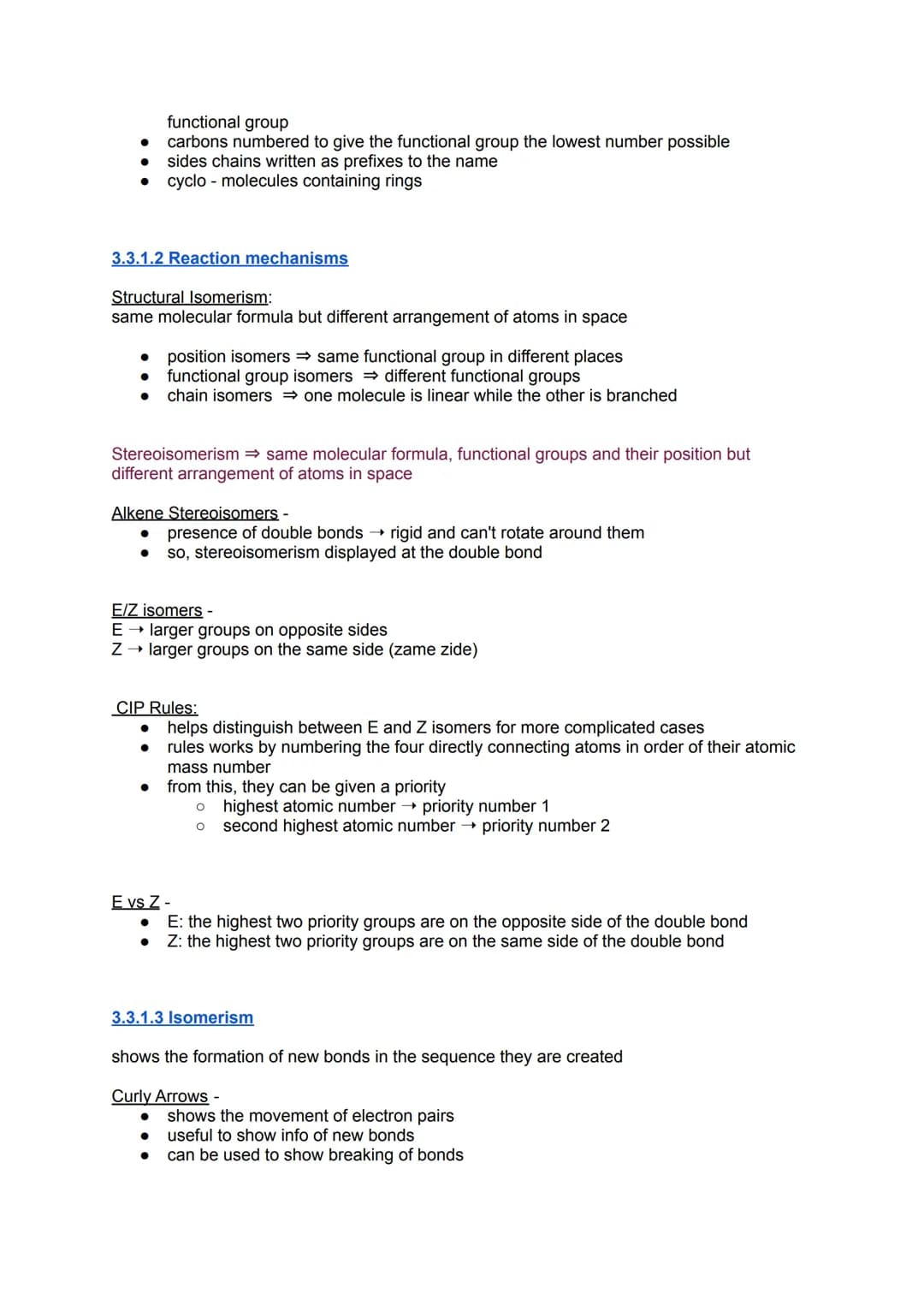
Isomerism - Same Formula, Different Arrangements
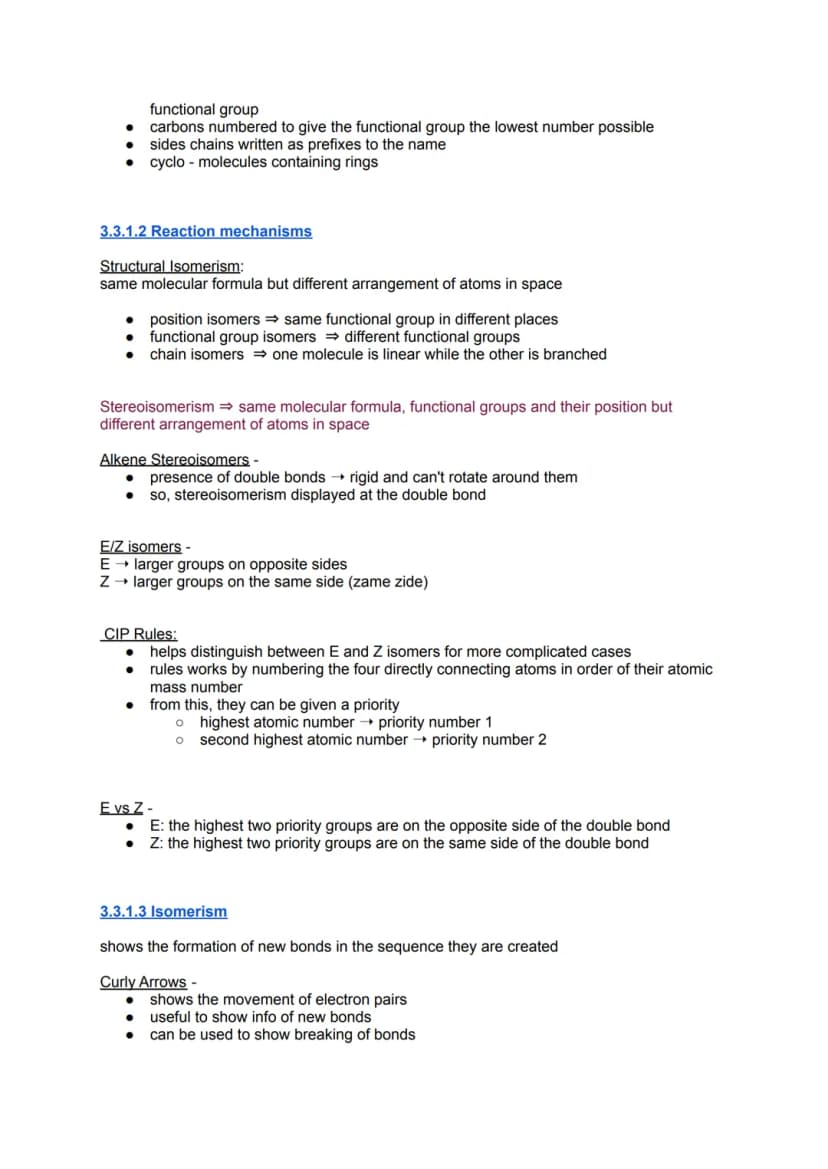
Structural isomers have identical molecular formulae but completely different atom arrangements. You'll spot three types: chain isomers (straight vs branched), position isomers (functional group in different spots), and functional group isomers (different functional groups entirely). It's like having the same Lego pieces but building different models.
Stereoisomers are trickier - same formula and functional groups, but atoms arranged differently in 3D space. This happens around double bonds because they can't rotate freely like single bonds.
E/Z isomerism occurs at double bonds where you compare the positions of the largest groups. Z means the big groups are on the "zame zide" (same side), while E means they're on opposite sides. For complex molecules, use CIP rules - rank the four atoms directly attached to the double bond by atomic mass, then see if the top two priorities are together (Z) or apart (E).
Memory Trick: "Z = Zame Zide" - the two highest priority groups are on the same side of the double bond.
3
of 3
Reaction Mechanisms and Free Radicals
Reaction mechanisms show exactly how bonds break and form during chemical reactions. They're like step-by-step instructions for molecular transformations, helping you predict what happens when molecules collide.
Curly arrows are your best mates for showing electron movement. These arrows always show where electron pairs go - either forming new bonds or breaking existing ones. Master these, and you'll understand why reactions happen the way they do.
Free radicals are highly reactive molecules with unpaired electrons, shown with a dot. They're incredibly unstable and will react with almost anything to pair up that lonely electron. Think of them as molecular desperados looking for a partner.
Key Point: Curly arrows always show electron pair movement - never just point randomly between atoms. Follow the electrons, and you'll follow the reaction.
We thought you’d never ask...
What is the Knowunity AI companion?
Our AI companion is specifically built for the needs of students. Based on the millions of content pieces we have on the platform we can provide truly meaningful and relevant answers to students. But its not only about answers, the companion is even more about guiding students through their daily learning challenges, with personalised study plans, quizzes or content pieces in the chat and 100% personalisation based on the students skills and developments.
Where can I download the Knowunity app?
You can download the app in the Google Play Store and in the Apple App Store.
Is Knowunity really free of charge?
That's right! Enjoy free access to study content, connect with fellow students, and get instant help – all at your fingertips.
Similar Content
Most popular content: Functional Groups
1Most popular content in Chemistry
9G
ChemistryGCSE AQA Chemistry Topic 1- The Atom
The Atom
101,2790
Chemistrychem paper 1
higher
112,07843
ChemistryA-level OCR A Chemistry summary sheets
Everything from snaprevise for OCR chemistry a-level
122,28779
C
Chemistrychem paper 1
Unlock the secrets of chemical reactions with this comprehensive flashcard set designed to help you conquer complex concepts and ace your Chemistry exams.
117251
ChemistryEssential Chemistry Practicals
Explore key AQA GCSE Chemistry practicals, including flame tests, titration, and gas identification. This resource covers essential techniques for analyzing ions, making salts, and understanding reaction kinetics. Perfect for students preparing for exams and practical assessments.
1011,972902
A
ChemistryAQA GCSE Chemistry 4.4 Chemical changes
4.4 Reactions of acids with bases or carbonates
97531
ChemistryChemistry paper 2
Chem paper 2 notes
1172214
F
ChemistryFundamentals of Atomic Structure
Practice identifying subatomic particles, calculating neutrons, and defining isotopes and atomic/mass numbers.
123460
A
ChemistryAtomic Mass and Atomic Number Calculations
Calculate the number of protons, neutrons, and electrons for different elements and isotopes.
S34940
Most popular content
9 Sociology
Sociology of Education Overview
Explore comprehensive A-Level Sociology notes on the education system, covering key theories, policies, and sociological perspectives. This resource includes insights on marketisation, gender roles, cultural deprivation, and educational inequalities, providing a thorough understanding of how education shapes social stratification and individual achievement. Ideal for exam preparation and in-depth study.
12102,8693,040
SociologySociology of Families: Comprehensive Revision
Dive into an extensive overview of family dynamics, perspectives, and patterns in sociology. This resource covers key concepts such as family diversity, gender roles, marriage, and the impact of social policies on family structures. Perfect for A-Level Sociology students preparing for Paper 2.
1273,6662,307
CriminologyCriminology: Crime & Punishment Overview
Comprehensive mindmaps covering key concepts in the Crime and Punishment topic for WJEC Criminology Unit 4. This resource includes detailed insights into the Criminal Justice System, crime prevention strategies, sentencing models, and the roles of various agencies. Ideal for A-Level revision, ensuring you grasp essential theories and legislative processes to excel in your exams.
1254,8721,059
SociologyComprehensive Crime & Deviance Overview
Explore an extensive revision of crime and deviance topics, including theories, types of crime, and the impact of media. This resource covers key concepts such as Marxism, functionalism, gender and crime, and the influence of globalization on criminal behavior. Ideal for students seeking a thorough understanding of criminology and its various theories. Type: Full Topic Revision.
1251,6541,399
C
 Biology
Cell Biology and Cell structure
cell structures
93,2490
 English Literature
An Inspector Calls: Character Insights
Explore in-depth analysis and key quotes for characters in J.B. Priestley's 'An Inspector Calls'. This resource covers Gerald Croft, Inspector Goole, Sheila Birling, Mrs. Birling, Eric Birling, and Eva Smith, focusing on themes of class, gender roles, and social responsibility. Ideal for students aiming for Grade 8 and above.
1025,429907
CriminologyWJEC Unit 4 Criminology
Criminology unit 4 detailed revision note
127,151125
CriminologyCriminology Theories Overview
Explore key criminology theories and their implications on crime and deviance. This comprehensive summary covers biological, psychological, and sociological perspectives, including labelling theory, right realism, and the impact of social campaigns on policy development. Ideal for A-Level criminology students seeking to understand the complexities of criminal behaviour and the factors influencing crime prevention strategies.
129,760210
English LiteratureRomeo and Juliet: Key themes
Key Romeo and Juliet themes and analysed quotes
106,708198
Can't find what you're looking for? Explore other subjects.
Students love us — and so will you.
4.6/5App Store
4.7/5Google Play
The app is very easy to use and well designed. I have found everything I was looking for so far and have been able to learn a lot from the presentations! I will definitely use the app for a class assignment! And of course it also helps a lot as an inspiration.
Stefan SiOS user
This app is really great. There are so many study notes and help [...]. My problem subject is French, for example, and the app has so many options for help. Thanks to this app, I have improved my French. I would recommend it to anyone.
Samantha KlichAndroid user
Wow, I am really amazed. I just tried the app because I've seen it advertised many times and was absolutely stunned. This app is THE HELP you want for school and above all, it offers so many things, such as workouts and fact sheets, which have been VERY helpful to me personally.
AnnaiOS user
Chemistry329 views·Updated Jun 24, 2026·3 pagesUnderstanding AQA AS Organic Chemistry: Basics and Key Topics
B
bv@bv
Organic chemistry might seem overwhelming at first, but it's actually just about learning how to name molecules and understand how they behave. Once you get the hang of the naming rules and can spot different types of isomers, you'll find...
1
of 3
Sign up to see the content. It's free!
- Access to all documents
- Improve your grades
- Join milions of students
Introduction to Organic Chemistry and Naming Rules
Understanding molecular formulae is your first step into organic chemistry. You'll encounter different types: empirical (simplest ratio), molecular (actual numbers of atoms), structural (showing connections), displayed (every bond drawn), and skeletal (simplified diagrams). Think of these as different ways to describe the same molecule - like giving directions using a map versus landmarks.
Homologous series are families of compounds that share the same functional group - the bit that makes them react in similar ways. Each series has its own general formula, making it dead easy to work out molecular formulae once you know the pattern.
The IUPAC naming system follows simple rules that work like a code. Start with the stem based on carbon count, then add the ending based on the functional group .
Quick Tip: Always find the longest carbon chain that includes the functional group - that's your main stem. Number carbons to give the functional group the lowest possible number.
2
of 3Sign up to see the content. It's free!
- Access to all documents
- Improve your grades
- Join milions of students
Isomerism - Same Formula, Different Arrangements
Structural isomers have identical molecular formulae but completely different atom arrangements. You'll spot three types: chain isomers (straight vs branched), position isomers (functional group in different spots), and functional group isomers (different functional groups entirely). It's like having the same Lego pieces but building different models.
Stereoisomers are trickier - same formula and functional groups, but atoms arranged differently in 3D space. This happens around double bonds because they can't rotate freely like single bonds.
E/Z isomerism occurs at double bonds where you compare the positions of the largest groups. Z means the big groups are on the "zame zide" (same side), while E means they're on opposite sides. For complex molecules, use CIP rules - rank the four atoms directly attached to the double bond by atomic mass, then see if the top two priorities are together (Z) or apart (E).
Memory Trick: "Z = Zame Zide" - the two highest priority groups are on the same side of the double bond.
3
of 3Sign up to see the content. It's free!
- Access to all documents
- Improve your grades
- Join milions of students
Reaction Mechanisms and Free Radicals
Reaction mechanisms show exactly how bonds break and form during chemical reactions. They're like step-by-step instructions for molecular transformations, helping you predict what happens when molecules collide.
Curly arrows are your best mates for showing electron movement. These arrows always show where electron pairs go - either forming new bonds or breaking existing ones. Master these, and you'll understand why reactions happen the way they do.
Free radicals are highly reactive molecules with unpaired electrons, shown with a dot. They're incredibly unstable and will react with almost anything to pair up that lonely electron. Think of them as molecular desperados looking for a partner.
Key Point: Curly arrows always show electron pair movement - never just point randomly between atoms. Follow the electrons, and you'll follow the reaction.
We thought you’d never ask...
What is the Knowunity AI companion?
Our AI companion is specifically built for the needs of students. Based on the millions of content pieces we have on the platform we can provide truly meaningful and relevant answers to students. But its not only about answers, the companion is even more about guiding students through their daily learning challenges, with personalised study plans, quizzes or content pieces in the chat and 100% personalisation based on the students skills and developments.
Where can I download the Knowunity app?
You can download the app in the Google Play Store and in the Apple App Store.
Is Knowunity really free of charge?
That's right! Enjoy free access to study content, connect with fellow students, and get instant help – all at your fingertips.
Similar Content
Most popular content: Functional Groups
1Most popular content in Chemistry
9G
ChemistryGCSE AQA Chemistry Topic 1- The Atom
The Atom
101,2790
Chemistrychem paper 1
higher
112,07843
ChemistryA-level OCR A Chemistry summary sheets
Everything from snaprevise for OCR chemistry a-level
122,28779
C
Chemistrychem paper 1
Unlock the secrets of chemical reactions with this comprehensive flashcard set designed to help you conquer complex concepts and ace your Chemistry exams.
117251
ChemistryEssential Chemistry Practicals
Explore key AQA GCSE Chemistry practicals, including flame tests, titration, and gas identification. This resource covers essential techniques for analyzing ions, making salts, and understanding reaction kinetics. Perfect for students preparing for exams and practical assessments.
1011,972902
A
ChemistryAQA GCSE Chemistry 4.4 Chemical changes
4.4 Reactions of acids with bases or carbonates
97531
ChemistryChemistry paper 2
Chem paper 2 notes
1172214
F
ChemistryFundamentals of Atomic Structure
Practice identifying subatomic particles, calculating neutrons, and defining isotopes and atomic/mass numbers.
123460
A
ChemistryAtomic Mass and Atomic Number Calculations
Calculate the number of protons, neutrons, and electrons for different elements and isotopes.
S34940
Most popular content
9SociologySociology of Education Overview
Explore comprehensive A-Level Sociology notes on the education system, covering key theories, policies, and sociological perspectives. This resource includes insights on marketisation, gender roles, cultural deprivation, and educational inequalities, providing a thorough understanding of how education shapes social stratification and individual achievement. Ideal for exam preparation and in-depth study.
12102,8693,040
SociologySociology of Families: Comprehensive Revision
Dive into an extensive overview of family dynamics, perspectives, and patterns in sociology. This resource covers key concepts such as family diversity, gender roles, marriage, and the impact of social policies on family structures. Perfect for A-Level Sociology students preparing for Paper 2.
1273,6662,307
CriminologyCriminology: Crime & Punishment Overview
Comprehensive mindmaps covering key concepts in the Crime and Punishment topic for WJEC Criminology Unit 4. This resource includes detailed insights into the Criminal Justice System, crime prevention strategies, sentencing models, and the roles of various agencies. Ideal for A-Level revision, ensuring you grasp essential theories and legislative processes to excel in your exams.
1254,8721,059
SociologyComprehensive Crime & Deviance Overview
Explore an extensive revision of crime and deviance topics, including theories, types of crime, and the impact of media. This resource covers key concepts such as Marxism, functionalism, gender and crime, and the influence of globalization on criminal behavior. Ideal for students seeking a thorough understanding of criminology and its various theories. Type: Full Topic Revision.
1251,6541,399
C
BiologyCell Biology and Cell structure
cell structures
93,2490
English LiteratureAn Inspector Calls: Character Insights
Explore in-depth analysis and key quotes for characters in J.B. Priestley's 'An Inspector Calls'. This resource covers Gerald Croft, Inspector Goole, Sheila Birling, Mrs. Birling, Eric Birling, and Eva Smith, focusing on themes of class, gender roles, and social responsibility. Ideal for students aiming for Grade 8 and above.
1025,429907
CriminologyWJEC Unit 4 Criminology
Criminology unit 4 detailed revision note
127,151125
CriminologyCriminology Theories Overview
Explore key criminology theories and their implications on crime and deviance. This comprehensive summary covers biological, psychological, and sociological perspectives, including labelling theory, right realism, and the impact of social campaigns on policy development. Ideal for A-Level criminology students seeking to understand the complexities of criminal behaviour and the factors influencing crime prevention strategies.
129,760210
English LiteratureRomeo and Juliet: Key themes
Key Romeo and Juliet themes and analysed quotes
106,708198
Can't find what you're looking for? Explore other subjects.
Students love us — and so will you.
4.6/5App Store
4.7/5Google Play
The app is very easy to use and well designed. I have found everything I was looking for so far and have been able to learn a lot from the presentations! I will definitely use the app for a class assignment! And of course it also helps a lot as an inspiration.
Stefan SiOS user
This app is really great. There are so many study notes and help [...]. My problem subject is French, for example, and the app has so many options for help. Thanks to this app, I have improved my French. I would recommend it to anyone.
Samantha KlichAndroid user
Wow, I am really amazed. I just tried the app because I've seen it advertised many times and was absolutely stunned. This app is THE HELP you want for school and above all, it offers so many things, such as workouts and fact sheets, which have been VERY helpful to me personally.
AnnaiOS user