

This document covers various chemical engineering calculations related to solubility,...
 Chemistry355 views·Updated Jun 7, 2026·7 pages
Fun with Soda Ash and Salt: Learn Solubility and Heat Experiments at Home!


1 / 7
1
of 7
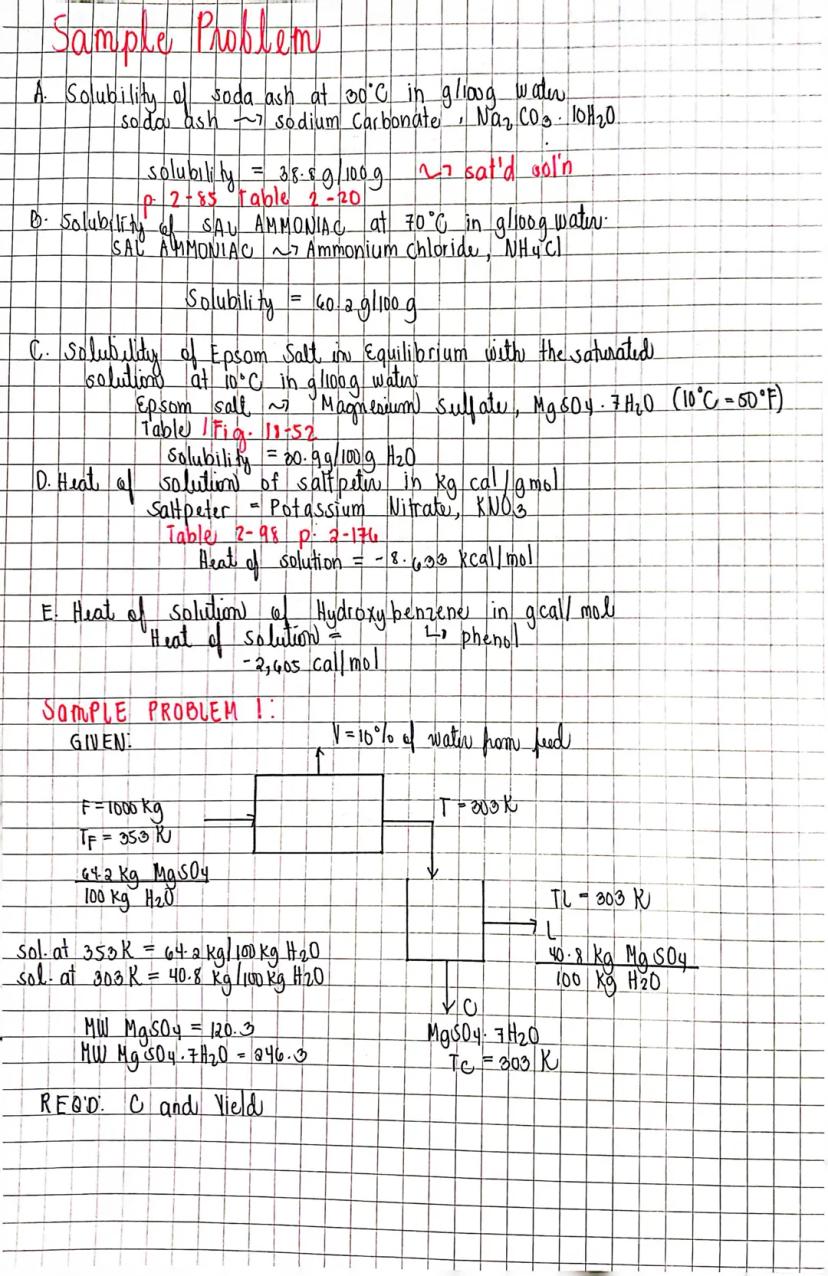
Sample Problem 1: Magnesium Sulfate Crystallization
This page details a sample problem involving the crystallization of magnesium sulfate heptahydrate (MgSO₄ · 7H₂O) from a solution.
Given information:
- Feed (F) = 1000 kg
- Feed temperature (TF) = 353 K
- Solubility at 353 K = 64.2 kg MgSO₄ / 100 kg H₂O
- Solubility at 303 K = 40.8 kg MgSO₄ / 100 kg H₂O
- 10% of water from feed is evaporated
The problem requires calculating the crystal yield and other process parameters.
Vocabulary: Crystal yield refers to the amount of solid crystals produced from a solution during the crystallization process.
The solution involves material balance equations and solubility calculations to determine the amount of crystals formed and the yield percentage.
Highlight: This problem demonstrates how to use solubility data at different temperatures to calculate crystallization yields, which is a fundamental skill in crystallization process in chemistry.
2
of 7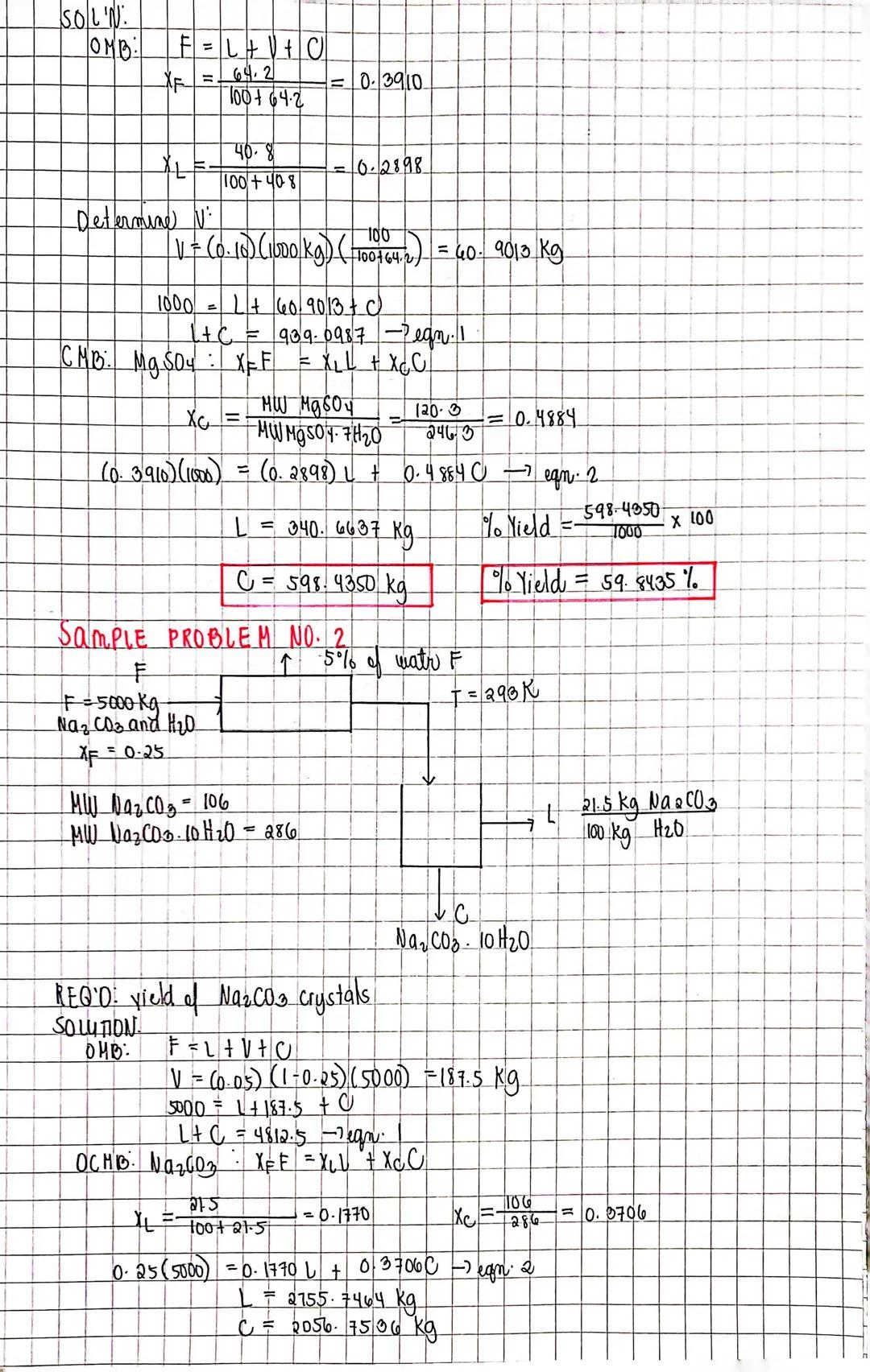
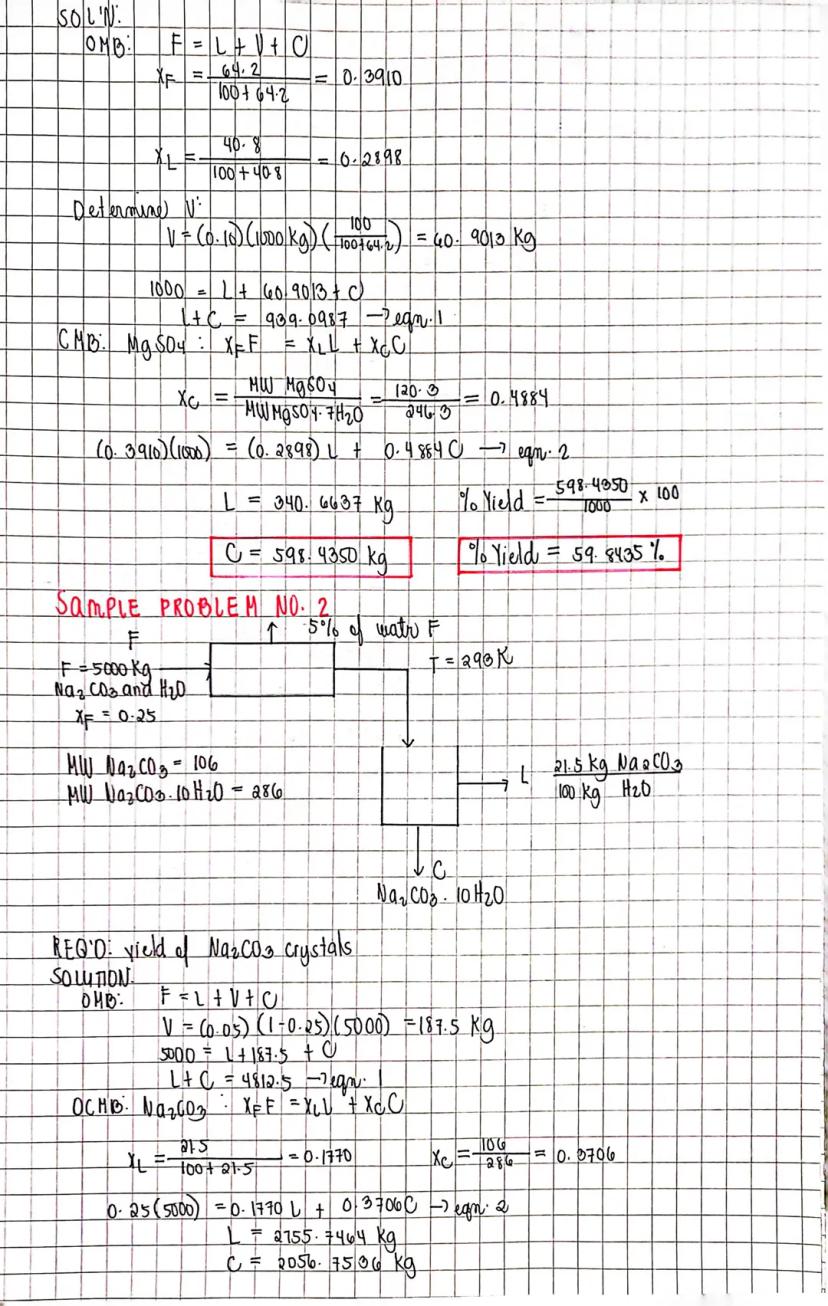
Sample Problem 2: Sodium Carbonate Crystallization
This section presents a problem focusing on the crystallization of sodium carbonate decahydrate (Na₂CO₃ · 10H₂O) from a solution.
Given information:
- Feed (F) = 5000 kg of Na₂CO₃ and H₂O mixture
- 5% of water evaporates
- Solubility data provided for different temperatures
The problem requires calculating the yield of Na₂CO₃ crystals.
Example: The solubility of sodium carbonate at the crystallization temperature is 21.5 kg Na₂CO₃ / 100 kg H₂O.
The solution involves material balance equations, similar to the previous problem, but with different solubility data and molecular weights.
Highlight: This problem illustrates how the solubility of sodium carbonate at different temperatures affects the crystallization yield, which is crucial knowledge for industrial crystallization processes.
3
of 7
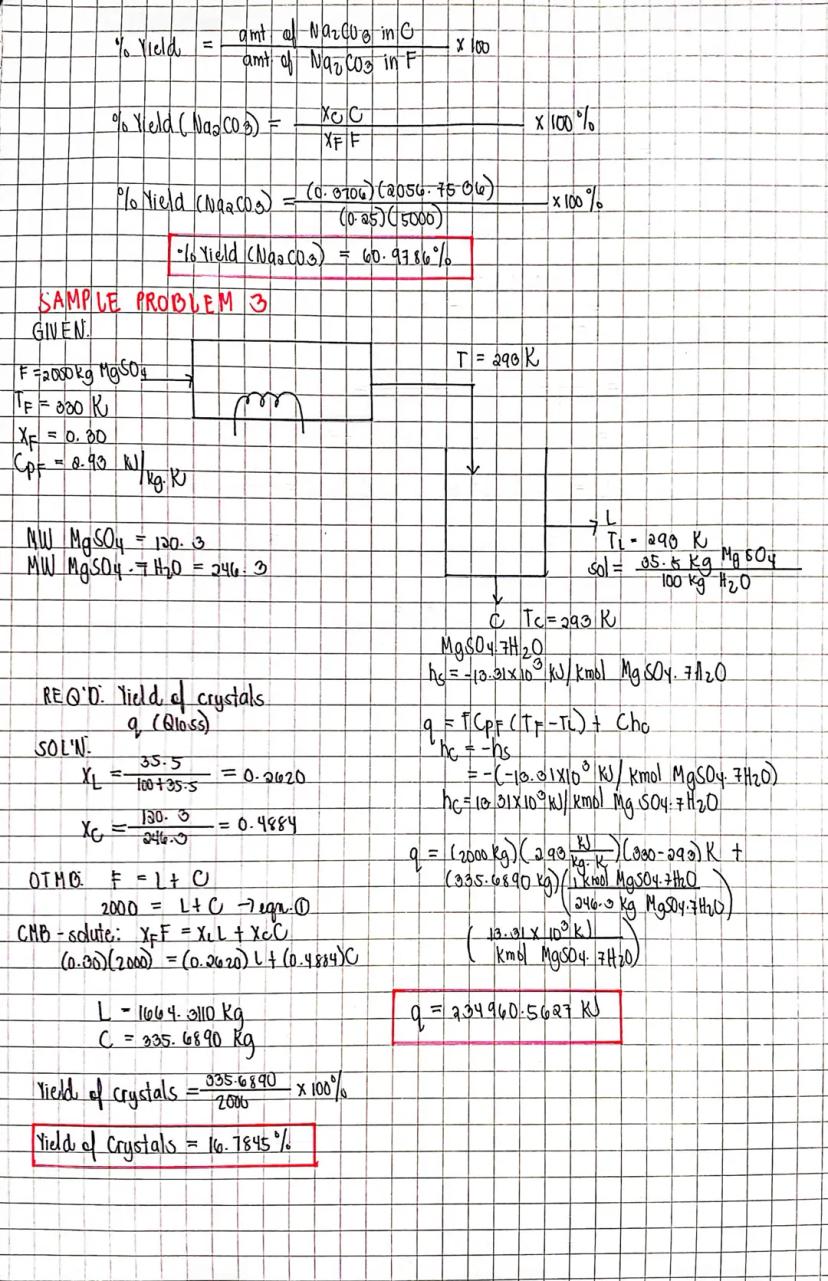
Sample Problem 3: Magnesium Sulfate Crystallization with Heat Loss
This problem expands on the previous magnesium sulfate crystallization example by incorporating heat loss calculations.
Given information:
- Feed (F) = 2000 kg MgSO₄
- Initial temperature (TF) = 330 K
- Final temperature (T) = 290 K
- Solubility and molecular weight data provided
The problem requires calculating the yield of crystals and the heat loss during the process.
Vocabulary: Heat of crystallization (Δhc) is the energy released when a substance transitions from a liquid to a solid crystalline state.
The solution involves both material balance and energy balance equations to determine the crystal yield and the heat loss during the crystallization process.
Highlight: This problem demonstrates the importance of considering both mass and energy balances in crystallization processes, which is essential for designing efficient industrial crystallizers.
4
of 7
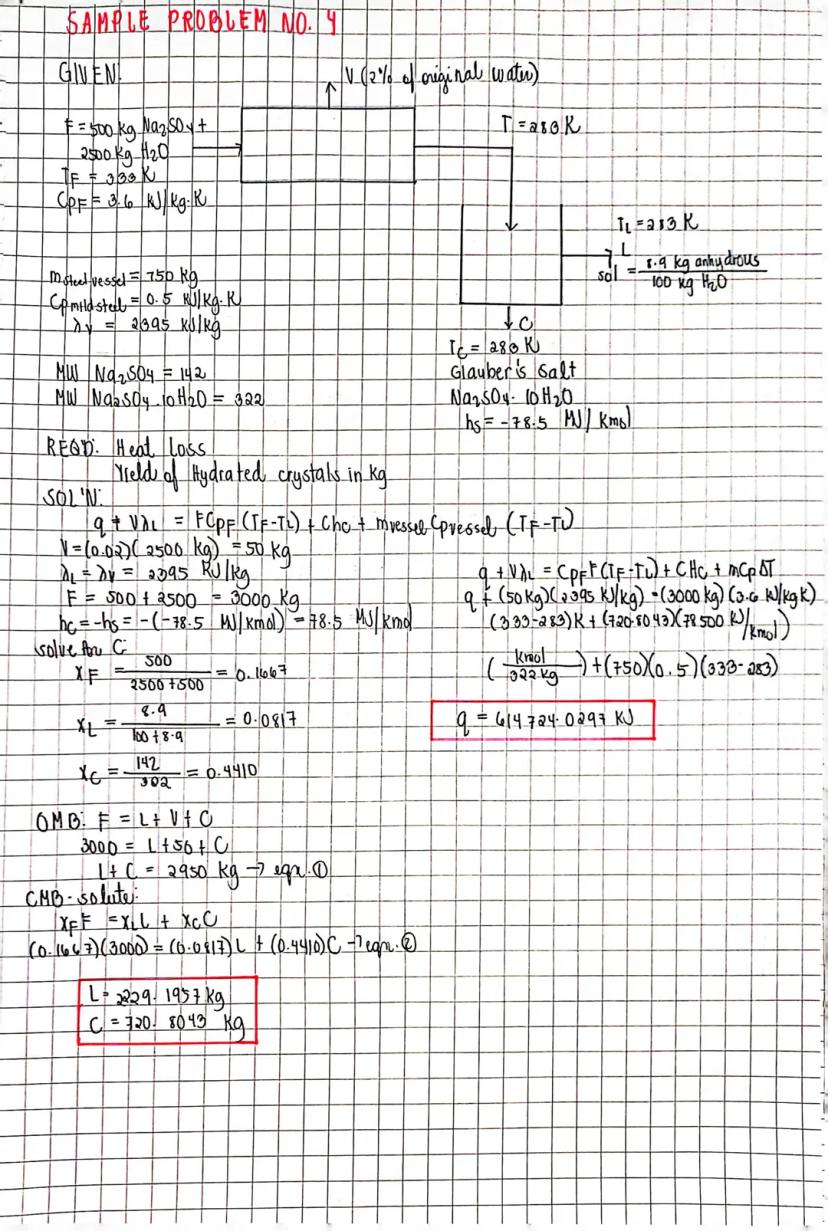
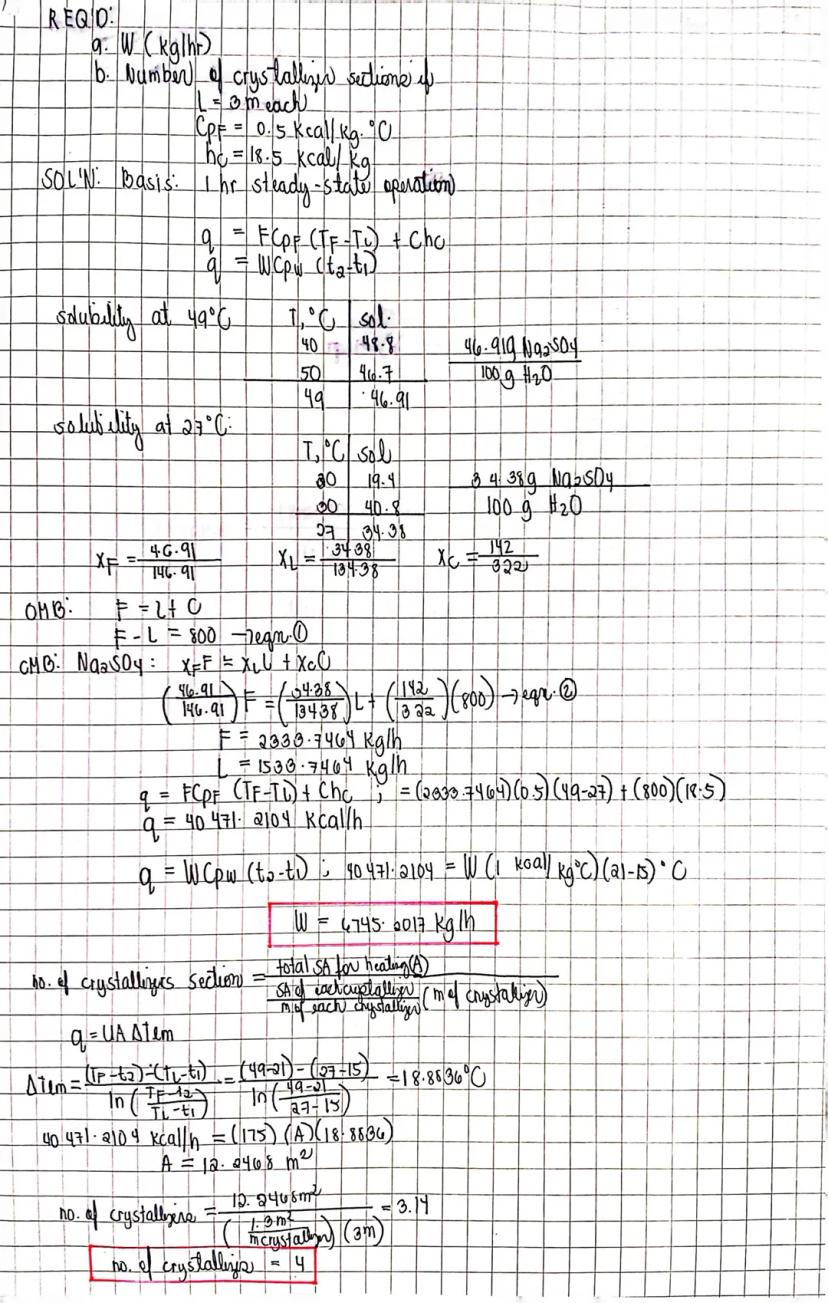
Sample Problem 4: Sodium Sulfate Crystallization
This problem focuses on the crystallization of sodium sulfate decahydrate (Na₂SO₄ · 10H₂O), also known as Glauber's salt.
Given information:
- Feed composition: 500 kg Na₂SO₄ + 2500 kg H₂O
- Initial temperature (TF) = 333 K
- Vessel mass and specific heat capacity
- Latent heat of vaporization and heat of solution data
The problem requires calculating the heat loss during the crystallization process.
Vocabulary: Glauber's salt is the common name for sodium sulfate decahydrate, an important industrial chemical.
The solution involves material balance equations to determine the amount of crystals formed, followed by an energy balance to calculate the heat loss.
Highlight: This problem showcases how the heat of solution in crystallization processes affects the overall energy balance, which is crucial for designing energy-efficient crystallization systems.
5
of 7
Sample Problem 5: Iron(II) Sulfate Crystallization
This problem deals with the crystallization of iron(II) sulfate heptahydrate (FeSO₄ · 7H₂O), also known as copperas, in an adiabatic vacuum crystallizer.
Given information:
- Feed composition: 38.9 parts FeSO₄ per 100 parts H₂O
- Initial temperature (TF) = 343 K
- Enthalpy data provided
- Production rate: 10 tons/hr of copperas crystals
The problem requires calculating the feed rate for steady-state operation.
Vocabulary: An adiabatic process is one that occurs without heat transfer to or from the surroundings.
The solution involves material and energy balance equations to determine the feed rate necessary to produce the specified amount of crystals.
Highlight: This problem illustrates the application of crystallization process steps in an industrial setting, demonstrating how theoretical concepts are applied to real-world production scenarios.
6
of 7
Sample Problem 6: Sodium Phosphate Crystallization
The final problem focuses on the crystallization of sodium phosphate dodecahydrate (Na₃PO₄ · 12H₂O) in a continuous crystallizer.
Given information:
- Feed temperature (TF) = 313 K
- Specific heat capacity and latent heat data
- Overall heat transfer coefficient
- Cooling water temperatures
- Crystal production rate: 0.060 kg/s
The problem requires calculating the length of the crystallizer.
Vocabulary: The overall heat transfer coefficient (U) is a measure of the overall ability of a series of conductive and convective barriers to transfer heat.
The solution involves energy balance equations to determine the heat transfer area required, which is then used to calculate the crystallizer length.
Highlight: This problem demonstrates how heat transfer principles are applied in the design of continuous crystallization equipment, which is essential knowledge for chemical engineers working on industrial crystallization processes.
7
of 7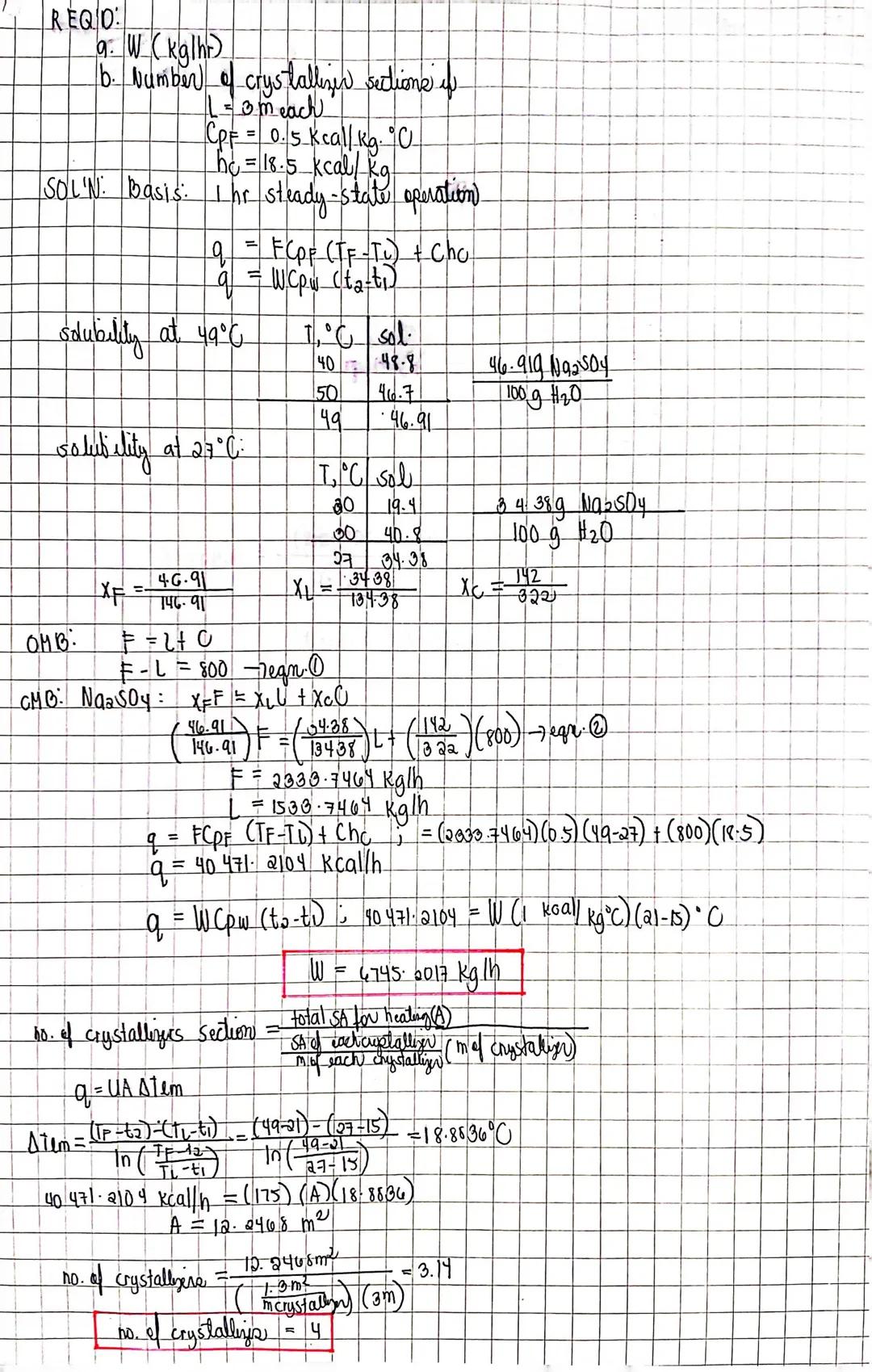
Sample Problems on Crystallization Computations
This section introduces the concept of crystallization computations with sample problems focusing on solubility and heat of solution for various compounds.
Vocabulary: Soda ash is another name for sodium carbonate (Na₂CO₃ · 10H₂O).
Example: The solubility of soda ash at 30°C in boiling water is 38.8g/100g.
Definition: Solubility is the amount of a substance that can dissolve in a given amount of solvent at a specific temperature.
The document provides solubility data for several compounds:
- Sal ammoniac (ammonium chloride, NH₄Cl) at 70°C: 60.2 g/100g water
- Epsom salt at 10°C: 20.9g/100g water
- Saltpeter (potassium nitrate, KNO₃) heat of solution: -8.633 kcal/mol
- Hydroxybenzene (phenol) heat of solution: -2,405 cal/mol
Highlight: Understanding solubility at different temperatures is crucial for designing crystallization processes in chemical engineering.
We thought you’d never ask...
What is the Knowunity AI companion?
Our AI companion is specifically built for the needs of students. Based on the millions of content pieces we have on the platform we can provide truly meaningful and relevant answers to students. But its not only about answers, the companion is even more about guiding students through their daily learning challenges, with personalised study plans, quizzes or content pieces in the chat and 100% personalisation based on the students skills and developments.
Where can I download the Knowunity app?
You can download the app in the Google Play Store and in the Apple App Store.
Is Knowunity really free of charge?
That's right! Enjoy free access to study content, connect with fellow students, and get instant help – all at your fingertips.
Similar Content
Most popular content in Chemistry
9ChemistryMass-to-Mass Stoichiometry: Calculating Grams to Grams
Learn how to perform mass-to-mass stoichiometric calculations. This guide covers the steps to convert grams of a reactant or product to grams of another substance using mole ratios and molar mass.
9th1993
I
ChemistryIntro to Chem - Test Review
Identifying elements, compounds, heterogeneous/homogeneous mixtures and chemical/physical change test review.
11th1973
ChemistryUnderstanding Atomic and Mass Numbers (Z and A)
Learn the definitions of atomic number (Z) and mass number (A). Understand how these numbers relate to protons, neutrons, and isotopes in an atom's nucleus.
9th522
ChemistryMolecular Geometry
Chemistry notes
10th1410
ChemistryPOGIL Stoichiometry
mole to mole, mole to mass, mass to mass, and volume conversions
10th4682
ChemistryThermochemistry Notes 🥵🔥
Unit 10 of Chemistry Honors (Inorganic)
10th87352
ChemistryChemistry: Atoms, Molecules, Ions
This is about atoms, molecules and ions.
9th1348
ChemistryAcids and Bases
This tackles the general properties of acids and bases, their examples and pH concept.
2611
ChemistryIsomerism
Structural and sterioisomers (geometric and optical)
11th821
Most popular content
9O
 AP US History
Origins and Dynamics of the Columbian Exchange
Analyze the ecological and economic motivations behind the initial transfer of goods, people, and diseases between the Old and New Worlds.
9th3,1280
I
AP US HistoryIntroduction to Early Cultural Interactions
Analyze the initial social and religious encounters between Europeans, Africans, and Indigenous peoples in the colonial Americas.
9th2,7730
O
 AP World History
Origins of Ancient River Civilizations
Analyze the environmental factors and technological innovations that led to the rise of early states in Mesopotamia, Egypt, and the Indus Valley.
9th3,1870
M
AP US HistoryMotivations for European Exploration
Analyze the economic, religious, and political factors that drove European powers to the Americas during the 15th and 16th centuries.
9th1,7780
F
 AP Psychology
Foundations of Ethical Guidelines in Research
Practice the core principles of the APA ethical code including informed consent, debriefing, and the role of Institutional Review Boards.
9th1,3360
I
AP US HistoryIntroduction to Native American Societies
Examine the diverse social, political, and economic structures of North American indigenous groups prior to European contact.
9th1,1100
I
 AP Biology
Introduction to Biological Elements of Life
Practice identifying the essential elements including carbon, nitrogen, phosphorus, and sulfur that compose biological macromolecules.
9th1,7390
I
AP US HistoryIntroduction to the Spanish Encomienda System
Explore the fundamental economic and social structures of the Spanish colonial system, focusing on the encomienda and the casta social hierarchy.
9th8890
O
AP World HistoryOrigins and Continuity of the Byzantine Empire
Analyze the political and cultural transitions from the Roman Empire to the Byzantine Empire, focusing on the reign of Justinian I and his code.
9th1,6320
Can't find what you're looking for? Explore other subjects.
Students love us — and so will you.
4.6/5App Store
4.7/5Google Play
The app is very easy to use and well designed. I have found everything I was looking for so far and have been able to learn a lot from the presentations! I will definitely use the app for a class assignment! And of course it also helps a lot as an inspiration.
Stefan SiOS user
This app is really great. There are so many study notes and help [...]. My problem subject is French, for example, and the app has so many options for help. Thanks to this app, I have improved my French. I would recommend it to anyone.
Samantha KlichAndroid user
Wow, I am really amazed. I just tried the app because I've seen it advertised many times and was absolutely stunned. This app is THE HELP you want for school and above all, it offers so many things, such as workouts and fact sheets, which have been VERY helpful to me personally.
AnnaiOS user
Chemistry355 views·Updated Jun 7, 2026·7 pagesFun with Soda Ash and Salt: Learn Solubility and Heat Experiments at Home!
This document covers various chemical engineering calculations related to solubility, crystallization, and heat transfer. It includes sample problems on solubility of soda ash in water at 30°C, yield calculation of sodium carbonate crystals, and heat of solution of...
1
of 7
Sign up to see the content. It's free!
- Access to all documents
- Improve your grades
- Join milions of students
Sample Problem 1: Magnesium Sulfate Crystallization
This page details a sample problem involving the crystallization of magnesium sulfate heptahydrate (MgSO₄ · 7H₂O) from a solution.
Given information:
- Feed (F) = 1000 kg
- Feed temperature (TF) = 353 K
- Solubility at 353 K = 64.2 kg MgSO₄ / 100 kg H₂O
- Solubility at 303 K = 40.8 kg MgSO₄ / 100 kg H₂O
- 10% of water from feed is evaporated
The problem requires calculating the crystal yield and other process parameters.
Vocabulary: Crystal yield refers to the amount of solid crystals produced from a solution during the crystallization process.
The solution involves material balance equations and solubility calculations to determine the amount of crystals formed and the yield percentage.
Highlight: This problem demonstrates how to use solubility data at different temperatures to calculate crystallization yields, which is a fundamental skill in crystallization process in chemistry.
2
of 7Sign up to see the content. It's free!
- Access to all documents
- Improve your grades
- Join milions of students
Sample Problem 2: Sodium Carbonate Crystallization
This section presents a problem focusing on the crystallization of sodium carbonate decahydrate (Na₂CO₃ · 10H₂O) from a solution.
Given information:
- Feed (F) = 5000 kg of Na₂CO₃ and H₂O mixture
- 5% of water evaporates
- Solubility data provided for different temperatures
The problem requires calculating the yield of Na₂CO₃ crystals.
Example: The solubility of sodium carbonate at the crystallization temperature is 21.5 kg Na₂CO₃ / 100 kg H₂O.
The solution involves material balance equations, similar to the previous problem, but with different solubility data and molecular weights.
Highlight: This problem illustrates how the solubility of sodium carbonate at different temperatures affects the crystallization yield, which is crucial knowledge for industrial crystallization processes.
3
of 7Sign up to see the content. It's free!
- Access to all documents
- Improve your grades
- Join milions of students
Sample Problem 3: Magnesium Sulfate Crystallization with Heat Loss
This problem expands on the previous magnesium sulfate crystallization example by incorporating heat loss calculations.
Given information:
- Feed (F) = 2000 kg MgSO₄
- Initial temperature (TF) = 330 K
- Final temperature (T) = 290 K
- Solubility and molecular weight data provided
The problem requires calculating the yield of crystals and the heat loss during the process.
Vocabulary: Heat of crystallization (Δhc) is the energy released when a substance transitions from a liquid to a solid crystalline state.
The solution involves both material balance and energy balance equations to determine the crystal yield and the heat loss during the crystallization process.
Highlight: This problem demonstrates the importance of considering both mass and energy balances in crystallization processes, which is essential for designing efficient industrial crystallizers.
4
of 7Sign up to see the content. It's free!
- Access to all documents
- Improve your grades
- Join milions of students
Sample Problem 4: Sodium Sulfate Crystallization
This problem focuses on the crystallization of sodium sulfate decahydrate (Na₂SO₄ · 10H₂O), also known as Glauber's salt.
Given information:
- Feed composition: 500 kg Na₂SO₄ + 2500 kg H₂O
- Initial temperature (TF) = 333 K
- Vessel mass and specific heat capacity
- Latent heat of vaporization and heat of solution data
The problem requires calculating the heat loss during the crystallization process.
Vocabulary: Glauber's salt is the common name for sodium sulfate decahydrate, an important industrial chemical.
The solution involves material balance equations to determine the amount of crystals formed, followed by an energy balance to calculate the heat loss.
Highlight: This problem showcases how the heat of solution in crystallization processes affects the overall energy balance, which is crucial for designing energy-efficient crystallization systems.
5
of 7Sign up to see the content. It's free!
- Access to all documents
- Improve your grades
- Join milions of students
Sample Problem 5: Iron(II) Sulfate Crystallization
This problem deals with the crystallization of iron(II) sulfate heptahydrate (FeSO₄ · 7H₂O), also known as copperas, in an adiabatic vacuum crystallizer.
Given information:
- Feed composition: 38.9 parts FeSO₄ per 100 parts H₂O
- Initial temperature (TF) = 343 K
- Enthalpy data provided
- Production rate: 10 tons/hr of copperas crystals
The problem requires calculating the feed rate for steady-state operation.
Vocabulary: An adiabatic process is one that occurs without heat transfer to or from the surroundings.
The solution involves material and energy balance equations to determine the feed rate necessary to produce the specified amount of crystals.
Highlight: This problem illustrates the application of crystallization process steps in an industrial setting, demonstrating how theoretical concepts are applied to real-world production scenarios.
6
of 7Sign up to see the content. It's free!
- Access to all documents
- Improve your grades
- Join milions of students
Sample Problem 6: Sodium Phosphate Crystallization
The final problem focuses on the crystallization of sodium phosphate dodecahydrate (Na₃PO₄ · 12H₂O) in a continuous crystallizer.
Given information:
- Feed temperature (TF) = 313 K
- Specific heat capacity and latent heat data
- Overall heat transfer coefficient
- Cooling water temperatures
- Crystal production rate: 0.060 kg/s
The problem requires calculating the length of the crystallizer.
Vocabulary: The overall heat transfer coefficient (U) is a measure of the overall ability of a series of conductive and convective barriers to transfer heat.
The solution involves energy balance equations to determine the heat transfer area required, which is then used to calculate the crystallizer length.
Highlight: This problem demonstrates how heat transfer principles are applied in the design of continuous crystallization equipment, which is essential knowledge for chemical engineers working on industrial crystallization processes.
7
of 7Sign up to see the content. It's free!
- Access to all documents
- Improve your grades
- Join milions of students
Sample Problems on Crystallization Computations
This section introduces the concept of crystallization computations with sample problems focusing on solubility and heat of solution for various compounds.
Vocabulary: Soda ash is another name for sodium carbonate (Na₂CO₃ · 10H₂O).
Example: The solubility of soda ash at 30°C in boiling water is 38.8g/100g.
Definition: Solubility is the amount of a substance that can dissolve in a given amount of solvent at a specific temperature.
The document provides solubility data for several compounds:
- Sal ammoniac (ammonium chloride, NH₄Cl) at 70°C: 60.2 g/100g water
- Epsom salt at 10°C: 20.9g/100g water
- Saltpeter (potassium nitrate, KNO₃) heat of solution: -8.633 kcal/mol
- Hydroxybenzene (phenol) heat of solution: -2,405 cal/mol
Highlight: Understanding solubility at different temperatures is crucial for designing crystallization processes in chemical engineering.
We thought you’d never ask...
What is the Knowunity AI companion?
Our AI companion is specifically built for the needs of students. Based on the millions of content pieces we have on the platform we can provide truly meaningful and relevant answers to students. But its not only about answers, the companion is even more about guiding students through their daily learning challenges, with personalised study plans, quizzes or content pieces in the chat and 100% personalisation based on the students skills and developments.
Where can I download the Knowunity app?
You can download the app in the Google Play Store and in the Apple App Store.
Is Knowunity really free of charge?
That's right! Enjoy free access to study content, connect with fellow students, and get instant help – all at your fingertips.
Similar Content
Most popular content in Chemistry
9ChemistryMass-to-Mass Stoichiometry: Calculating Grams to Grams
Learn how to perform mass-to-mass stoichiometric calculations. This guide covers the steps to convert grams of a reactant or product to grams of another substance using mole ratios and molar mass.
9th1993
I
ChemistryIntro to Chem - Test Review
Identifying elements, compounds, heterogeneous/homogeneous mixtures and chemical/physical change test review.
11th1973
ChemistryUnderstanding Atomic and Mass Numbers (Z and A)
Learn the definitions of atomic number (Z) and mass number (A). Understand how these numbers relate to protons, neutrons, and isotopes in an atom's nucleus.
9th522
ChemistryMolecular Geometry
Chemistry notes
10th1410
ChemistryPOGIL Stoichiometry
mole to mole, mole to mass, mass to mass, and volume conversions
10th4682
ChemistryThermochemistry Notes 🥵🔥
Unit 10 of Chemistry Honors (Inorganic)
10th87352
ChemistryChemistry: Atoms, Molecules, Ions
This is about atoms, molecules and ions.
9th1348
ChemistryAcids and Bases
This tackles the general properties of acids and bases, their examples and pH concept.
2611
ChemistryIsomerism
Structural and sterioisomers (geometric and optical)
11th821
Most popular content
9O
AP US HistoryOrigins and Dynamics of the Columbian Exchange
Analyze the ecological and economic motivations behind the initial transfer of goods, people, and diseases between the Old and New Worlds.
9th3,1280
I
AP US HistoryIntroduction to Early Cultural Interactions
Analyze the initial social and religious encounters between Europeans, Africans, and Indigenous peoples in the colonial Americas.
9th2,7730
O
AP World HistoryOrigins of Ancient River Civilizations
Analyze the environmental factors and technological innovations that led to the rise of early states in Mesopotamia, Egypt, and the Indus Valley.
9th3,1870
M
AP US HistoryMotivations for European Exploration
Analyze the economic, religious, and political factors that drove European powers to the Americas during the 15th and 16th centuries.
9th1,7780
F
AP PsychologyFoundations of Ethical Guidelines in Research
Practice the core principles of the APA ethical code including informed consent, debriefing, and the role of Institutional Review Boards.
9th1,3360
I
AP US HistoryIntroduction to Native American Societies
Examine the diverse social, political, and economic structures of North American indigenous groups prior to European contact.
9th1,1100
I
AP BiologyIntroduction to Biological Elements of Life
Practice identifying the essential elements including carbon, nitrogen, phosphorus, and sulfur that compose biological macromolecules.
9th1,7390
I
AP US HistoryIntroduction to the Spanish Encomienda System
Explore the fundamental economic and social structures of the Spanish colonial system, focusing on the encomienda and the casta social hierarchy.
9th8890
O
AP World HistoryOrigins and Continuity of the Byzantine Empire
Analyze the political and cultural transitions from the Roman Empire to the Byzantine Empire, focusing on the reign of Justinian I and his code.
9th1,6320
Can't find what you're looking for? Explore other subjects.
Students love us — and so will you.
4.6/5App Store
4.7/5Google Play
The app is very easy to use and well designed. I have found everything I was looking for so far and have been able to learn a lot from the presentations! I will definitely use the app for a class assignment! And of course it also helps a lot as an inspiration.
Stefan SiOS user
This app is really great. There are so many study notes and help [...]. My problem subject is French, for example, and the app has so many options for help. Thanks to this app, I have improved my French. I would recommend it to anyone.
Samantha KlichAndroid user
Wow, I am really amazed. I just tried the app because I've seen it advertised many times and was absolutely stunned. This app is THE HELP you want for school and above all, it offers so many things, such as workouts and fact sheets, which have been VERY helpful to me personally.
AnnaiOS user