
Chemistry might seem overwhelming, but it's actually about understanding how...
 Chemistry112 views·Updated Jun 24, 2026·7 pages
GCSE WJEC Chemistry Unit 1 Guide

Carys x@xxcxrysx



1 / 7
1
of 7
Basic Chemistry Concepts
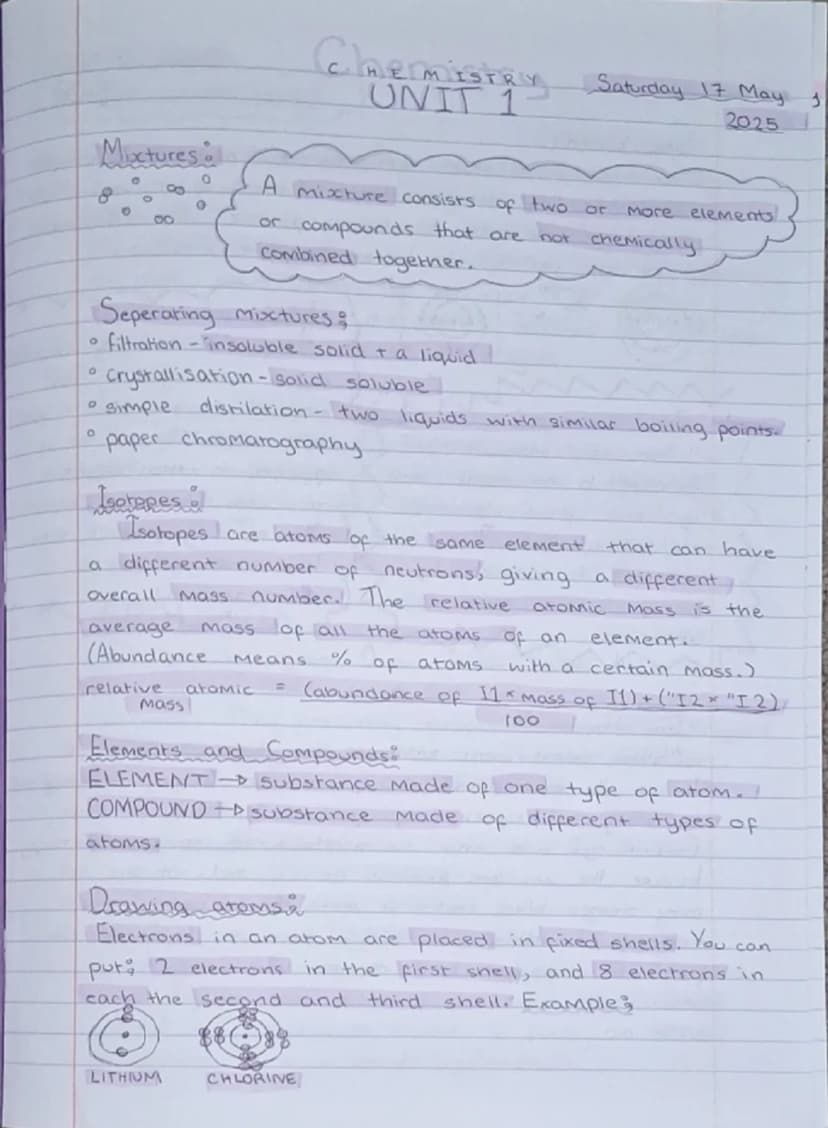
Ever wondered how scientists separate salt from seawater or why some substances mix whilst others don't? Mixtures are simply two or more elements or compounds that aren't chemically stuck together - think of a bowl of cereal where you can still pick out individual pieces.
You can separate mixtures using clever techniques. Filtration works for insoluble solids (like sand from water), crystallisation recovers dissolved solids, distillation separates liquids with different boiling points, and chromatography splits up substances that travel at different speeds.
Isotopes are like identical twins with different weights - same element, but different numbers of neutrons. The relative atomic mass you see on the periodic table is actually an average of all these different versions. Scientists calculate this using abundance (how common each isotope is) and their individual masses.
Quick Tip: Remember that elements contain only one type of atom, whilst compounds mix different types together - like the difference between a bag of only red sweets versus a mixed bag!
2
of 7
Ionic Bonding
When metals meet non-metals, it's like a generous friend giving away their belongings! Ionic bonding happens when metal atoms transfer electrons to non-metal atoms instead of sharing them. The metal becomes a positive ion (lost electrons), whilst the non-metal becomes a negative ion (gained electrons).
These oppositely charged ions attract each other with strong electrostatic forces, creating ionic compounds. It's like powerful magnets sticking together - the attraction is incredibly strong.
Ionic compounds have some predictable properties that make perfect sense. They have high melting points because those electrostatic attractions are tough to break. They don't conduct electricity when solid (ions can't move), but they do conduct when melted or dissolved (ions become free to carry charge).
Understanding these properties helps explain why salt dissolves in water and why ionic compounds are often used in batteries and electronics.
Key Point: Think of ionic bonding as a permanent loan - the metal "lends" electrons to the non-metal, but they're so attracted to each other that they stick together!
3
of 7
The Periodic Table and Groups
Mendeleev was brilliant but had gaps in his periodic table because some elements hadn't been discovered yet. Today's periodic table orders elements by atomic number with no gaps - metals on the left, non-metals on the right.
Group 0 elements (noble gases) are the chemistry equivalent of content cats - they have full outer electron shells so they don't react with anything. They exist as single atoms and their boiling points increase as you go down the group.
Group 1 elements (alkali metals) are the complete opposite - they're incredibly reactive because they desperately want to lose that single outer electron. They react with oxygen, chlorine, and water to form predictable products. The name "alkali metals" comes from their reaction with water producing alkaline solutions.
Memory Trick: Noble gases are "noble" because they don't need to react with anyone - they're perfectly happy on their own!
4
of 7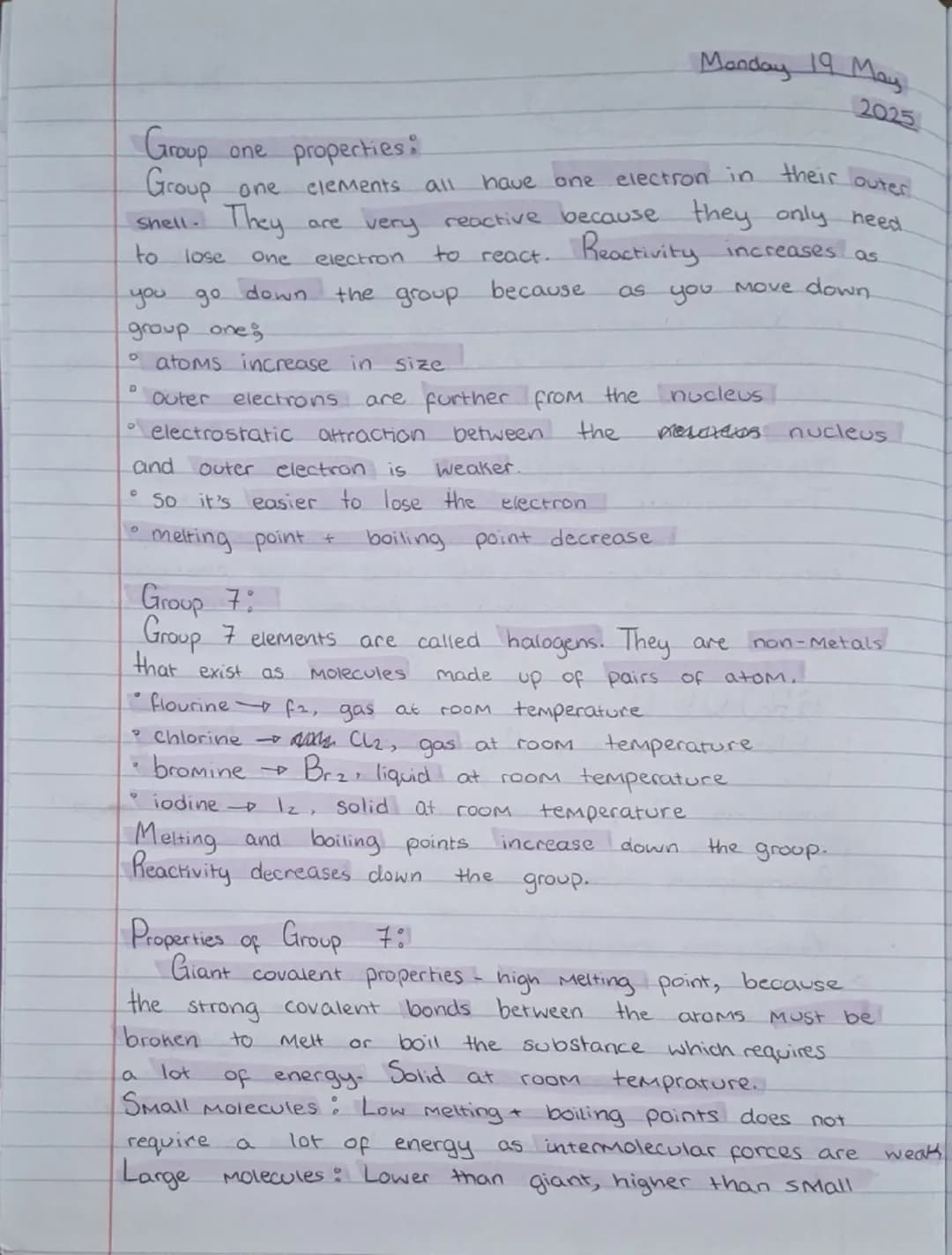
Group Properties and Trends
Group 1 reactivity increases as you go down because the atoms get bigger and the outer electron gets further from the nucleus. It's like trying to hold onto a balloon on a longer string in the wind - much harder! This weaker attraction makes it easier to lose that outer electron.
Group 7 elements (halogens) are non-metals that exist as molecules made of atom pairs. Fluorine and chlorine are gases, bromine is liquid, and iodine is solid at room temperature. Unlike Group 1, their reactivity decreases down the group because it becomes harder to gain that extra electron.
The structure of substances affects their properties dramatically. Giant covalent structures have high melting points because you need lots of energy to break strong covalent bonds. Small molecules have low melting points due to weak forces between molecules, whilst large molecules fall somewhere in between.
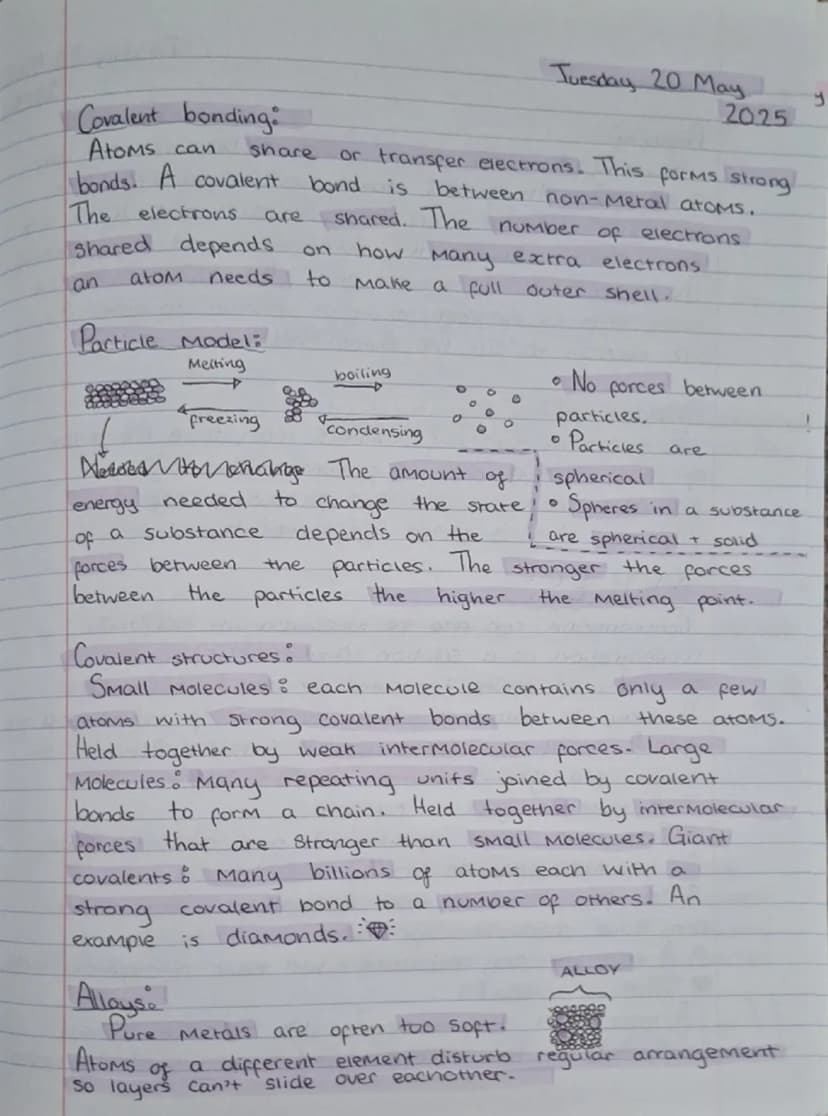
Alloys solve the problem of pure metals being too soft - adding different atoms disrupts the regular arrangement so layers can't slide over each other easily.
Pattern Spotting: Group 1 gets more reactive going down, Group 7 gets less reactive - they're like opposite trends!
5
of 7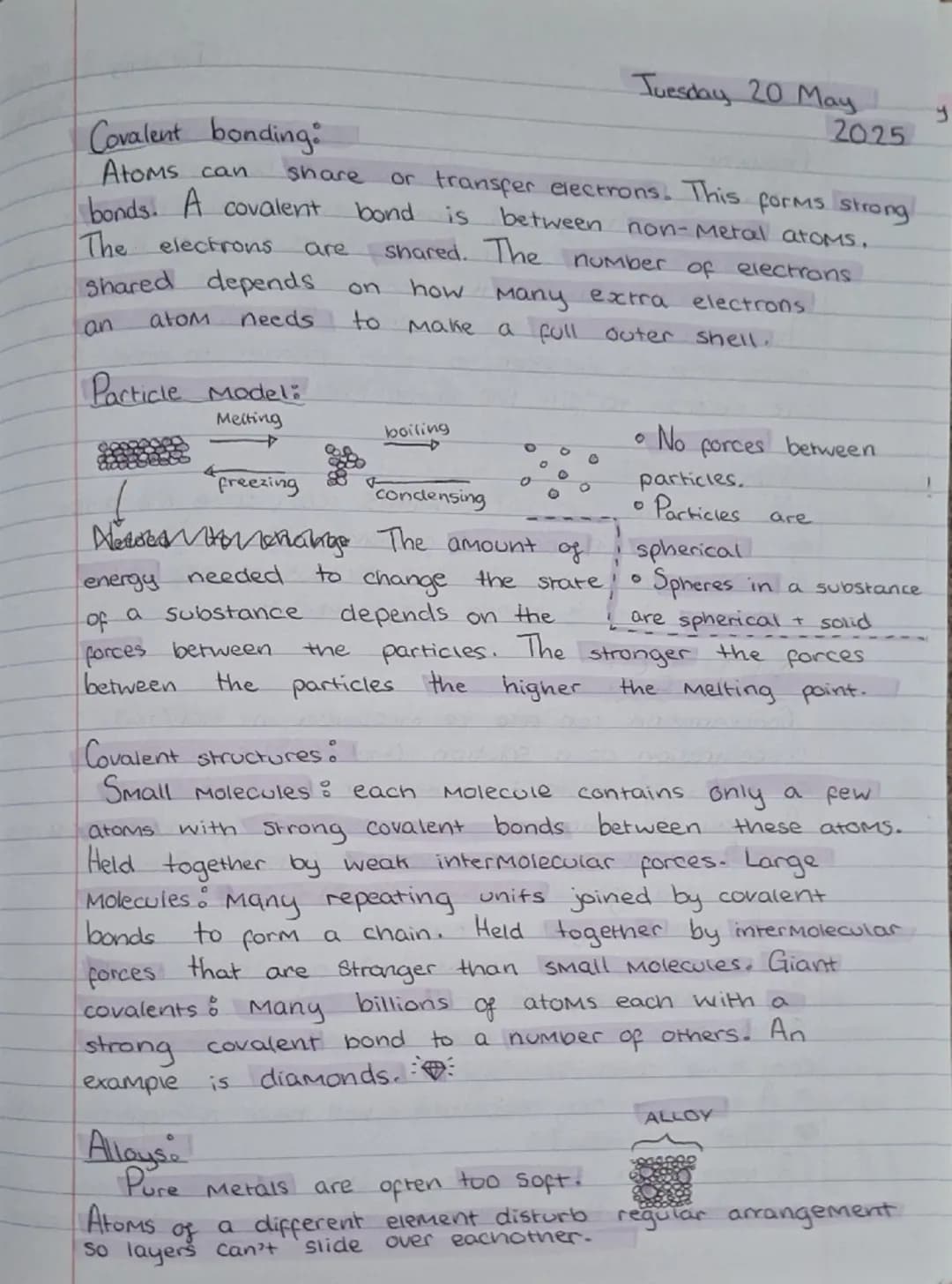
Covalent Bonding and States of Matter
Covalent bonding happens between non-metals that share electrons rather than transferring them. It's like sharing a pizza - each atom contributes electrons to make both atoms happy with full outer shells.
The particle model shows how substances change state through melting, freezing, boiling, and condensing. The energy needed for these changes depends on forces between particles - stronger forces mean higher melting and boiling points.
Covalent structures come in three main types. Small molecules have strong bonds within molecules but weak forces between them (low melting points). Large molecules have stronger intermolecular forces than small ones. Giant covalent structures like diamond have billions of atoms all connected by strong covalent bonds (very high melting points).
Real-World Connection: Diamond's giant covalent structure makes it incredibly hard, whilst graphite (also carbon) has a different structure that makes it soft enough to use in pencils!
6
of 7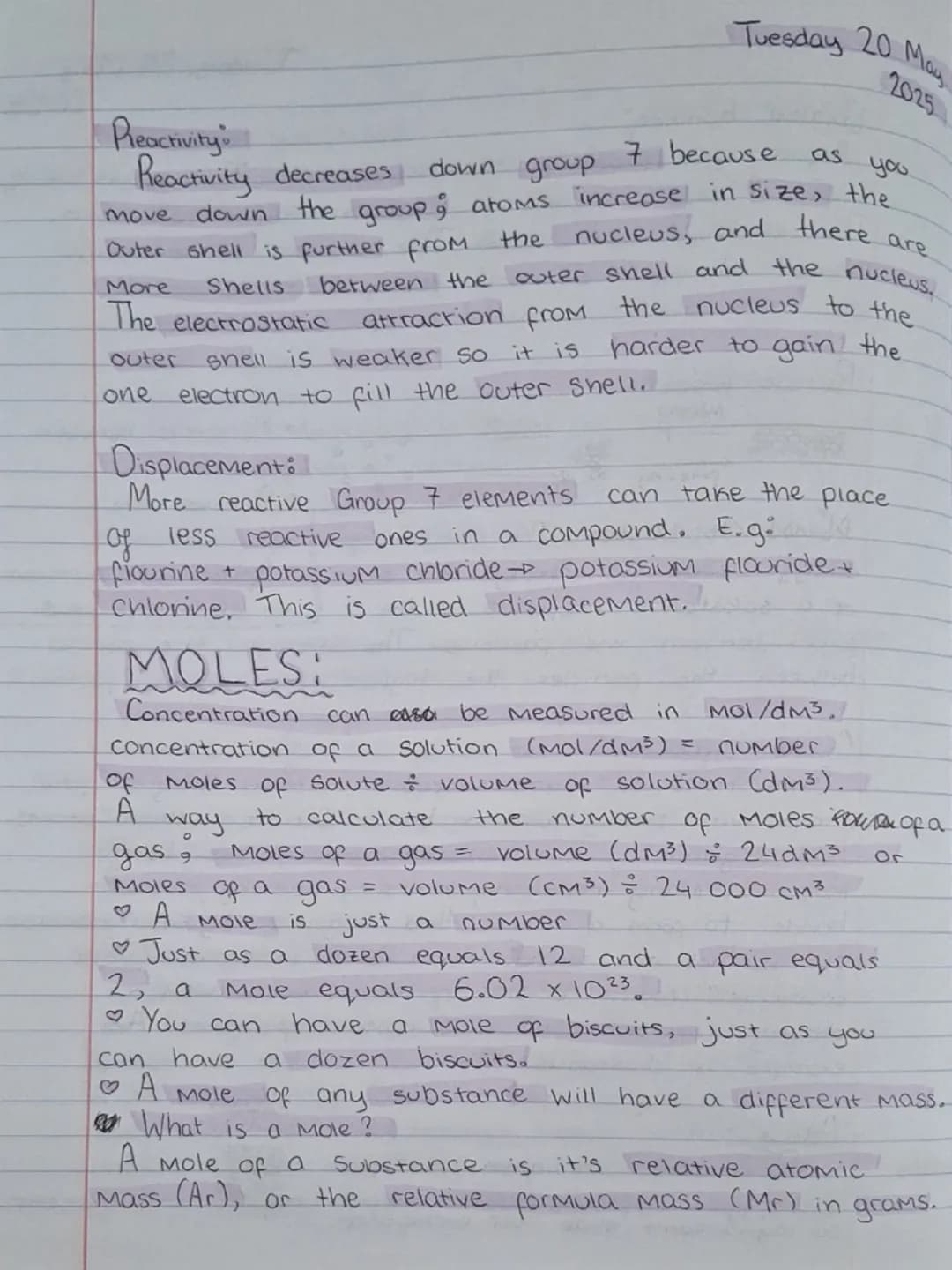
Chemical Calculations with Moles
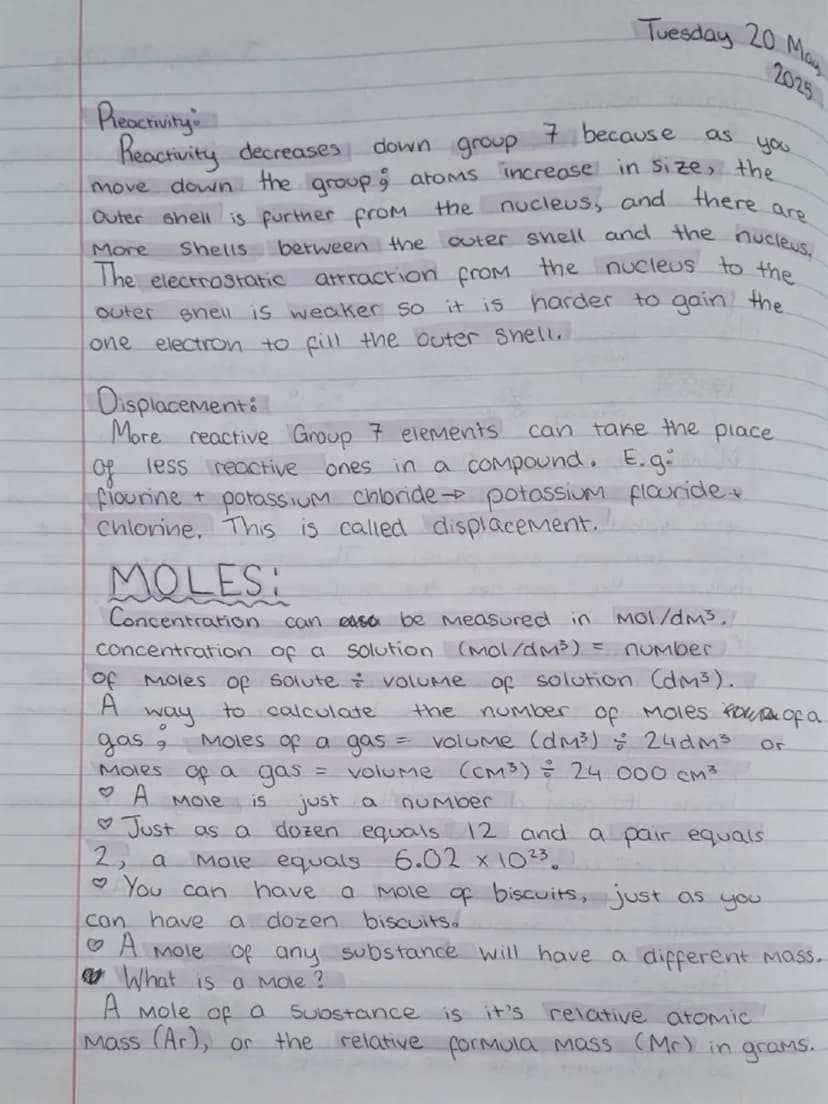
Group 7 reactivity decreases down the group because atoms get larger and it becomes harder to attract that extra electron needed to fill the outer shell. More reactive halogens can displace less reactive ones from compounds - it's like a stronger person taking someone's seat!
Moles are chemistry's counting system. Just like a dozen equals 12, a mole equals 6.02 × 10²³ particles. You can have a mole of anything - biscuits, atoms, or molecules! The genius is that one mole of any substance has a mass equal to its relative atomic or formula mass in grams.
Concentration in mol/dm³ makes calculations much easier: concentration = moles of solute ÷ volume of solution. For gases, you can find moles by dividing volume by 24 dm³ (or 24,000 cm³).
Why Moles Matter: Using moles lets chemists count atoms without actually counting billions of individual particles - it's like using dozens to count eggs!
7
of 7
Mole Calculations in Practice
Working out moles is straightforward once you get the hang of it: moles = mass ÷ molar mass. The molar mass is just the relative atomic mass (Ar) or relative formula mass (Mr) expressed in grams per mole.
Let's make this real with examples. One mole of lithium oxide (Li₂O) weighs 30g because you add up the masses: lithium (7 × 2 = 14) plus oxygen (16 × 1 = 16). For 250g of iron, you'd have 4.46 moles since iron's molar mass is 56g/mol.
These calculations aren't just academic exercises - they're essential for making sure chemical reactions have the right amounts of each substance. Too little of one reactant and you'll have leftovers; too much and you're wasting materials.
Mastering mole calculations gives you the power to predict exactly what will happen in chemical reactions and how much product you'll make.
Success Tip: Practice with simple examples first - once you can calculate moles for single elements, compounds become much easier to handle!
We thought you’d never ask...
What is the Knowunity AI companion?
Our AI companion is specifically built for the needs of students. Based on the millions of content pieces we have on the platform we can provide truly meaningful and relevant answers to students. But its not only about answers, the companion is even more about guiding students through their daily learning challenges, with personalised study plans, quizzes or content pieces in the chat and 100% personalisation based on the students skills and developments.
Where can I download the Knowunity app?
You can download the app in the Google Play Store and in the Apple App Store.
Is Knowunity really free of charge?
That's right! Enjoy free access to study content, connect with fellow students, and get instant help – all at your fingertips.
Similar Content
 Kimya
KimyaMost popular content: Bond
1Most popular content in Chemistry
9G
ChemistryGCSE AQA Chemistry Topic 1- The Atom
The Atom
101,2790
Chemistrychem paper 1
higher
112,07843
ChemistryA-level OCR A Chemistry summary sheets
Everything from snaprevise for OCR chemistry a-level
122,28779
C
Chemistrychem paper 1
Unlock the secrets of chemical reactions with this comprehensive flashcard set designed to help you conquer complex concepts and ace your Chemistry exams.
117251
ChemistryEssential Chemistry Practicals
Explore key AQA GCSE Chemistry practicals, including flame tests, titration, and gas identification. This resource covers essential techniques for analyzing ions, making salts, and understanding reaction kinetics. Perfect for students preparing for exams and practical assessments.
1011,972902
A
ChemistryAQA GCSE Chemistry 4.4 Chemical changes
4.4 Reactions of acids with bases or carbonates
117531
ChemistryChemistry paper 2
Chem paper 2 notes
1172214
F
ChemistryFundamentals of Atomic Structure
Practice identifying subatomic particles, calculating neutrons, and defining isotopes and atomic/mass numbers.
123460
A
ChemistryAtomic Mass and Atomic Number Calculations
Calculate the number of protons, neutrons, and electrons for different elements and isotopes.
S34940
Most popular content
9 Sociology
Sociology of Education Overview
Explore comprehensive A-Level Sociology notes on the education system, covering key theories, policies, and sociological perspectives. This resource includes insights on marketisation, gender roles, cultural deprivation, and educational inequalities, providing a thorough understanding of how education shapes social stratification and individual achievement. Ideal for exam preparation and in-depth study.
12102,8523,040
SociologySociology of Families: Comprehensive Revision
Dive into an extensive overview of family dynamics, perspectives, and patterns in sociology. This resource covers key concepts such as family diversity, gender roles, marriage, and the impact of social policies on family structures. Perfect for A-Level Sociology students preparing for Paper 2.
1273,6612,307
CriminologyCriminology: Crime & Punishment Overview
Comprehensive mindmaps covering key concepts in the Crime and Punishment topic for WJEC Criminology Unit 4. This resource includes detailed insights into the Criminal Justice System, crime prevention strategies, sentencing models, and the roles of various agencies. Ideal for A-Level revision, ensuring you grasp essential theories and legislative processes to excel in your exams.
1254,8691,059
SociologyComprehensive Crime & Deviance Overview
Explore an extensive revision of crime and deviance topics, including theories, types of crime, and the impact of media. This resource covers key concepts such as Marxism, functionalism, gender and crime, and the influence of globalization on criminal behavior. Ideal for students seeking a thorough understanding of criminology and its various theories. Type: Full Topic Revision.
1251,6541,399
C
 Biology
Cell Biology and Cell structure
cell structures
93,2470
 English Literature
An Inspector Calls: Character Insights
Explore in-depth analysis and key quotes for characters in J.B. Priestley's 'An Inspector Calls'. This resource covers Gerald Croft, Inspector Goole, Sheila Birling, Mrs. Birling, Eric Birling, and Eva Smith, focusing on themes of class, gender roles, and social responsibility. Ideal for students aiming for Grade 8 and above.
1025,429907
CriminologyWJEC Unit 4 Criminology
Criminology unit 4 detailed revision note
127,151125
CriminologyCriminology Theories Overview
Explore key criminology theories and their implications on crime and deviance. This comprehensive summary covers biological, psychological, and sociological perspectives, including labelling theory, right realism, and the impact of social campaigns on policy development. Ideal for A-Level criminology students seeking to understand the complexities of criminal behaviour and the factors influencing crime prevention strategies.
129,760210
English LiteratureRomeo and Juliet: Key themes
Key Romeo and Juliet themes and analysed quotes
106,708198
Can't find what you're looking for? Explore other subjects.
Students love us — and so will you.
4.6/5App Store
4.7/5Google Play
The app is very easy to use and well designed. I have found everything I was looking for so far and have been able to learn a lot from the presentations! I will definitely use the app for a class assignment! And of course it also helps a lot as an inspiration.
Stefan SiOS user
This app is really great. There are so many study notes and help [...]. My problem subject is French, for example, and the app has so many options for help. Thanks to this app, I have improved my French. I would recommend it to anyone.
Samantha KlichAndroid user
Wow, I am really amazed. I just tried the app because I've seen it advertised many times and was absolutely stunned. This app is THE HELP you want for school and above all, it offers so many things, such as workouts and fact sheets, which have been VERY helpful to me personally.
AnnaiOS user
Chemistry112 views·Updated Jun 24, 2026·7 pagesGCSE WJEC Chemistry Unit 1 Guide
Carys x@xxcxrysx
Chemistry might seem overwhelming, but it's actually about understanding how atoms behave and combine to create everything around us. This unit covers the fundamental building blocks - from separating mixtures to understanding why elements react the way they do, plus...
1
of 7
Sign up to see the content. It's free!
- Access to all documents
- Improve your grades
- Join milions of students
Basic Chemistry Concepts
Ever wondered how scientists separate salt from seawater or why some substances mix whilst others don't? Mixtures are simply two or more elements or compounds that aren't chemically stuck together - think of a bowl of cereal where you can still pick out individual pieces.
You can separate mixtures using clever techniques. Filtration works for insoluble solids (like sand from water), crystallisation recovers dissolved solids, distillation separates liquids with different boiling points, and chromatography splits up substances that travel at different speeds.
Isotopes are like identical twins with different weights - same element, but different numbers of neutrons. The relative atomic mass you see on the periodic table is actually an average of all these different versions. Scientists calculate this using abundance (how common each isotope is) and their individual masses.
Quick Tip: Remember that elements contain only one type of atom, whilst compounds mix different types together - like the difference between a bag of only red sweets versus a mixed bag!
2
of 7Sign up to see the content. It's free!
- Access to all documents
- Improve your grades
- Join milions of students
Ionic Bonding
When metals meet non-metals, it's like a generous friend giving away their belongings! Ionic bonding happens when metal atoms transfer electrons to non-metal atoms instead of sharing them. The metal becomes a positive ion (lost electrons), whilst the non-metal becomes a negative ion (gained electrons).
These oppositely charged ions attract each other with strong electrostatic forces, creating ionic compounds. It's like powerful magnets sticking together - the attraction is incredibly strong.
Ionic compounds have some predictable properties that make perfect sense. They have high melting points because those electrostatic attractions are tough to break. They don't conduct electricity when solid (ions can't move), but they do conduct when melted or dissolved (ions become free to carry charge).
Understanding these properties helps explain why salt dissolves in water and why ionic compounds are often used in batteries and electronics.
Key Point: Think of ionic bonding as a permanent loan - the metal "lends" electrons to the non-metal, but they're so attracted to each other that they stick together!
3
of 7Sign up to see the content. It's free!
- Access to all documents
- Improve your grades
- Join milions of students
The Periodic Table and Groups
Mendeleev was brilliant but had gaps in his periodic table because some elements hadn't been discovered yet. Today's periodic table orders elements by atomic number with no gaps - metals on the left, non-metals on the right.
Group 0 elements (noble gases) are the chemistry equivalent of content cats - they have full outer electron shells so they don't react with anything. They exist as single atoms and their boiling points increase as you go down the group.
Group 1 elements (alkali metals) are the complete opposite - they're incredibly reactive because they desperately want to lose that single outer electron. They react with oxygen, chlorine, and water to form predictable products. The name "alkali metals" comes from their reaction with water producing alkaline solutions.
Memory Trick: Noble gases are "noble" because they don't need to react with anyone - they're perfectly happy on their own!
4
of 7Sign up to see the content. It's free!
- Access to all documents
- Improve your grades
- Join milions of students
Group Properties and Trends
Group 1 reactivity increases as you go down because the atoms get bigger and the outer electron gets further from the nucleus. It's like trying to hold onto a balloon on a longer string in the wind - much harder! This weaker attraction makes it easier to lose that outer electron.
Group 7 elements (halogens) are non-metals that exist as molecules made of atom pairs. Fluorine and chlorine are gases, bromine is liquid, and iodine is solid at room temperature. Unlike Group 1, their reactivity decreases down the group because it becomes harder to gain that extra electron.
The structure of substances affects their properties dramatically. Giant covalent structures have high melting points because you need lots of energy to break strong covalent bonds. Small molecules have low melting points due to weak forces between molecules, whilst large molecules fall somewhere in between.
Alloys solve the problem of pure metals being too soft - adding different atoms disrupts the regular arrangement so layers can't slide over each other easily.
Pattern Spotting: Group 1 gets more reactive going down, Group 7 gets less reactive - they're like opposite trends!
5
of 7Sign up to see the content. It's free!
- Access to all documents
- Improve your grades
- Join milions of students
Covalent Bonding and States of Matter
Covalent bonding happens between non-metals that share electrons rather than transferring them. It's like sharing a pizza - each atom contributes electrons to make both atoms happy with full outer shells.
The particle model shows how substances change state through melting, freezing, boiling, and condensing. The energy needed for these changes depends on forces between particles - stronger forces mean higher melting and boiling points.
Covalent structures come in three main types. Small molecules have strong bonds within molecules but weak forces between them (low melting points). Large molecules have stronger intermolecular forces than small ones. Giant covalent structures like diamond have billions of atoms all connected by strong covalent bonds (very high melting points).
Real-World Connection: Diamond's giant covalent structure makes it incredibly hard, whilst graphite (also carbon) has a different structure that makes it soft enough to use in pencils!
6
of 7Sign up to see the content. It's free!
- Access to all documents
- Improve your grades
- Join milions of students
Chemical Calculations with Moles
Group 7 reactivity decreases down the group because atoms get larger and it becomes harder to attract that extra electron needed to fill the outer shell. More reactive halogens can displace less reactive ones from compounds - it's like a stronger person taking someone's seat!
Moles are chemistry's counting system. Just like a dozen equals 12, a mole equals 6.02 × 10²³ particles. You can have a mole of anything - biscuits, atoms, or molecules! The genius is that one mole of any substance has a mass equal to its relative atomic or formula mass in grams.
Concentration in mol/dm³ makes calculations much easier: concentration = moles of solute ÷ volume of solution. For gases, you can find moles by dividing volume by 24 dm³ (or 24,000 cm³).
Why Moles Matter: Using moles lets chemists count atoms without actually counting billions of individual particles - it's like using dozens to count eggs!
7
of 7Sign up to see the content. It's free!
- Access to all documents
- Improve your grades
- Join milions of students
Mole Calculations in Practice
Working out moles is straightforward once you get the hang of it: moles = mass ÷ molar mass. The molar mass is just the relative atomic mass (Ar) or relative formula mass (Mr) expressed in grams per mole.
Let's make this real with examples. One mole of lithium oxide (Li₂O) weighs 30g because you add up the masses: lithium (7 × 2 = 14) plus oxygen (16 × 1 = 16). For 250g of iron, you'd have 4.46 moles since iron's molar mass is 56g/mol.
These calculations aren't just academic exercises - they're essential for making sure chemical reactions have the right amounts of each substance. Too little of one reactant and you'll have leftovers; too much and you're wasting materials.
Mastering mole calculations gives you the power to predict exactly what will happen in chemical reactions and how much product you'll make.
Success Tip: Practice with simple examples first - once you can calculate moles for single elements, compounds become much easier to handle!
We thought you’d never ask...
What is the Knowunity AI companion?
Our AI companion is specifically built for the needs of students. Based on the millions of content pieces we have on the platform we can provide truly meaningful and relevant answers to students. But its not only about answers, the companion is even more about guiding students through their daily learning challenges, with personalised study plans, quizzes or content pieces in the chat and 100% personalisation based on the students skills and developments.
Where can I download the Knowunity app?
You can download the app in the Google Play Store and in the Apple App Store.
Is Knowunity really free of charge?
That's right! Enjoy free access to study content, connect with fellow students, and get instant help – all at your fingertips.
Similar Content
Most popular content: Bond
1Most popular content in Chemistry
9G
ChemistryGCSE AQA Chemistry Topic 1- The Atom
The Atom
101,2790
Chemistrychem paper 1
higher
112,07843
ChemistryA-level OCR A Chemistry summary sheets
Everything from snaprevise for OCR chemistry a-level
122,28779
C
Chemistrychem paper 1
Unlock the secrets of chemical reactions with this comprehensive flashcard set designed to help you conquer complex concepts and ace your Chemistry exams.
117251
ChemistryEssential Chemistry Practicals
Explore key AQA GCSE Chemistry practicals, including flame tests, titration, and gas identification. This resource covers essential techniques for analyzing ions, making salts, and understanding reaction kinetics. Perfect for students preparing for exams and practical assessments.
1011,972902
A
ChemistryAQA GCSE Chemistry 4.4 Chemical changes
4.4 Reactions of acids with bases or carbonates
117531
ChemistryChemistry paper 2
Chem paper 2 notes
1172214
F
ChemistryFundamentals of Atomic Structure
Practice identifying subatomic particles, calculating neutrons, and defining isotopes and atomic/mass numbers.
123460
A
ChemistryAtomic Mass and Atomic Number Calculations
Calculate the number of protons, neutrons, and electrons for different elements and isotopes.
S34940
Most popular content
9SociologySociology of Education Overview
Explore comprehensive A-Level Sociology notes on the education system, covering key theories, policies, and sociological perspectives. This resource includes insights on marketisation, gender roles, cultural deprivation, and educational inequalities, providing a thorough understanding of how education shapes social stratification and individual achievement. Ideal for exam preparation and in-depth study.
12102,8523,040
SociologySociology of Families: Comprehensive Revision
Dive into an extensive overview of family dynamics, perspectives, and patterns in sociology. This resource covers key concepts such as family diversity, gender roles, marriage, and the impact of social policies on family structures. Perfect for A-Level Sociology students preparing for Paper 2.
1273,6612,307
CriminologyCriminology: Crime & Punishment Overview
Comprehensive mindmaps covering key concepts in the Crime and Punishment topic for WJEC Criminology Unit 4. This resource includes detailed insights into the Criminal Justice System, crime prevention strategies, sentencing models, and the roles of various agencies. Ideal for A-Level revision, ensuring you grasp essential theories and legislative processes to excel in your exams.
1254,8691,059
SociologyComprehensive Crime & Deviance Overview
Explore an extensive revision of crime and deviance topics, including theories, types of crime, and the impact of media. This resource covers key concepts such as Marxism, functionalism, gender and crime, and the influence of globalization on criminal behavior. Ideal for students seeking a thorough understanding of criminology and its various theories. Type: Full Topic Revision.
1251,6541,399
C
BiologyCell Biology and Cell structure
cell structures
93,2470
English LiteratureAn Inspector Calls: Character Insights
Explore in-depth analysis and key quotes for characters in J.B. Priestley's 'An Inspector Calls'. This resource covers Gerald Croft, Inspector Goole, Sheila Birling, Mrs. Birling, Eric Birling, and Eva Smith, focusing on themes of class, gender roles, and social responsibility. Ideal for students aiming for Grade 8 and above.
1025,429907
CriminologyWJEC Unit 4 Criminology
Criminology unit 4 detailed revision note
127,151125
CriminologyCriminology Theories Overview
Explore key criminology theories and their implications on crime and deviance. This comprehensive summary covers biological, psychological, and sociological perspectives, including labelling theory, right realism, and the impact of social campaigns on policy development. Ideal for A-Level criminology students seeking to understand the complexities of criminal behaviour and the factors influencing crime prevention strategies.
129,760210
English LiteratureRomeo and Juliet: Key themes
Key Romeo and Juliet themes and analysed quotes
106,708198
Can't find what you're looking for? Explore other subjects.
Students love us — and so will you.
4.6/5App Store
4.7/5Google Play
The app is very easy to use and well designed. I have found everything I was looking for so far and have been able to learn a lot from the presentations! I will definitely use the app for a class assignment! And of course it also helps a lot as an inspiration.
Stefan SiOS user
This app is really great. There are so many study notes and help [...]. My problem subject is French, for example, and the app has so many options for help. Thanks to this app, I have improved my French. I would recommend it to anyone.
Samantha KlichAndroid user
Wow, I am really amazed. I just tried the app because I've seen it advertised many times and was absolutely stunned. This app is THE HELP you want for school and above all, it offers so many things, such as workouts and fact sheets, which have been VERY helpful to me personally.
AnnaiOS user