
Benzene and aromaticity are foundational concepts in organic chemistry that...
 Chemistry55 views·Updated Jun 5, 2026·24 pages
Understanding Benzene and Aromatic Compounds

Benjamin Arguelles@benjaminarguelles_ysur
1 / 10
1
of 10
Benzene and Aromaticity
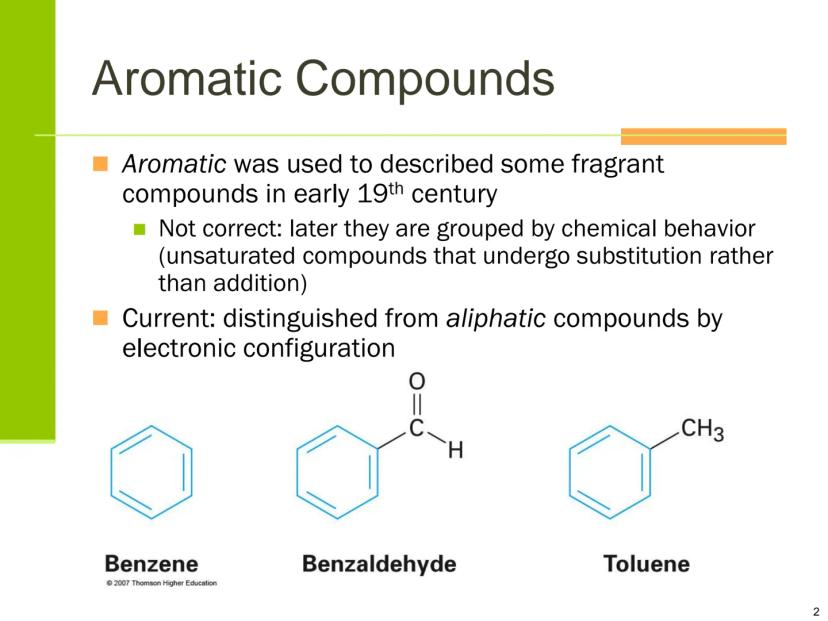
Aromatic compounds are special chemical structures with unique stability and reactivity. Initially, the term "aromatic" described fragrant compounds in the early 19th century, but this wasn't quite right.
The modern definition distinguishes aromatic compounds from aliphatic compounds based on their electronic configuration. These compounds typically undergo substitution reactions rather than addition reactions, which makes them behave differently than other unsaturated compounds.
Benzene is the most important aromatic compound and serves as the foundation for understanding aromaticity.
💡 Quick Fact: The unique behavior of aromatic compounds is what makes them so important to study—they don't react the way their structure might initially suggest!
2
of 10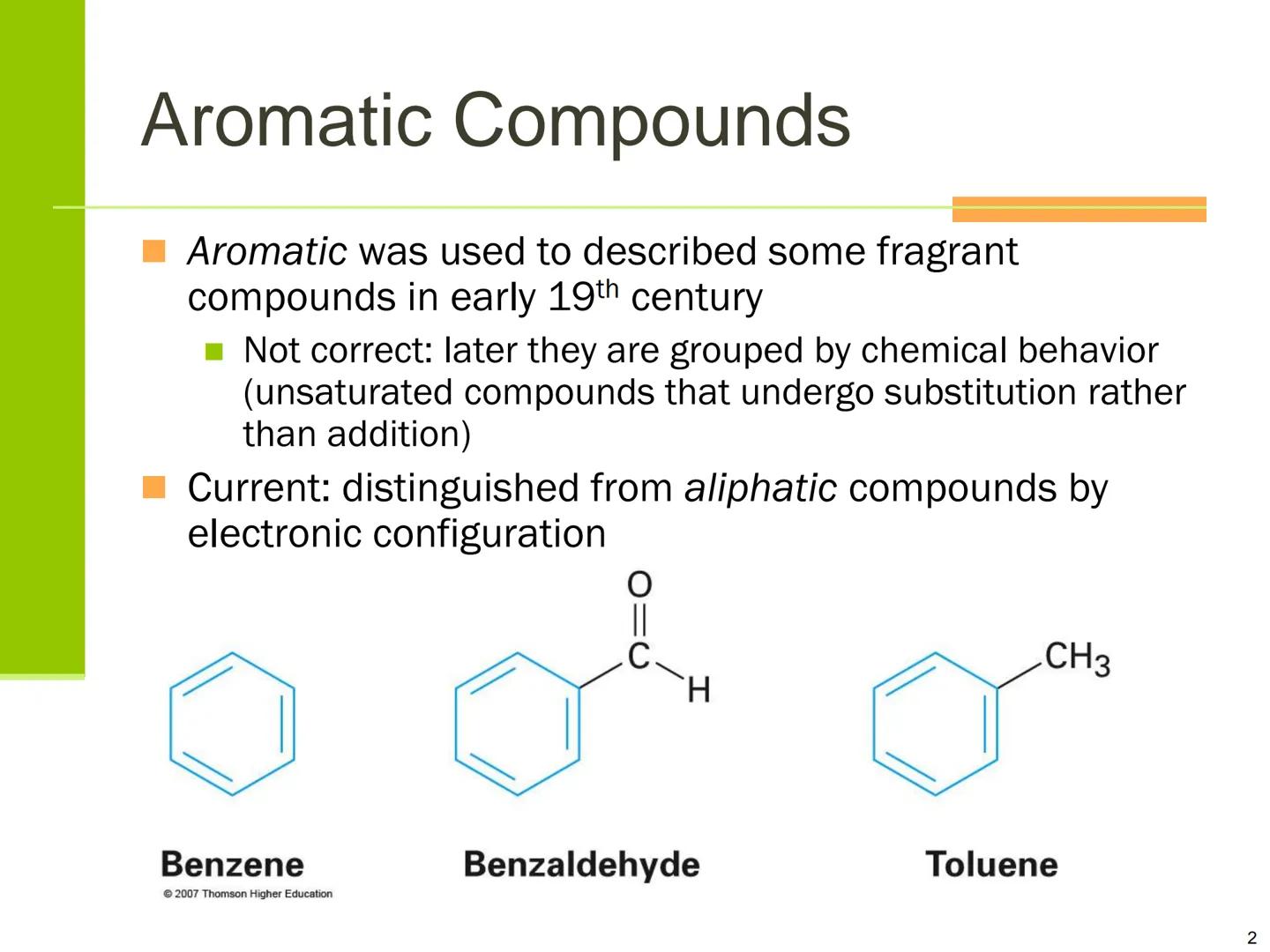
Why Study Aromatic Compounds?
The reactivity of substituted aromatic compounds directly connects to their unique structure. This makes them fascinating to study!
Aromatic compounds provide chemists with a sensitive way to explore the relationship between molecular structure and chemical reactivity. Understanding this relationship helps predict how different compounds will behave in reactions.
When you understand aromaticity, you'll have a powerful tool for predicting chemical behavior across many different compounds.
3
of 10
Sources and Names of Aromatic Hydrocarbons
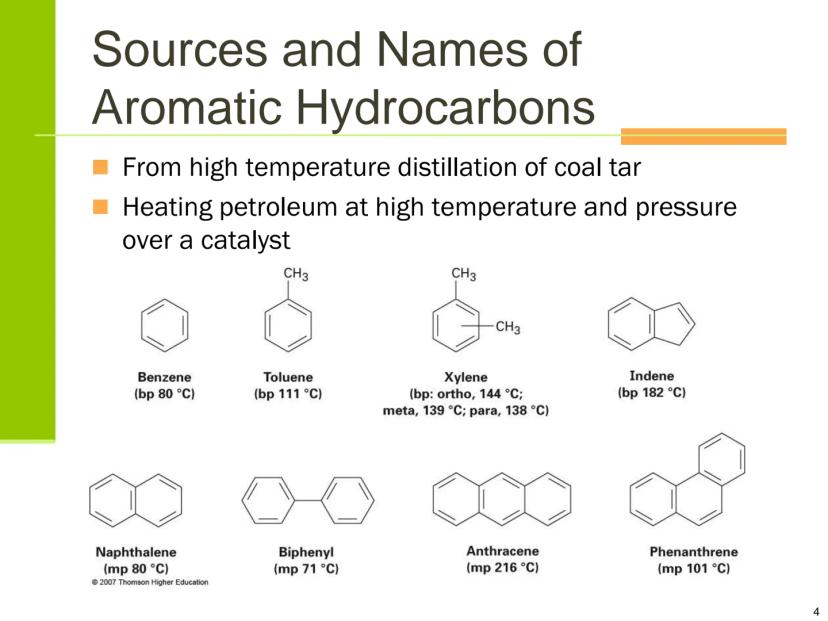
Aromatic compounds come from two main industrial sources: high-temperature distillation of coal tar and heating petroleum at high temperatures over catalysts. These processes give us important compounds like benzene, toluene, and xylene.
Aromatic hydrocarbons vary in complexity from simple benzene (C₆H₆) with a boiling point of 80°C to multi-ring structures like anthracene with a melting point of 216°C. Each compound has distinct physical properties that make it useful for different applications.
Some common aromatic compounds include naphthalene (used in mothballs), biphenyl, and phenanthrene. These compounds all share the special stability that comes from their aromatic structure.
💡 Remember: The physical properties (like boiling and melting points) of aromatic compounds help determine how they're used in industrial applications and everyday products.
4
of 10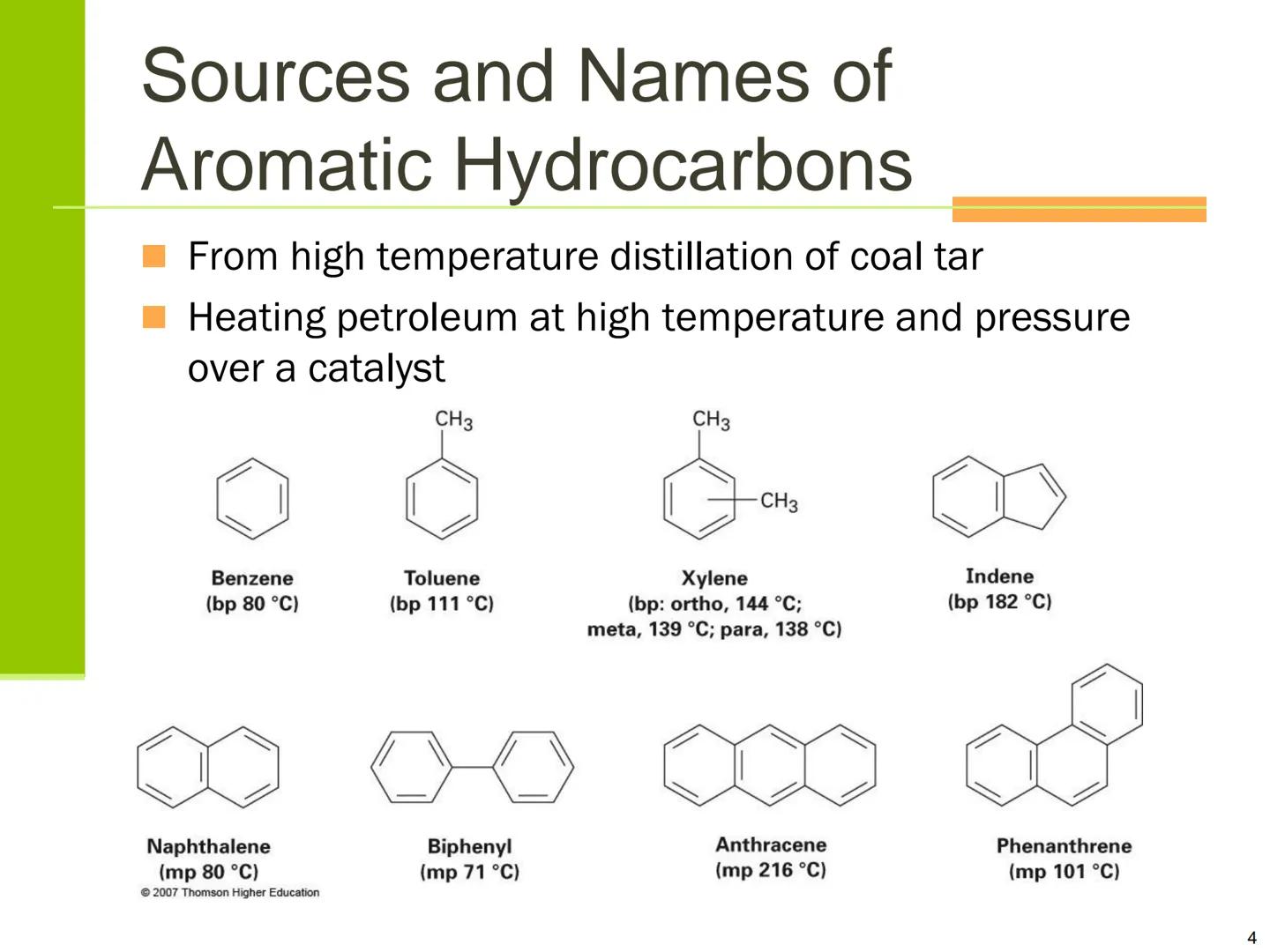
Naming Aromatic Compounds
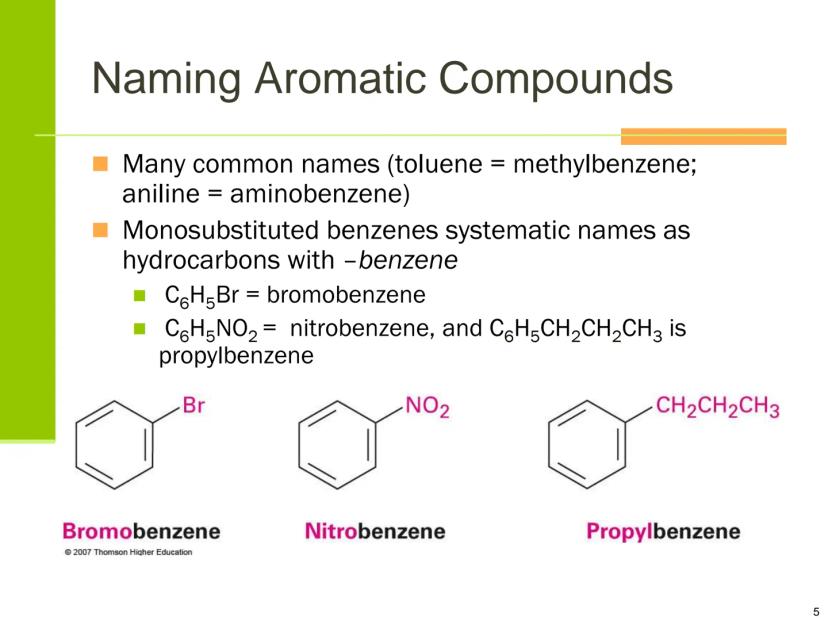
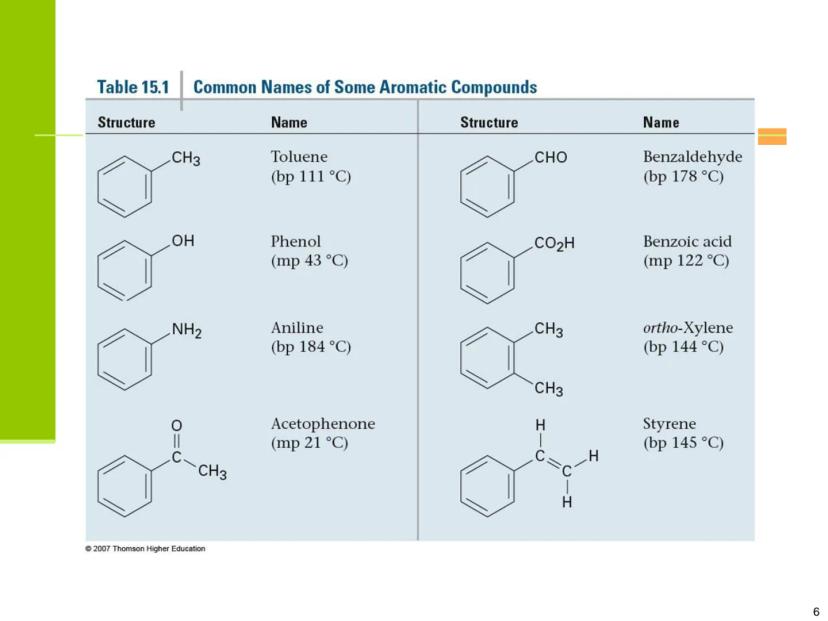
Many aromatic compounds have common names you'll need to memorize. For example, methylbenzene is usually called toluene, and aminobenzene is known as aniline.
For monosubstituted benzenes (benzene with one group attached), we use the substituent name followed by "benzene." Examples include bromobenzene (C₆H₅Br), nitrobenzene (C₆H₅NO₂), and propylbenzene (C₆H₅CH₂CH₂CH₃).
Other common aromatic compounds include phenol (with an OH group), acetophenone (with a COCH₃ group), benzaldehyde (with a CHO group), and benzoic acid (with a CO₂H group). Learning these common names will make organic chemistry much easier!
5
of 10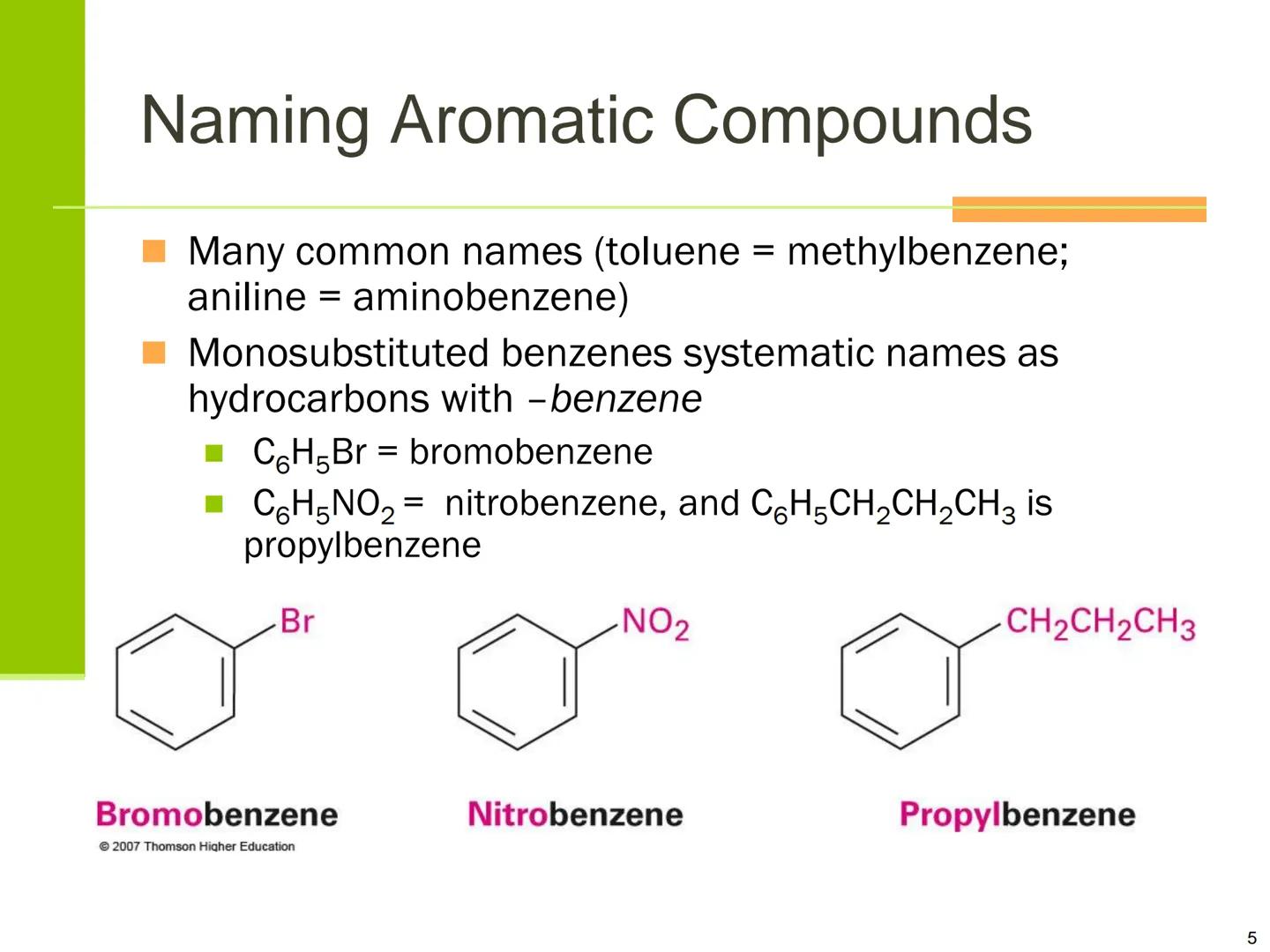
The Phenyl Group
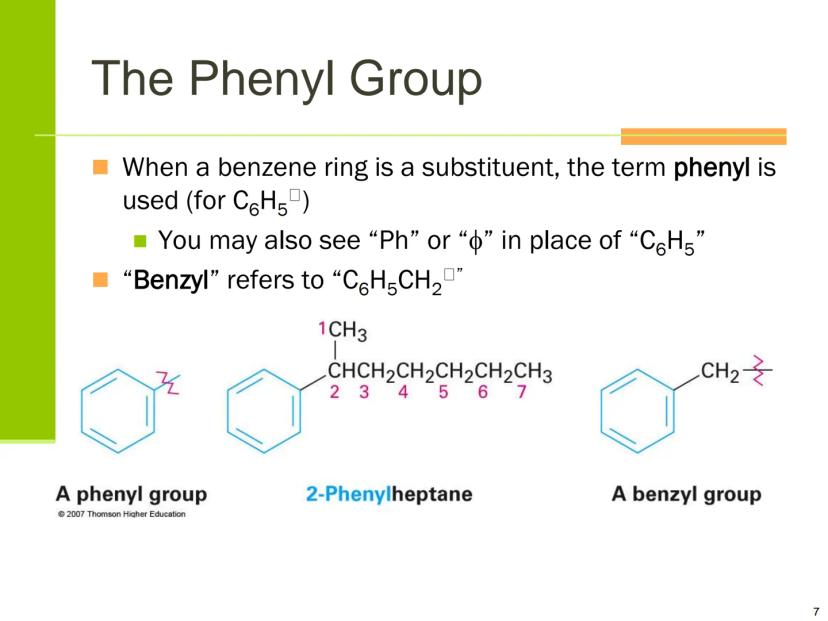
When a benzene ring acts as a substituent on another molecule, we call it a phenyl group (C₆H₅). This term appears frequently in organic chemistry naming.
In chemical shorthand, you might see "Ph" or "φ" used to represent the phenyl group. Similarly, "benzyl" refers to C₆H₅CH₂—a phenyl group with an attached methylene group.
The phenyl group appears in countless organic molecules, including pharmaceuticals, dyes, and polymers. Understanding how to identify and name phenyl-containing compounds is an essential skill in organic chemistry.
💡 Tip: When you see "phenyl" in a compound name, it means there's a benzene ring attached to the main structure as a substituent.
6
of 10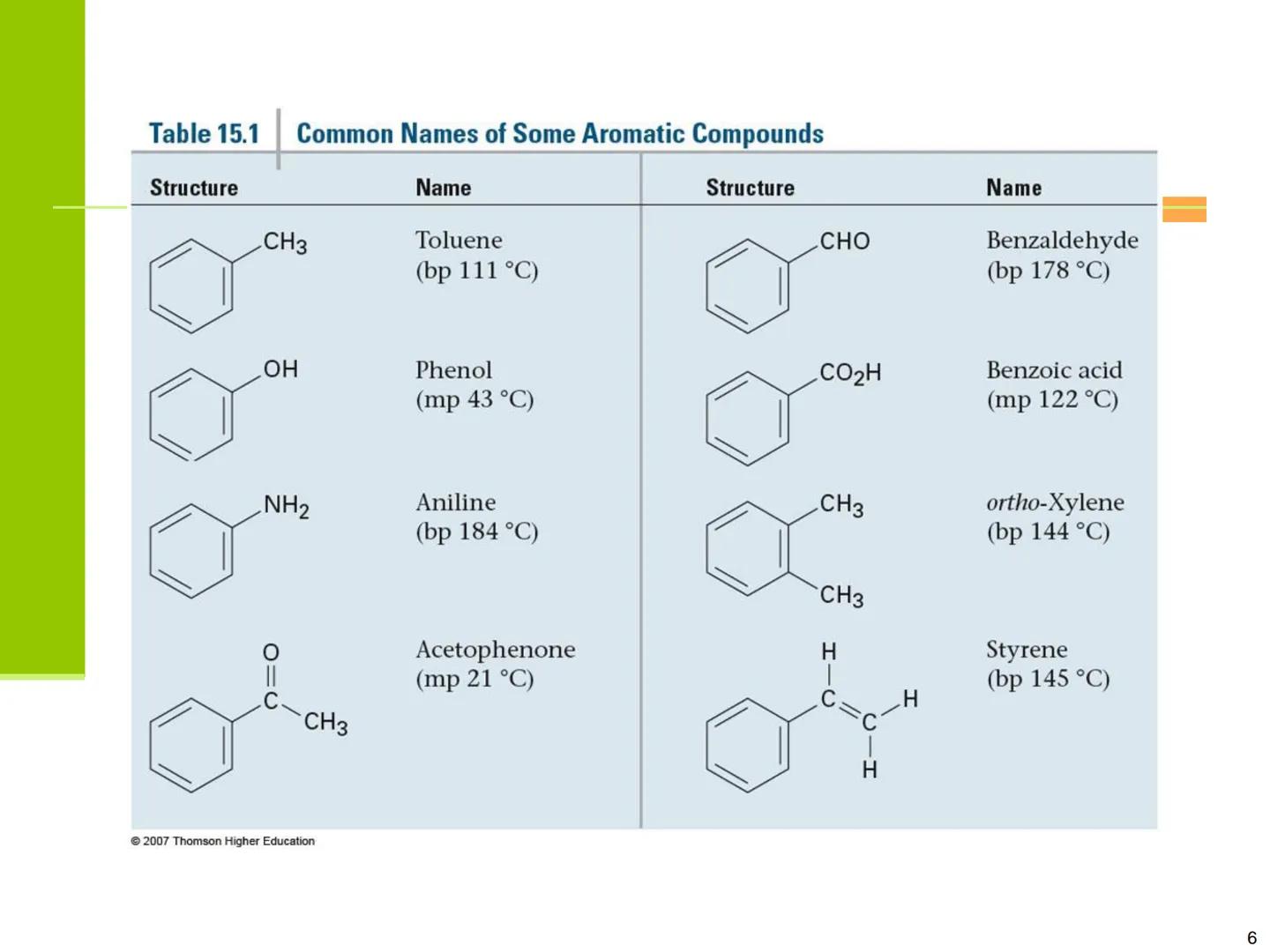
Disubstituted Benzenes
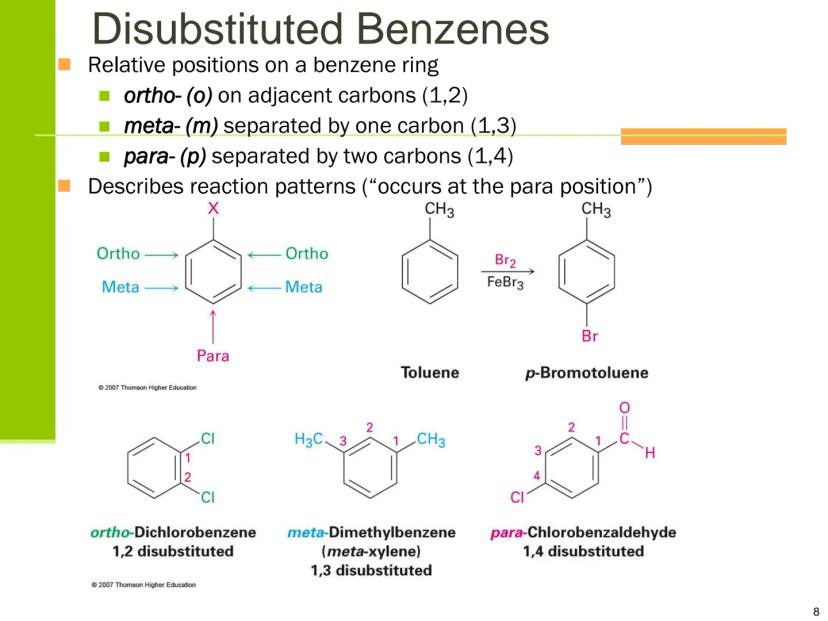
When benzene has two substituents, their positions relative to each other are super important! These positions are described using three terms:
Ortho : Substituents on adjacent carbons (positions 1,2) Meta : Substituents separated by one carbon (positions 1,3) Para : Substituents directly across from each other (positions 1,4)
These position terms don't just help with naming—they also help predict reaction patterns. For instance, some reactions occur preferentially at the para position.
Examples include ortho-dichlorobenzene , meta-xylene , and para-chlorobenzaldehyde . The position of substituents affects both physical properties and chemical reactivity.
7
of 10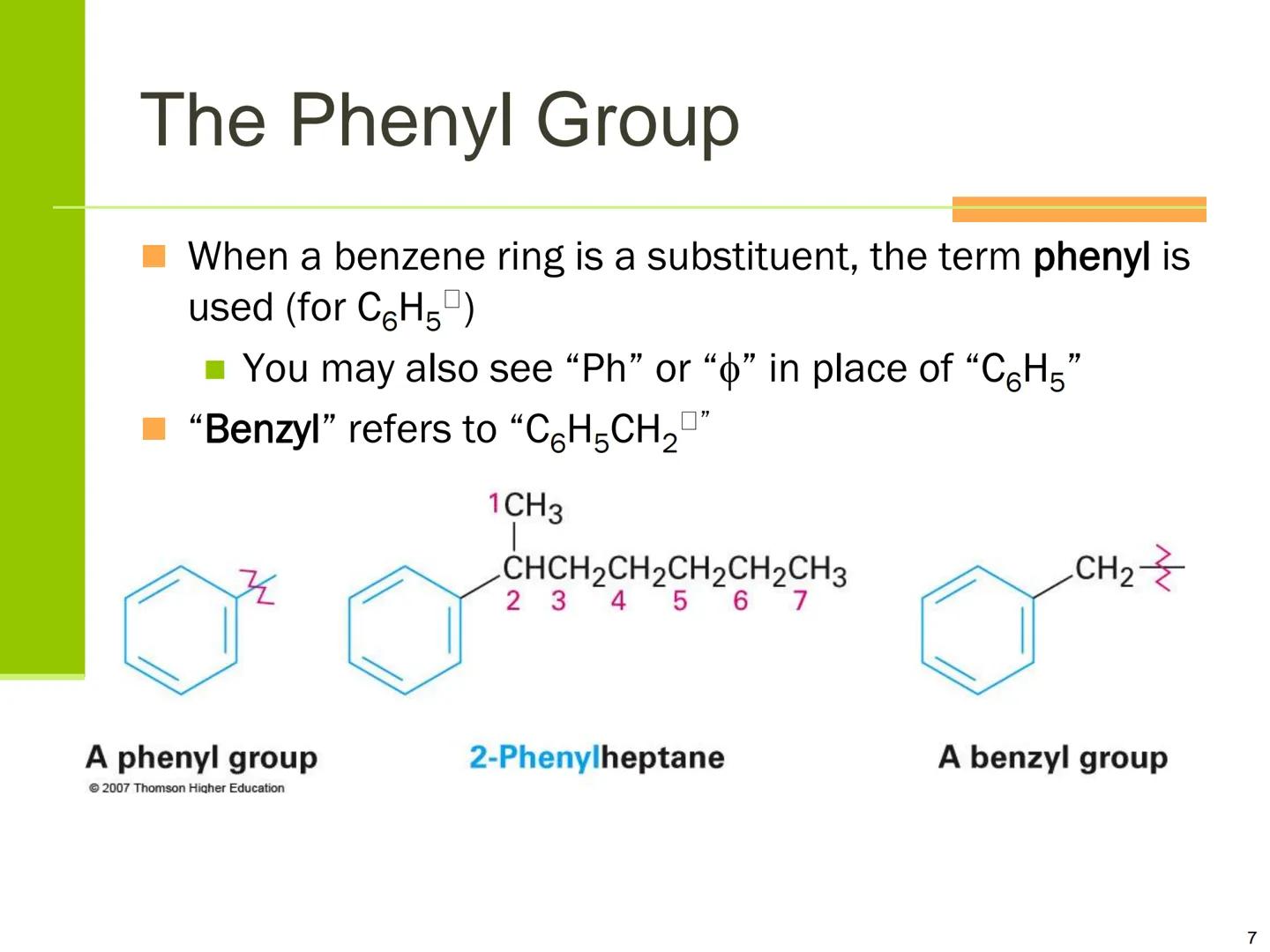
Naming Benzenes With More Than Two Substituents
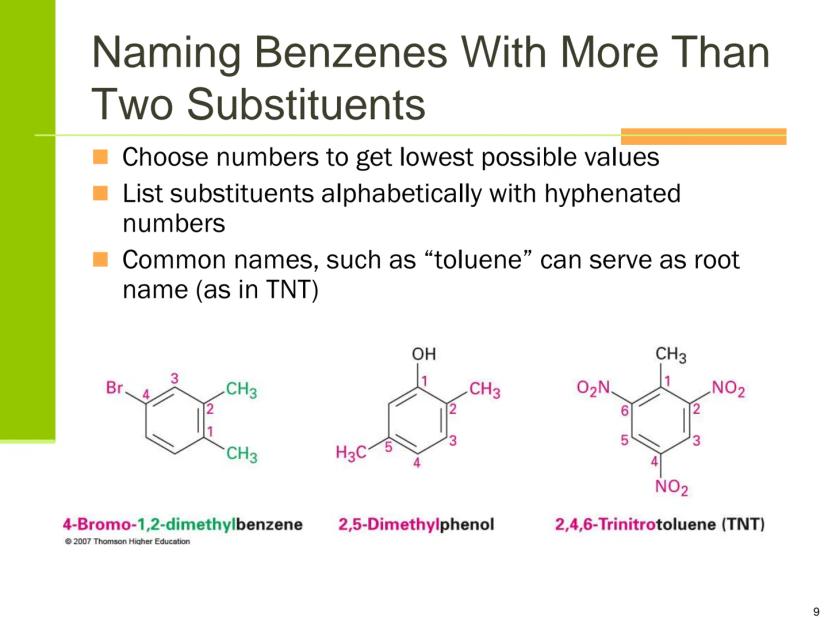
When naming benzenes with three or more substituents, we use numbers to specify positions. Always choose numbers that give the lowest possible values for the substituents.
List the substituents in alphabetical order, with each preceded by its position number. For example, 4-bromo-1,2-dimethylbenzene has a bromine at position 4 and methyl groups at positions 1 and 2.
Sometimes common names serve as root names. TNT is named using toluene as the base name, with three nitro groups attached at positions 2, 4, and 6.
💡 Strategy: When naming complex benzene compounds, first identify all substituents, number the carbons to get the lowest possible position numbers, then list the substituents alphabetically.
8
of 10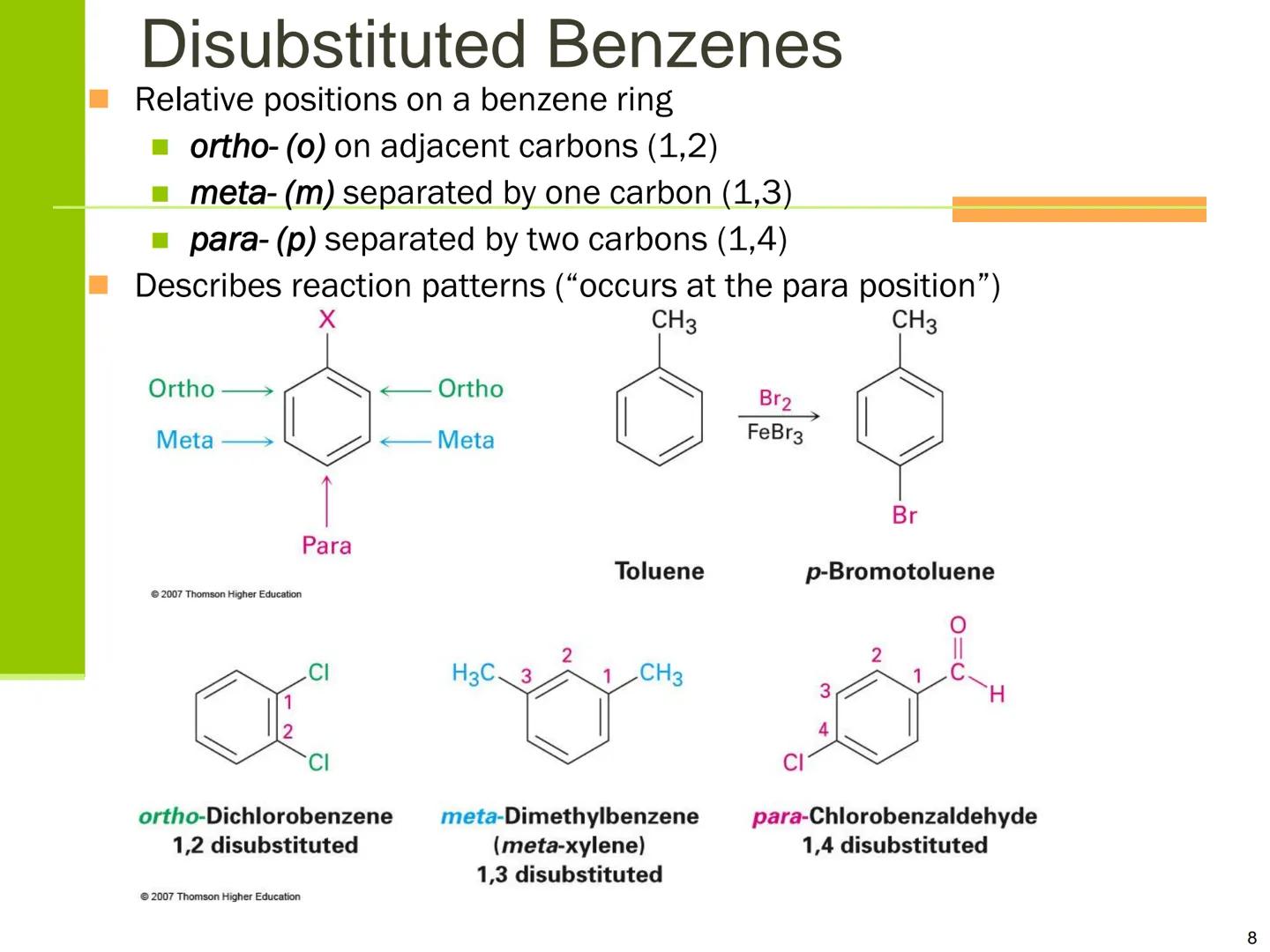
Structure and Stability of Benzene
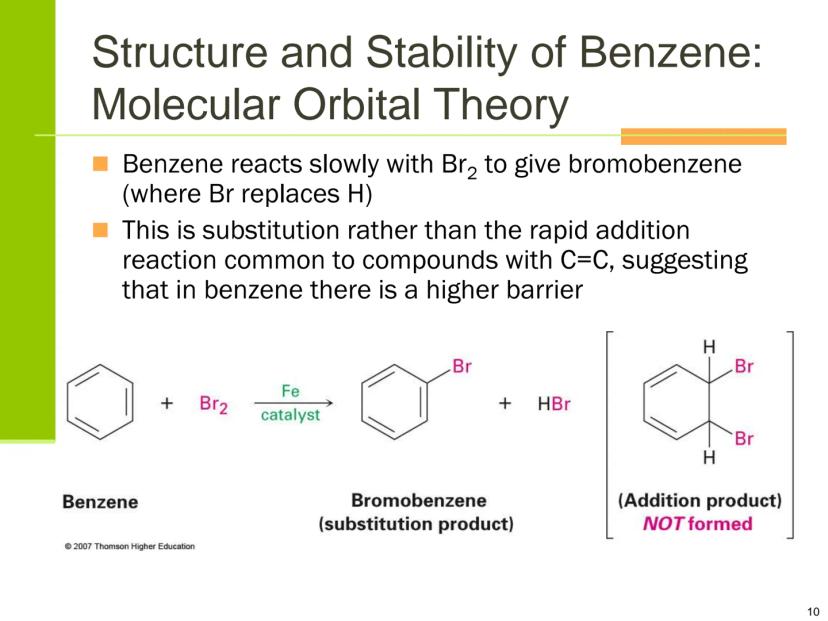
Benzene behaves differently than typical compounds with carbon-carbon double bonds. When benzene reacts with bromine (Br₂), it undergoes substitution to form bromobenzene rather than the addition reaction you'd expect with double bonds.
This unexpected reaction pattern happens because benzene has unusual stability. The barrier to disrupting benzene's structure is much higher than for regular double bonds, which is why it prefers substitution over addition reactions.
The stability of benzene can be measured through heats of hydrogenation. When hydrogen is added to a regular double bond, about 118 kJ/mol of energy is released. With three double bonds, you'd expect 356 kJ/mol, but benzene releases only 206 kJ/mol when fully hydrogenated. This difference represents benzene's extra stability!
9
of 10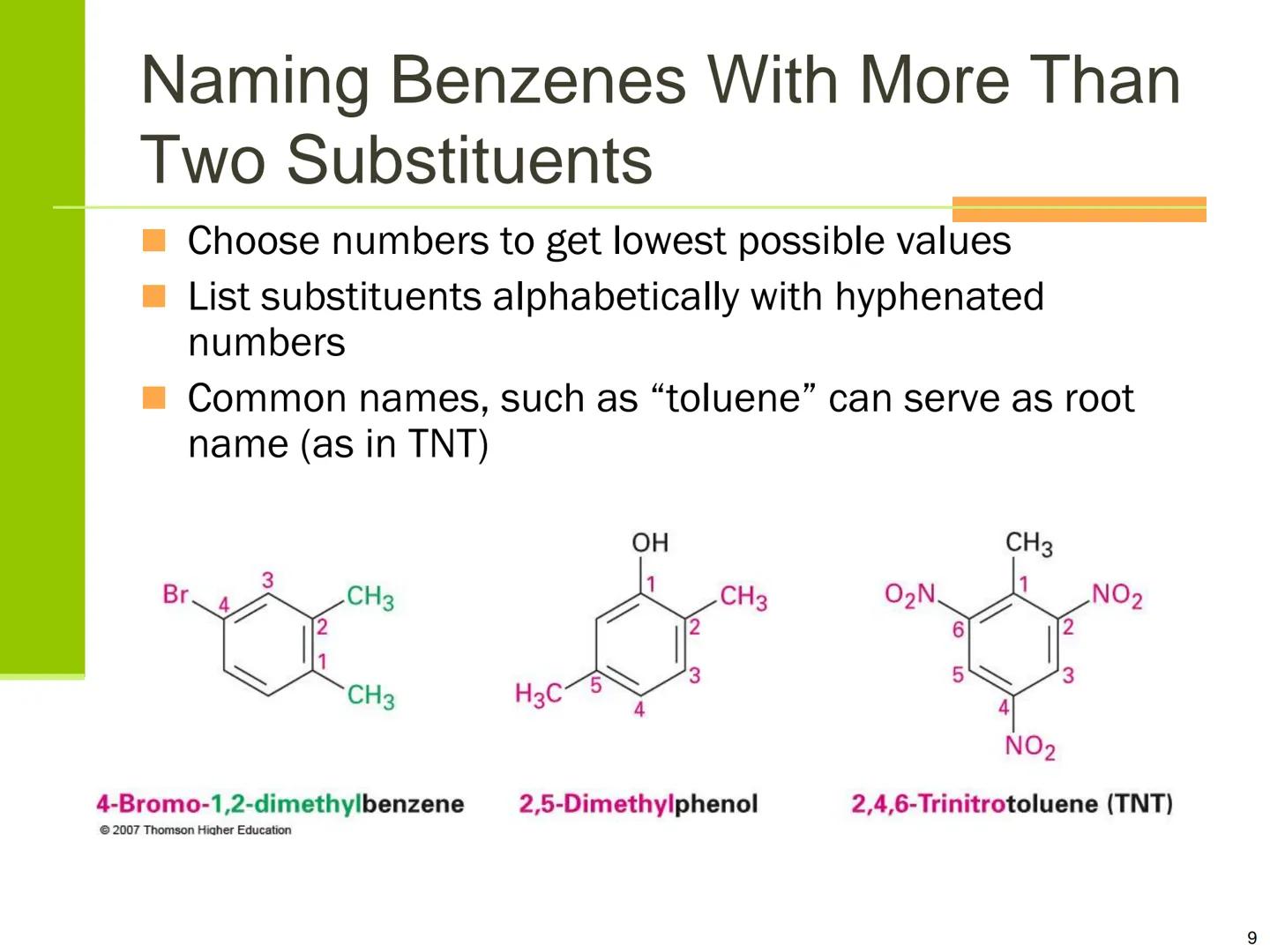
Benzene's Unusual Structure
Benzene's structure explains its unique stability. All six carbon-carbon bonds in benzene are identical, measuring 139 picometers—a length between typical single bonds (154 pm) and double bonds (134 pm).
The molecule forms a perfect planar hexagon with 120° bond angles. Each carbon atom is sp² hybridized with a p orbital perpendicular to the ring plane. These p orbitals overlap to create a continuous ring of electron density.
This arrangement means that each carbon-carbon connection has a "bond order" of 1.5—like having one and a half bonds between each carbon. This continuous ring of electrons is what gives benzene its exceptional stability.
💡 Visualization: Think of benzene's electrons like a donut of electron density floating above and below the flat ring of carbon atoms, rather than fixed double bonds between specific carbons.
10
of 10
Molecular Orbital Description of Benzene
Benzene's stability can be explained through molecular orbital theory. The six p orbitals from the carbon atoms combine to form six molecular orbitals—three bonding and three antibonding.
The six π electrons from the three "double bonds" all occupy the three bonding molecular orbitals. This arrangement is very stable because all bonding orbitals are filled, and no electrons occupy antibonding orbitals.
Orbitals with the same energy are called "degenerate." This equal energy distribution across the ring is why all carbon-carbon bonds in benzene are identical, rather than alternating between single and double bonds.
We thought you’d never ask...
What is the Knowunity AI companion?
Our AI companion is specifically built for the needs of students. Based on the millions of content pieces we have on the platform we can provide truly meaningful and relevant answers to students. But its not only about answers, the companion is even more about guiding students through their daily learning challenges, with personalised study plans, quizzes or content pieces in the chat and 100% personalisation based on the students skills and developments.
Where can I download the Knowunity app?
You can download the app in the Google Play Store and in the Apple App Store.
Is Knowunity really free of charge?
That's right! Enjoy free access to study content, connect with fellow students, and get instant help – all at your fingertips.
Similar Content
Most popular content: Organic Chemistry
2Most popular content in Chemistry
9ChemistryMass-to-Mass Stoichiometry: Calculating Grams to Grams
Learn how to perform mass-to-mass stoichiometric calculations. This guide covers the steps to convert grams of a reactant or product to grams of another substance using mole ratios and molar mass.
9th1993
I
ChemistryIntro to Chem - Test Review
Identifying elements, compounds, heterogeneous/homogeneous mixtures and chemical/physical change test review.
11th1973
ChemistryUnderstanding Atomic and Mass Numbers (Z and A)
Learn the definitions of atomic number (Z) and mass number (A). Understand how these numbers relate to protons, neutrons, and isotopes in an atom's nucleus.
9th522
ChemistryMolecular Geometry
Chemistry notes
10th1410
ChemistryPOGIL Stoichiometry
mole to mole, mole to mass, mass to mass, and volume conversions
10th4682
ChemistryThermochemistry Notes 🥵🔥
Unit 10 of Chemistry Honors (Inorganic)
10th87352
ChemistryChemistry: Atoms, Molecules, Ions
This is about atoms, molecules and ions.
9th1348
ChemistryAcids and Bases
This tackles the general properties of acids and bases, their examples and pH concept.
2611
ChemistryIsomerism
Structural and sterioisomers (geometric and optical)
11th821
Most popular content
9O
 AP US History
Origins and Dynamics of the Columbian Exchange
Analyze the ecological and economic motivations behind the initial transfer of goods, people, and diseases between the Old and New Worlds.
9th3,1280
I
AP US HistoryIntroduction to Early Cultural Interactions
Analyze the initial social and religious encounters between Europeans, Africans, and Indigenous peoples in the colonial Americas.
9th2,7730
O
 AP World History
Origins of Ancient River Civilizations
Analyze the environmental factors and technological innovations that led to the rise of early states in Mesopotamia, Egypt, and the Indus Valley.
9th3,1870
M
AP US HistoryMotivations for European Exploration
Analyze the economic, religious, and political factors that drove European powers to the Americas during the 15th and 16th centuries.
9th1,7780
F
 AP Psychology
Foundations of Ethical Guidelines in Research
Practice the core principles of the APA ethical code including informed consent, debriefing, and the role of Institutional Review Boards.
9th1,3360
I
AP US HistoryIntroduction to Native American Societies
Examine the diverse social, political, and economic structures of North American indigenous groups prior to European contact.
9th1,1100
I
 AP Biology
Introduction to Biological Elements of Life
Practice identifying the essential elements including carbon, nitrogen, phosphorus, and sulfur that compose biological macromolecules.
9th1,7390
I
AP US HistoryIntroduction to the Spanish Encomienda System
Explore the fundamental economic and social structures of the Spanish colonial system, focusing on the encomienda and the casta social hierarchy.
9th8890
O
AP World HistoryOrigins and Continuity of the Byzantine Empire
Analyze the political and cultural transitions from the Roman Empire to the Byzantine Empire, focusing on the reign of Justinian I and his code.
9th1,6320
Can't find what you're looking for? Explore other subjects.
Students love us — and so will you.
4.6/5App Store
4.7/5Google Play
The app is very easy to use and well designed. I have found everything I was looking for so far and have been able to learn a lot from the presentations! I will definitely use the app for a class assignment! And of course it also helps a lot as an inspiration.
Stefan SiOS user
This app is really great. There are so many study notes and help [...]. My problem subject is French, for example, and the app has so many options for help. Thanks to this app, I have improved my French. I would recommend it to anyone.
Samantha KlichAndroid user
Wow, I am really amazed. I just tried the app because I've seen it advertised many times and was absolutely stunned. This app is THE HELP you want for school and above all, it offers so many things, such as workouts and fact sheets, which have been VERY helpful to me personally.
AnnaiOS user
Chemistry55 views·Updated Jun 5, 2026·24 pagesUnderstanding Benzene and Aromatic Compounds
Benjamin Arguelles@benjaminarguelles_ysur
Benzene and aromaticity are foundational concepts in organic chemistry that explain why certain compounds behave differently than expected. Understanding aromatic compounds helps you make sense of their unique stability and reaction patterns, which will be crucial for predicting chemical behavior...
1
of 10
Sign up to see the content. It's free!
- Access to all documents
- Improve your grades
- Join milions of students
Benzene and Aromaticity
Aromatic compounds are special chemical structures with unique stability and reactivity. Initially, the term "aromatic" described fragrant compounds in the early 19th century, but this wasn't quite right.
The modern definition distinguishes aromatic compounds from aliphatic compounds based on their electronic configuration. These compounds typically undergo substitution reactions rather than addition reactions, which makes them behave differently than other unsaturated compounds.
Benzene is the most important aromatic compound and serves as the foundation for understanding aromaticity.
💡 Quick Fact: The unique behavior of aromatic compounds is what makes them so important to study—they don't react the way their structure might initially suggest!
2
of 10Sign up to see the content. It's free!
- Access to all documents
- Improve your grades
- Join milions of students
Why Study Aromatic Compounds?
The reactivity of substituted aromatic compounds directly connects to their unique structure. This makes them fascinating to study!
Aromatic compounds provide chemists with a sensitive way to explore the relationship between molecular structure and chemical reactivity. Understanding this relationship helps predict how different compounds will behave in reactions.
When you understand aromaticity, you'll have a powerful tool for predicting chemical behavior across many different compounds.
3
of 10Sign up to see the content. It's free!
- Access to all documents
- Improve your grades
- Join milions of students
Sources and Names of Aromatic Hydrocarbons
Aromatic compounds come from two main industrial sources: high-temperature distillation of coal tar and heating petroleum at high temperatures over catalysts. These processes give us important compounds like benzene, toluene, and xylene.
Aromatic hydrocarbons vary in complexity from simple benzene (C₆H₆) with a boiling point of 80°C to multi-ring structures like anthracene with a melting point of 216°C. Each compound has distinct physical properties that make it useful for different applications.
Some common aromatic compounds include naphthalene (used in mothballs), biphenyl, and phenanthrene. These compounds all share the special stability that comes from their aromatic structure.
💡 Remember: The physical properties (like boiling and melting points) of aromatic compounds help determine how they're used in industrial applications and everyday products.
4
of 10Sign up to see the content. It's free!
- Access to all documents
- Improve your grades
- Join milions of students
Naming Aromatic Compounds
Many aromatic compounds have common names you'll need to memorize. For example, methylbenzene is usually called toluene, and aminobenzene is known as aniline.
For monosubstituted benzenes (benzene with one group attached), we use the substituent name followed by "benzene." Examples include bromobenzene (C₆H₅Br), nitrobenzene (C₆H₅NO₂), and propylbenzene (C₆H₅CH₂CH₂CH₃).
Other common aromatic compounds include phenol (with an OH group), acetophenone (with a COCH₃ group), benzaldehyde (with a CHO group), and benzoic acid (with a CO₂H group). Learning these common names will make organic chemistry much easier!
5
of 10Sign up to see the content. It's free!
- Access to all documents
- Improve your grades
- Join milions of students
The Phenyl Group
When a benzene ring acts as a substituent on another molecule, we call it a phenyl group (C₆H₅). This term appears frequently in organic chemistry naming.
In chemical shorthand, you might see "Ph" or "φ" used to represent the phenyl group. Similarly, "benzyl" refers to C₆H₅CH₂—a phenyl group with an attached methylene group.
The phenyl group appears in countless organic molecules, including pharmaceuticals, dyes, and polymers. Understanding how to identify and name phenyl-containing compounds is an essential skill in organic chemistry.
💡 Tip: When you see "phenyl" in a compound name, it means there's a benzene ring attached to the main structure as a substituent.
6
of 10Sign up to see the content. It's free!
- Access to all documents
- Improve your grades
- Join milions of students
Disubstituted Benzenes
When benzene has two substituents, their positions relative to each other are super important! These positions are described using three terms:
Ortho : Substituents on adjacent carbons (positions 1,2) Meta : Substituents separated by one carbon (positions 1,3) Para : Substituents directly across from each other (positions 1,4)
These position terms don't just help with naming—they also help predict reaction patterns. For instance, some reactions occur preferentially at the para position.
Examples include ortho-dichlorobenzene , meta-xylene , and para-chlorobenzaldehyde . The position of substituents affects both physical properties and chemical reactivity.
7
of 10Sign up to see the content. It's free!
- Access to all documents
- Improve your grades
- Join milions of students
Naming Benzenes With More Than Two Substituents
When naming benzenes with three or more substituents, we use numbers to specify positions. Always choose numbers that give the lowest possible values for the substituents.
List the substituents in alphabetical order, with each preceded by its position number. For example, 4-bromo-1,2-dimethylbenzene has a bromine at position 4 and methyl groups at positions 1 and 2.
Sometimes common names serve as root names. TNT is named using toluene as the base name, with three nitro groups attached at positions 2, 4, and 6.
💡 Strategy: When naming complex benzene compounds, first identify all substituents, number the carbons to get the lowest possible position numbers, then list the substituents alphabetically.
8
of 10Sign up to see the content. It's free!
- Access to all documents
- Improve your grades
- Join milions of students
Structure and Stability of Benzene
Benzene behaves differently than typical compounds with carbon-carbon double bonds. When benzene reacts with bromine (Br₂), it undergoes substitution to form bromobenzene rather than the addition reaction you'd expect with double bonds.
This unexpected reaction pattern happens because benzene has unusual stability. The barrier to disrupting benzene's structure is much higher than for regular double bonds, which is why it prefers substitution over addition reactions.
The stability of benzene can be measured through heats of hydrogenation. When hydrogen is added to a regular double bond, about 118 kJ/mol of energy is released. With three double bonds, you'd expect 356 kJ/mol, but benzene releases only 206 kJ/mol when fully hydrogenated. This difference represents benzene's extra stability!
9
of 10Sign up to see the content. It's free!
- Access to all documents
- Improve your grades
- Join milions of students
Benzene's Unusual Structure
Benzene's structure explains its unique stability. All six carbon-carbon bonds in benzene are identical, measuring 139 picometers—a length between typical single bonds (154 pm) and double bonds (134 pm).
The molecule forms a perfect planar hexagon with 120° bond angles. Each carbon atom is sp² hybridized with a p orbital perpendicular to the ring plane. These p orbitals overlap to create a continuous ring of electron density.
This arrangement means that each carbon-carbon connection has a "bond order" of 1.5—like having one and a half bonds between each carbon. This continuous ring of electrons is what gives benzene its exceptional stability.
💡 Visualization: Think of benzene's electrons like a donut of electron density floating above and below the flat ring of carbon atoms, rather than fixed double bonds between specific carbons.
10
of 10Sign up to see the content. It's free!
- Access to all documents
- Improve your grades
- Join milions of students
Molecular Orbital Description of Benzene
Benzene's stability can be explained through molecular orbital theory. The six p orbitals from the carbon atoms combine to form six molecular orbitals—three bonding and three antibonding.
The six π electrons from the three "double bonds" all occupy the three bonding molecular orbitals. This arrangement is very stable because all bonding orbitals are filled, and no electrons occupy antibonding orbitals.
Orbitals with the same energy are called "degenerate." This equal energy distribution across the ring is why all carbon-carbon bonds in benzene are identical, rather than alternating between single and double bonds.
We thought you’d never ask...
What is the Knowunity AI companion?
Our AI companion is specifically built for the needs of students. Based on the millions of content pieces we have on the platform we can provide truly meaningful and relevant answers to students. But its not only about answers, the companion is even more about guiding students through their daily learning challenges, with personalised study plans, quizzes or content pieces in the chat and 100% personalisation based on the students skills and developments.
Where can I download the Knowunity app?
You can download the app in the Google Play Store and in the Apple App Store.
Is Knowunity really free of charge?
That's right! Enjoy free access to study content, connect with fellow students, and get instant help – all at your fingertips.
Similar Content
Most popular content: Organic Chemistry
2Most popular content in Chemistry
9ChemistryMass-to-Mass Stoichiometry: Calculating Grams to Grams
Learn how to perform mass-to-mass stoichiometric calculations. This guide covers the steps to convert grams of a reactant or product to grams of another substance using mole ratios and molar mass.
9th1993
I
ChemistryIntro to Chem - Test Review
Identifying elements, compounds, heterogeneous/homogeneous mixtures and chemical/physical change test review.
11th1973
ChemistryUnderstanding Atomic and Mass Numbers (Z and A)
Learn the definitions of atomic number (Z) and mass number (A). Understand how these numbers relate to protons, neutrons, and isotopes in an atom's nucleus.
9th522
ChemistryMolecular Geometry
Chemistry notes
10th1410
ChemistryPOGIL Stoichiometry
mole to mole, mole to mass, mass to mass, and volume conversions
10th4682
ChemistryThermochemistry Notes 🥵🔥
Unit 10 of Chemistry Honors (Inorganic)
10th87352
ChemistryChemistry: Atoms, Molecules, Ions
This is about atoms, molecules and ions.
9th1348
ChemistryAcids and Bases
This tackles the general properties of acids and bases, their examples and pH concept.
2611
ChemistryIsomerism
Structural and sterioisomers (geometric and optical)
11th821
Most popular content
9O
AP US HistoryOrigins and Dynamics of the Columbian Exchange
Analyze the ecological and economic motivations behind the initial transfer of goods, people, and diseases between the Old and New Worlds.
9th3,1280
I
AP US HistoryIntroduction to Early Cultural Interactions
Analyze the initial social and religious encounters between Europeans, Africans, and Indigenous peoples in the colonial Americas.
9th2,7730
O
AP World HistoryOrigins of Ancient River Civilizations
Analyze the environmental factors and technological innovations that led to the rise of early states in Mesopotamia, Egypt, and the Indus Valley.
9th3,1870
M
AP US HistoryMotivations for European Exploration
Analyze the economic, religious, and political factors that drove European powers to the Americas during the 15th and 16th centuries.
9th1,7780
F
AP PsychologyFoundations of Ethical Guidelines in Research
Practice the core principles of the APA ethical code including informed consent, debriefing, and the role of Institutional Review Boards.
9th1,3360
I
AP US HistoryIntroduction to Native American Societies
Examine the diverse social, political, and economic structures of North American indigenous groups prior to European contact.
9th1,1100
I
AP BiologyIntroduction to Biological Elements of Life
Practice identifying the essential elements including carbon, nitrogen, phosphorus, and sulfur that compose biological macromolecules.
9th1,7390
I
AP US HistoryIntroduction to the Spanish Encomienda System
Explore the fundamental economic and social structures of the Spanish colonial system, focusing on the encomienda and the casta social hierarchy.
9th8890
O
AP World HistoryOrigins and Continuity of the Byzantine Empire
Analyze the political and cultural transitions from the Roman Empire to the Byzantine Empire, focusing on the reign of Justinian I and his code.
9th1,6320
Can't find what you're looking for? Explore other subjects.
Students love us — and so will you.
4.6/5App Store
4.7/5Google Play
The app is very easy to use and well designed. I have found everything I was looking for so far and have been able to learn a lot from the presentations! I will definitely use the app for a class assignment! And of course it also helps a lot as an inspiration.
Stefan SiOS user
This app is really great. There are so many study notes and help [...]. My problem subject is French, for example, and the app has so many options for help. Thanks to this app, I have improved my French. I would recommend it to anyone.
Samantha KlichAndroid user
Wow, I am really amazed. I just tried the app because I've seen it advertised many times and was absolutely stunned. This app is THE HELP you want for school and above all, it offers so many things, such as workouts and fact sheets, which have been VERY helpful to me personally.
AnnaiOS user