
Ready to dive into some seriously cool chemistry? These pages...
 Chemistry324 views·Updated Jun 27, 2026·7 pages
Advanced Higher Chemistry Unit 1 - Summary Mind Maps
M
megan@meganreid_imme


1 / 7
1
of 7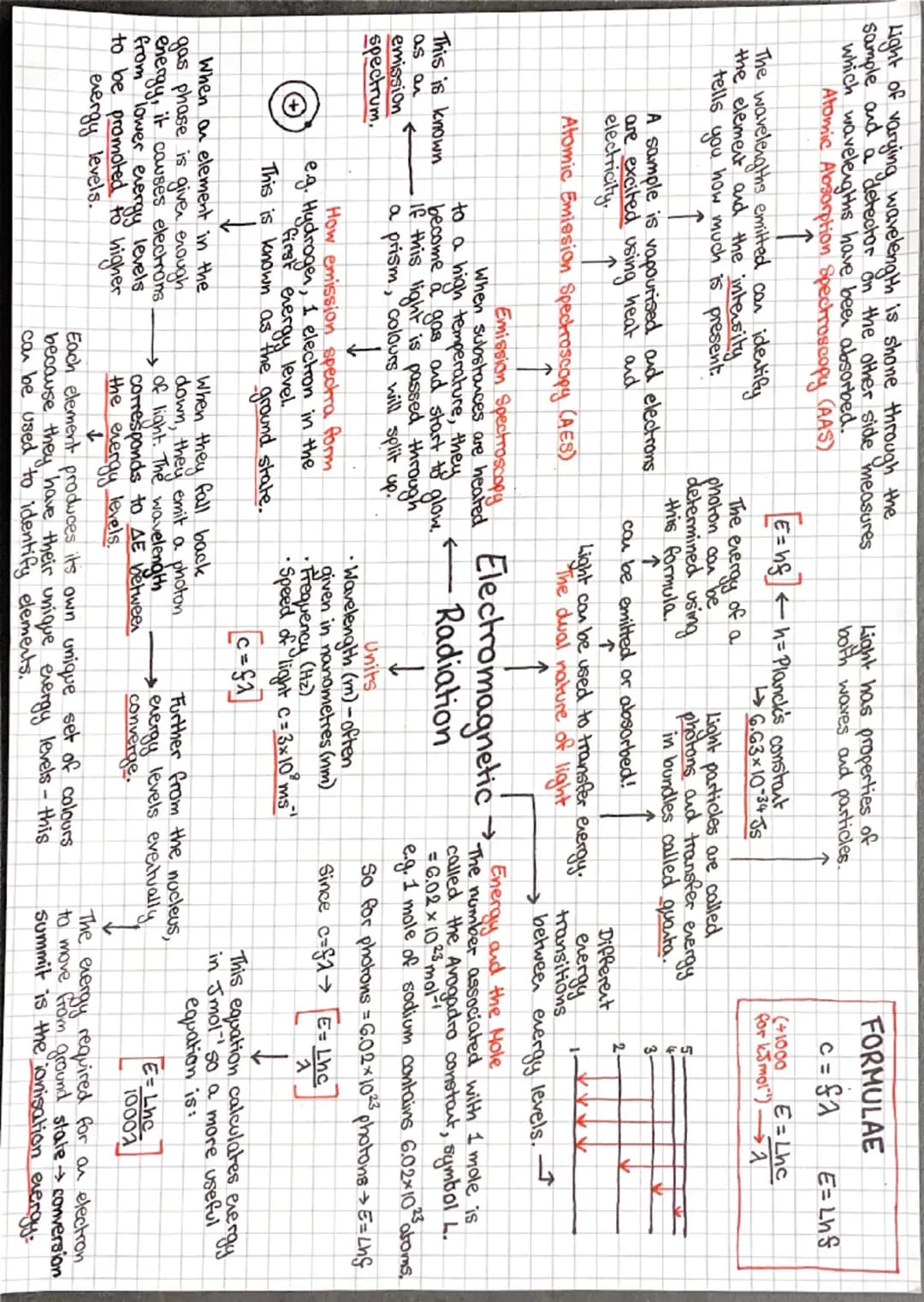
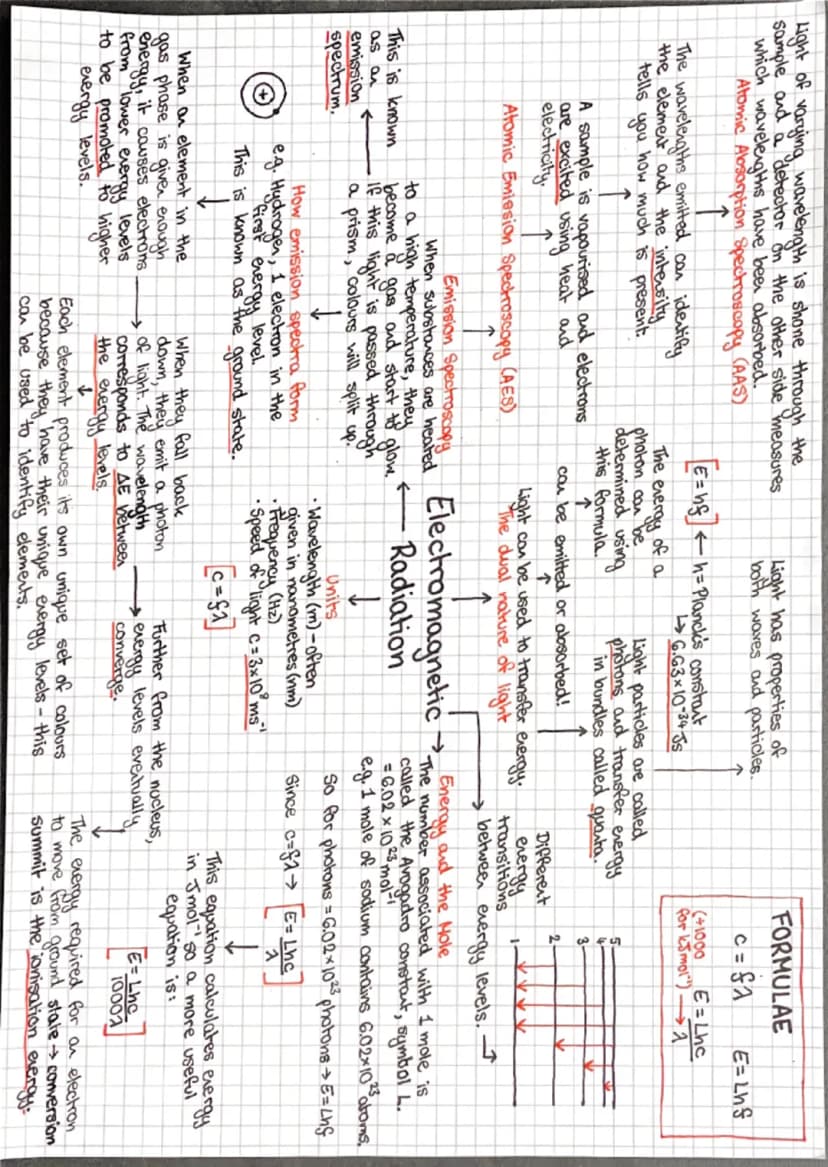
Light and Atomic Spectroscopy
Ever wondered how scientists figure out what stars are made of? It's all about light and energy levels in atoms! When you heat up elements, their electrons get excited and jump to higher energy levels - like students moving up to harder classes.
When these excited electrons fall back down, they release photons of specific colours. Each element has its own unique fingerprint of colours, which is brilliant for identification. Hydrogen produces different colours than sodium, for example.
There are two main techniques you need to know: Atomic Emission Spectroscopy (AES) measures the light given off when electrons fall down energy levels, while Atomic Absorption Spectroscopy (AAS) measures which wavelengths get absorbed. The intensity tells you how much of an element is present - dead useful for analysis!
The key equation connecting energy and light is E = hf, where h is Planck's constant (6.63×10⁻³⁴ J·s). Light behaves as both waves and particles (called photons), which might sound mental but it's absolutely fundamental to understanding atomic behaviour.
💡 Quick Tip: Remember that the further electrons are from the nucleus, the less energy difference between levels - this affects which colours you'll see!
2
of 7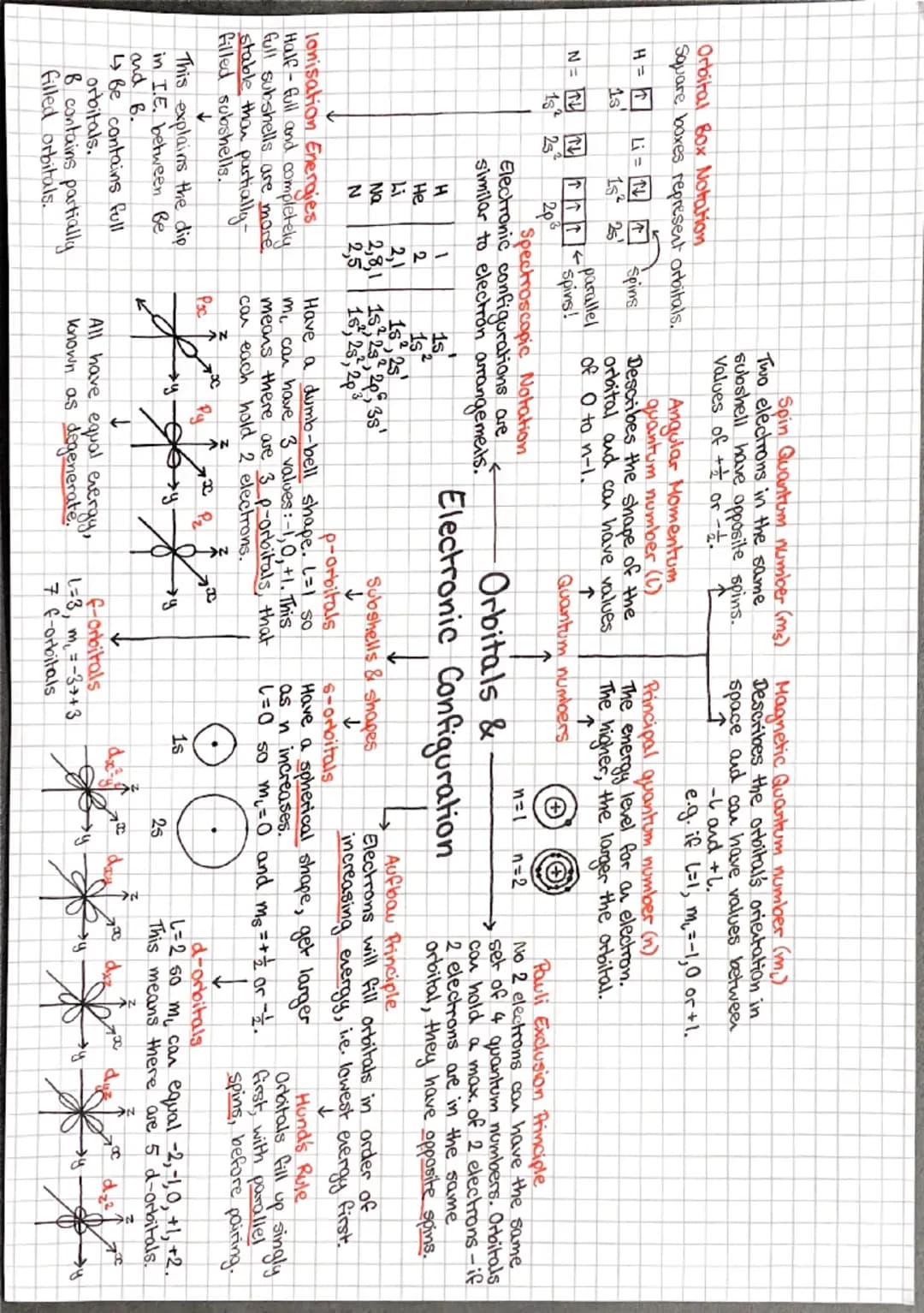
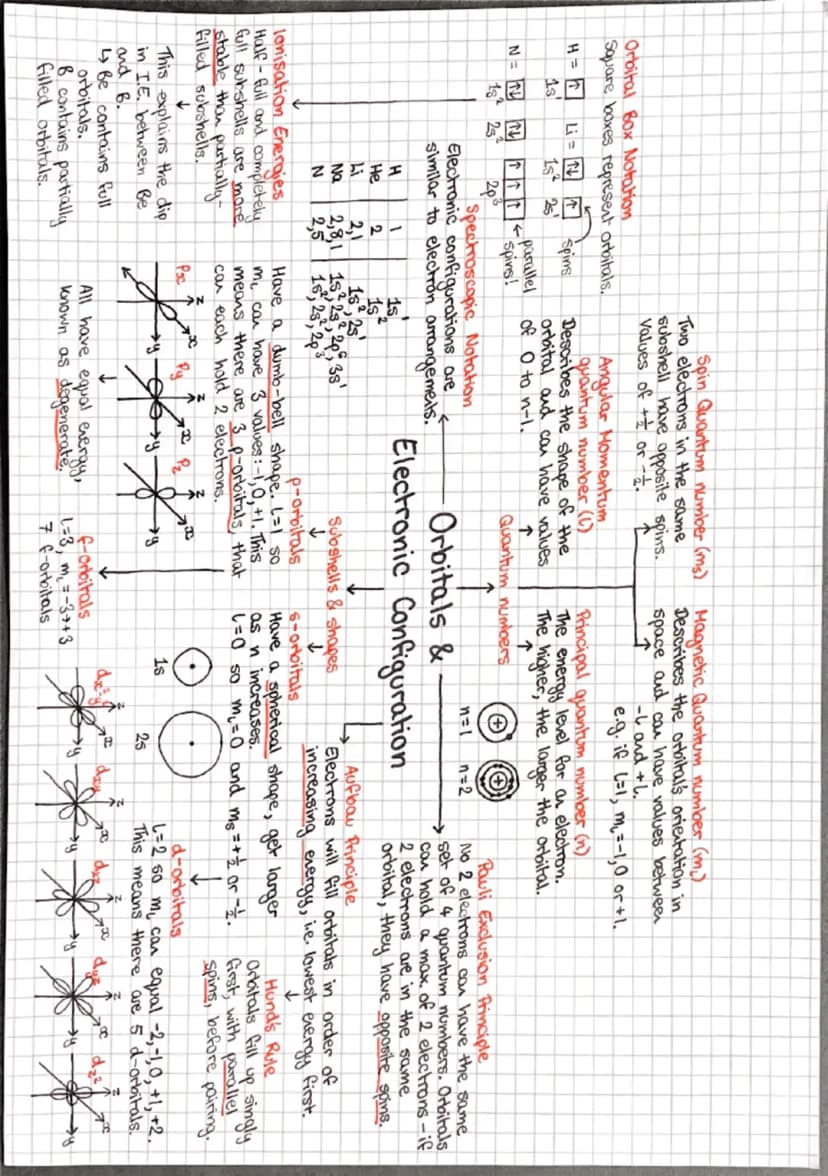
Electronic Structure and Quantum Numbers
Your electron arrangements from earlier years were just the beginning - now we're getting into the proper detail with quantum numbers and orbital shapes! Think of orbitals as the specific "rooms" where electrons live around an atom.
S-orbitals are spherical (like footballs), p-orbitals are dumbbell-shaped, and d-orbitals have more complex shapes. Each type can hold different numbers of electrons: s holds 2, p holds 6, and d holds 10. The principal quantum number (n) tells you the energy level.
Three crucial rules govern how electrons fill orbitals: Aufbau principle (lowest energy first), Pauli exclusion principle (maximum 2 electrons per orbital with opposite spins), and Hund's rule (fill singly before pairing up). These explain why ionisation energies don't always increase smoothly across periods.
Half-filled and completely filled subshells are particularly stable, which explains some unexpected electron configurations. For instance, chromium prefers [Ar] 3d⁵ 4s¹ rather than [Ar] 3d⁴ 4s² because the half-filled d-shell provides extra stability.
💡 Quick Tip: Use orbital box notation to visualise electron arrangements - it makes predicting magnetic properties and reactivity much clearer!
3
of 7
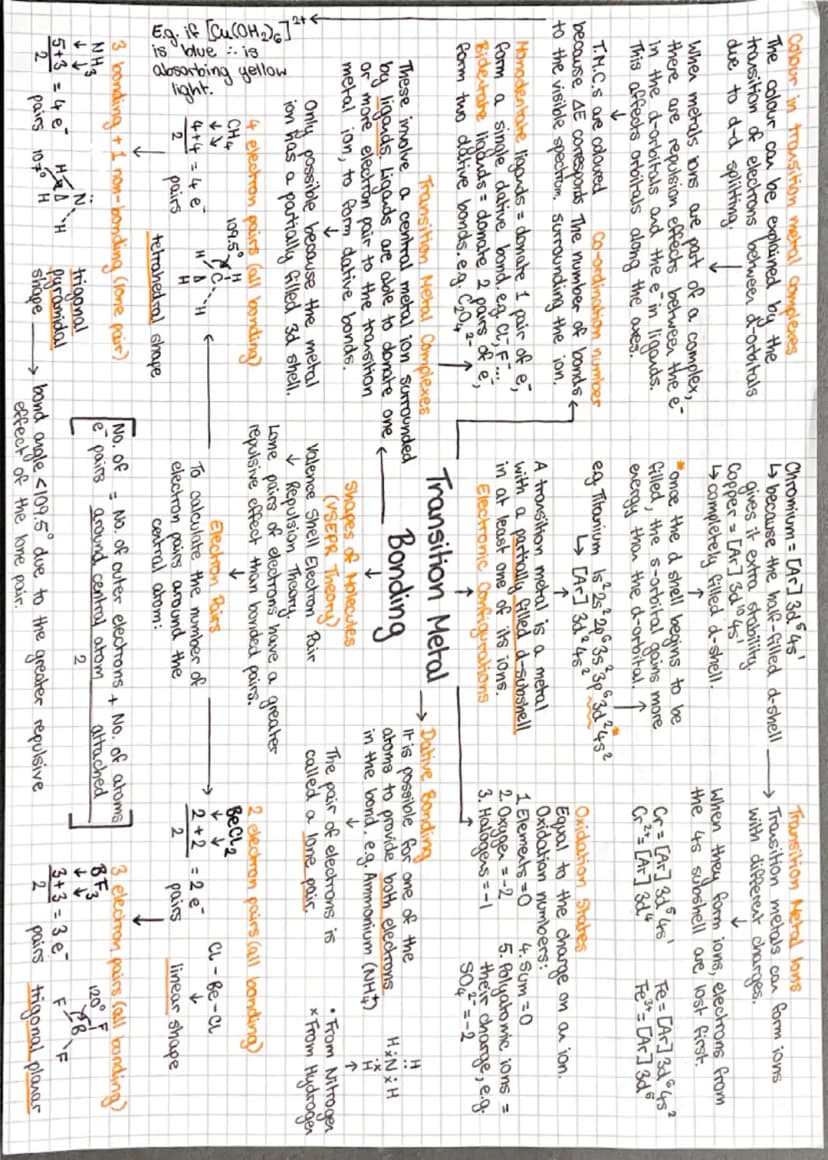
Molecular Shapes and Transition Metal Chemistry
VSEPR theory is your best mate for predicting molecular shapes - electrons hate each other and spread out as far as possible! Count up electron pairs around the central atom: 2 pairs = linear, 3 pairs = trigonal planar, 4 pairs = tetrahedral.
Lone pairs are bullies - they repel more strongly than bonding pairs, so they squash bond angles. That's why ammonia (with one lone pair) has a bond angle less than 109.5°, making it trigonal pyramidal rather than tetrahedral.
Transition metals are the colourful characters of chemistry! They form complex ions where ligands (electron pair donors) surround a central metal ion through dative bonding. The gorgeous colours come from d-d electron transitions when light hits these complexes.
These metals can form multiple oxidation states because they lose 4s electrons first, then d electrons. When forming complexes, the d-orbitals split due to ligand repulsion, creating an energy gap that corresponds perfectly to visible light wavelengths.
💡 Quick Tip: Only transition metals with partially filled d-shells show colour - if the d-shell is empty or completely full, no d-d transitions can occur!
4
of 7
Chemical Equilibrium
Dynamic equilibrium isn't about nothing happening - it's like a busy roundabout where cars enter and leave at exactly the same rate! The forward and reverse reaction rates become equal, but molecules are still reacting constantly.
The equilibrium constant (K) tells you who's winning the battle between reactants and products. If K > 1, products dominate; if K < 1, reactants are in charge. Temperature is the only thing that actually changes K values.
Le Chatelier's principle is your prediction tool: disturb an equilibrium and it shifts to minimise that disturbance. Add more reactant? The equilibrium shifts right to use it up. Increase pressure? It shifts towards fewer gas molecules.
ICE calculations (Initial, Change, Equilibrium) help you work out concentrations and K values. Set up a table, use algebra to track the changes, and substitute into the K expression. For temperature effects, remember: increasing temperature favours the endothermic direction.
💡 Quick Tip: Only include gases and aqueous species in K expressions - pure solids and liquids have constant concentrations so they're ignored!
5
of 7
Acids, Bases and pH
Forget the old "acids taste sour" definition - Brønsted-Lowry theory is where it's at! Acids are proton (H⁺) donors, bases are proton acceptors. When they react, they form conjugate acid-base pairs.
Strong acids like HCl completely dissociate in water, so pH calculations are straightforward: pH = -log[H⁺]. Weak acids only partially dissociate, so you need the acid dissociation constant Ka and the equation pH = -log Ka - log.
The ionic product of water is absolutely crucial. It connects [H⁺] and [OH⁻] in any aqueous solution, letting you calculate pH of bases too. For strong bases, work out [OH⁻], then use Kw to find [H⁺].
Buffer solutions resist pH changes by containing a weak acid and its conjugate base. They work by neutralising small amounts of added acid or base. The Henderson-Hasselbalch equation helps calculate buffer pH.
💡 Quick Tip: Indicators change colour at their pKa value - choose one whose pKa matches your expected equivalence point pH for sharp colour changes!
6
of 7
Thermodynamics and Reaction Feasibility
Gibbs free energy (ΔG) is the ultimate judge of whether reactions can happen spontaneously. The equation ΔG = ΔH - TΔS combines enthalpy and entropy effects. If ΔG is negative, the reaction is feasible - products are favoured.
Entropy measures disorder, and the universe loves chaos! Solids have low entropy, gases have high entropy. When calculating ΔS, remember that reactions producing more gas molecules usually increase entropy significantly.
Temperature can make or break reaction feasibility. For endothermic reactions with positive ΔS, there's a threshold temperature where ΔG becomes negative. Set ΔG = 0 and solve: T = ΔH/ΔS gives you this crossover point.
Standard enthalpy of formation values let you calculate ΔH using Hess's law: ΔH = Σ ΔHf(products) - Σ ΔHf(reactants). Elements in their standard states have ΔHf = 0, which simplifies calculations loads.
💡 Quick Tip: Watch your units! ΔH is usually in kJ/mol but ΔS is in J/K·mol - convert ΔS by dividing by 1000 to match units in the Gibbs equation.
7
of 7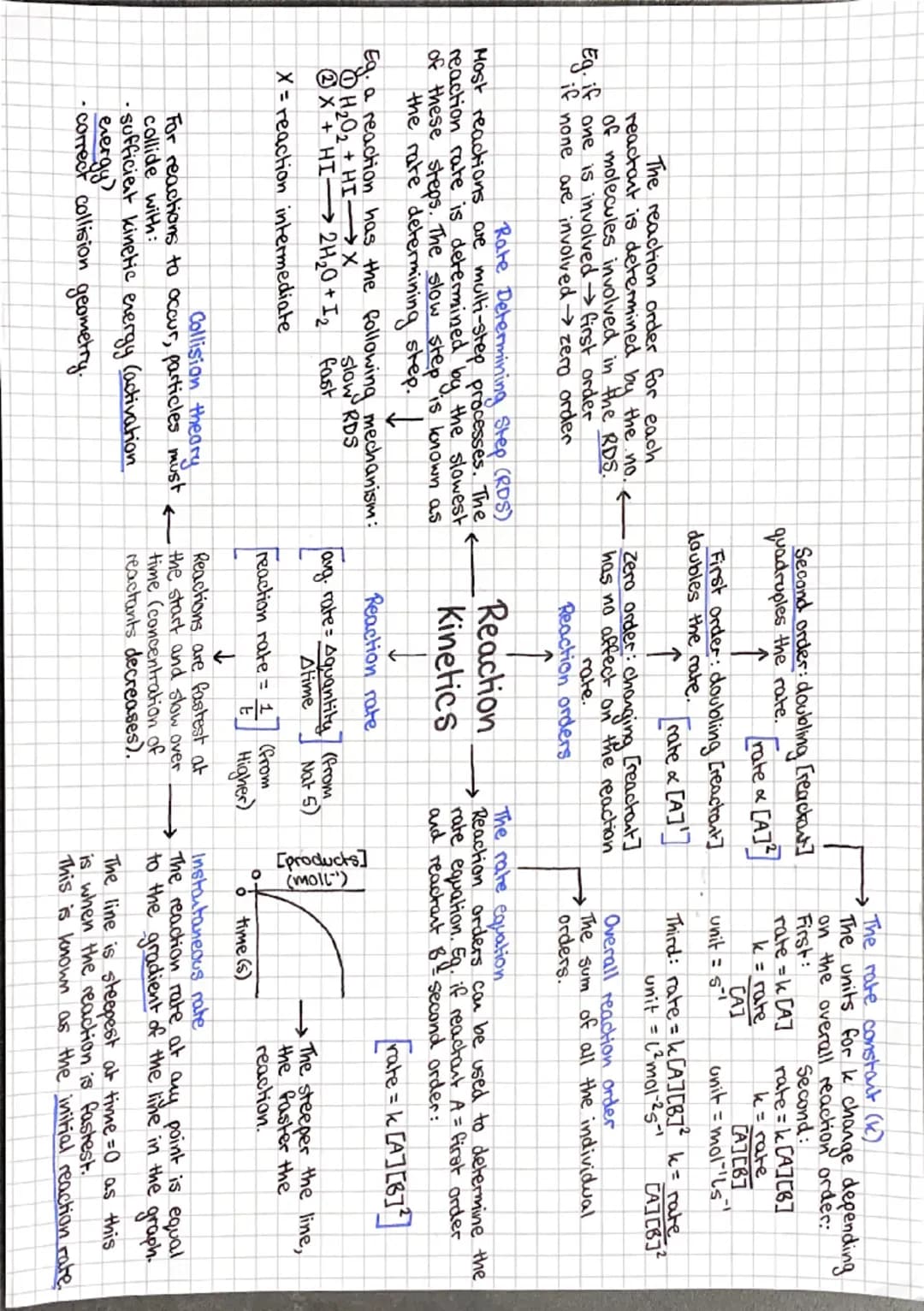
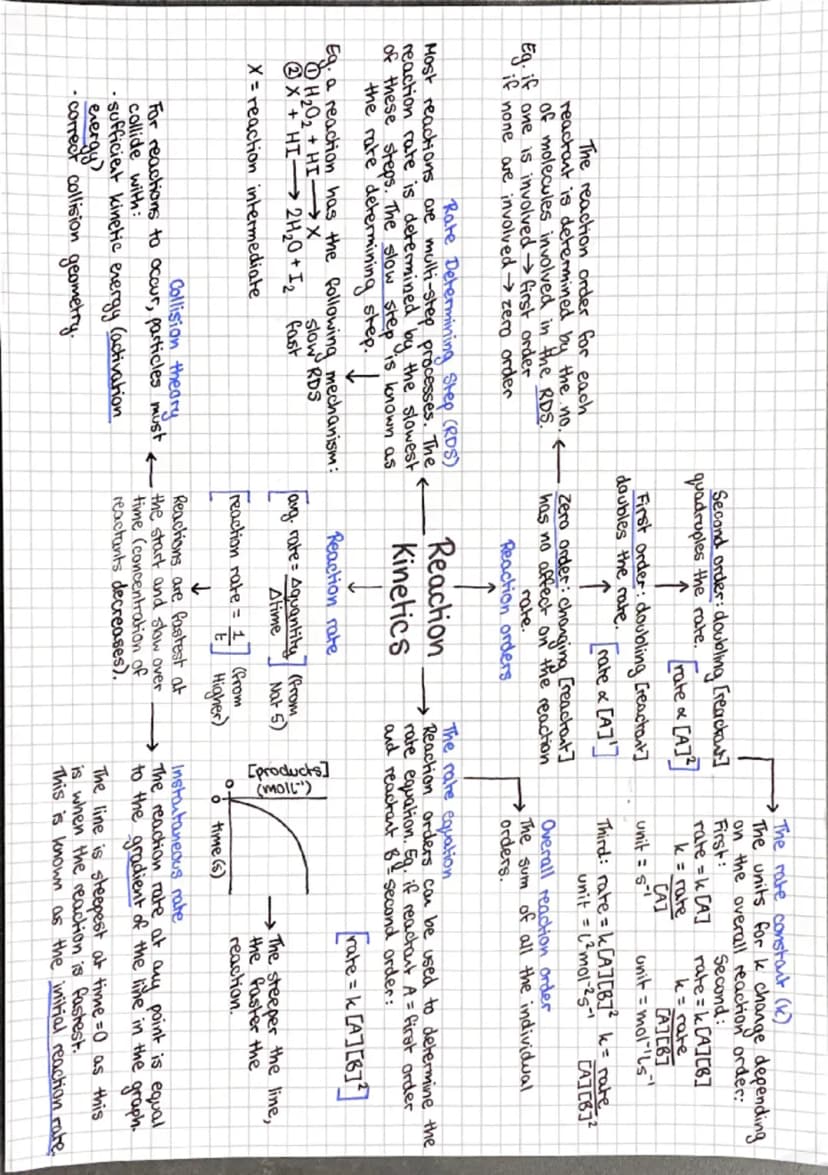
Reaction Kinetics
Collision theory explains why reactions have different speeds - particles need enough kinetic energy and the right orientation to react successfully. It's like trying to unlock your phone while running for the bus!
The rate-determining step (RDS) is the slowest step in any multi-step reaction mechanism. Think of it as the bottleneck that controls the overall reaction rate. The rate equation depends only on species involved in this slow step.
Reaction orders show how concentration changes affect rate. Zero order means concentration has no effect, first order means doubling concentration doubles the rate, and second order means doubling concentration quadruples the rate.
The rate constant (k) depends on temperature and tells you how fast a reaction proceeds at given concentrations. Its units change with overall reaction order: mol⁻¹s⁻¹ for second order, s⁻¹ for first order, mol·s⁻¹ for zero order.
Rate-concentration graphs have the steepest gradient at t = 0 (the initial rate) because this is when reactant concentrations are highest. As reactions progress, rates slow down because there's less reactant left to collide.
💡 Quick Tip: You can't predict reaction orders from balanced equations - they must be determined experimentally by measuring how rate changes with concentration!
We thought you’d never ask...
What is the Knowunity AI companion?
Our AI companion is specifically built for the needs of students. Based on the millions of content pieces we have on the platform we can provide truly meaningful and relevant answers to students. But its not only about answers, the companion is even more about guiding students through their daily learning challenges, with personalised study plans, quizzes or content pieces in the chat and 100% personalisation based on the students skills and developments.
Where can I download the Knowunity app?
You can download the app in the Google Play Store and in the Apple App Store.
Is Knowunity really free of charge?
That's right! Enjoy free access to study content, connect with fellow students, and get instant help – all at your fingertips.
Similar Content
Most popular content: Base
1Most popular content in Chemistry
9G
ChemistryGCSE AQA Chemistry Topic 1- The Atom
The Atom
101,2790
Chemistrychem paper 1
higher
112,07843
ChemistryA-level OCR A Chemistry summary sheets
Everything from snaprevise for OCR chemistry a-level
122,28779
C
Chemistrychem paper 1
Unlock the secrets of chemical reactions with this comprehensive flashcard set designed to help you conquer complex concepts and ace your Chemistry exams.
117251
ChemistryEssential Chemistry Practicals
Explore key AQA GCSE Chemistry practicals, including flame tests, titration, and gas identification. This resource covers essential techniques for analyzing ions, making salts, and understanding reaction kinetics. Perfect for students preparing for exams and practical assessments.
1011,972902
A
ChemistryAQA GCSE Chemistry 4.4 Chemical changes
4.4 Reactions of acids with bases or carbonates
97531
ChemistryChemistry paper 2
Chem paper 2 notes
1172214
F
ChemistryFundamentals of Atomic Structure
Practice identifying subatomic particles, calculating neutrons, and defining isotopes and atomic/mass numbers.
123460
A
ChemistryAtomic Mass and Atomic Number Calculations
Calculate the number of protons, neutrons, and electrons for different elements and isotopes.
S34940
Most popular content
9 Sociology
Sociology of Education Overview
Explore comprehensive A-Level Sociology notes on the education system, covering key theories, policies, and sociological perspectives. This resource includes insights on marketisation, gender roles, cultural deprivation, and educational inequalities, providing a thorough understanding of how education shapes social stratification and individual achievement. Ideal for exam preparation and in-depth study.
12102,8693,040
SociologySociology of Families: Comprehensive Revision
Dive into an extensive overview of family dynamics, perspectives, and patterns in sociology. This resource covers key concepts such as family diversity, gender roles, marriage, and the impact of social policies on family structures. Perfect for A-Level Sociology students preparing for Paper 2.
1273,6662,307
CriminologyCriminology: Crime & Punishment Overview
Comprehensive mindmaps covering key concepts in the Crime and Punishment topic for WJEC Criminology Unit 4. This resource includes detailed insights into the Criminal Justice System, crime prevention strategies, sentencing models, and the roles of various agencies. Ideal for A-Level revision, ensuring you grasp essential theories and legislative processes to excel in your exams.
1254,8721,059
SociologyComprehensive Crime & Deviance Overview
Explore an extensive revision of crime and deviance topics, including theories, types of crime, and the impact of media. This resource covers key concepts such as Marxism, functionalism, gender and crime, and the influence of globalization on criminal behavior. Ideal for students seeking a thorough understanding of criminology and its various theories. Type: Full Topic Revision.
1251,6541,399
C
 Biology
Cell Biology and Cell structure
cell structures
93,2490
 English Literature
An Inspector Calls: Character Insights
Explore in-depth analysis and key quotes for characters in J.B. Priestley's 'An Inspector Calls'. This resource covers Gerald Croft, Inspector Goole, Sheila Birling, Mrs. Birling, Eric Birling, and Eva Smith, focusing on themes of class, gender roles, and social responsibility. Ideal for students aiming for Grade 8 and above.
1025,429907
CriminologyWJEC Unit 4 Criminology
Criminology unit 4 detailed revision note
127,151125
CriminologyCriminology Theories Overview
Explore key criminology theories and their implications on crime and deviance. This comprehensive summary covers biological, psychological, and sociological perspectives, including labelling theory, right realism, and the impact of social campaigns on policy development. Ideal for A-Level criminology students seeking to understand the complexities of criminal behaviour and the factors influencing crime prevention strategies.
129,760210
English LiteratureRomeo and Juliet: Key themes
Key Romeo and Juliet themes and analysed quotes
106,708198
Can't find what you're looking for? Explore other subjects.
Students love us — and so will you.
4.6/5App Store
4.7/5Google Play
The app is very easy to use and well designed. I have found everything I was looking for so far and have been able to learn a lot from the presentations! I will definitely use the app for a class assignment! And of course it also helps a lot as an inspiration.
Stefan SiOS user
This app is really great. There are so many study notes and help [...]. My problem subject is French, for example, and the app has so many options for help. Thanks to this app, I have improved my French. I would recommend it to anyone.
Samantha KlichAndroid user
Wow, I am really amazed. I just tried the app because I've seen it advertised many times and was absolutely stunned. This app is THE HELP you want for school and above all, it offers so many things, such as workouts and fact sheets, which have been VERY helpful to me personally.
AnnaiOS user
Chemistry324 views·Updated Jun 27, 2026·7 pagesAdvanced Higher Chemistry Unit 1 - Summary Mind Maps
M
megan@meganreid_imme
Ready to dive into some seriously cool chemistry? These pages cover everything from how light reveals the secrets of atoms to why reactions happen at different speeds - basically all the chemistry knowledge that'll make you sound like a proper...
1
of 7
Sign up to see the content. It's free!
- Access to all documents
- Improve your grades
- Join milions of students
Light and Atomic Spectroscopy
Ever wondered how scientists figure out what stars are made of? It's all about light and energy levels in atoms! When you heat up elements, their electrons get excited and jump to higher energy levels - like students moving up to harder classes.
When these excited electrons fall back down, they release photons of specific colours. Each element has its own unique fingerprint of colours, which is brilliant for identification. Hydrogen produces different colours than sodium, for example.
There are two main techniques you need to know: Atomic Emission Spectroscopy (AES) measures the light given off when electrons fall down energy levels, while Atomic Absorption Spectroscopy (AAS) measures which wavelengths get absorbed. The intensity tells you how much of an element is present - dead useful for analysis!
The key equation connecting energy and light is E = hf, where h is Planck's constant (6.63×10⁻³⁴ J·s). Light behaves as both waves and particles (called photons), which might sound mental but it's absolutely fundamental to understanding atomic behaviour.
💡 Quick Tip: Remember that the further electrons are from the nucleus, the less energy difference between levels - this affects which colours you'll see!
2
of 7Sign up to see the content. It's free!
- Access to all documents
- Improve your grades
- Join milions of students
Electronic Structure and Quantum Numbers
Your electron arrangements from earlier years were just the beginning - now we're getting into the proper detail with quantum numbers and orbital shapes! Think of orbitals as the specific "rooms" where electrons live around an atom.
S-orbitals are spherical (like footballs), p-orbitals are dumbbell-shaped, and d-orbitals have more complex shapes. Each type can hold different numbers of electrons: s holds 2, p holds 6, and d holds 10. The principal quantum number (n) tells you the energy level.
Three crucial rules govern how electrons fill orbitals: Aufbau principle (lowest energy first), Pauli exclusion principle (maximum 2 electrons per orbital with opposite spins), and Hund's rule (fill singly before pairing up). These explain why ionisation energies don't always increase smoothly across periods.
Half-filled and completely filled subshells are particularly stable, which explains some unexpected electron configurations. For instance, chromium prefers [Ar] 3d⁵ 4s¹ rather than [Ar] 3d⁴ 4s² because the half-filled d-shell provides extra stability.
💡 Quick Tip: Use orbital box notation to visualise electron arrangements - it makes predicting magnetic properties and reactivity much clearer!
3
of 7Sign up to see the content. It's free!
- Access to all documents
- Improve your grades
- Join milions of students
Molecular Shapes and Transition Metal Chemistry
VSEPR theory is your best mate for predicting molecular shapes - electrons hate each other and spread out as far as possible! Count up electron pairs around the central atom: 2 pairs = linear, 3 pairs = trigonal planar, 4 pairs = tetrahedral.
Lone pairs are bullies - they repel more strongly than bonding pairs, so they squash bond angles. That's why ammonia (with one lone pair) has a bond angle less than 109.5°, making it trigonal pyramidal rather than tetrahedral.
Transition metals are the colourful characters of chemistry! They form complex ions where ligands (electron pair donors) surround a central metal ion through dative bonding. The gorgeous colours come from d-d electron transitions when light hits these complexes.
These metals can form multiple oxidation states because they lose 4s electrons first, then d electrons. When forming complexes, the d-orbitals split due to ligand repulsion, creating an energy gap that corresponds perfectly to visible light wavelengths.
💡 Quick Tip: Only transition metals with partially filled d-shells show colour - if the d-shell is empty or completely full, no d-d transitions can occur!
4
of 7Sign up to see the content. It's free!
- Access to all documents
- Improve your grades
- Join milions of students
Chemical Equilibrium
Dynamic equilibrium isn't about nothing happening - it's like a busy roundabout where cars enter and leave at exactly the same rate! The forward and reverse reaction rates become equal, but molecules are still reacting constantly.
The equilibrium constant (K) tells you who's winning the battle between reactants and products. If K > 1, products dominate; if K < 1, reactants are in charge. Temperature is the only thing that actually changes K values.
Le Chatelier's principle is your prediction tool: disturb an equilibrium and it shifts to minimise that disturbance. Add more reactant? The equilibrium shifts right to use it up. Increase pressure? It shifts towards fewer gas molecules.
ICE calculations (Initial, Change, Equilibrium) help you work out concentrations and K values. Set up a table, use algebra to track the changes, and substitute into the K expression. For temperature effects, remember: increasing temperature favours the endothermic direction.
💡 Quick Tip: Only include gases and aqueous species in K expressions - pure solids and liquids have constant concentrations so they're ignored!
5
of 7Sign up to see the content. It's free!
- Access to all documents
- Improve your grades
- Join milions of students
Acids, Bases and pH
Forget the old "acids taste sour" definition - Brønsted-Lowry theory is where it's at! Acids are proton (H⁺) donors, bases are proton acceptors. When they react, they form conjugate acid-base pairs.
Strong acids like HCl completely dissociate in water, so pH calculations are straightforward: pH = -log[H⁺]. Weak acids only partially dissociate, so you need the acid dissociation constant Ka and the equation pH = -log Ka - log.
The ionic product of water is absolutely crucial. It connects [H⁺] and [OH⁻] in any aqueous solution, letting you calculate pH of bases too. For strong bases, work out [OH⁻], then use Kw to find [H⁺].
Buffer solutions resist pH changes by containing a weak acid and its conjugate base. They work by neutralising small amounts of added acid or base. The Henderson-Hasselbalch equation helps calculate buffer pH.
💡 Quick Tip: Indicators change colour at their pKa value - choose one whose pKa matches your expected equivalence point pH for sharp colour changes!
6
of 7Sign up to see the content. It's free!
- Access to all documents
- Improve your grades
- Join milions of students
Thermodynamics and Reaction Feasibility
Gibbs free energy (ΔG) is the ultimate judge of whether reactions can happen spontaneously. The equation ΔG = ΔH - TΔS combines enthalpy and entropy effects. If ΔG is negative, the reaction is feasible - products are favoured.
Entropy measures disorder, and the universe loves chaos! Solids have low entropy, gases have high entropy. When calculating ΔS, remember that reactions producing more gas molecules usually increase entropy significantly.
Temperature can make or break reaction feasibility. For endothermic reactions with positive ΔS, there's a threshold temperature where ΔG becomes negative. Set ΔG = 0 and solve: T = ΔH/ΔS gives you this crossover point.
Standard enthalpy of formation values let you calculate ΔH using Hess's law: ΔH = Σ ΔHf(products) - Σ ΔHf(reactants). Elements in their standard states have ΔHf = 0, which simplifies calculations loads.
💡 Quick Tip: Watch your units! ΔH is usually in kJ/mol but ΔS is in J/K·mol - convert ΔS by dividing by 1000 to match units in the Gibbs equation.
7
of 7Sign up to see the content. It's free!
- Access to all documents
- Improve your grades
- Join milions of students
Reaction Kinetics
Collision theory explains why reactions have different speeds - particles need enough kinetic energy and the right orientation to react successfully. It's like trying to unlock your phone while running for the bus!
The rate-determining step (RDS) is the slowest step in any multi-step reaction mechanism. Think of it as the bottleneck that controls the overall reaction rate. The rate equation depends only on species involved in this slow step.
Reaction orders show how concentration changes affect rate. Zero order means concentration has no effect, first order means doubling concentration doubles the rate, and second order means doubling concentration quadruples the rate.
The rate constant (k) depends on temperature and tells you how fast a reaction proceeds at given concentrations. Its units change with overall reaction order: mol⁻¹s⁻¹ for second order, s⁻¹ for first order, mol·s⁻¹ for zero order.
Rate-concentration graphs have the steepest gradient at t = 0 (the initial rate) because this is when reactant concentrations are highest. As reactions progress, rates slow down because there's less reactant left to collide.
💡 Quick Tip: You can't predict reaction orders from balanced equations - they must be determined experimentally by measuring how rate changes with concentration!
We thought you’d never ask...
What is the Knowunity AI companion?
Our AI companion is specifically built for the needs of students. Based on the millions of content pieces we have on the platform we can provide truly meaningful and relevant answers to students. But its not only about answers, the companion is even more about guiding students through their daily learning challenges, with personalised study plans, quizzes or content pieces in the chat and 100% personalisation based on the students skills and developments.
Where can I download the Knowunity app?
You can download the app in the Google Play Store and in the Apple App Store.
Is Knowunity really free of charge?
That's right! Enjoy free access to study content, connect with fellow students, and get instant help – all at your fingertips.
Similar Content
Most popular content: Base
1Most popular content in Chemistry
9G
ChemistryGCSE AQA Chemistry Topic 1- The Atom
The Atom
101,2790
Chemistrychem paper 1
higher
112,07843
ChemistryA-level OCR A Chemistry summary sheets
Everything from snaprevise for OCR chemistry a-level
122,28779
C
Chemistrychem paper 1
Unlock the secrets of chemical reactions with this comprehensive flashcard set designed to help you conquer complex concepts and ace your Chemistry exams.
117251
ChemistryEssential Chemistry Practicals
Explore key AQA GCSE Chemistry practicals, including flame tests, titration, and gas identification. This resource covers essential techniques for analyzing ions, making salts, and understanding reaction kinetics. Perfect for students preparing for exams and practical assessments.
1011,972902
A
ChemistryAQA GCSE Chemistry 4.4 Chemical changes
4.4 Reactions of acids with bases or carbonates
97531
ChemistryChemistry paper 2
Chem paper 2 notes
1172214
F
ChemistryFundamentals of Atomic Structure
Practice identifying subatomic particles, calculating neutrons, and defining isotopes and atomic/mass numbers.
123460
A
ChemistryAtomic Mass and Atomic Number Calculations
Calculate the number of protons, neutrons, and electrons for different elements and isotopes.
S34940
Most popular content
9SociologySociology of Education Overview
Explore comprehensive A-Level Sociology notes on the education system, covering key theories, policies, and sociological perspectives. This resource includes insights on marketisation, gender roles, cultural deprivation, and educational inequalities, providing a thorough understanding of how education shapes social stratification and individual achievement. Ideal for exam preparation and in-depth study.
12102,8693,040
SociologySociology of Families: Comprehensive Revision
Dive into an extensive overview of family dynamics, perspectives, and patterns in sociology. This resource covers key concepts such as family diversity, gender roles, marriage, and the impact of social policies on family structures. Perfect for A-Level Sociology students preparing for Paper 2.
1273,6662,307
CriminologyCriminology: Crime & Punishment Overview
Comprehensive mindmaps covering key concepts in the Crime and Punishment topic for WJEC Criminology Unit 4. This resource includes detailed insights into the Criminal Justice System, crime prevention strategies, sentencing models, and the roles of various agencies. Ideal for A-Level revision, ensuring you grasp essential theories and legislative processes to excel in your exams.
1254,8721,059
SociologyComprehensive Crime & Deviance Overview
Explore an extensive revision of crime and deviance topics, including theories, types of crime, and the impact of media. This resource covers key concepts such as Marxism, functionalism, gender and crime, and the influence of globalization on criminal behavior. Ideal for students seeking a thorough understanding of criminology and its various theories. Type: Full Topic Revision.
1251,6541,399
C
BiologyCell Biology and Cell structure
cell structures
93,2490
English LiteratureAn Inspector Calls: Character Insights
Explore in-depth analysis and key quotes for characters in J.B. Priestley's 'An Inspector Calls'. This resource covers Gerald Croft, Inspector Goole, Sheila Birling, Mrs. Birling, Eric Birling, and Eva Smith, focusing on themes of class, gender roles, and social responsibility. Ideal for students aiming for Grade 8 and above.
1025,429907
CriminologyWJEC Unit 4 Criminology
Criminology unit 4 detailed revision note
127,151125
CriminologyCriminology Theories Overview
Explore key criminology theories and their implications on crime and deviance. This comprehensive summary covers biological, psychological, and sociological perspectives, including labelling theory, right realism, and the impact of social campaigns on policy development. Ideal for A-Level criminology students seeking to understand the complexities of criminal behaviour and the factors influencing crime prevention strategies.
129,760210
English LiteratureRomeo and Juliet: Key themes
Key Romeo and Juliet themes and analysed quotes
106,708198
Can't find what you're looking for? Explore other subjects.
Students love us — and so will you.
4.6/5App Store
4.7/5Google Play
The app is very easy to use and well designed. I have found everything I was looking for so far and have been able to learn a lot from the presentations! I will definitely use the app for a class assignment! And of course it also helps a lot as an inspiration.
Stefan SiOS user
This app is really great. There are so many study notes and help [...]. My problem subject is French, for example, and the app has so many options for help. Thanks to this app, I have improved my French. I would recommend it to anyone.
Samantha KlichAndroid user
Wow, I am really amazed. I just tried the app because I've seen it advertised many times and was absolutely stunned. This app is THE HELP you want for school and above all, it offers so many things, such as workouts and fact sheets, which have been VERY helpful to me personally.
AnnaiOS user