
Understanding enthalpy changeis fundamental to mastering A-level chemistry thermodynamics...
 Chemistry330 views·Updated Jun 15, 2026·19 pages
A Level Chemistry: Enthalpy Change Calculations Worksheet and Answers

JJ@jjstudymaster


1 / 10
1
of 10
Understanding Enthalpy Changes in A-Level Chemistry
Standard Conditions and Measurements
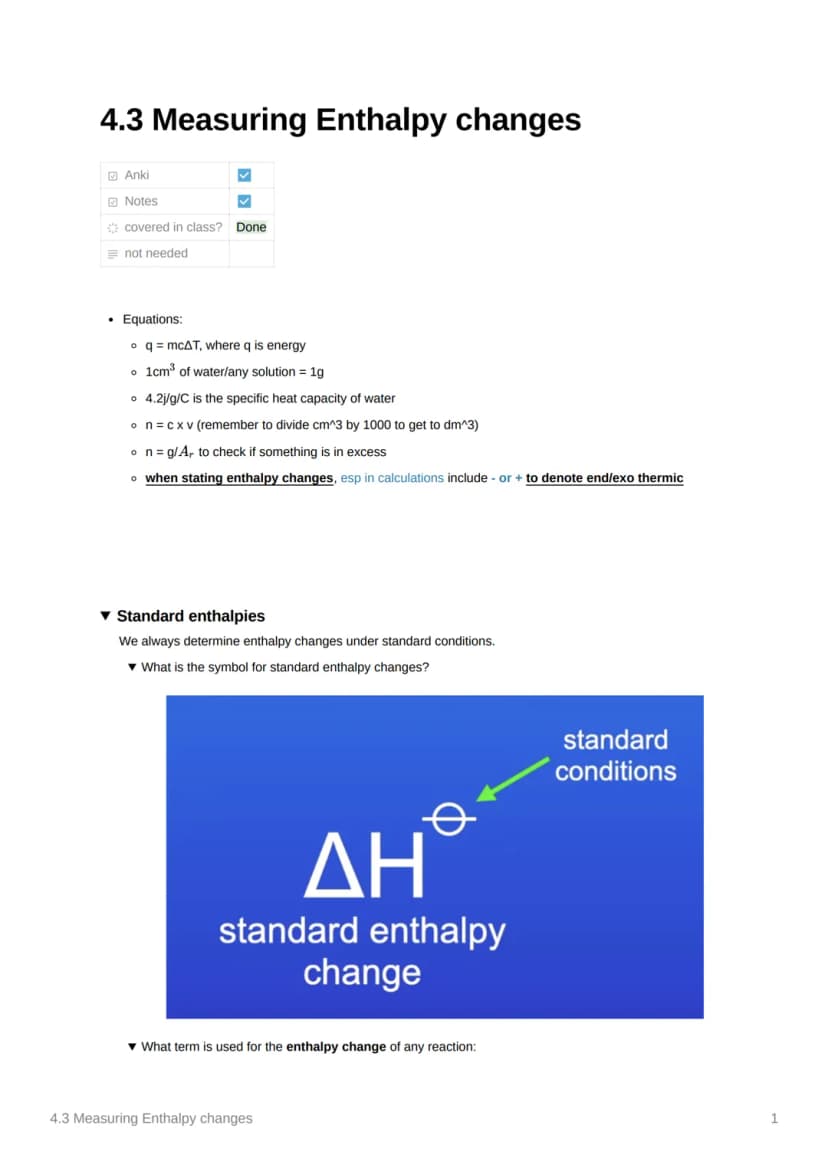
The study of enthalpy change A level chemistry questions begins with understanding standard conditions. When measuring enthalpy changes, specific conditions must be maintained for accurate results. These include a temperature of 298 Kelvin (25°C), pressure of 100 kilopascals, and concentration of 1 mol dm⁻³ for solutions. All substances must be in their standard states - whether solid, liquid, or gas - to ensure consistent measurements.
Definition: Standard enthalpy change is measured in kJ mol⁻¹ and represents the energy change when reactants transform into products under standard conditions.
The fundamental equation for calculating enthalpy changes involves q = mcΔT, where q represents energy transfer, m is mass, c is specific heat capacity, and ΔT is temperature change. For water-based solutions, the specific heat capacity is 4.18 J/g/°C, and 1 cm³ equals 1g of solution.
Understanding these principles is crucial for solving A level chemistry enthalpy change calculations questions and answers. Students must remember to include positive or negative signs to indicate endothermic or exothermic reactions respectively.
2
of 10
Calculating Enthalpy Changes of Combustion
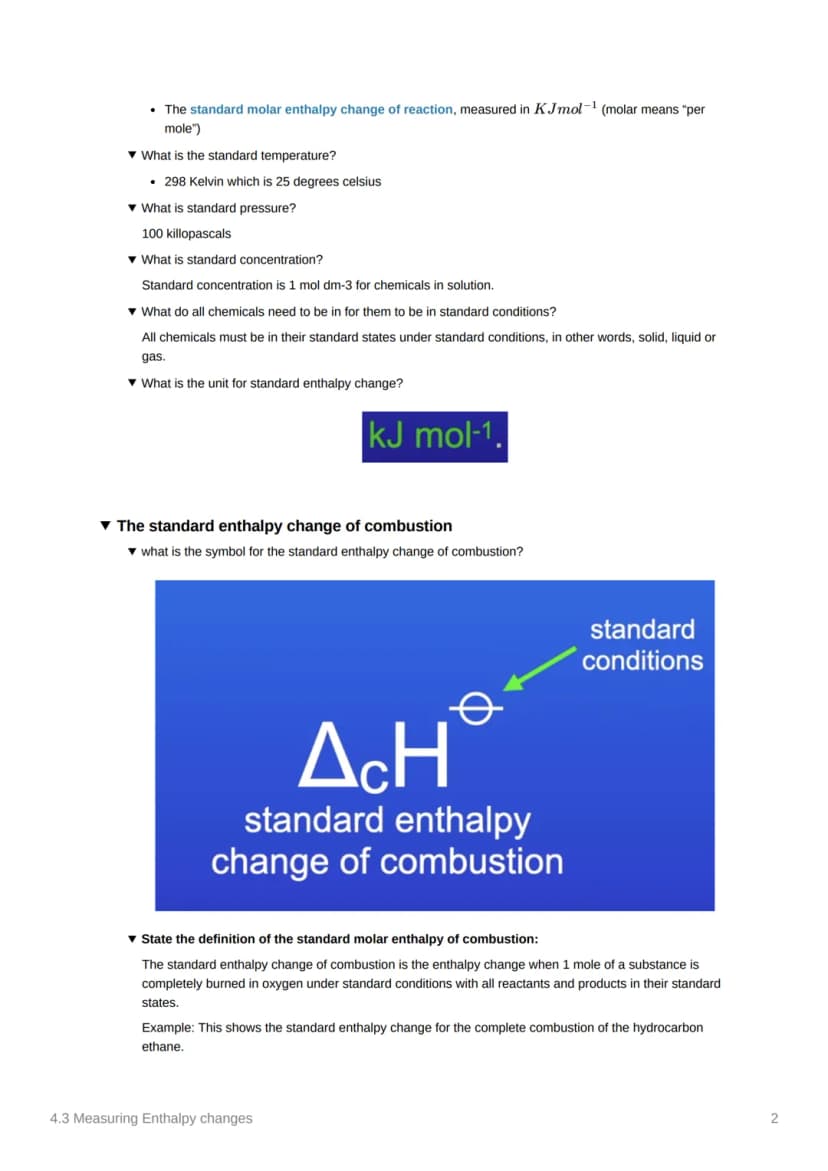
The standard enthalpy change of combustion (ΔHc) represents a crucial concept in thermochemistry. It measures the energy change when one mole of a substance completely burns in oxygen under standard conditions.
Example: Consider the combustion of ethane: C₂H₆(g) + 3.5O₂(g) → 2CO₂(g) + 3H₂O(l)
When calculating the enthalpy change of combustion formula A Level, several key points must be considered:
- Complete combustion produces only carbon dioxide and water
- All reactants and products must be in their standard states
- The equation must be balanced
- One mole of fuel is always used as the reference
Highlight: For accurate calculations, remember that mass measurements must be converted to moles using molar mass, and energy values should be expressed in kJ mol⁻¹.
3
of 10
Practical Applications and Calculations
Learning how to calculate enthalpy change using bond energies involves understanding both theoretical principles and practical applications. In experimental settings, the process typically involves measuring temperature changes in water when a fuel combusts.
For example, when calculating the enthalpy change of combustion of ethanol, follow these steps:
- Measure the mass of water and temperature change
- Calculate energy transferred using q = mcΔT
- Convert joules to kilojoules
- Calculate moles of fuel used
- Determine enthalpy change per mole
Vocabulary: The specific heat capacity of water is a crucial constant in these calculations.
4
of 10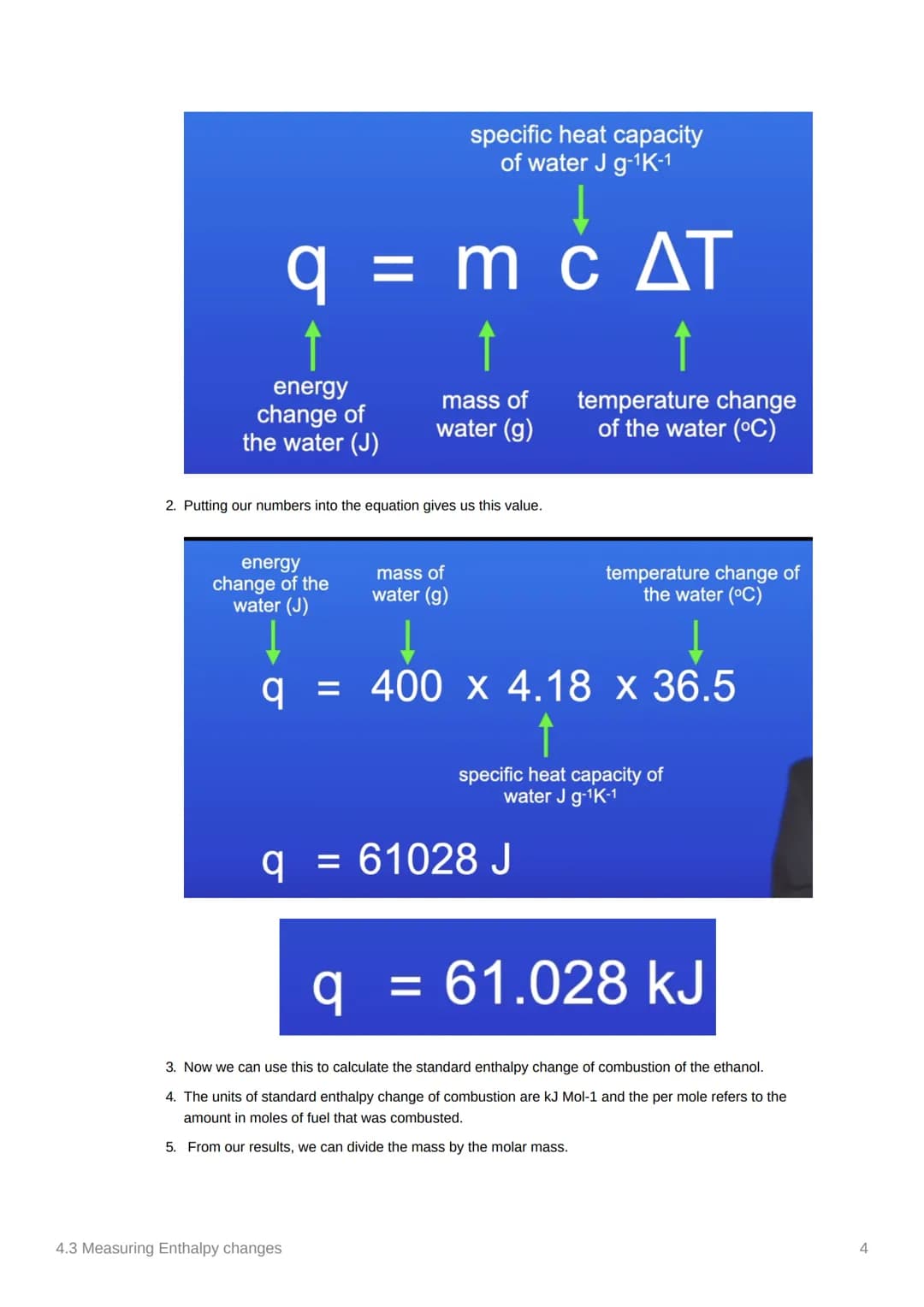
Advanced Concepts and Problem-Solving
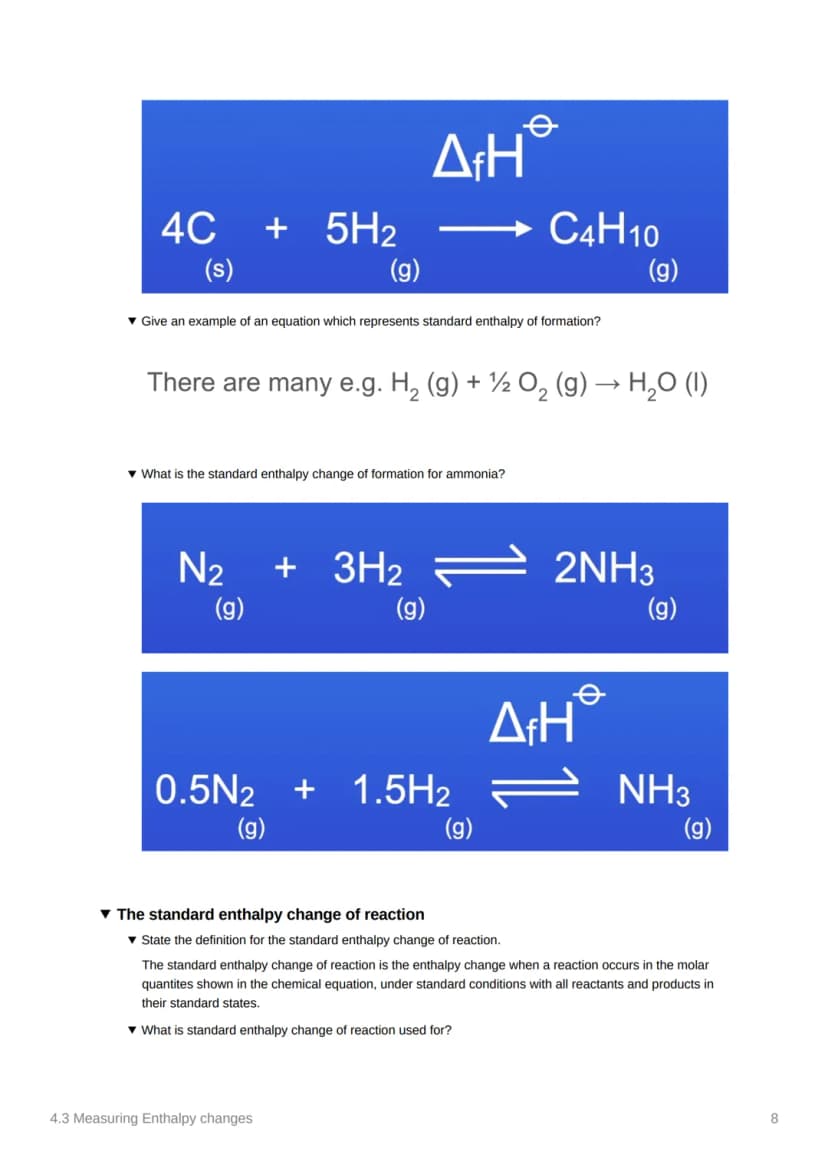
Understanding standard enthalpy change of formation symbol and related concepts helps in solving complex problems. When working with enthalpy change calculations pdf resources, students should focus on:
- Converting between units (J to kJ, g to mol)
- Identifying standard states of all substances
- Recognizing endothermic versus exothermic processes
- Applying Hess's Law for indirect calculations
Definition: The standard enthalpy change of neutralisation is the energy change when one mole of H⁺ ions reacts with one mole of OH⁻ ions under standard conditions.
These concepts interconnect with other areas of chemistry, including thermodynamics and chemical bonding. Understanding these relationships helps in mastering enthalpy change questions and answers A Level.
5
of 10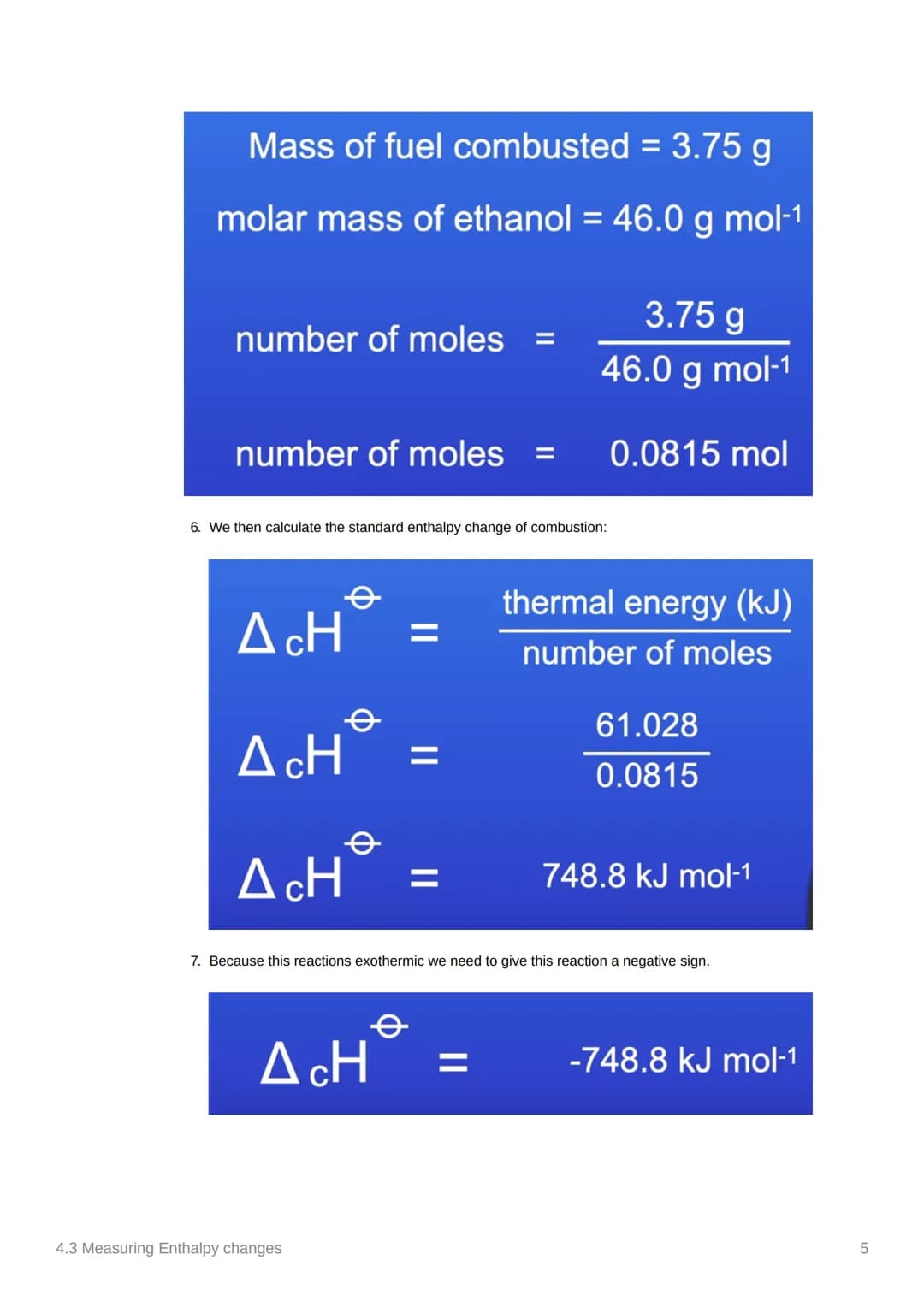
Understanding Enthalpy Change Calculations in Chemistry
The calculation of enthalpy change involves several key steps and concepts that are fundamental to A-level chemistry. When measuring enthalpy changes, particularly for enthalpy change of combustion, we need to follow specific procedures and calculations.
Definition: Enthalpy change is the heat energy transferred between a system and its surroundings during a chemical reaction under constant pressure.
For combustion reactions, we first determine the mass of fuel used and convert it to moles using the molar mass. The thermal energy transfer is calculated using the formula Q = mcΔT, where:
- m = mass of water in grams
- c = specific heat capacity of water
- ΔT = temperature change in degrees Celsius
Example: For ethanol combustion:
- Mass of ethanol = 3.75g
- Molar mass = 46.0 g/mol
- Number of moles = 0.0815 mol
- Resulting enthalpy change = -748.8 kJ/mol
6
of 10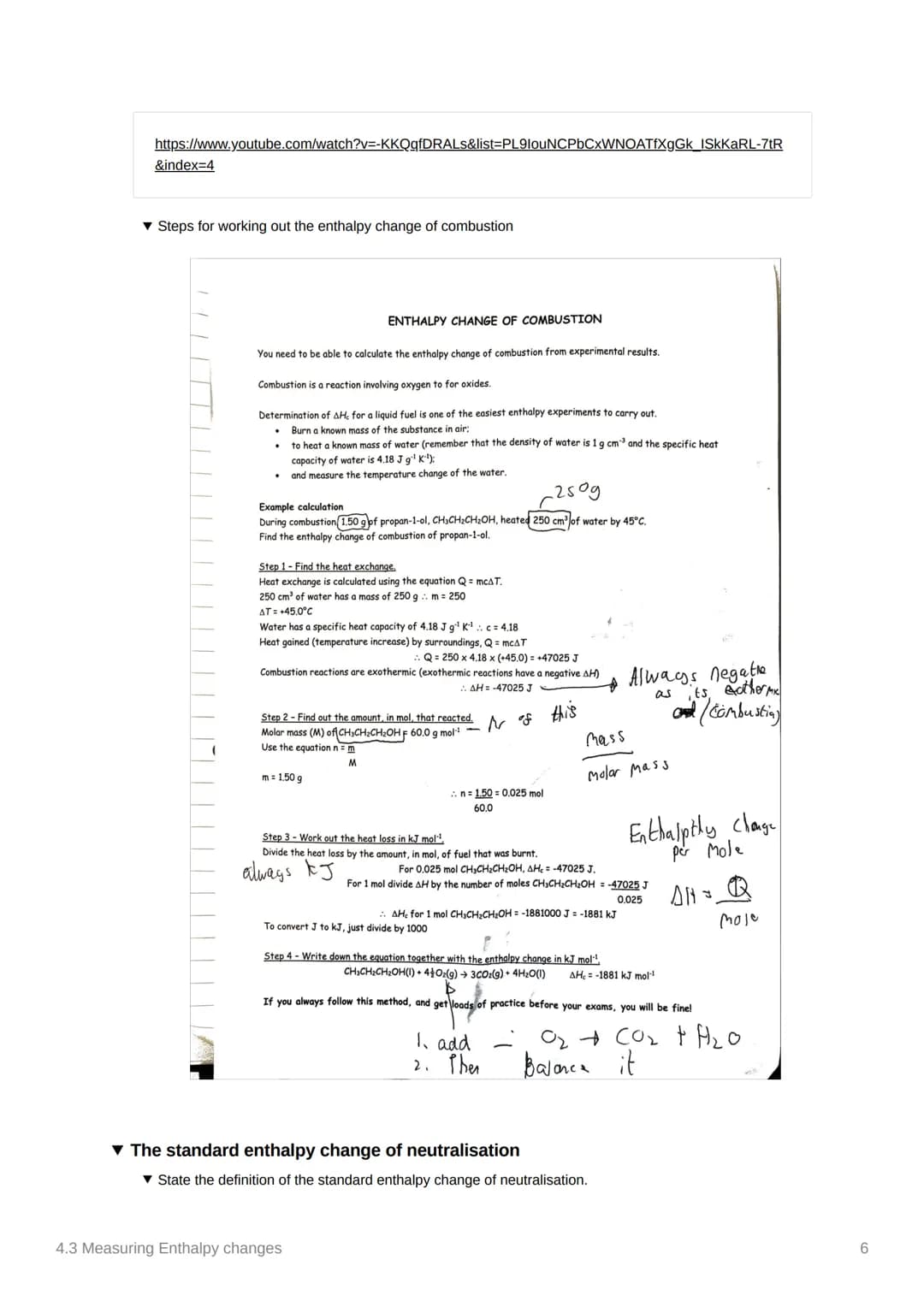
Calculating Enthalpy Change of Combustion
How to calculate enthalpy change using bond energies requires careful experimental setup and precise measurements. The process involves burning a known mass of fuel under controlled conditions.
Highlight: Combustion reactions are always exothermic, resulting in negative enthalpy values.
For example, when calculating the enthalpy change of combustion for propan-1-ol:
- Measure the heat exchange using Q = mcΔT
- Convert the mass of fuel to moles
- Calculate the enthalpy change per mole
- Express the result with proper units
Example: For propan-1-ol combustion: CH₃CH₂CH₂OH(l) + 4O₂(g) → 3CO₂(g) + 4H₂O(l) ΔH = -1881 kJ/mol
7
of 10
Standard Enthalpy Changes and Neutralization
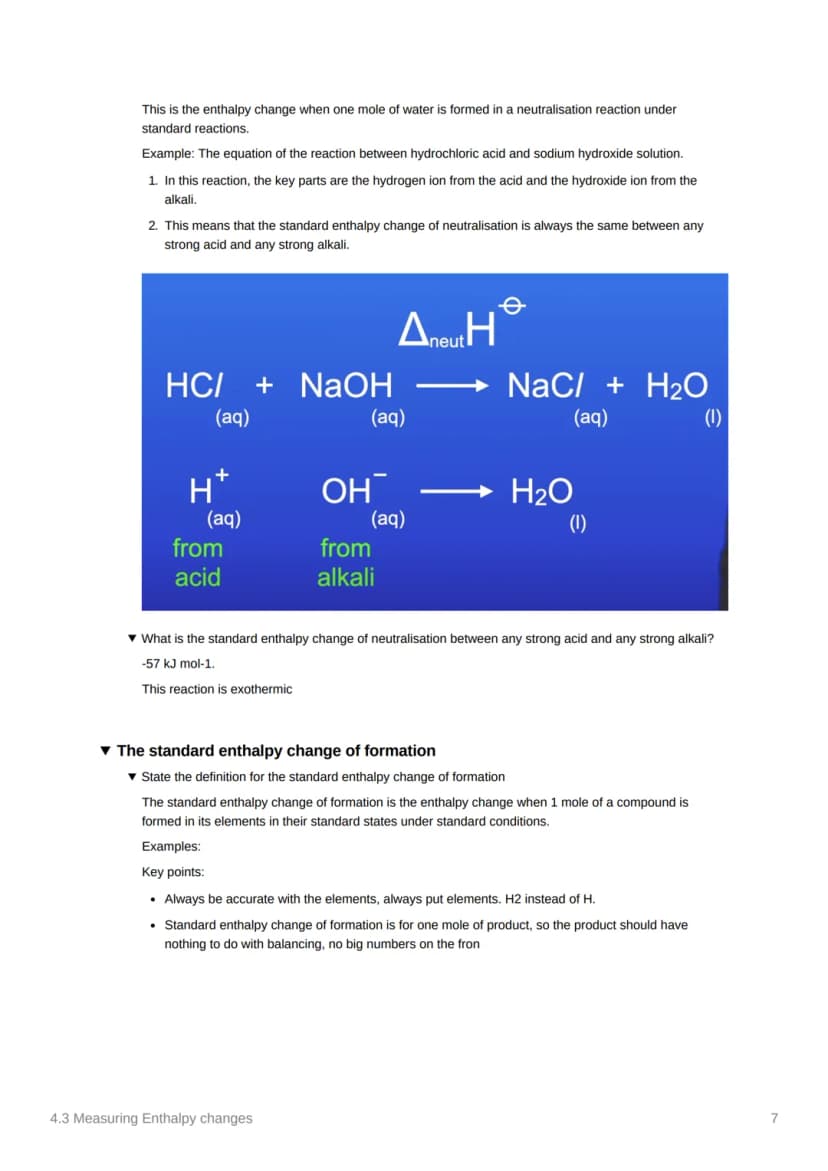
The standard enthalpy change of neutralisation is a specific type of enthalpy change that occurs when acids and bases react.
Definition: Standard enthalpy change of neutralization is the energy change when one mole of water is formed from H⁺ and OH⁻ ions under standard conditions.
For strong acids and bases, the enthalpy change of neutralization is consistently -57 kJ/mol. This consistency occurs because the fundamental reaction is always:
H⁺(aq) + OH⁻(aq) → H₂O(l)
Vocabulary: Standard conditions refer to:
- 298K (25°C)
- 1 atmosphere pressure
- 1 mol/dm³ concentration for solutions
8
of 10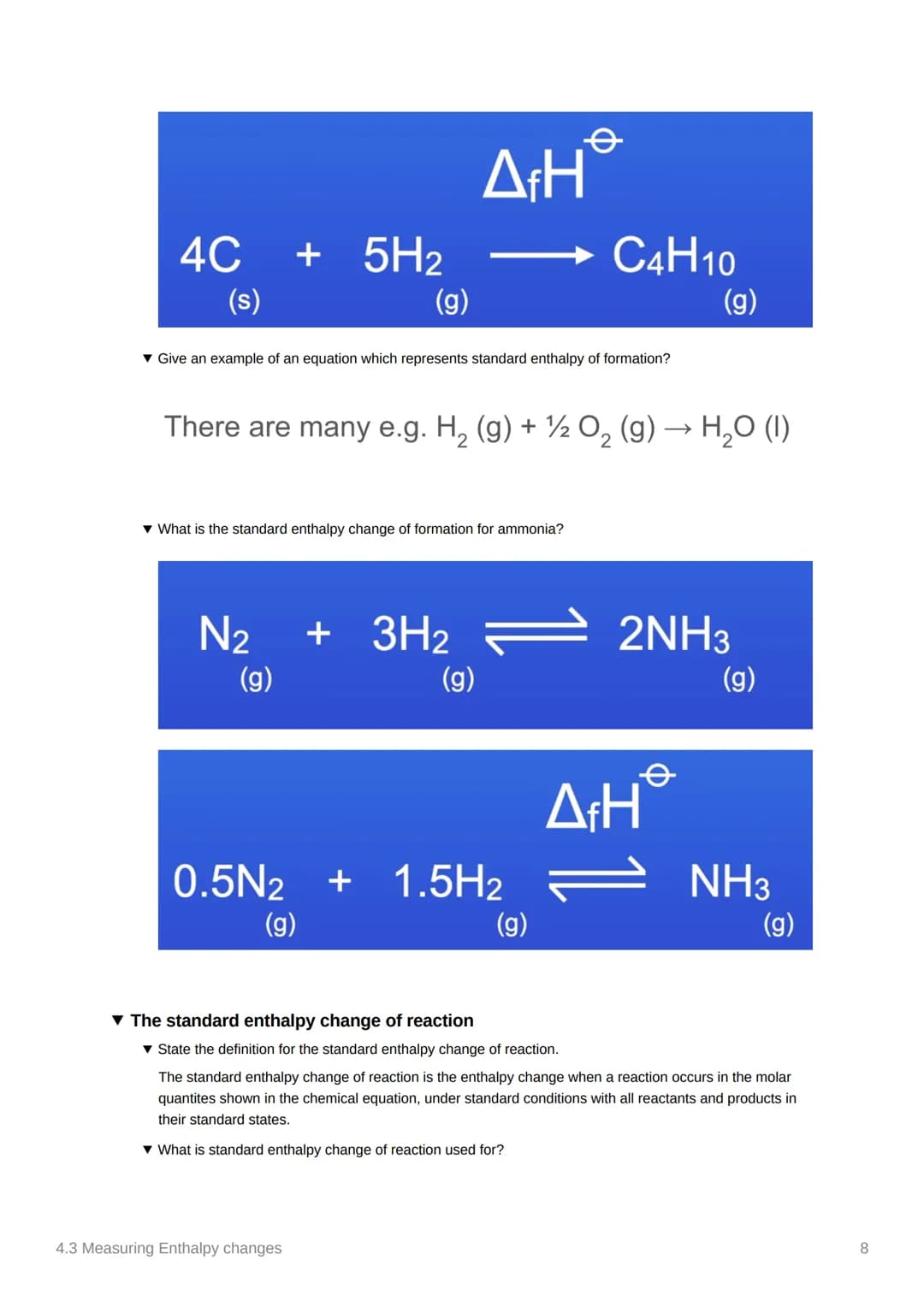
Experimental Measurements and Calculations
When determining enthalpy change A level chemistry questions, proper experimental technique is crucial. Heat measurements are typically indirect, using calorimetry methods.
Highlight: Key factors in enthalpy measurements:
- Mass of substance
- Temperature change
- Specific heat capacity
- Heat losses to surroundings
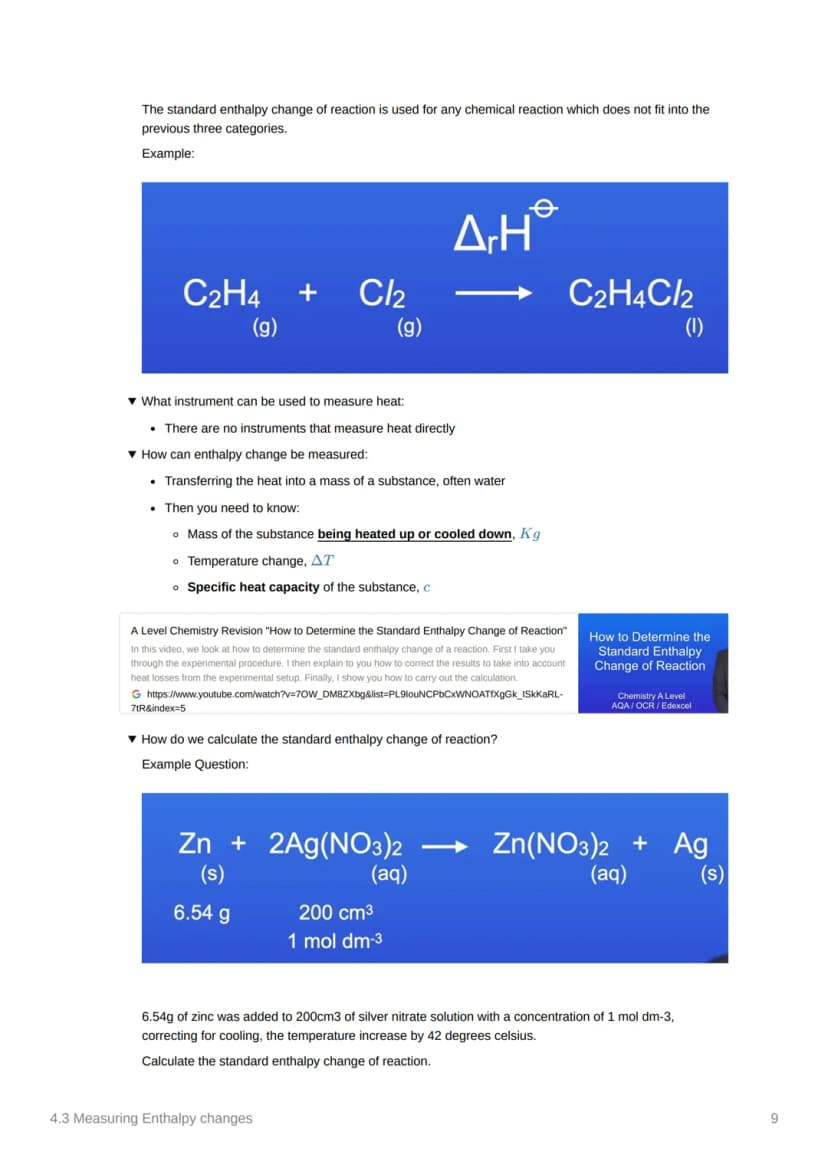
For example, in a reaction between zinc and silver nitrate:
- Measure initial temperatures
- Record temperature changes
- Account for heat losses
- Calculate final enthalpy change
Example: For a reaction using:
- 6.54g Zn
- 200cm³ of 1M AgNO₃
- Temperature increase of 42°C Calculate the enthalpy change considering all heat transfers and stoichiometry.
9
of 10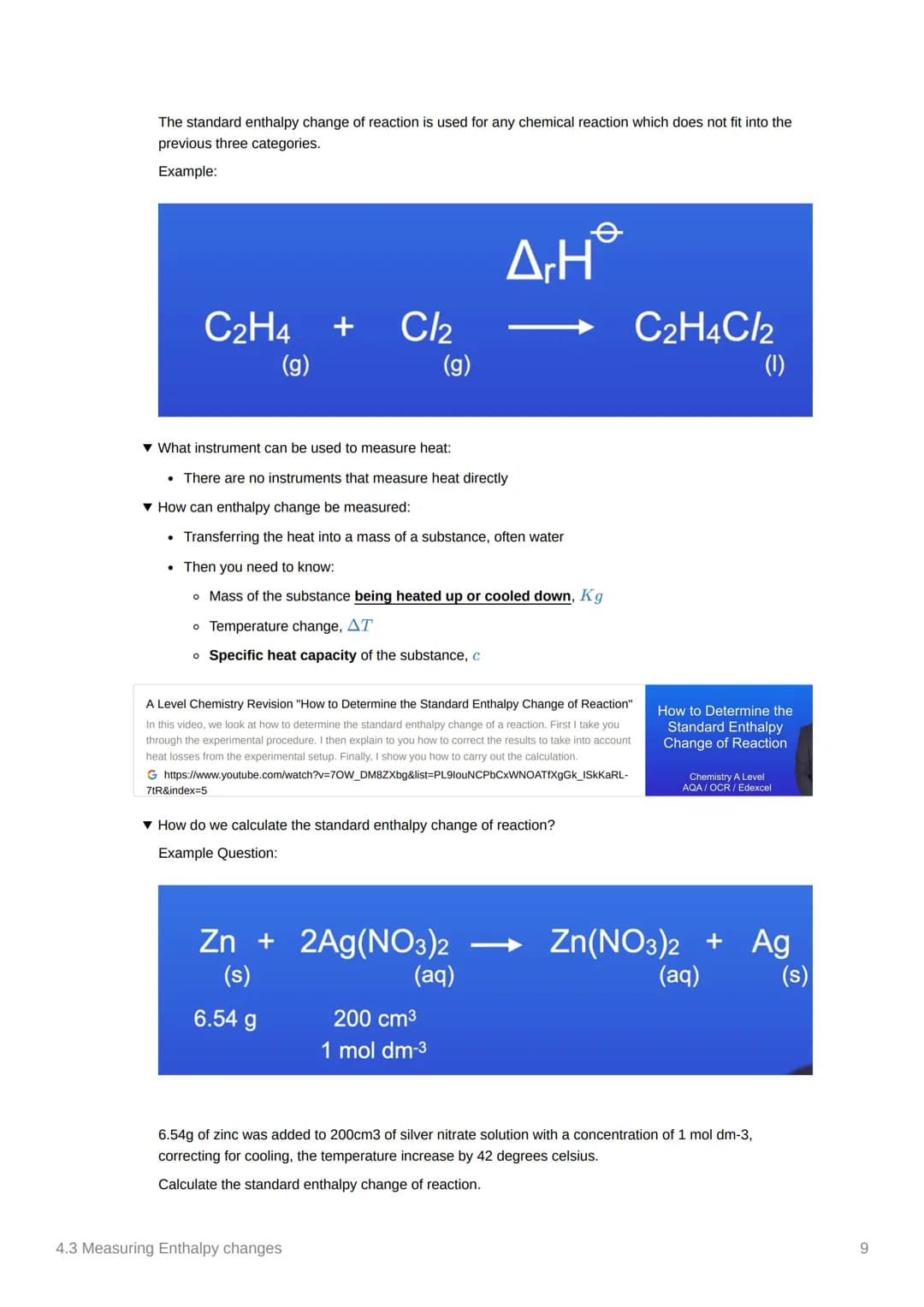
Understanding Enthalpy Change Measurements in Chemistry
When studying enthalpy change A level chemistry questions, it's crucial to understand how to calculate heat energy released during chemical reactions. The process involves careful consideration of several factors and the application of specific formulas.
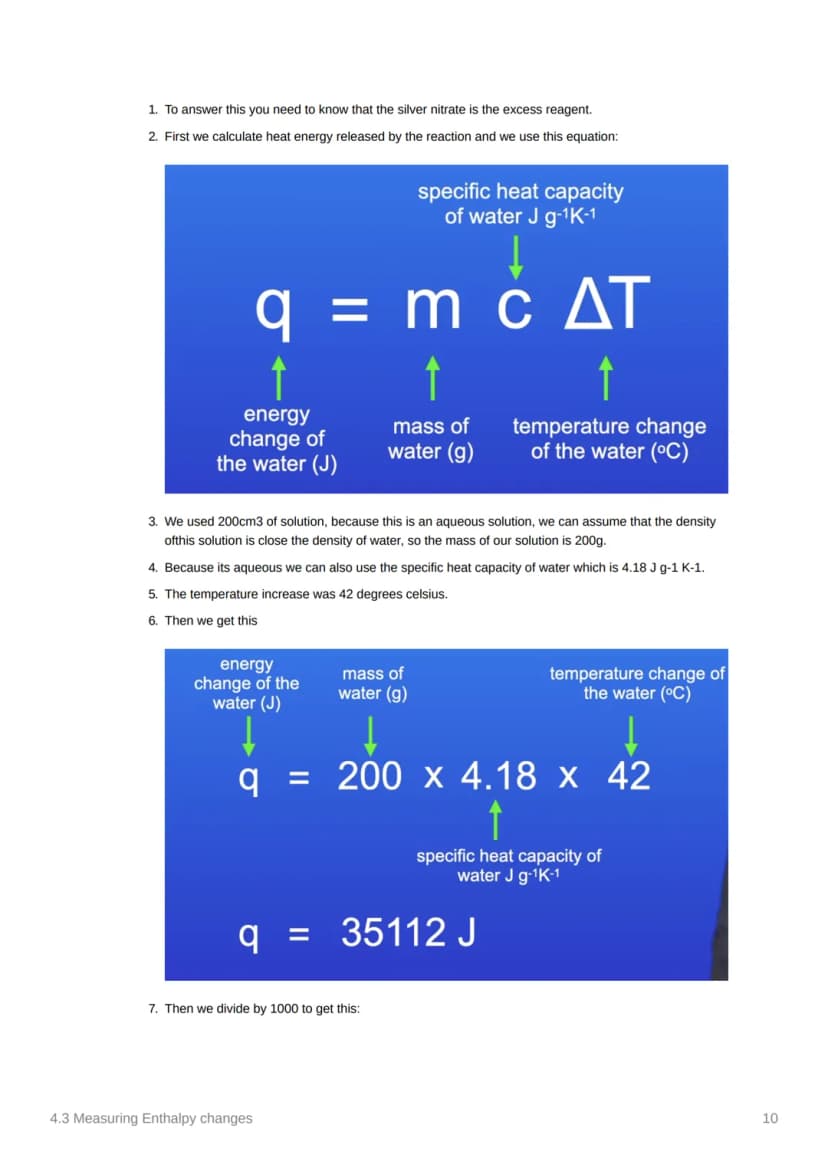
The fundamental equation for calculating heat energy in aqueous solutions relies on three key variables: mass, specific heat capacity, and temperature change. For aqueous solutions, we can make practical assumptions that simplify our calculations. Since most solutions are primarily water-based, we can use water's density and specific heat capacity (4.18 J g⁻¹K⁻¹) as reliable approximations.
Definition: The heat energy equation is expressed as q = mcΔT, where:
- q = energy change (J)
- m = mass of solution (g)
- c = specific heat capacity (J g⁻¹K⁻¹)
- ΔT = temperature change (°C)
When performing enthalpy change calculations, it's essential to follow a systematic approach. For example, with a 200cm³ solution experiencing a temperature increase of 42°C, we can calculate the energy change by multiplying these values: 200g × 4.18 J g⁻¹K⁻¹ × 42°C = 35,112 J. This result can then be converted to kilojoules by dividing by 1000, giving us 35.112 kJ.
10
of 10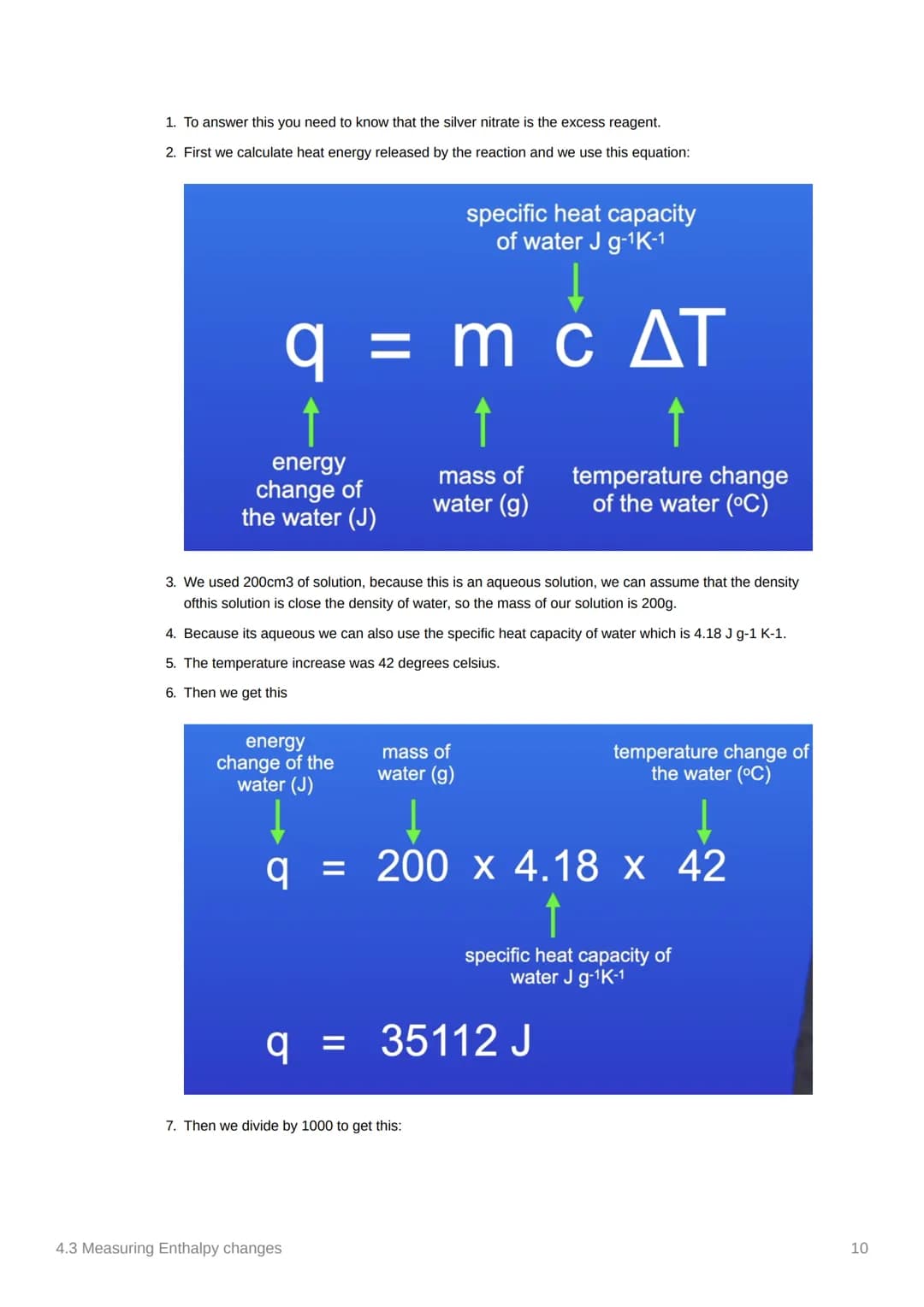
Advanced Applications of Enthalpy Change Calculations
Understanding how to calculate enthalpy change using bond energies requires attention to detail and proper application of thermodynamic principles. When working with standard conditions for measuring enthalpy changes, it's important to recognize that aqueous solutions behave differently from pure substances.
Highlight: When working with aqueous solutions:
- Assume the density is approximately equal to water
- Use water's specific heat capacity (4.18 J g⁻¹K⁻¹)
- Ensure measurements are taken under standard conditions
The enthalpy change formula A Level Chemistry applications extend beyond simple calculations. When dealing with reactions involving excess reagents, like silver nitrate solutions, it's crucial to account for the total volume of solution rather than just the limiting reagent. This understanding is particularly important for enthalpy change of neutralisation experiments.
For practical applications, students should remember that while these calculations provide theoretical values, real-world experiments might show slight variations due to heat loss to surroundings and other environmental factors. Understanding these potential discrepancies helps in developing a more comprehensive grasp of thermochemistry principles.
We thought you’d never ask...
What is the Knowunity AI companion?
Our AI companion is specifically built for the needs of students. Based on the millions of content pieces we have on the platform we can provide truly meaningful and relevant answers to students. But its not only about answers, the companion is even more about guiding students through their daily learning challenges, with personalised study plans, quizzes or content pieces in the chat and 100% personalisation based on the students skills and developments.
Where can I download the Knowunity app?
You can download the app in the Google Play Store and in the Apple App Store.
Is Knowunity really free of charge?
That's right! Enjoy free access to study content, connect with fellow students, and get instant help – all at your fingertips.
Similar Content
Most popular content in Chemistry
9G
ChemistryGCSE AQA Chemistry Topic 1- The Atom
The Atom
101,2790
Chemistrychem paper 1
higher
112,07843
ChemistryA-level OCR A Chemistry summary sheets
Everything from snaprevise for OCR chemistry a-level
122,28779
C
Chemistrychem paper 1
Unlock the secrets of chemical reactions with this comprehensive flashcard set designed to help you conquer complex concepts and ace your Chemistry exams.
117251
ChemistryEssential Chemistry Practicals
Explore key AQA GCSE Chemistry practicals, including flame tests, titration, and gas identification. This resource covers essential techniques for analyzing ions, making salts, and understanding reaction kinetics. Perfect for students preparing for exams and practical assessments.
1011,972902
A
ChemistryAQA GCSE Chemistry 4.4 Chemical changes
4.4 Reactions of acids with bases or carbonates
97531
ChemistryChemistry paper 2
Chem paper 2 notes
1172214
F
ChemistryFundamentals of Atomic Structure
Practice identifying subatomic particles, calculating neutrons, and defining isotopes and atomic/mass numbers.
123460
A
ChemistryAtomic Mass and Atomic Number Calculations
Calculate the number of protons, neutrons, and electrons for different elements and isotopes.
S34940
Most popular content
9 Sociology
Sociology of Education Overview
Explore comprehensive A-Level Sociology notes on the education system, covering key theories, policies, and sociological perspectives. This resource includes insights on marketisation, gender roles, cultural deprivation, and educational inequalities, providing a thorough understanding of how education shapes social stratification and individual achievement. Ideal for exam preparation and in-depth study.
12102,8693,040
SociologySociology of Families: Comprehensive Revision
Dive into an extensive overview of family dynamics, perspectives, and patterns in sociology. This resource covers key concepts such as family diversity, gender roles, marriage, and the impact of social policies on family structures. Perfect for A-Level Sociology students preparing for Paper 2.
1273,6612,307
CriminologyCriminology: Crime & Punishment Overview
Comprehensive mindmaps covering key concepts in the Crime and Punishment topic for WJEC Criminology Unit 4. This resource includes detailed insights into the Criminal Justice System, crime prevention strategies, sentencing models, and the roles of various agencies. Ideal for A-Level revision, ensuring you grasp essential theories and legislative processes to excel in your exams.
1254,8691,059
SociologyComprehensive Crime & Deviance Overview
Explore an extensive revision of crime and deviance topics, including theories, types of crime, and the impact of media. This resource covers key concepts such as Marxism, functionalism, gender and crime, and the influence of globalization on criminal behavior. Ideal for students seeking a thorough understanding of criminology and its various theories. Type: Full Topic Revision.
1251,6541,399
C
 Biology
Cell Biology and Cell structure
cell structures
93,2470
 English Literature
An Inspector Calls: Character Insights
Explore in-depth analysis and key quotes for characters in J.B. Priestley's 'An Inspector Calls'. This resource covers Gerald Croft, Inspector Goole, Sheila Birling, Mrs. Birling, Eric Birling, and Eva Smith, focusing on themes of class, gender roles, and social responsibility. Ideal for students aiming for Grade 8 and above.
1025,429907
CriminologyWJEC Unit 4 Criminology
Criminology unit 4 detailed revision note
127,151125
CriminologyCriminology Theories Overview
Explore key criminology theories and their implications on crime and deviance. This comprehensive summary covers biological, psychological, and sociological perspectives, including labelling theory, right realism, and the impact of social campaigns on policy development. Ideal for A-Level criminology students seeking to understand the complexities of criminal behaviour and the factors influencing crime prevention strategies.
129,760210
English LiteratureRomeo and Juliet: Key themes
Key Romeo and Juliet themes and analysed quotes
106,708198
Can't find what you're looking for? Explore other subjects.
Students love us — and so will you.
4.6/5App Store
4.7/5Google Play
The app is very easy to use and well designed. I have found everything I was looking for so far and have been able to learn a lot from the presentations! I will definitely use the app for a class assignment! And of course it also helps a lot as an inspiration.
Stefan SiOS user
This app is really great. There are so many study notes and help [...]. My problem subject is French, for example, and the app has so many options for help. Thanks to this app, I have improved my French. I would recommend it to anyone.
Samantha KlichAndroid user
Wow, I am really amazed. I just tried the app because I've seen it advertised many times and was absolutely stunned. This app is THE HELP you want for school and above all, it offers so many things, such as workouts and fact sheets, which have been VERY helpful to me personally.
AnnaiOS user
Chemistry330 views·Updated Jun 15, 2026·19 pagesA Level Chemistry: Enthalpy Change Calculations Worksheet and Answers
JJ@jjstudymaster
Understanding enthalpy change is fundamental to mastering A-level chemistry thermodynamics concepts.
The study of enthalpy change involves several key types of reactions and calculations that students need to master. The most common types include enthalpy change of neutralisation, which...
1
of 10
Sign up to see the content. It's free!
- Access to all documents
- Improve your grades
- Join milions of students
Understanding Enthalpy Changes in A-Level Chemistry
Standard Conditions and Measurements
The study of enthalpy change A level chemistry questions begins with understanding standard conditions. When measuring enthalpy changes, specific conditions must be maintained for accurate results. These include a temperature of 298 Kelvin (25°C), pressure of 100 kilopascals, and concentration of 1 mol dm⁻³ for solutions. All substances must be in their standard states - whether solid, liquid, or gas - to ensure consistent measurements.
Definition: Standard enthalpy change is measured in kJ mol⁻¹ and represents the energy change when reactants transform into products under standard conditions.
The fundamental equation for calculating enthalpy changes involves q = mcΔT, where q represents energy transfer, m is mass, c is specific heat capacity, and ΔT is temperature change. For water-based solutions, the specific heat capacity is 4.18 J/g/°C, and 1 cm³ equals 1g of solution.
Understanding these principles is crucial for solving A level chemistry enthalpy change calculations questions and answers. Students must remember to include positive or negative signs to indicate endothermic or exothermic reactions respectively.
2
of 10Sign up to see the content. It's free!
- Access to all documents
- Improve your grades
- Join milions of students
Calculating Enthalpy Changes of Combustion
The standard enthalpy change of combustion (ΔHc) represents a crucial concept in thermochemistry. It measures the energy change when one mole of a substance completely burns in oxygen under standard conditions.
Example: Consider the combustion of ethane: C₂H₆(g) + 3.5O₂(g) → 2CO₂(g) + 3H₂O(l)
When calculating the enthalpy change of combustion formula A Level, several key points must be considered:
- Complete combustion produces only carbon dioxide and water
- All reactants and products must be in their standard states
- The equation must be balanced
- One mole of fuel is always used as the reference
Highlight: For accurate calculations, remember that mass measurements must be converted to moles using molar mass, and energy values should be expressed in kJ mol⁻¹.
3
of 10Sign up to see the content. It's free!
- Access to all documents
- Improve your grades
- Join milions of students
Practical Applications and Calculations
Learning how to calculate enthalpy change using bond energies involves understanding both theoretical principles and practical applications. In experimental settings, the process typically involves measuring temperature changes in water when a fuel combusts.
For example, when calculating the enthalpy change of combustion of ethanol, follow these steps:
- Measure the mass of water and temperature change
- Calculate energy transferred using q = mcΔT
- Convert joules to kilojoules
- Calculate moles of fuel used
- Determine enthalpy change per mole
Vocabulary: The specific heat capacity of water is a crucial constant in these calculations.
4
of 10Sign up to see the content. It's free!
- Access to all documents
- Improve your grades
- Join milions of students
Advanced Concepts and Problem-Solving
Understanding standard enthalpy change of formation symbol and related concepts helps in solving complex problems. When working with enthalpy change calculations pdf resources, students should focus on:
- Converting between units (J to kJ, g to mol)
- Identifying standard states of all substances
- Recognizing endothermic versus exothermic processes
- Applying Hess's Law for indirect calculations
Definition: The standard enthalpy change of neutralisation is the energy change when one mole of H⁺ ions reacts with one mole of OH⁻ ions under standard conditions.
These concepts interconnect with other areas of chemistry, including thermodynamics and chemical bonding. Understanding these relationships helps in mastering enthalpy change questions and answers A Level.
5
of 10Sign up to see the content. It's free!
- Access to all documents
- Improve your grades
- Join milions of students
Understanding Enthalpy Change Calculations in Chemistry
The calculation of enthalpy change involves several key steps and concepts that are fundamental to A-level chemistry. When measuring enthalpy changes, particularly for enthalpy change of combustion, we need to follow specific procedures and calculations.
Definition: Enthalpy change is the heat energy transferred between a system and its surroundings during a chemical reaction under constant pressure.
For combustion reactions, we first determine the mass of fuel used and convert it to moles using the molar mass. The thermal energy transfer is calculated using the formula Q = mcΔT, where:
- m = mass of water in grams
- c = specific heat capacity of water
- ΔT = temperature change in degrees Celsius
Example: For ethanol combustion:
- Mass of ethanol = 3.75g
- Molar mass = 46.0 g/mol
- Number of moles = 0.0815 mol
- Resulting enthalpy change = -748.8 kJ/mol
6
of 10Sign up to see the content. It's free!
- Access to all documents
- Improve your grades
- Join milions of students
Calculating Enthalpy Change of Combustion
How to calculate enthalpy change using bond energies requires careful experimental setup and precise measurements. The process involves burning a known mass of fuel under controlled conditions.
Highlight: Combustion reactions are always exothermic, resulting in negative enthalpy values.
For example, when calculating the enthalpy change of combustion for propan-1-ol:
- Measure the heat exchange using Q = mcΔT
- Convert the mass of fuel to moles
- Calculate the enthalpy change per mole
- Express the result with proper units
Example: For propan-1-ol combustion: CH₃CH₂CH₂OH(l) + 4O₂(g) → 3CO₂(g) + 4H₂O(l) ΔH = -1881 kJ/mol
7
of 10Sign up to see the content. It's free!
- Access to all documents
- Improve your grades
- Join milions of students
Standard Enthalpy Changes and Neutralization
The standard enthalpy change of neutralisation is a specific type of enthalpy change that occurs when acids and bases react.
Definition: Standard enthalpy change of neutralization is the energy change when one mole of water is formed from H⁺ and OH⁻ ions under standard conditions.
For strong acids and bases, the enthalpy change of neutralization is consistently -57 kJ/mol. This consistency occurs because the fundamental reaction is always:
H⁺(aq) + OH⁻(aq) → H₂O(l)
Vocabulary: Standard conditions refer to:
- 298K (25°C)
- 1 atmosphere pressure
- 1 mol/dm³ concentration for solutions
8
of 10Sign up to see the content. It's free!
- Access to all documents
- Improve your grades
- Join milions of students
Experimental Measurements and Calculations
When determining enthalpy change A level chemistry questions, proper experimental technique is crucial. Heat measurements are typically indirect, using calorimetry methods.
Highlight: Key factors in enthalpy measurements:
- Mass of substance
- Temperature change
- Specific heat capacity
- Heat losses to surroundings
For example, in a reaction between zinc and silver nitrate:
- Measure initial temperatures
- Record temperature changes
- Account for heat losses
- Calculate final enthalpy change
Example: For a reaction using:
- 6.54g Zn
- 200cm³ of 1M AgNO₃
- Temperature increase of 42°C Calculate the enthalpy change considering all heat transfers and stoichiometry.
9
of 10Sign up to see the content. It's free!
- Access to all documents
- Improve your grades
- Join milions of students
Understanding Enthalpy Change Measurements in Chemistry
When studying enthalpy change A level chemistry questions, it's crucial to understand how to calculate heat energy released during chemical reactions. The process involves careful consideration of several factors and the application of specific formulas.
The fundamental equation for calculating heat energy in aqueous solutions relies on three key variables: mass, specific heat capacity, and temperature change. For aqueous solutions, we can make practical assumptions that simplify our calculations. Since most solutions are primarily water-based, we can use water's density and specific heat capacity (4.18 J g⁻¹K⁻¹) as reliable approximations.
Definition: The heat energy equation is expressed as q = mcΔT, where:
- q = energy change (J)
- m = mass of solution (g)
- c = specific heat capacity (J g⁻¹K⁻¹)
- ΔT = temperature change (°C)
When performing enthalpy change calculations, it's essential to follow a systematic approach. For example, with a 200cm³ solution experiencing a temperature increase of 42°C, we can calculate the energy change by multiplying these values: 200g × 4.18 J g⁻¹K⁻¹ × 42°C = 35,112 J. This result can then be converted to kilojoules by dividing by 1000, giving us 35.112 kJ.
10
of 10Sign up to see the content. It's free!
- Access to all documents
- Improve your grades
- Join milions of students
Advanced Applications of Enthalpy Change Calculations
Understanding how to calculate enthalpy change using bond energies requires attention to detail and proper application of thermodynamic principles. When working with standard conditions for measuring enthalpy changes, it's important to recognize that aqueous solutions behave differently from pure substances.
Highlight: When working with aqueous solutions:
- Assume the density is approximately equal to water
- Use water's specific heat capacity (4.18 J g⁻¹K⁻¹)
- Ensure measurements are taken under standard conditions
The enthalpy change formula A Level Chemistry applications extend beyond simple calculations. When dealing with reactions involving excess reagents, like silver nitrate solutions, it's crucial to account for the total volume of solution rather than just the limiting reagent. This understanding is particularly important for enthalpy change of neutralisation experiments.
For practical applications, students should remember that while these calculations provide theoretical values, real-world experiments might show slight variations due to heat loss to surroundings and other environmental factors. Understanding these potential discrepancies helps in developing a more comprehensive grasp of thermochemistry principles.
We thought you’d never ask...
What is the Knowunity AI companion?
Our AI companion is specifically built for the needs of students. Based on the millions of content pieces we have on the platform we can provide truly meaningful and relevant answers to students. But its not only about answers, the companion is even more about guiding students through their daily learning challenges, with personalised study plans, quizzes or content pieces in the chat and 100% personalisation based on the students skills and developments.
Where can I download the Knowunity app?
You can download the app in the Google Play Store and in the Apple App Store.
Is Knowunity really free of charge?
That's right! Enjoy free access to study content, connect with fellow students, and get instant help – all at your fingertips.
Similar Content
Most popular content in Chemistry
9G
ChemistryGCSE AQA Chemistry Topic 1- The Atom
The Atom
101,2790
Chemistrychem paper 1
higher
112,07843
ChemistryA-level OCR A Chemistry summary sheets
Everything from snaprevise for OCR chemistry a-level
122,28779
C
Chemistrychem paper 1
Unlock the secrets of chemical reactions with this comprehensive flashcard set designed to help you conquer complex concepts and ace your Chemistry exams.
117251
ChemistryEssential Chemistry Practicals
Explore key AQA GCSE Chemistry practicals, including flame tests, titration, and gas identification. This resource covers essential techniques for analyzing ions, making salts, and understanding reaction kinetics. Perfect for students preparing for exams and practical assessments.
1011,972902
A
ChemistryAQA GCSE Chemistry 4.4 Chemical changes
4.4 Reactions of acids with bases or carbonates
97531
ChemistryChemistry paper 2
Chem paper 2 notes
1172214
F
ChemistryFundamentals of Atomic Structure
Practice identifying subatomic particles, calculating neutrons, and defining isotopes and atomic/mass numbers.
123460
A
ChemistryAtomic Mass and Atomic Number Calculations
Calculate the number of protons, neutrons, and electrons for different elements and isotopes.
S34940
Most popular content
9SociologySociology of Education Overview
Explore comprehensive A-Level Sociology notes on the education system, covering key theories, policies, and sociological perspectives. This resource includes insights on marketisation, gender roles, cultural deprivation, and educational inequalities, providing a thorough understanding of how education shapes social stratification and individual achievement. Ideal for exam preparation and in-depth study.
12102,8693,040
SociologySociology of Families: Comprehensive Revision
Dive into an extensive overview of family dynamics, perspectives, and patterns in sociology. This resource covers key concepts such as family diversity, gender roles, marriage, and the impact of social policies on family structures. Perfect for A-Level Sociology students preparing for Paper 2.
1273,6612,307
CriminologyCriminology: Crime & Punishment Overview
Comprehensive mindmaps covering key concepts in the Crime and Punishment topic for WJEC Criminology Unit 4. This resource includes detailed insights into the Criminal Justice System, crime prevention strategies, sentencing models, and the roles of various agencies. Ideal for A-Level revision, ensuring you grasp essential theories and legislative processes to excel in your exams.
1254,8691,059
SociologyComprehensive Crime & Deviance Overview
Explore an extensive revision of crime and deviance topics, including theories, types of crime, and the impact of media. This resource covers key concepts such as Marxism, functionalism, gender and crime, and the influence of globalization on criminal behavior. Ideal for students seeking a thorough understanding of criminology and its various theories. Type: Full Topic Revision.
1251,6541,399
C
BiologyCell Biology and Cell structure
cell structures
93,2470
English LiteratureAn Inspector Calls: Character Insights
Explore in-depth analysis and key quotes for characters in J.B. Priestley's 'An Inspector Calls'. This resource covers Gerald Croft, Inspector Goole, Sheila Birling, Mrs. Birling, Eric Birling, and Eva Smith, focusing on themes of class, gender roles, and social responsibility. Ideal for students aiming for Grade 8 and above.
1025,429907
CriminologyWJEC Unit 4 Criminology
Criminology unit 4 detailed revision note
127,151125
CriminologyCriminology Theories Overview
Explore key criminology theories and their implications on crime and deviance. This comprehensive summary covers biological, psychological, and sociological perspectives, including labelling theory, right realism, and the impact of social campaigns on policy development. Ideal for A-Level criminology students seeking to understand the complexities of criminal behaviour and the factors influencing crime prevention strategies.
129,760210
English LiteratureRomeo and Juliet: Key themes
Key Romeo and Juliet themes and analysed quotes
106,708198
Can't find what you're looking for? Explore other subjects.
Students love us — and so will you.
4.6/5App Store
4.7/5Google Play
The app is very easy to use and well designed. I have found everything I was looking for so far and have been able to learn a lot from the presentations! I will definitely use the app for a class assignment! And of course it also helps a lot as an inspiration.
Stefan SiOS user
This app is really great. There are so many study notes and help [...]. My problem subject is French, for example, and the app has so many options for help. Thanks to this app, I have improved my French. I would recommend it to anyone.
Samantha KlichAndroid user
Wow, I am really amazed. I just tried the app because I've seen it advertised many times and was absolutely stunned. This app is THE HELP you want for school and above all, it offers so many things, such as workouts and fact sheets, which have been VERY helpful to me personally.
AnnaiOS user