
Mitosis is the process where a single cell divides into...
 Biology40 views·Updated Jun 14, 2026·15 pages
The 6 Phases of Cell Cycle Explained

Lalia Weir@lalialovescarti

1 / 10
1
of 10
Phases of Mitosis
Mitosis is how one cell becomes two identical cells. This process is happening in your body right now, helping you heal cuts, grow taller, and replace worn-out cells.
The complete process involves several distinct phases, each with specific events that ensure genetic information is passed correctly to new cells.
Quick Fact: Every day, your body produces billions of new cells through mitosis to replace cells that have died or been damaged!
2
of 10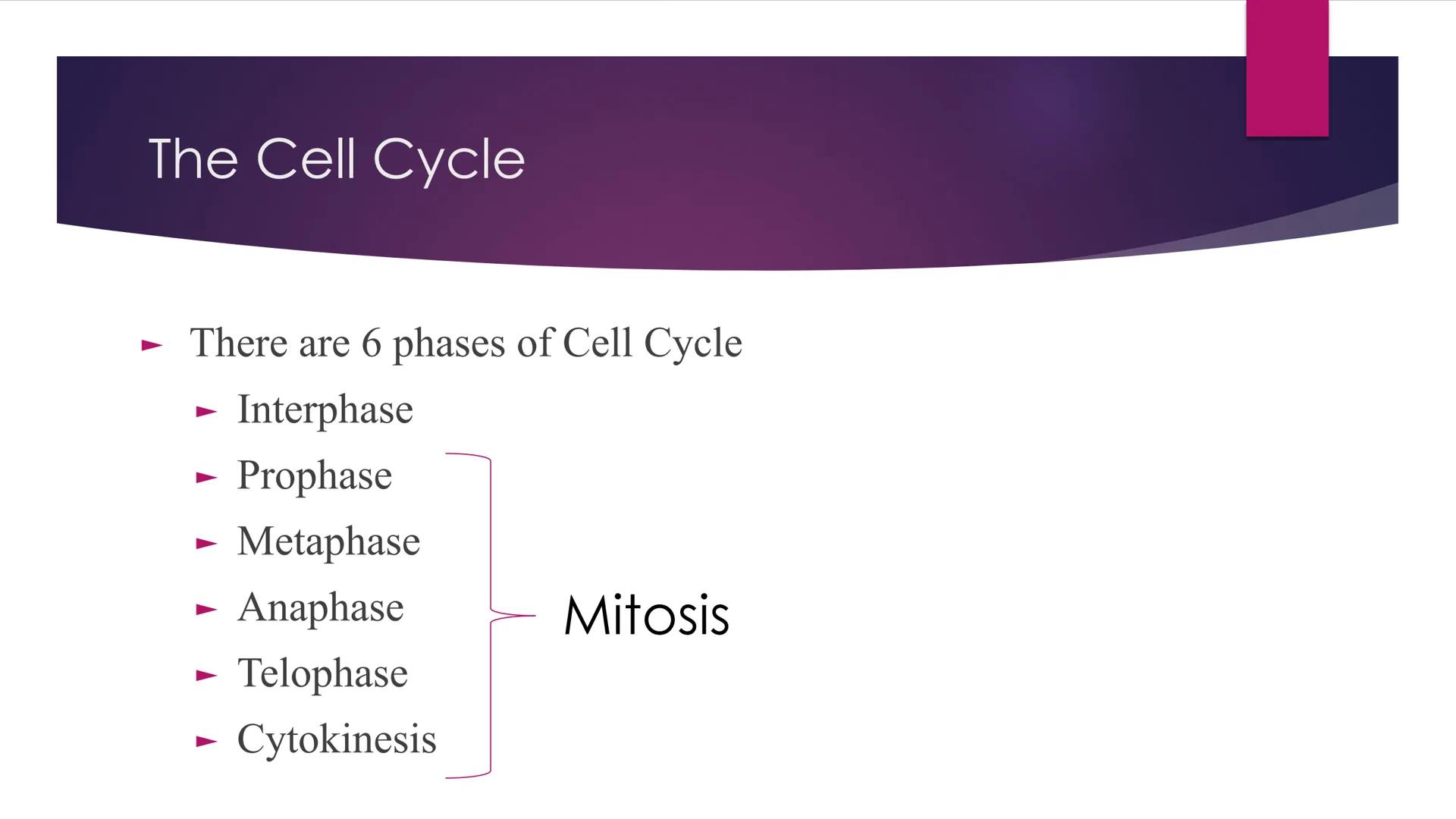
The Cell Cycle
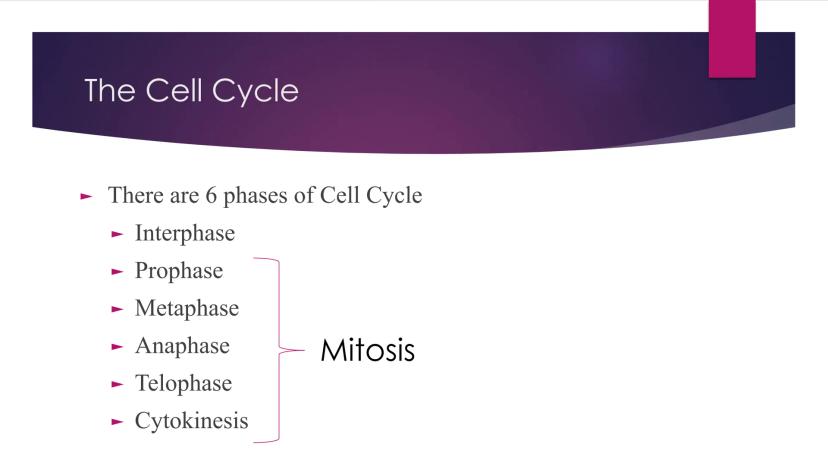
The cell cycle consists of 6 key phases that cells go through when dividing. These phases include Interphase (when the cell prepares for division) and the phases of mitosis: Prophase, Metaphase, Anaphase, and Telophase, followed by Cytokinesis.
Each phase plays a crucial role in making sure the genetic material is accurately copied and distributed to the new cells.
Understanding this cycle helps explain how your body grows and repairs itself throughout your life.
3
of 10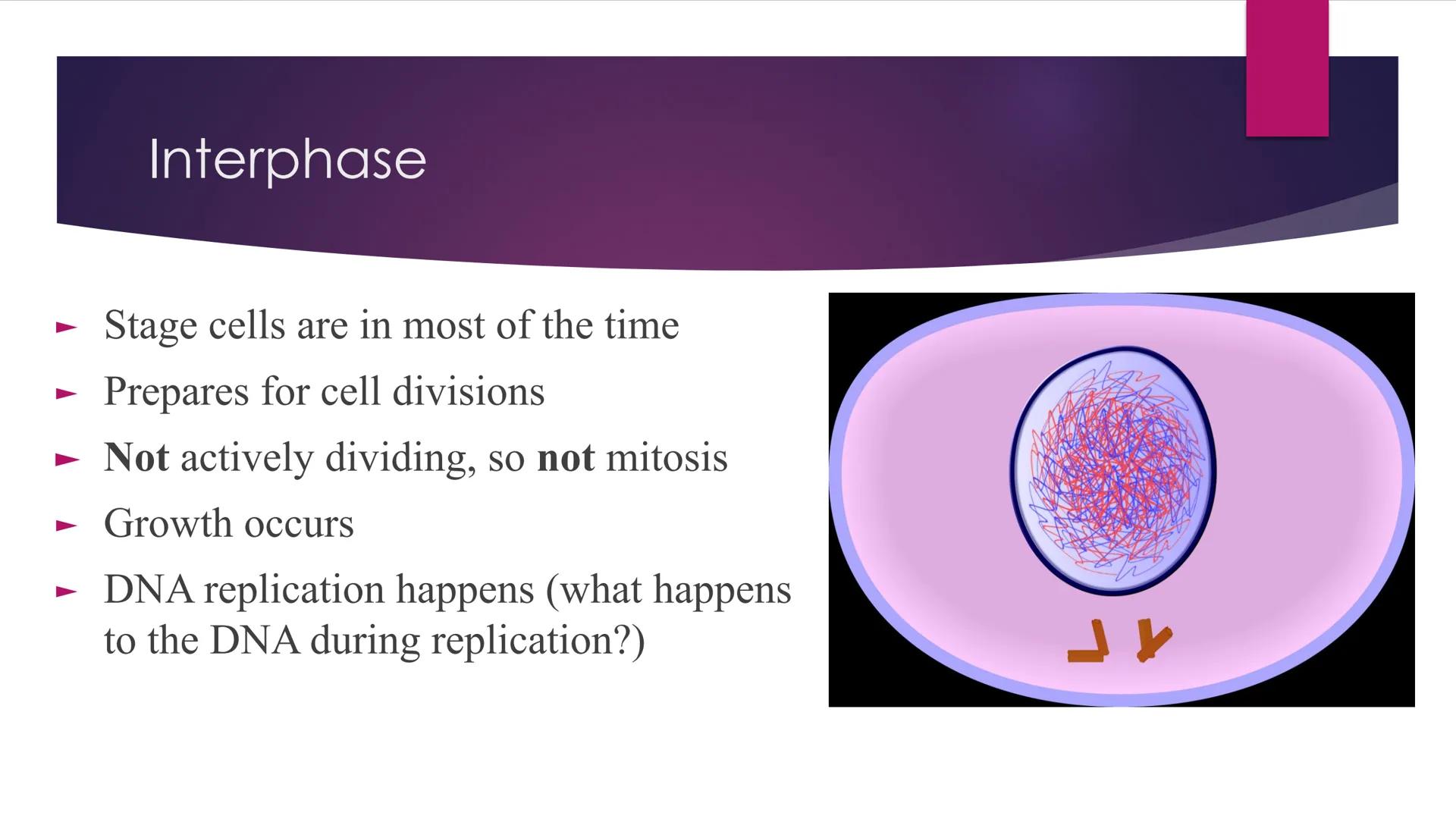
Interphase
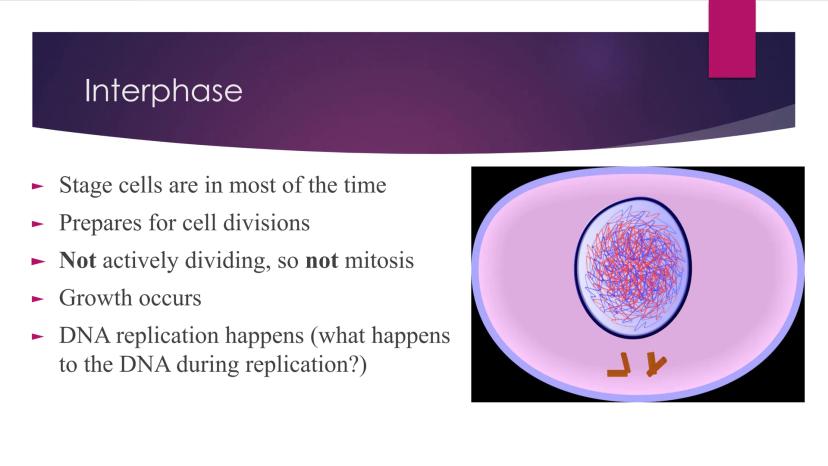
Interphase is when cells spend most of their time. Think of it as the prep stage before the main event of cell division.
During interphase, the cell grows larger and makes a complete copy of its DNA through a process called replication. This ensures each new daughter cell will receive a full set of genetic instructions.
Although the cell isn't actively dividing during interphase, it's busy preparing everything needed for a successful division later.
Remember: While interphase isn't technically part of mitosis, it's a critical preparatory stage where DNA duplication occurs!
4
of 10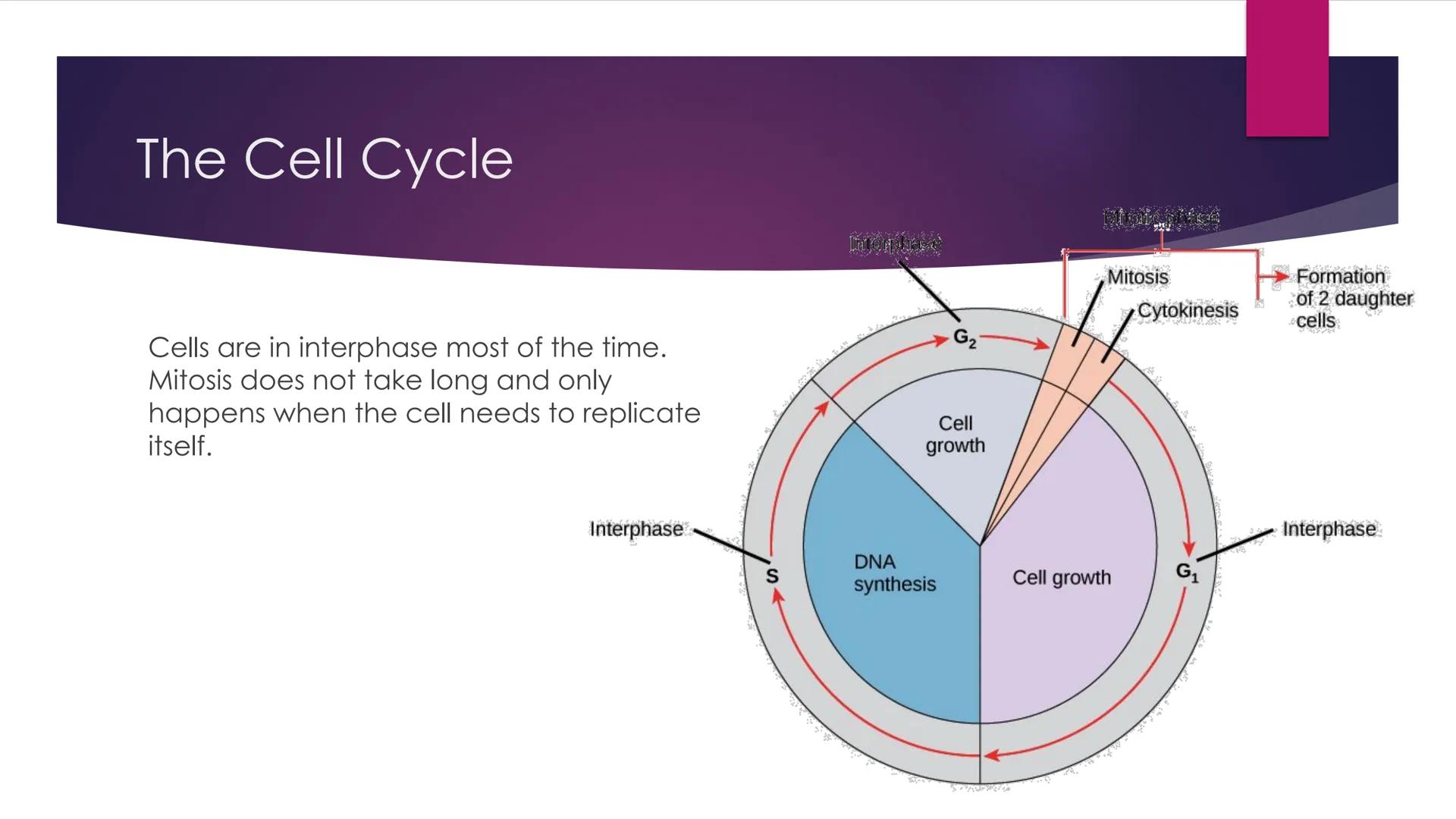
The Cell Cycle in Detail
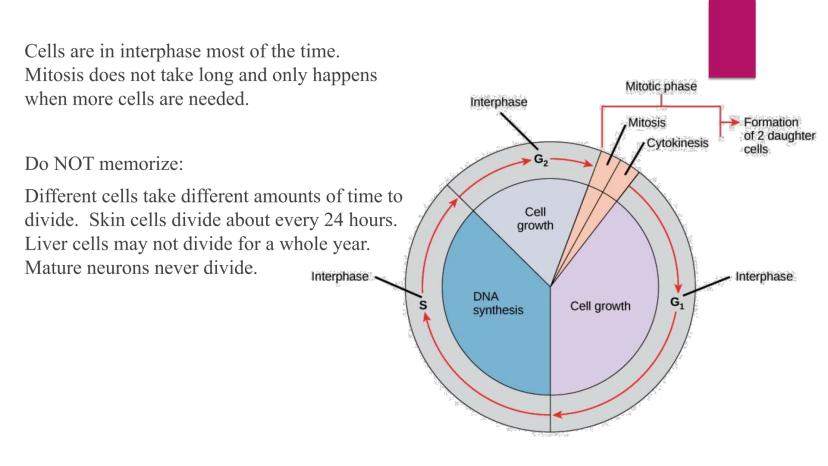
The cell cycle alternates between long periods of interphase and brief periods of mitosis followed by cytokinesis (the physical splitting of the cell).
Interphase itself has three stages: G₁ (first growth phase), S (DNA synthesis), and G₂ (second growth phase). During these stages, the cell increases in size and duplicates its DNA.
Mitosis is the shorter, more dramatic part where the duplicated DNA is sorted into two new nuclei, with cytokinesis finishing the job by creating two separate cells.
5
of 10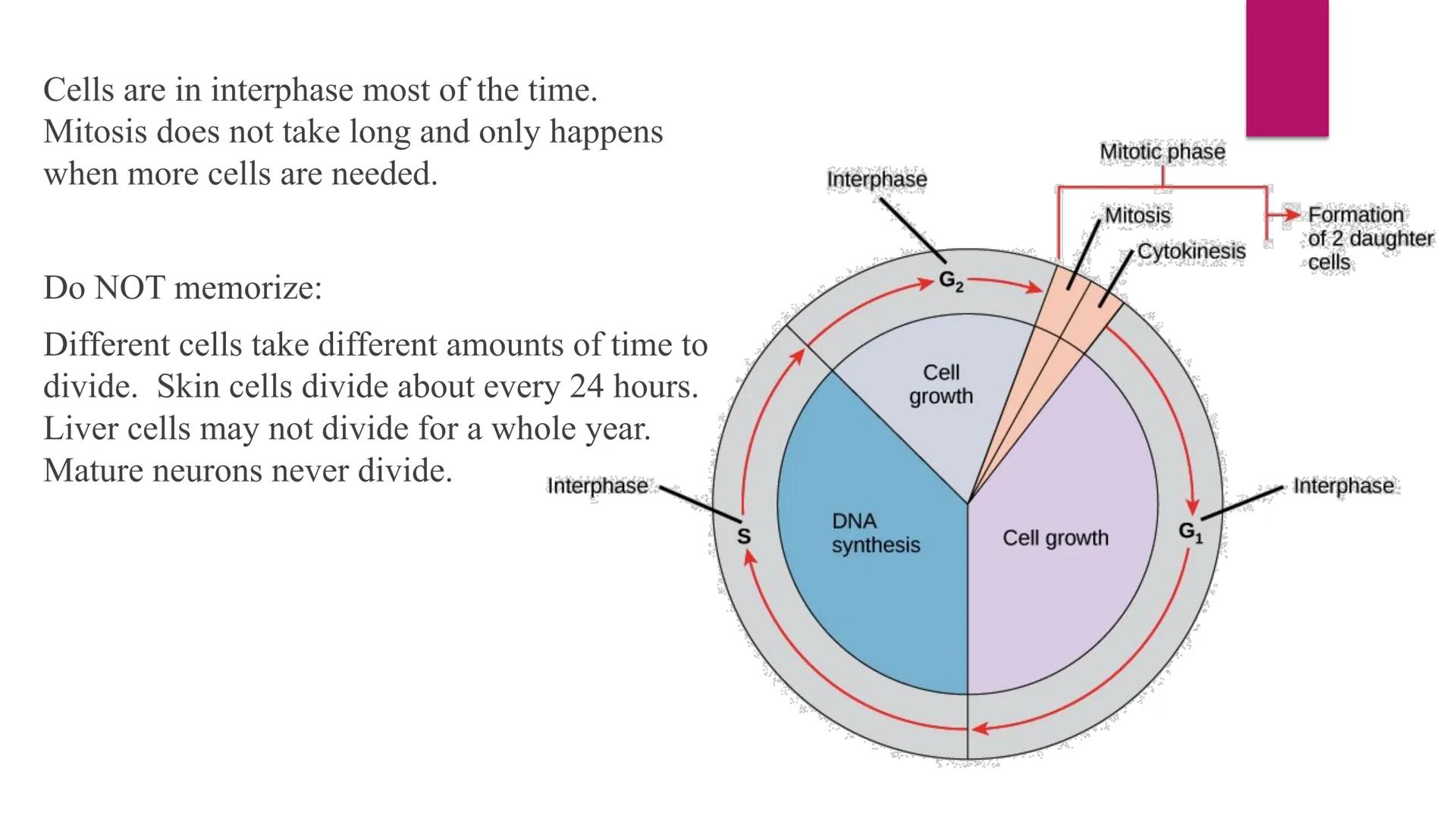
Timing of Cell Division
Cells spend most of their time in interphase, with mitosis being a relatively brief event that only happens when new cells are needed.
Different types of cells divide at dramatically different rates. Skin cells divide approximately every 24 hours, while liver cells might only divide once a year. Interestingly, mature neurons (brain cells) don't divide at all.
This varied timing explains why cuts on your skin heal quickly, while damaged nerve cells typically don't regenerate.
Fascinating fact: The cells lining your stomach replace themselves every 2-3 days, which is why your stomach can heal quickly after minor irritations!
6
of 10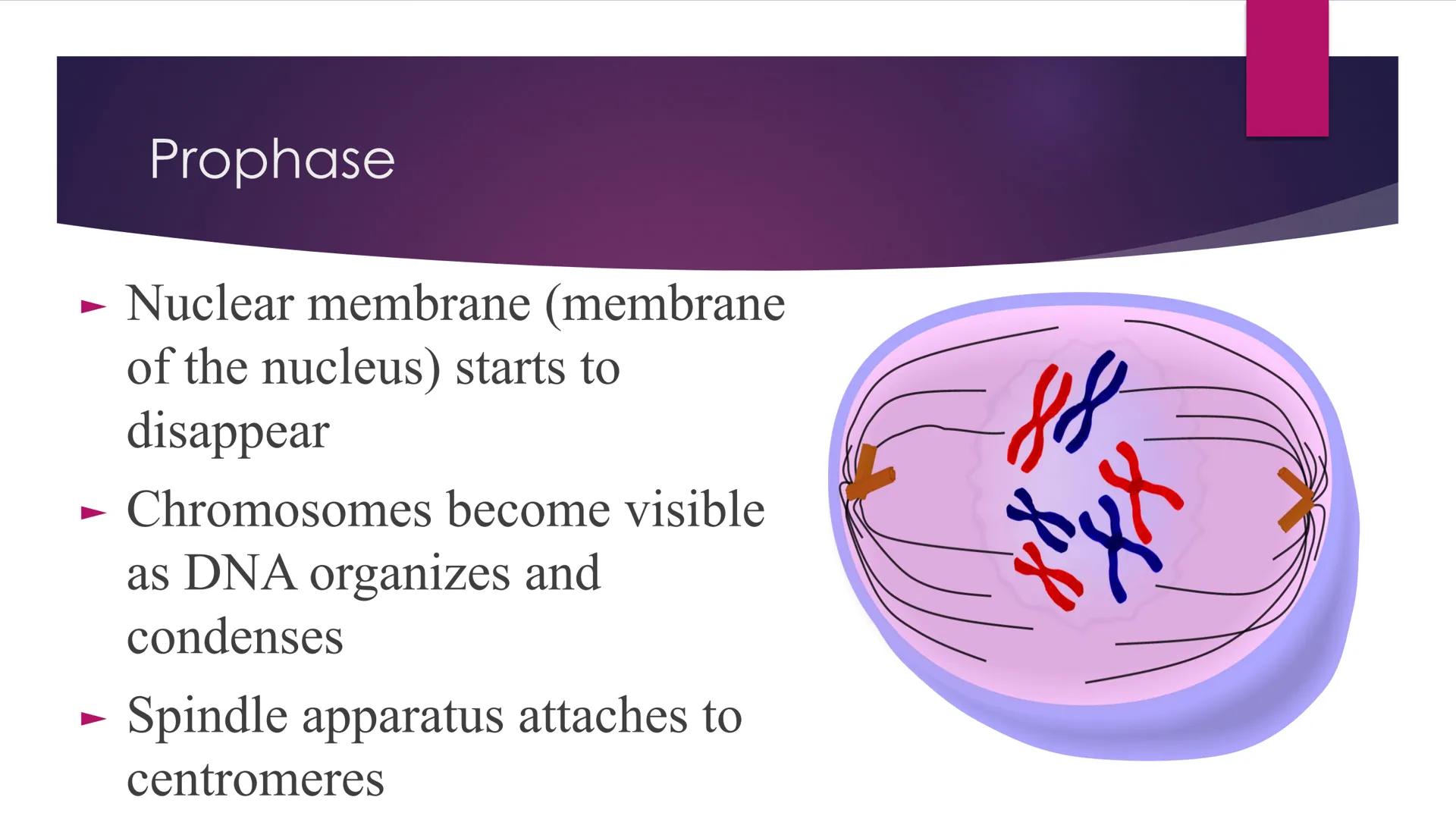
Prophase
Prophase marks the beginning of mitosis when visible changes start occurring in the cell.
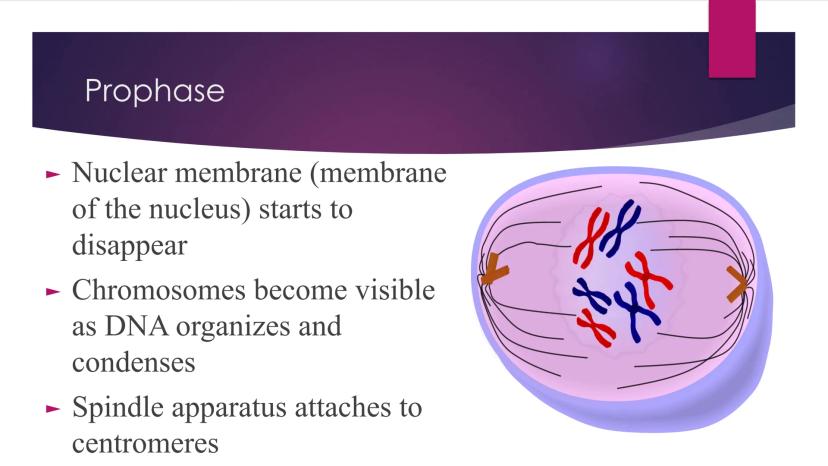
During this phase, the nuclear membrane begins to disappear, making the barrier between the nucleus and the rest of the cell fade away. The DNA, which was spread out during interphase, condenses into visible chromosomes that look like X-shaped structures.
Meanwhile, the spindle apparatus forms and attaches to the centromeres (the middle part of each chromosome). This spindle will later help separate the chromosomes.
7
of 10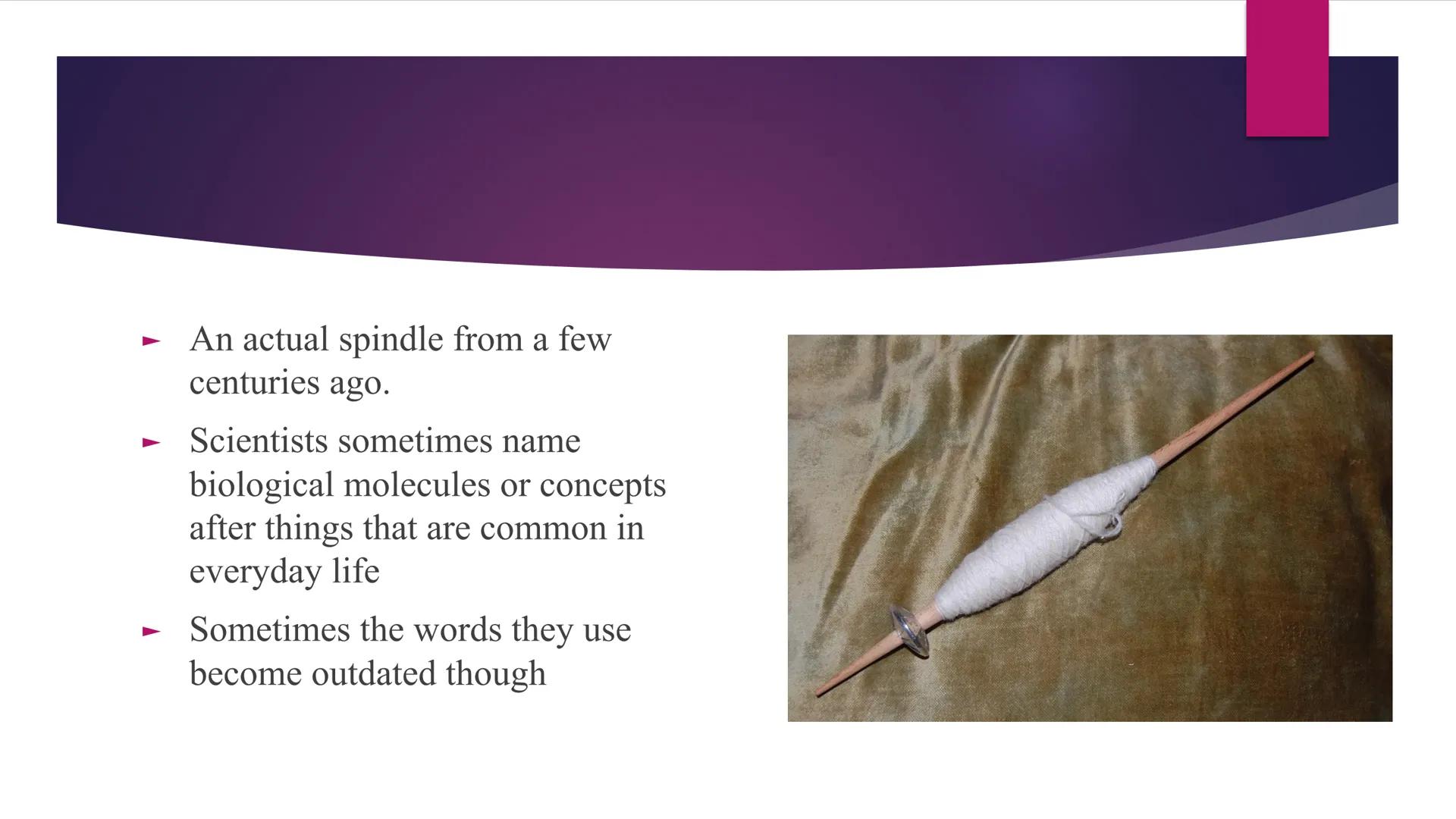
Scientific Naming
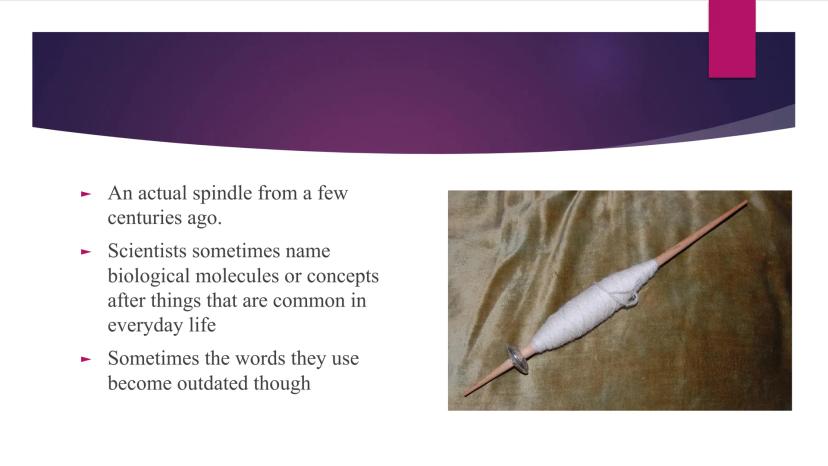
Scientists often name biological structures after everyday objects they resemble. The spindle apparatus in mitosis was named after spinning wheel spindles used centuries ago for making thread.
This naming tradition helps scientists visualize and remember complex biological concepts by connecting them to familiar objects.
However, as everyday technology changes, some of these names become less familiar to modern students, though they remain in scientific terminology.
Fun fact: Many scientific terms come from everyday objects - like the "dendrites" of neurons, named after tree branches (dendron means "tree" in Greek)!
8
of 10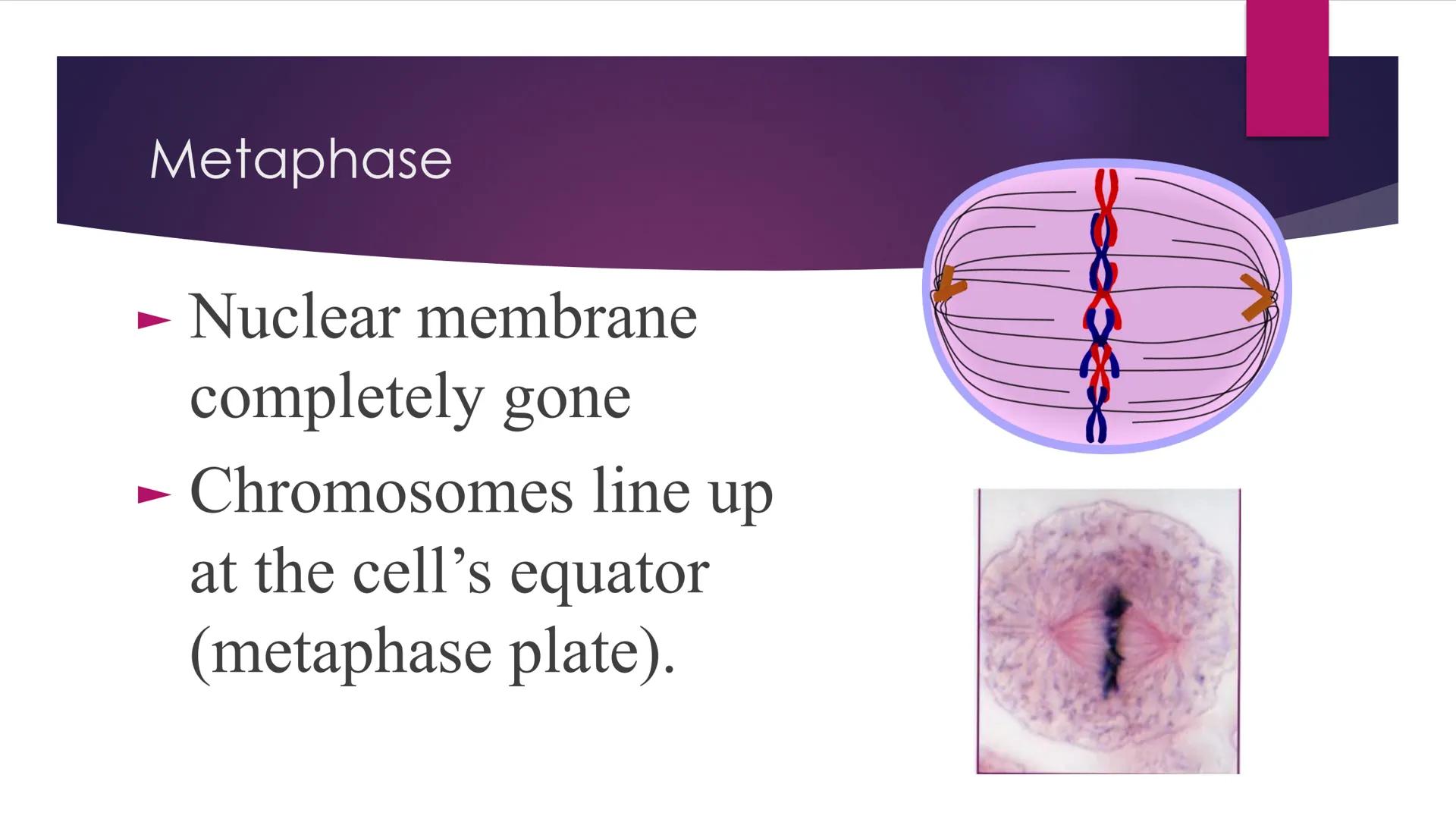
Metaphase
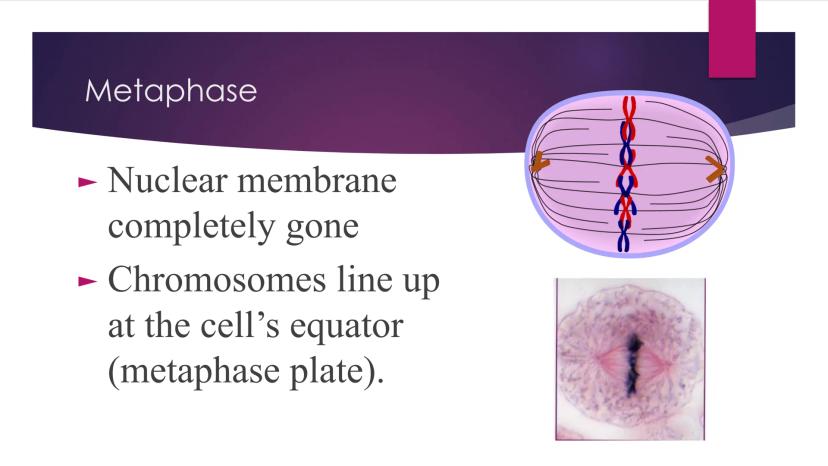
Metaphase is the alignment phase of mitosis. During this stage, the nuclear membrane has completely disappeared, leaving no barrier between the chromosomes and the rest of the cell.
The chromosomes line up precisely along the cell's equator, also called the metaphase plate. This middle-line arrangement is crucial for ensuring each new cell will receive an equal set of chromosomes.
Think of metaphase as the chromosomes lining up at the starting line before the race to opposite sides of the cell begins.
9
of 10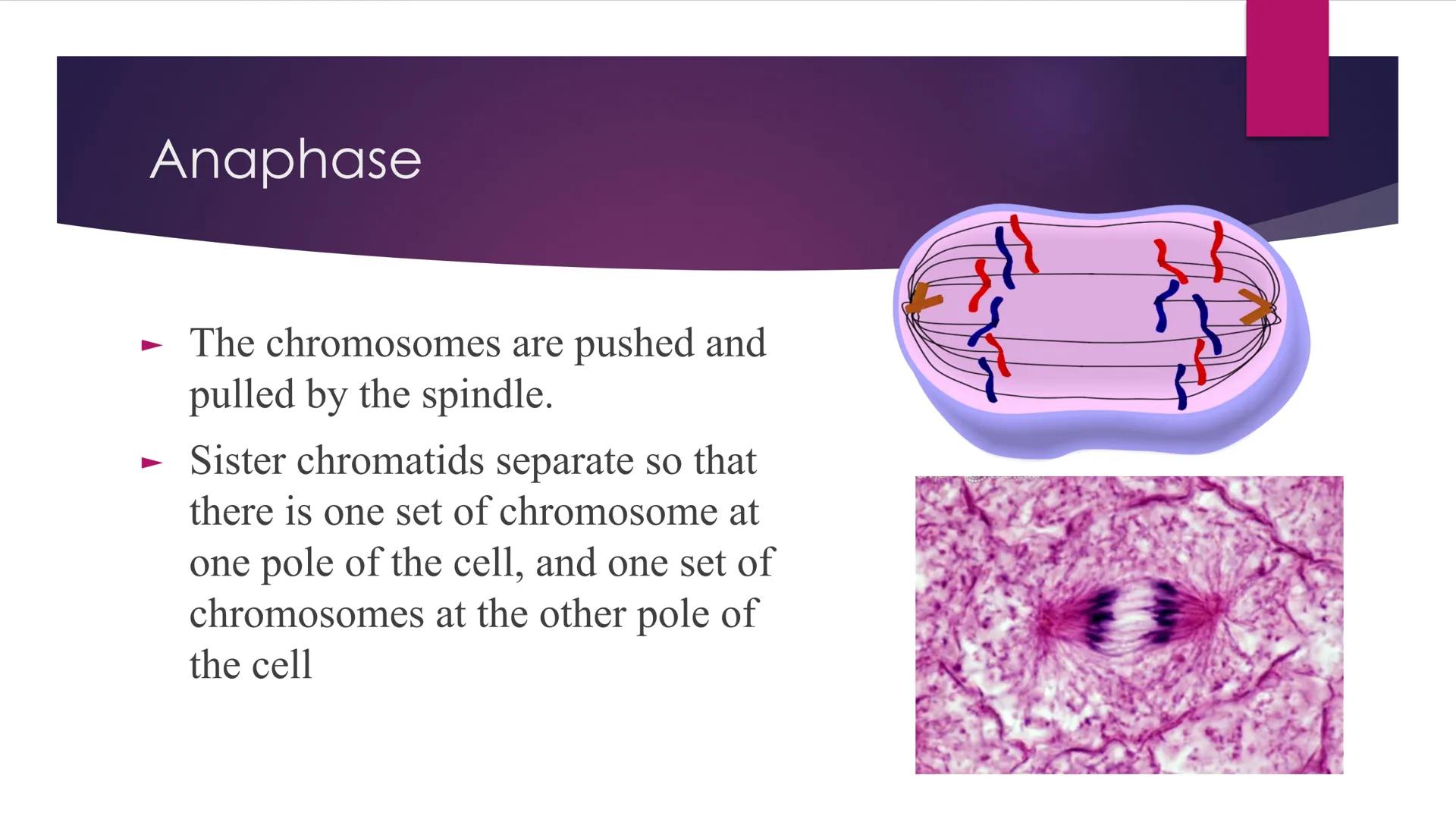
Anaphase
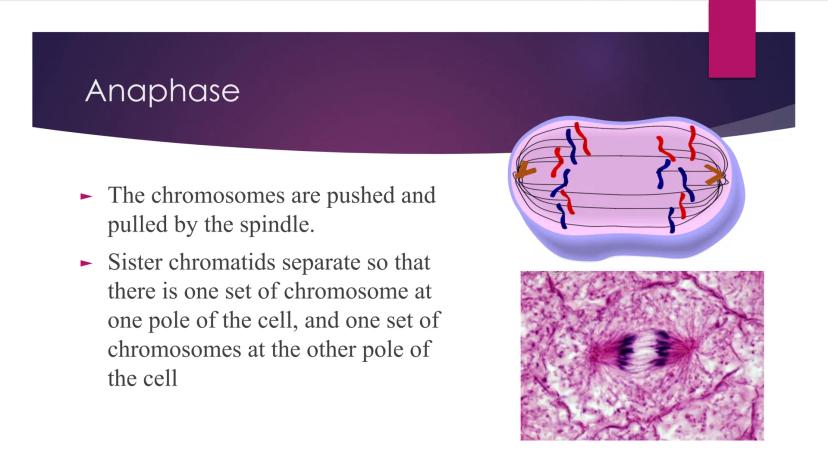
Anaphase is the separation phase and one of the most dramatic parts of mitosis. During this phase, the spindle fibers actively push and pull the chromosomes.
The sister chromatids (the identical halves of each chromosome) separate from each other and move to opposite poles of the cell. This ensures that each future daughter cell will receive one complete set of chromosomes.
This movement resembles a choreographed dance as the chromosomes travel simultaneously toward opposite ends of the cell, creating two equal genetic collections.
10
of 10
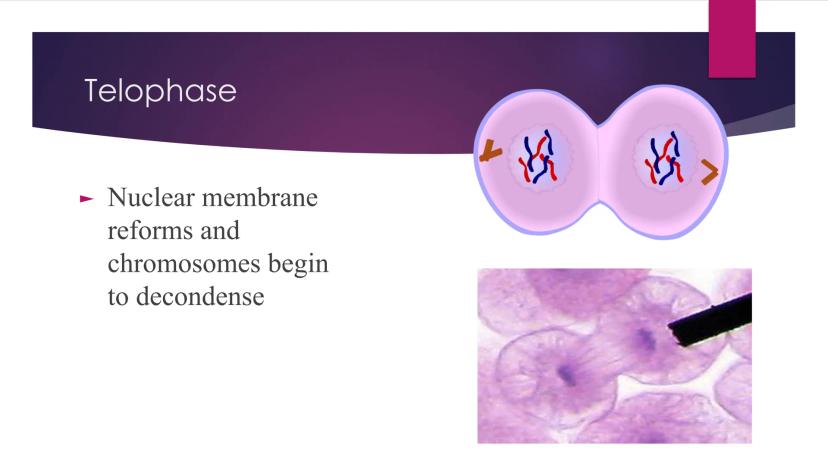
Telophase
During telophase, the cell begins to finalize the creation of two new nuclei. The nuclear membrane starts to reform around each set of chromosomes that reached the poles during anaphase.
The chromosomes also begin to decondense, returning to their more relaxed state as they were during interphase. They become less visible as they spread out within the newly forming nuclei.
Telophase essentially reverses many of the changes that happened during prophase, preparing for the final separation of the cell.
Key insight: The prefix "telo-" means "end," making telophase the "end phase" of mitosis before cytokinesis completes the division!
We thought you’d never ask...
What is the Knowunity AI companion?
Our AI companion is specifically built for the needs of students. Based on the millions of content pieces we have on the platform we can provide truly meaningful and relevant answers to students. But its not only about answers, the companion is even more about guiding students through their daily learning challenges, with personalised study plans, quizzes or content pieces in the chat and 100% personalisation based on the students skills and developments.
Where can I download the Knowunity app?
You can download the app in the Google Play Store and in the Apple App Store.
Is Knowunity really free of charge?
That's right! Enjoy free access to study content, connect with fellow students, and get instant help – all at your fingertips.
Similar Content
Most popular content: Cytokinesis
1Most popular content in Biology
9C
BiologyCell Organelles
This Quiz Is To Test Your Knowledge Of Cell Organelles And Their Functions Inside The Cell. It Can Also Be A Study Guide To Remember Them Better.
6th6710
B
Biologybiology cell organelles and functions
Do you know the cell organelles and their functions?
9th4410
M
BiologyMitosis and Cell Division Flashcards
These flashcards cover the basics of mitosis and why cell division occurs in the first place.
9th3390
D
BiologyDNA and RNA
Uncover the secrets of life with this comprehensive Biology flashcard set. Perfect for grade 10 students studying Living Environment.
10th1,0782
D
BiologyDiscover the Fascinating World of Living Organisms
Uncover the secrets of biology and explore the diverse and amazing life forms that inhabit our planet with this captivating flashcard set.
7th4380
A
BiologyAnimal and plant cell structure
Quiz on animal and plant cell structures
9th3240
D
BiologyDiscover Punnet Squares
Uncover the secrets of life with this comprehensive Biology flashcard set. Perfect for grade 10 students studying Living Environment.
10th3961
D
BiologyDNA
Parts of DNA
9th2970
S
BiologySteps of Cellular Respiration
3 basic steps and Molecule Vocab
9th2660
Most popular content
9O
 AP US History
Origins and Dynamics of the Columbian Exchange
Analyze the ecological and economic motivations behind the initial transfer of goods, people, and diseases between the Old and New Worlds.
9th3,1280
I
AP US HistoryIntroduction to Early Cultural Interactions
Analyze the initial social and religious encounters between Europeans, Africans, and Indigenous peoples in the colonial Americas.
9th2,7730
O
 AP World History
Origins of Ancient River Civilizations
Analyze the environmental factors and technological innovations that led to the rise of early states in Mesopotamia, Egypt, and the Indus Valley.
9th3,1870
M
AP US HistoryMotivations for European Exploration
Analyze the economic, religious, and political factors that drove European powers to the Americas during the 15th and 16th centuries.
9th1,7780
F
 AP Psychology
Foundations of Ethical Guidelines in Research
Practice the core principles of the APA ethical code including informed consent, debriefing, and the role of Institutional Review Boards.
9th1,3360
I
AP US HistoryIntroduction to Native American Societies
Examine the diverse social, political, and economic structures of North American indigenous groups prior to European contact.
9th1,1100
I
AP BiologyIntroduction to Biological Elements of Life
Practice identifying the essential elements including carbon, nitrogen, phosphorus, and sulfur that compose biological macromolecules.
9th1,7390
I
AP US HistoryIntroduction to the Spanish Encomienda System
Explore the fundamental economic and social structures of the Spanish colonial system, focusing on the encomienda and the casta social hierarchy.
9th8890
O
AP World HistoryOrigins and Continuity of the Byzantine Empire
Analyze the political and cultural transitions from the Roman Empire to the Byzantine Empire, focusing on the reign of Justinian I and his code.
9th1,6320
Can't find what you're looking for? Explore other subjects.
Students love us — and so will you.
4.6/5App Store
4.7/5Google Play
The app is very easy to use and well designed. I have found everything I was looking for so far and have been able to learn a lot from the presentations! I will definitely use the app for a class assignment! And of course it also helps a lot as an inspiration.
Stefan SiOS user
This app is really great. There are so many study notes and help [...]. My problem subject is French, for example, and the app has so many options for help. Thanks to this app, I have improved my French. I would recommend it to anyone.
Samantha KlichAndroid user
Wow, I am really amazed. I just tried the app because I've seen it advertised many times and was absolutely stunned. This app is THE HELP you want for school and above all, it offers so many things, such as workouts and fact sheets, which have been VERY helpful to me personally.
AnnaiOS user
Biology40 views·Updated Jun 14, 2026·15 pagesThe 6 Phases of Cell Cycle Explained
Lalia Weir@lalialovescarti
Mitosis is the process where a single cell divides into two identical daughter cells. This fundamental biological process is essential for growth, healing, and replacing damaged cells in your body. Understanding the phases of mitosis helps explain how your body...
1
of 10
Sign up to see the content. It's free!
- Access to all documents
- Improve your grades
- Join milions of students
Phases of Mitosis
Mitosis is how one cell becomes two identical cells. This process is happening in your body right now, helping you heal cuts, grow taller, and replace worn-out cells.
The complete process involves several distinct phases, each with specific events that ensure genetic information is passed correctly to new cells.
Quick Fact: Every day, your body produces billions of new cells through mitosis to replace cells that have died or been damaged!
2
of 10Sign up to see the content. It's free!
- Access to all documents
- Improve your grades
- Join milions of students
The Cell Cycle
The cell cycle consists of 6 key phases that cells go through when dividing. These phases include Interphase (when the cell prepares for division) and the phases of mitosis: Prophase, Metaphase, Anaphase, and Telophase, followed by Cytokinesis.
Each phase plays a crucial role in making sure the genetic material is accurately copied and distributed to the new cells.
Understanding this cycle helps explain how your body grows and repairs itself throughout your life.
3
of 10Sign up to see the content. It's free!
- Access to all documents
- Improve your grades
- Join milions of students
Interphase
Interphase is when cells spend most of their time. Think of it as the prep stage before the main event of cell division.
During interphase, the cell grows larger and makes a complete copy of its DNA through a process called replication. This ensures each new daughter cell will receive a full set of genetic instructions.
Although the cell isn't actively dividing during interphase, it's busy preparing everything needed for a successful division later.
Remember: While interphase isn't technically part of mitosis, it's a critical preparatory stage where DNA duplication occurs!
4
of 10Sign up to see the content. It's free!
- Access to all documents
- Improve your grades
- Join milions of students
The Cell Cycle in Detail
The cell cycle alternates between long periods of interphase and brief periods of mitosis followed by cytokinesis (the physical splitting of the cell).
Interphase itself has three stages: G₁ (first growth phase), S (DNA synthesis), and G₂ (second growth phase). During these stages, the cell increases in size and duplicates its DNA.
Mitosis is the shorter, more dramatic part where the duplicated DNA is sorted into two new nuclei, with cytokinesis finishing the job by creating two separate cells.
5
of 10Sign up to see the content. It's free!
- Access to all documents
- Improve your grades
- Join milions of students
Timing of Cell Division
Cells spend most of their time in interphase, with mitosis being a relatively brief event that only happens when new cells are needed.
Different types of cells divide at dramatically different rates. Skin cells divide approximately every 24 hours, while liver cells might only divide once a year. Interestingly, mature neurons (brain cells) don't divide at all.
This varied timing explains why cuts on your skin heal quickly, while damaged nerve cells typically don't regenerate.
Fascinating fact: The cells lining your stomach replace themselves every 2-3 days, which is why your stomach can heal quickly after minor irritations!
6
of 10Sign up to see the content. It's free!
- Access to all documents
- Improve your grades
- Join milions of students
Prophase
Prophase marks the beginning of mitosis when visible changes start occurring in the cell.
During this phase, the nuclear membrane begins to disappear, making the barrier between the nucleus and the rest of the cell fade away. The DNA, which was spread out during interphase, condenses into visible chromosomes that look like X-shaped structures.
Meanwhile, the spindle apparatus forms and attaches to the centromeres (the middle part of each chromosome). This spindle will later help separate the chromosomes.
7
of 10Sign up to see the content. It's free!
- Access to all documents
- Improve your grades
- Join milions of students
Scientific Naming
Scientists often name biological structures after everyday objects they resemble. The spindle apparatus in mitosis was named after spinning wheel spindles used centuries ago for making thread.
This naming tradition helps scientists visualize and remember complex biological concepts by connecting them to familiar objects.
However, as everyday technology changes, some of these names become less familiar to modern students, though they remain in scientific terminology.
Fun fact: Many scientific terms come from everyday objects - like the "dendrites" of neurons, named after tree branches (dendron means "tree" in Greek)!
8
of 10Sign up to see the content. It's free!
- Access to all documents
- Improve your grades
- Join milions of students
Metaphase
Metaphase is the alignment phase of mitosis. During this stage, the nuclear membrane has completely disappeared, leaving no barrier between the chromosomes and the rest of the cell.
The chromosomes line up precisely along the cell's equator, also called the metaphase plate. This middle-line arrangement is crucial for ensuring each new cell will receive an equal set of chromosomes.
Think of metaphase as the chromosomes lining up at the starting line before the race to opposite sides of the cell begins.
9
of 10Sign up to see the content. It's free!
- Access to all documents
- Improve your grades
- Join milions of students
Anaphase
Anaphase is the separation phase and one of the most dramatic parts of mitosis. During this phase, the spindle fibers actively push and pull the chromosomes.
The sister chromatids (the identical halves of each chromosome) separate from each other and move to opposite poles of the cell. This ensures that each future daughter cell will receive one complete set of chromosomes.
This movement resembles a choreographed dance as the chromosomes travel simultaneously toward opposite ends of the cell, creating two equal genetic collections.
10
of 10Sign up to see the content. It's free!
- Access to all documents
- Improve your grades
- Join milions of students
Telophase
During telophase, the cell begins to finalize the creation of two new nuclei. The nuclear membrane starts to reform around each set of chromosomes that reached the poles during anaphase.
The chromosomes also begin to decondense, returning to their more relaxed state as they were during interphase. They become less visible as they spread out within the newly forming nuclei.
Telophase essentially reverses many of the changes that happened during prophase, preparing for the final separation of the cell.
Key insight: The prefix "telo-" means "end," making telophase the "end phase" of mitosis before cytokinesis completes the division!
We thought you’d never ask...
What is the Knowunity AI companion?
Our AI companion is specifically built for the needs of students. Based on the millions of content pieces we have on the platform we can provide truly meaningful and relevant answers to students. But its not only about answers, the companion is even more about guiding students through their daily learning challenges, with personalised study plans, quizzes or content pieces in the chat and 100% personalisation based on the students skills and developments.
Where can I download the Knowunity app?
You can download the app in the Google Play Store and in the Apple App Store.
Is Knowunity really free of charge?
That's right! Enjoy free access to study content, connect with fellow students, and get instant help – all at your fingertips.
Similar Content
Most popular content: Cytokinesis
1Most popular content in Biology
9C
BiologyCell Organelles
This Quiz Is To Test Your Knowledge Of Cell Organelles And Their Functions Inside The Cell. It Can Also Be A Study Guide To Remember Them Better.
6th6710
B
Biologybiology cell organelles and functions
Do you know the cell organelles and their functions?
9th4410
M
BiologyMitosis and Cell Division Flashcards
These flashcards cover the basics of mitosis and why cell division occurs in the first place.
9th3390
D
BiologyDNA and RNA
Uncover the secrets of life with this comprehensive Biology flashcard set. Perfect for grade 10 students studying Living Environment.
10th1,0782
D
BiologyDiscover the Fascinating World of Living Organisms
Uncover the secrets of biology and explore the diverse and amazing life forms that inhabit our planet with this captivating flashcard set.
7th4380
A
BiologyAnimal and plant cell structure
Quiz on animal and plant cell structures
9th3240
D
BiologyDiscover Punnet Squares
Uncover the secrets of life with this comprehensive Biology flashcard set. Perfect for grade 10 students studying Living Environment.
10th3961
D
BiologyDNA
Parts of DNA
9th2970
S
BiologySteps of Cellular Respiration
3 basic steps and Molecule Vocab
9th2660
Most popular content
9O
AP US HistoryOrigins and Dynamics of the Columbian Exchange
Analyze the ecological and economic motivations behind the initial transfer of goods, people, and diseases between the Old and New Worlds.
9th3,1280
I
AP US HistoryIntroduction to Early Cultural Interactions
Analyze the initial social and religious encounters between Europeans, Africans, and Indigenous peoples in the colonial Americas.
9th2,7730
O
AP World HistoryOrigins of Ancient River Civilizations
Analyze the environmental factors and technological innovations that led to the rise of early states in Mesopotamia, Egypt, and the Indus Valley.
9th3,1870
M
AP US HistoryMotivations for European Exploration
Analyze the economic, religious, and political factors that drove European powers to the Americas during the 15th and 16th centuries.
9th1,7780
F
AP PsychologyFoundations of Ethical Guidelines in Research
Practice the core principles of the APA ethical code including informed consent, debriefing, and the role of Institutional Review Boards.
9th1,3360
I
AP US HistoryIntroduction to Native American Societies
Examine the diverse social, political, and economic structures of North American indigenous groups prior to European contact.
9th1,1100
I
AP BiologyIntroduction to Biological Elements of Life
Practice identifying the essential elements including carbon, nitrogen, phosphorus, and sulfur that compose biological macromolecules.
9th1,7390
I
AP US HistoryIntroduction to the Spanish Encomienda System
Explore the fundamental economic and social structures of the Spanish colonial system, focusing on the encomienda and the casta social hierarchy.
9th8890
O
AP World HistoryOrigins and Continuity of the Byzantine Empire
Analyze the political and cultural transitions from the Roman Empire to the Byzantine Empire, focusing on the reign of Justinian I and his code.
9th1,6320
Can't find what you're looking for? Explore other subjects.
Students love us — and so will you.
4.6/5App Store
4.7/5Google Play
The app is very easy to use and well designed. I have found everything I was looking for so far and have been able to learn a lot from the presentations! I will definitely use the app for a class assignment! And of course it also helps a lot as an inspiration.
Stefan SiOS user
This app is really great. There are so many study notes and help [...]. My problem subject is French, for example, and the app has so many options for help. Thanks to this app, I have improved my French. I would recommend it to anyone.
Samantha KlichAndroid user
Wow, I am really amazed. I just tried the app because I've seen it advertised many times and was absolutely stunned. This app is THE HELP you want for school and above all, it offers so many things, such as workouts and fact sheets, which have been VERY helpful to me personally.
AnnaiOS user