

The compound microscope is a powerful tool that lets you...
 Biology46 views·Updated Jun 12, 2026·2 pages
Understanding Compound Microscope Functions and FAQs
1
of 2
Compound Microscope Parts and Functions
Ever wondered how scientists see things too small for our eyes? A compound microscope makes this possible with its many specialized parts working together. Let's break down what each part does!
The microscope's structure includes the arm and base that support the entire instrument. The body tube connects the eyepiece to the objective lens, creating the pathway for light to travel. At the top, the eyepiece magnifies objects 10 times (10x) their actual size.
For viewing specimens, the stage holds your slide in place with stage clips. Light passes through the stage opening and is controlled by the diaphragm, which adjusts brightness. The light comes from either a lamp (in modern microscopes) or a mirror (in older models) that reflects light upward.
Pro Tip: Always start viewing with the low-power objective (4x or 10x) before switching to the high-power objective (40x or 43x) using the revolving nosepiece.
The microscope has two focusing knobs: the coarse adjustment for initial focusing under low power, and the fine adjustment for detailed focusing under high power. Remember that using the coarse adjustment while on high power can damage both the lens and your slide!
2
of 2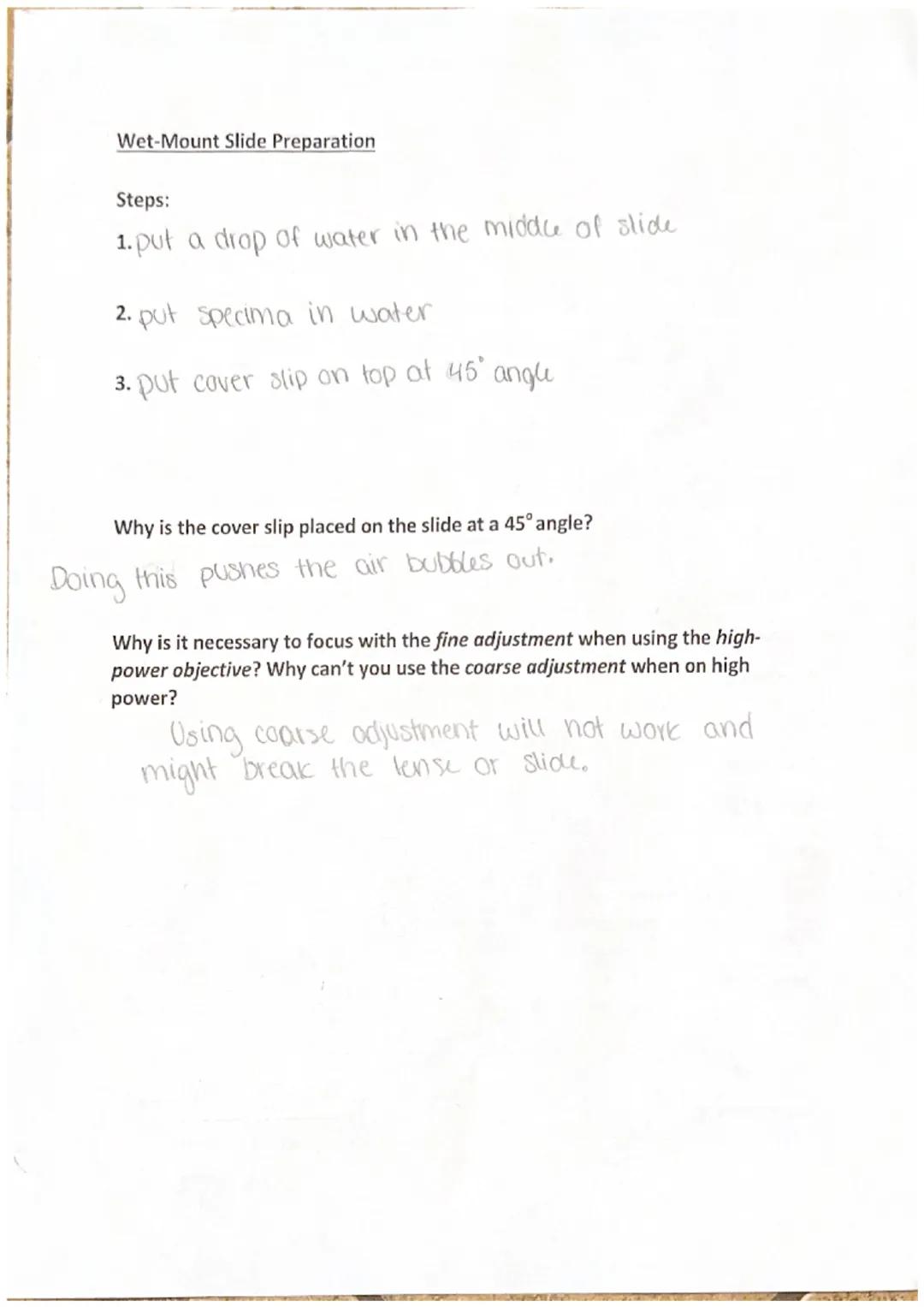
Creating and Using Wet-Mount Slides
Creating your own wet-mount slides is easy once you know the proper technique! This three-step process lets you observe living specimens like pond water organisms or plant cells.
First, place a drop of water in the middle of a clean slide. Next, carefully position your specimen in the water droplet. Finally, place a cover slip at a 45° angle before lowering it completely over the specimen. The angled approach is important because it pushes air bubbles out, giving you a clearer view.
When observing your wet-mount slide, always start with the low-power objective. Once you've found your specimen, you can carefully switch to high power for a more detailed look.
Important Safety Note: When using high power, only use the fine adjustment knob for focusing! The coarse adjustment moves too dramatically and can crack your slide or damage the expensive objective lens.
With practice, you'll become comfortable creating wet-mounts and navigating between different magnification levels. This skill will serve you well throughout your science classes!
We thought you’d never ask...
What is the Knowunity AI companion?
Our AI companion is specifically built for the needs of students. Based on the millions of content pieces we have on the platform we can provide truly meaningful and relevant answers to students. But its not only about answers, the companion is even more about guiding students through their daily learning challenges, with personalised study plans, quizzes or content pieces in the chat and 100% personalisation based on the students skills and developments.
Where can I download the Knowunity app?
You can download the app in the Google Play Store and in the Apple App Store.
Is Knowunity really free of charge?
That's right! Enjoy free access to study content, connect with fellow students, and get instant help – all at your fingertips.
Similar Content
Most popular content: Structure of a Microscope
2Most popular content in Biology
9C
BiologyCell Organelles
This Quiz Is To Test Your Knowledge Of Cell Organelles And Their Functions Inside The Cell. It Can Also Be A Study Guide To Remember Them Better.
6th6710
B
Biologybiology cell organelles and functions
Do you know the cell organelles and their functions?
9th4410
M
BiologyMitosis and Cell Division Flashcards
These flashcards cover the basics of mitosis and why cell division occurs in the first place.
9th3390
D
BiologyDNA and RNA
Uncover the secrets of life with this comprehensive Biology flashcard set. Perfect for grade 10 students studying Living Environment.
10th1,0782
D
BiologyDiscover the Fascinating World of Living Organisms
Uncover the secrets of biology and explore the diverse and amazing life forms that inhabit our planet with this captivating flashcard set.
7th4380
A
BiologyAnimal and plant cell structure
Quiz on animal and plant cell structures
9th3240
D
BiologyDiscover Punnet Squares
Uncover the secrets of life with this comprehensive Biology flashcard set. Perfect for grade 10 students studying Living Environment.
10th3961
D
BiologyDNA
Parts of DNA
9th2970
S
BiologySteps of Cellular Respiration
3 basic steps and Molecule Vocab
9th2660
Most popular content
9O
 AP US History
Origins and Dynamics of the Columbian Exchange
Analyze the ecological and economic motivations behind the initial transfer of goods, people, and diseases between the Old and New Worlds.
9th3,1280
I
AP US HistoryIntroduction to Early Cultural Interactions
Analyze the initial social and religious encounters between Europeans, Africans, and Indigenous peoples in the colonial Americas.
9th2,7730
O
 AP World History
Origins of Ancient River Civilizations
Analyze the environmental factors and technological innovations that led to the rise of early states in Mesopotamia, Egypt, and the Indus Valley.
9th3,1870
M
AP US HistoryMotivations for European Exploration
Analyze the economic, religious, and political factors that drove European powers to the Americas during the 15th and 16th centuries.
9th1,7780
F
 AP Psychology
Foundations of Ethical Guidelines in Research
Practice the core principles of the APA ethical code including informed consent, debriefing, and the role of Institutional Review Boards.
9th1,3360
I
AP US HistoryIntroduction to Native American Societies
Examine the diverse social, political, and economic structures of North American indigenous groups prior to European contact.
9th1,1100
I
AP BiologyIntroduction to Biological Elements of Life
Practice identifying the essential elements including carbon, nitrogen, phosphorus, and sulfur that compose biological macromolecules.
9th1,7390
I
AP US HistoryIntroduction to the Spanish Encomienda System
Explore the fundamental economic and social structures of the Spanish colonial system, focusing on the encomienda and the casta social hierarchy.
9th8890
O
AP World HistoryOrigins and Continuity of the Byzantine Empire
Analyze the political and cultural transitions from the Roman Empire to the Byzantine Empire, focusing on the reign of Justinian I and his code.
9th1,6320
Can't find what you're looking for? Explore other subjects.
Students love us — and so will you.
4.6/5App Store
4.7/5Google Play
The app is very easy to use and well designed. I have found everything I was looking for so far and have been able to learn a lot from the presentations! I will definitely use the app for a class assignment! And of course it also helps a lot as an inspiration.
Stefan SiOS user
This app is really great. There are so many study notes and help [...]. My problem subject is French, for example, and the app has so many options for help. Thanks to this app, I have improved my French. I would recommend it to anyone.
Samantha KlichAndroid user
Wow, I am really amazed. I just tried the app because I've seen it advertised many times and was absolutely stunned. This app is THE HELP you want for school and above all, it offers so many things, such as workouts and fact sheets, which have been VERY helpful to me personally.
AnnaiOS user
Biology46 views·Updated Jun 12, 2026·2 pagesUnderstanding Compound Microscope Functions and FAQs
The compound microscope is a powerful tool that lets you see tiny things normally invisible to the naked eye. Understanding its parts and how to use it correctly is essential for success in science class experiments and observations.
1
of 2
Sign up to see the content. It's free!
- Access to all documents
- Improve your grades
- Join milions of students
Compound Microscope Parts and Functions
Ever wondered how scientists see things too small for our eyes? A compound microscope makes this possible with its many specialized parts working together. Let's break down what each part does!
The microscope's structure includes the arm and base that support the entire instrument. The body tube connects the eyepiece to the objective lens, creating the pathway for light to travel. At the top, the eyepiece magnifies objects 10 times (10x) their actual size.
For viewing specimens, the stage holds your slide in place with stage clips. Light passes through the stage opening and is controlled by the diaphragm, which adjusts brightness. The light comes from either a lamp (in modern microscopes) or a mirror (in older models) that reflects light upward.
Pro Tip: Always start viewing with the low-power objective (4x or 10x) before switching to the high-power objective (40x or 43x) using the revolving nosepiece.
The microscope has two focusing knobs: the coarse adjustment for initial focusing under low power, and the fine adjustment for detailed focusing under high power. Remember that using the coarse adjustment while on high power can damage both the lens and your slide!
2
of 2Sign up to see the content. It's free!
- Access to all documents
- Improve your grades
- Join milions of students
Creating and Using Wet-Mount Slides
Creating your own wet-mount slides is easy once you know the proper technique! This three-step process lets you observe living specimens like pond water organisms or plant cells.
First, place a drop of water in the middle of a clean slide. Next, carefully position your specimen in the water droplet. Finally, place a cover slip at a 45° angle before lowering it completely over the specimen. The angled approach is important because it pushes air bubbles out, giving you a clearer view.
When observing your wet-mount slide, always start with the low-power objective. Once you've found your specimen, you can carefully switch to high power for a more detailed look.
Important Safety Note: When using high power, only use the fine adjustment knob for focusing! The coarse adjustment moves too dramatically and can crack your slide or damage the expensive objective lens.
With practice, you'll become comfortable creating wet-mounts and navigating between different magnification levels. This skill will serve you well throughout your science classes!
We thought you’d never ask...
What is the Knowunity AI companion?
Our AI companion is specifically built for the needs of students. Based on the millions of content pieces we have on the platform we can provide truly meaningful and relevant answers to students. But its not only about answers, the companion is even more about guiding students through their daily learning challenges, with personalised study plans, quizzes or content pieces in the chat and 100% personalisation based on the students skills and developments.
Where can I download the Knowunity app?
You can download the app in the Google Play Store and in the Apple App Store.
Is Knowunity really free of charge?
That's right! Enjoy free access to study content, connect with fellow students, and get instant help – all at your fingertips.
Similar Content
Most popular content: Structure of a Microscope
2Most popular content in Biology
9C
BiologyCell Organelles
This Quiz Is To Test Your Knowledge Of Cell Organelles And Their Functions Inside The Cell. It Can Also Be A Study Guide To Remember Them Better.
6th6710
B
Biologybiology cell organelles and functions
Do you know the cell organelles and their functions?
9th4410
M
BiologyMitosis and Cell Division Flashcards
These flashcards cover the basics of mitosis and why cell division occurs in the first place.
9th3390
D
BiologyDNA and RNA
Uncover the secrets of life with this comprehensive Biology flashcard set. Perfect for grade 10 students studying Living Environment.
10th1,0782
D
BiologyDiscover the Fascinating World of Living Organisms
Uncover the secrets of biology and explore the diverse and amazing life forms that inhabit our planet with this captivating flashcard set.
7th4380
A
BiologyAnimal and plant cell structure
Quiz on animal and plant cell structures
9th3240
D
BiologyDiscover Punnet Squares
Uncover the secrets of life with this comprehensive Biology flashcard set. Perfect for grade 10 students studying Living Environment.
10th3961
D
BiologyDNA
Parts of DNA
9th2970
S
BiologySteps of Cellular Respiration
3 basic steps and Molecule Vocab
9th2660
Most popular content
9O
AP US HistoryOrigins and Dynamics of the Columbian Exchange
Analyze the ecological and economic motivations behind the initial transfer of goods, people, and diseases between the Old and New Worlds.
9th3,1280
I
AP US HistoryIntroduction to Early Cultural Interactions
Analyze the initial social and religious encounters between Europeans, Africans, and Indigenous peoples in the colonial Americas.
9th2,7730
O
AP World HistoryOrigins of Ancient River Civilizations
Analyze the environmental factors and technological innovations that led to the rise of early states in Mesopotamia, Egypt, and the Indus Valley.
9th3,1870
M
AP US HistoryMotivations for European Exploration
Analyze the economic, religious, and political factors that drove European powers to the Americas during the 15th and 16th centuries.
9th1,7780
F
AP PsychologyFoundations of Ethical Guidelines in Research
Practice the core principles of the APA ethical code including informed consent, debriefing, and the role of Institutional Review Boards.
9th1,3360
I
AP US HistoryIntroduction to Native American Societies
Examine the diverse social, political, and economic structures of North American indigenous groups prior to European contact.
9th1,1100
I
AP BiologyIntroduction to Biological Elements of Life
Practice identifying the essential elements including carbon, nitrogen, phosphorus, and sulfur that compose biological macromolecules.
9th1,7390
I
AP US HistoryIntroduction to the Spanish Encomienda System
Explore the fundamental economic and social structures of the Spanish colonial system, focusing on the encomienda and the casta social hierarchy.
9th8890
O
AP World HistoryOrigins and Continuity of the Byzantine Empire
Analyze the political and cultural transitions from the Roman Empire to the Byzantine Empire, focusing on the reign of Justinian I and his code.
9th1,6320
Can't find what you're looking for? Explore other subjects.
Students love us — and so will you.
4.6/5App Store
4.7/5Google Play
The app is very easy to use and well designed. I have found everything I was looking for so far and have been able to learn a lot from the presentations! I will definitely use the app for a class assignment! And of course it also helps a lot as an inspiration.
Stefan SiOS user
This app is really great. There are so many study notes and help [...]. My problem subject is French, for example, and the app has so many options for help. Thanks to this app, I have improved my French. I would recommend it to anyone.
Samantha KlichAndroid user
Wow, I am really amazed. I just tried the app because I've seen it advertised many times and was absolutely stunned. This app is THE HELP you want for school and above all, it offers so many things, such as workouts and fact sheets, which have been VERY helpful to me personally.
AnnaiOS user