
Cell reproduction is a fascinating process that happens in different...
 Biology51 views·Updated Jun 17, 2026·2 pages
Understanding Sexual and Asexual Reproduction

Bee Hyder@beehyder_lanm
1
of 2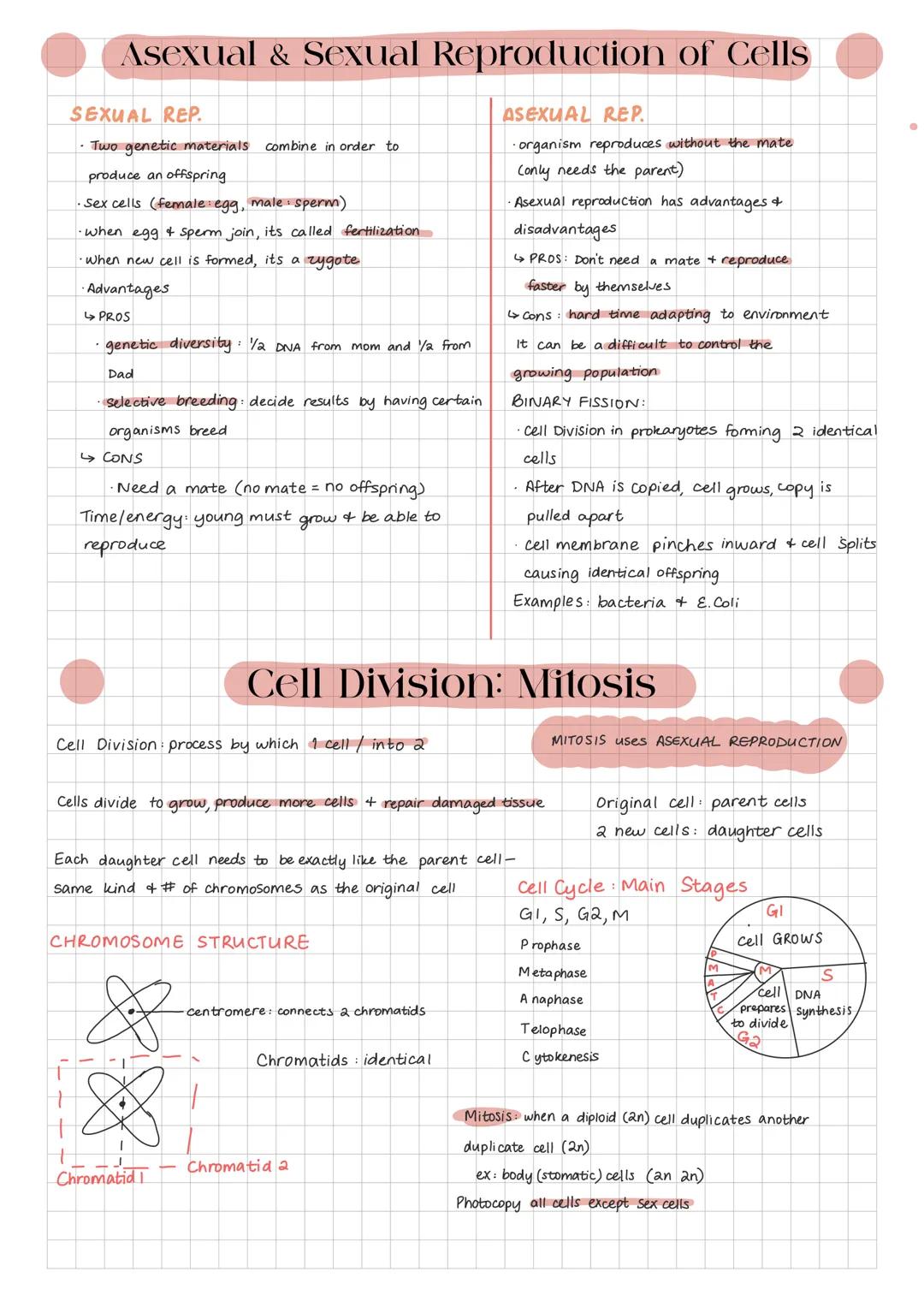
Asexual & Sexual Reproduction of Cells
Ever wondered how organisms create more of themselves? There are two main methods: sexual and asexual reproduction. In sexual reproduction, two genetic materials combine to produce offspring. This happens when sex cells (egg from females and sperm from males) join in a process called fertilization, forming a zygote.
Sexual reproduction has some clear advantages. It creates genetic diversity since offspring get half their DNA from each parent. It also allows for selective breeding to achieve specific results. However, it requires finding a mate, and young organisms need time and energy to grow before they can reproduce themselves.
Asexual reproduction works differently - an organism reproduces without needing a mate. The big advantage? Organisms can reproduce faster by themselves. The downside is that these organisms might struggle to adapt to changing environments, and population growth can be difficult to control.
Quick Fact: Binary fission is a type of asexual reproduction used by bacteria like E. coli, where a single cell divides into two identical cells after copying its DNA.
Cell division through mitosis is a form of asexual reproduction. This process helps cells grow, produce more cells, and repair damaged tissue. The parent cell divides to form two daughter cells that are exactly like the original, containing the same kind and number of chromosomes. This process happens in your body cells all the time!
2
of 2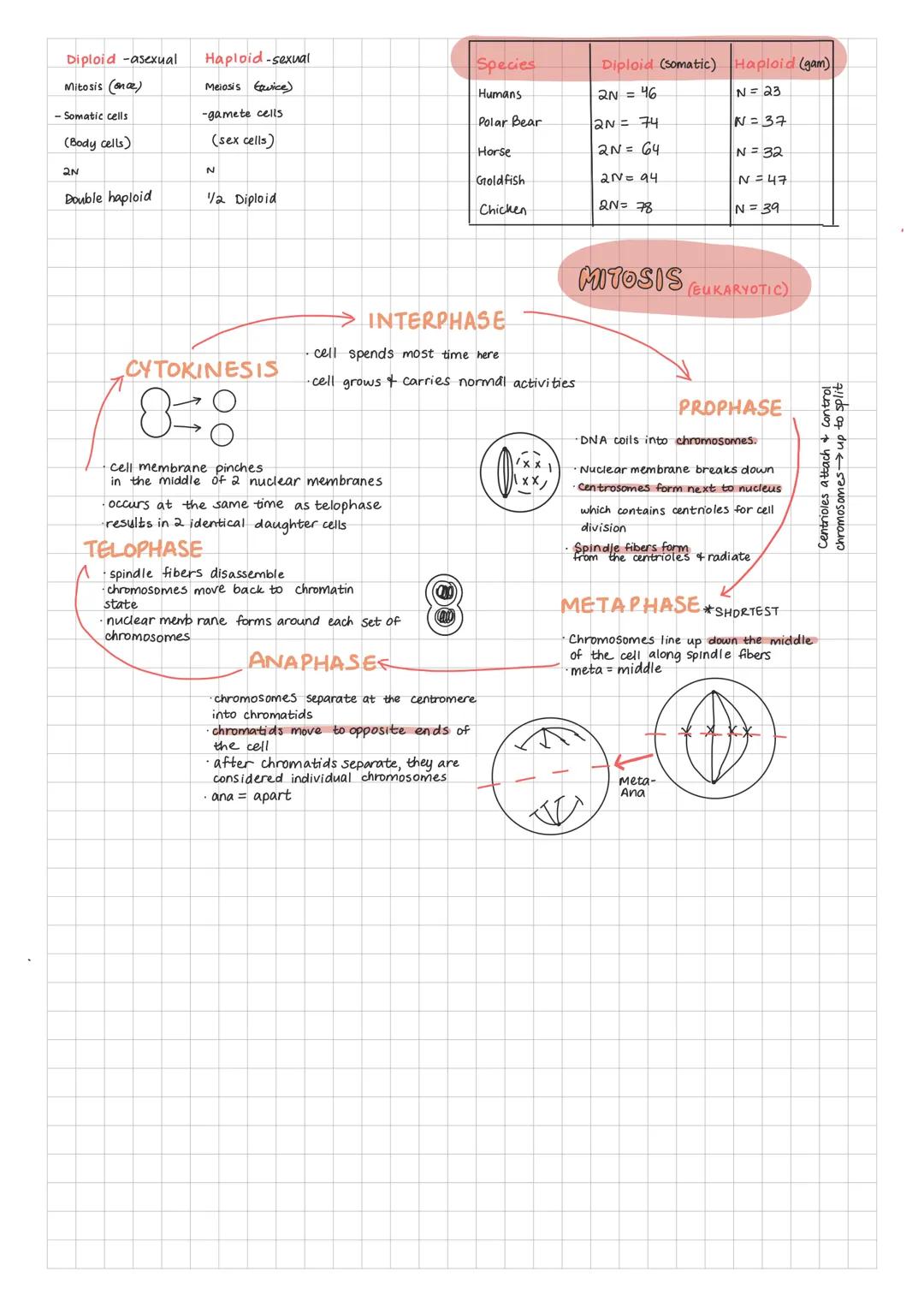
Understanding Cell Division Cycles
Did you know your body contains both diploid and haploid cells? Diploid (2n) cells contain full sets of chromosomes and reproduce through mitosis. These are your normal body (somatic) cells. Haploid (n) cells contain half the number of chromosomes and are involved in sexual reproduction - these are your gametes (sex cells).
The number of chromosomes varies by species. Humans have 46 chromosomes in diploid cells and 23 in haploid cells. Other organisms have different counts - polar bears have 74 diploid chromosomes while goldfish have a whopping 94!
Mitosis follows a precise sequence of phases. During prophase, DNA coils into visible chromosomes, the nuclear membrane breaks down, and spindle fibers form. In metaphase (the shortest phase), chromosomes line up in the middle of the cell. Anaphase follows when chromosomes separate and move to opposite ends of the cell.
Remember This: The word parts can help you remember the phases - "meta" means middle (chromosomes in the middle) and "ana" means apart (chromosomes moving apart).
Finally, during telophase, the nuclear membrane reforms around each set of chromosomes. Cytokinesis happens at the same time, when the cell membrane pinches in the middle, creating two identical daughter cells. The cell spends most of its time in interphase, growing and carrying out normal activities before the next division begins.
We thought you’d never ask...
What is the Knowunity AI companion?
Our AI companion is specifically built for the needs of students. Based on the millions of content pieces we have on the platform we can provide truly meaningful and relevant answers to students. But its not only about answers, the companion is even more about guiding students through their daily learning challenges, with personalised study plans, quizzes or content pieces in the chat and 100% personalisation based on the students skills and developments.
Where can I download the Knowunity app?
You can download the app in the Google Play Store and in the Apple App Store.
Is Knowunity really free of charge?
That's right! Enjoy free access to study content, connect with fellow students, and get instant help – all at your fingertips.
Similar Content
Most popular content: Mitosis
4BiologyMitosis/Meiosis
Includes phases of cell growth, how cell division occurs and why as well and important vocabulary and information on chromosomes
9th400
BiologyMitosis
Biology - learn about mitosis, asexual reproduction, chromosomes, pre-mitosis, prophase, metaphase, anaphase, telophase, post-mitosis, and cell division
9th643
AP BiologyCell Division
There are two types of cell division: mitosis and meiosis. Most of the time when people refer to “cell division,” they mean mitosis, the process of making new body cells.
841
BiologyMitosis Process
PMAT (prophase, metaphase, anaphase, telophase), function, visual
9th1191
Most popular content in Biology
9C
BiologyCell Organelles
This Quiz Is To Test Your Knowledge Of Cell Organelles And Their Functions Inside The Cell. It Can Also Be A Study Guide To Remember Them Better.
6th6710
B
Biologybiology cell organelles and functions
Do you know the cell organelles and their functions?
9th4410
M
BiologyMitosis and Cell Division Flashcards
These flashcards cover the basics of mitosis and why cell division occurs in the first place.
9th3390
D
BiologyDNA and RNA
Uncover the secrets of life with this comprehensive Biology flashcard set. Perfect for grade 10 students studying Living Environment.
10th1,0782
D
BiologyDiscover the Fascinating World of Living Organisms
Uncover the secrets of biology and explore the diverse and amazing life forms that inhabit our planet with this captivating flashcard set.
7th4380
A
BiologyAnimal and plant cell structure
Quiz on animal and plant cell structures
9th3240
D
BiologyDiscover Punnet Squares
Uncover the secrets of life with this comprehensive Biology flashcard set. Perfect for grade 10 students studying Living Environment.
10th3961
D
BiologyDNA
Parts of DNA
9th2970
S
BiologySteps of Cellular Respiration
3 basic steps and Molecule Vocab
9th2660
Most popular content
9O
 AP US History
Origins and Dynamics of the Columbian Exchange
Analyze the ecological and economic motivations behind the initial transfer of goods, people, and diseases between the Old and New Worlds.
9th3,1280
I
AP US HistoryIntroduction to Early Cultural Interactions
Analyze the initial social and religious encounters between Europeans, Africans, and Indigenous peoples in the colonial Americas.
9th2,7730
O
 AP World History
Origins of Ancient River Civilizations
Analyze the environmental factors and technological innovations that led to the rise of early states in Mesopotamia, Egypt, and the Indus Valley.
9th3,1870
M
AP US HistoryMotivations for European Exploration
Analyze the economic, religious, and political factors that drove European powers to the Americas during the 15th and 16th centuries.
9th1,7780
F
 AP Psychology
Foundations of Ethical Guidelines in Research
Practice the core principles of the APA ethical code including informed consent, debriefing, and the role of Institutional Review Boards.
9th1,3360
I
AP US HistoryIntroduction to Native American Societies
Examine the diverse social, political, and economic structures of North American indigenous groups prior to European contact.
9th1,1100
I
AP BiologyIntroduction to Biological Elements of Life
Practice identifying the essential elements including carbon, nitrogen, phosphorus, and sulfur that compose biological macromolecules.
9th1,7390
I
AP US HistoryIntroduction to the Spanish Encomienda System
Explore the fundamental economic and social structures of the Spanish colonial system, focusing on the encomienda and the casta social hierarchy.
9th8890
O
AP World HistoryOrigins and Continuity of the Byzantine Empire
Analyze the political and cultural transitions from the Roman Empire to the Byzantine Empire, focusing on the reign of Justinian I and his code.
9th1,6320
Can't find what you're looking for? Explore other subjects.
Students love us — and so will you.
4.6/5App Store
4.7/5Google Play
The app is very easy to use and well designed. I have found everything I was looking for so far and have been able to learn a lot from the presentations! I will definitely use the app for a class assignment! And of course it also helps a lot as an inspiration.
Stefan SiOS user
This app is really great. There are so many study notes and help [...]. My problem subject is French, for example, and the app has so many options for help. Thanks to this app, I have improved my French. I would recommend it to anyone.
Samantha KlichAndroid user
Wow, I am really amazed. I just tried the app because I've seen it advertised many times and was absolutely stunned. This app is THE HELP you want for school and above all, it offers so many things, such as workouts and fact sheets, which have been VERY helpful to me personally.
AnnaiOS user
Biology51 views·Updated Jun 17, 2026·2 pagesUnderstanding Sexual and Asexual Reproduction
Bee Hyder@beehyder_lanm
Cell reproduction is a fascinating process that happens in different ways. Whether through asexual or sexual reproduction, cells divide to create new organisms, enable growth, and repair tissues. Understanding these processes helps us see how life continues and evolves.
1
of 2
Sign up to see the content. It's free!
- Access to all documents
- Improve your grades
- Join milions of students
Asexual & Sexual Reproduction of Cells
Ever wondered how organisms create more of themselves? There are two main methods: sexual and asexual reproduction. In sexual reproduction, two genetic materials combine to produce offspring. This happens when sex cells (egg from females and sperm from males) join in a process called fertilization, forming a zygote.
Sexual reproduction has some clear advantages. It creates genetic diversity since offspring get half their DNA from each parent. It also allows for selective breeding to achieve specific results. However, it requires finding a mate, and young organisms need time and energy to grow before they can reproduce themselves.
Asexual reproduction works differently - an organism reproduces without needing a mate. The big advantage? Organisms can reproduce faster by themselves. The downside is that these organisms might struggle to adapt to changing environments, and population growth can be difficult to control.
Quick Fact: Binary fission is a type of asexual reproduction used by bacteria like E. coli, where a single cell divides into two identical cells after copying its DNA.
Cell division through mitosis is a form of asexual reproduction. This process helps cells grow, produce more cells, and repair damaged tissue. The parent cell divides to form two daughter cells that are exactly like the original, containing the same kind and number of chromosomes. This process happens in your body cells all the time!
2
of 2Sign up to see the content. It's free!
- Access to all documents
- Improve your grades
- Join milions of students
Understanding Cell Division Cycles
Did you know your body contains both diploid and haploid cells? Diploid (2n) cells contain full sets of chromosomes and reproduce through mitosis. These are your normal body (somatic) cells. Haploid (n) cells contain half the number of chromosomes and are involved in sexual reproduction - these are your gametes (sex cells).
The number of chromosomes varies by species. Humans have 46 chromosomes in diploid cells and 23 in haploid cells. Other organisms have different counts - polar bears have 74 diploid chromosomes while goldfish have a whopping 94!
Mitosis follows a precise sequence of phases. During prophase, DNA coils into visible chromosomes, the nuclear membrane breaks down, and spindle fibers form. In metaphase (the shortest phase), chromosomes line up in the middle of the cell. Anaphase follows when chromosomes separate and move to opposite ends of the cell.
Remember This: The word parts can help you remember the phases - "meta" means middle (chromosomes in the middle) and "ana" means apart (chromosomes moving apart).
Finally, during telophase, the nuclear membrane reforms around each set of chromosomes. Cytokinesis happens at the same time, when the cell membrane pinches in the middle, creating two identical daughter cells. The cell spends most of its time in interphase, growing and carrying out normal activities before the next division begins.
We thought you’d never ask...
What is the Knowunity AI companion?
Our AI companion is specifically built for the needs of students. Based on the millions of content pieces we have on the platform we can provide truly meaningful and relevant answers to students. But its not only about answers, the companion is even more about guiding students through their daily learning challenges, with personalised study plans, quizzes or content pieces in the chat and 100% personalisation based on the students skills and developments.
Where can I download the Knowunity app?
You can download the app in the Google Play Store and in the Apple App Store.
Is Knowunity really free of charge?
That's right! Enjoy free access to study content, connect with fellow students, and get instant help – all at your fingertips.
Similar Content
Most popular content: Mitosis
4BiologyMitosis/Meiosis
Includes phases of cell growth, how cell division occurs and why as well and important vocabulary and information on chromosomes
9th400
BiologyMitosis
Biology - learn about mitosis, asexual reproduction, chromosomes, pre-mitosis, prophase, metaphase, anaphase, telophase, post-mitosis, and cell division
9th643
AP BiologyCell Division
There are two types of cell division: mitosis and meiosis. Most of the time when people refer to “cell division,” they mean mitosis, the process of making new body cells.
841
BiologyMitosis Process
PMAT (prophase, metaphase, anaphase, telophase), function, visual
9th1191
Most popular content in Biology
9C
BiologyCell Organelles
This Quiz Is To Test Your Knowledge Of Cell Organelles And Their Functions Inside The Cell. It Can Also Be A Study Guide To Remember Them Better.
6th6710
B
Biologybiology cell organelles and functions
Do you know the cell organelles and their functions?
9th4410
M
BiologyMitosis and Cell Division Flashcards
These flashcards cover the basics of mitosis and why cell division occurs in the first place.
9th3390
D
BiologyDNA and RNA
Uncover the secrets of life with this comprehensive Biology flashcard set. Perfect for grade 10 students studying Living Environment.
10th1,0782
D
BiologyDiscover the Fascinating World of Living Organisms
Uncover the secrets of biology and explore the diverse and amazing life forms that inhabit our planet with this captivating flashcard set.
7th4380
A
BiologyAnimal and plant cell structure
Quiz on animal and plant cell structures
9th3240
D
BiologyDiscover Punnet Squares
Uncover the secrets of life with this comprehensive Biology flashcard set. Perfect for grade 10 students studying Living Environment.
10th3961
D
BiologyDNA
Parts of DNA
9th2970
S
BiologySteps of Cellular Respiration
3 basic steps and Molecule Vocab
9th2660
Most popular content
9O
AP US HistoryOrigins and Dynamics of the Columbian Exchange
Analyze the ecological and economic motivations behind the initial transfer of goods, people, and diseases between the Old and New Worlds.
9th3,1280
I
AP US HistoryIntroduction to Early Cultural Interactions
Analyze the initial social and religious encounters between Europeans, Africans, and Indigenous peoples in the colonial Americas.
9th2,7730
O
AP World HistoryOrigins of Ancient River Civilizations
Analyze the environmental factors and technological innovations that led to the rise of early states in Mesopotamia, Egypt, and the Indus Valley.
9th3,1870
M
AP US HistoryMotivations for European Exploration
Analyze the economic, religious, and political factors that drove European powers to the Americas during the 15th and 16th centuries.
9th1,7780
F
AP PsychologyFoundations of Ethical Guidelines in Research
Practice the core principles of the APA ethical code including informed consent, debriefing, and the role of Institutional Review Boards.
9th1,3360
I
AP US HistoryIntroduction to Native American Societies
Examine the diverse social, political, and economic structures of North American indigenous groups prior to European contact.
9th1,1100
I
AP BiologyIntroduction to Biological Elements of Life
Practice identifying the essential elements including carbon, nitrogen, phosphorus, and sulfur that compose biological macromolecules.
9th1,7390
I
AP US HistoryIntroduction to the Spanish Encomienda System
Explore the fundamental economic and social structures of the Spanish colonial system, focusing on the encomienda and the casta social hierarchy.
9th8890
O
AP World HistoryOrigins and Continuity of the Byzantine Empire
Analyze the political and cultural transitions from the Roman Empire to the Byzantine Empire, focusing on the reign of Justinian I and his code.
9th1,6320
Can't find what you're looking for? Explore other subjects.
Students love us — and so will you.
4.6/5App Store
4.7/5Google Play
The app is very easy to use and well designed. I have found everything I was looking for so far and have been able to learn a lot from the presentations! I will definitely use the app for a class assignment! And of course it also helps a lot as an inspiration.
Stefan SiOS user
This app is really great. There are so many study notes and help [...]. My problem subject is French, for example, and the app has so many options for help. Thanks to this app, I have improved my French. I would recommend it to anyone.
Samantha KlichAndroid user
Wow, I am really amazed. I just tried the app because I've seen it advertised many times and was absolutely stunned. This app is THE HELP you want for school and above all, it offers so many things, such as workouts and fact sheets, which have been VERY helpful to me personally.
AnnaiOS user