

Plant reproduction is a fascinating journey through evolutionary adaptations that...
 Biology89 views·Updated Jun 13, 2026·3 pages
Comprehensive Guide to Plant Reproduction

1 / 3
1
of 3
Plant Reproduction Basics
Plants alternate between two life phases during reproduction - the gametophyte (produces gametes) and the sporophyte (produces spores). As plants evolved, the dominant phase shifted from gametophyte to sporophyte. Gametophytes contain structures called antheridium (where sperm forms) and archegonium (where eggs develop).
Bryophytes like mosses represent early land plants that still depend heavily on water. They can reproduce asexually through fragmentation, but sexual reproduction requires water for their swimming sperm to reach eggs. Some bryophytes are bisexual with both male and female parts on one plant, while others have separate male and female plants.
Ferns show evolutionary advancement with their dominant sporophyte phase. They can reproduce asexually using rhizomes (horizontal underground stems) that create clones. For sexual reproduction, they develop special chambers called sori that produce spores, which are dispersed by wind.
💡 The evolution of plant reproduction shows a clear trend: as plants became more advanced, they developed better ways to protect their reproductive cells and became less dependent on water for reproduction.
2
of 3
Seeds and Gymnosperms
Seeds represent a major evolutionary breakthrough in plant reproduction. A seed consists of a protective coat that shields against predators and harsh environments, plus nutritious tissue that feeds the developing embryo. Seeds can remain dormant until conditions are right for growth.
Various environmental triggers can break seed dormancy, including fire (heat and smoke), freezing temperatures that split the seed, exposure to water causing swelling, or passing through an animal's digestive system. These adaptations ensure seeds germinate under optimal conditions.
Conifers are gymnosperms that produce seeds in cones rather than flowers. They have separate male and female structures - woody cones (female) contain eggs on scales, while pollen cones (male) produce massive amounts of pollen grains (hundreds of thousands!) that travel by wind to female cones.
🌲 Gymnosperm means "naked seed" - their seeds develop on the surfaces of cone scales rather than being enclosed within a fruit like flowering plants.
3
of 3
Flowering Plants
Angiosperms (flowering plants) represent the most advanced plant reproduction strategy. They protect their seeds within fleshy fruits and use colorful flowers to attract pollinators. Interestingly, many flowers contain UV patterns invisible to humans but visible to insect pollinators.
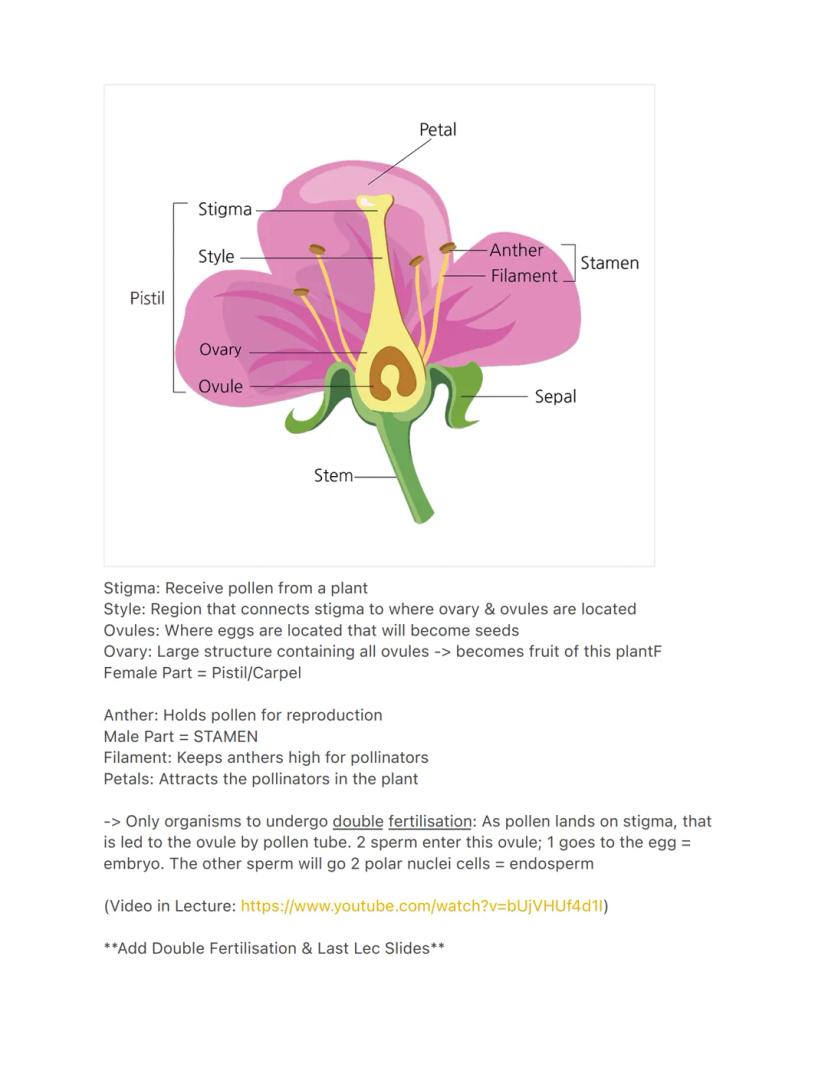
Flowers contain both male and female reproductive parts. The female structure (pistil) includes the stigma (receives pollen), style (connects stigma to ovary), and ovary (contains egg-bearing ovules that become seeds). The male structure (stamen) consists of the anther (produces pollen) and filament (supports the anther).
Angiosperms are unique in using double fertilization. When pollen lands on the stigma, it forms a tube to the ovule. Two sperm cells travel down this tube - one fertilizes the egg to form the embryo, while the other fuses with polar nuclei cells to create the nutritive endosperm. This efficient process ensures both the embryo and its food supply develop.
🌺 Next time you see a flower, remember you're looking at one of evolution's most successful innovations - a structure that turned insects and animals into plant reproductive helpers!
We thought you’d never ask...
What is the Knowunity AI companion?
Our AI companion is specifically built for the needs of students. Based on the millions of content pieces we have on the platform we can provide truly meaningful and relevant answers to students. But its not only about answers, the companion is even more about guiding students through their daily learning challenges, with personalised study plans, quizzes or content pieces in the chat and 100% personalisation based on the students skills and developments.
Where can I download the Knowunity app?
You can download the app in the Google Play Store and in the Apple App Store.
Is Knowunity really free of charge?
That's right! Enjoy free access to study content, connect with fellow students, and get instant help – all at your fingertips.
Similar Content
Most popular content in Biology
9C
BiologyCell Organelles
This Quiz Is To Test Your Knowledge Of Cell Organelles And Their Functions Inside The Cell. It Can Also Be A Study Guide To Remember Them Better.
6th6710
B
Biologybiology cell organelles and functions
Do you know the cell organelles and their functions?
9th4410
M
BiologyMitosis and Cell Division Flashcards
These flashcards cover the basics of mitosis and why cell division occurs in the first place.
9th3390
D
BiologyDNA and RNA
Uncover the secrets of life with this comprehensive Biology flashcard set. Perfect for grade 10 students studying Living Environment.
10th1,0782
D
BiologyDiscover the Fascinating World of Living Organisms
Uncover the secrets of biology and explore the diverse and amazing life forms that inhabit our planet with this captivating flashcard set.
7th4380
A
BiologyAnimal and plant cell structure
Quiz on animal and plant cell structures
9th3240
D
BiologyDiscover Punnet Squares
Uncover the secrets of life with this comprehensive Biology flashcard set. Perfect for grade 10 students studying Living Environment.
10th3961
D
BiologyDNA
Parts of DNA
9th2970
S
BiologySteps of Cellular Respiration
3 basic steps and Molecule Vocab
9th2660
Most popular content
9O
 AP US History
Origins and Dynamics of the Columbian Exchange
Analyze the ecological and economic motivations behind the initial transfer of goods, people, and diseases between the Old and New Worlds.
9th3,1280
I
AP US HistoryIntroduction to Early Cultural Interactions
Analyze the initial social and religious encounters between Europeans, Africans, and Indigenous peoples in the colonial Americas.
9th2,7730
O
 AP World History
Origins of Ancient River Civilizations
Analyze the environmental factors and technological innovations that led to the rise of early states in Mesopotamia, Egypt, and the Indus Valley.
9th3,1870
M
AP US HistoryMotivations for European Exploration
Analyze the economic, religious, and political factors that drove European powers to the Americas during the 15th and 16th centuries.
9th1,7780
F
 AP Psychology
Foundations of Ethical Guidelines in Research
Practice the core principles of the APA ethical code including informed consent, debriefing, and the role of Institutional Review Boards.
9th1,3360
I
AP US HistoryIntroduction to Native American Societies
Examine the diverse social, political, and economic structures of North American indigenous groups prior to European contact.
9th1,1100
I
AP BiologyIntroduction to Biological Elements of Life
Practice identifying the essential elements including carbon, nitrogen, phosphorus, and sulfur that compose biological macromolecules.
9th1,7390
I
AP US HistoryIntroduction to the Spanish Encomienda System
Explore the fundamental economic and social structures of the Spanish colonial system, focusing on the encomienda and the casta social hierarchy.
9th8890
O
AP World HistoryOrigins and Continuity of the Byzantine Empire
Analyze the political and cultural transitions from the Roman Empire to the Byzantine Empire, focusing on the reign of Justinian I and his code.
9th1,6320
Can't find what you're looking for? Explore other subjects.
Students love us — and so will you.
4.6/5App Store
4.7/5Google Play
The app is very easy to use and well designed. I have found everything I was looking for so far and have been able to learn a lot from the presentations! I will definitely use the app for a class assignment! And of course it also helps a lot as an inspiration.
Stefan SiOS user
This app is really great. There are so many study notes and help [...]. My problem subject is French, for example, and the app has so many options for help. Thanks to this app, I have improved my French. I would recommend it to anyone.
Samantha KlichAndroid user
Wow, I am really amazed. I just tried the app because I've seen it advertised many times and was absolutely stunned. This app is THE HELP you want for school and above all, it offers so many things, such as workouts and fact sheets, which have been VERY helpful to me personally.
AnnaiOS user
Biology89 views·Updated Jun 13, 2026·3 pagesComprehensive Guide to Plant Reproduction
Plant reproduction is a fascinating journey through evolutionary adaptations that enable plants to survive and multiply. From ancient bryophytes to complex flowering plants, each group has developed unique reproductive strategies. Understanding these patterns helps us see how plants have conquered...
1
of 3
Sign up to see the content. It's free!
- Access to all documents
- Improve your grades
- Join milions of students
Plant Reproduction Basics
Plants alternate between two life phases during reproduction - the gametophyte (produces gametes) and the sporophyte (produces spores). As plants evolved, the dominant phase shifted from gametophyte to sporophyte. Gametophytes contain structures called antheridium (where sperm forms) and archegonium (where eggs develop).
Bryophytes like mosses represent early land plants that still depend heavily on water. They can reproduce asexually through fragmentation, but sexual reproduction requires water for their swimming sperm to reach eggs. Some bryophytes are bisexual with both male and female parts on one plant, while others have separate male and female plants.
Ferns show evolutionary advancement with their dominant sporophyte phase. They can reproduce asexually using rhizomes (horizontal underground stems) that create clones. For sexual reproduction, they develop special chambers called sori that produce spores, which are dispersed by wind.
💡 The evolution of plant reproduction shows a clear trend: as plants became more advanced, they developed better ways to protect their reproductive cells and became less dependent on water for reproduction.
2
of 3Sign up to see the content. It's free!
- Access to all documents
- Improve your grades
- Join milions of students
Seeds and Gymnosperms
Seeds represent a major evolutionary breakthrough in plant reproduction. A seed consists of a protective coat that shields against predators and harsh environments, plus nutritious tissue that feeds the developing embryo. Seeds can remain dormant until conditions are right for growth.
Various environmental triggers can break seed dormancy, including fire (heat and smoke), freezing temperatures that split the seed, exposure to water causing swelling, or passing through an animal's digestive system. These adaptations ensure seeds germinate under optimal conditions.
Conifers are gymnosperms that produce seeds in cones rather than flowers. They have separate male and female structures - woody cones (female) contain eggs on scales, while pollen cones (male) produce massive amounts of pollen grains (hundreds of thousands!) that travel by wind to female cones.
🌲 Gymnosperm means "naked seed" - their seeds develop on the surfaces of cone scales rather than being enclosed within a fruit like flowering plants.
3
of 3Sign up to see the content. It's free!
- Access to all documents
- Improve your grades
- Join milions of students
Flowering Plants
Angiosperms (flowering plants) represent the most advanced plant reproduction strategy. They protect their seeds within fleshy fruits and use colorful flowers to attract pollinators. Interestingly, many flowers contain UV patterns invisible to humans but visible to insect pollinators.
Flowers contain both male and female reproductive parts. The female structure (pistil) includes the stigma (receives pollen), style (connects stigma to ovary), and ovary (contains egg-bearing ovules that become seeds). The male structure (stamen) consists of the anther (produces pollen) and filament (supports the anther).
Angiosperms are unique in using double fertilization. When pollen lands on the stigma, it forms a tube to the ovule. Two sperm cells travel down this tube - one fertilizes the egg to form the embryo, while the other fuses with polar nuclei cells to create the nutritive endosperm. This efficient process ensures both the embryo and its food supply develop.
🌺 Next time you see a flower, remember you're looking at one of evolution's most successful innovations - a structure that turned insects and animals into plant reproductive helpers!
We thought you’d never ask...
What is the Knowunity AI companion?
Our AI companion is specifically built for the needs of students. Based on the millions of content pieces we have on the platform we can provide truly meaningful and relevant answers to students. But its not only about answers, the companion is even more about guiding students through their daily learning challenges, with personalised study plans, quizzes or content pieces in the chat and 100% personalisation based on the students skills and developments.
Where can I download the Knowunity app?
You can download the app in the Google Play Store and in the Apple App Store.
Is Knowunity really free of charge?
That's right! Enjoy free access to study content, connect with fellow students, and get instant help – all at your fingertips.
Similar Content
Most popular content in Biology
9C
BiologyCell Organelles
This Quiz Is To Test Your Knowledge Of Cell Organelles And Their Functions Inside The Cell. It Can Also Be A Study Guide To Remember Them Better.
6th6710
B
Biologybiology cell organelles and functions
Do you know the cell organelles and their functions?
9th4410
M
BiologyMitosis and Cell Division Flashcards
These flashcards cover the basics of mitosis and why cell division occurs in the first place.
9th3390
D
BiologyDNA and RNA
Uncover the secrets of life with this comprehensive Biology flashcard set. Perfect for grade 10 students studying Living Environment.
10th1,0782
D
BiologyDiscover the Fascinating World of Living Organisms
Uncover the secrets of biology and explore the diverse and amazing life forms that inhabit our planet with this captivating flashcard set.
7th4380
A
BiologyAnimal and plant cell structure
Quiz on animal and plant cell structures
9th3240
D
BiologyDiscover Punnet Squares
Uncover the secrets of life with this comprehensive Biology flashcard set. Perfect for grade 10 students studying Living Environment.
10th3961
D
BiologyDNA
Parts of DNA
9th2970
S
BiologySteps of Cellular Respiration
3 basic steps and Molecule Vocab
9th2660
Most popular content
9O
AP US HistoryOrigins and Dynamics of the Columbian Exchange
Analyze the ecological and economic motivations behind the initial transfer of goods, people, and diseases between the Old and New Worlds.
9th3,1280
I
AP US HistoryIntroduction to Early Cultural Interactions
Analyze the initial social and religious encounters between Europeans, Africans, and Indigenous peoples in the colonial Americas.
9th2,7730
O
AP World HistoryOrigins of Ancient River Civilizations
Analyze the environmental factors and technological innovations that led to the rise of early states in Mesopotamia, Egypt, and the Indus Valley.
9th3,1870
M
AP US HistoryMotivations for European Exploration
Analyze the economic, religious, and political factors that drove European powers to the Americas during the 15th and 16th centuries.
9th1,7780
F
AP PsychologyFoundations of Ethical Guidelines in Research
Practice the core principles of the APA ethical code including informed consent, debriefing, and the role of Institutional Review Boards.
9th1,3360
I
AP US HistoryIntroduction to Native American Societies
Examine the diverse social, political, and economic structures of North American indigenous groups prior to European contact.
9th1,1100
I
AP BiologyIntroduction to Biological Elements of Life
Practice identifying the essential elements including carbon, nitrogen, phosphorus, and sulfur that compose biological macromolecules.
9th1,7390
I
AP US HistoryIntroduction to the Spanish Encomienda System
Explore the fundamental economic and social structures of the Spanish colonial system, focusing on the encomienda and the casta social hierarchy.
9th8890
O
AP World HistoryOrigins and Continuity of the Byzantine Empire
Analyze the political and cultural transitions from the Roman Empire to the Byzantine Empire, focusing on the reign of Justinian I and his code.
9th1,6320
Can't find what you're looking for? Explore other subjects.
Students love us — and so will you.
4.6/5App Store
4.7/5Google Play
The app is very easy to use and well designed. I have found everything I was looking for so far and have been able to learn a lot from the presentations! I will definitely use the app for a class assignment! And of course it also helps a lot as an inspiration.
Stefan SiOS user
This app is really great. There are so many study notes and help [...]. My problem subject is French, for example, and the app has so many options for help. Thanks to this app, I have improved my French. I would recommend it to anyone.
Samantha KlichAndroid user
Wow, I am really amazed. I just tried the app because I've seen it advertised many times and was absolutely stunned. This app is THE HELP you want for school and above all, it offers so many things, such as workouts and fact sheets, which have been VERY helpful to me personally.
AnnaiOS user