
Photosynthesis powers life on Earth by converting sunlight into usable...
 Environmental Science41 views·Updated Jun 10, 2026·3 pages
Photosynthesis Light Reactions Explained Step-by-Step

Shea Swan@iiamsheaaa
1 / 3
1
of 3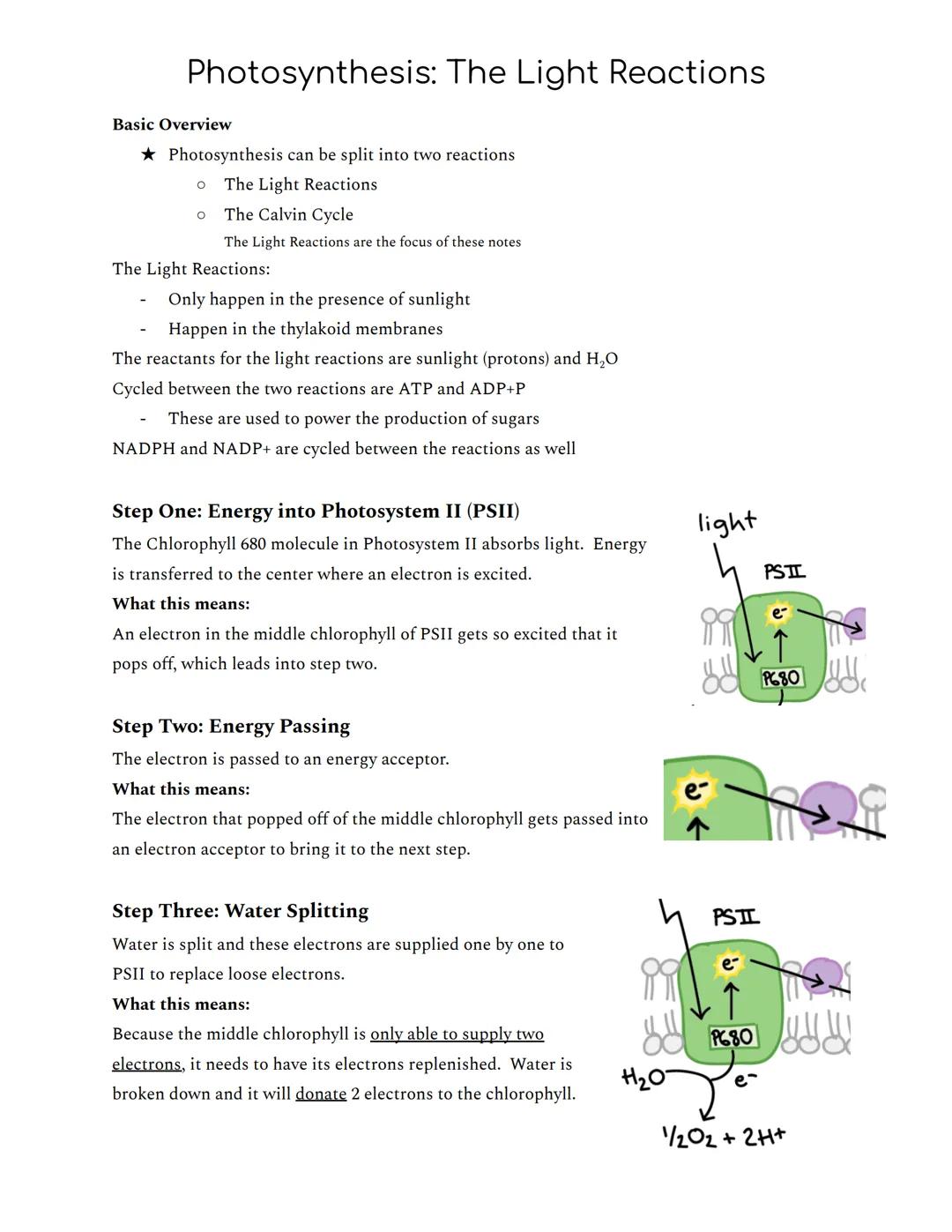
Photosynthesis: The Light Reactions Basics
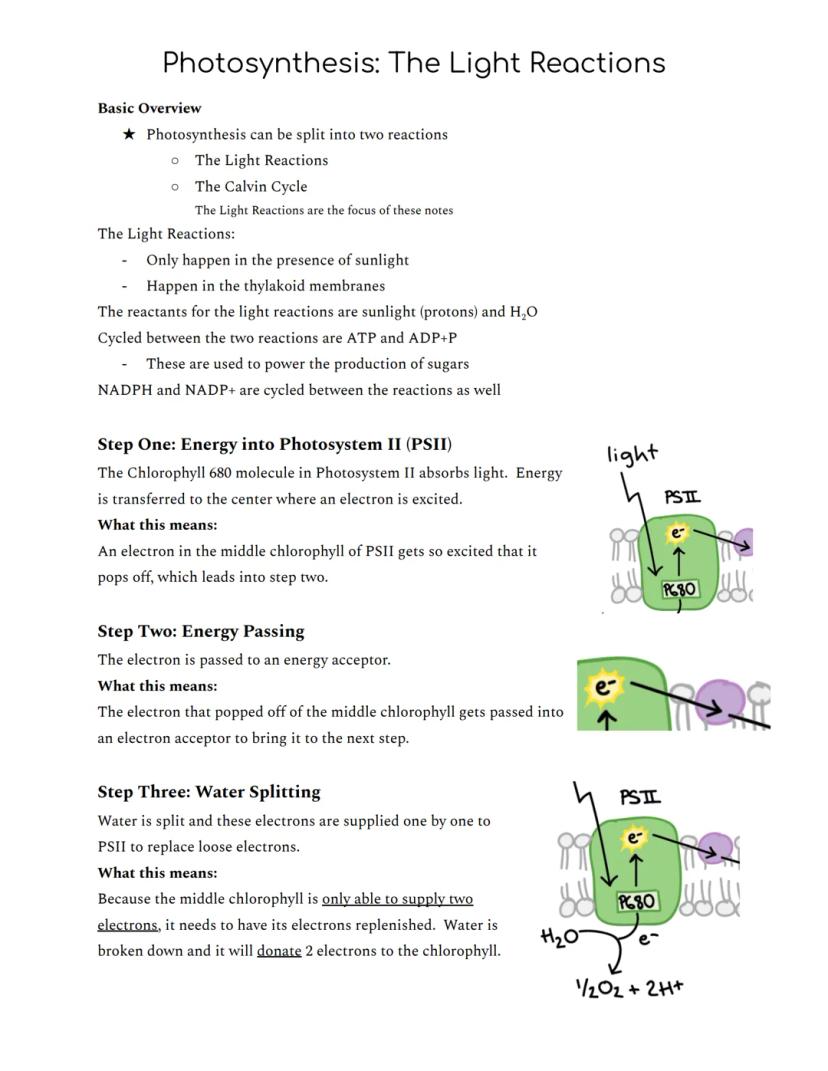
Photosynthesis consists of two main parts: the Light Reactions and the Calvin Cycle. The Light Reactions occur only when sunlight is present and take place in the thylakoid membranes of plant cells.
During these reactions, plants use sunlight and water as reactants. They produce two essential energy carriers: ATP (energy currency) and NADPH (electron carrier). These molecules will later power sugar production in the Calvin Cycle.
The process begins when Photosystem II (PSII) absorbs light energy. The chlorophyll molecule (specifically Chlorophyll 680) at the center of PSII gets so excited by this energy that an electron pops off and moves to an electron acceptor. This creates an electron deficiency that needs to be filled.
💡 Think of chlorophyll like a solar panel that gets so charged up by sunlight that it releases electrons - these electrons then flow through the plant cell like electricity through wires!
To replace these lost electrons, plants perform water splitting - breaking water molecules apart. This process provides new electrons to PSII while releasing oxygen into the atmosphere as a byproduct. The hydrogen ions from water will be used later in the process.
2
of 3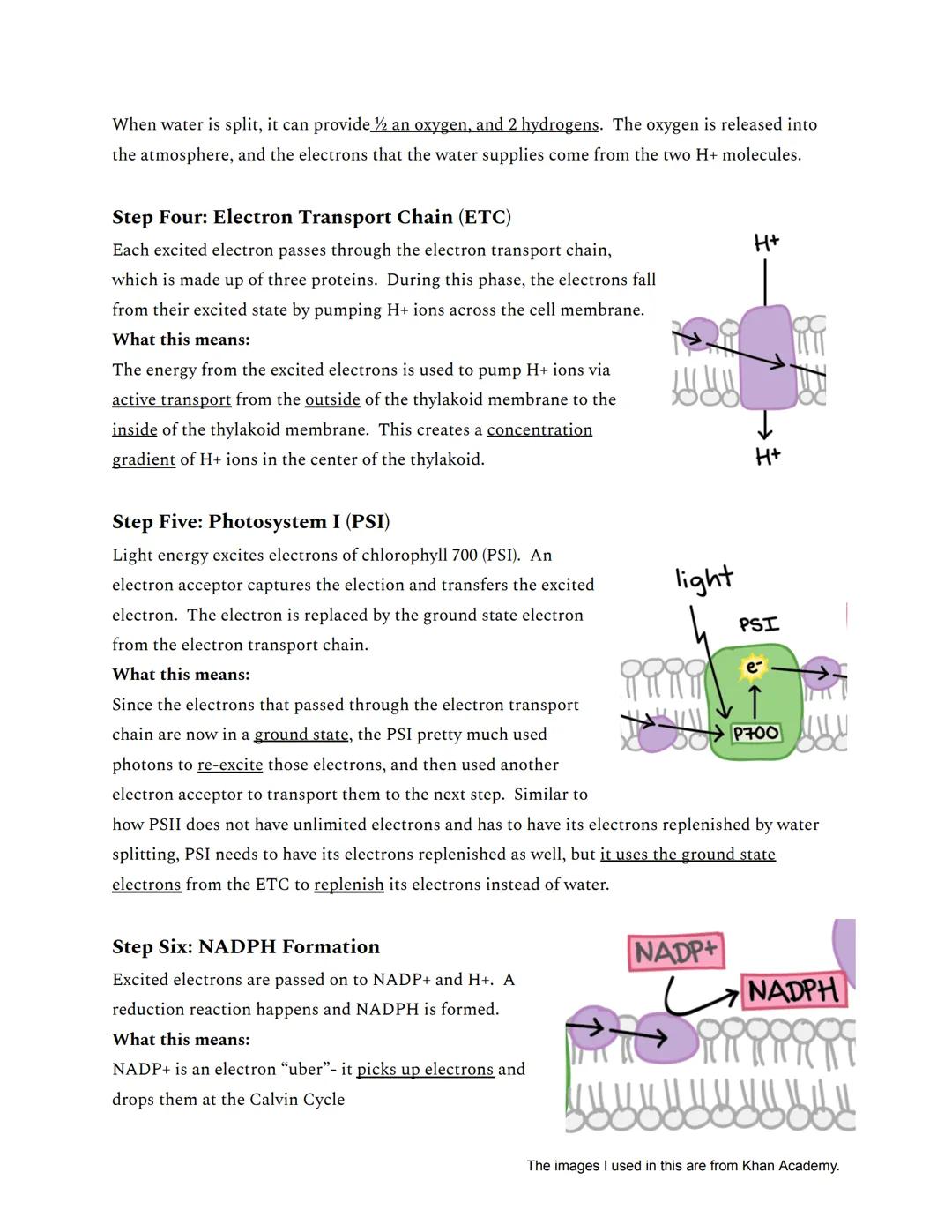
The Electron Journey
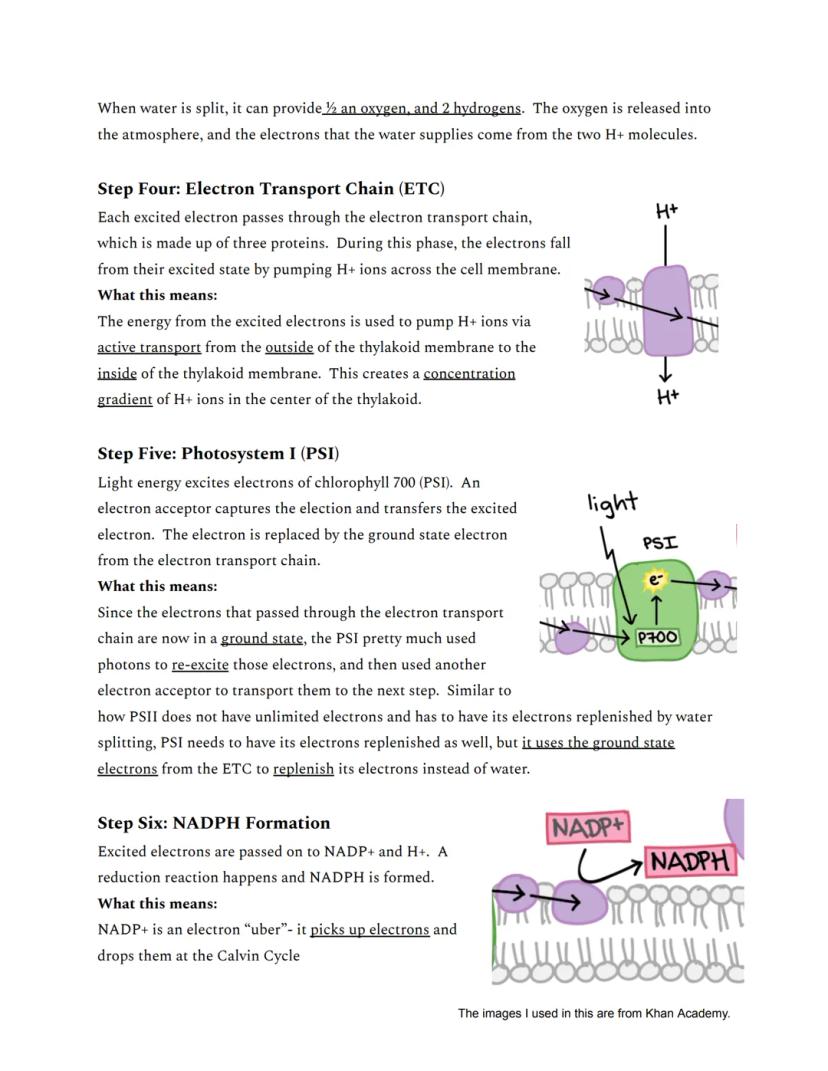
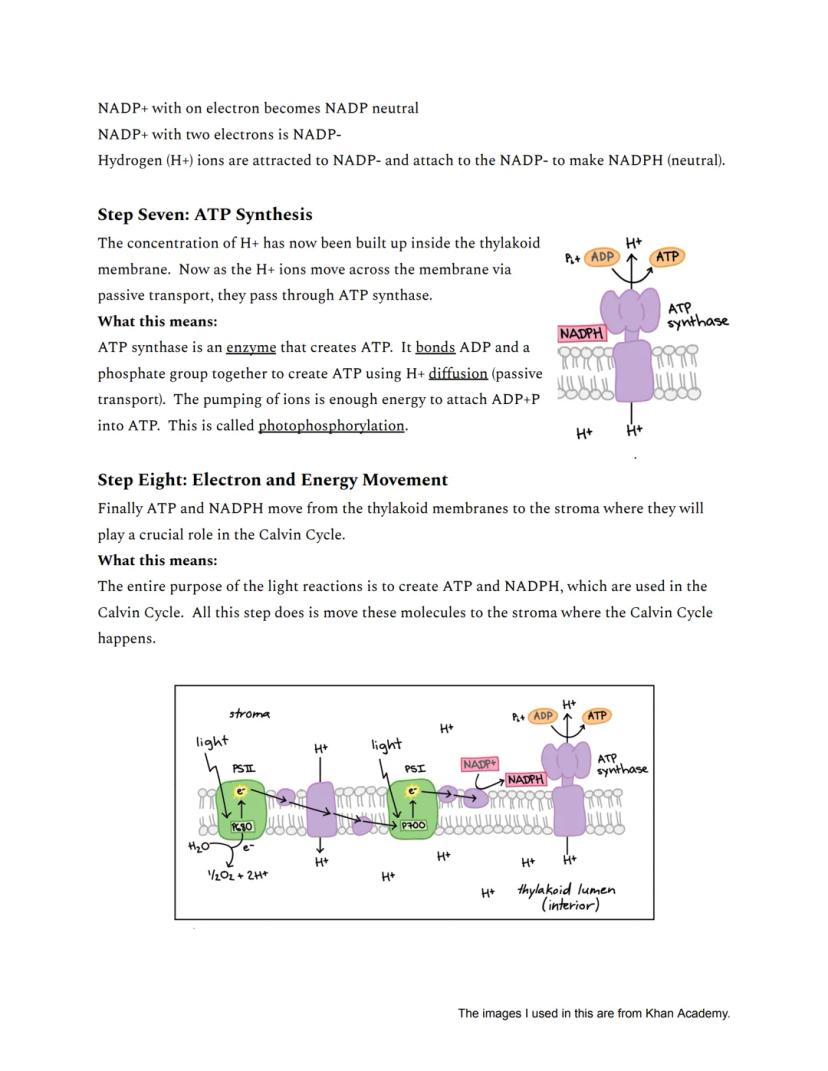
After electrons leave Photosystem II, they enter the Electron Transport Chain (ETC) - a series of three proteins that pass electrons along like a bucket brigade. As these excited electrons move through the chain, they gradually lose energy, which is used to pump hydrogen ions across the thylakoid membrane.
This pumping creates a concentration gradient with many H+ ions inside the thylakoid membrane. This gradient stores potential energy, similar to water behind a dam.
The journey continues when light hits Photosystem I (PSI), exciting electrons in Chlorophyll 700. These newly excited electrons get picked up by another acceptor, while PSI replaces its lost electrons with those coming from the ETC.
🔋 The concentration gradient of H+ ions is like a biological battery that the cell can tap into when it needs energy!
The excited electrons from PSI are then passed to NADP+, which acts like an electron "taxi service." When NADP+ receives two electrons and a hydrogen ion , it transforms into NADPH. This molecule will carry this captured energy to the Calvin Cycle where sugar production happens.
3
of 3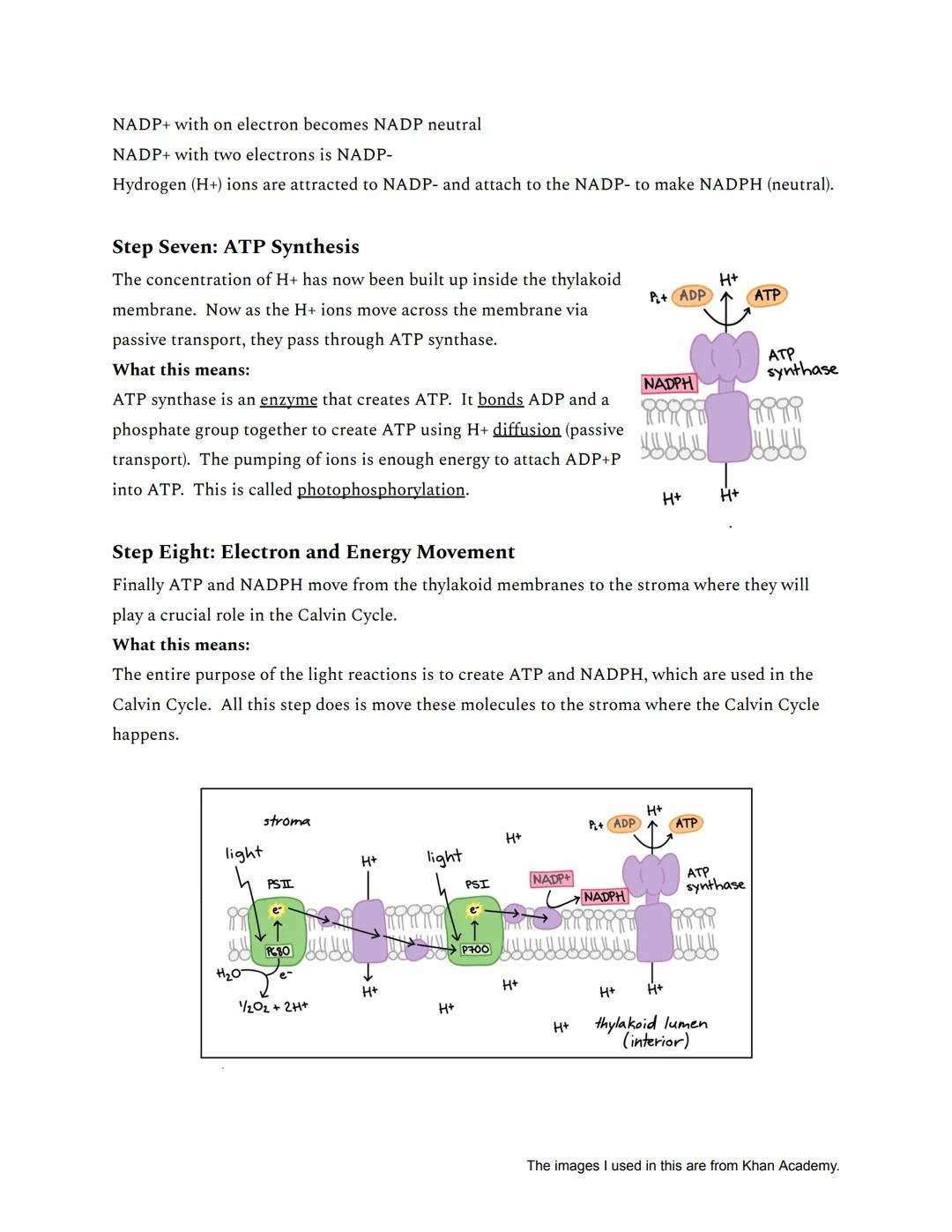
Completing the Light Reactions
The formation of NADPH is a crucial step in the light reactions. NADP+ first accepts electrons to become NADP-, which then attracts hydrogen ions to form NADPH. This molecule is now charged with energy and electrons ready to fuel sugar production.
Meanwhile, the high concentration of H+ ions built up inside the thylakoid membrane creates pressure. These ions naturally want to diffuse back across the membrane (moving from high to low concentration). As they flow through special protein channels called ATP synthase, they provide the energy needed to combine ADP and phosphate into ATP.
This process, called photophosphorylation, is like a water wheel generating electricity as water flows through it. The flowing H+ ions power the ATP synthase "wheel" to produce ATP.
🌟 Every time you take a breath of oxygen, thank the light reactions! The oxygen we breathe is actually a byproduct of plants splitting water during photosynthesis.
In the final step, the newly created ATP and NADPH molecules move from the thylakoid membranes to the stroma . There, they'll deliver their captured energy to power the Calvin Cycle, where the plant will use carbon dioxide from the air to produce sugars.
We thought you’d never ask...
What is the Knowunity AI companion?
Our AI companion is specifically built for the needs of students. Based on the millions of content pieces we have on the platform we can provide truly meaningful and relevant answers to students. But its not only about answers, the companion is even more about guiding students through their daily learning challenges, with personalised study plans, quizzes or content pieces in the chat and 100% personalisation based on the students skills and developments.
Where can I download the Knowunity app?
You can download the app in the Google Play Store and in the Apple App Store.
Is Knowunity really free of charge?
That's right! Enjoy free access to study content, connect with fellow students, and get instant help – all at your fingertips.
Similar Content
Most popular content: Light Reactions
1Most popular content in Environmental Science
9C
Environmental ScienceCells
Basics
9th800
Environmental ScienceStudent Exploration: GMOs and the Environment Answer Key.pdf
GMOs and the Environment
4267
Environmental ScienceEarth and Space: Ch. 2- Minerals
Slideshow about Ch. 2 of Earth and Space Science
11th742
 Chemistry
Photosynthesis: The Calvin Cycle
Understanding the Calvin Cycle as well as impact of light intensity, carbon dioxide levels, and temperature on the rate of photosynthesis. CHECK MY NOTES ON THE LIGHT REACTIONS FOR THE FIRST PART OF PHOTOSYNTHESIS
9th993
 Earth and Space Science
Human Impact on the Earth: Effects of Environmental Change on Biodiversity
Very interesting and full of info presentation about human impact on our planet and the biodiversity among the animal species
390
Environmental ScienceEcology
Gives an overview of Ecological levels of Organization .
1141
Environmental ScienceSymbiotic Relationships
Covers: community interactions, mutualism, commensalism, parasitism, habitats, microhabitats, tolerance, ecological niche, keystone species
9th911
Environmental ScienceThe Moon
In depth notes on the moon and its phases.
9th611
Environmental ScienceAsexual vs Sexual Reproduction
Comparison of advantages and disadvantages of asexual and sexual reproduction, including mitosis and meiosis processes.
9th1547
Most popular content
9O
 AP US History
Origins and Dynamics of the Columbian Exchange
Analyze the ecological and economic motivations behind the initial transfer of goods, people, and diseases between the Old and New Worlds.
9th3,1280
I
AP US HistoryIntroduction to Early Cultural Interactions
Analyze the initial social and religious encounters between Europeans, Africans, and Indigenous peoples in the colonial Americas.
9th2,7730
O
AP World HistoryOrigins of Ancient River Civilizations
Analyze the environmental factors and technological innovations that led to the rise of early states in Mesopotamia, Egypt, and the Indus Valley.
9th3,1870
M
AP US HistoryMotivations for European Exploration
Analyze the economic, religious, and political factors that drove European powers to the Americas during the 15th and 16th centuries.
9th1,7780
F
 AP Psychology
Foundations of Ethical Guidelines in Research
Practice the core principles of the APA ethical code including informed consent, debriefing, and the role of Institutional Review Boards.
9th1,3360
I
AP US HistoryIntroduction to Native American Societies
Examine the diverse social, political, and economic structures of North American indigenous groups prior to European contact.
9th1,1100
I
 AP Biology
Introduction to Biological Elements of Life
Practice identifying the essential elements including carbon, nitrogen, phosphorus, and sulfur that compose biological macromolecules.
9th1,7390
I
AP US HistoryIntroduction to the Spanish Encomienda System
Explore the fundamental economic and social structures of the Spanish colonial system, focusing on the encomienda and the casta social hierarchy.
9th8890
O
AP World HistoryOrigins and Continuity of the Byzantine Empire
Analyze the political and cultural transitions from the Roman Empire to the Byzantine Empire, focusing on the reign of Justinian I and his code.
9th1,6320
Can't find what you're looking for? Explore other subjects.
Students love us — and so will you.
4.6/5App Store
4.7/5Google Play
The app is very easy to use and well designed. I have found everything I was looking for so far and have been able to learn a lot from the presentations! I will definitely use the app for a class assignment! And of course it also helps a lot as an inspiration.
Stefan SiOS user
This app is really great. There are so many study notes and help [...]. My problem subject is French, for example, and the app has so many options for help. Thanks to this app, I have improved my French. I would recommend it to anyone.
Samantha KlichAndroid user
Wow, I am really amazed. I just tried the app because I've seen it advertised many times and was absolutely stunned. This app is THE HELP you want for school and above all, it offers so many things, such as workouts and fact sheets, which have been VERY helpful to me personally.
AnnaiOS user
Environmental Science41 views·Updated Jun 10, 2026·3 pagesPhotosynthesis Light Reactions Explained Step-by-Step
Shea Swan@iiamsheaaa
Photosynthesis powers life on Earth by converting sunlight into usable energy. The light reactions are the first stage of this process, capturing sunlight energy and transforming it into chemical energy that plants can use to build sugars. Understanding this process...
1
of 3
Sign up to see the content. It's free!
- Access to all documents
- Improve your grades
- Join milions of students
Photosynthesis: The Light Reactions Basics
Photosynthesis consists of two main parts: the Light Reactions and the Calvin Cycle. The Light Reactions occur only when sunlight is present and take place in the thylakoid membranes of plant cells.
During these reactions, plants use sunlight and water as reactants. They produce two essential energy carriers: ATP (energy currency) and NADPH (electron carrier). These molecules will later power sugar production in the Calvin Cycle.
The process begins when Photosystem II (PSII) absorbs light energy. The chlorophyll molecule (specifically Chlorophyll 680) at the center of PSII gets so excited by this energy that an electron pops off and moves to an electron acceptor. This creates an electron deficiency that needs to be filled.
💡 Think of chlorophyll like a solar panel that gets so charged up by sunlight that it releases electrons - these electrons then flow through the plant cell like electricity through wires!
To replace these lost electrons, plants perform water splitting - breaking water molecules apart. This process provides new electrons to PSII while releasing oxygen into the atmosphere as a byproduct. The hydrogen ions from water will be used later in the process.
2
of 3Sign up to see the content. It's free!
- Access to all documents
- Improve your grades
- Join milions of students
The Electron Journey
After electrons leave Photosystem II, they enter the Electron Transport Chain (ETC) - a series of three proteins that pass electrons along like a bucket brigade. As these excited electrons move through the chain, they gradually lose energy, which is used to pump hydrogen ions across the thylakoid membrane.
This pumping creates a concentration gradient with many H+ ions inside the thylakoid membrane. This gradient stores potential energy, similar to water behind a dam.
The journey continues when light hits Photosystem I (PSI), exciting electrons in Chlorophyll 700. These newly excited electrons get picked up by another acceptor, while PSI replaces its lost electrons with those coming from the ETC.
🔋 The concentration gradient of H+ ions is like a biological battery that the cell can tap into when it needs energy!
The excited electrons from PSI are then passed to NADP+, which acts like an electron "taxi service." When NADP+ receives two electrons and a hydrogen ion , it transforms into NADPH. This molecule will carry this captured energy to the Calvin Cycle where sugar production happens.
3
of 3Sign up to see the content. It's free!
- Access to all documents
- Improve your grades
- Join milions of students
Completing the Light Reactions
The formation of NADPH is a crucial step in the light reactions. NADP+ first accepts electrons to become NADP-, which then attracts hydrogen ions to form NADPH. This molecule is now charged with energy and electrons ready to fuel sugar production.
Meanwhile, the high concentration of H+ ions built up inside the thylakoid membrane creates pressure. These ions naturally want to diffuse back across the membrane (moving from high to low concentration). As they flow through special protein channels called ATP synthase, they provide the energy needed to combine ADP and phosphate into ATP.
This process, called photophosphorylation, is like a water wheel generating electricity as water flows through it. The flowing H+ ions power the ATP synthase "wheel" to produce ATP.
🌟 Every time you take a breath of oxygen, thank the light reactions! The oxygen we breathe is actually a byproduct of plants splitting water during photosynthesis.
In the final step, the newly created ATP and NADPH molecules move from the thylakoid membranes to the stroma . There, they'll deliver their captured energy to power the Calvin Cycle, where the plant will use carbon dioxide from the air to produce sugars.
We thought you’d never ask...
What is the Knowunity AI companion?
Our AI companion is specifically built for the needs of students. Based on the millions of content pieces we have on the platform we can provide truly meaningful and relevant answers to students. But its not only about answers, the companion is even more about guiding students through their daily learning challenges, with personalised study plans, quizzes or content pieces in the chat and 100% personalisation based on the students skills and developments.
Where can I download the Knowunity app?
You can download the app in the Google Play Store and in the Apple App Store.
Is Knowunity really free of charge?
That's right! Enjoy free access to study content, connect with fellow students, and get instant help – all at your fingertips.
Similar Content
Most popular content: Light Reactions
1Most popular content in Environmental Science
9C
Environmental ScienceCells
Basics
9th800
Environmental ScienceStudent Exploration: GMOs and the Environment Answer Key.pdf
GMOs and the Environment
4267
Environmental ScienceEarth and Space: Ch. 2- Minerals
Slideshow about Ch. 2 of Earth and Space Science
11th742
ChemistryPhotosynthesis: The Calvin Cycle
Understanding the Calvin Cycle as well as impact of light intensity, carbon dioxide levels, and temperature on the rate of photosynthesis. CHECK MY NOTES ON THE LIGHT REACTIONS FOR THE FIRST PART OF PHOTOSYNTHESIS
9th993
Earth and Space ScienceHuman Impact on the Earth: Effects of Environmental Change on Biodiversity
Very interesting and full of info presentation about human impact on our planet and the biodiversity among the animal species
390
Environmental ScienceEcology
Gives an overview of Ecological levels of Organization .
1141
Environmental ScienceSymbiotic Relationships
Covers: community interactions, mutualism, commensalism, parasitism, habitats, microhabitats, tolerance, ecological niche, keystone species
9th911
Environmental ScienceThe Moon
In depth notes on the moon and its phases.
9th611
Environmental ScienceAsexual vs Sexual Reproduction
Comparison of advantages and disadvantages of asexual and sexual reproduction, including mitosis and meiosis processes.
9th1547
Most popular content
9O
AP US HistoryOrigins and Dynamics of the Columbian Exchange
Analyze the ecological and economic motivations behind the initial transfer of goods, people, and diseases between the Old and New Worlds.
9th3,1280
I
AP US HistoryIntroduction to Early Cultural Interactions
Analyze the initial social and religious encounters between Europeans, Africans, and Indigenous peoples in the colonial Americas.
9th2,7730
O
AP World HistoryOrigins of Ancient River Civilizations
Analyze the environmental factors and technological innovations that led to the rise of early states in Mesopotamia, Egypt, and the Indus Valley.
9th3,1870
M
AP US HistoryMotivations for European Exploration
Analyze the economic, religious, and political factors that drove European powers to the Americas during the 15th and 16th centuries.
9th1,7780
F
AP PsychologyFoundations of Ethical Guidelines in Research
Practice the core principles of the APA ethical code including informed consent, debriefing, and the role of Institutional Review Boards.
9th1,3360
I
AP US HistoryIntroduction to Native American Societies
Examine the diverse social, political, and economic structures of North American indigenous groups prior to European contact.
9th1,1100
I
AP BiologyIntroduction to Biological Elements of Life
Practice identifying the essential elements including carbon, nitrogen, phosphorus, and sulfur that compose biological macromolecules.
9th1,7390
I
AP US HistoryIntroduction to the Spanish Encomienda System
Explore the fundamental economic and social structures of the Spanish colonial system, focusing on the encomienda and the casta social hierarchy.
9th8890
O
AP World HistoryOrigins and Continuity of the Byzantine Empire
Analyze the political and cultural transitions from the Roman Empire to the Byzantine Empire, focusing on the reign of Justinian I and his code.
9th1,6320
Can't find what you're looking for? Explore other subjects.
Students love us — and so will you.
4.6/5App Store
4.7/5Google Play
The app is very easy to use and well designed. I have found everything I was looking for so far and have been able to learn a lot from the presentations! I will definitely use the app for a class assignment! And of course it also helps a lot as an inspiration.
Stefan SiOS user
This app is really great. There are so many study notes and help [...]. My problem subject is French, for example, and the app has so many options for help. Thanks to this app, I have improved my French. I would recommend it to anyone.
Samantha KlichAndroid user
Wow, I am really amazed. I just tried the app because I've seen it advertised many times and was absolutely stunned. This app is THE HELP you want for school and above all, it offers so many things, such as workouts and fact sheets, which have been VERY helpful to me personally.
AnnaiOS user