

Diving into ocean motion and scuba diving concepts will help...
 Biology37 views·Updated Jun 17, 2026·4 pages
Exploring Ocean Motion: Comprehensive Test Review



1 / 4
1
of 4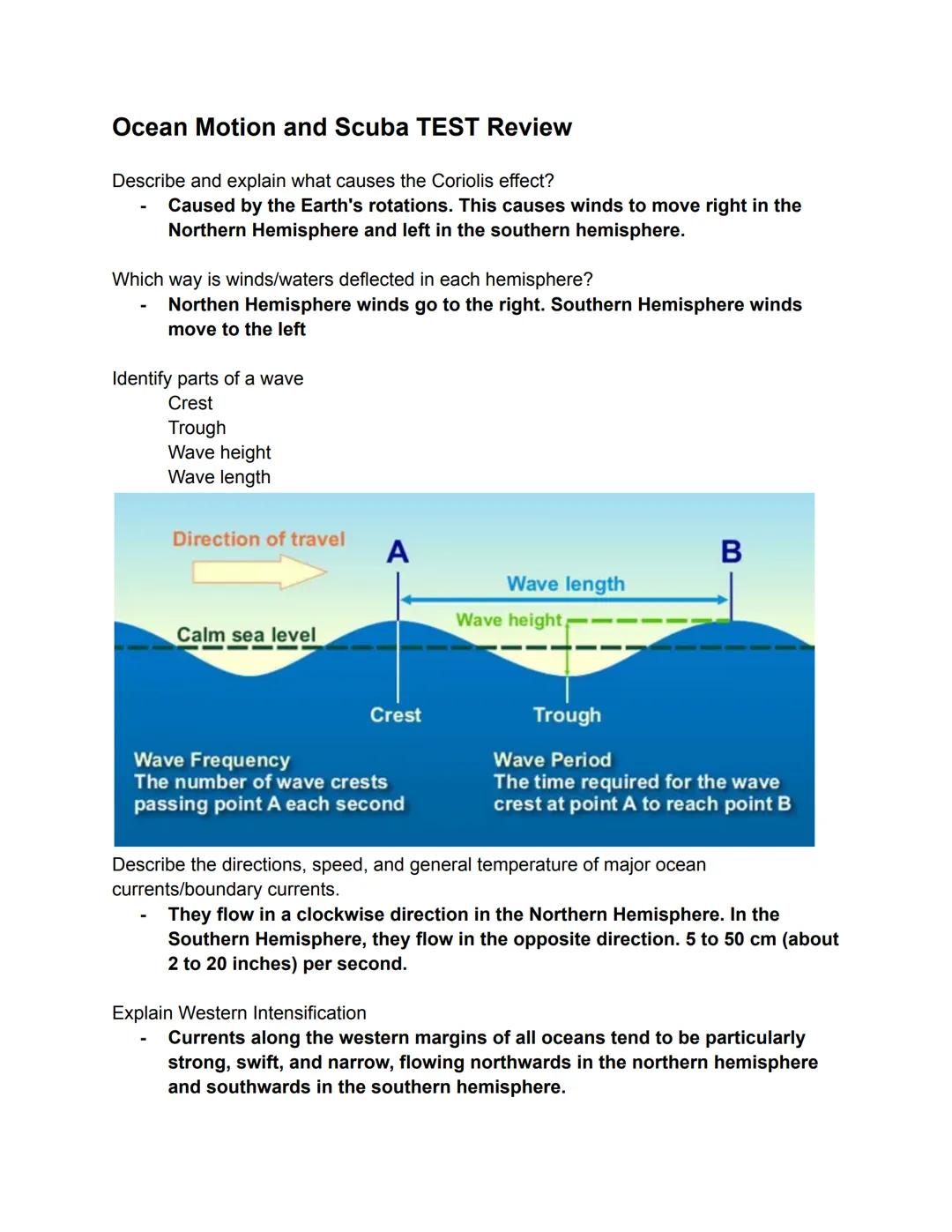
Ocean Motion Fundamentals
Ever wondered why ocean currents move in specific patterns? The Coriolis effect, caused by Earth's rotation, deflects winds to the right in the Northern Hemisphere and to the left in the Southern Hemisphere. This effect shapes our global ocean currents.
When studying waves, you need to know key parts: the crest (highest point), trough (lowest point), wave height (vertical distance from trough to crest), and wavelength (horizontal distance between crests). Wave frequency measures how many crests pass a point each second, while wave period is the time needed for a wave to travel between two points.
Major ocean currents follow predictable patterns - flowing clockwise in the Northern Hemisphere and counterclockwise in the Southern Hemisphere, typically moving at 5-50 cm per second. Western intensification explains why currents along the western edges of oceans are particularly strong, swift, and narrow.
Quick Tip: Remember that ocean currents are like giant rivers in the sea, but they flow in opposite directions in the Northern and Southern hemispheres!
2
of 4
Tides and Wind Patterns
The Ekman spiral is fascinating - it occurs when wind creates surface currents that spiral clockwise as depth increases, eventually flowing opposite to the wind direction at about 100m depth. This happens because of two forces: shear stress and the Coriolis force, resulting in Ekman transport (net water movement at right angles to the wind).
Wind itself is created by uneven heating of Earth's surface by the sun, with atmospheric pressure differences driving its movement and strength. These winds directly influence our tides.
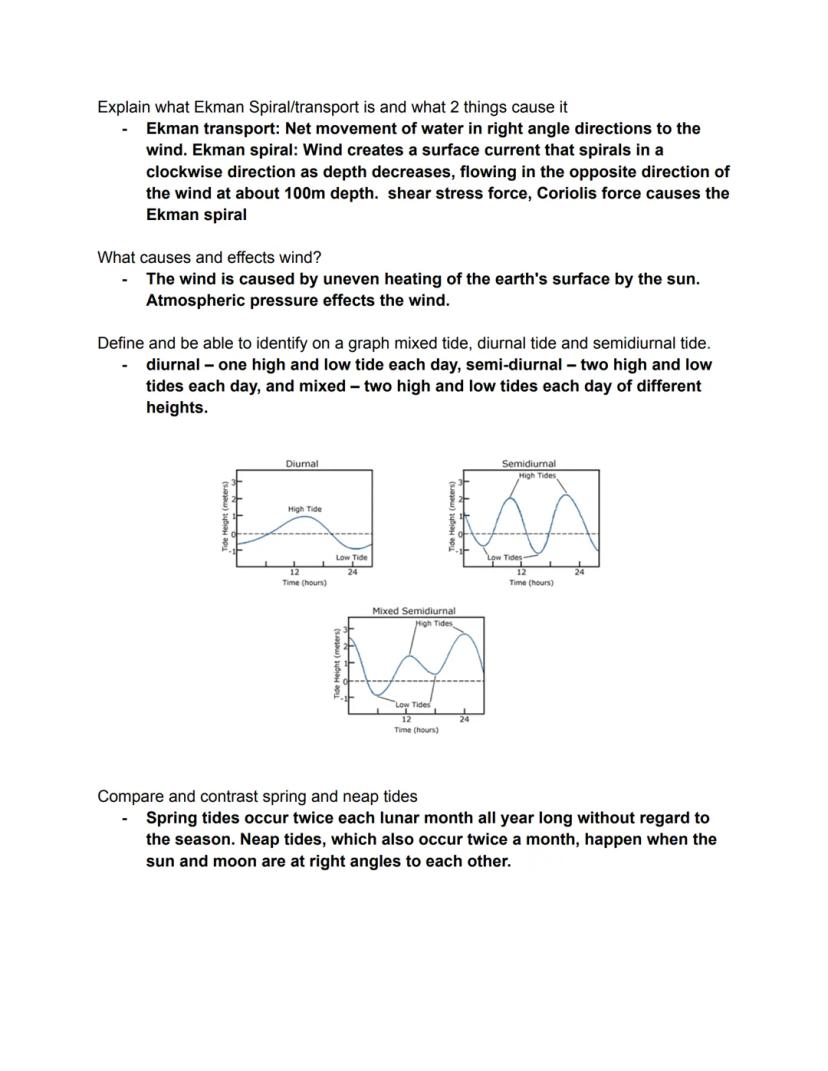
Speaking of tides, there are three main patterns you should recognize. Diurnal tides have one high and one low tide daily. Semi-diurnal tides feature two roughly equal high and low tides each day. Mixed tides also have two cycles daily but with different heights.
Spring tides and neap tides occur twice monthly but differ significantly. Spring tides happen when the sun and moon align (creating especially high tides), while neap tides form when the sun and moon are at right angles to each other (producing moderate tides).
Remember: Tides aren't connected to seasons - "spring" tides happen year-round when the sun and moon align!
3
of 4
Global Ocean Patterns
El Niño Southern Oscillation (ENSO) is an irregular climate pattern involving changes in winds and sea temperatures in the tropical Pacific Ocean. During El Niño, the Central Pacific receives more rainfall while the Western Pacific becomes relatively dry. Meanwhile, La Niña is the opposite pattern - a periodic cooling of ocean surface temperatures in the central and east-central equatorial Pacific.
These Pacific patterns affect weather worldwide! In the Atlantic Ocean, ENSO events typically cause more hurricanes. Understanding these patterns helps predict weather globally.
Our oceans feature five main circular current systems called ocean gyres: the North Atlantic Gyre, South Atlantic Gyre, North Pacific Gyre, South Pacific Gyre, and Indian Ocean Gyre. These massive current systems help distribute heat around our planet.
Upwelling and downwelling are vertical water movements that impact marine life. During upwelling, deeper water rises to replace diverging surface water, bringing nutrients to the surface. Downwelling occurs when surface water is forced downward, delivering oxygen to deeper waters.
Science Connection: Ocean gyres are why plastic pollution concentrates in specific ocean regions, forming "garbage patches" where currents converge!
4
of 4
SCUBA Diving Physics and Safety
When you're scuba diving, understanding gas laws becomes a matter of safety, not just theory! Boyle's Law relates pressure and volume, explaining why your lungs would expand dangerously if you held your breath while ascending. Charles' Law connects volume and temperature, while Gay-Lussac's Law describes the relationship between pressure and temperature.
Dalton's Law states that the total pressure of a gas mixture equals the sum of the pressures of each gas . This helps divers calculate partial pressures at different depths to avoid dangerous conditions.
Diving too deep can cause nitrogen narcosis (getting "narked"), which affects consciousness and behavior when breathing compressed gases. The infamous "bends" or decompression sickness happens when nitrogen gas forms bubbles in your bloodstream during rapid pressure decreases.
An embolism is another serious risk - a blocked artery caused by a foreign body like an air bubble. The golden rule in scuba diving is "never hold your breath" to prevent these potentially fatal conditions.
Safety Alert: Ascending too quickly in scuba diving can be life-threatening - always ascend slowly and breathe continuously to allow gases to leave your bloodstream safely!
We thought you’d never ask...
What is the Knowunity AI companion?
Our AI companion is specifically built for the needs of students. Based on the millions of content pieces we have on the platform we can provide truly meaningful and relevant answers to students. But its not only about answers, the companion is even more about guiding students through their daily learning challenges, with personalised study plans, quizzes or content pieces in the chat and 100% personalisation based on the students skills and developments.
Where can I download the Knowunity app?
You can download the app in the Google Play Store and in the Apple App Store.
Is Knowunity really free of charge?
That's right! Enjoy free access to study content, connect with fellow students, and get instant help – all at your fingertips.
Similar Content
 Biology
Most popular content in Biology
9C
BiologyCell Organelles
This Quiz Is To Test Your Knowledge Of Cell Organelles And Their Functions Inside The Cell. It Can Also Be A Study Guide To Remember Them Better.
6th6710
B
Biologybiology cell organelles and functions
Do you know the cell organelles and their functions?
9th4410
M
BiologyMitosis and Cell Division Flashcards
These flashcards cover the basics of mitosis and why cell division occurs in the first place.
9th3390
D
BiologyDNA and RNA
Uncover the secrets of life with this comprehensive Biology flashcard set. Perfect for grade 10 students studying Living Environment.
10th1,0782
D
BiologyDiscover the Fascinating World of Living Organisms
Uncover the secrets of biology and explore the diverse and amazing life forms that inhabit our planet with this captivating flashcard set.
7th4380
A
BiologyAnimal and plant cell structure
Quiz on animal and plant cell structures
9th3240
D
BiologyDiscover Punnet Squares
Uncover the secrets of life with this comprehensive Biology flashcard set. Perfect for grade 10 students studying Living Environment.
10th3961
D
BiologyDNA
Parts of DNA
9th2970
S
BiologySteps of Cellular Respiration
3 basic steps and Molecule Vocab
9th2660
Most popular content
9O
 AP US History
Origins and Dynamics of the Columbian Exchange
Analyze the ecological and economic motivations behind the initial transfer of goods, people, and diseases between the Old and New Worlds.
9th3,1280
I
AP US HistoryIntroduction to Early Cultural Interactions
Analyze the initial social and religious encounters between Europeans, Africans, and Indigenous peoples in the colonial Americas.
9th2,7730
O
 AP World History
Origins of Ancient River Civilizations
Analyze the environmental factors and technological innovations that led to the rise of early states in Mesopotamia, Egypt, and the Indus Valley.
9th3,1870
M
AP US HistoryMotivations for European Exploration
Analyze the economic, religious, and political factors that drove European powers to the Americas during the 15th and 16th centuries.
9th1,7780
F
 AP Psychology
Foundations of Ethical Guidelines in Research
Practice the core principles of the APA ethical code including informed consent, debriefing, and the role of Institutional Review Boards.
9th1,3360
I
AP US HistoryIntroduction to Native American Societies
Examine the diverse social, political, and economic structures of North American indigenous groups prior to European contact.
9th1,1100
I
AP BiologyIntroduction to Biological Elements of Life
Practice identifying the essential elements including carbon, nitrogen, phosphorus, and sulfur that compose biological macromolecules.
9th1,7390
I
AP US HistoryIntroduction to the Spanish Encomienda System
Explore the fundamental economic and social structures of the Spanish colonial system, focusing on the encomienda and the casta social hierarchy.
9th8890
O
AP World HistoryOrigins and Continuity of the Byzantine Empire
Analyze the political and cultural transitions from the Roman Empire to the Byzantine Empire, focusing on the reign of Justinian I and his code.
9th1,6320
Can't find what you're looking for? Explore other subjects.
Students love us — and so will you.
4.6/5App Store
4.7/5Google Play
The app is very easy to use and well designed. I have found everything I was looking for so far and have been able to learn a lot from the presentations! I will definitely use the app for a class assignment! And of course it also helps a lot as an inspiration.
Stefan SiOS user
This app is really great. There are so many study notes and help [...]. My problem subject is French, for example, and the app has so many options for help. Thanks to this app, I have improved my French. I would recommend it to anyone.
Samantha KlichAndroid user
Wow, I am really amazed. I just tried the app because I've seen it advertised many times and was absolutely stunned. This app is THE HELP you want for school and above all, it offers so many things, such as workouts and fact sheets, which have been VERY helpful to me personally.
AnnaiOS user
Biology37 views·Updated Jun 17, 2026·4 pagesExploring Ocean Motion: Comprehensive Test Review
Diving into ocean motion and scuba diving concepts will help you understand how our oceans move and how pressure affects divers. These scientific principles explain everything from global current patterns to critical safety considerations underwater.
1
of 4
Sign up to see the content. It's free!
- Access to all documents
- Improve your grades
- Join milions of students
Ocean Motion Fundamentals
Ever wondered why ocean currents move in specific patterns? The Coriolis effect, caused by Earth's rotation, deflects winds to the right in the Northern Hemisphere and to the left in the Southern Hemisphere. This effect shapes our global ocean currents.
When studying waves, you need to know key parts: the crest (highest point), trough (lowest point), wave height (vertical distance from trough to crest), and wavelength (horizontal distance between crests). Wave frequency measures how many crests pass a point each second, while wave period is the time needed for a wave to travel between two points.
Major ocean currents follow predictable patterns - flowing clockwise in the Northern Hemisphere and counterclockwise in the Southern Hemisphere, typically moving at 5-50 cm per second. Western intensification explains why currents along the western edges of oceans are particularly strong, swift, and narrow.
Quick Tip: Remember that ocean currents are like giant rivers in the sea, but they flow in opposite directions in the Northern and Southern hemispheres!
2
of 4Sign up to see the content. It's free!
- Access to all documents
- Improve your grades
- Join milions of students
Tides and Wind Patterns
The Ekman spiral is fascinating - it occurs when wind creates surface currents that spiral clockwise as depth increases, eventually flowing opposite to the wind direction at about 100m depth. This happens because of two forces: shear stress and the Coriolis force, resulting in Ekman transport (net water movement at right angles to the wind).
Wind itself is created by uneven heating of Earth's surface by the sun, with atmospheric pressure differences driving its movement and strength. These winds directly influence our tides.
Speaking of tides, there are three main patterns you should recognize. Diurnal tides have one high and one low tide daily. Semi-diurnal tides feature two roughly equal high and low tides each day. Mixed tides also have two cycles daily but with different heights.
Spring tides and neap tides occur twice monthly but differ significantly. Spring tides happen when the sun and moon align (creating especially high tides), while neap tides form when the sun and moon are at right angles to each other (producing moderate tides).
Remember: Tides aren't connected to seasons - "spring" tides happen year-round when the sun and moon align!
3
of 4Sign up to see the content. It's free!
- Access to all documents
- Improve your grades
- Join milions of students
Global Ocean Patterns
El Niño Southern Oscillation (ENSO) is an irregular climate pattern involving changes in winds and sea temperatures in the tropical Pacific Ocean. During El Niño, the Central Pacific receives more rainfall while the Western Pacific becomes relatively dry. Meanwhile, La Niña is the opposite pattern - a periodic cooling of ocean surface temperatures in the central and east-central equatorial Pacific.
These Pacific patterns affect weather worldwide! In the Atlantic Ocean, ENSO events typically cause more hurricanes. Understanding these patterns helps predict weather globally.
Our oceans feature five main circular current systems called ocean gyres: the North Atlantic Gyre, South Atlantic Gyre, North Pacific Gyre, South Pacific Gyre, and Indian Ocean Gyre. These massive current systems help distribute heat around our planet.
Upwelling and downwelling are vertical water movements that impact marine life. During upwelling, deeper water rises to replace diverging surface water, bringing nutrients to the surface. Downwelling occurs when surface water is forced downward, delivering oxygen to deeper waters.
Science Connection: Ocean gyres are why plastic pollution concentrates in specific ocean regions, forming "garbage patches" where currents converge!
4
of 4Sign up to see the content. It's free!
- Access to all documents
- Improve your grades
- Join milions of students
SCUBA Diving Physics and Safety
When you're scuba diving, understanding gas laws becomes a matter of safety, not just theory! Boyle's Law relates pressure and volume, explaining why your lungs would expand dangerously if you held your breath while ascending. Charles' Law connects volume and temperature, while Gay-Lussac's Law describes the relationship between pressure and temperature.
Dalton's Law states that the total pressure of a gas mixture equals the sum of the pressures of each gas . This helps divers calculate partial pressures at different depths to avoid dangerous conditions.
Diving too deep can cause nitrogen narcosis (getting "narked"), which affects consciousness and behavior when breathing compressed gases. The infamous "bends" or decompression sickness happens when nitrogen gas forms bubbles in your bloodstream during rapid pressure decreases.
An embolism is another serious risk - a blocked artery caused by a foreign body like an air bubble. The golden rule in scuba diving is "never hold your breath" to prevent these potentially fatal conditions.
Safety Alert: Ascending too quickly in scuba diving can be life-threatening - always ascend slowly and breathe continuously to allow gases to leave your bloodstream safely!
We thought you’d never ask...
What is the Knowunity AI companion?
Our AI companion is specifically built for the needs of students. Based on the millions of content pieces we have on the platform we can provide truly meaningful and relevant answers to students. But its not only about answers, the companion is even more about guiding students through their daily learning challenges, with personalised study plans, quizzes or content pieces in the chat and 100% personalisation based on the students skills and developments.
Where can I download the Knowunity app?
You can download the app in the Google Play Store and in the Apple App Store.
Is Knowunity really free of charge?
That's right! Enjoy free access to study content, connect with fellow students, and get instant help – all at your fingertips.
Similar Content
Most popular content in Biology
9C
BiologyCell Organelles
This Quiz Is To Test Your Knowledge Of Cell Organelles And Their Functions Inside The Cell. It Can Also Be A Study Guide To Remember Them Better.
6th6710
B
Biologybiology cell organelles and functions
Do you know the cell organelles and their functions?
9th4410
M
BiologyMitosis and Cell Division Flashcards
These flashcards cover the basics of mitosis and why cell division occurs in the first place.
9th3390
D
BiologyDNA and RNA
Uncover the secrets of life with this comprehensive Biology flashcard set. Perfect for grade 10 students studying Living Environment.
10th1,0782
D
BiologyDiscover the Fascinating World of Living Organisms
Uncover the secrets of biology and explore the diverse and amazing life forms that inhabit our planet with this captivating flashcard set.
7th4380
A
BiologyAnimal and plant cell structure
Quiz on animal and plant cell structures
9th3240
D
BiologyDiscover Punnet Squares
Uncover the secrets of life with this comprehensive Biology flashcard set. Perfect for grade 10 students studying Living Environment.
10th3961
D
BiologyDNA
Parts of DNA
9th2970
S
BiologySteps of Cellular Respiration
3 basic steps and Molecule Vocab
9th2660
Most popular content
9O
AP US HistoryOrigins and Dynamics of the Columbian Exchange
Analyze the ecological and economic motivations behind the initial transfer of goods, people, and diseases between the Old and New Worlds.
9th3,1280
I
AP US HistoryIntroduction to Early Cultural Interactions
Analyze the initial social and religious encounters between Europeans, Africans, and Indigenous peoples in the colonial Americas.
9th2,7730
O
AP World HistoryOrigins of Ancient River Civilizations
Analyze the environmental factors and technological innovations that led to the rise of early states in Mesopotamia, Egypt, and the Indus Valley.
9th3,1870
M
AP US HistoryMotivations for European Exploration
Analyze the economic, religious, and political factors that drove European powers to the Americas during the 15th and 16th centuries.
9th1,7780
F
AP PsychologyFoundations of Ethical Guidelines in Research
Practice the core principles of the APA ethical code including informed consent, debriefing, and the role of Institutional Review Boards.
9th1,3360
I
AP US HistoryIntroduction to Native American Societies
Examine the diverse social, political, and economic structures of North American indigenous groups prior to European contact.
9th1,1100
I
AP BiologyIntroduction to Biological Elements of Life
Practice identifying the essential elements including carbon, nitrogen, phosphorus, and sulfur that compose biological macromolecules.
9th1,7390
I
AP US HistoryIntroduction to the Spanish Encomienda System
Explore the fundamental economic and social structures of the Spanish colonial system, focusing on the encomienda and the casta social hierarchy.
9th8890
O
AP World HistoryOrigins and Continuity of the Byzantine Empire
Analyze the political and cultural transitions from the Roman Empire to the Byzantine Empire, focusing on the reign of Justinian I and his code.
9th1,6320
Can't find what you're looking for? Explore other subjects.
Students love us — and so will you.
4.6/5App Store
4.7/5Google Play
The app is very easy to use and well designed. I have found everything I was looking for so far and have been able to learn a lot from the presentations! I will definitely use the app for a class assignment! And of course it also helps a lot as an inspiration.
Stefan SiOS user
This app is really great. There are so many study notes and help [...]. My problem subject is French, for example, and the app has so many options for help. Thanks to this app, I have improved my French. I would recommend it to anyone.
Samantha KlichAndroid user
Wow, I am really amazed. I just tried the app because I've seen it advertised many times and was absolutely stunned. This app is THE HELP you want for school and above all, it offers so many things, such as workouts and fact sheets, which have been VERY helpful to me personally.
AnnaiOS user