

The Scientific Revolution transformed our understanding of the universe from...
 Physics71 views·Updated Jun 12, 2026·2 pages
Understanding Different Models of the Universe
1
of 2
Models of the Universe
Ever wonder why we don't feel the Earth moving? For centuries, people believed we weren't! The Geocentric Model placed Earth at the center of everything, with planets, stars, and the Sun orbiting around us. Ancient astronomers like Aristotle and Ptolemy championed this view, making it the accepted theory for most of human history.
The Heliocentric Model turned everything upside down by putting the Sun at the center. Though the idea existed in ancient times, it wasn't until 1543 when Nicolaus Copernicus developed a mathematical theory supporting it. This revolutionary concept suggested Earth rotated on its axis while orbiting the Sun along with other planets.
Galileo Galilei didn't invent the heliocentric model, but his observations provided evidence supporting it. This put him in direct conflict with the Catholic Church, which preferred the geocentric model based on scripture. The Church believed Earth was central because God created it first, and they had difficulty explaining why planets sometimes appeared to move backward (retrograde motion) in a Sun-centered system.
Fun Fact: The Catholic Church banned Copernicus's theory in 1616 and accused Galileo of heresy for supporting it. Talk about an astronomical disagreement!
The Scientific Revolution gained momentum with Johannes Kepler's Three Laws of Planetary Motion and Galileo's telescope discoveries, including Jupiter's moons and sunspots. Later, Sir Isaac Newton's Law of Universal Gravitation explained the force keeping planets in orbit around the Sun, solidifying the heliocentric model's acceptance.
2
of 2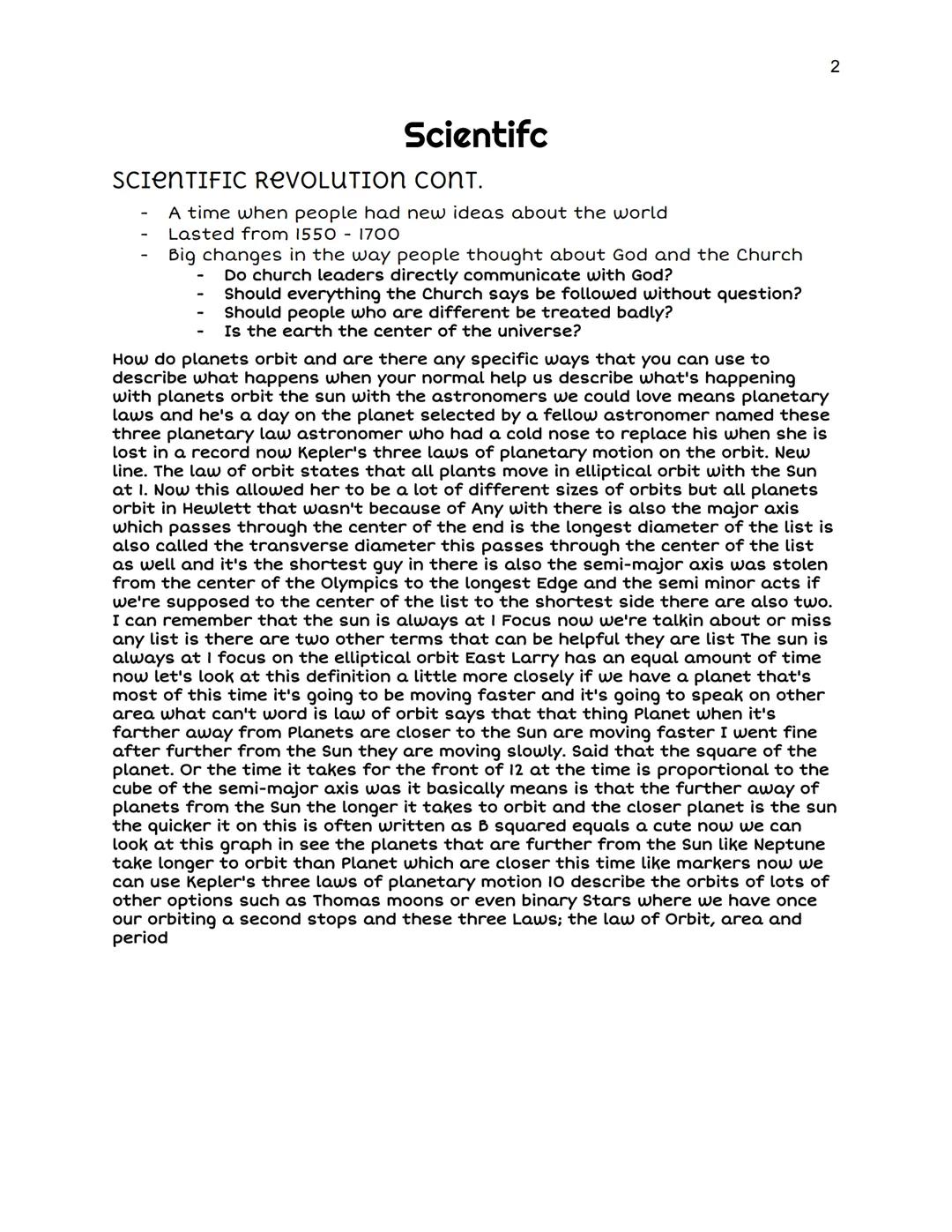
Scientific Revolution & Kepler's Laws
The Scientific Revolution (1550-1700) wasn't just about astronomy—it challenged how people thought about everything! During this time, people questioned whether church leaders spoke directly to God, if religious teachings should be followed without question, and even Earth's place in the universe.
Johannes Kepler transformed our understanding of planetary motion with his three famous laws. His Law of Orbit states that planets move in elliptical orbits with the Sun at one focus. Unlike perfect circles, ellipses have a major axis (longest diameter) and a minor axis (shortest diameter), with the Sun positioned at one of the two focal points of the ellipse.
Kepler's Law of Area explains why planets move at different speeds depending on their position. When planets are closer to the Sun, they move faster; when farther away, they slow down. This happens because planets sweep equal areas in equal time periods regardless of their position in orbit.
Remember This: Kepler's Law of Period tells us that the square of a planet's orbital period equals the cube of its semi-major axis. In simpler terms: the farther a planet is from the Sun, the longer it takes to complete its orbit!
These three laws don't just work for planets orbiting our Sun—they apply to moons, comets, and even binary star systems where one star orbits another. Kepler's discoveries gave us the mathematical tools to describe and predict the movement of celestial objects throughout the universe.
We thought you’d never ask...
What is the Knowunity AI companion?
Our AI companion is specifically built for the needs of students. Based on the millions of content pieces we have on the platform we can provide truly meaningful and relevant answers to students. But its not only about answers, the companion is even more about guiding students through their daily learning challenges, with personalised study plans, quizzes or content pieces in the chat and 100% personalisation based on the students skills and developments.
Where can I download the Knowunity app?
You can download the app in the Google Play Store and in the Apple App Store.
Is Knowunity really free of charge?
That's right! Enjoy free access to study content, connect with fellow students, and get instant help – all at your fingertips.
Similar Content
Most popular content: Kepler's Laws
1Most popular content in Physics
9P
Physicsphysical science 8th grade
test your abilities
8th1380
AP Physics 1Newton's Second Law of Motion
A detailed explanation of Concept of Newton's Second Law of Motion, Examples, Formulas, and Sample Problems with solution.
36613
Physicsmomentum and impulse
momentum, impulse, conservation of momentum
98427
PhysicsPhysics Reviewer
This is an extensive physics reviewer.
College1,49334
PhysicsSimple Machines PowerPoint
This presentation offers an explanation of simple machines and how to solve for mechanical advantage, ideal mechanical advantage, and efficiency of each machine. It also provides definitions and examples.
9th29113
F
PhysicsForce and Motion
a study set for chapter 1 of Physical Science
1875
PhysicsHonors Physics Semester Two Review Sheet
This note sheet can be used for high school students taking physics classes to study for finals, unit tests, and review.
9th29313
PhysicsContact and Non-Contact Forces
Ppt on contact and Non-Contact Forces
7th781
AP Physics 1Types of Collisions
Understanding perfectly inelastic, perfectly elastic, and other types of collisions and the conservation of momentum.
10th713
Most popular content
9O
 AP US History
Origins and Dynamics of the Columbian Exchange
Analyze the ecological and economic motivations behind the initial transfer of goods, people, and diseases between the Old and New Worlds.
9th3,1280
I
AP US HistoryIntroduction to Early Cultural Interactions
Analyze the initial social and religious encounters between Europeans, Africans, and Indigenous peoples in the colonial Americas.
9th2,7730
O
 AP World History
Origins of Ancient River Civilizations
Analyze the environmental factors and technological innovations that led to the rise of early states in Mesopotamia, Egypt, and the Indus Valley.
9th3,1870
M
AP US HistoryMotivations for European Exploration
Analyze the economic, religious, and political factors that drove European powers to the Americas during the 15th and 16th centuries.
9th1,7780
F
 AP Psychology
Foundations of Ethical Guidelines in Research
Practice the core principles of the APA ethical code including informed consent, debriefing, and the role of Institutional Review Boards.
9th1,3360
I
AP US HistoryIntroduction to Native American Societies
Examine the diverse social, political, and economic structures of North American indigenous groups prior to European contact.
9th1,1100
I
 AP Biology
Introduction to Biological Elements of Life
Practice identifying the essential elements including carbon, nitrogen, phosphorus, and sulfur that compose biological macromolecules.
9th1,7390
I
AP US HistoryIntroduction to the Spanish Encomienda System
Explore the fundamental economic and social structures of the Spanish colonial system, focusing on the encomienda and the casta social hierarchy.
9th8890
O
AP World HistoryOrigins and Continuity of the Byzantine Empire
Analyze the political and cultural transitions from the Roman Empire to the Byzantine Empire, focusing on the reign of Justinian I and his code.
9th1,6320
Can't find what you're looking for? Explore other subjects.
Students love us — and so will you.
4.6/5App Store
4.7/5Google Play
The app is very easy to use and well designed. I have found everything I was looking for so far and have been able to learn a lot from the presentations! I will definitely use the app for a class assignment! And of course it also helps a lot as an inspiration.
Stefan SiOS user
This app is really great. There are so many study notes and help [...]. My problem subject is French, for example, and the app has so many options for help. Thanks to this app, I have improved my French. I would recommend it to anyone.
Samantha KlichAndroid user
Wow, I am really amazed. I just tried the app because I've seen it advertised many times and was absolutely stunned. This app is THE HELP you want for school and above all, it offers so many things, such as workouts and fact sheets, which have been VERY helpful to me personally.
AnnaiOS user
Physics71 views·Updated Jun 12, 2026·2 pagesUnderstanding Different Models of the Universe
The Scientific Revolution transformed our understanding of the universe from Earth-centered to Sun-centered models. This shift challenged long-held beliefs and sparked conflict between scientific discovery and religious authority, ultimately leading to our modern understanding of planetary motion.
1
of 2
Sign up to see the content. It's free!
- Access to all documents
- Improve your grades
- Join milions of students
Models of the Universe
Ever wonder why we don't feel the Earth moving? For centuries, people believed we weren't! The Geocentric Model placed Earth at the center of everything, with planets, stars, and the Sun orbiting around us. Ancient astronomers like Aristotle and Ptolemy championed this view, making it the accepted theory for most of human history.
The Heliocentric Model turned everything upside down by putting the Sun at the center. Though the idea existed in ancient times, it wasn't until 1543 when Nicolaus Copernicus developed a mathematical theory supporting it. This revolutionary concept suggested Earth rotated on its axis while orbiting the Sun along with other planets.
Galileo Galilei didn't invent the heliocentric model, but his observations provided evidence supporting it. This put him in direct conflict with the Catholic Church, which preferred the geocentric model based on scripture. The Church believed Earth was central because God created it first, and they had difficulty explaining why planets sometimes appeared to move backward (retrograde motion) in a Sun-centered system.
Fun Fact: The Catholic Church banned Copernicus's theory in 1616 and accused Galileo of heresy for supporting it. Talk about an astronomical disagreement!
The Scientific Revolution gained momentum with Johannes Kepler's Three Laws of Planetary Motion and Galileo's telescope discoveries, including Jupiter's moons and sunspots. Later, Sir Isaac Newton's Law of Universal Gravitation explained the force keeping planets in orbit around the Sun, solidifying the heliocentric model's acceptance.
2
of 2Sign up to see the content. It's free!
- Access to all documents
- Improve your grades
- Join milions of students
Scientific Revolution & Kepler's Laws
The Scientific Revolution (1550-1700) wasn't just about astronomy—it challenged how people thought about everything! During this time, people questioned whether church leaders spoke directly to God, if religious teachings should be followed without question, and even Earth's place in the universe.
Johannes Kepler transformed our understanding of planetary motion with his three famous laws. His Law of Orbit states that planets move in elliptical orbits with the Sun at one focus. Unlike perfect circles, ellipses have a major axis (longest diameter) and a minor axis (shortest diameter), with the Sun positioned at one of the two focal points of the ellipse.
Kepler's Law of Area explains why planets move at different speeds depending on their position. When planets are closer to the Sun, they move faster; when farther away, they slow down. This happens because planets sweep equal areas in equal time periods regardless of their position in orbit.
Remember This: Kepler's Law of Period tells us that the square of a planet's orbital period equals the cube of its semi-major axis. In simpler terms: the farther a planet is from the Sun, the longer it takes to complete its orbit!
These three laws don't just work for planets orbiting our Sun—they apply to moons, comets, and even binary star systems where one star orbits another. Kepler's discoveries gave us the mathematical tools to describe and predict the movement of celestial objects throughout the universe.
We thought you’d never ask...
What is the Knowunity AI companion?
Our AI companion is specifically built for the needs of students. Based on the millions of content pieces we have on the platform we can provide truly meaningful and relevant answers to students. But its not only about answers, the companion is even more about guiding students through their daily learning challenges, with personalised study plans, quizzes or content pieces in the chat and 100% personalisation based on the students skills and developments.
Where can I download the Knowunity app?
You can download the app in the Google Play Store and in the Apple App Store.
Is Knowunity really free of charge?
That's right! Enjoy free access to study content, connect with fellow students, and get instant help – all at your fingertips.
Similar Content
Most popular content: Kepler's Laws
1Most popular content in Physics
9P
Physicsphysical science 8th grade
test your abilities
8th1380
AP Physics 1Newton's Second Law of Motion
A detailed explanation of Concept of Newton's Second Law of Motion, Examples, Formulas, and Sample Problems with solution.
36613
Physicsmomentum and impulse
momentum, impulse, conservation of momentum
98427
PhysicsPhysics Reviewer
This is an extensive physics reviewer.
College1,49334
PhysicsSimple Machines PowerPoint
This presentation offers an explanation of simple machines and how to solve for mechanical advantage, ideal mechanical advantage, and efficiency of each machine. It also provides definitions and examples.
9th29113
F
PhysicsForce and Motion
a study set for chapter 1 of Physical Science
1875
PhysicsHonors Physics Semester Two Review Sheet
This note sheet can be used for high school students taking physics classes to study for finals, unit tests, and review.
9th29313
PhysicsContact and Non-Contact Forces
Ppt on contact and Non-Contact Forces
7th781
AP Physics 1Types of Collisions
Understanding perfectly inelastic, perfectly elastic, and other types of collisions and the conservation of momentum.
10th713
Most popular content
9O
AP US HistoryOrigins and Dynamics of the Columbian Exchange
Analyze the ecological and economic motivations behind the initial transfer of goods, people, and diseases between the Old and New Worlds.
9th3,1280
I
AP US HistoryIntroduction to Early Cultural Interactions
Analyze the initial social and religious encounters between Europeans, Africans, and Indigenous peoples in the colonial Americas.
9th2,7730
O
AP World HistoryOrigins of Ancient River Civilizations
Analyze the environmental factors and technological innovations that led to the rise of early states in Mesopotamia, Egypt, and the Indus Valley.
9th3,1870
M
AP US HistoryMotivations for European Exploration
Analyze the economic, religious, and political factors that drove European powers to the Americas during the 15th and 16th centuries.
9th1,7780
F
AP PsychologyFoundations of Ethical Guidelines in Research
Practice the core principles of the APA ethical code including informed consent, debriefing, and the role of Institutional Review Boards.
9th1,3360
I
AP US HistoryIntroduction to Native American Societies
Examine the diverse social, political, and economic structures of North American indigenous groups prior to European contact.
9th1,1100
I
AP BiologyIntroduction to Biological Elements of Life
Practice identifying the essential elements including carbon, nitrogen, phosphorus, and sulfur that compose biological macromolecules.
9th1,7390
I
AP US HistoryIntroduction to the Spanish Encomienda System
Explore the fundamental economic and social structures of the Spanish colonial system, focusing on the encomienda and the casta social hierarchy.
9th8890
O
AP World HistoryOrigins and Continuity of the Byzantine Empire
Analyze the political and cultural transitions from the Roman Empire to the Byzantine Empire, focusing on the reign of Justinian I and his code.
9th1,6320
Can't find what you're looking for? Explore other subjects.
Students love us — and so will you.
4.6/5App Store
4.7/5Google Play
The app is very easy to use and well designed. I have found everything I was looking for so far and have been able to learn a lot from the presentations! I will definitely use the app for a class assignment! And of course it also helps a lot as an inspiration.
Stefan SiOS user
This app is really great. There are so many study notes and help [...]. My problem subject is French, for example, and the app has so many options for help. Thanks to this app, I have improved my French. I would recommend it to anyone.
Samantha KlichAndroid user
Wow, I am really amazed. I just tried the app because I've seen it advertised many times and was absolutely stunned. This app is THE HELP you want for school and above all, it offers so many things, such as workouts and fact sheets, which have been VERY helpful to me personally.
AnnaiOS user