
Genetics is all about how traits get passed from parents...
 Biology119 views·Updated Jun 13, 2026·7 pages
Basics of Genetics: Understanding Heredity

Katy Hodge@theonlykatinthehat


1 / 7
1
of 7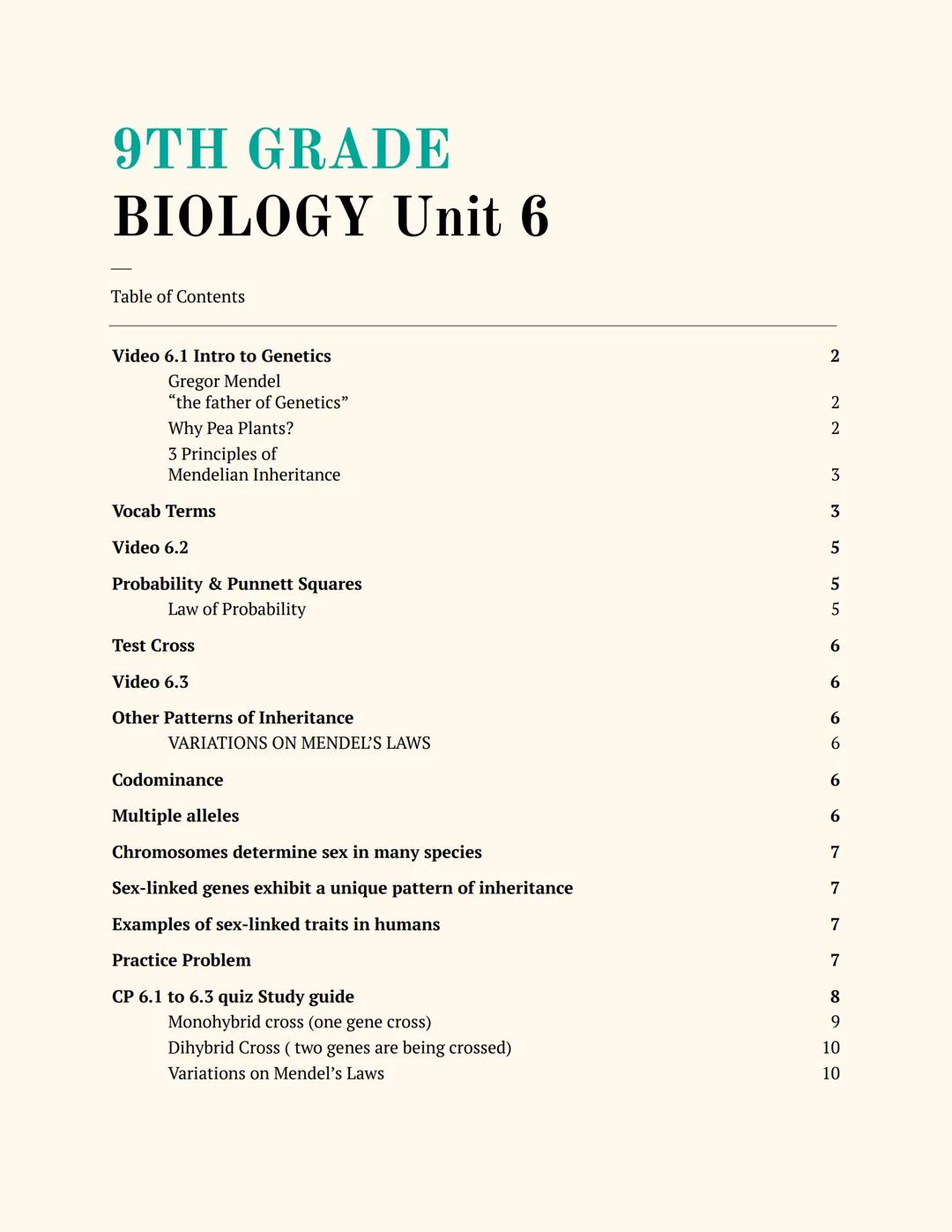
Introduction to Genetics
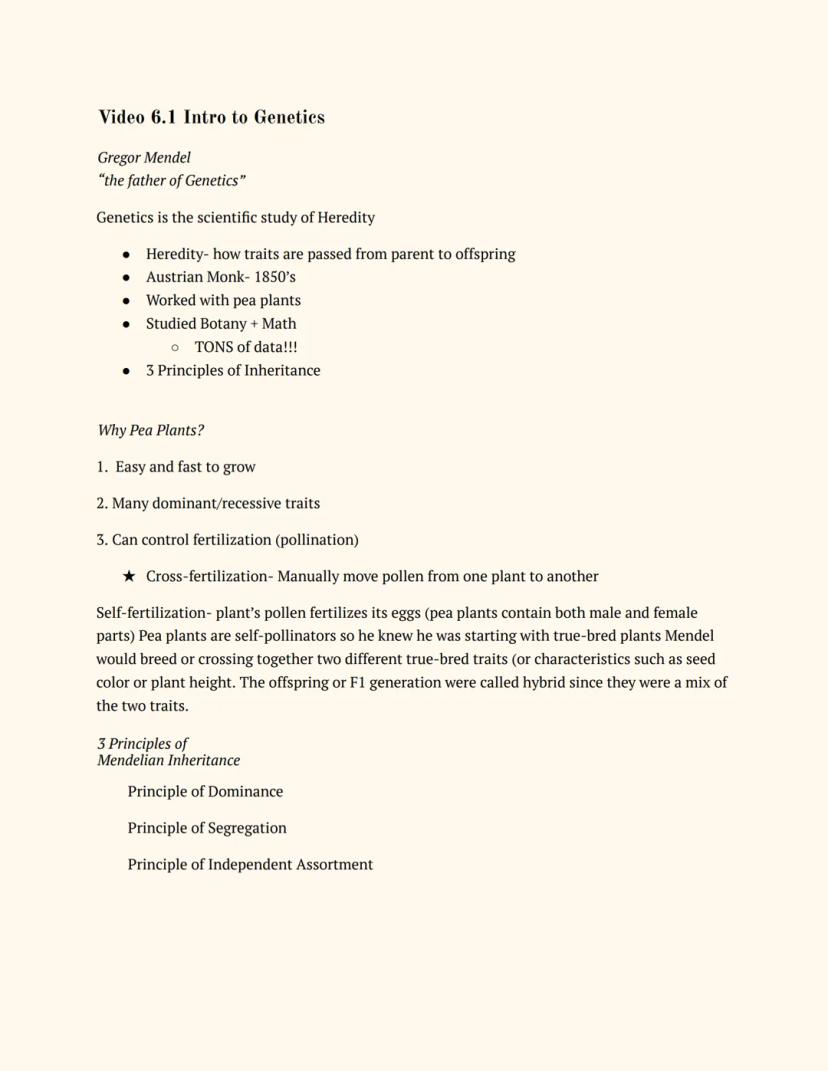
Gregor Mendel, nicknamed the "father of Genetics," was an Austrian monk who conducted groundbreaking experiments with pea plants in the 1850s. He combined his knowledge of botany and math to collect tons of data that revealed how traits pass from one generation to the next.
Why pea plants? They were perfect for Mendel's experiments because they grow quickly, have many obvious traits (like purple or white flowers), and their pollination can be controlled. Mendel could either allow them to self-pollinate (when a plant's own pollen fertilizes its eggs) or perform cross-pollination by manually moving pollen between plants.
Through his meticulous experiments, Mendel established three fundamental principles of inheritance: the Principle of Dominance, the Principle of Segregation, and the Principle of Independent Assortment. These principles form the foundation of what we now call Mendelian inheritance.
Quick Fact: When Mendel crossed plants with different traits, he called the offspring "hybrids" because they were a mix of the two parent plants. These hybrids formed what scientists call the F1 generation.
2
of 7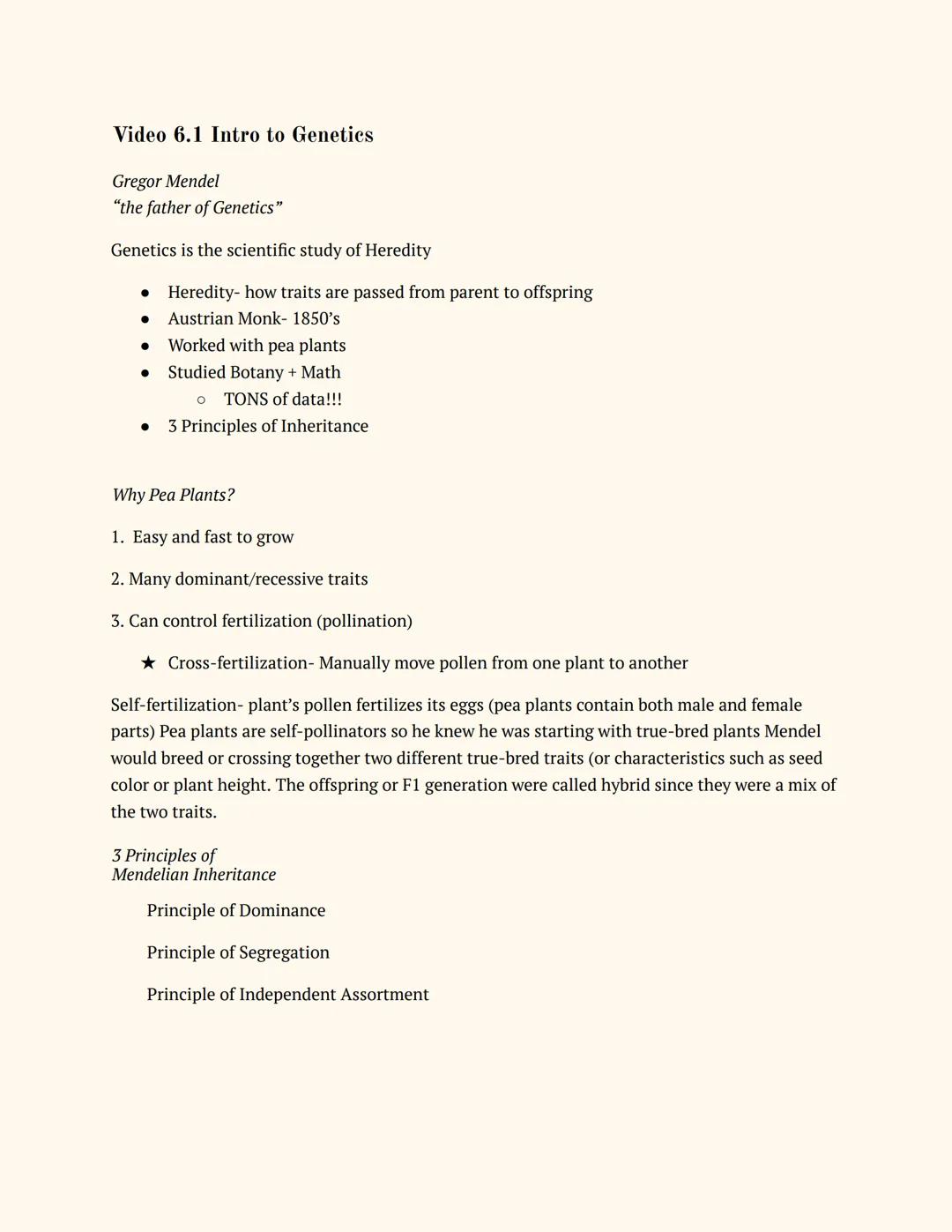
Key Genetics Vocabulary
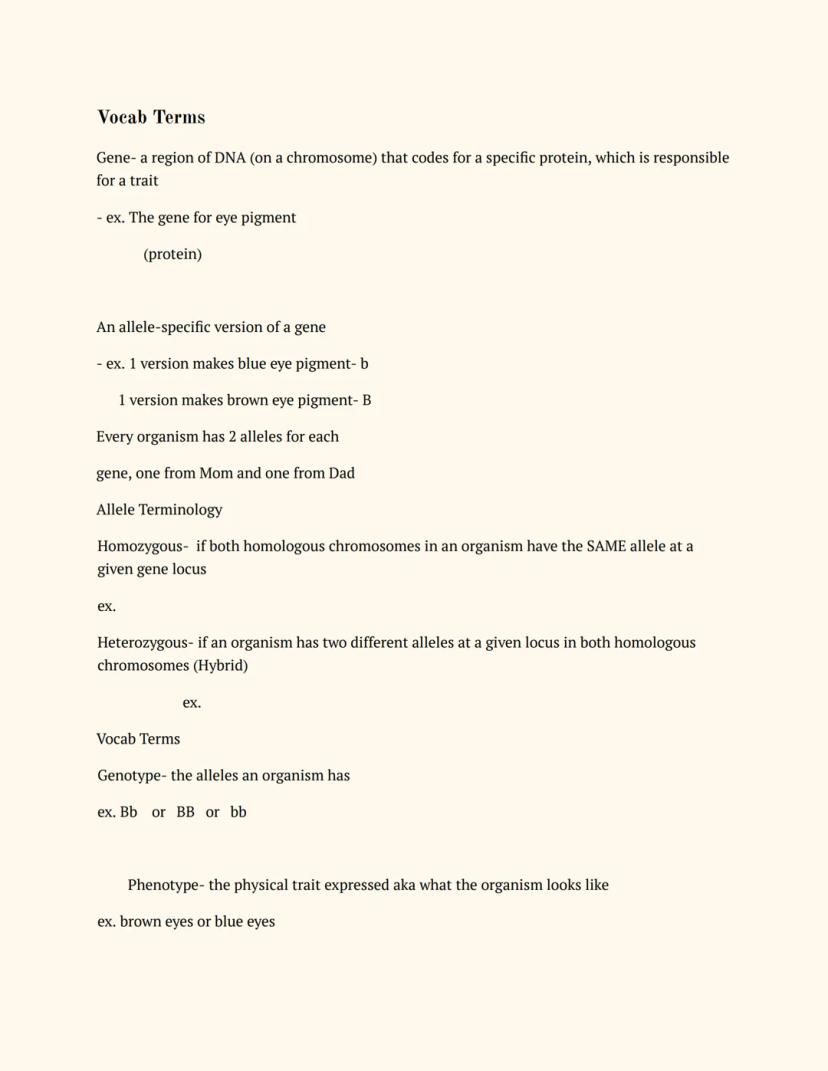
When we talk about genetics, we need to understand some important terms. A gene is a section of DNA on a chromosome that codes for a specific protein, which creates a trait like eye color. An allele is a specific version of that gene - for example, one version might make blue eye pigment while another makes brown.
Every organism inherits two alleles for each gene—one from mom and one from dad. When both alleles are the same (like BB or bb), we call this homozygous. When the alleles are different (like Bb), we call this heterozygous or hybrid.
Your genotype refers to the actual alleles you have (BB, Bb, or bb), while your phenotype is the physical trait that's expressed - what you can actually observe, like brown or blue eyes. Phenotypes can include anything observable, from eye color to blood type to certain behaviors.
Remember This: Dominant alleles (written as capital letters like B) are always expressed when present, while recessive alleles (written as lowercase letters like b) only show up when no dominant allele is present.
3
of 7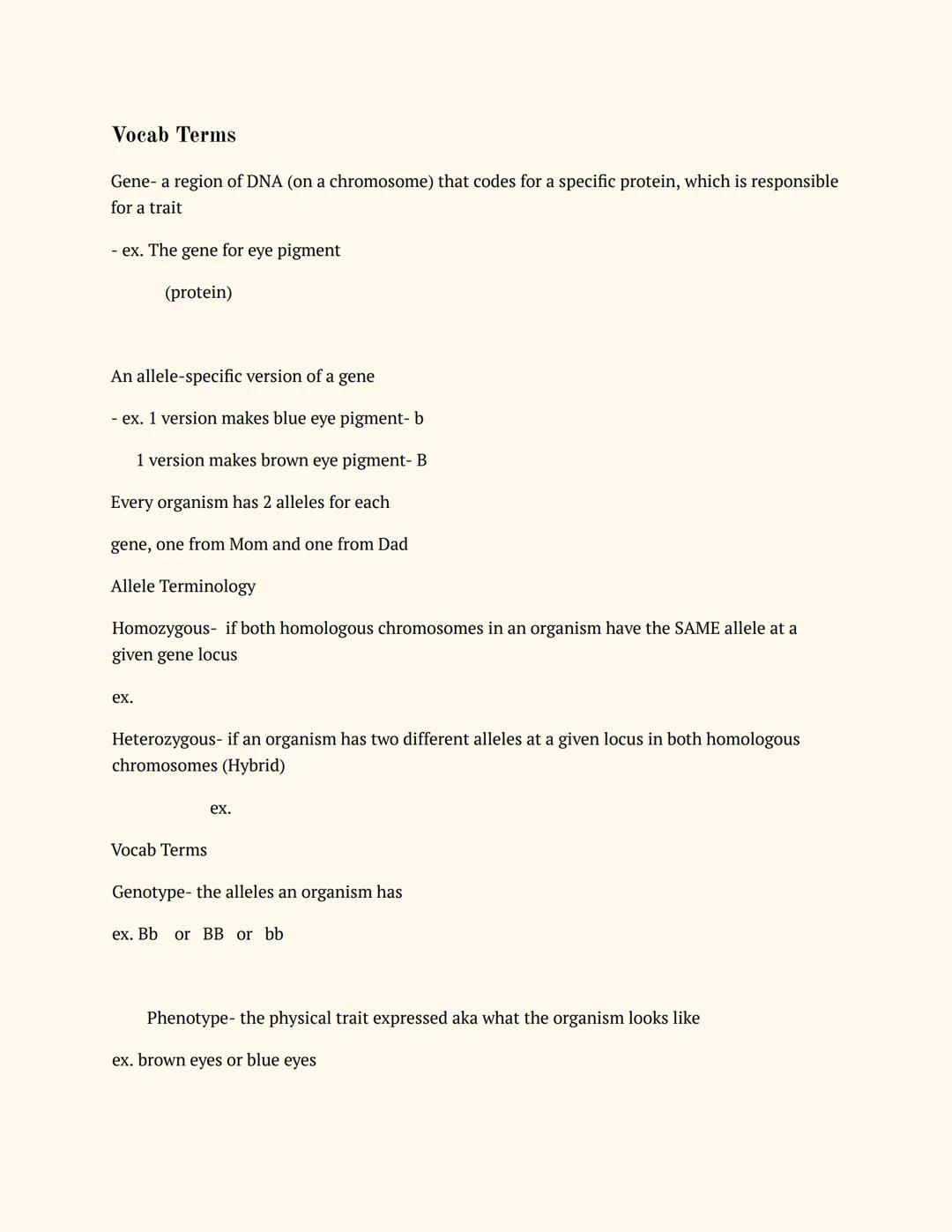
Mendel's Principles & Probability
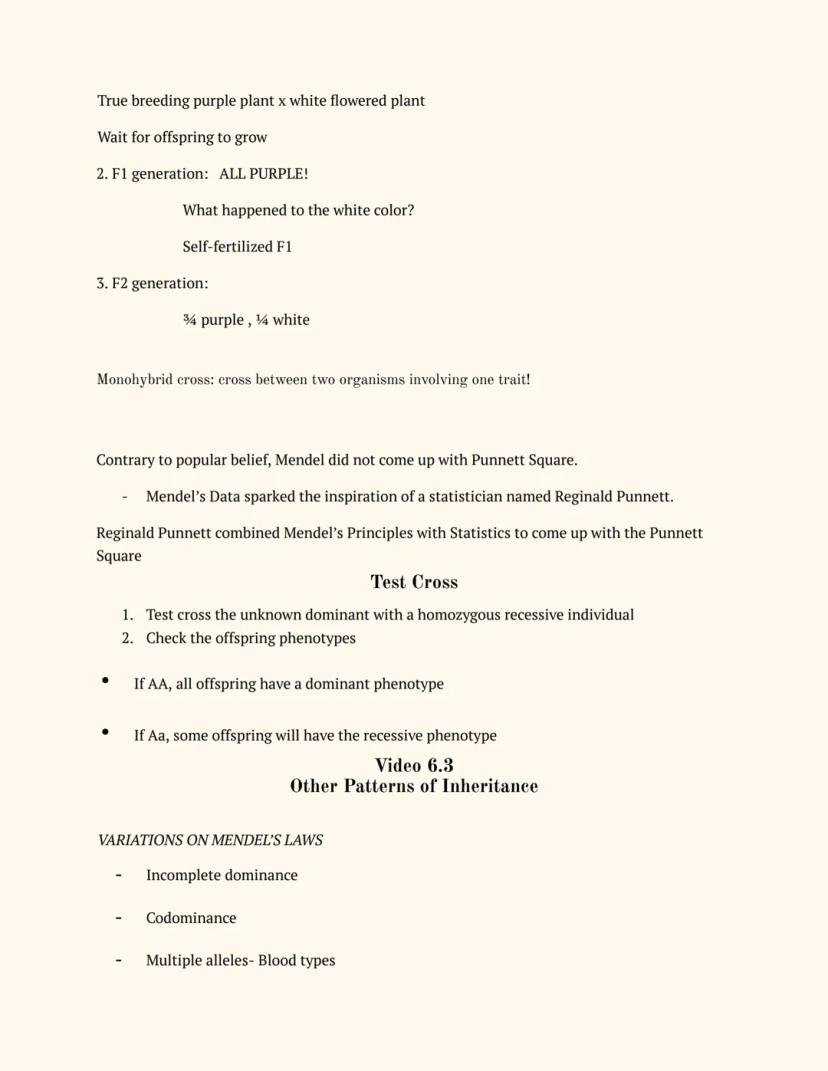
Mendel's first principle, the Principle of Dominance, states that some alleles are dominant and mask recessive alleles. His second principle, the Principle of Segregation, explains that during reproduction, the two alleles for each trait separate randomly into different gametes (egg or sperm cells) during meiosis.
Probability plays a huge role in genetics. Just like there's a 1/2 chance of getting heads when flipping a coin, there are predictable odds for inheriting specific alleles. Mendel used this concept to predict the outcomes of his pea plant crosses.
When Mendel crossed purple-flowered plants with white-flowered plants (the P generation), all the offspring (F1 generation) had purple flowers! The white color seemed to disappear. But when he let these F1 plants self-pollinate, the F2 generation showed a ratio of about 3/4 purple to 1/4 white flowers.
Try This: A cross between two organisms for a single trait is called a monohybrid cross. You can predict the results using a Punnett Square, a tool developed by scientist Reginald Punnett based on Mendel's work.
4
of 7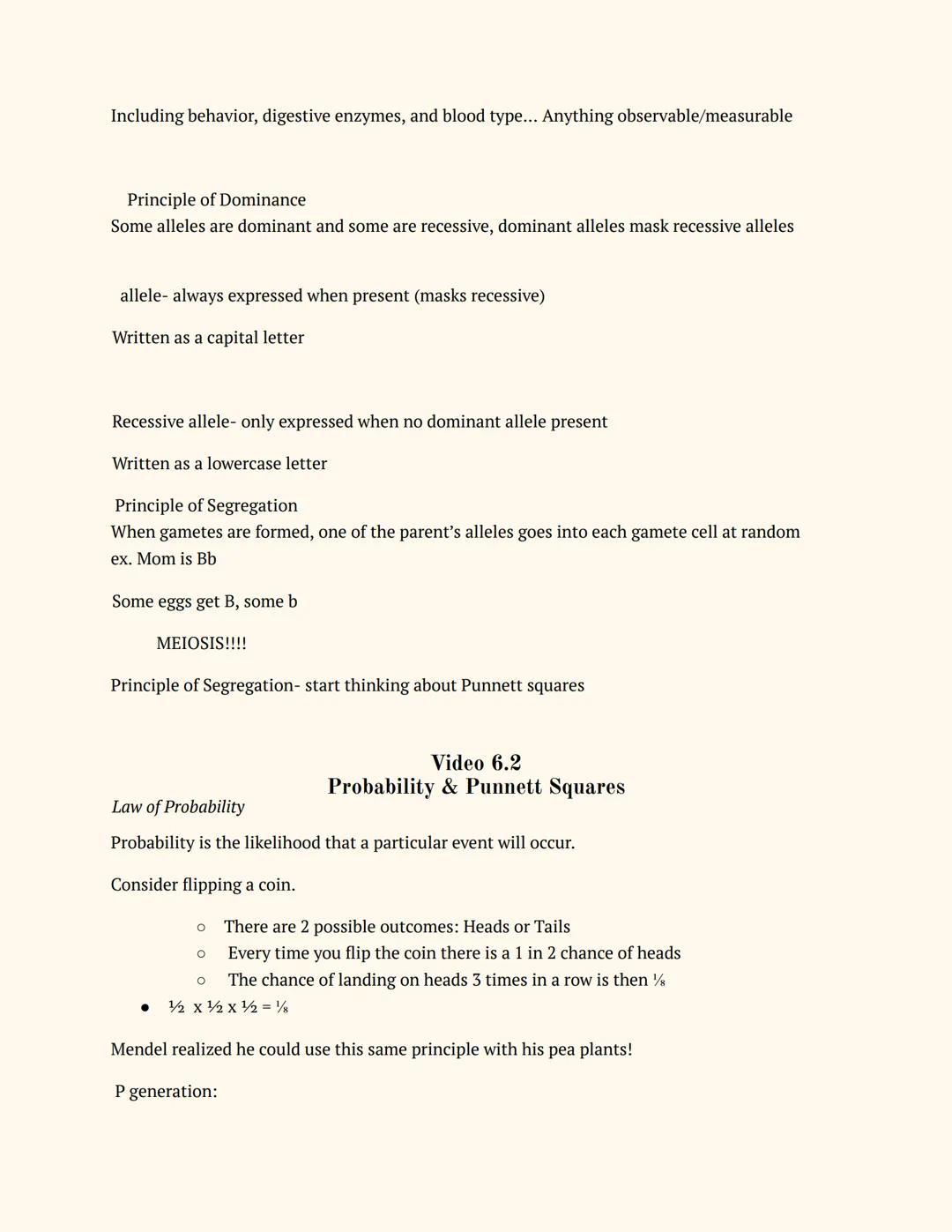
Beyond Simple Inheritance Patterns
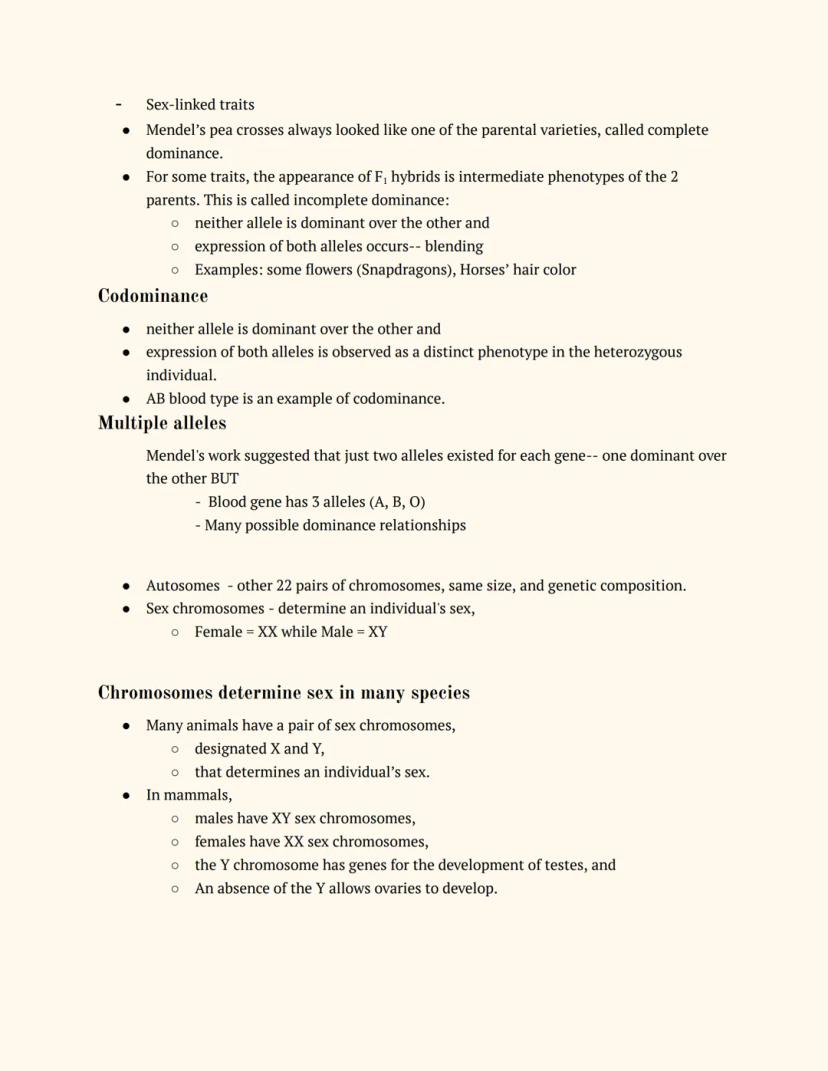
Not all traits follow Mendel's simple dominant/recessive pattern. In incomplete dominance, neither allele is completely dominant, resulting in a blended phenotype. For example, when a red snapdragon is crossed with a white one, the offspring are pink!
With codominance, both alleles are fully expressed in the heterozygous individual. Blood type AB is a perfect example - both the A and B alleles are expressed equally, not blended.
Many genes have multiple alleles in a population, not just two. Human blood type is determined by three alleles (A, B, and O), creating four possible blood types (A, B, AB, and O).
Cool Connection: Your biological sex is determined by special chromosomes called sex chromosomes. Females typically have XX chromosomes, while males have XY. The other 22 pairs of chromosomes (called autosomes) are the same in both sexes.
5
of 7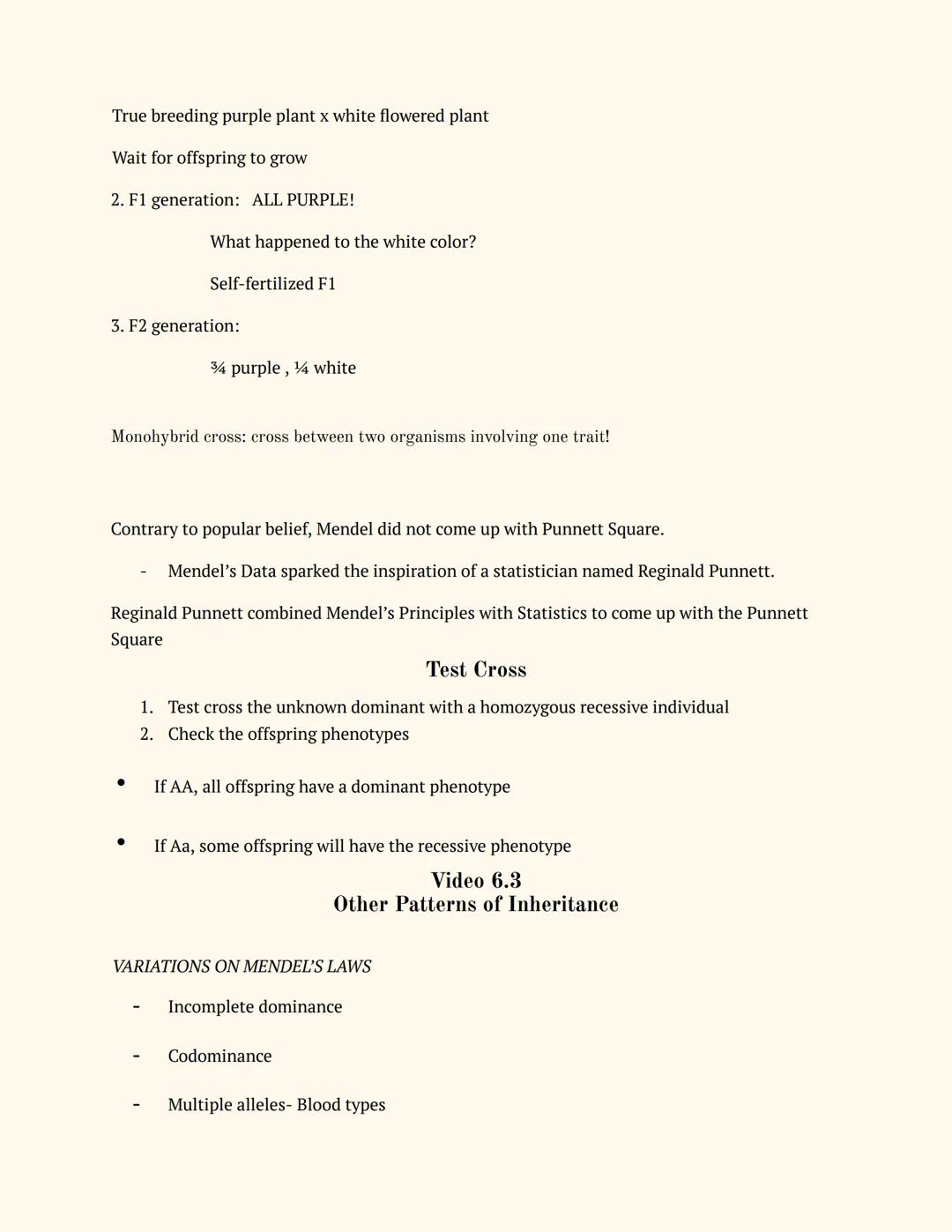
Sex-Linked Traits
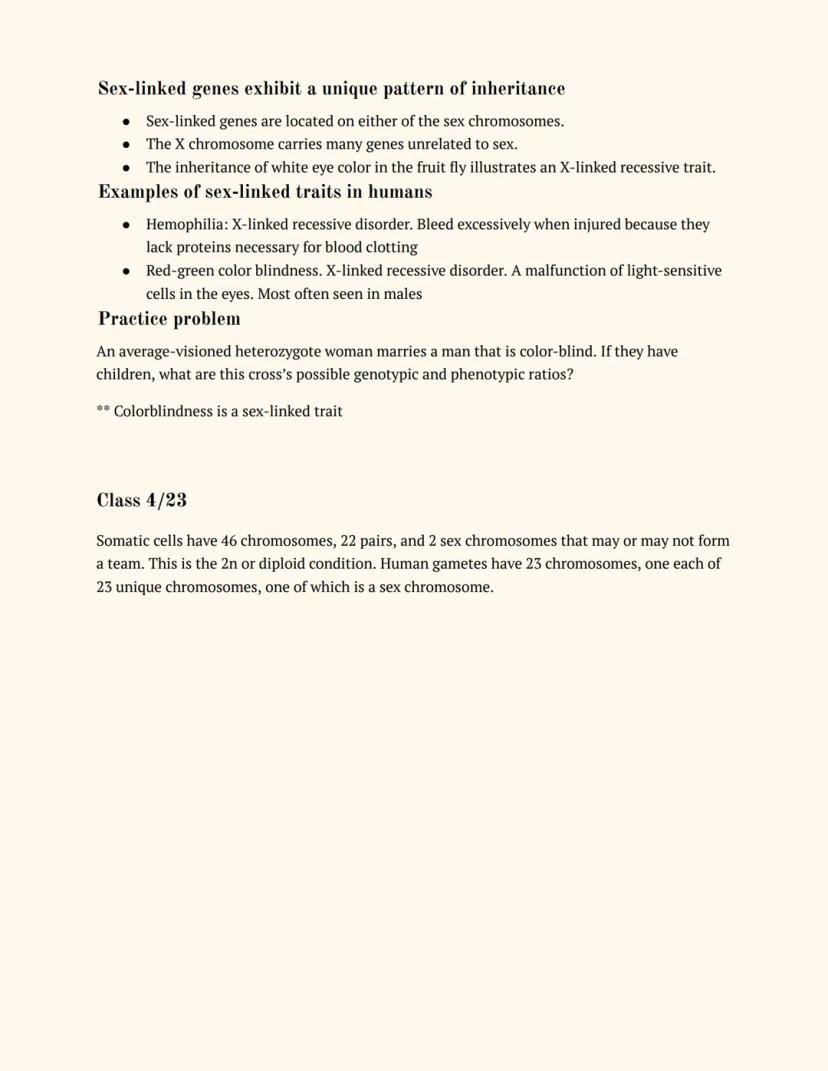
Sex-linked traits follow a unique inheritance pattern because they're located on sex chromosomes. The X chromosome carries many genes unrelated to determining sex, while the Y chromosome mainly contains genes for male development.
Since males have only one X chromosome (XY), they'll show sex-linked recessive traits more often than females, who have two X chromosomes (XX). This explains why conditions like color blindness and hemophilia affect males more frequently than females.
For example, hemophilia is an X-linked recessive disorder where people bleed excessively when injured because they lack proteins necessary for blood clotting. Red-green color blindness is another X-linked recessive trait caused by a malfunction in the eye's light-sensitive cells.
Think About This: If a woman with normal vision (but carrying a recessive color blindness allele) has children with a color-blind man, what are the chances their sons will be color-blind? Their daughters? Try solving this with a Punnett square!
6
of 7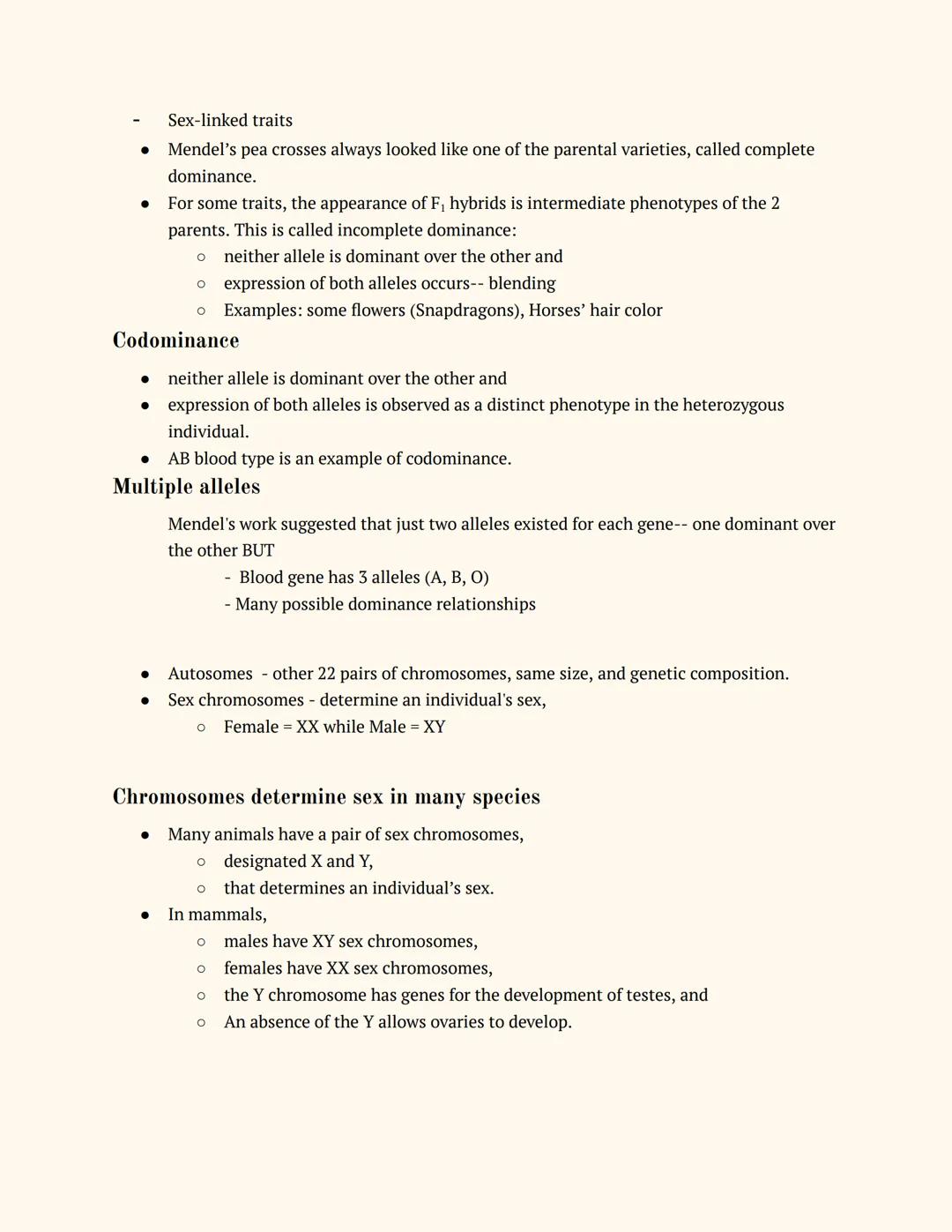
7
of 7
We thought you’d never ask...
What is the Knowunity AI companion?
Our AI companion is specifically built for the needs of students. Based on the millions of content pieces we have on the platform we can provide truly meaningful and relevant answers to students. But its not only about answers, the companion is even more about guiding students through their daily learning challenges, with personalised study plans, quizzes or content pieces in the chat and 100% personalisation based on the students skills and developments.
Where can I download the Knowunity app?
You can download the app in the Google Play Store and in the Apple App Store.
Is Knowunity really free of charge?
That's right! Enjoy free access to study content, connect with fellow students, and get instant help – all at your fingertips.
Similar Content
Most popular content in Biology
9C
BiologyCell Organelles
This Quiz Is To Test Your Knowledge Of Cell Organelles And Their Functions Inside The Cell. It Can Also Be A Study Guide To Remember Them Better.
6th6710
B
Biologybiology cell organelles and functions
Do you know the cell organelles and their functions?
9th4410
M
BiologyMitosis and Cell Division Flashcards
These flashcards cover the basics of mitosis and why cell division occurs in the first place.
9th3390
D
BiologyDNA and RNA
Uncover the secrets of life with this comprehensive Biology flashcard set. Perfect for grade 10 students studying Living Environment.
10th1,0782
D
BiologyDiscover the Fascinating World of Living Organisms
Uncover the secrets of biology and explore the diverse and amazing life forms that inhabit our planet with this captivating flashcard set.
7th4380
A
BiologyAnimal and plant cell structure
Quiz on animal and plant cell structures
9th3240
D
BiologyDiscover Punnet Squares
Uncover the secrets of life with this comprehensive Biology flashcard set. Perfect for grade 10 students studying Living Environment.
10th3961
D
BiologyDNA
Parts of DNA
9th2970
S
BiologySteps of Cellular Respiration
3 basic steps and Molecule Vocab
9th2660
Most popular content
9O
 AP US History
Origins and Dynamics of the Columbian Exchange
Analyze the ecological and economic motivations behind the initial transfer of goods, people, and diseases between the Old and New Worlds.
9th3,1280
I
AP US HistoryIntroduction to Early Cultural Interactions
Analyze the initial social and religious encounters between Europeans, Africans, and Indigenous peoples in the colonial Americas.
9th2,7730
O
 AP World History
Origins of Ancient River Civilizations
Analyze the environmental factors and technological innovations that led to the rise of early states in Mesopotamia, Egypt, and the Indus Valley.
9th3,1870
M
AP US HistoryMotivations for European Exploration
Analyze the economic, religious, and political factors that drove European powers to the Americas during the 15th and 16th centuries.
9th1,7780
F
 AP Psychology
Foundations of Ethical Guidelines in Research
Practice the core principles of the APA ethical code including informed consent, debriefing, and the role of Institutional Review Boards.
9th1,3360
I
AP US HistoryIntroduction to Native American Societies
Examine the diverse social, political, and economic structures of North American indigenous groups prior to European contact.
9th1,1100
I
AP BiologyIntroduction to Biological Elements of Life
Practice identifying the essential elements including carbon, nitrogen, phosphorus, and sulfur that compose biological macromolecules.
9th1,7390
I
AP US HistoryIntroduction to the Spanish Encomienda System
Explore the fundamental economic and social structures of the Spanish colonial system, focusing on the encomienda and the casta social hierarchy.
9th8890
O
AP World HistoryOrigins and Continuity of the Byzantine Empire
Analyze the political and cultural transitions from the Roman Empire to the Byzantine Empire, focusing on the reign of Justinian I and his code.
9th1,6320
Can't find what you're looking for? Explore other subjects.
Students love us — and so will you.
4.6/5App Store
4.7/5Google Play
The app is very easy to use and well designed. I have found everything I was looking for so far and have been able to learn a lot from the presentations! I will definitely use the app for a class assignment! And of course it also helps a lot as an inspiration.
Stefan SiOS user
This app is really great. There are so many study notes and help [...]. My problem subject is French, for example, and the app has so many options for help. Thanks to this app, I have improved my French. I would recommend it to anyone.
Samantha KlichAndroid user
Wow, I am really amazed. I just tried the app because I've seen it advertised many times and was absolutely stunned. This app is THE HELP you want for school and above all, it offers so many things, such as workouts and fact sheets, which have been VERY helpful to me personally.
AnnaiOS user
Biology119 views·Updated Jun 13, 2026·7 pagesBasics of Genetics: Understanding Heredity
Katy Hodge@theonlykatinthehat
Genetics is all about how traits get passed from parents to children. It's like solving a puzzle to understand why you have blue eyes or why your friend is taller than you. In this unit, we'll explore how Gregor Mendel,...
1
of 7
Sign up to see the content. It's free!
- Access to all documents
- Improve your grades
- Join milions of students
Introduction to Genetics
Gregor Mendel, nicknamed the "father of Genetics," was an Austrian monk who conducted groundbreaking experiments with pea plants in the 1850s. He combined his knowledge of botany and math to collect tons of data that revealed how traits pass from one generation to the next.
Why pea plants? They were perfect for Mendel's experiments because they grow quickly, have many obvious traits (like purple or white flowers), and their pollination can be controlled. Mendel could either allow them to self-pollinate (when a plant's own pollen fertilizes its eggs) or perform cross-pollination by manually moving pollen between plants.
Through his meticulous experiments, Mendel established three fundamental principles of inheritance: the Principle of Dominance, the Principle of Segregation, and the Principle of Independent Assortment. These principles form the foundation of what we now call Mendelian inheritance.
Quick Fact: When Mendel crossed plants with different traits, he called the offspring "hybrids" because they were a mix of the two parent plants. These hybrids formed what scientists call the F1 generation.
2
of 7Sign up to see the content. It's free!
- Access to all documents
- Improve your grades
- Join milions of students
Key Genetics Vocabulary
When we talk about genetics, we need to understand some important terms. A gene is a section of DNA on a chromosome that codes for a specific protein, which creates a trait like eye color. An allele is a specific version of that gene - for example, one version might make blue eye pigment while another makes brown.
Every organism inherits two alleles for each gene—one from mom and one from dad. When both alleles are the same (like BB or bb), we call this homozygous. When the alleles are different (like Bb), we call this heterozygous or hybrid.
Your genotype refers to the actual alleles you have (BB, Bb, or bb), while your phenotype is the physical trait that's expressed - what you can actually observe, like brown or blue eyes. Phenotypes can include anything observable, from eye color to blood type to certain behaviors.
Remember This: Dominant alleles (written as capital letters like B) are always expressed when present, while recessive alleles (written as lowercase letters like b) only show up when no dominant allele is present.
3
of 7Sign up to see the content. It's free!
- Access to all documents
- Improve your grades
- Join milions of students
Mendel's Principles & Probability
Mendel's first principle, the Principle of Dominance, states that some alleles are dominant and mask recessive alleles. His second principle, the Principle of Segregation, explains that during reproduction, the two alleles for each trait separate randomly into different gametes (egg or sperm cells) during meiosis.
Probability plays a huge role in genetics. Just like there's a 1/2 chance of getting heads when flipping a coin, there are predictable odds for inheriting specific alleles. Mendel used this concept to predict the outcomes of his pea plant crosses.
When Mendel crossed purple-flowered plants with white-flowered plants (the P generation), all the offspring (F1 generation) had purple flowers! The white color seemed to disappear. But when he let these F1 plants self-pollinate, the F2 generation showed a ratio of about 3/4 purple to 1/4 white flowers.
Try This: A cross between two organisms for a single trait is called a monohybrid cross. You can predict the results using a Punnett Square, a tool developed by scientist Reginald Punnett based on Mendel's work.
4
of 7Sign up to see the content. It's free!
- Access to all documents
- Improve your grades
- Join milions of students
Beyond Simple Inheritance Patterns
Not all traits follow Mendel's simple dominant/recessive pattern. In incomplete dominance, neither allele is completely dominant, resulting in a blended phenotype. For example, when a red snapdragon is crossed with a white one, the offspring are pink!
With codominance, both alleles are fully expressed in the heterozygous individual. Blood type AB is a perfect example - both the A and B alleles are expressed equally, not blended.
Many genes have multiple alleles in a population, not just two. Human blood type is determined by three alleles (A, B, and O), creating four possible blood types (A, B, AB, and O).
Cool Connection: Your biological sex is determined by special chromosomes called sex chromosomes. Females typically have XX chromosomes, while males have XY. The other 22 pairs of chromosomes (called autosomes) are the same in both sexes.
5
of 7Sign up to see the content. It's free!
- Access to all documents
- Improve your grades
- Join milions of students
Sex-Linked Traits
Sex-linked traits follow a unique inheritance pattern because they're located on sex chromosomes. The X chromosome carries many genes unrelated to determining sex, while the Y chromosome mainly contains genes for male development.
Since males have only one X chromosome (XY), they'll show sex-linked recessive traits more often than females, who have two X chromosomes (XX). This explains why conditions like color blindness and hemophilia affect males more frequently than females.
For example, hemophilia is an X-linked recessive disorder where people bleed excessively when injured because they lack proteins necessary for blood clotting. Red-green color blindness is another X-linked recessive trait caused by a malfunction in the eye's light-sensitive cells.
Think About This: If a woman with normal vision (but carrying a recessive color blindness allele) has children with a color-blind man, what are the chances their sons will be color-blind? Their daughters? Try solving this with a Punnett square!
6
of 7Sign up to see the content. It's free!
- Access to all documents
- Improve your grades
- Join milions of students
7
of 7Sign up to see the content. It's free!
- Access to all documents
- Improve your grades
- Join milions of students
We thought you’d never ask...
What is the Knowunity AI companion?
Our AI companion is specifically built for the needs of students. Based on the millions of content pieces we have on the platform we can provide truly meaningful and relevant answers to students. But its not only about answers, the companion is even more about guiding students through their daily learning challenges, with personalised study plans, quizzes or content pieces in the chat and 100% personalisation based on the students skills and developments.
Where can I download the Knowunity app?
You can download the app in the Google Play Store and in the Apple App Store.
Is Knowunity really free of charge?
That's right! Enjoy free access to study content, connect with fellow students, and get instant help – all at your fingertips.
Similar Content
Most popular content in Biology
9C
BiologyCell Organelles
This Quiz Is To Test Your Knowledge Of Cell Organelles And Their Functions Inside The Cell. It Can Also Be A Study Guide To Remember Them Better.
6th6710
B
Biologybiology cell organelles and functions
Do you know the cell organelles and their functions?
9th4410
M
BiologyMitosis and Cell Division Flashcards
These flashcards cover the basics of mitosis and why cell division occurs in the first place.
9th3390
D
BiologyDNA and RNA
Uncover the secrets of life with this comprehensive Biology flashcard set. Perfect for grade 10 students studying Living Environment.
10th1,0782
D
BiologyDiscover the Fascinating World of Living Organisms
Uncover the secrets of biology and explore the diverse and amazing life forms that inhabit our planet with this captivating flashcard set.
7th4380
A
BiologyAnimal and plant cell structure
Quiz on animal and plant cell structures
9th3240
D
BiologyDiscover Punnet Squares
Uncover the secrets of life with this comprehensive Biology flashcard set. Perfect for grade 10 students studying Living Environment.
10th3961
D
BiologyDNA
Parts of DNA
9th2970
S
BiologySteps of Cellular Respiration
3 basic steps and Molecule Vocab
9th2660
Most popular content
9O
AP US HistoryOrigins and Dynamics of the Columbian Exchange
Analyze the ecological and economic motivations behind the initial transfer of goods, people, and diseases between the Old and New Worlds.
9th3,1280
I
AP US HistoryIntroduction to Early Cultural Interactions
Analyze the initial social and religious encounters between Europeans, Africans, and Indigenous peoples in the colonial Americas.
9th2,7730
O
AP World HistoryOrigins of Ancient River Civilizations
Analyze the environmental factors and technological innovations that led to the rise of early states in Mesopotamia, Egypt, and the Indus Valley.
9th3,1870
M
AP US HistoryMotivations for European Exploration
Analyze the economic, religious, and political factors that drove European powers to the Americas during the 15th and 16th centuries.
9th1,7780
F
AP PsychologyFoundations of Ethical Guidelines in Research
Practice the core principles of the APA ethical code including informed consent, debriefing, and the role of Institutional Review Boards.
9th1,3360
I
AP US HistoryIntroduction to Native American Societies
Examine the diverse social, political, and economic structures of North American indigenous groups prior to European contact.
9th1,1100
I
AP BiologyIntroduction to Biological Elements of Life
Practice identifying the essential elements including carbon, nitrogen, phosphorus, and sulfur that compose biological macromolecules.
9th1,7390
I
AP US HistoryIntroduction to the Spanish Encomienda System
Explore the fundamental economic and social structures of the Spanish colonial system, focusing on the encomienda and the casta social hierarchy.
9th8890
O
AP World HistoryOrigins and Continuity of the Byzantine Empire
Analyze the political and cultural transitions from the Roman Empire to the Byzantine Empire, focusing on the reign of Justinian I and his code.
9th1,6320
Can't find what you're looking for? Explore other subjects.
Students love us — and so will you.
4.6/5App Store
4.7/5Google Play
The app is very easy to use and well designed. I have found everything I was looking for so far and have been able to learn a lot from the presentations! I will definitely use the app for a class assignment! And of course it also helps a lot as an inspiration.
Stefan SiOS user
This app is really great. There are so many study notes and help [...]. My problem subject is French, for example, and the app has so many options for help. Thanks to this app, I have improved my French. I would recommend it to anyone.
Samantha KlichAndroid user
Wow, I am really amazed. I just tried the app because I've seen it advertised many times and was absolutely stunned. This app is THE HELP you want for school and above all, it offers so many things, such as workouts and fact sheets, which have been VERY helpful to me personally.
AnnaiOS user