
Welcome to your guide on the skin, its structures, and...
 Biology57 views·Updated Jun 17, 2026·4 pages
Understanding the Layers and Role of the Integumentary System
C
Carley Lyons@carleylyons_vtwk


1 / 4
1
of 4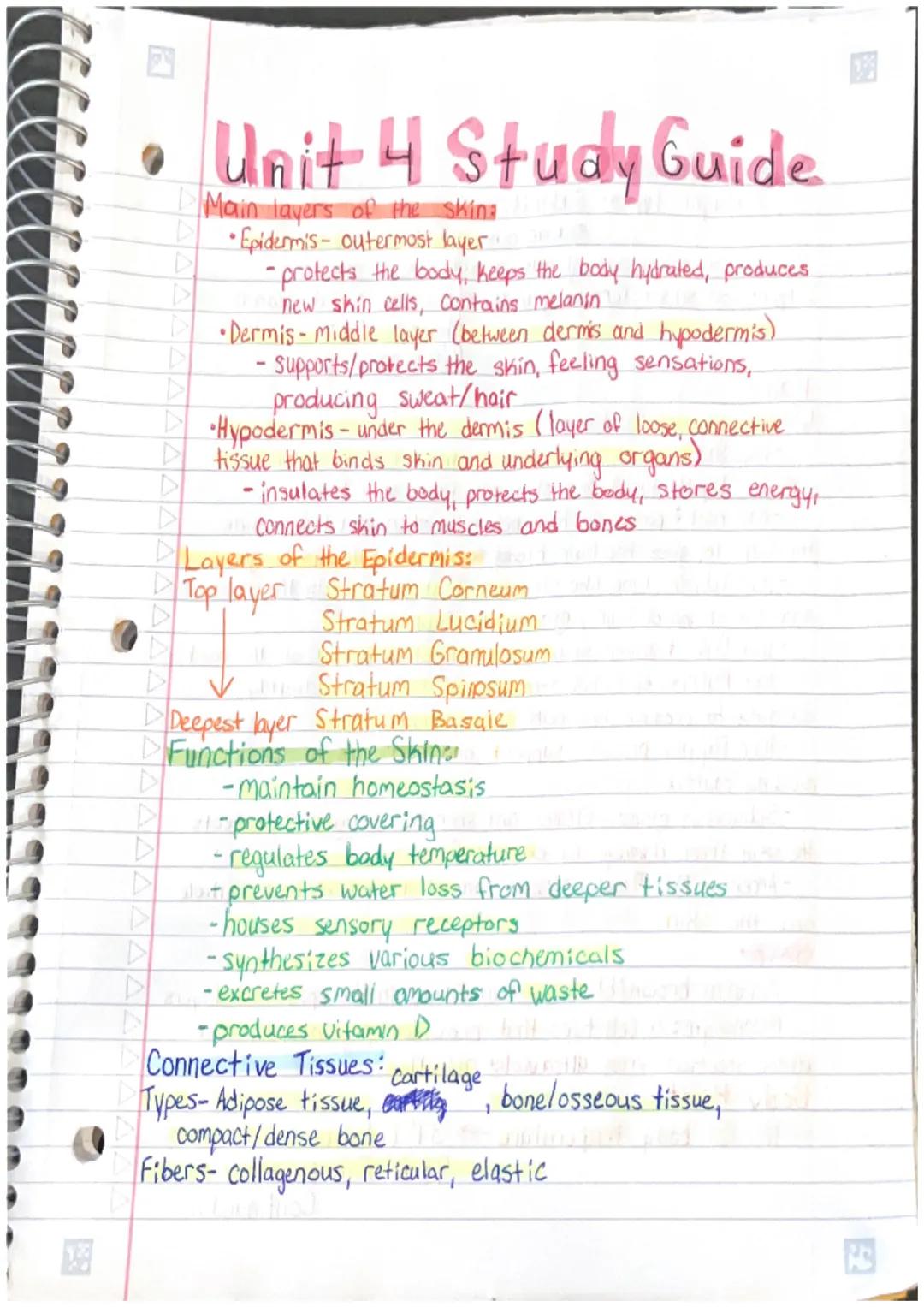
Skin Structure and Function
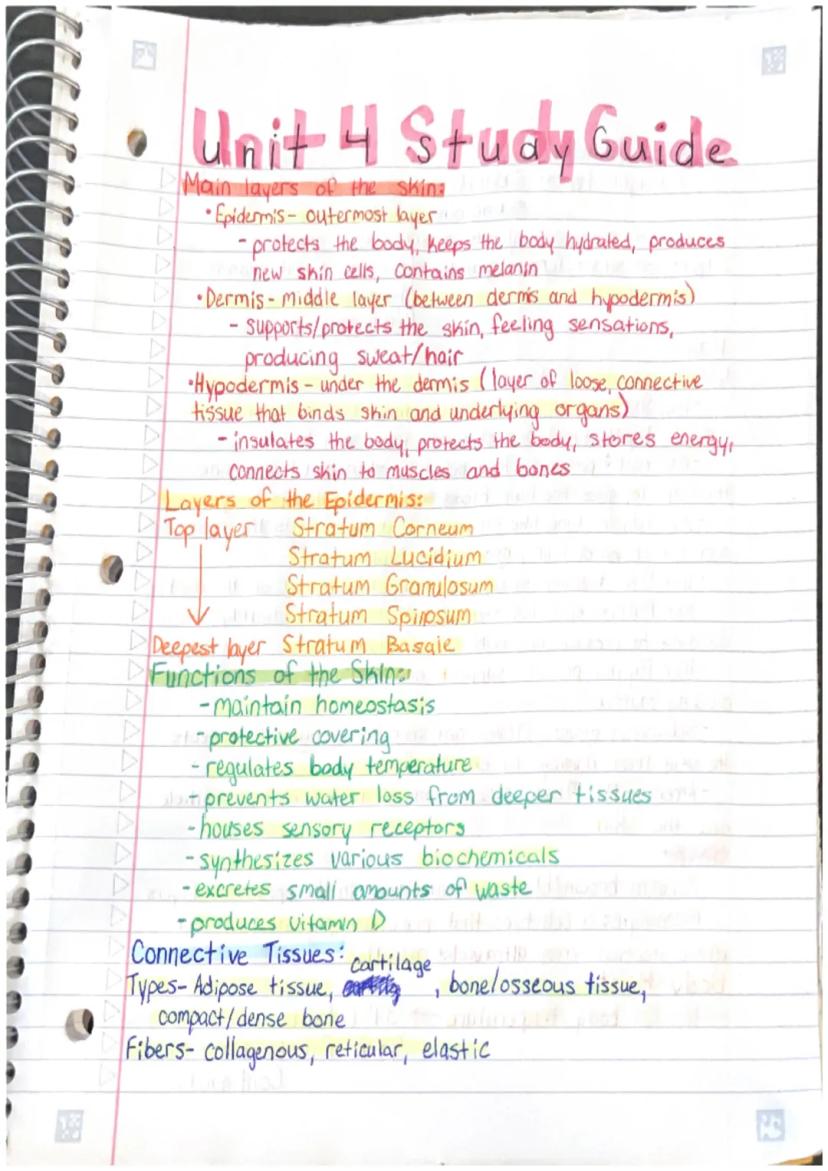
Your skin is organized into three main layers, each with specific roles. The epidermis, the outermost layer, protects your body, maintains hydration, produces new skin cells, and contains melanin for pigmentation. The dermis sits in the middle, supporting and protecting the skin while enabling sensations and producing sweat and hair. The hypodermis (underneath) insulates your body, stores energy, and connects skin to muscles and bones.
The epidermis itself has five layers, from deepest to most superficial: Stratum Basale, Stratum Spinosum, Stratum Granulosum, Stratum Lucidum, and Stratum Corneum. These layers work together as skin cells develop and move outward.
Your skin performs numerous vital functions including maintaining homeostasis, regulating body temperature, preventing water loss, housing sensory receptors, and even producing vitamin D. It also provides a protective covering for your body and excretes small amounts of waste.
💡 Think of your skin as your body's custom-designed spacesuit - it regulates temperature, prevents dehydration, and protects you from harmful environmental elements all at once!
Connective tissues work alongside skin, including adipose tissue, cartilage, and bone. These tissues contain various fibers (collagenous, reticular, and elastic) that provide structure and flexibility.
2
of 4
Glands, Hair, and Body Temperature
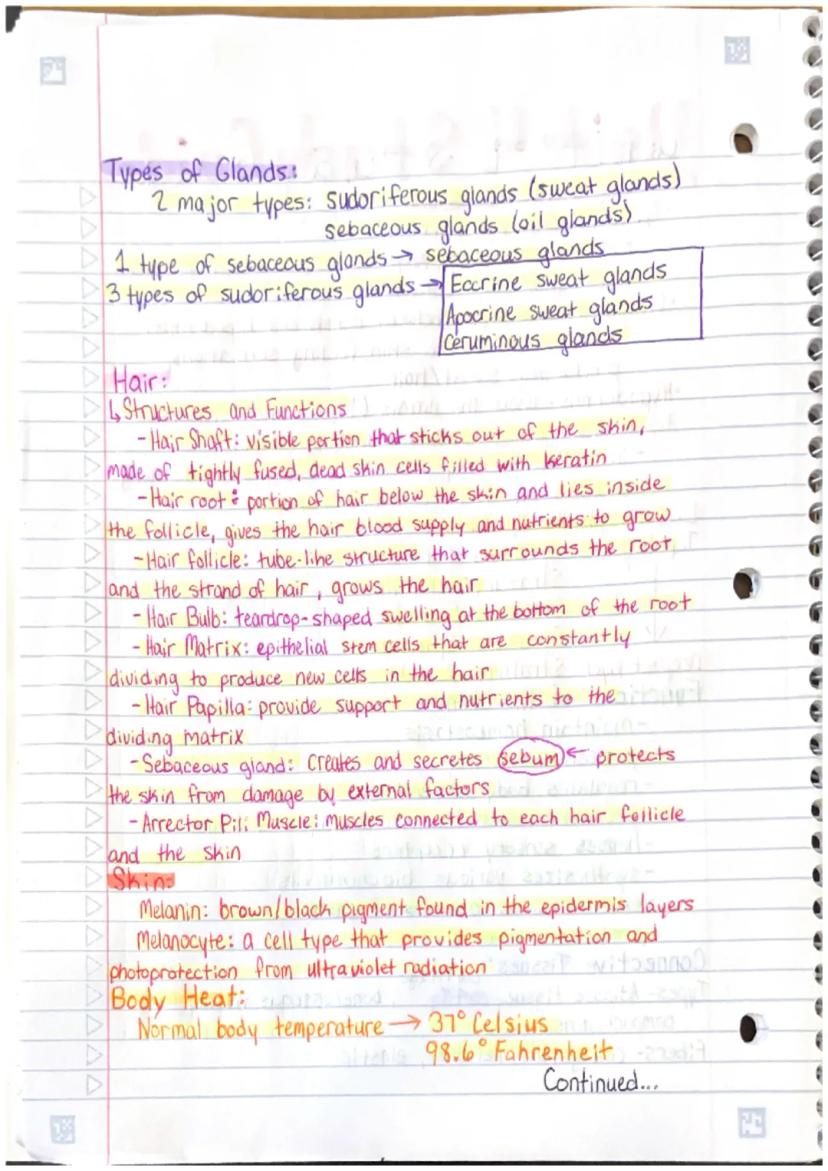
Your skin contains two major types of glands that help it function properly. Sebaceous glands produce oil (sebum) that waterproofs and lubricates your skin and hair. Sudoriferous glands (sweat glands) come in three varieties: eccrine sweat glands (all over your body), apocrine sweat glands (in armpits and groin), and ceruminous glands (in ear canals, producing earwax).
Hair has several important structures working together. The hair shaft is the visible portion made of dead, keratin-filled cells. Below the skin, the hair root receives nutrients from blood vessels, while the hair follicle surrounds both. The hair bulb and matrix contain actively dividing cells that produce new hair, nourished by the hair papilla. Each follicle connects to a sebaceous gland and an arrector pili muscle that can make hair stand up.
Melanin is the brown/black pigment in your skin produced by melanocytes, providing both color and protection from harmful UV radiation. Your normal body temperature stays around 37°C (98.6°F), and when it rises, your nervous system triggers vasodilation - blood vessels widen to allow more heat to escape through the skin.
🔍 Did you know that the arrector pili muscles that make your hair stand on end during "goosebumps" are the same type of involuntary muscles that dilate your pupils and move food through your digestive system?
3
of 4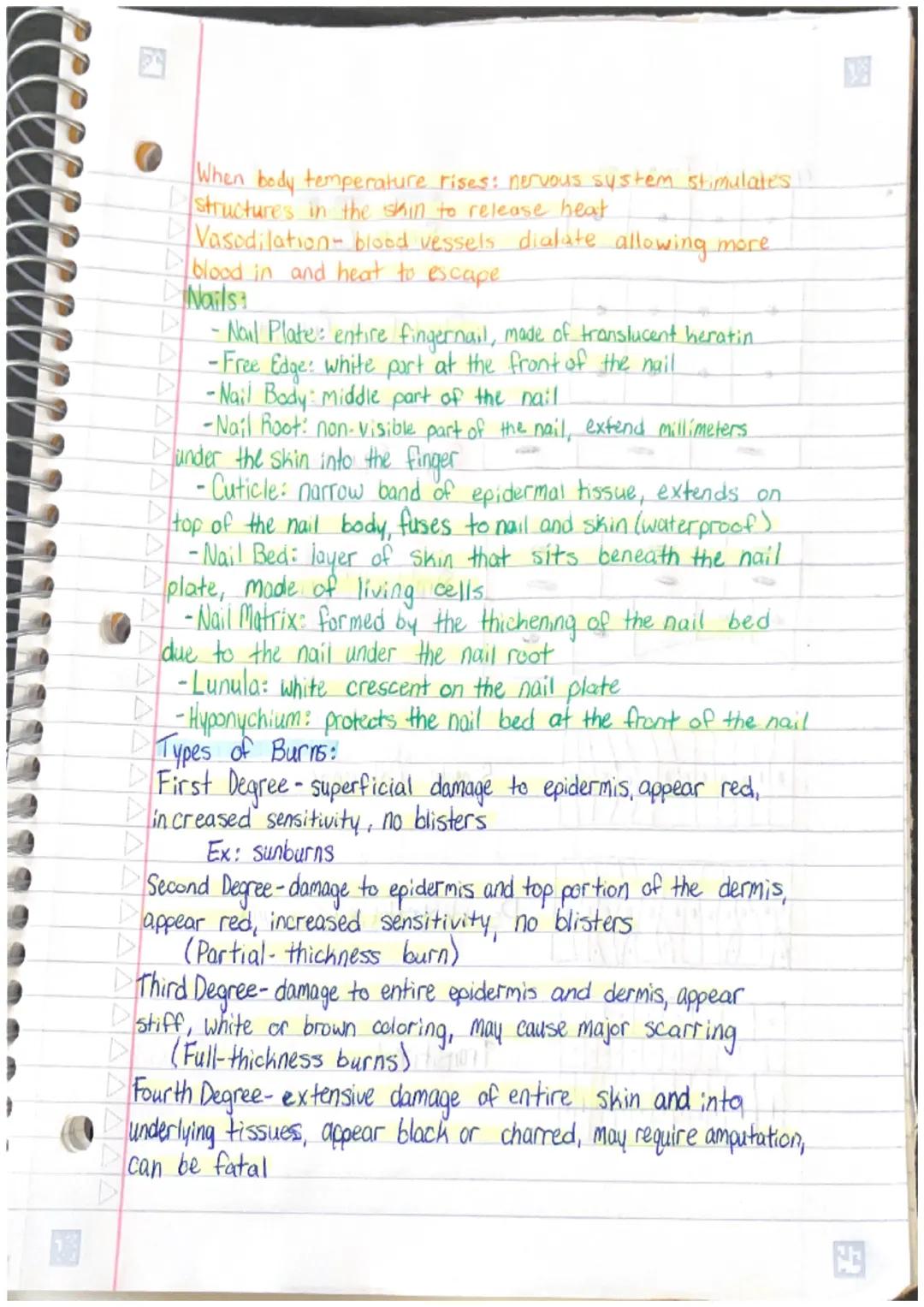
Nails and Burns
Your fingernails and toenails consist of several specialized structures. The visible nail plate is made of translucent keratin with a free edge (the white tip), a nail body (middle section), and a nail root that extends under your skin. The cuticle forms a waterproof seal where nail meets skin, while the nail bed beneath contains living cells. The nail matrix is where new nail cells form, visible as the white lunula at the base. The hyponychium protects the front edge of the nail bed.
Burns are classified by severity and depth of tissue damage. First-degree burns damage only the epidermis, appearing red with increased sensitivity but no blistering (like mild sunburns). Second-degree burns affect both the epidermis and upper dermis, causing redness, pain, and blistering .
Third-degree burns destroy the entire epidermis and dermis, appearing stiff with white or brown coloration and often causing major scarring . The most severe, fourth-degree burns, damage not only all skin layers but underlying tissues as well, appearing black or charred. These can be life-threatening and may require amputation.
⚠️ Burn severity isn't just about pain level - third and fourth-degree burns might actually hurt less because nerve endings have been destroyed, but they're much more dangerous to your health and recovery!
4
of 4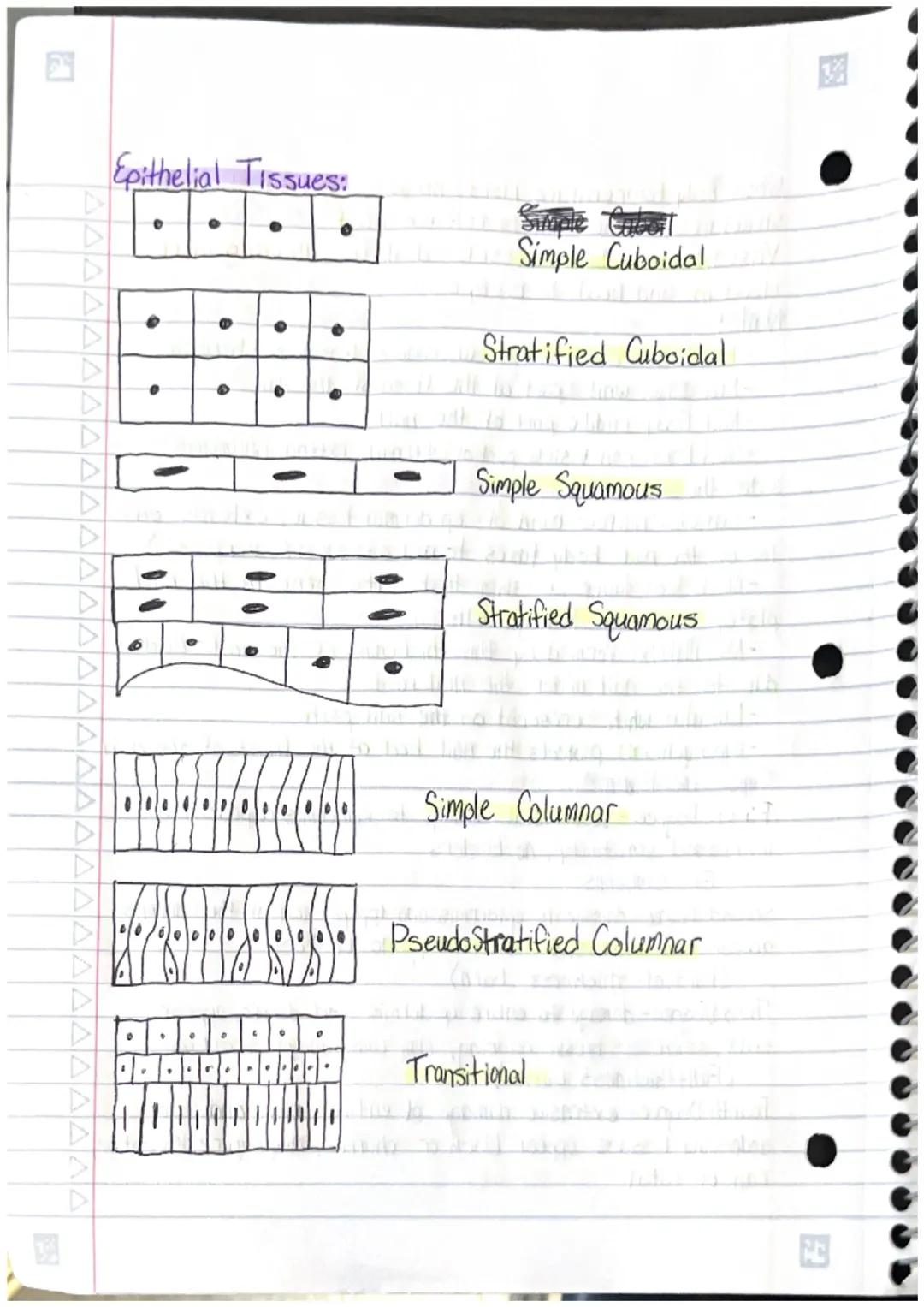
Epithelial Tissues
Epithelial tissues cover surfaces throughout your body and come in several important types based on their cell shapes and arrangements. Simple epithelium consists of a single layer of cells, while stratified epithelium has multiple layers.
The cell shapes determine tissue types: squamous , cuboidal , and columnar . These combine to form specific tissue types such as Simple Squamous (single layer of flat cells), Stratified Squamous (multiple layers of flat cells), and Simple Columnar (single layer of tall cells).
Pseudostratified Columnar epithelium appears to have multiple layers but actually doesn't, while Transitional epithelium can stretch and change shape. Each type of epithelial tissue is specially adapted for its location and function in your body.
🔎 The epithelial tissue lining your respiratory tract (pseudostratified columnar) has tiny hair-like projections called cilia that sweep mucus and trapped particles up and away from your lungs - like a microscopic escalator keeping your airways clean!
We thought you’d never ask...
What is the Knowunity AI companion?
Our AI companion is specifically built for the needs of students. Based on the millions of content pieces we have on the platform we can provide truly meaningful and relevant answers to students. But its not only about answers, the companion is even more about guiding students through their daily learning challenges, with personalised study plans, quizzes or content pieces in the chat and 100% personalisation based on the students skills and developments.
Where can I download the Knowunity app?
You can download the app in the Google Play Store and in the Apple App Store.
Is Knowunity really free of charge?
That's right! Enjoy free access to study content, connect with fellow students, and get instant help – all at your fingertips.
Similar Content
Most popular content: Integumentary System
5BiologyThe Integumentary System
Notes on the integumentary system (includes the skin, sweat glands, oil glands, hair, nails) for anatomy and physiology classes.
10th1057
AP BiologyBody Systems Notes for AP Bio
Notes of the Human Organ Systems with diagrams, functions, main organs, and explanations. Includes 10 human organ systems
50521
 Health & Medicine
Anatomy and Physiology Notes
The integumentary system notes
1082
Health & MedicineIntegumentary Organs Functions
Description of the structure and function of the organs in the integumentary system
9th1573
BiologyANATOMY Unit 2: Integumentary System(Skin)
CONTAINS: skin layers (epidermis, dermis, hypodermis) with in depth descriptions, melanin, melanocytes, keratin. ADDITIONAL: diseases, harmful factors, effects of tattoos, accessory organs of the skin & diagram
10th25446
Most popular content in Biology
9C
BiologyCell Organelles
This Quiz Is To Test Your Knowledge Of Cell Organelles And Their Functions Inside The Cell. It Can Also Be A Study Guide To Remember Them Better.
6th6710
B
Biologybiology cell organelles and functions
Do you know the cell organelles and their functions?
9th4410
M
BiologyMitosis and Cell Division Flashcards
These flashcards cover the basics of mitosis and why cell division occurs in the first place.
9th3390
D
BiologyDNA and RNA
Uncover the secrets of life with this comprehensive Biology flashcard set. Perfect for grade 10 students studying Living Environment.
10th1,0782
D
BiologyDiscover the Fascinating World of Living Organisms
Uncover the secrets of biology and explore the diverse and amazing life forms that inhabit our planet with this captivating flashcard set.
7th4380
A
BiologyAnimal and plant cell structure
Quiz on animal and plant cell structures
9th3240
D
BiologyDiscover Punnet Squares
Uncover the secrets of life with this comprehensive Biology flashcard set. Perfect for grade 10 students studying Living Environment.
10th3961
D
BiologyDNA
Parts of DNA
9th2970
S
BiologySteps of Cellular Respiration
3 basic steps and Molecule Vocab
9th2660
Most popular content
9O
 AP US History
Origins and Dynamics of the Columbian Exchange
Analyze the ecological and economic motivations behind the initial transfer of goods, people, and diseases between the Old and New Worlds.
9th3,1280
I
AP US HistoryIntroduction to Early Cultural Interactions
Analyze the initial social and religious encounters between Europeans, Africans, and Indigenous peoples in the colonial Americas.
9th2,7730
O
 AP World History
Origins of Ancient River Civilizations
Analyze the environmental factors and technological innovations that led to the rise of early states in Mesopotamia, Egypt, and the Indus Valley.
9th3,1870
M
AP US HistoryMotivations for European Exploration
Analyze the economic, religious, and political factors that drove European powers to the Americas during the 15th and 16th centuries.
9th1,7780
F
 AP Psychology
Foundations of Ethical Guidelines in Research
Practice the core principles of the APA ethical code including informed consent, debriefing, and the role of Institutional Review Boards.
9th1,3360
I
AP US HistoryIntroduction to Native American Societies
Examine the diverse social, political, and economic structures of North American indigenous groups prior to European contact.
9th1,1100
I
AP BiologyIntroduction to Biological Elements of Life
Practice identifying the essential elements including carbon, nitrogen, phosphorus, and sulfur that compose biological macromolecules.
9th1,7390
I
AP US HistoryIntroduction to the Spanish Encomienda System
Explore the fundamental economic and social structures of the Spanish colonial system, focusing on the encomienda and the casta social hierarchy.
9th8890
O
AP World HistoryOrigins and Continuity of the Byzantine Empire
Analyze the political and cultural transitions from the Roman Empire to the Byzantine Empire, focusing on the reign of Justinian I and his code.
9th1,6320
Can't find what you're looking for? Explore other subjects.
Students love us — and so will you.
4.6/5App Store
4.7/5Google Play
The app is very easy to use and well designed. I have found everything I was looking for so far and have been able to learn a lot from the presentations! I will definitely use the app for a class assignment! And of course it also helps a lot as an inspiration.
Stefan SiOS user
This app is really great. There are so many study notes and help [...]. My problem subject is French, for example, and the app has so many options for help. Thanks to this app, I have improved my French. I would recommend it to anyone.
Samantha KlichAndroid user
Wow, I am really amazed. I just tried the app because I've seen it advertised many times and was absolutely stunned. This app is THE HELP you want for school and above all, it offers so many things, such as workouts and fact sheets, which have been VERY helpful to me personally.
AnnaiOS user
Biology57 views·Updated Jun 17, 2026·4 pagesUnderstanding the Layers and Role of the Integumentary System
C
Carley Lyons@carleylyons_vtwk
Welcome to your guide on the skin, its structures, and related tissues! This summary covers the layers of skin, how it functions, and the various accessory structures like hair, nails, and glands that make this remarkable organ work. Understanding skin...
1
of 4
Sign up to see the content. It's free!
- Access to all documents
- Improve your grades
- Join milions of students
Skin Structure and Function
Your skin is organized into three main layers, each with specific roles. The epidermis, the outermost layer, protects your body, maintains hydration, produces new skin cells, and contains melanin for pigmentation. The dermis sits in the middle, supporting and protecting the skin while enabling sensations and producing sweat and hair. The hypodermis (underneath) insulates your body, stores energy, and connects skin to muscles and bones.
The epidermis itself has five layers, from deepest to most superficial: Stratum Basale, Stratum Spinosum, Stratum Granulosum, Stratum Lucidum, and Stratum Corneum. These layers work together as skin cells develop and move outward.
Your skin performs numerous vital functions including maintaining homeostasis, regulating body temperature, preventing water loss, housing sensory receptors, and even producing vitamin D. It also provides a protective covering for your body and excretes small amounts of waste.
💡 Think of your skin as your body's custom-designed spacesuit - it regulates temperature, prevents dehydration, and protects you from harmful environmental elements all at once!
Connective tissues work alongside skin, including adipose tissue, cartilage, and bone. These tissues contain various fibers (collagenous, reticular, and elastic) that provide structure and flexibility.
2
of 4Sign up to see the content. It's free!
- Access to all documents
- Improve your grades
- Join milions of students
Glands, Hair, and Body Temperature
Your skin contains two major types of glands that help it function properly. Sebaceous glands produce oil (sebum) that waterproofs and lubricates your skin and hair. Sudoriferous glands (sweat glands) come in three varieties: eccrine sweat glands (all over your body), apocrine sweat glands (in armpits and groin), and ceruminous glands (in ear canals, producing earwax).
Hair has several important structures working together. The hair shaft is the visible portion made of dead, keratin-filled cells. Below the skin, the hair root receives nutrients from blood vessels, while the hair follicle surrounds both. The hair bulb and matrix contain actively dividing cells that produce new hair, nourished by the hair papilla. Each follicle connects to a sebaceous gland and an arrector pili muscle that can make hair stand up.
Melanin is the brown/black pigment in your skin produced by melanocytes, providing both color and protection from harmful UV radiation. Your normal body temperature stays around 37°C (98.6°F), and when it rises, your nervous system triggers vasodilation - blood vessels widen to allow more heat to escape through the skin.
🔍 Did you know that the arrector pili muscles that make your hair stand on end during "goosebumps" are the same type of involuntary muscles that dilate your pupils and move food through your digestive system?
3
of 4Sign up to see the content. It's free!
- Access to all documents
- Improve your grades
- Join milions of students
Nails and Burns
Your fingernails and toenails consist of several specialized structures. The visible nail plate is made of translucent keratin with a free edge (the white tip), a nail body (middle section), and a nail root that extends under your skin. The cuticle forms a waterproof seal where nail meets skin, while the nail bed beneath contains living cells. The nail matrix is where new nail cells form, visible as the white lunula at the base. The hyponychium protects the front edge of the nail bed.
Burns are classified by severity and depth of tissue damage. First-degree burns damage only the epidermis, appearing red with increased sensitivity but no blistering (like mild sunburns). Second-degree burns affect both the epidermis and upper dermis, causing redness, pain, and blistering .
Third-degree burns destroy the entire epidermis and dermis, appearing stiff with white or brown coloration and often causing major scarring . The most severe, fourth-degree burns, damage not only all skin layers but underlying tissues as well, appearing black or charred. These can be life-threatening and may require amputation.
⚠️ Burn severity isn't just about pain level - third and fourth-degree burns might actually hurt less because nerve endings have been destroyed, but they're much more dangerous to your health and recovery!
4
of 4Sign up to see the content. It's free!
- Access to all documents
- Improve your grades
- Join milions of students
Epithelial Tissues
Epithelial tissues cover surfaces throughout your body and come in several important types based on their cell shapes and arrangements. Simple epithelium consists of a single layer of cells, while stratified epithelium has multiple layers.
The cell shapes determine tissue types: squamous , cuboidal , and columnar . These combine to form specific tissue types such as Simple Squamous (single layer of flat cells), Stratified Squamous (multiple layers of flat cells), and Simple Columnar (single layer of tall cells).
Pseudostratified Columnar epithelium appears to have multiple layers but actually doesn't, while Transitional epithelium can stretch and change shape. Each type of epithelial tissue is specially adapted for its location and function in your body.
🔎 The epithelial tissue lining your respiratory tract (pseudostratified columnar) has tiny hair-like projections called cilia that sweep mucus and trapped particles up and away from your lungs - like a microscopic escalator keeping your airways clean!
We thought you’d never ask...
What is the Knowunity AI companion?
Our AI companion is specifically built for the needs of students. Based on the millions of content pieces we have on the platform we can provide truly meaningful and relevant answers to students. But its not only about answers, the companion is even more about guiding students through their daily learning challenges, with personalised study plans, quizzes or content pieces in the chat and 100% personalisation based on the students skills and developments.
Where can I download the Knowunity app?
You can download the app in the Google Play Store and in the Apple App Store.
Is Knowunity really free of charge?
That's right! Enjoy free access to study content, connect with fellow students, and get instant help – all at your fingertips.
Similar Content
Most popular content: Integumentary System
5BiologyThe Integumentary System
Notes on the integumentary system (includes the skin, sweat glands, oil glands, hair, nails) for anatomy and physiology classes.
10th1057
AP BiologyBody Systems Notes for AP Bio
Notes of the Human Organ Systems with diagrams, functions, main organs, and explanations. Includes 10 human organ systems
50521
Health & MedicineAnatomy and Physiology Notes
The integumentary system notes
1082
Health & MedicineIntegumentary Organs Functions
Description of the structure and function of the organs in the integumentary system
9th1573
BiologyANATOMY Unit 2: Integumentary System(Skin)
CONTAINS: skin layers (epidermis, dermis, hypodermis) with in depth descriptions, melanin, melanocytes, keratin. ADDITIONAL: diseases, harmful factors, effects of tattoos, accessory organs of the skin & diagram
10th25446
Most popular content in Biology
9C
BiologyCell Organelles
This Quiz Is To Test Your Knowledge Of Cell Organelles And Their Functions Inside The Cell. It Can Also Be A Study Guide To Remember Them Better.
6th6710
B
Biologybiology cell organelles and functions
Do you know the cell organelles and their functions?
9th4410
M
BiologyMitosis and Cell Division Flashcards
These flashcards cover the basics of mitosis and why cell division occurs in the first place.
9th3390
D
BiologyDNA and RNA
Uncover the secrets of life with this comprehensive Biology flashcard set. Perfect for grade 10 students studying Living Environment.
10th1,0782
D
BiologyDiscover the Fascinating World of Living Organisms
Uncover the secrets of biology and explore the diverse and amazing life forms that inhabit our planet with this captivating flashcard set.
7th4380
A
BiologyAnimal and plant cell structure
Quiz on animal and plant cell structures
9th3240
D
BiologyDiscover Punnet Squares
Uncover the secrets of life with this comprehensive Biology flashcard set. Perfect for grade 10 students studying Living Environment.
10th3961
D
BiologyDNA
Parts of DNA
9th2970
S
BiologySteps of Cellular Respiration
3 basic steps and Molecule Vocab
9th2660
Most popular content
9O
AP US HistoryOrigins and Dynamics of the Columbian Exchange
Analyze the ecological and economic motivations behind the initial transfer of goods, people, and diseases between the Old and New Worlds.
9th3,1280
I
AP US HistoryIntroduction to Early Cultural Interactions
Analyze the initial social and religious encounters between Europeans, Africans, and Indigenous peoples in the colonial Americas.
9th2,7730
O
AP World HistoryOrigins of Ancient River Civilizations
Analyze the environmental factors and technological innovations that led to the rise of early states in Mesopotamia, Egypt, and the Indus Valley.
9th3,1870
M
AP US HistoryMotivations for European Exploration
Analyze the economic, religious, and political factors that drove European powers to the Americas during the 15th and 16th centuries.
9th1,7780
F
AP PsychologyFoundations of Ethical Guidelines in Research
Practice the core principles of the APA ethical code including informed consent, debriefing, and the role of Institutional Review Boards.
9th1,3360
I
AP US HistoryIntroduction to Native American Societies
Examine the diverse social, political, and economic structures of North American indigenous groups prior to European contact.
9th1,1100
I
AP BiologyIntroduction to Biological Elements of Life
Practice identifying the essential elements including carbon, nitrogen, phosphorus, and sulfur that compose biological macromolecules.
9th1,7390
I
AP US HistoryIntroduction to the Spanish Encomienda System
Explore the fundamental economic and social structures of the Spanish colonial system, focusing on the encomienda and the casta social hierarchy.
9th8890
O
AP World HistoryOrigins and Continuity of the Byzantine Empire
Analyze the political and cultural transitions from the Roman Empire to the Byzantine Empire, focusing on the reign of Justinian I and his code.
9th1,6320
Can't find what you're looking for? Explore other subjects.
Students love us — and so will you.
4.6/5App Store
4.7/5Google Play
The app is very easy to use and well designed. I have found everything I was looking for so far and have been able to learn a lot from the presentations! I will definitely use the app for a class assignment! And of course it also helps a lot as an inspiration.
Stefan SiOS user
This app is really great. There are so many study notes and help [...]. My problem subject is French, for example, and the app has so many options for help. Thanks to this app, I have improved my French. I would recommend it to anyone.
Samantha KlichAndroid user
Wow, I am really amazed. I just tried the app because I've seen it advertised many times and was absolutely stunned. This app is THE HELP you want for school and above all, it offers so many things, such as workouts and fact sheets, which have been VERY helpful to me personally.
AnnaiOS user