

Fungi form their own kingdom with unique characteristics that set...
 Biology41 views·Updated Jun 7, 2026·5 pages
Comprehensive Fungi Lecture Notes

1 / 5
1
of 5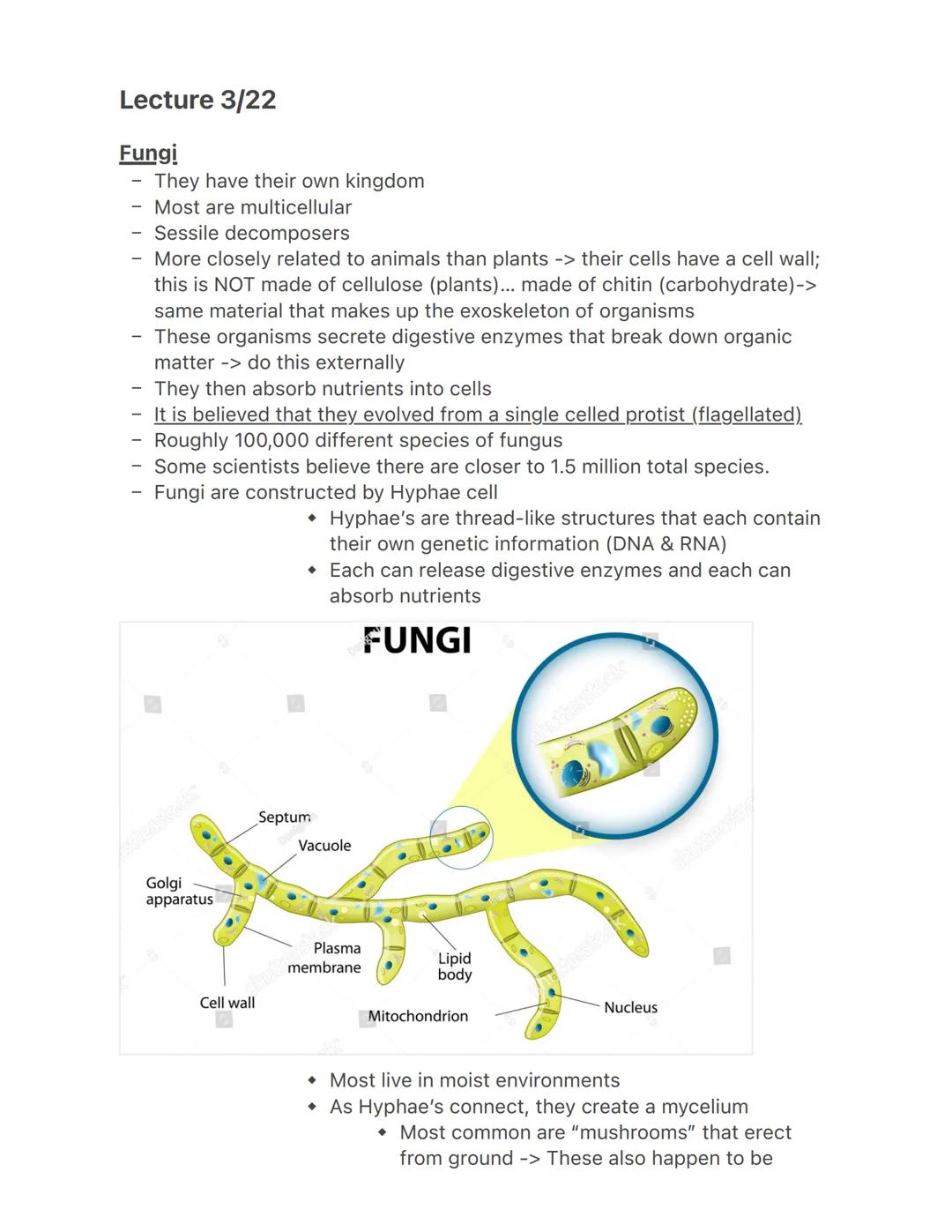
Fungi Fundamentals
Fungi are their own kingdom of mostly multicellular, sessile decomposers that are more closely related to animals than plants. Unlike plants with cellulose cell walls, fungi have cell walls made of chitin, the same material found in insect exoskeletons.
These organisms have a unique feeding strategy - they secrete digestive enzymes to break down organic matter externally, then absorb the nutrients into their cells. Scientists estimate there are roughly 100,000 known fungal species, but believe the total could reach 1.5 million species!
The basic building block of fungi is the hyphae - thread-like structures that each contain their own genetic information. Each hyphae can release digestive enzymes and absorb nutrients. When hyphae connect, they create a structure called a mycelium, which forms the main body of the fungus.
💡 The mushrooms we see popping up from the ground aren't the main fungal organism - they're just reproductive structures! The vast majority of the fungus exists as an underground network of hyphae.
2
of 5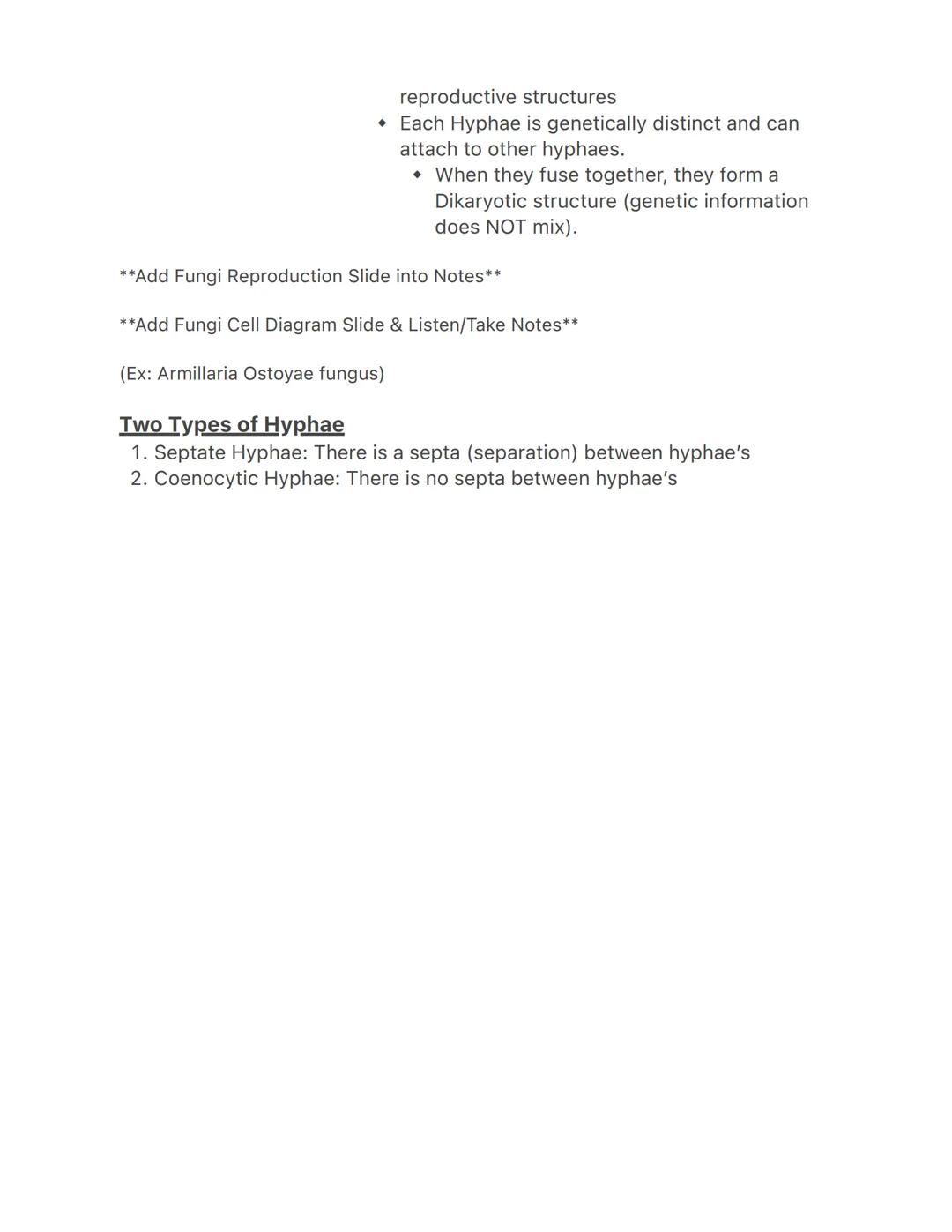
Fungal Structure and Reproduction
Hyphae are genetically distinct and can attach to other hyphae. When they fuse together, they form a dikaryotic structure where the genetic information doesn't mix right away. This unusual arrangement allows fungi to maintain genetic diversity.
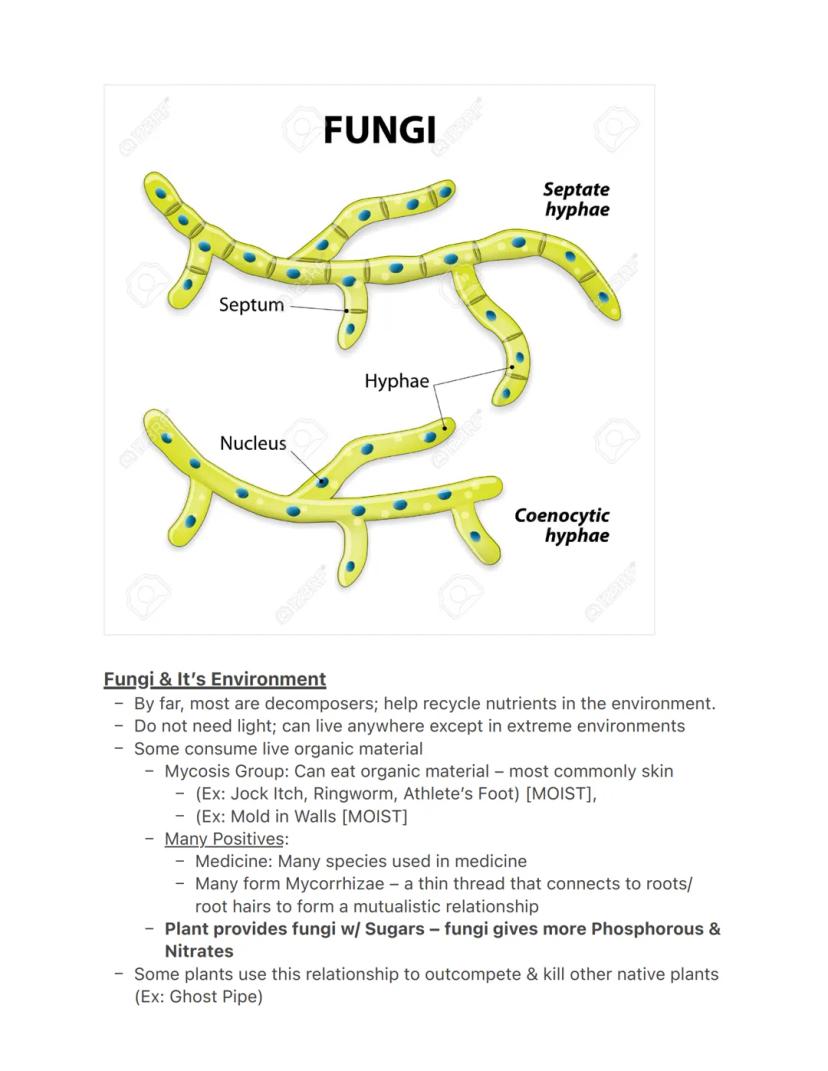
There are two main types of hyphae structures. Septate hyphae have separations (septa) between cells, while coenocytic hyphae lack these separations. These different structures affect how materials move through the fungal body.
Some fungi can grow to enormous sizes by connecting vast networks of hyphae. The Armillaria ostoyae fungus is an excellent example of this - a single organism can spread through acres of forest underground!
🔬 Fungi have their own unique cell structures that differ from both plants and animals. Their cellular organization allows them to thrive in their specialized ecological roles.
3
of 5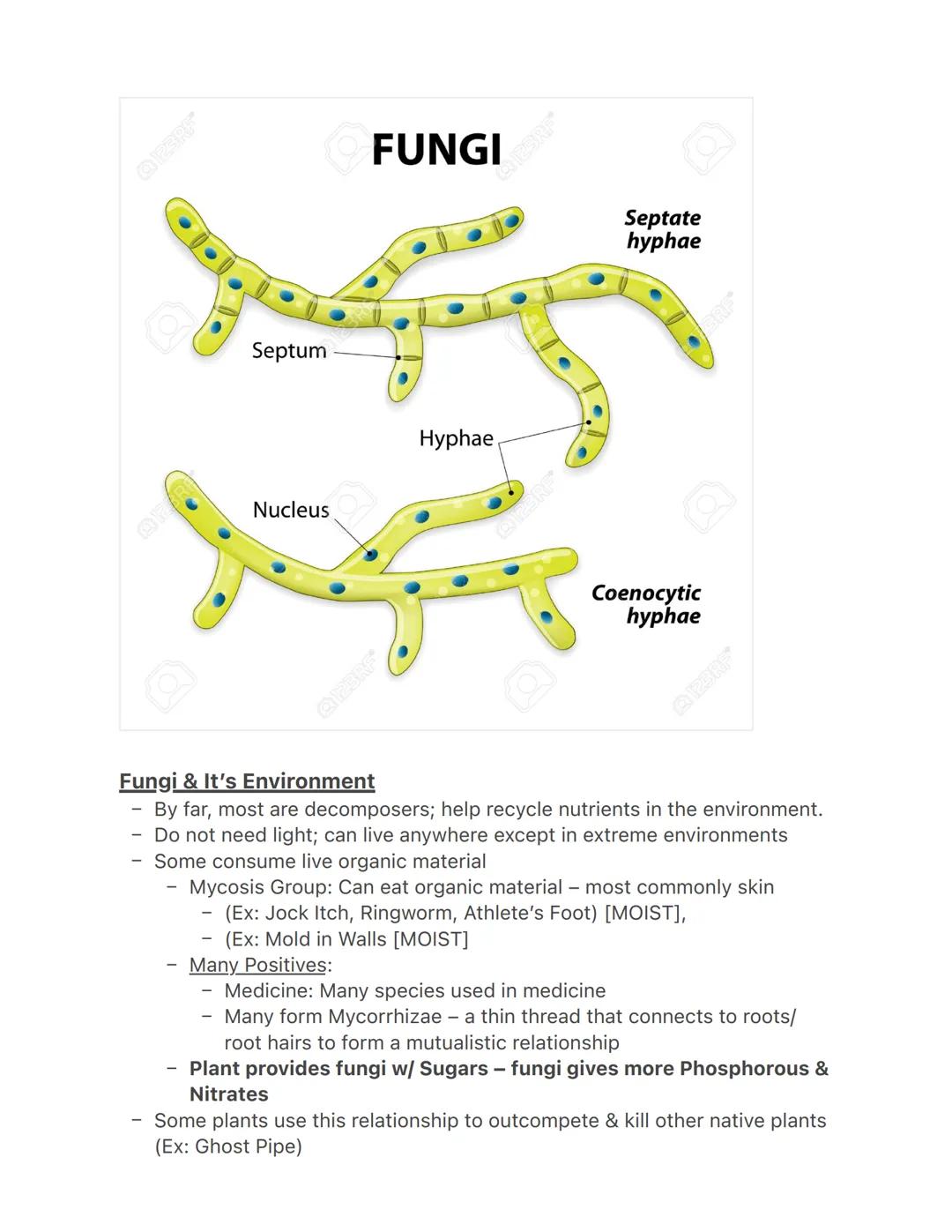
Fungi in the Environment
Fungi are primarily decomposers that help recycle nutrients in ecosystems. They don't need light to survive and can live almost anywhere except in extreme environments. This adaptability has allowed them to colonize virtually every habitat on Earth.
Some fungi consume living organic material. The mycosis group specifically can consume organic material like human skin, causing conditions like jock itch, ringworm, and athlete's foot. These fungi thrive in moist environments, which is why you'll also find mold growing on damp walls.
Many fungi form beneficial relationships. Mycorrhizae are thin threads that connect to plant roots, creating a mutualistic relationship. The plant provides the fungi with sugars, while the fungi supply the plant with more phosphorous and nitrates. Some plants use this relationship strategically to outcompete native plants.
🌱 About 90% of land plants form mycorrhizal relationships with fungi! This partnership is so important that many plants cannot survive without their fungal partners.
4
of 5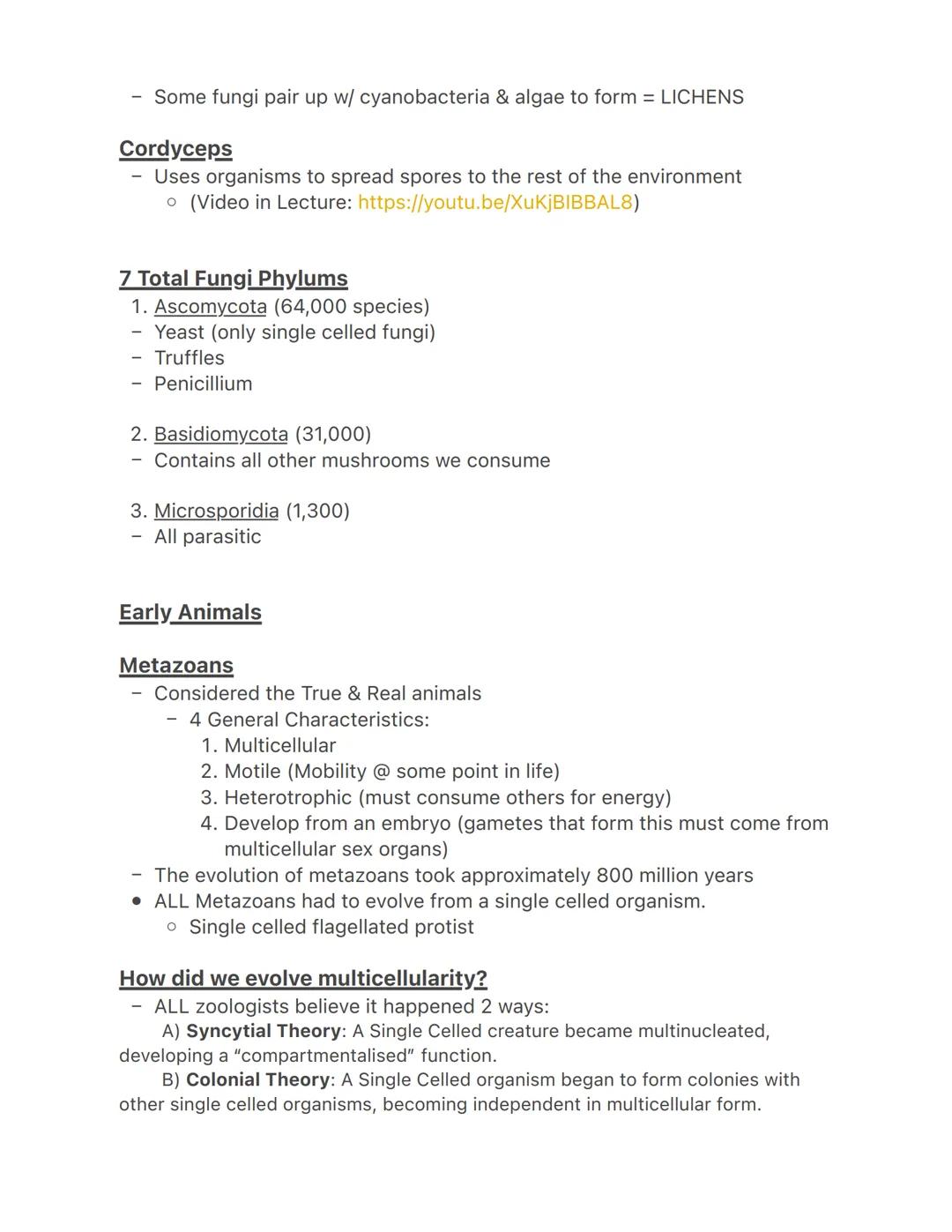
Fungal Diversity and Early Animals
Some fungi pair up with cyanobacteria or algae to form lichens, creating complex symbiotic organisms. Others, like Cordyceps, use living organisms to spread their spores throughout the environment - often with dramatic and sometimes gruesome effects!
Scientists classify fungi into seven major phyla. The Ascomycota (64,000 species) includes yeast, truffles, and penicillium. The Basidiomycota (31,000 species) contains most mushrooms we consume. The Microsporidia (1,300 species) are all parasitic fungi.
Early animals, known as metazoans, share four general characteristics: they're multicellular, motile at some point in their lives, heterotrophic (consuming others for energy), and develop from embryos. The evolution of metazoans took approximately 800 million years, evolving from single-celled organisms.
🧬 How did multicellularity evolve? Zoologists believe it happened in one of two ways: either through the Syncytial Theory (single cells becoming multinucleated) or the Colonial Theory (single cells forming colonies that became interdependent).
5
of 5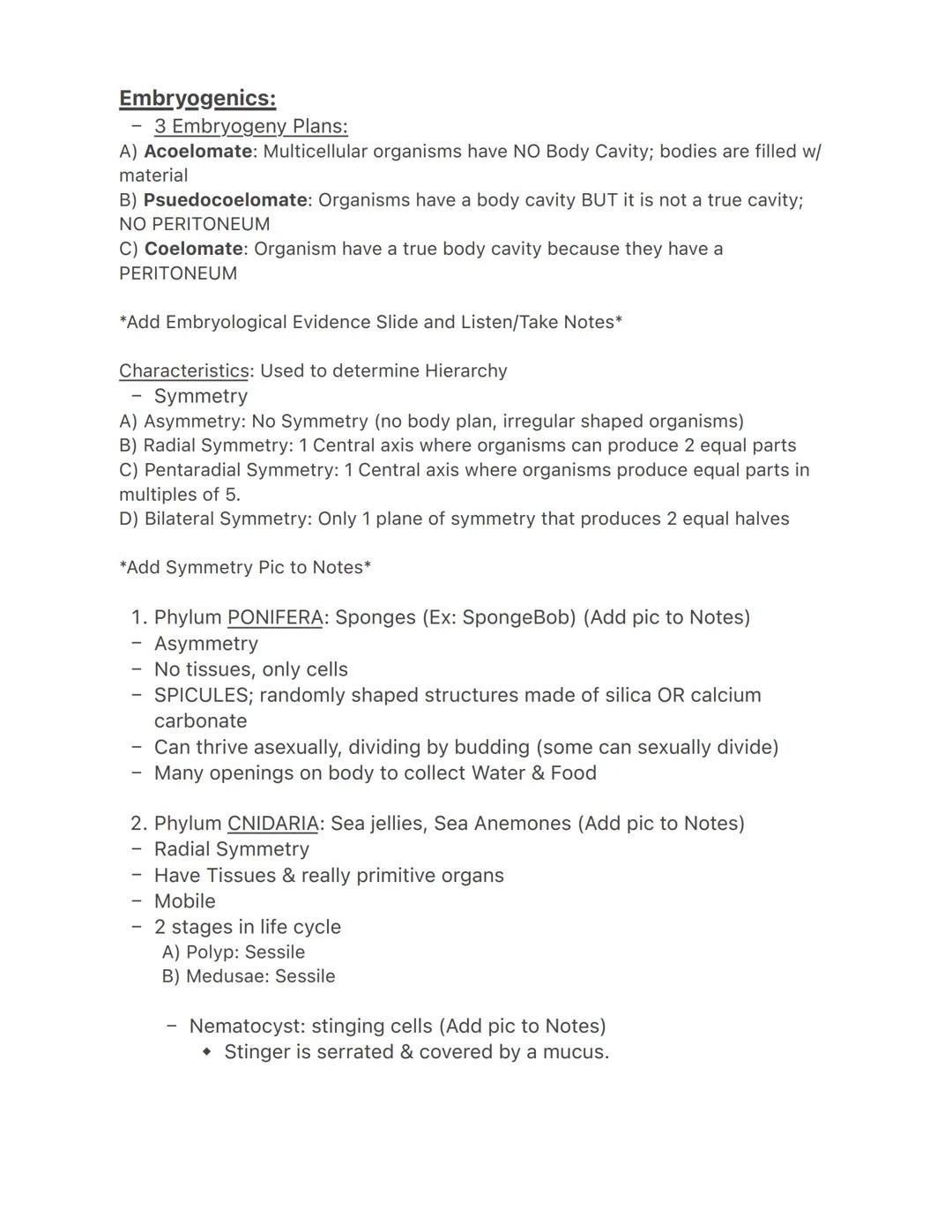
Animal Classification and Early Phyla
Animals develop according to three main embryogenic plans: acoelomates (no body cavity), pseudocoelomates (partial cavity without a peritoneum), and coelomates (true body cavity with a peritoneum). These developmental patterns help scientists classify animals.
Body symmetry is another important classification characteristic. Animals can be asymmetrical (irregular shape), have radial symmetry (equal parts around a central axis), pentaradial symmetry (equal parts in multiples of five), or bilateral symmetry (one plane creating two equal halves).
The phylum Porifera (sponges) represents some of the simplest animals. They're asymmetrical with no tissues (only cells), and have structures called spicules made of silica or calcium carbonate. They can reproduce both sexually and asexually through budding.
🌊 The phylum Cnidaria includes sea jellies and sea anemones with radial symmetry. They have tissues and primitive organs, can move, and cycle between two life stages: polyps (sessile) and medusae (mobile). Their distinctive nematocysts (stinging cells) are used for defense and capturing prey!
We thought you’d never ask...
What is the Knowunity AI companion?
Our AI companion is specifically built for the needs of students. Based on the millions of content pieces we have on the platform we can provide truly meaningful and relevant answers to students. But its not only about answers, the companion is even more about guiding students through their daily learning challenges, with personalised study plans, quizzes or content pieces in the chat and 100% personalisation based on the students skills and developments.
Where can I download the Knowunity app?
You can download the app in the Google Play Store and in the Apple App Store.
Is Knowunity really free of charge?
That's right! Enjoy free access to study content, connect with fellow students, and get instant help – all at your fingertips.
Similar Content
Most popular content in Biology
9C
BiologyCell Organelles
This Quiz Is To Test Your Knowledge Of Cell Organelles And Their Functions Inside The Cell. It Can Also Be A Study Guide To Remember Them Better.
6th6710
B
Biologybiology cell organelles and functions
Do you know the cell organelles and their functions?
9th4410
M
BiologyMitosis and Cell Division Flashcards
These flashcards cover the basics of mitosis and why cell division occurs in the first place.
9th3390
D
BiologyDNA and RNA
Uncover the secrets of life with this comprehensive Biology flashcard set. Perfect for grade 10 students studying Living Environment.
10th1,0782
D
BiologyDiscover the Fascinating World of Living Organisms
Uncover the secrets of biology and explore the diverse and amazing life forms that inhabit our planet with this captivating flashcard set.
7th4380
A
BiologyAnimal and plant cell structure
Quiz on animal and plant cell structures
9th3240
D
BiologyDiscover Punnet Squares
Uncover the secrets of life with this comprehensive Biology flashcard set. Perfect for grade 10 students studying Living Environment.
10th3961
D
BiologyDNA
Parts of DNA
9th2970
S
BiologySteps of Cellular Respiration
3 basic steps and Molecule Vocab
9th2660
Most popular content
9O
 AP US History
Origins and Dynamics of the Columbian Exchange
Analyze the ecological and economic motivations behind the initial transfer of goods, people, and diseases between the Old and New Worlds.
9th3,1280
I
AP US HistoryIntroduction to Early Cultural Interactions
Analyze the initial social and religious encounters between Europeans, Africans, and Indigenous peoples in the colonial Americas.
9th2,7730
O
 AP World History
Origins of Ancient River Civilizations
Analyze the environmental factors and technological innovations that led to the rise of early states in Mesopotamia, Egypt, and the Indus Valley.
9th3,1870
M
AP US HistoryMotivations for European Exploration
Analyze the economic, religious, and political factors that drove European powers to the Americas during the 15th and 16th centuries.
9th1,7780
F
 AP Psychology
Foundations of Ethical Guidelines in Research
Practice the core principles of the APA ethical code including informed consent, debriefing, and the role of Institutional Review Boards.
9th1,3360
I
AP US HistoryIntroduction to Native American Societies
Examine the diverse social, political, and economic structures of North American indigenous groups prior to European contact.
9th1,1100
I
AP BiologyIntroduction to Biological Elements of Life
Practice identifying the essential elements including carbon, nitrogen, phosphorus, and sulfur that compose biological macromolecules.
9th1,7390
I
AP US HistoryIntroduction to the Spanish Encomienda System
Explore the fundamental economic and social structures of the Spanish colonial system, focusing on the encomienda and the casta social hierarchy.
9th8890
O
AP World HistoryOrigins and Continuity of the Byzantine Empire
Analyze the political and cultural transitions from the Roman Empire to the Byzantine Empire, focusing on the reign of Justinian I and his code.
9th1,6320
Can't find what you're looking for? Explore other subjects.
Students love us — and so will you.
4.6/5App Store
4.7/5Google Play
The app is very easy to use and well designed. I have found everything I was looking for so far and have been able to learn a lot from the presentations! I will definitely use the app for a class assignment! And of course it also helps a lot as an inspiration.
Stefan SiOS user
This app is really great. There are so many study notes and help [...]. My problem subject is French, for example, and the app has so many options for help. Thanks to this app, I have improved my French. I would recommend it to anyone.
Samantha KlichAndroid user
Wow, I am really amazed. I just tried the app because I've seen it advertised many times and was absolutely stunned. This app is THE HELP you want for school and above all, it offers so many things, such as workouts and fact sheets, which have been VERY helpful to me personally.
AnnaiOS user
Biology41 views·Updated Jun 7, 2026·5 pagesComprehensive Fungi Lecture Notes
Fungi form their own kingdom with unique characteristics that set them apart from plants and animals. Despite being more closely related to animals, fungi have cell walls made of chitin, not cellulose. These fascinating organisms play vital roles in ecosystems...
1
of 5
Sign up to see the content. It's free!
- Access to all documents
- Improve your grades
- Join milions of students
Fungi Fundamentals
Fungi are their own kingdom of mostly multicellular, sessile decomposers that are more closely related to animals than plants. Unlike plants with cellulose cell walls, fungi have cell walls made of chitin, the same material found in insect exoskeletons.
These organisms have a unique feeding strategy - they secrete digestive enzymes to break down organic matter externally, then absorb the nutrients into their cells. Scientists estimate there are roughly 100,000 known fungal species, but believe the total could reach 1.5 million species!
The basic building block of fungi is the hyphae - thread-like structures that each contain their own genetic information. Each hyphae can release digestive enzymes and absorb nutrients. When hyphae connect, they create a structure called a mycelium, which forms the main body of the fungus.
💡 The mushrooms we see popping up from the ground aren't the main fungal organism - they're just reproductive structures! The vast majority of the fungus exists as an underground network of hyphae.
2
of 5Sign up to see the content. It's free!
- Access to all documents
- Improve your grades
- Join milions of students
Fungal Structure and Reproduction
Hyphae are genetically distinct and can attach to other hyphae. When they fuse together, they form a dikaryotic structure where the genetic information doesn't mix right away. This unusual arrangement allows fungi to maintain genetic diversity.
There are two main types of hyphae structures. Septate hyphae have separations (septa) between cells, while coenocytic hyphae lack these separations. These different structures affect how materials move through the fungal body.
Some fungi can grow to enormous sizes by connecting vast networks of hyphae. The Armillaria ostoyae fungus is an excellent example of this - a single organism can spread through acres of forest underground!
🔬 Fungi have their own unique cell structures that differ from both plants and animals. Their cellular organization allows them to thrive in their specialized ecological roles.
3
of 5Sign up to see the content. It's free!
- Access to all documents
- Improve your grades
- Join milions of students
Fungi in the Environment
Fungi are primarily decomposers that help recycle nutrients in ecosystems. They don't need light to survive and can live almost anywhere except in extreme environments. This adaptability has allowed them to colonize virtually every habitat on Earth.
Some fungi consume living organic material. The mycosis group specifically can consume organic material like human skin, causing conditions like jock itch, ringworm, and athlete's foot. These fungi thrive in moist environments, which is why you'll also find mold growing on damp walls.
Many fungi form beneficial relationships. Mycorrhizae are thin threads that connect to plant roots, creating a mutualistic relationship. The plant provides the fungi with sugars, while the fungi supply the plant with more phosphorous and nitrates. Some plants use this relationship strategically to outcompete native plants.
🌱 About 90% of land plants form mycorrhizal relationships with fungi! This partnership is so important that many plants cannot survive without their fungal partners.
4
of 5Sign up to see the content. It's free!
- Access to all documents
- Improve your grades
- Join milions of students
Fungal Diversity and Early Animals
Some fungi pair up with cyanobacteria or algae to form lichens, creating complex symbiotic organisms. Others, like Cordyceps, use living organisms to spread their spores throughout the environment - often with dramatic and sometimes gruesome effects!
Scientists classify fungi into seven major phyla. The Ascomycota (64,000 species) includes yeast, truffles, and penicillium. The Basidiomycota (31,000 species) contains most mushrooms we consume. The Microsporidia (1,300 species) are all parasitic fungi.
Early animals, known as metazoans, share four general characteristics: they're multicellular, motile at some point in their lives, heterotrophic (consuming others for energy), and develop from embryos. The evolution of metazoans took approximately 800 million years, evolving from single-celled organisms.
🧬 How did multicellularity evolve? Zoologists believe it happened in one of two ways: either through the Syncytial Theory (single cells becoming multinucleated) or the Colonial Theory (single cells forming colonies that became interdependent).
5
of 5Sign up to see the content. It's free!
- Access to all documents
- Improve your grades
- Join milions of students
Animal Classification and Early Phyla
Animals develop according to three main embryogenic plans: acoelomates (no body cavity), pseudocoelomates (partial cavity without a peritoneum), and coelomates (true body cavity with a peritoneum). These developmental patterns help scientists classify animals.
Body symmetry is another important classification characteristic. Animals can be asymmetrical (irregular shape), have radial symmetry (equal parts around a central axis), pentaradial symmetry (equal parts in multiples of five), or bilateral symmetry (one plane creating two equal halves).
The phylum Porifera (sponges) represents some of the simplest animals. They're asymmetrical with no tissues (only cells), and have structures called spicules made of silica or calcium carbonate. They can reproduce both sexually and asexually through budding.
🌊 The phylum Cnidaria includes sea jellies and sea anemones with radial symmetry. They have tissues and primitive organs, can move, and cycle between two life stages: polyps (sessile) and medusae (mobile). Their distinctive nematocysts (stinging cells) are used for defense and capturing prey!
We thought you’d never ask...
What is the Knowunity AI companion?
Our AI companion is specifically built for the needs of students. Based on the millions of content pieces we have on the platform we can provide truly meaningful and relevant answers to students. But its not only about answers, the companion is even more about guiding students through their daily learning challenges, with personalised study plans, quizzes or content pieces in the chat and 100% personalisation based on the students skills and developments.
Where can I download the Knowunity app?
You can download the app in the Google Play Store and in the Apple App Store.
Is Knowunity really free of charge?
That's right! Enjoy free access to study content, connect with fellow students, and get instant help – all at your fingertips.
Similar Content
Most popular content in Biology
9C
BiologyCell Organelles
This Quiz Is To Test Your Knowledge Of Cell Organelles And Their Functions Inside The Cell. It Can Also Be A Study Guide To Remember Them Better.
6th6710
B
Biologybiology cell organelles and functions
Do you know the cell organelles and their functions?
9th4410
M
BiologyMitosis and Cell Division Flashcards
These flashcards cover the basics of mitosis and why cell division occurs in the first place.
9th3390
D
BiologyDNA and RNA
Uncover the secrets of life with this comprehensive Biology flashcard set. Perfect for grade 10 students studying Living Environment.
10th1,0782
D
BiologyDiscover the Fascinating World of Living Organisms
Uncover the secrets of biology and explore the diverse and amazing life forms that inhabit our planet with this captivating flashcard set.
7th4380
A
BiologyAnimal and plant cell structure
Quiz on animal and plant cell structures
9th3240
D
BiologyDiscover Punnet Squares
Uncover the secrets of life with this comprehensive Biology flashcard set. Perfect for grade 10 students studying Living Environment.
10th3961
D
BiologyDNA
Parts of DNA
9th2970
S
BiologySteps of Cellular Respiration
3 basic steps and Molecule Vocab
9th2660
Most popular content
9O
AP US HistoryOrigins and Dynamics of the Columbian Exchange
Analyze the ecological and economic motivations behind the initial transfer of goods, people, and diseases between the Old and New Worlds.
9th3,1280
I
AP US HistoryIntroduction to Early Cultural Interactions
Analyze the initial social and religious encounters between Europeans, Africans, and Indigenous peoples in the colonial Americas.
9th2,7730
O
AP World HistoryOrigins of Ancient River Civilizations
Analyze the environmental factors and technological innovations that led to the rise of early states in Mesopotamia, Egypt, and the Indus Valley.
9th3,1870
M
AP US HistoryMotivations for European Exploration
Analyze the economic, religious, and political factors that drove European powers to the Americas during the 15th and 16th centuries.
9th1,7780
F
AP PsychologyFoundations of Ethical Guidelines in Research
Practice the core principles of the APA ethical code including informed consent, debriefing, and the role of Institutional Review Boards.
9th1,3360
I
AP US HistoryIntroduction to Native American Societies
Examine the diverse social, political, and economic structures of North American indigenous groups prior to European contact.
9th1,1100
I
AP BiologyIntroduction to Biological Elements of Life
Practice identifying the essential elements including carbon, nitrogen, phosphorus, and sulfur that compose biological macromolecules.
9th1,7390
I
AP US HistoryIntroduction to the Spanish Encomienda System
Explore the fundamental economic and social structures of the Spanish colonial system, focusing on the encomienda and the casta social hierarchy.
9th8890
O
AP World HistoryOrigins and Continuity of the Byzantine Empire
Analyze the political and cultural transitions from the Roman Empire to the Byzantine Empire, focusing on the reign of Justinian I and his code.
9th1,6320
Can't find what you're looking for? Explore other subjects.
Students love us — and so will you.
4.6/5App Store
4.7/5Google Play
The app is very easy to use and well designed. I have found everything I was looking for so far and have been able to learn a lot from the presentations! I will definitely use the app for a class assignment! And of course it also helps a lot as an inspiration.
Stefan SiOS user
This app is really great. There are so many study notes and help [...]. My problem subject is French, for example, and the app has so many options for help. Thanks to this app, I have improved my French. I would recommend it to anyone.
Samantha KlichAndroid user
Wow, I am really amazed. I just tried the app because I've seen it advertised many times and was absolutely stunned. This app is THE HELP you want for school and above all, it offers so many things, such as workouts and fact sheets, which have been VERY helpful to me personally.
AnnaiOS user