

Food chains and energy pyramids are fascinating ways to understand...
 Biology36 views·Updated Jun 19, 2026·13 pages
Exploring Food Chains and Energy Pyramids on BrainPOP
1 / 10
1
of 10
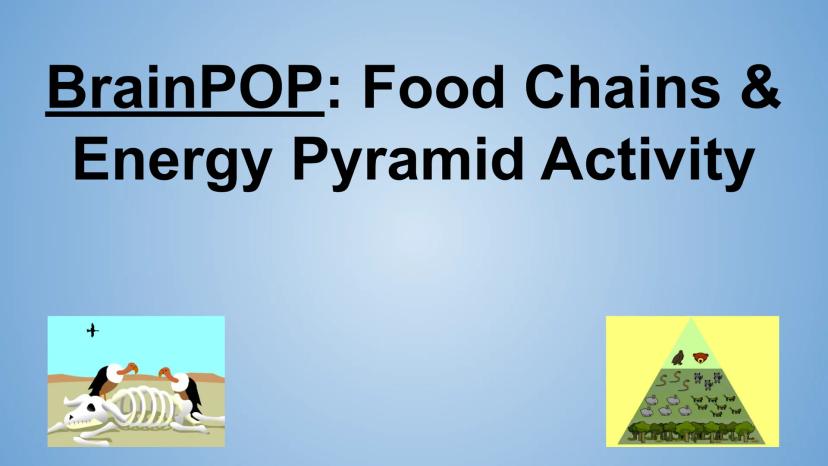
Food Chains & Energy Pyramid Activity
This activity explores how organisms are connected through feeding relationships in ecosystems. You'll discover how energy moves through living systems and why protecting these relationships is crucial for maintaining healthy environments.
Did you know? What you eat for lunch today connects you to a complex web of relationships that extends all the way to the sun's energy!
2
of 10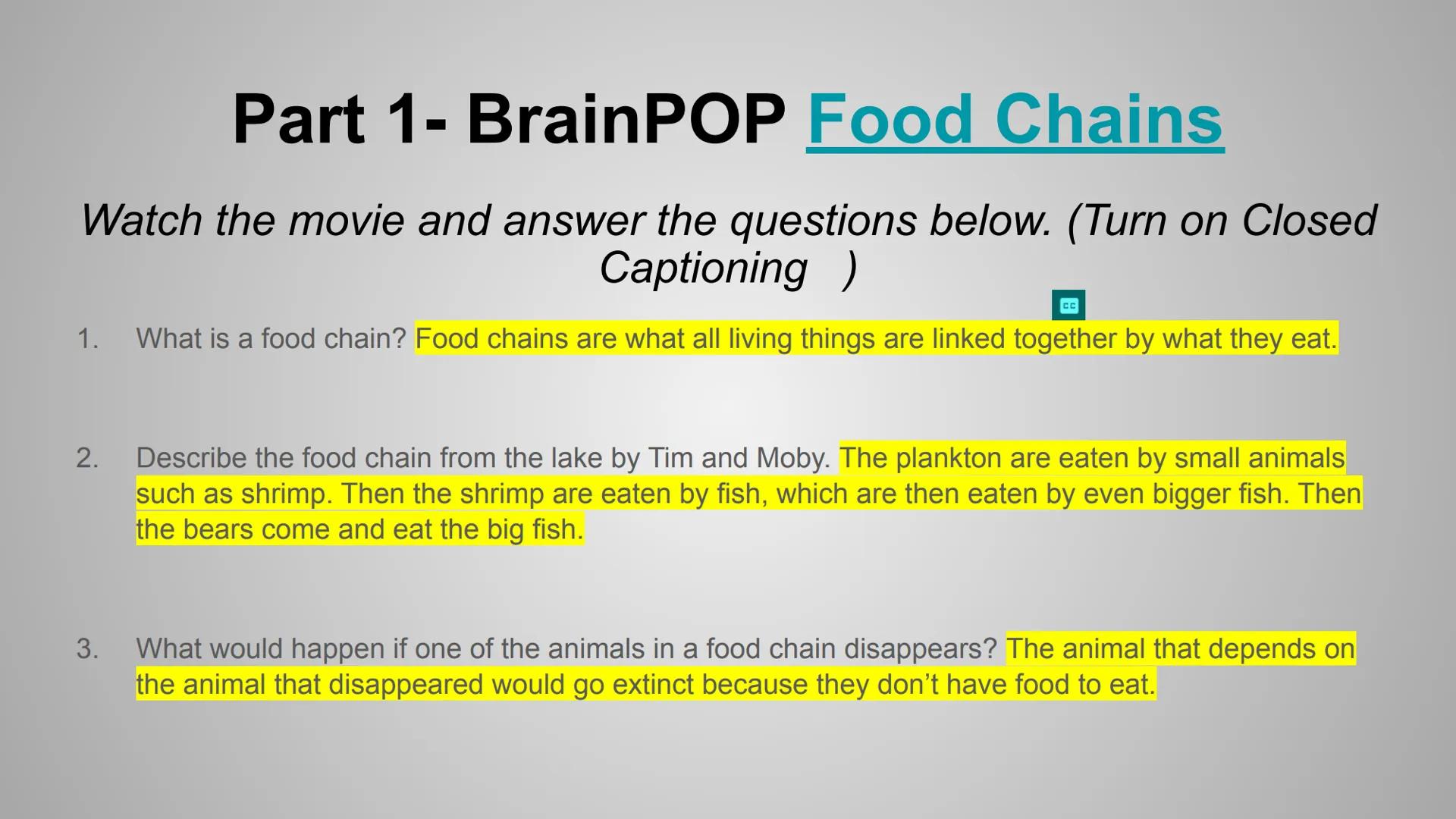
Food Chain Basics
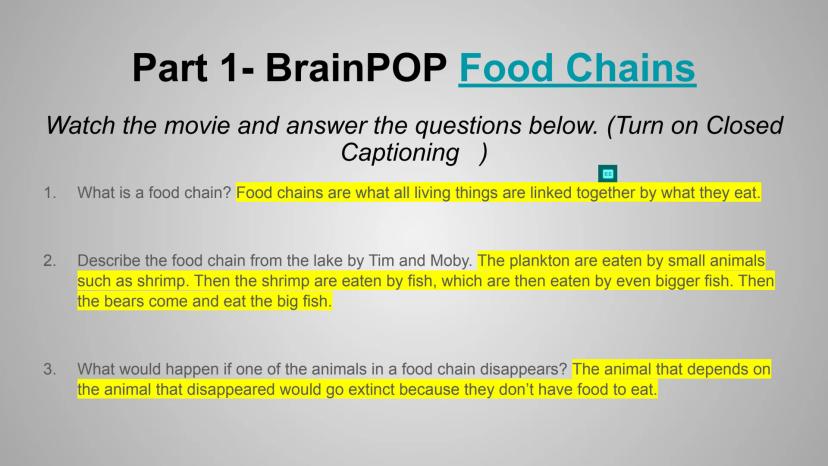
A food chain shows how living things are linked together by what they eat. For example, in a lake ecosystem, plankton are eaten by small shrimp, which are eaten by fish, then by bigger fish, and finally by bears.
If one animal in the food chain disappears, it can cause serious problems. The animals that depend on it for food might go extinct because they've lost their food source.
Food chains aren't usually simple straight lines in nature. Instead, they connect and overlap to form food webs, which show the complex feeding relationships in an ecosystem.
3
of 10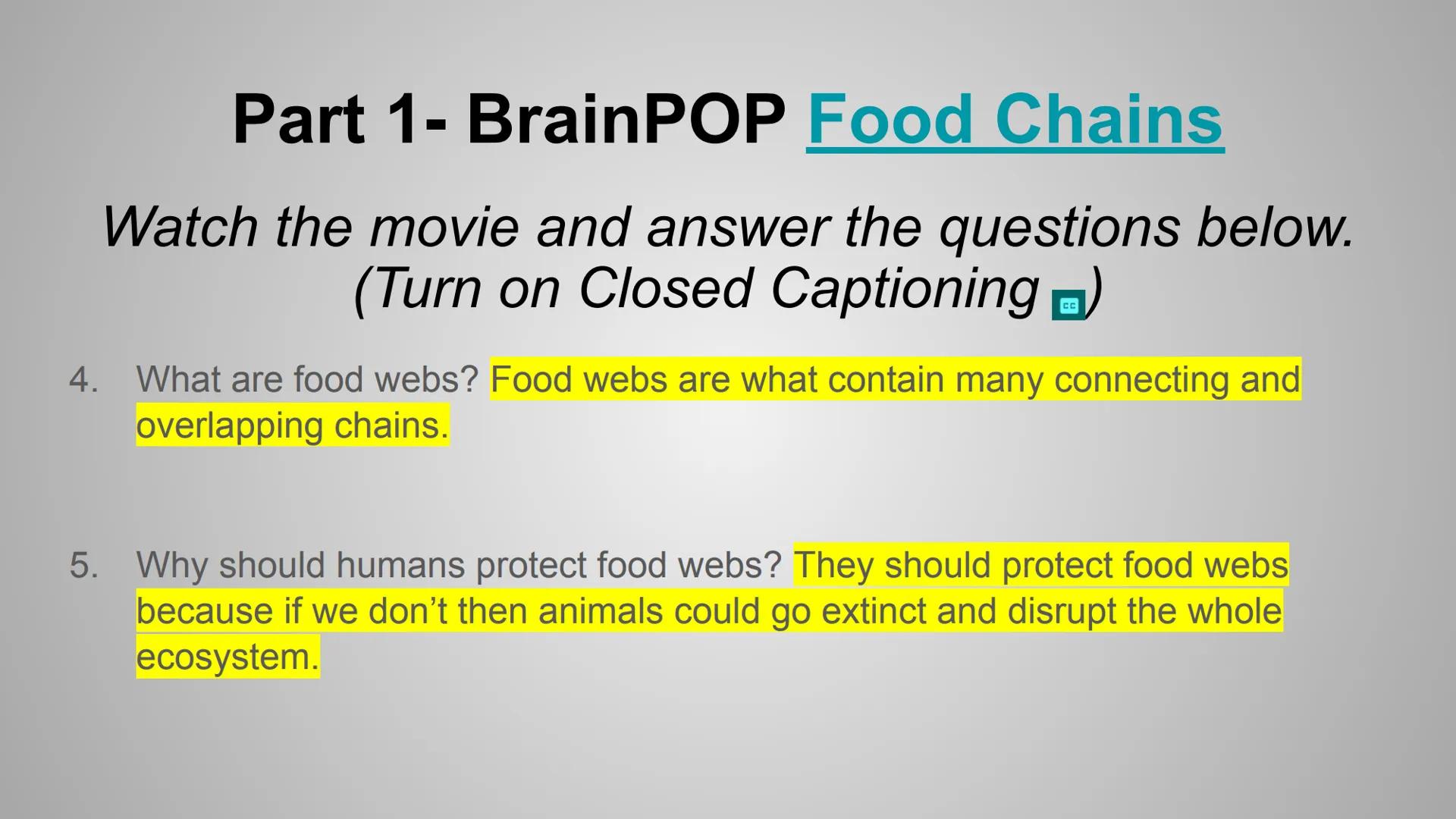
Food Webs and Their Importance
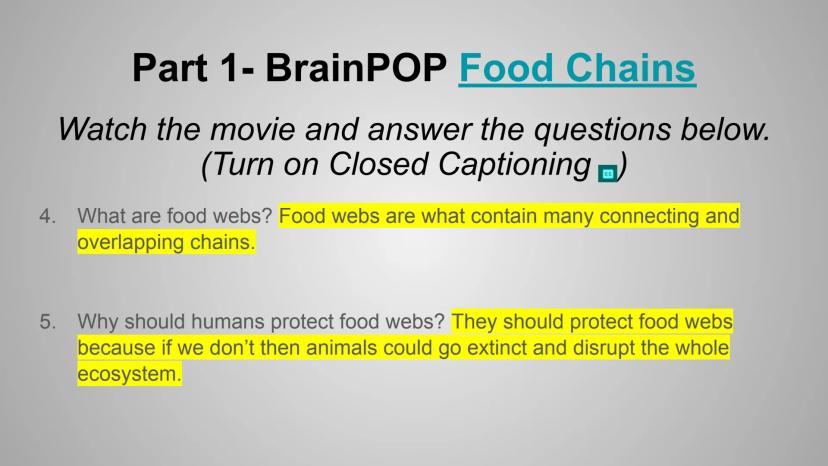
Food webs contain many connecting and overlapping food chains. They show the complete picture of "who eats what" in an ecosystem.
Humans should protect food webs because disrupting them can cause animals to go extinct and damage entire ecosystems. When one species disappears, it can trigger a chain reaction affecting many other species.
Think of a food web like a complex spider web - pull one strand, and the whole thing can unravel!
4
of 10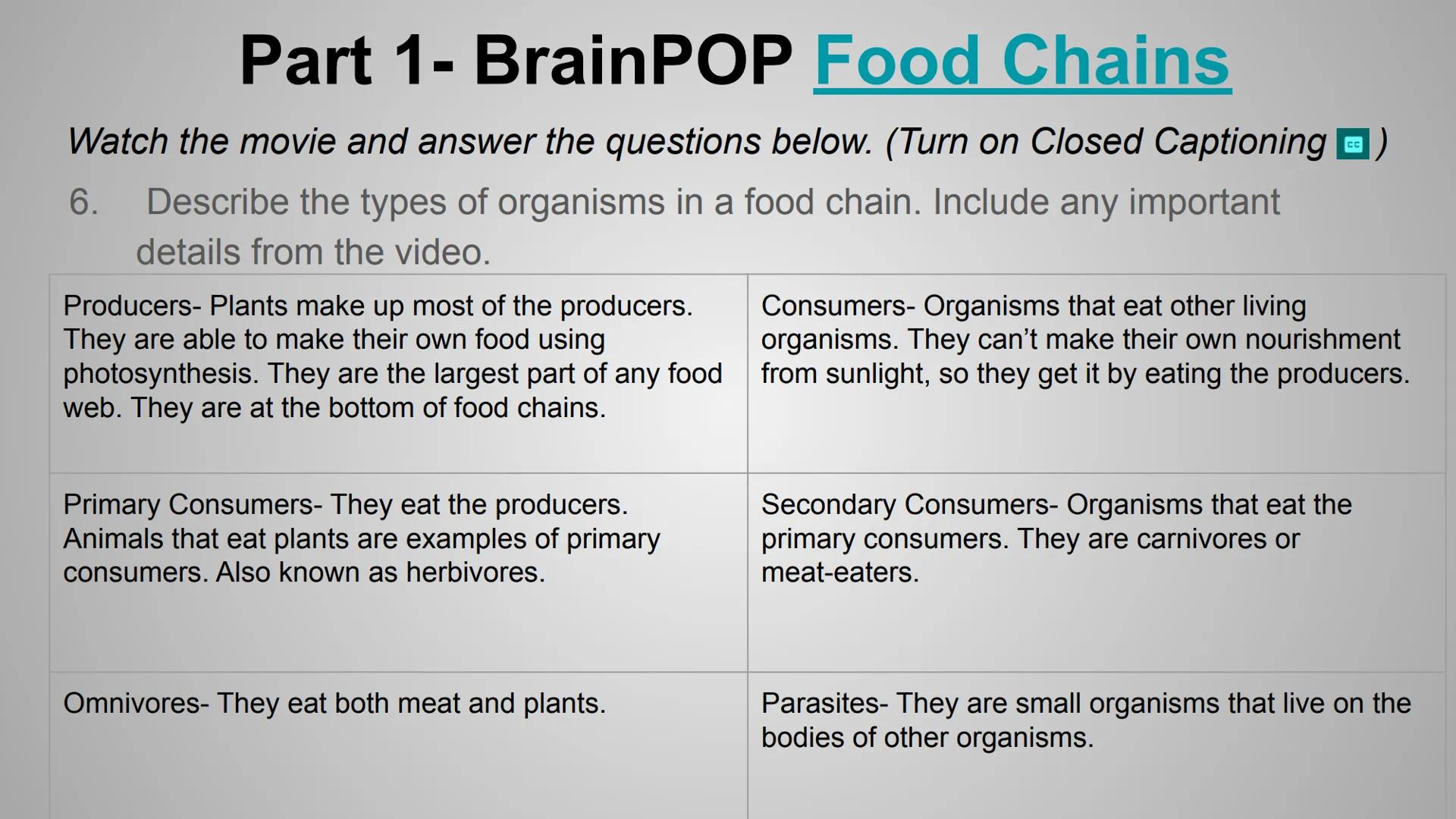
Types of Organisms in Food Chains
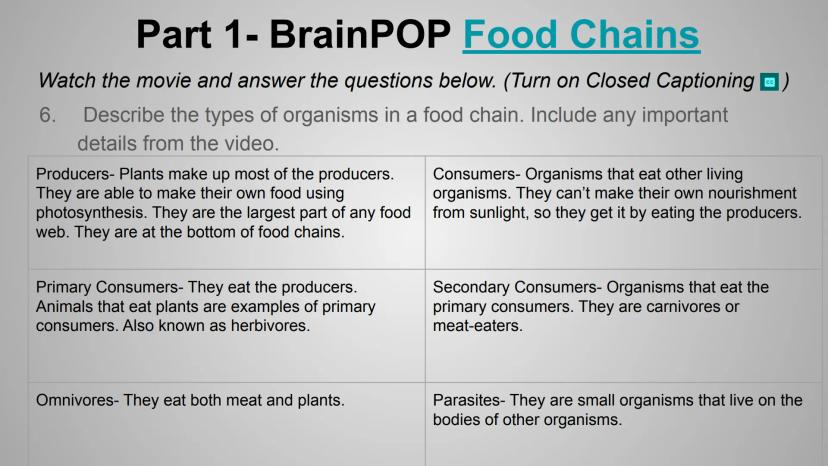
Producers are mostly plants that make their own food through photosynthesis. They form the foundation of food chains and are the largest part of any food web.
Consumers eat other organisms because they can't make their own food from sunlight. They include:
- Primary consumers (herbivores) that eat plants
- Secondary consumers (carnivores) that eat the plant-eaters
- Omnivores that eat both plants and animals
- Parasites that live on the bodies of other organisms
Remember this! Everything starts with producers capturing energy from the sun - without them, the entire food chain would collapse!
5
of 10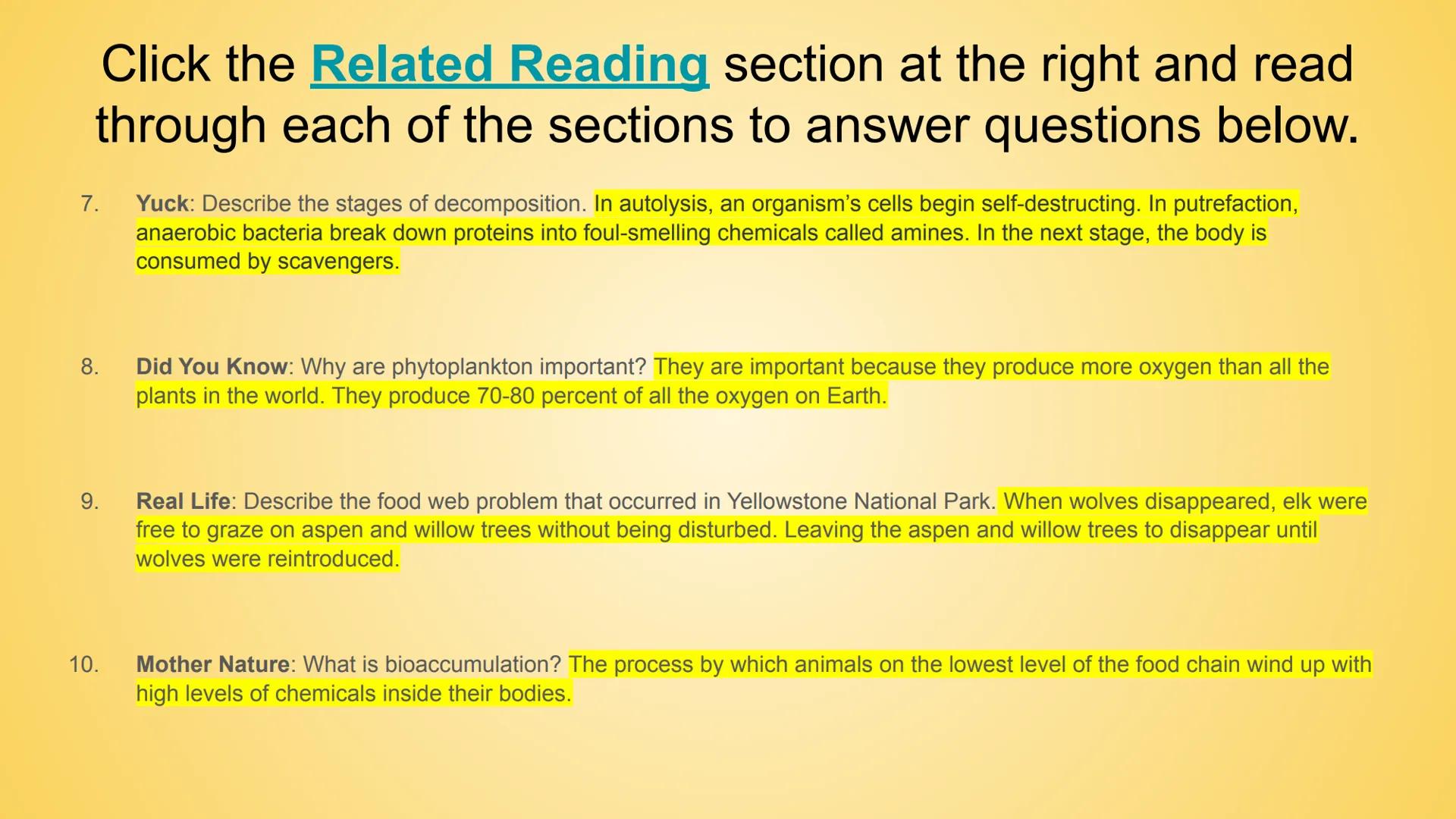
Natural Cycles and Ecosystem Balance
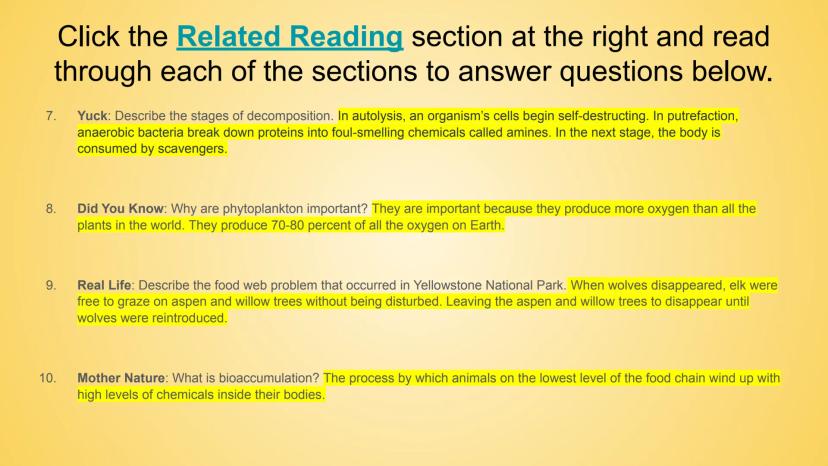
Decomposition happens in stages: first autolysis , then putrefaction (bacteria breaking down proteins), and finally, scavengers consuming the remains. This process recycles nutrients back into the ecosystem.
Phytoplankton are super important! They produce a whopping 70-80% of Earth's oxygen—more than all land plants combined.
Ecosystem balance is delicate. In Yellowstone, when wolves disappeared, elk overgrazed aspen and willow trees. When wolves were reintroduced, the balance returned.
Bioaccumulation occurs when chemicals build up in animals' bodies, starting at the lowest level of the food chain and becoming more concentrated as they move up.
6
of 10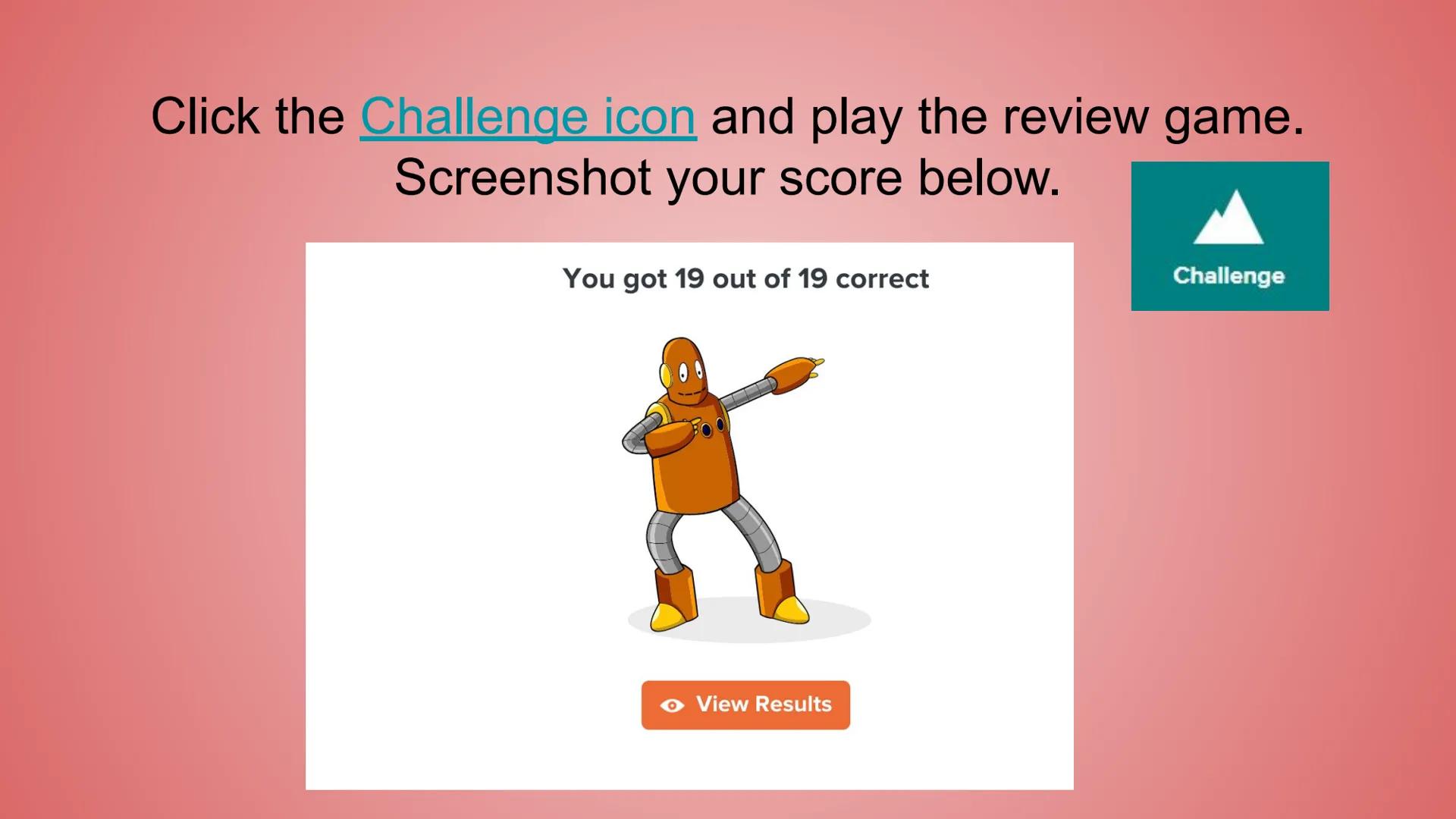
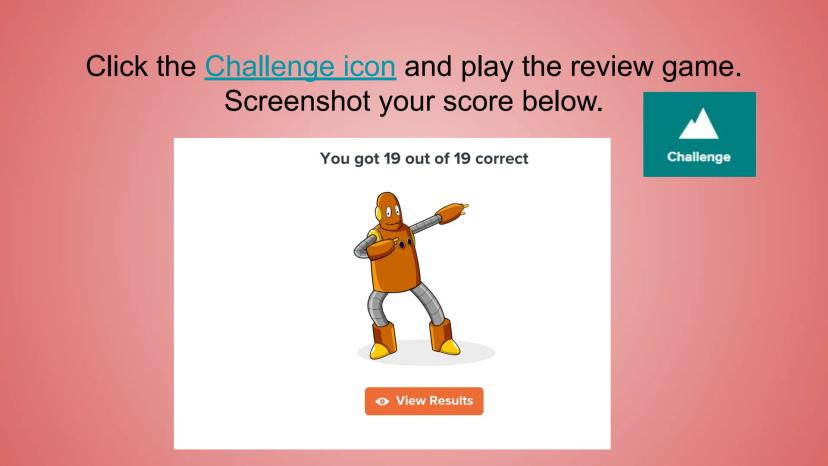
Review Challenge
Testing your knowledge with review games helps cement your understanding of food chains and ecosystems.
The perfect score shown here demonstrates mastery of the food chain concepts we've covered so far!
Getting a high score means you're ready to take on more complex topics like energy pyramids, which we'll explore next.
7
of 10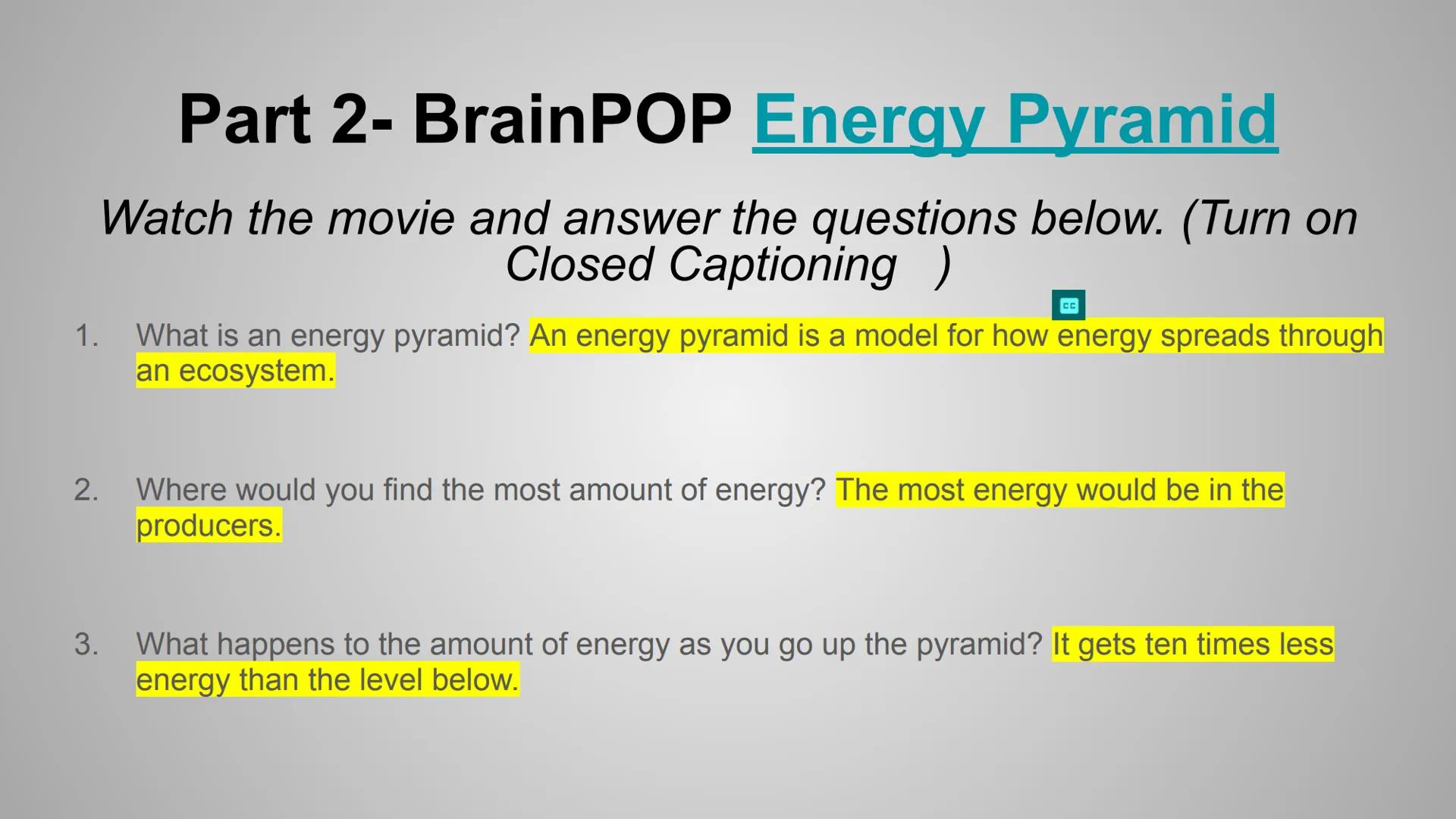
Energy Pyramids Introduction
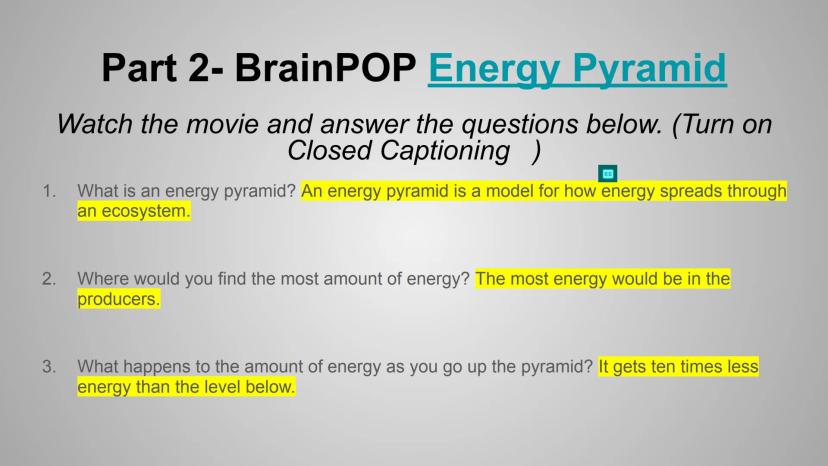
An energy pyramid is a model that shows how energy spreads through an ecosystem. It's shaped like a pyramid because energy decreases as you move up from one level to the next.
The most energy is found at the bottom level with the producers (plants and other organisms that make their own food). This makes sense because they capture energy directly from the sun!
As you go up the pyramid, each level has about 10 times less energy than the level below it. This explains why there are usually more plants than plant-eaters, and more plant-eaters than meat-eaters in an ecosystem.
Energy fact: When you eat a vegetable, you get much more of the original sun energy than when you eat meat from an animal that ate plants!
8
of 10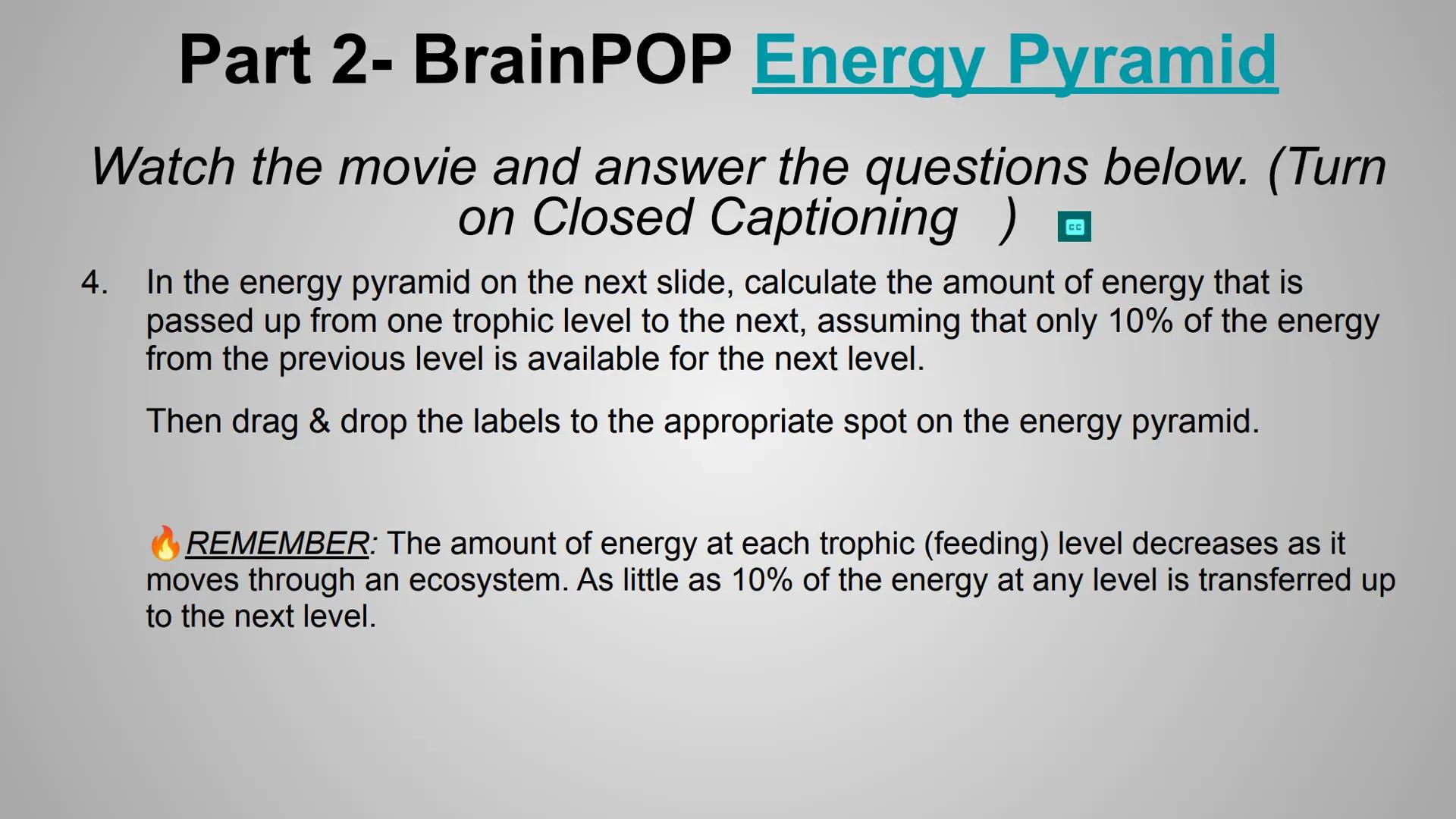
Energy Transfer in Ecosystems
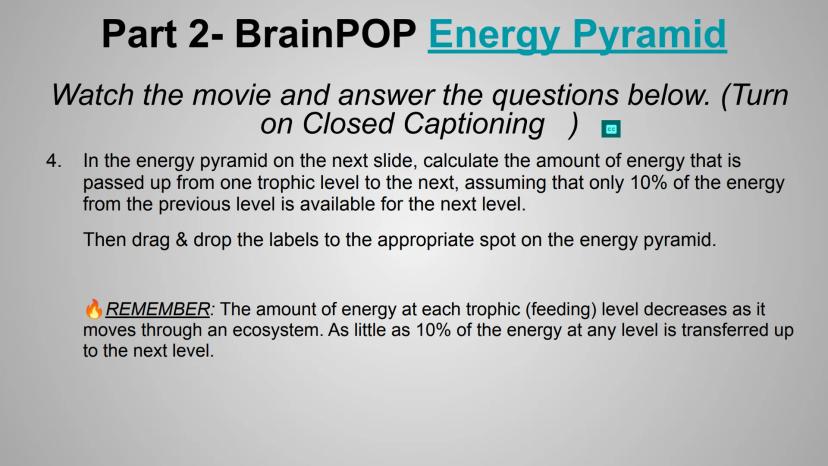
In energy pyramids, only about 10% of the energy from one level transfers to the next level up. This is why pyramids get narrower at the top – there's much less energy available.
This energy loss happens because animals use most of their energy for daily activities like moving, staying warm, and basic body functions. Only a small portion becomes body tissue that can feed the next level.
Understanding these trophic (feeding) levels helps explain why there are more herbivores than carnivores in most ecosystems – there simply isn't enough energy to support many top predators!
9
of 10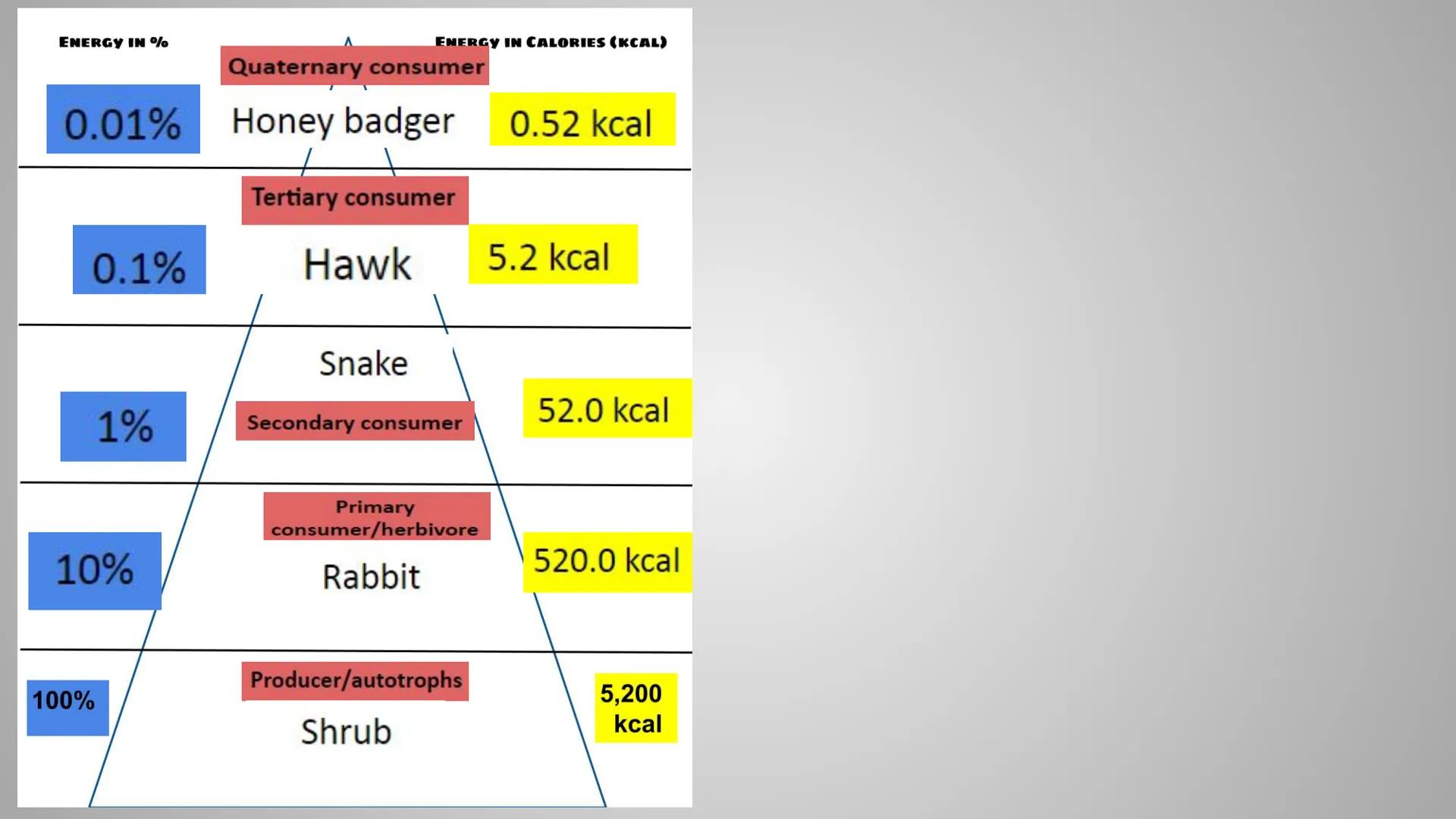
Energy Pyramid Example
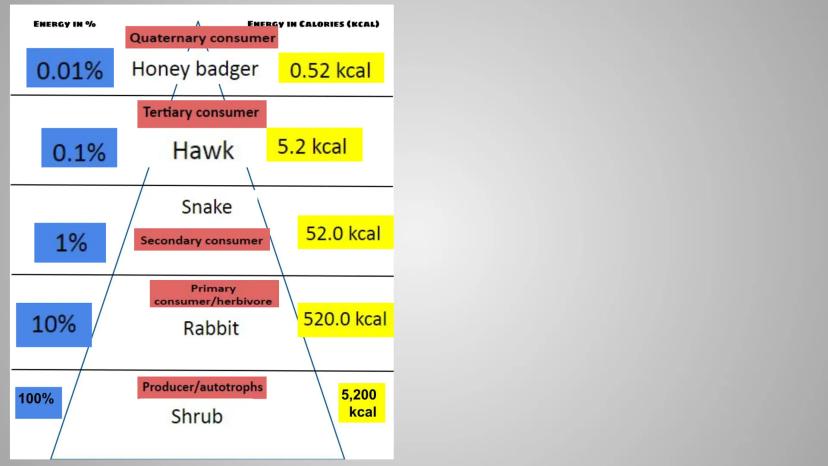
This energy pyramid shows exactly how energy decreases as it moves up the levels. Starting with 5,200 kilocalories at the producer level (shrubs), only 10% (520 kcal) reaches rabbits at the primary consumer level.
The energy continues to decrease by 90% at each level: secondary consumers (snakes) get 52 kcal, tertiary consumers (hawks) get 5.2 kcal, and quaternary consumers (honey badgers) receive just 0.52 kcal – only 0.01% of the original energy!
This dramatic energy loss explains why food chains rarely have more than 4-5 levels. There simply isn't enough energy left to support another level of consumers.
10
of 10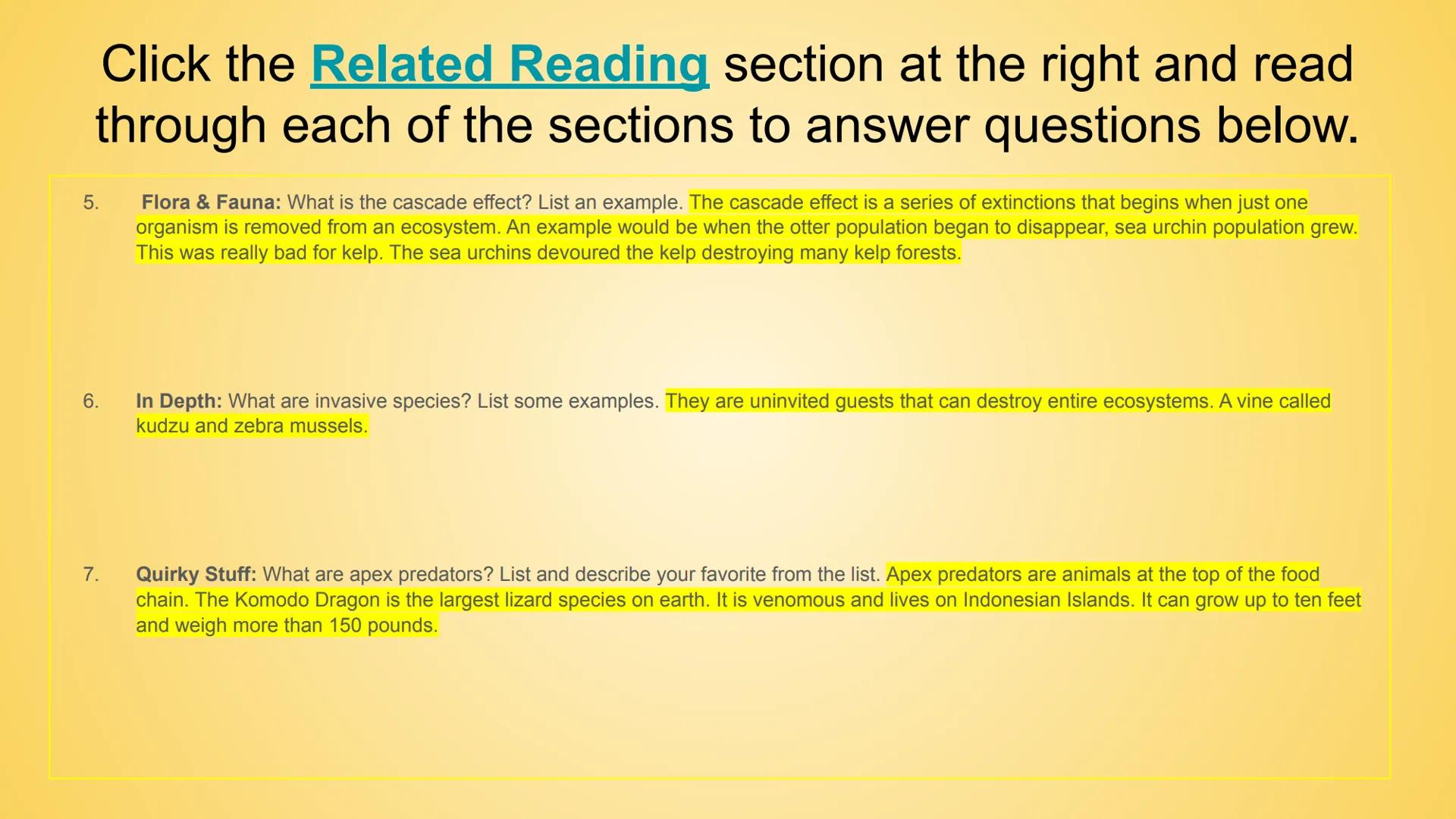
Ecosystem Balance and Disruptions
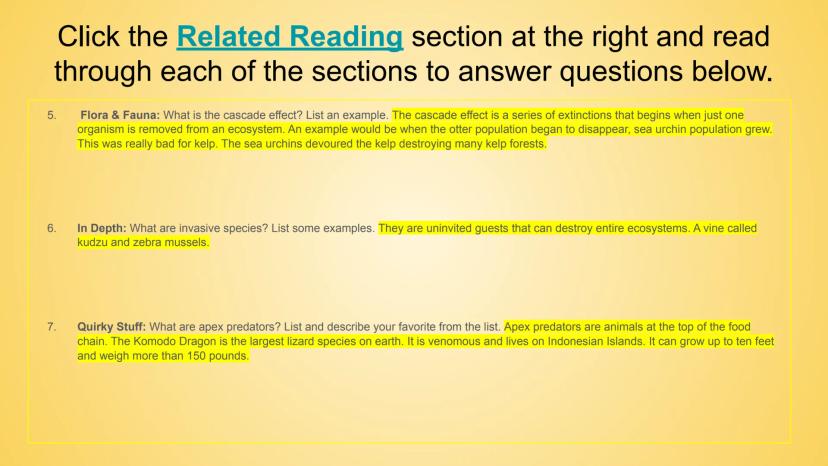
The cascade effect happens when one organism's removal triggers multiple extinctions throughout an ecosystem. For instance, when otters disappeared, sea urchins multiplied and destroyed kelp forests, harming many marine species.
Invasive species are unwelcome organisms that can devastate ecosystems. Examples include kudzu vine and zebra mussels, which outcompete native species and disrupt natural balances.
Apex predators sit at the top of food chains. The Komodo dragon is an impressive example - a venomous lizard that grows up to 10 feet long, weighs over 150 pounds, and rules its island ecosystem.
Think about it: What might happen in your local ecosystem if an invasive species arrived or if a key predator disappeared?
We thought you’d never ask...
What is the Knowunity AI companion?
Our AI companion is specifically built for the needs of students. Based on the millions of content pieces we have on the platform we can provide truly meaningful and relevant answers to students. But its not only about answers, the companion is even more about guiding students through their daily learning challenges, with personalised study plans, quizzes or content pieces in the chat and 100% personalisation based on the students skills and developments.
Where can I download the Knowunity app?
You can download the app in the Google Play Store and in the Apple App Store.
Is Knowunity really free of charge?
That's right! Enjoy free access to study content, connect with fellow students, and get instant help – all at your fingertips.
Similar Content
Most popular content: Food Chains
2Most popular content in Biology
9C
BiologyCell Organelles
This Quiz Is To Test Your Knowledge Of Cell Organelles And Their Functions Inside The Cell. It Can Also Be A Study Guide To Remember Them Better.
6th6710
B
Biologybiology cell organelles and functions
Do you know the cell organelles and their functions?
9th4410
M
BiologyMitosis and Cell Division Flashcards
These flashcards cover the basics of mitosis and why cell division occurs in the first place.
9th3390
D
BiologyDNA and RNA
Uncover the secrets of life with this comprehensive Biology flashcard set. Perfect for grade 10 students studying Living Environment.
10th1,0782
D
BiologyDiscover the Fascinating World of Living Organisms
Uncover the secrets of biology and explore the diverse and amazing life forms that inhabit our planet with this captivating flashcard set.
7th4380
A
BiologyAnimal and plant cell structure
Quiz on animal and plant cell structures
9th3240
D
BiologyDiscover Punnet Squares
Uncover the secrets of life with this comprehensive Biology flashcard set. Perfect for grade 10 students studying Living Environment.
10th3961
D
BiologyDNA
Parts of DNA
9th2970
S
BiologySteps of Cellular Respiration
3 basic steps and Molecule Vocab
9th2660
Most popular content
9O
 AP US History
Origins and Dynamics of the Columbian Exchange
Analyze the ecological and economic motivations behind the initial transfer of goods, people, and diseases between the Old and New Worlds.
9th3,1280
I
AP US HistoryIntroduction to Early Cultural Interactions
Analyze the initial social and religious encounters between Europeans, Africans, and Indigenous peoples in the colonial Americas.
9th2,7730
O
 AP World History
Origins of Ancient River Civilizations
Analyze the environmental factors and technological innovations that led to the rise of early states in Mesopotamia, Egypt, and the Indus Valley.
9th3,1870
M
AP US HistoryMotivations for European Exploration
Analyze the economic, religious, and political factors that drove European powers to the Americas during the 15th and 16th centuries.
9th1,7780
F
 AP Psychology
Foundations of Ethical Guidelines in Research
Practice the core principles of the APA ethical code including informed consent, debriefing, and the role of Institutional Review Boards.
9th1,3360
I
AP US HistoryIntroduction to Native American Societies
Examine the diverse social, political, and economic structures of North American indigenous groups prior to European contact.
9th1,1100
I
AP BiologyIntroduction to Biological Elements of Life
Practice identifying the essential elements including carbon, nitrogen, phosphorus, and sulfur that compose biological macromolecules.
9th1,7390
I
AP US HistoryIntroduction to the Spanish Encomienda System
Explore the fundamental economic and social structures of the Spanish colonial system, focusing on the encomienda and the casta social hierarchy.
9th8890
O
AP World HistoryOrigins and Continuity of the Byzantine Empire
Analyze the political and cultural transitions from the Roman Empire to the Byzantine Empire, focusing on the reign of Justinian I and his code.
9th1,6320
Can't find what you're looking for? Explore other subjects.
Students love us — and so will you.
4.6/5App Store
4.7/5Google Play
The app is very easy to use and well designed. I have found everything I was looking for so far and have been able to learn a lot from the presentations! I will definitely use the app for a class assignment! And of course it also helps a lot as an inspiration.
Stefan SiOS user
This app is really great. There are so many study notes and help [...]. My problem subject is French, for example, and the app has so many options for help. Thanks to this app, I have improved my French. I would recommend it to anyone.
Samantha KlichAndroid user
Wow, I am really amazed. I just tried the app because I've seen it advertised many times and was absolutely stunned. This app is THE HELP you want for school and above all, it offers so many things, such as workouts and fact sheets, which have been VERY helpful to me personally.
AnnaiOS user
Biology36 views·Updated Jun 19, 2026·13 pagesExploring Food Chains and Energy Pyramids on BrainPOP
Food chains and energy pyramids are fascinating ways to understand how living things interact through what they eat. These systems show us how energy flows through ecosystems and why every creature plays an important role in maintaining nature's balance.
1
of 10
Sign up to see the content. It's free!
- Access to all documents
- Improve your grades
- Join milions of students
Food Chains & Energy Pyramid Activity
This activity explores how organisms are connected through feeding relationships in ecosystems. You'll discover how energy moves through living systems and why protecting these relationships is crucial for maintaining healthy environments.
Did you know? What you eat for lunch today connects you to a complex web of relationships that extends all the way to the sun's energy!
2
of 10Sign up to see the content. It's free!
- Access to all documents
- Improve your grades
- Join milions of students
Food Chain Basics
A food chain shows how living things are linked together by what they eat. For example, in a lake ecosystem, plankton are eaten by small shrimp, which are eaten by fish, then by bigger fish, and finally by bears.
If one animal in the food chain disappears, it can cause serious problems. The animals that depend on it for food might go extinct because they've lost their food source.
Food chains aren't usually simple straight lines in nature. Instead, they connect and overlap to form food webs, which show the complex feeding relationships in an ecosystem.
3
of 10Sign up to see the content. It's free!
- Access to all documents
- Improve your grades
- Join milions of students
Food Webs and Their Importance
Food webs contain many connecting and overlapping food chains. They show the complete picture of "who eats what" in an ecosystem.
Humans should protect food webs because disrupting them can cause animals to go extinct and damage entire ecosystems. When one species disappears, it can trigger a chain reaction affecting many other species.
Think of a food web like a complex spider web - pull one strand, and the whole thing can unravel!
4
of 10Sign up to see the content. It's free!
- Access to all documents
- Improve your grades
- Join milions of students
Types of Organisms in Food Chains
Producers are mostly plants that make their own food through photosynthesis. They form the foundation of food chains and are the largest part of any food web.
Consumers eat other organisms because they can't make their own food from sunlight. They include:
- Primary consumers (herbivores) that eat plants
- Secondary consumers (carnivores) that eat the plant-eaters
- Omnivores that eat both plants and animals
- Parasites that live on the bodies of other organisms
Remember this! Everything starts with producers capturing energy from the sun - without them, the entire food chain would collapse!
5
of 10Sign up to see the content. It's free!
- Access to all documents
- Improve your grades
- Join milions of students
Natural Cycles and Ecosystem Balance
Decomposition happens in stages: first autolysis , then putrefaction (bacteria breaking down proteins), and finally, scavengers consuming the remains. This process recycles nutrients back into the ecosystem.
Phytoplankton are super important! They produce a whopping 70-80% of Earth's oxygen—more than all land plants combined.
Ecosystem balance is delicate. In Yellowstone, when wolves disappeared, elk overgrazed aspen and willow trees. When wolves were reintroduced, the balance returned.
Bioaccumulation occurs when chemicals build up in animals' bodies, starting at the lowest level of the food chain and becoming more concentrated as they move up.
6
of 10Sign up to see the content. It's free!
- Access to all documents
- Improve your grades
- Join milions of students
Review Challenge
Testing your knowledge with review games helps cement your understanding of food chains and ecosystems.
The perfect score shown here demonstrates mastery of the food chain concepts we've covered so far!
Getting a high score means you're ready to take on more complex topics like energy pyramids, which we'll explore next.
7
of 10Sign up to see the content. It's free!
- Access to all documents
- Improve your grades
- Join milions of students
Energy Pyramids Introduction
An energy pyramid is a model that shows how energy spreads through an ecosystem. It's shaped like a pyramid because energy decreases as you move up from one level to the next.
The most energy is found at the bottom level with the producers (plants and other organisms that make their own food). This makes sense because they capture energy directly from the sun!
As you go up the pyramid, each level has about 10 times less energy than the level below it. This explains why there are usually more plants than plant-eaters, and more plant-eaters than meat-eaters in an ecosystem.
Energy fact: When you eat a vegetable, you get much more of the original sun energy than when you eat meat from an animal that ate plants!
8
of 10Sign up to see the content. It's free!
- Access to all documents
- Improve your grades
- Join milions of students
Energy Transfer in Ecosystems
In energy pyramids, only about 10% of the energy from one level transfers to the next level up. This is why pyramids get narrower at the top – there's much less energy available.
This energy loss happens because animals use most of their energy for daily activities like moving, staying warm, and basic body functions. Only a small portion becomes body tissue that can feed the next level.
Understanding these trophic (feeding) levels helps explain why there are more herbivores than carnivores in most ecosystems – there simply isn't enough energy to support many top predators!
9
of 10Sign up to see the content. It's free!
- Access to all documents
- Improve your grades
- Join milions of students
Energy Pyramid Example
This energy pyramid shows exactly how energy decreases as it moves up the levels. Starting with 5,200 kilocalories at the producer level (shrubs), only 10% (520 kcal) reaches rabbits at the primary consumer level.
The energy continues to decrease by 90% at each level: secondary consumers (snakes) get 52 kcal, tertiary consumers (hawks) get 5.2 kcal, and quaternary consumers (honey badgers) receive just 0.52 kcal – only 0.01% of the original energy!
This dramatic energy loss explains why food chains rarely have more than 4-5 levels. There simply isn't enough energy left to support another level of consumers.
10
of 10Sign up to see the content. It's free!
- Access to all documents
- Improve your grades
- Join milions of students
Ecosystem Balance and Disruptions
The cascade effect happens when one organism's removal triggers multiple extinctions throughout an ecosystem. For instance, when otters disappeared, sea urchins multiplied and destroyed kelp forests, harming many marine species.
Invasive species are unwelcome organisms that can devastate ecosystems. Examples include kudzu vine and zebra mussels, which outcompete native species and disrupt natural balances.
Apex predators sit at the top of food chains. The Komodo dragon is an impressive example - a venomous lizard that grows up to 10 feet long, weighs over 150 pounds, and rules its island ecosystem.
Think about it: What might happen in your local ecosystem if an invasive species arrived or if a key predator disappeared?
We thought you’d never ask...
What is the Knowunity AI companion?
Our AI companion is specifically built for the needs of students. Based on the millions of content pieces we have on the platform we can provide truly meaningful and relevant answers to students. But its not only about answers, the companion is even more about guiding students through their daily learning challenges, with personalised study plans, quizzes or content pieces in the chat and 100% personalisation based on the students skills and developments.
Where can I download the Knowunity app?
You can download the app in the Google Play Store and in the Apple App Store.
Is Knowunity really free of charge?
That's right! Enjoy free access to study content, connect with fellow students, and get instant help – all at your fingertips.
Similar Content
Most popular content: Food Chains
2Most popular content in Biology
9C
BiologyCell Organelles
This Quiz Is To Test Your Knowledge Of Cell Organelles And Their Functions Inside The Cell. It Can Also Be A Study Guide To Remember Them Better.
6th6710
B
Biologybiology cell organelles and functions
Do you know the cell organelles and their functions?
9th4410
M
BiologyMitosis and Cell Division Flashcards
These flashcards cover the basics of mitosis and why cell division occurs in the first place.
9th3390
D
BiologyDNA and RNA
Uncover the secrets of life with this comprehensive Biology flashcard set. Perfect for grade 10 students studying Living Environment.
10th1,0782
D
BiologyDiscover the Fascinating World of Living Organisms
Uncover the secrets of biology and explore the diverse and amazing life forms that inhabit our planet with this captivating flashcard set.
7th4380
A
BiologyAnimal and plant cell structure
Quiz on animal and plant cell structures
9th3240
D
BiologyDiscover Punnet Squares
Uncover the secrets of life with this comprehensive Biology flashcard set. Perfect for grade 10 students studying Living Environment.
10th3961
D
BiologyDNA
Parts of DNA
9th2970
S
BiologySteps of Cellular Respiration
3 basic steps and Molecule Vocab
9th2660
Most popular content
9O
AP US HistoryOrigins and Dynamics of the Columbian Exchange
Analyze the ecological and economic motivations behind the initial transfer of goods, people, and diseases between the Old and New Worlds.
9th3,1280
I
AP US HistoryIntroduction to Early Cultural Interactions
Analyze the initial social and religious encounters between Europeans, Africans, and Indigenous peoples in the colonial Americas.
9th2,7730
O
AP World HistoryOrigins of Ancient River Civilizations
Analyze the environmental factors and technological innovations that led to the rise of early states in Mesopotamia, Egypt, and the Indus Valley.
9th3,1870
M
AP US HistoryMotivations for European Exploration
Analyze the economic, religious, and political factors that drove European powers to the Americas during the 15th and 16th centuries.
9th1,7780
F
AP PsychologyFoundations of Ethical Guidelines in Research
Practice the core principles of the APA ethical code including informed consent, debriefing, and the role of Institutional Review Boards.
9th1,3360
I
AP US HistoryIntroduction to Native American Societies
Examine the diverse social, political, and economic structures of North American indigenous groups prior to European contact.
9th1,1100
I
AP BiologyIntroduction to Biological Elements of Life
Practice identifying the essential elements including carbon, nitrogen, phosphorus, and sulfur that compose biological macromolecules.
9th1,7390
I
AP US HistoryIntroduction to the Spanish Encomienda System
Explore the fundamental economic and social structures of the Spanish colonial system, focusing on the encomienda and the casta social hierarchy.
9th8890
O
AP World HistoryOrigins and Continuity of the Byzantine Empire
Analyze the political and cultural transitions from the Roman Empire to the Byzantine Empire, focusing on the reign of Justinian I and his code.
9th1,6320
Can't find what you're looking for? Explore other subjects.
Students love us — and so will you.
4.6/5App Store
4.7/5Google Play
The app is very easy to use and well designed. I have found everything I was looking for so far and have been able to learn a lot from the presentations! I will definitely use the app for a class assignment! And of course it also helps a lot as an inspiration.
Stefan SiOS user
This app is really great. There are so many study notes and help [...]. My problem subject is French, for example, and the app has so many options for help. Thanks to this app, I have improved my French. I would recommend it to anyone.
Samantha KlichAndroid user
Wow, I am really amazed. I just tried the app because I've seen it advertised many times and was absolutely stunned. This app is THE HELP you want for school and above all, it offers so many things, such as workouts and fact sheets, which have been VERY helpful to me personally.
AnnaiOS user