
Enzymes are powerful biological molecules that make life possible by...
 Biology52 views·Updated Jun 6, 2026·3 pages
Understanding Enzymes: Structure, Functions, and Activity

Amy <3@learn_with_me.
1 / 3
1
of 3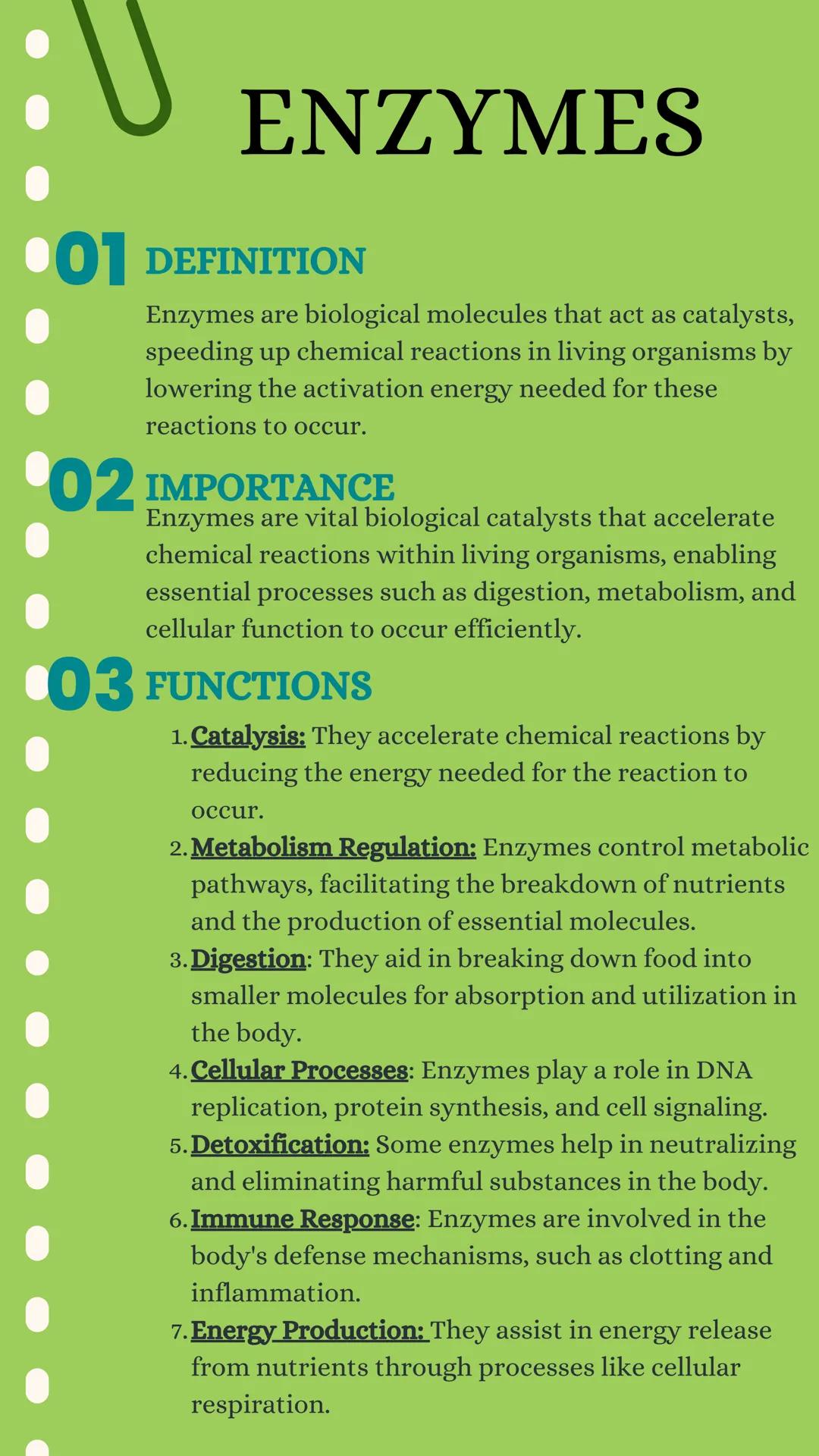
What Are Enzymes?
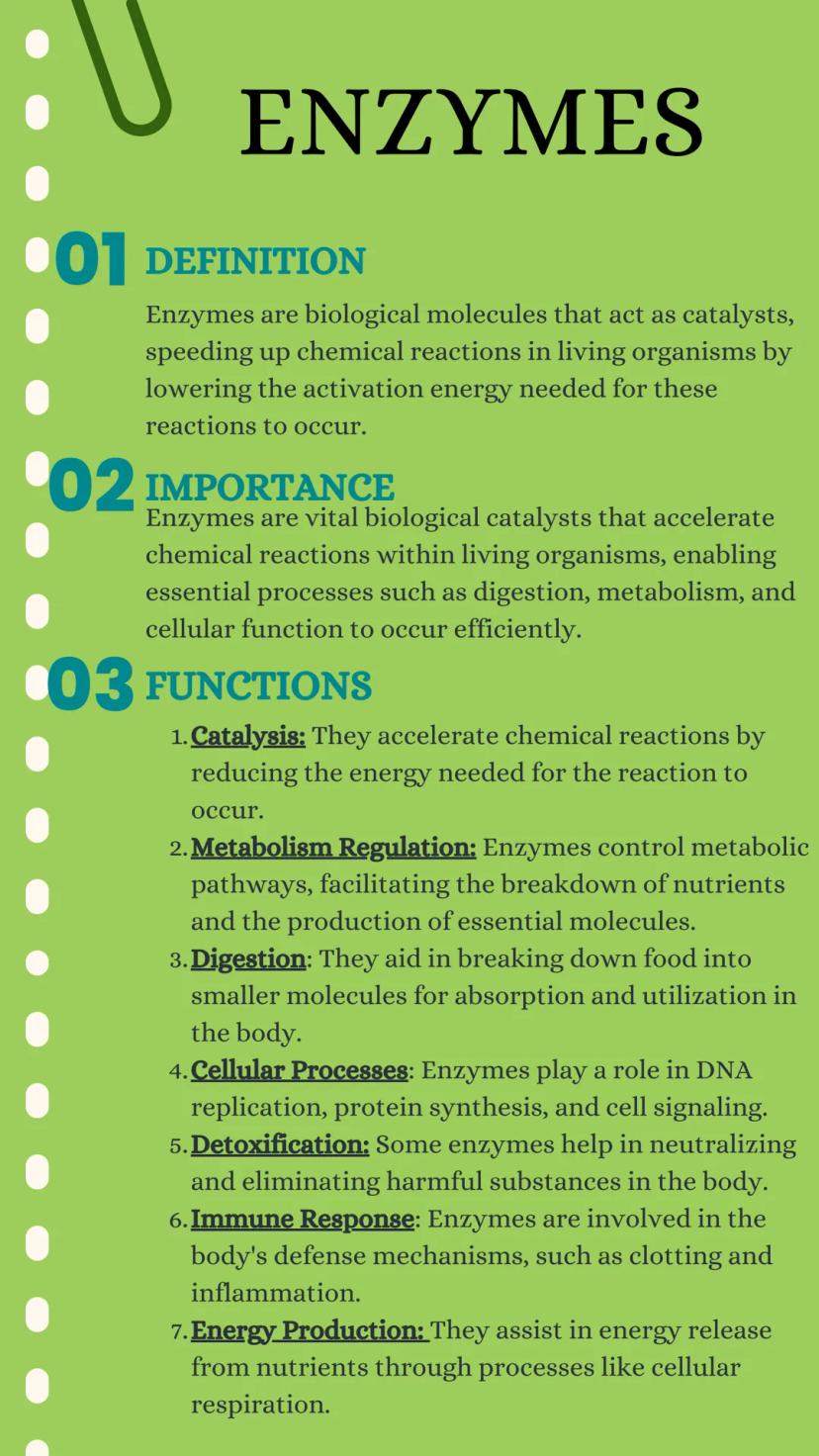
Enzymes are specialized biological molecules that act as catalysts, dramatically speeding up chemical reactions by lowering the activation energy needed. Think of them as tiny molecular machines that help your body function efficiently.
These remarkable molecules perform several critical functions in living organisms. They enable essential processes like digestion (breaking down food into usable nutrients), metabolism (chemical reactions that sustain life), and vital cellular functions that keep your cells working properly.
Enzymes also play crucial roles in energy production, helping release energy from the food you eat through processes like cellular respiration. They're involved in your immune response, assisting with functions like blood clotting and inflammation when you're injured.
Quick Fact: Without enzymes, many biological reactions would happen too slowly to support life! A reaction that might take years can happen in milliseconds with the right enzyme present.
2
of 3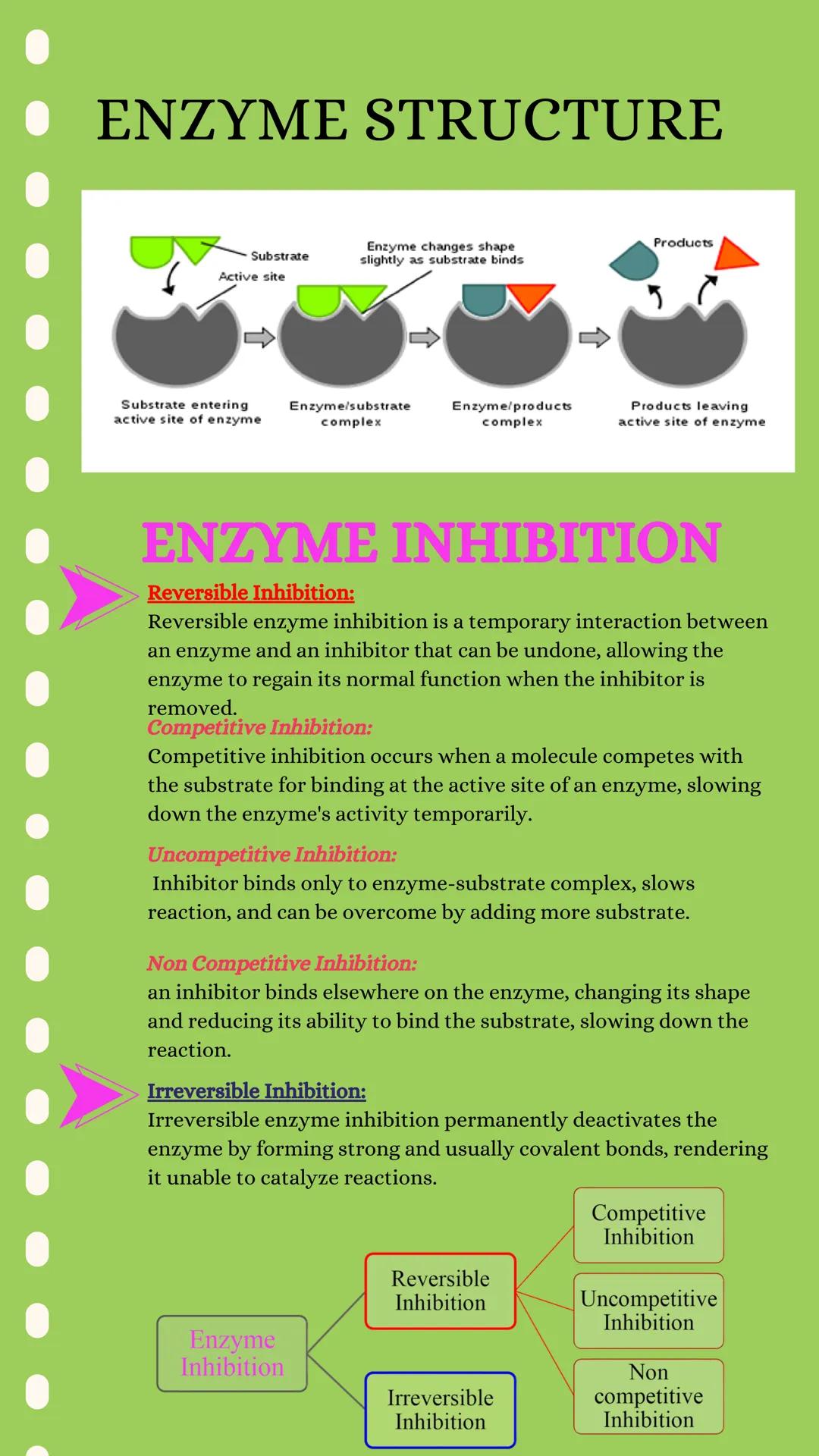
How Enzymes Work & Inhibition
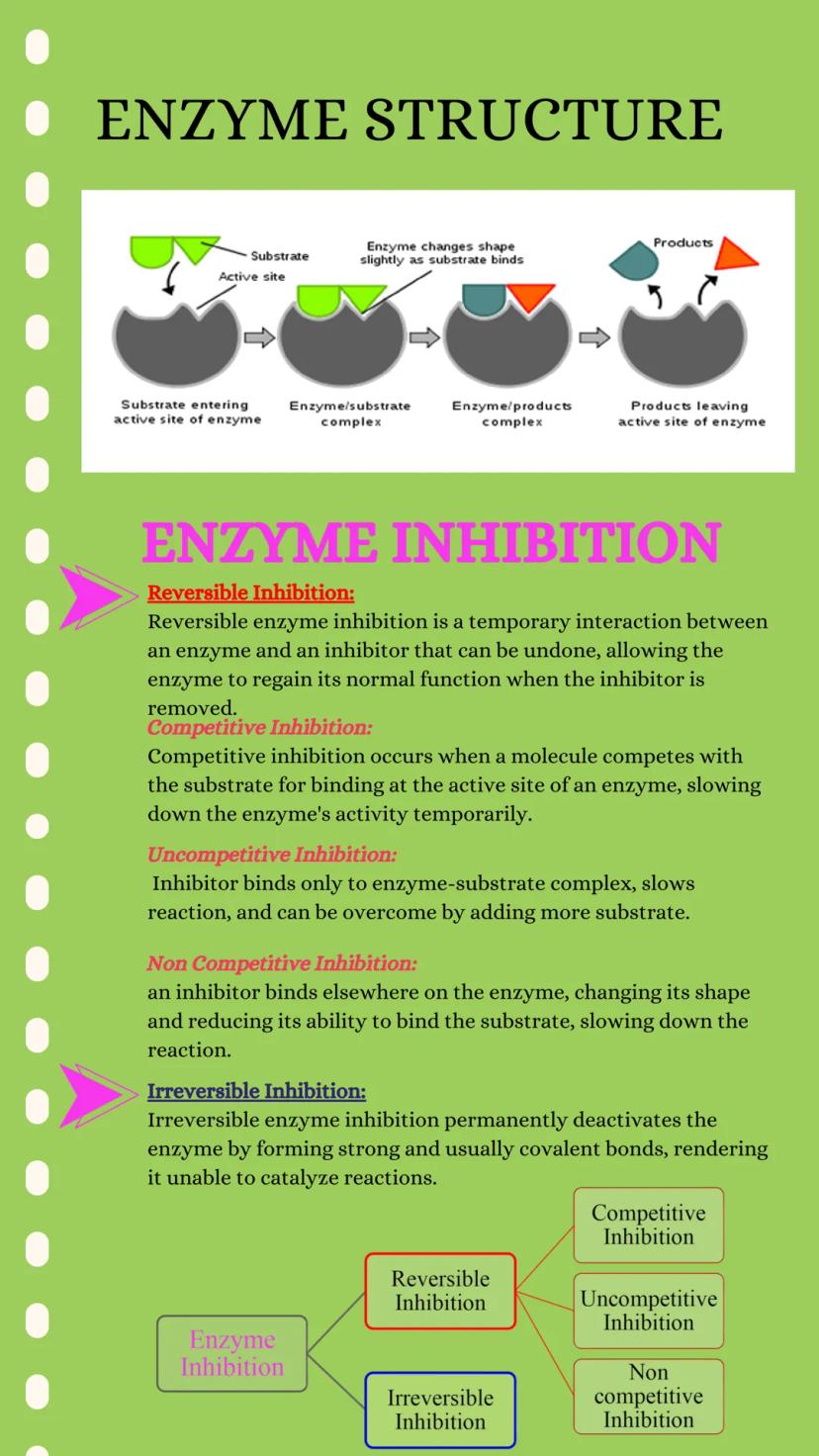
Enzymes have a special region called the active site where substrates (the molecules being acted upon) bind. When a substrate enters this active site, the enzyme changes shape slightly to fit it perfectly, forming an enzyme-substrate complex. After the reaction occurs, the products are released, and the enzyme returns to its original state.
Enzyme activity can be blocked through several types of inhibition. In competitive inhibition, molecules compete with the substrate for the active site, temporarily slowing enzyme activity. With non-competitive inhibition, inhibitors bind elsewhere on the enzyme, changing its shape and reducing efficiency.
Reversible inhibition is temporary and can be overcome when the inhibitor is removed. In contrast, irreversible inhibition permanently deactivates enzymes by forming strong bonds that cannot be broken, completely stopping their function.
Remember: The lock-and-key or induced fit model helps explain enzyme specificity - enzymes are highly selective about which molecules they interact with!
3
of 3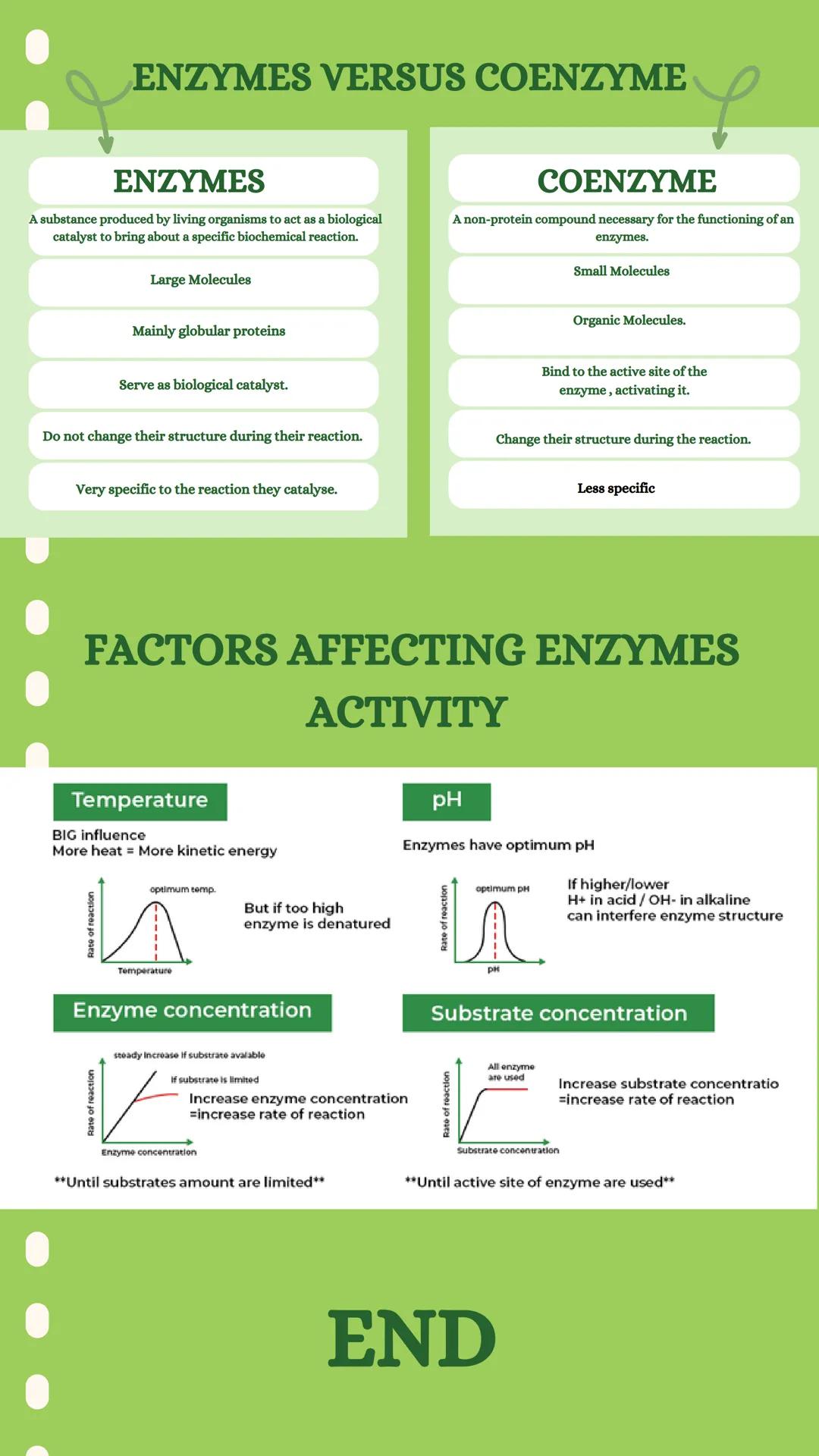
Enzymes vs. Coenzymes & Factors Affecting Activity
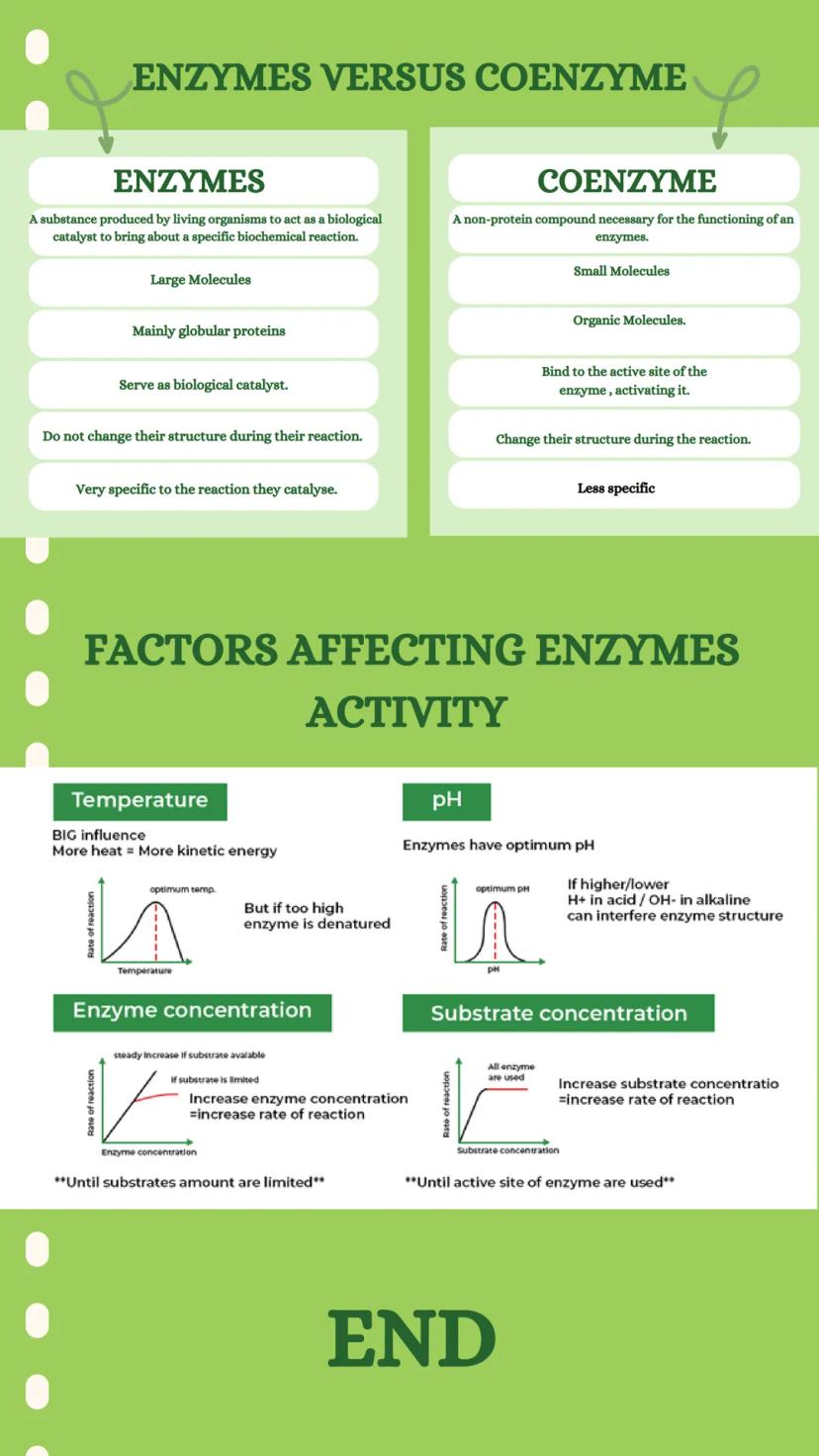
Enzymes and coenzymes work together but have distinct differences. Enzymes are large protein molecules that remain unchanged during reactions and are highly specific to particular reactions. Coenzymes, however, are smaller non-protein compounds that bind to enzymes' active sites, change during reactions, and are less specific.
Multiple factors affect how well enzymes work. Temperature significantly impacts enzyme activity - reactions speed up with increasing temperature until reaching an optimum point, after which enzymes denature and lose function. Similarly, each enzyme has an optimum pH where it works best.
Enzyme concentration affects reaction rates too - more enzyme generally means faster reactions, as long as enough substrate is available. Likewise, increasing substrate concentration speeds up reactions until all enzyme active sites are occupied, creating a plateau in reaction rate.
Study Tip: Think about enzyme factors like Goldilocks - conditions need to be "just right" for optimal enzyme function!
We thought you’d never ask...
What is the Knowunity AI companion?
Our AI companion is specifically built for the needs of students. Based on the millions of content pieces we have on the platform we can provide truly meaningful and relevant answers to students. But its not only about answers, the companion is even more about guiding students through their daily learning challenges, with personalised study plans, quizzes or content pieces in the chat and 100% personalisation based on the students skills and developments.
Where can I download the Knowunity app?
You can download the app in the Google Play Store and in the Apple App Store.
Is Knowunity really free of charge?
That's right! Enjoy free access to study content, connect with fellow students, and get instant help – all at your fingertips.
Similar Content
Most popular content: Enzymes
1Most popular content in Biology
9C
BiologyCell Organelles
This Quiz Is To Test Your Knowledge Of Cell Organelles And Their Functions Inside The Cell. It Can Also Be A Study Guide To Remember Them Better.
6th6710
B
Biologybiology cell organelles and functions
Do you know the cell organelles and their functions?
9th4410
M
BiologyMitosis and Cell Division Flashcards
These flashcards cover the basics of mitosis and why cell division occurs in the first place.
9th3390
D
BiologyDNA and RNA
Uncover the secrets of life with this comprehensive Biology flashcard set. Perfect for grade 10 students studying Living Environment.
10th1,0782
D
BiologyDiscover the Fascinating World of Living Organisms
Uncover the secrets of biology and explore the diverse and amazing life forms that inhabit our planet with this captivating flashcard set.
7th4380
A
BiologyAnimal and plant cell structure
Quiz on animal and plant cell structures
9th3240
D
BiologyDiscover Punnet Squares
Uncover the secrets of life with this comprehensive Biology flashcard set. Perfect for grade 10 students studying Living Environment.
10th3961
D
BiologyDNA
Parts of DNA
9th2970
S
BiologySteps of Cellular Respiration
3 basic steps and Molecule Vocab
9th2660
Most popular content
9O
 AP US History
Origins and Dynamics of the Columbian Exchange
Analyze the ecological and economic motivations behind the initial transfer of goods, people, and diseases between the Old and New Worlds.
9th3,1280
I
AP US HistoryIntroduction to Early Cultural Interactions
Analyze the initial social and religious encounters between Europeans, Africans, and Indigenous peoples in the colonial Americas.
9th2,7730
O
 AP World History
Origins of Ancient River Civilizations
Analyze the environmental factors and technological innovations that led to the rise of early states in Mesopotamia, Egypt, and the Indus Valley.
9th3,1870
M
AP US HistoryMotivations for European Exploration
Analyze the economic, religious, and political factors that drove European powers to the Americas during the 15th and 16th centuries.
9th1,7780
F
 AP Psychology
Foundations of Ethical Guidelines in Research
Practice the core principles of the APA ethical code including informed consent, debriefing, and the role of Institutional Review Boards.
9th1,3360
I
AP US HistoryIntroduction to Native American Societies
Examine the diverse social, political, and economic structures of North American indigenous groups prior to European contact.
9th1,1100
I
AP BiologyIntroduction to Biological Elements of Life
Practice identifying the essential elements including carbon, nitrogen, phosphorus, and sulfur that compose biological macromolecules.
9th1,7390
I
AP US HistoryIntroduction to the Spanish Encomienda System
Explore the fundamental economic and social structures of the Spanish colonial system, focusing on the encomienda and the casta social hierarchy.
9th8890
O
AP World HistoryOrigins and Continuity of the Byzantine Empire
Analyze the political and cultural transitions from the Roman Empire to the Byzantine Empire, focusing on the reign of Justinian I and his code.
9th1,6320
Can't find what you're looking for? Explore other subjects.
Students love us — and so will you.
4.6/5App Store
4.7/5Google Play
The app is very easy to use and well designed. I have found everything I was looking for so far and have been able to learn a lot from the presentations! I will definitely use the app for a class assignment! And of course it also helps a lot as an inspiration.
Stefan SiOS user
This app is really great. There are so many study notes and help [...]. My problem subject is French, for example, and the app has so many options for help. Thanks to this app, I have improved my French. I would recommend it to anyone.
Samantha KlichAndroid user
Wow, I am really amazed. I just tried the app because I've seen it advertised many times and was absolutely stunned. This app is THE HELP you want for school and above all, it offers so many things, such as workouts and fact sheets, which have been VERY helpful to me personally.
AnnaiOS user
Biology52 views·Updated Jun 6, 2026·3 pagesUnderstanding Enzymes: Structure, Functions, and Activity
Amy <3@learn_with_me.
Enzymes are powerful biological molecules that make life possible by speeding up chemical reactions in our bodies. Without these microscopic helpers, processes like digestion and energy production would be too slow to sustain life. Understanding how enzymes work is key...
1
of 3
Sign up to see the content. It's free!
- Access to all documents
- Improve your grades
- Join milions of students
What Are Enzymes?
Enzymes are specialized biological molecules that act as catalysts, dramatically speeding up chemical reactions by lowering the activation energy needed. Think of them as tiny molecular machines that help your body function efficiently.
These remarkable molecules perform several critical functions in living organisms. They enable essential processes like digestion (breaking down food into usable nutrients), metabolism (chemical reactions that sustain life), and vital cellular functions that keep your cells working properly.
Enzymes also play crucial roles in energy production, helping release energy from the food you eat through processes like cellular respiration. They're involved in your immune response, assisting with functions like blood clotting and inflammation when you're injured.
Quick Fact: Without enzymes, many biological reactions would happen too slowly to support life! A reaction that might take years can happen in milliseconds with the right enzyme present.
2
of 3Sign up to see the content. It's free!
- Access to all documents
- Improve your grades
- Join milions of students
How Enzymes Work & Inhibition
Enzymes have a special region called the active site where substrates (the molecules being acted upon) bind. When a substrate enters this active site, the enzyme changes shape slightly to fit it perfectly, forming an enzyme-substrate complex. After the reaction occurs, the products are released, and the enzyme returns to its original state.
Enzyme activity can be blocked through several types of inhibition. In competitive inhibition, molecules compete with the substrate for the active site, temporarily slowing enzyme activity. With non-competitive inhibition, inhibitors bind elsewhere on the enzyme, changing its shape and reducing efficiency.
Reversible inhibition is temporary and can be overcome when the inhibitor is removed. In contrast, irreversible inhibition permanently deactivates enzymes by forming strong bonds that cannot be broken, completely stopping their function.
Remember: The lock-and-key or induced fit model helps explain enzyme specificity - enzymes are highly selective about which molecules they interact with!
3
of 3Sign up to see the content. It's free!
- Access to all documents
- Improve your grades
- Join milions of students
Enzymes vs. Coenzymes & Factors Affecting Activity
Enzymes and coenzymes work together but have distinct differences. Enzymes are large protein molecules that remain unchanged during reactions and are highly specific to particular reactions. Coenzymes, however, are smaller non-protein compounds that bind to enzymes' active sites, change during reactions, and are less specific.
Multiple factors affect how well enzymes work. Temperature significantly impacts enzyme activity - reactions speed up with increasing temperature until reaching an optimum point, after which enzymes denature and lose function. Similarly, each enzyme has an optimum pH where it works best.
Enzyme concentration affects reaction rates too - more enzyme generally means faster reactions, as long as enough substrate is available. Likewise, increasing substrate concentration speeds up reactions until all enzyme active sites are occupied, creating a plateau in reaction rate.
Study Tip: Think about enzyme factors like Goldilocks - conditions need to be "just right" for optimal enzyme function!
We thought you’d never ask...
What is the Knowunity AI companion?
Our AI companion is specifically built for the needs of students. Based on the millions of content pieces we have on the platform we can provide truly meaningful and relevant answers to students. But its not only about answers, the companion is even more about guiding students through their daily learning challenges, with personalised study plans, quizzes or content pieces in the chat and 100% personalisation based on the students skills and developments.
Where can I download the Knowunity app?
You can download the app in the Google Play Store and in the Apple App Store.
Is Knowunity really free of charge?
That's right! Enjoy free access to study content, connect with fellow students, and get instant help – all at your fingertips.
Similar Content
Most popular content: Enzymes
1Most popular content in Biology
9C
BiologyCell Organelles
This Quiz Is To Test Your Knowledge Of Cell Organelles And Their Functions Inside The Cell. It Can Also Be A Study Guide To Remember Them Better.
6th6710
B
Biologybiology cell organelles and functions
Do you know the cell organelles and their functions?
9th4410
M
BiologyMitosis and Cell Division Flashcards
These flashcards cover the basics of mitosis and why cell division occurs in the first place.
9th3390
D
BiologyDNA and RNA
Uncover the secrets of life with this comprehensive Biology flashcard set. Perfect for grade 10 students studying Living Environment.
10th1,0782
D
BiologyDiscover the Fascinating World of Living Organisms
Uncover the secrets of biology and explore the diverse and amazing life forms that inhabit our planet with this captivating flashcard set.
7th4380
A
BiologyAnimal and plant cell structure
Quiz on animal and plant cell structures
9th3240
D
BiologyDiscover Punnet Squares
Uncover the secrets of life with this comprehensive Biology flashcard set. Perfect for grade 10 students studying Living Environment.
10th3961
D
BiologyDNA
Parts of DNA
9th2970
S
BiologySteps of Cellular Respiration
3 basic steps and Molecule Vocab
9th2660
Most popular content
9O
AP US HistoryOrigins and Dynamics of the Columbian Exchange
Analyze the ecological and economic motivations behind the initial transfer of goods, people, and diseases between the Old and New Worlds.
9th3,1280
I
AP US HistoryIntroduction to Early Cultural Interactions
Analyze the initial social and religious encounters between Europeans, Africans, and Indigenous peoples in the colonial Americas.
9th2,7730
O
AP World HistoryOrigins of Ancient River Civilizations
Analyze the environmental factors and technological innovations that led to the rise of early states in Mesopotamia, Egypt, and the Indus Valley.
9th3,1870
M
AP US HistoryMotivations for European Exploration
Analyze the economic, religious, and political factors that drove European powers to the Americas during the 15th and 16th centuries.
9th1,7780
F
AP PsychologyFoundations of Ethical Guidelines in Research
Practice the core principles of the APA ethical code including informed consent, debriefing, and the role of Institutional Review Boards.
9th1,3360
I
AP US HistoryIntroduction to Native American Societies
Examine the diverse social, political, and economic structures of North American indigenous groups prior to European contact.
9th1,1100
I
AP BiologyIntroduction to Biological Elements of Life
Practice identifying the essential elements including carbon, nitrogen, phosphorus, and sulfur that compose biological macromolecules.
9th1,7390
I
AP US HistoryIntroduction to the Spanish Encomienda System
Explore the fundamental economic and social structures of the Spanish colonial system, focusing on the encomienda and the casta social hierarchy.
9th8890
O
AP World HistoryOrigins and Continuity of the Byzantine Empire
Analyze the political and cultural transitions from the Roman Empire to the Byzantine Empire, focusing on the reign of Justinian I and his code.
9th1,6320
Can't find what you're looking for? Explore other subjects.
Students love us — and so will you.
4.6/5App Store
4.7/5Google Play
The app is very easy to use and well designed. I have found everything I was looking for so far and have been able to learn a lot from the presentations! I will definitely use the app for a class assignment! And of course it also helps a lot as an inspiration.
Stefan SiOS user
This app is really great. There are so many study notes and help [...]. My problem subject is French, for example, and the app has so many options for help. Thanks to this app, I have improved my French. I would recommend it to anyone.
Samantha KlichAndroid user
Wow, I am really amazed. I just tried the app because I've seen it advertised many times and was absolutely stunned. This app is THE HELP you want for school and above all, it offers so many things, such as workouts and fact sheets, which have been VERY helpful to me personally.
AnnaiOS user