
Histology is the study of tissues - groups of similar...
 Biology102 views·Updated Jun 20, 2026·4 pages
BSCI 21010 Anatomy Histology and Tissues Study Notes

allison gibson@allison.gibson
1 / 4
1
of 4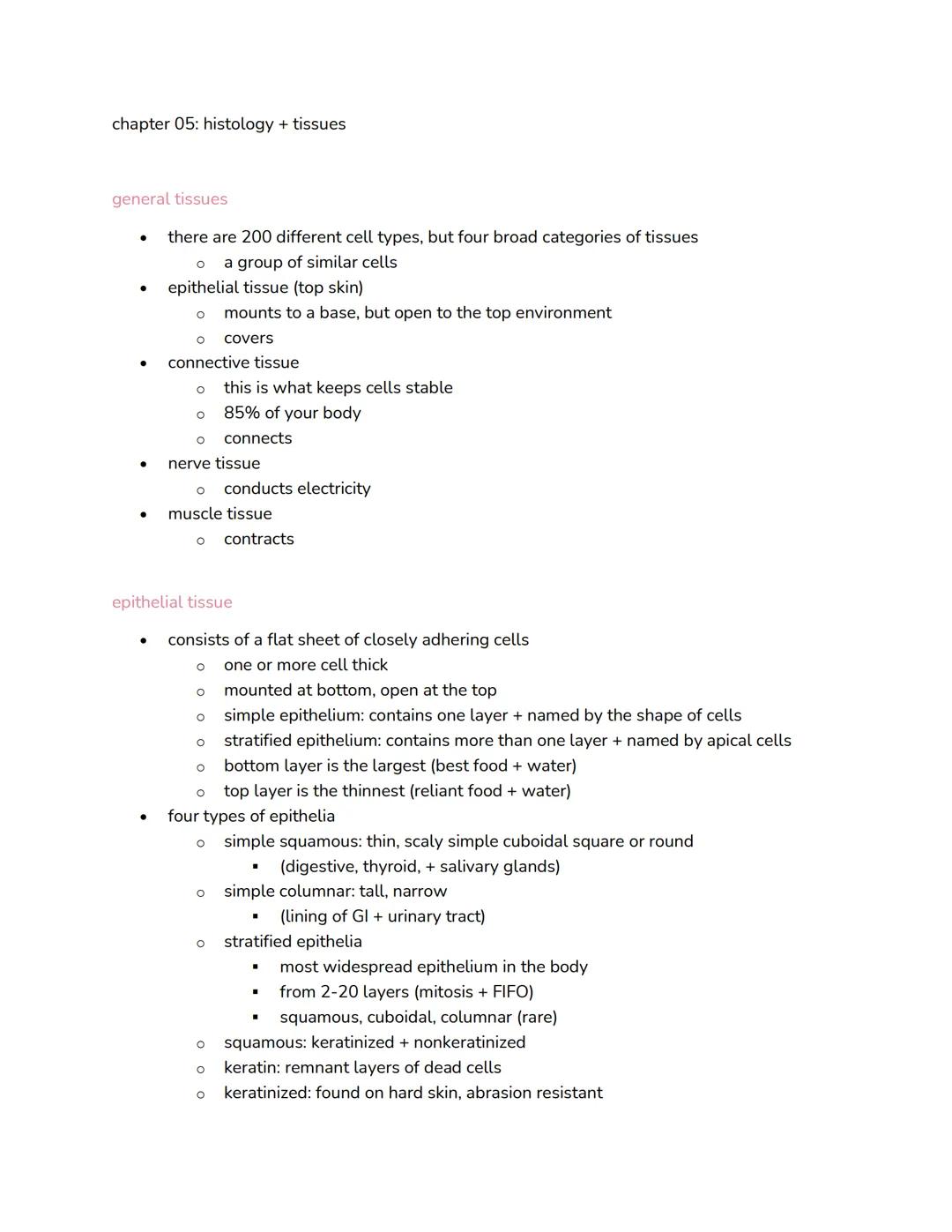
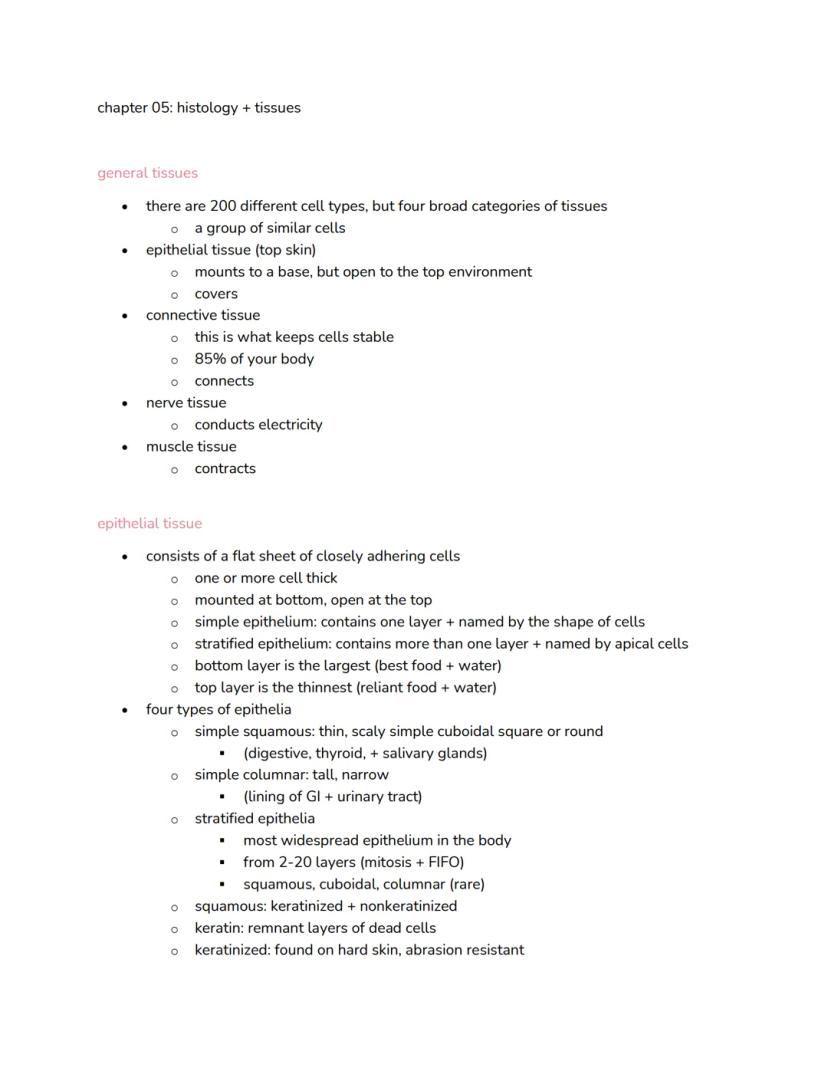
General Tissues and Epithelial Tissue
Your body contains about 200 different cell types organized into just four broad tissue categories. Each tissue type serves specific functions - epithelial tissue covers surfaces, connective tissue (making up 85% of your body) provides support, nerve tissue conducts electricity, and muscle tissue contracts.
Epithelial tissue forms sheets of tightly packed cells that cover surfaces. The bottom layer attaches to a base while the top remains open to the environment. Simple epithelium has only one layer and is named by cell shape (squamous, cuboidal, or columnar). Stratified epithelium contains multiple layers and is named by the shape of its top cells.
The four main types of epithelia include simple squamous (thin, scaly cells), simple cuboidal (square or round cells found in glands), simple columnar (tall, narrow cells lining digestive and urinary tracts), and stratified epithelia. Stratified epithelia can have 2-20 layers with new cells continually forming at the bottom through mitosis while older cells move upward.
Did you know? Your skin replaces itself completely about every 27 days! This happens through a process where new cells form at the bottom layer while old cells move up and eventually flake off.
2
of 4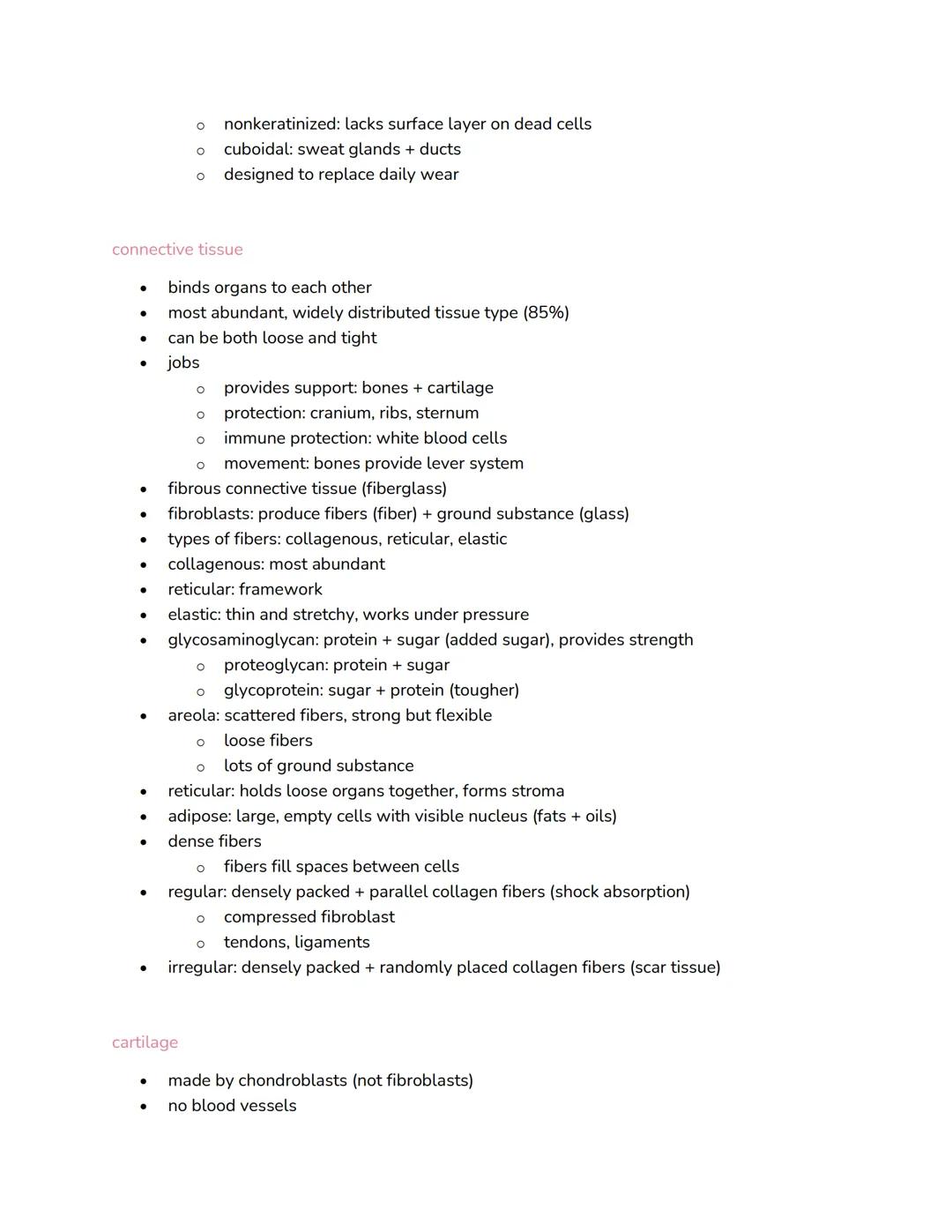
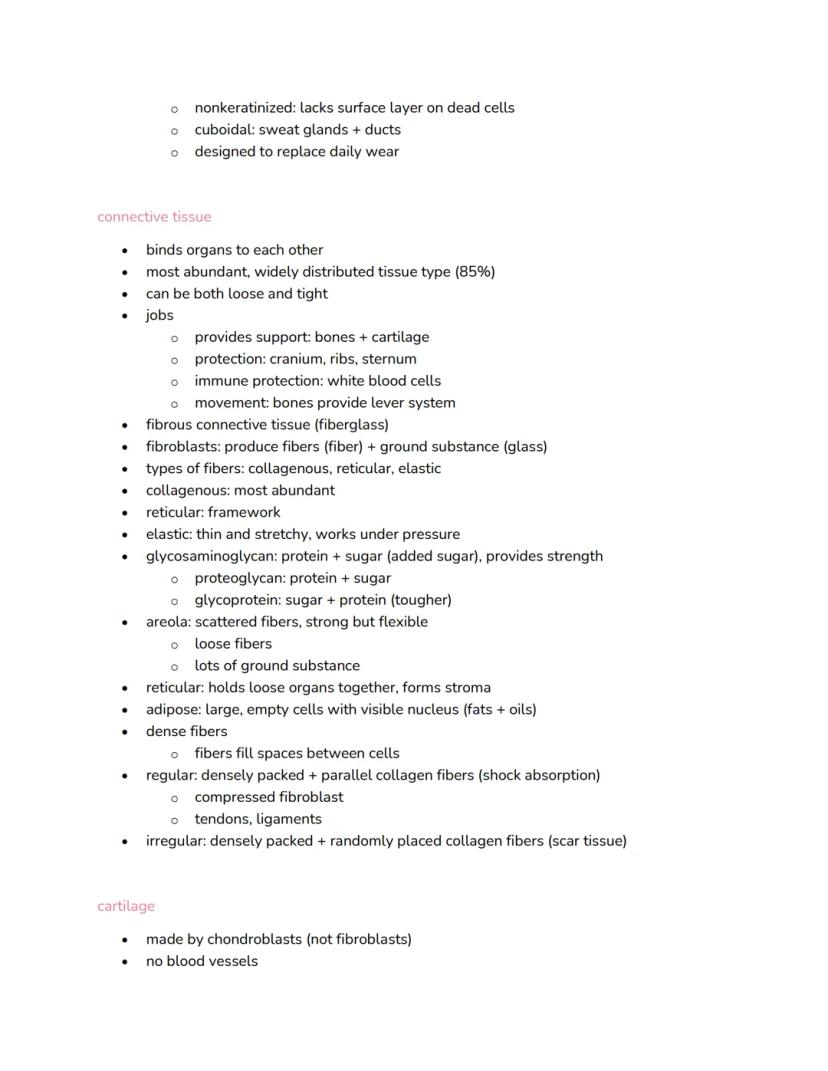
Connective Tissue
Connective tissue is the most abundant tissue in your body, making up about 85% of your total body composition. It binds organs together and can be either loose or tight depending on its function. This versatile tissue provides support through bones and cartilage, offers protection (like your skull protecting your brain), assists with immune defense through white blood cells, and enables movement.
The main cell type in connective tissue is the fibroblast, which produces both fibers and ground substance (like fiberglass). There are three types of fibers: collagenous (most abundant), reticular (forms frameworks), and elastic . The ground substance contains glycosaminoglycans - complex molecules made of proteins and sugars that provide strength.
Connective tissue comes in several forms. Loose connective tissue includes areolar tissue (scattered fibers, strong yet flexible), reticular tissue (holds organs together), and adipose tissue (fat storage). Dense connective tissue has tightly packed fibers and can be regular (parallel fibers like in tendons) or irregular (random fibers like in scar tissue).
Remember this: Connective tissue is like the body's infrastructure system - it provides the framework that holds everything together while also playing important roles in protection, support, and movement.
3
of 4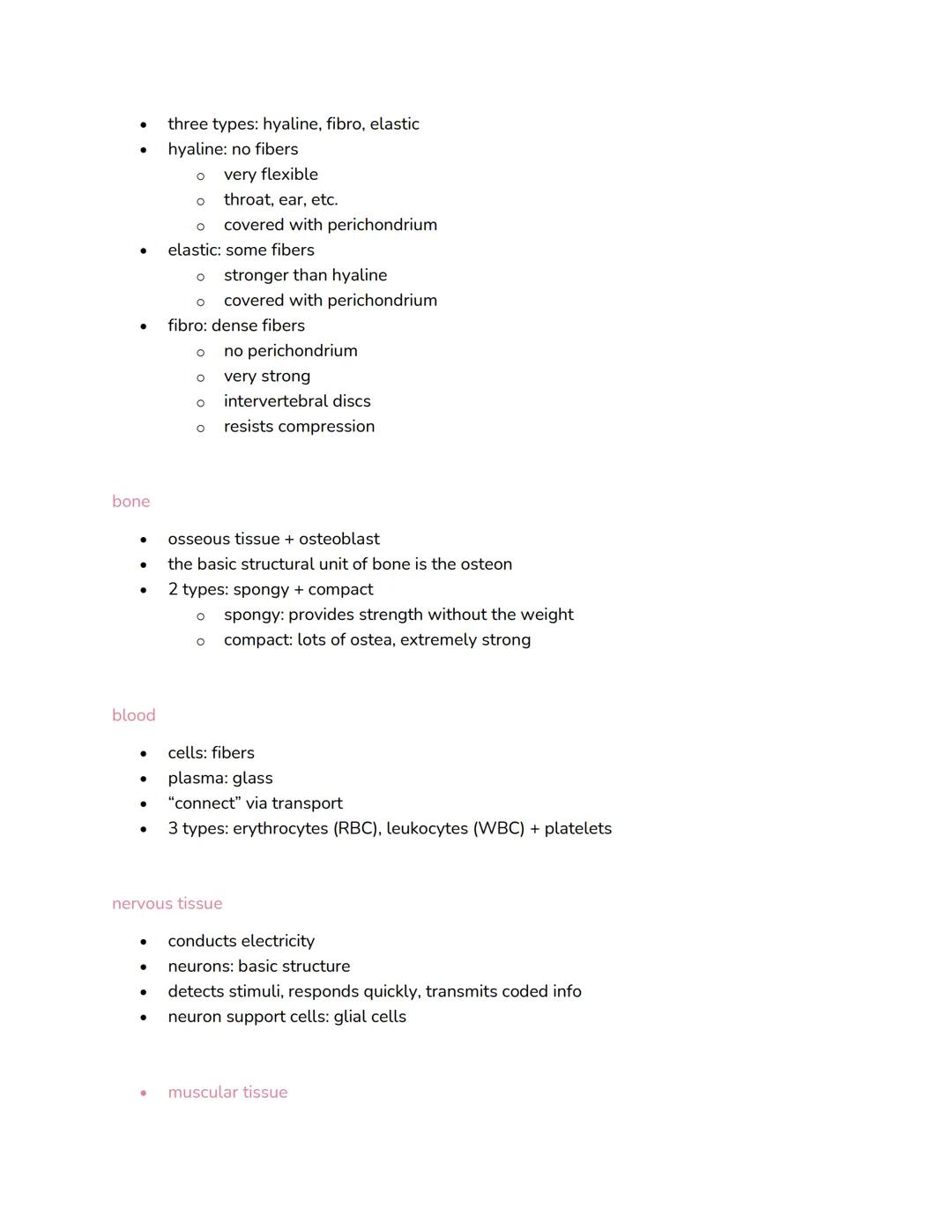
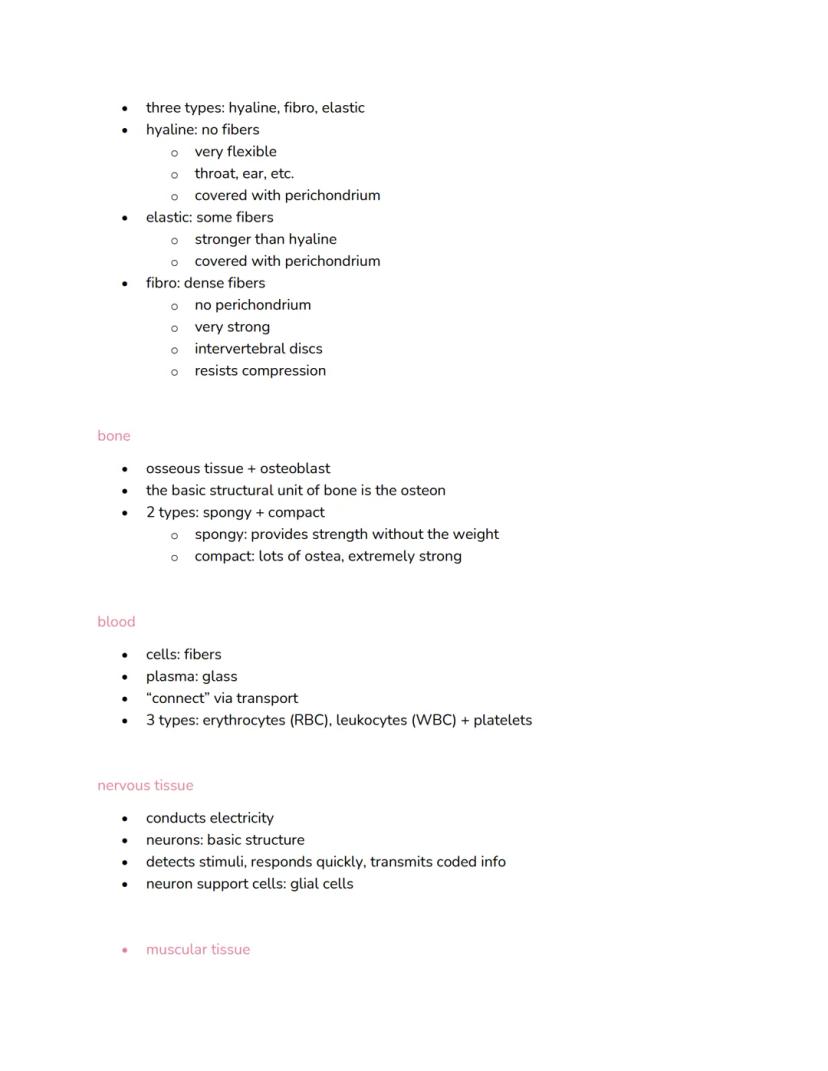
Cartilage, Bone, Blood and Nervous Tissue
Cartilage is a specialized connective tissue made by cells called chondroblasts. Unlike most tissues, it contains no blood vessels. The three types of cartilage vary in strength and flexibility: hyaline (very flexible, found in throat and ears), elastic (stronger than hyaline), and fibrocartilage (very strong, found in intervertebral discs).
Bone tissue (osseous tissue) is produced by osteoblasts. Its basic structural unit is the osteon. Bones come in two types: spongy bone provides strength without weight, while compact bone contains many osteons and is extremely strong. Blood is another form of connective tissue with cells (erythrocytes, leukocytes, and platelets) suspended in plasma.
Nervous tissue conducts electricity throughout your body. The basic unit is the neuron, which detects stimuli, responds quickly, and transmits coded information. Supporting cells called glial cells help neurons function properly. This tissue is essential for all sensations and movements.
Cool fact: Neurons can transmit signals at speeds of up to 268 miles per hour! This incredible speed allows your brain to communicate with your body almost instantaneously.
4
of 4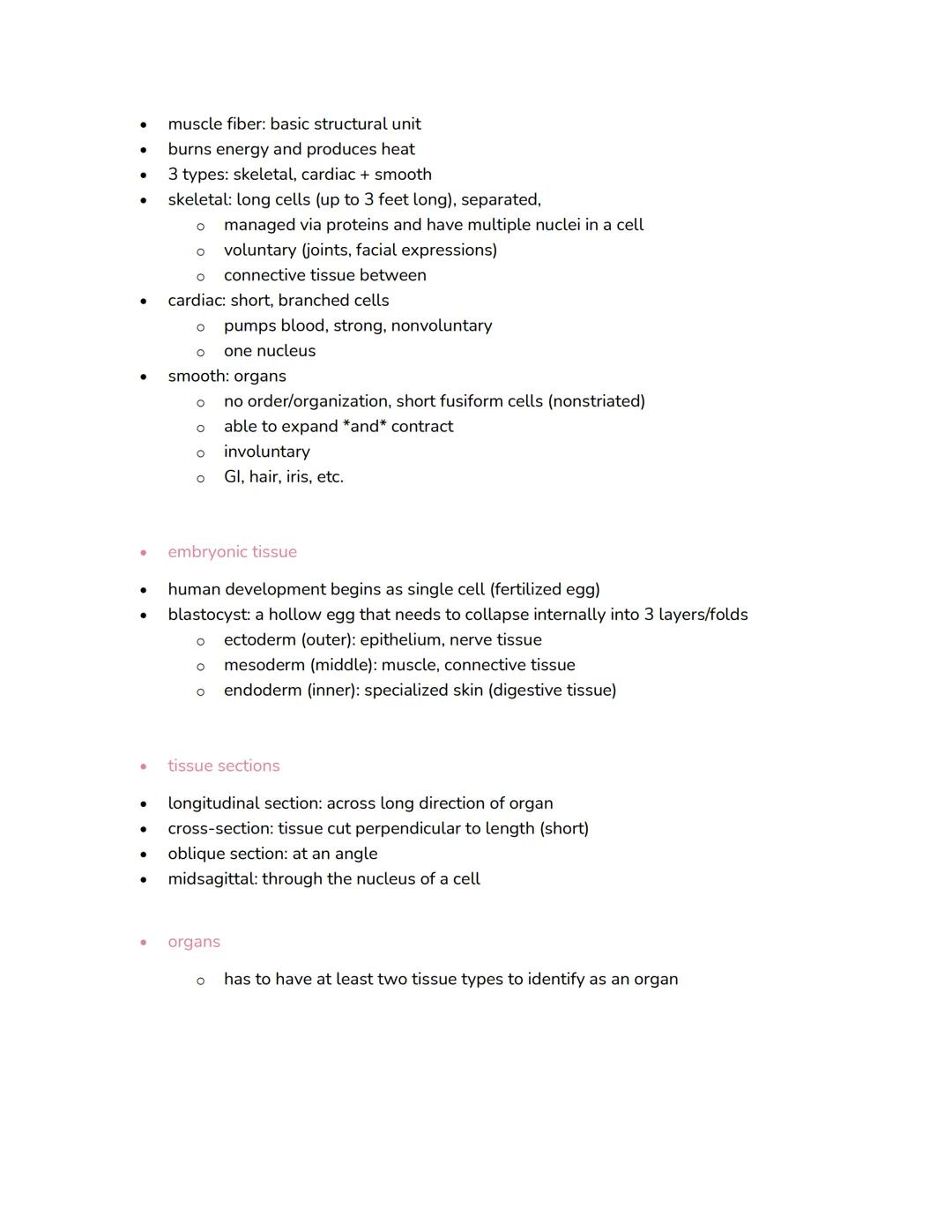
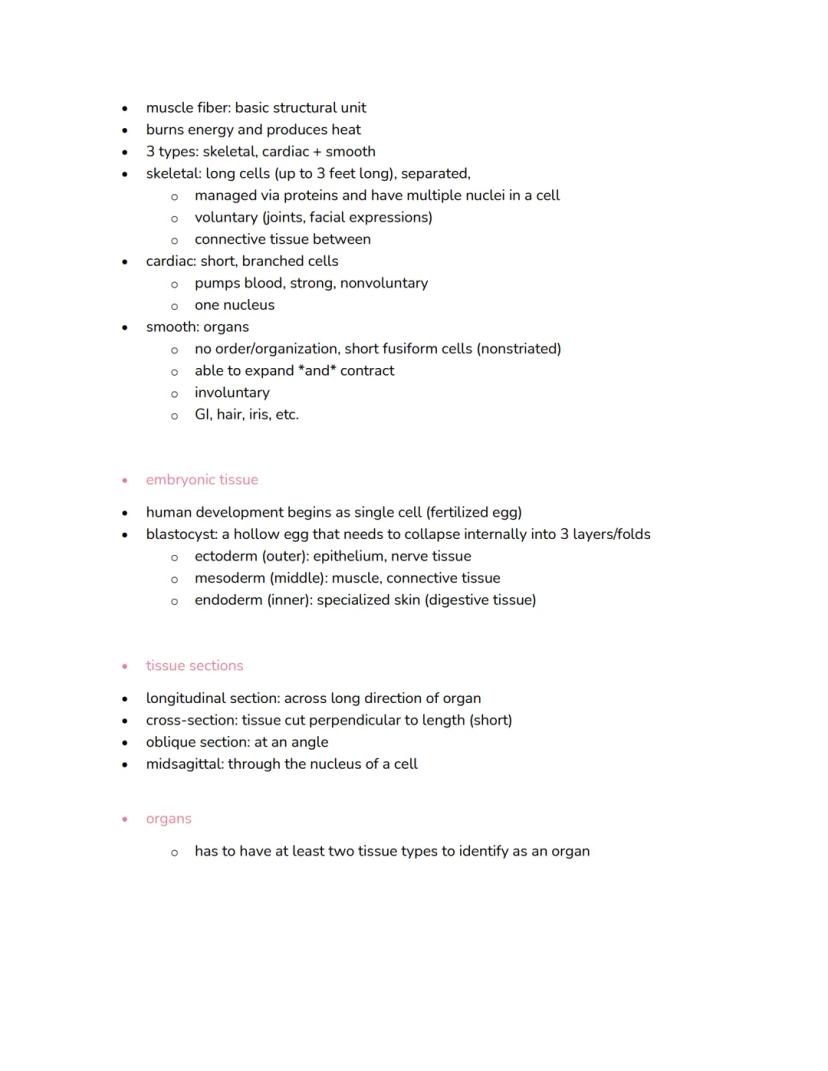
Muscular Tissue and Development
Muscular tissue burns energy to produce movement and heat. The basic unit is the muscle fiber, and there are three distinct types. Skeletal muscle has long cells with multiple nuclei, connects to bones, and is under voluntary control. Cardiac muscle has short, branched cells with single nuclei and pumps blood involuntarily. Smooth muscle found in organs has short, fusiform cells that can both expand and contract, working involuntarily.
Human development begins as a single fertilized egg that develops into a blastocyst - a hollow structure that folds inward to create three tissue layers. The ectoderm (outer layer) forms epithelium and nerve tissue, the mesoderm (middle layer) becomes muscle and connective tissues, and the endoderm (inner layer) develops into specialized digestive tissues.
When studying tissues, scientists use different section cuts: longitudinal (along the length), cross-section (perpendicular to length), oblique (at an angle), and midsagittal (through the center). For a structure to be considered an organ, it must contain at least two different tissue types working together.
Pro tip: When thinking about the three embryonic tissue layers, remember "outside-in": ectoderm forms outer structures like skin, mesoderm forms middle structures like muscles, and endoderm forms inner structures like digestive linings.
We thought you’d never ask...
What is the Knowunity AI companion?
Our AI companion is specifically built for the needs of students. Based on the millions of content pieces we have on the platform we can provide truly meaningful and relevant answers to students. But its not only about answers, the companion is even more about guiding students through their daily learning challenges, with personalised study plans, quizzes or content pieces in the chat and 100% personalisation based on the students skills and developments.
Where can I download the Knowunity app?
You can download the app in the Google Play Store and in the Apple App Store.
Is Knowunity really free of charge?
That's right! Enjoy free access to study content, connect with fellow students, and get instant help – all at your fingertips.
Similar Content
Most popular content: Connective Tissue
1Most popular content in Biology
9C
BiologyCell Organelles
This Quiz Is To Test Your Knowledge Of Cell Organelles And Their Functions Inside The Cell. It Can Also Be A Study Guide To Remember Them Better.
6th6710
B
Biologybiology cell organelles and functions
Do you know the cell organelles and their functions?
9th4410
M
BiologyMitosis and Cell Division Flashcards
These flashcards cover the basics of mitosis and why cell division occurs in the first place.
9th3390
D
BiologyDNA and RNA
Uncover the secrets of life with this comprehensive Biology flashcard set. Perfect for grade 10 students studying Living Environment.
10th1,0782
D
BiologyDiscover the Fascinating World of Living Organisms
Uncover the secrets of biology and explore the diverse and amazing life forms that inhabit our planet with this captivating flashcard set.
7th4380
A
BiologyAnimal and plant cell structure
Quiz on animal and plant cell structures
9th3240
D
BiologyDiscover Punnet Squares
Uncover the secrets of life with this comprehensive Biology flashcard set. Perfect for grade 10 students studying Living Environment.
10th3961
D
BiologyDNA
Parts of DNA
9th2970
S
BiologySteps of Cellular Respiration
3 basic steps and Molecule Vocab
9th2660
Most popular content
9O
 AP US History
Origins and Dynamics of the Columbian Exchange
Analyze the ecological and economic motivations behind the initial transfer of goods, people, and diseases between the Old and New Worlds.
9th3,1280
I
AP US HistoryIntroduction to Early Cultural Interactions
Analyze the initial social and religious encounters between Europeans, Africans, and Indigenous peoples in the colonial Americas.
9th2,7730
O
 AP World History
Origins of Ancient River Civilizations
Analyze the environmental factors and technological innovations that led to the rise of early states in Mesopotamia, Egypt, and the Indus Valley.
9th3,1870
M
AP US HistoryMotivations for European Exploration
Analyze the economic, religious, and political factors that drove European powers to the Americas during the 15th and 16th centuries.
9th1,7780
F
 AP Psychology
Foundations of Ethical Guidelines in Research
Practice the core principles of the APA ethical code including informed consent, debriefing, and the role of Institutional Review Boards.
9th1,3360
I
AP US HistoryIntroduction to Native American Societies
Examine the diverse social, political, and economic structures of North American indigenous groups prior to European contact.
9th1,1100
I
AP BiologyIntroduction to Biological Elements of Life
Practice identifying the essential elements including carbon, nitrogen, phosphorus, and sulfur that compose biological macromolecules.
9th1,7390
I
AP US HistoryIntroduction to the Spanish Encomienda System
Explore the fundamental economic and social structures of the Spanish colonial system, focusing on the encomienda and the casta social hierarchy.
9th8890
O
AP World HistoryOrigins and Continuity of the Byzantine Empire
Analyze the political and cultural transitions from the Roman Empire to the Byzantine Empire, focusing on the reign of Justinian I and his code.
9th1,6320
Can't find what you're looking for? Explore other subjects.
Students love us — and so will you.
4.6/5App Store
4.7/5Google Play
The app is very easy to use and well designed. I have found everything I was looking for so far and have been able to learn a lot from the presentations! I will definitely use the app for a class assignment! And of course it also helps a lot as an inspiration.
Stefan SiOS user
This app is really great. There are so many study notes and help [...]. My problem subject is French, for example, and the app has so many options for help. Thanks to this app, I have improved my French. I would recommend it to anyone.
Samantha KlichAndroid user
Wow, I am really amazed. I just tried the app because I've seen it advertised many times and was absolutely stunned. This app is THE HELP you want for school and above all, it offers so many things, such as workouts and fact sheets, which have been VERY helpful to me personally.
AnnaiOS user
Biology102 views·Updated Jun 20, 2026·4 pagesBSCI 21010 Anatomy Histology and Tissues Study Notes
allison gibson@allison.gibson
Histology is the study of tissues - groups of similar cells that work together for specific functions. Our bodies contain four main types of tissues: epithelial, connective, nervous, and muscle tissues. Each type has unique structures and functions that allow...
1
of 4
Sign up to see the content. It's free!
- Access to all documents
- Improve your grades
- Join milions of students
General Tissues and Epithelial Tissue
Your body contains about 200 different cell types organized into just four broad tissue categories. Each tissue type serves specific functions - epithelial tissue covers surfaces, connective tissue (making up 85% of your body) provides support, nerve tissue conducts electricity, and muscle tissue contracts.
Epithelial tissue forms sheets of tightly packed cells that cover surfaces. The bottom layer attaches to a base while the top remains open to the environment. Simple epithelium has only one layer and is named by cell shape (squamous, cuboidal, or columnar). Stratified epithelium contains multiple layers and is named by the shape of its top cells.
The four main types of epithelia include simple squamous (thin, scaly cells), simple cuboidal (square or round cells found in glands), simple columnar (tall, narrow cells lining digestive and urinary tracts), and stratified epithelia. Stratified epithelia can have 2-20 layers with new cells continually forming at the bottom through mitosis while older cells move upward.
Did you know? Your skin replaces itself completely about every 27 days! This happens through a process where new cells form at the bottom layer while old cells move up and eventually flake off.
2
of 4Sign up to see the content. It's free!
- Access to all documents
- Improve your grades
- Join milions of students
Connective Tissue
Connective tissue is the most abundant tissue in your body, making up about 85% of your total body composition. It binds organs together and can be either loose or tight depending on its function. This versatile tissue provides support through bones and cartilage, offers protection (like your skull protecting your brain), assists with immune defense through white blood cells, and enables movement.
The main cell type in connective tissue is the fibroblast, which produces both fibers and ground substance (like fiberglass). There are three types of fibers: collagenous (most abundant), reticular (forms frameworks), and elastic . The ground substance contains glycosaminoglycans - complex molecules made of proteins and sugars that provide strength.
Connective tissue comes in several forms. Loose connective tissue includes areolar tissue (scattered fibers, strong yet flexible), reticular tissue (holds organs together), and adipose tissue (fat storage). Dense connective tissue has tightly packed fibers and can be regular (parallel fibers like in tendons) or irregular (random fibers like in scar tissue).
Remember this: Connective tissue is like the body's infrastructure system - it provides the framework that holds everything together while also playing important roles in protection, support, and movement.
3
of 4Sign up to see the content. It's free!
- Access to all documents
- Improve your grades
- Join milions of students
Cartilage, Bone, Blood and Nervous Tissue
Cartilage is a specialized connective tissue made by cells called chondroblasts. Unlike most tissues, it contains no blood vessels. The three types of cartilage vary in strength and flexibility: hyaline (very flexible, found in throat and ears), elastic (stronger than hyaline), and fibrocartilage (very strong, found in intervertebral discs).
Bone tissue (osseous tissue) is produced by osteoblasts. Its basic structural unit is the osteon. Bones come in two types: spongy bone provides strength without weight, while compact bone contains many osteons and is extremely strong. Blood is another form of connective tissue with cells (erythrocytes, leukocytes, and platelets) suspended in plasma.
Nervous tissue conducts electricity throughout your body. The basic unit is the neuron, which detects stimuli, responds quickly, and transmits coded information. Supporting cells called glial cells help neurons function properly. This tissue is essential for all sensations and movements.
Cool fact: Neurons can transmit signals at speeds of up to 268 miles per hour! This incredible speed allows your brain to communicate with your body almost instantaneously.
4
of 4Sign up to see the content. It's free!
- Access to all documents
- Improve your grades
- Join milions of students
Muscular Tissue and Development
Muscular tissue burns energy to produce movement and heat. The basic unit is the muscle fiber, and there are three distinct types. Skeletal muscle has long cells with multiple nuclei, connects to bones, and is under voluntary control. Cardiac muscle has short, branched cells with single nuclei and pumps blood involuntarily. Smooth muscle found in organs has short, fusiform cells that can both expand and contract, working involuntarily.
Human development begins as a single fertilized egg that develops into a blastocyst - a hollow structure that folds inward to create three tissue layers. The ectoderm (outer layer) forms epithelium and nerve tissue, the mesoderm (middle layer) becomes muscle and connective tissues, and the endoderm (inner layer) develops into specialized digestive tissues.
When studying tissues, scientists use different section cuts: longitudinal (along the length), cross-section (perpendicular to length), oblique (at an angle), and midsagittal (through the center). For a structure to be considered an organ, it must contain at least two different tissue types working together.
Pro tip: When thinking about the three embryonic tissue layers, remember "outside-in": ectoderm forms outer structures like skin, mesoderm forms middle structures like muscles, and endoderm forms inner structures like digestive linings.
We thought you’d never ask...
What is the Knowunity AI companion?
Our AI companion is specifically built for the needs of students. Based on the millions of content pieces we have on the platform we can provide truly meaningful and relevant answers to students. But its not only about answers, the companion is even more about guiding students through their daily learning challenges, with personalised study plans, quizzes or content pieces in the chat and 100% personalisation based on the students skills and developments.
Where can I download the Knowunity app?
You can download the app in the Google Play Store and in the Apple App Store.
Is Knowunity really free of charge?
That's right! Enjoy free access to study content, connect with fellow students, and get instant help – all at your fingertips.
Similar Content
Most popular content: Connective Tissue
1Most popular content in Biology
9C
BiologyCell Organelles
This Quiz Is To Test Your Knowledge Of Cell Organelles And Their Functions Inside The Cell. It Can Also Be A Study Guide To Remember Them Better.
6th6710
B
Biologybiology cell organelles and functions
Do you know the cell organelles and their functions?
9th4410
M
BiologyMitosis and Cell Division Flashcards
These flashcards cover the basics of mitosis and why cell division occurs in the first place.
9th3390
D
BiologyDNA and RNA
Uncover the secrets of life with this comprehensive Biology flashcard set. Perfect for grade 10 students studying Living Environment.
10th1,0782
D
BiologyDiscover the Fascinating World of Living Organisms
Uncover the secrets of biology and explore the diverse and amazing life forms that inhabit our planet with this captivating flashcard set.
7th4380
A
BiologyAnimal and plant cell structure
Quiz on animal and plant cell structures
9th3240
D
BiologyDiscover Punnet Squares
Uncover the secrets of life with this comprehensive Biology flashcard set. Perfect for grade 10 students studying Living Environment.
10th3961
D
BiologyDNA
Parts of DNA
9th2970
S
BiologySteps of Cellular Respiration
3 basic steps and Molecule Vocab
9th2660
Most popular content
9O
AP US HistoryOrigins and Dynamics of the Columbian Exchange
Analyze the ecological and economic motivations behind the initial transfer of goods, people, and diseases between the Old and New Worlds.
9th3,1280
I
AP US HistoryIntroduction to Early Cultural Interactions
Analyze the initial social and religious encounters between Europeans, Africans, and Indigenous peoples in the colonial Americas.
9th2,7730
O
AP World HistoryOrigins of Ancient River Civilizations
Analyze the environmental factors and technological innovations that led to the rise of early states in Mesopotamia, Egypt, and the Indus Valley.
9th3,1870
M
AP US HistoryMotivations for European Exploration
Analyze the economic, religious, and political factors that drove European powers to the Americas during the 15th and 16th centuries.
9th1,7780
F
AP PsychologyFoundations of Ethical Guidelines in Research
Practice the core principles of the APA ethical code including informed consent, debriefing, and the role of Institutional Review Boards.
9th1,3360
I
AP US HistoryIntroduction to Native American Societies
Examine the diverse social, political, and economic structures of North American indigenous groups prior to European contact.
9th1,1100
I
AP BiologyIntroduction to Biological Elements of Life
Practice identifying the essential elements including carbon, nitrogen, phosphorus, and sulfur that compose biological macromolecules.
9th1,7390
I
AP US HistoryIntroduction to the Spanish Encomienda System
Explore the fundamental economic and social structures of the Spanish colonial system, focusing on the encomienda and the casta social hierarchy.
9th8890
O
AP World HistoryOrigins and Continuity of the Byzantine Empire
Analyze the political and cultural transitions from the Roman Empire to the Byzantine Empire, focusing on the reign of Justinian I and his code.
9th1,6320
Can't find what you're looking for? Explore other subjects.
Students love us — and so will you.
4.6/5App Store
4.7/5Google Play
The app is very easy to use and well designed. I have found everything I was looking for so far and have been able to learn a lot from the presentations! I will definitely use the app for a class assignment! And of course it also helps a lot as an inspiration.
Stefan SiOS user
This app is really great. There are so many study notes and help [...]. My problem subject is French, for example, and the app has so many options for help. Thanks to this app, I have improved my French. I would recommend it to anyone.
Samantha KlichAndroid user
Wow, I am really amazed. I just tried the app because I've seen it advertised many times and was absolutely stunned. This app is THE HELP you want for school and above all, it offers so many things, such as workouts and fact sheets, which have been VERY helpful to me personally.
AnnaiOS user