

The integumentary system is your body's protective outer layer, including...
 Health & Medicine108 views·Updated Jun 17, 2026·3 pages
Comprehensive Notes on Anatomy & Physiology
1 / 3
1
of 3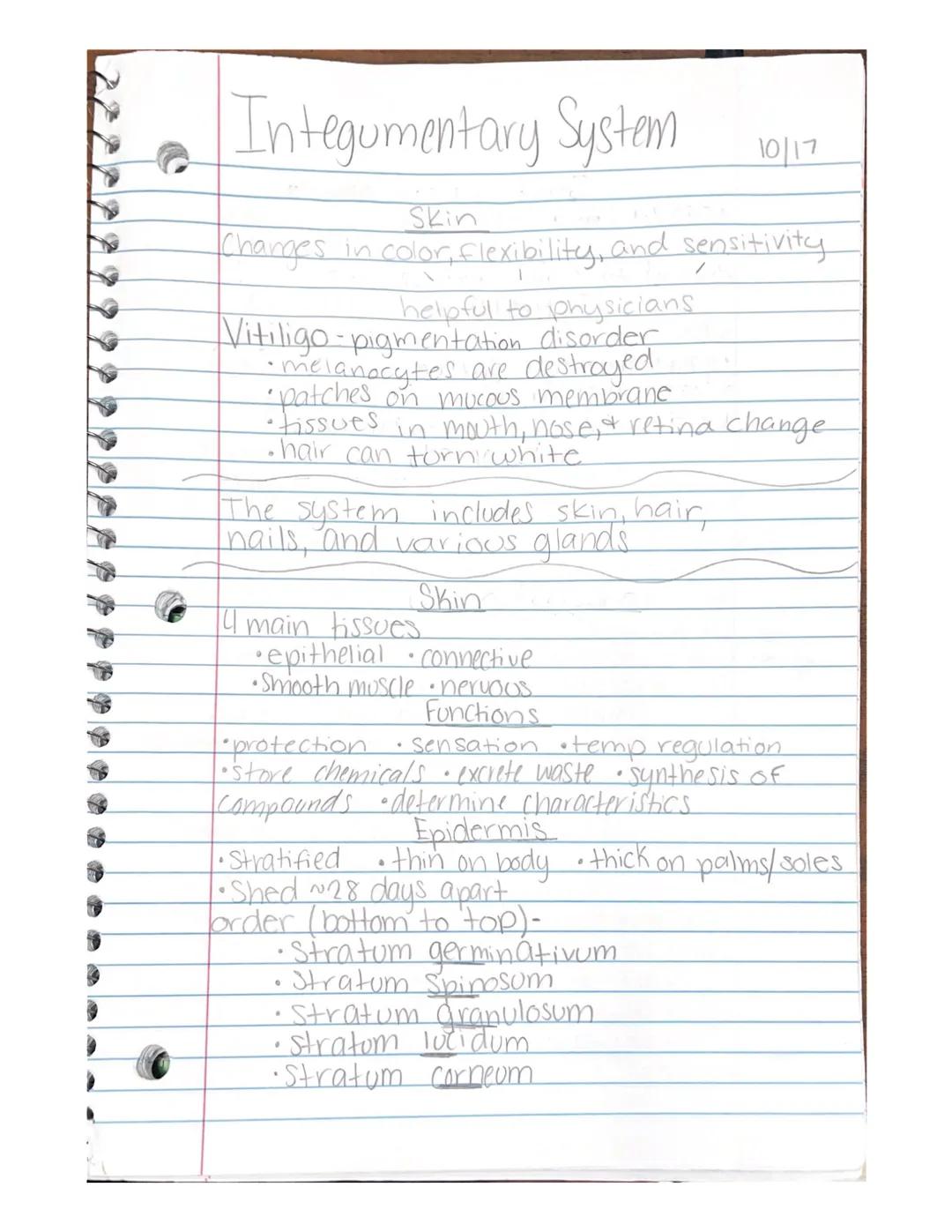
Integumentary System Overview
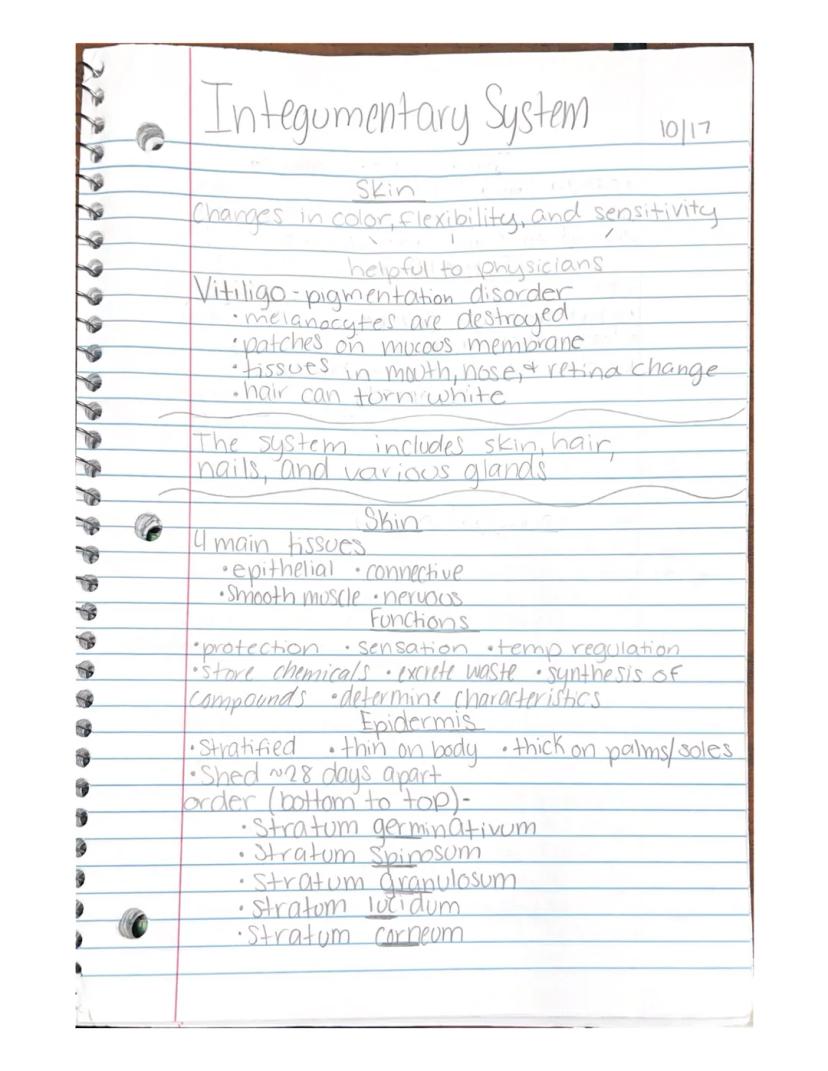
Your skin is more complex than it appears! It contains four main tissues (epithelial, connective, smooth muscle, and nervous) working together to protect you, help you feel sensations, regulate body temperature, and even synthesize important compounds.
The epidermis, your skin's outer layer, is constantly renewing itself in a 28-day cycle. It's thicker on your palms and soles where you need extra protection. This layer is organized from bottom to top as: Stratum Germinativum, Stratum Spinosum, Stratum Granulosum, Stratum Lucidum, and finally Stratum Corneum.
Vitiligo is a pigmentation disorder where melanocytes are destroyed, creating distinctive light patches on the skin and mucous membranes. You might even notice affected hair turning white as pigment disappears.
Fun Fact: Every month, you essentially get a completely new outer layer of skin as old cells are shed and replaced by new ones from below!
2
of 3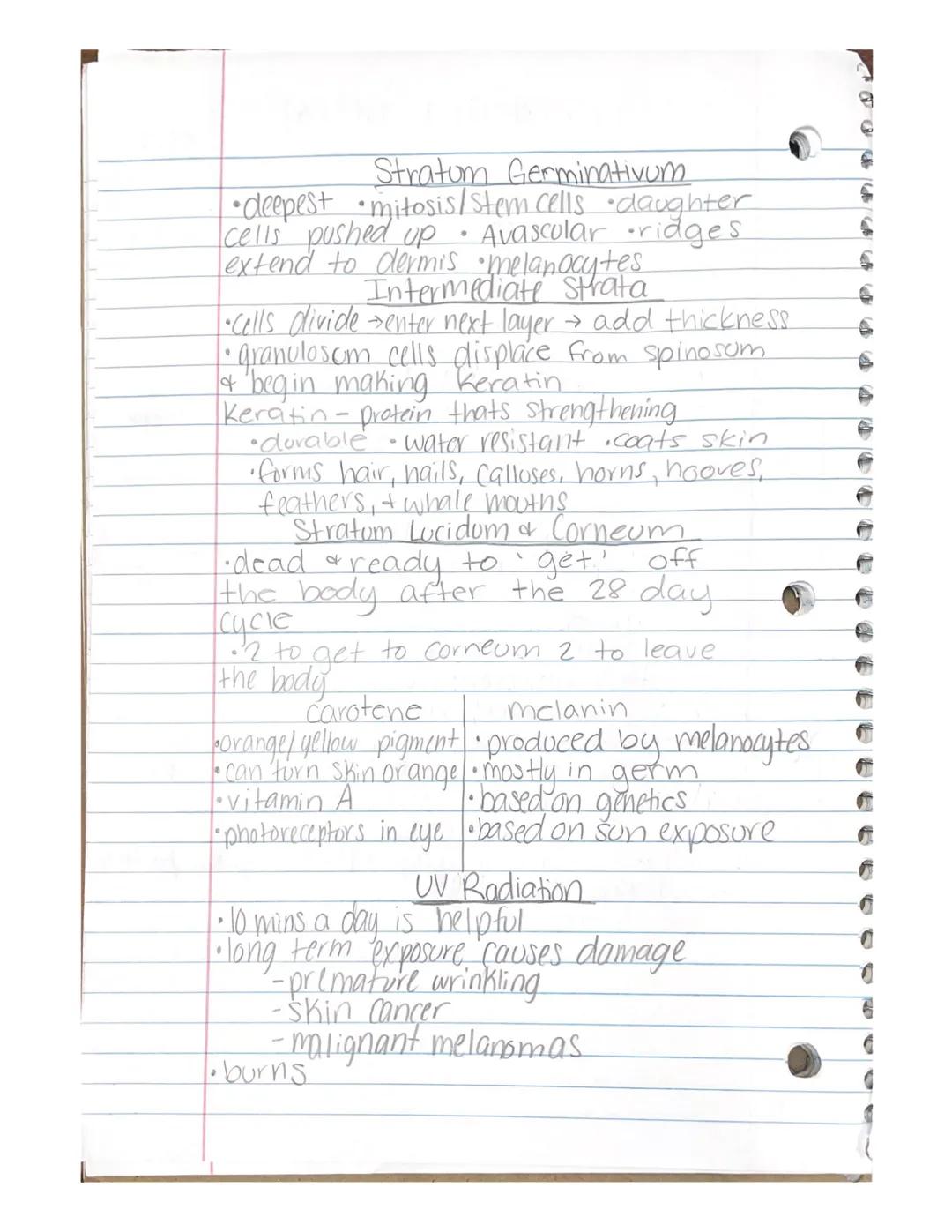
Skin Layers and Protection
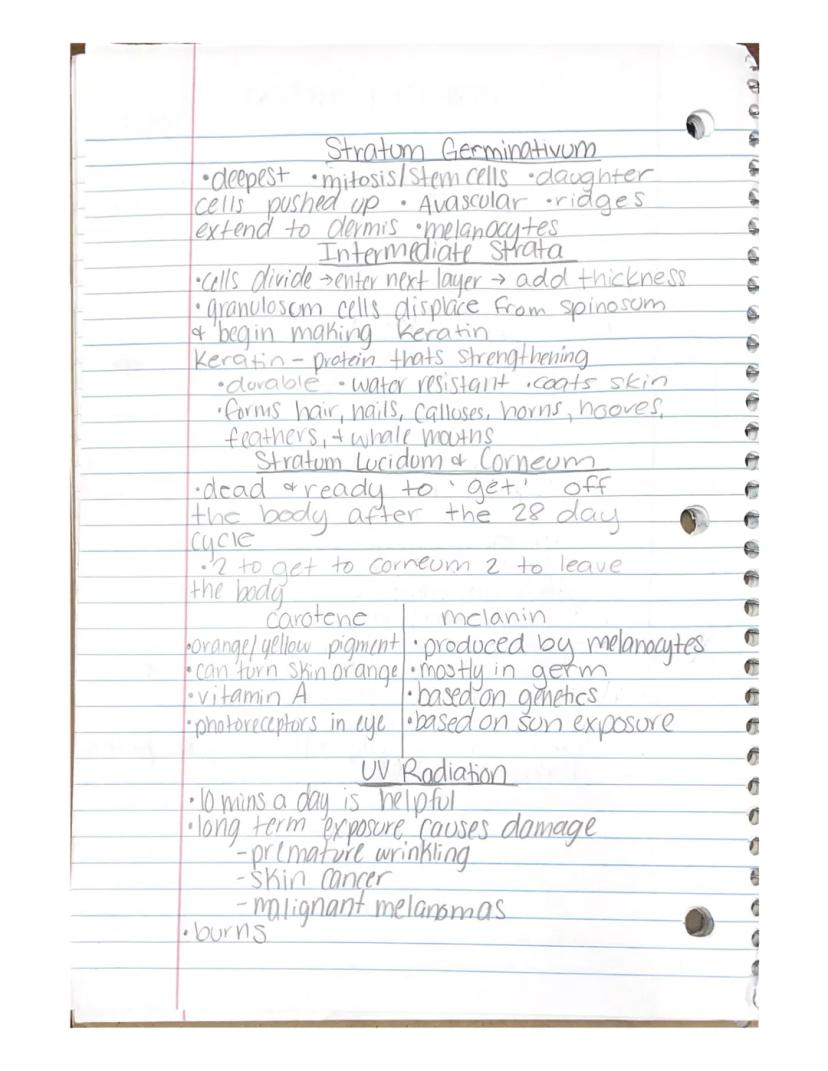
The Stratum Germinativum is your skin's powerhouse - it's the deepest layer where stem cells actively divide. These new cells gradually push upward through the layers. Interestingly, this layer contains melanocytes that produce the pigment giving your skin its color.
As cells move up through the intermediate strata, they begin producing keratin - an incredibly strong protein that makes your skin water-resistant and durable. Keratin doesn't just protect your skin; it's the same protein that forms your hair, nails, calluses, and even animal features like horns and hooves!
By the time cells reach the Stratum Lucidum and Corneum, they're actually dead and ready to be shed. While some sun exposure (about 10 minutes daily) is beneficial, prolonged UV radiation can lead to premature wrinkles and various forms of skin cancer.
Remember: Your skin color comes from two main pigments - melanin (produced by melanocytes and influenced by genetics and sun exposure) and carotene .
3
of 3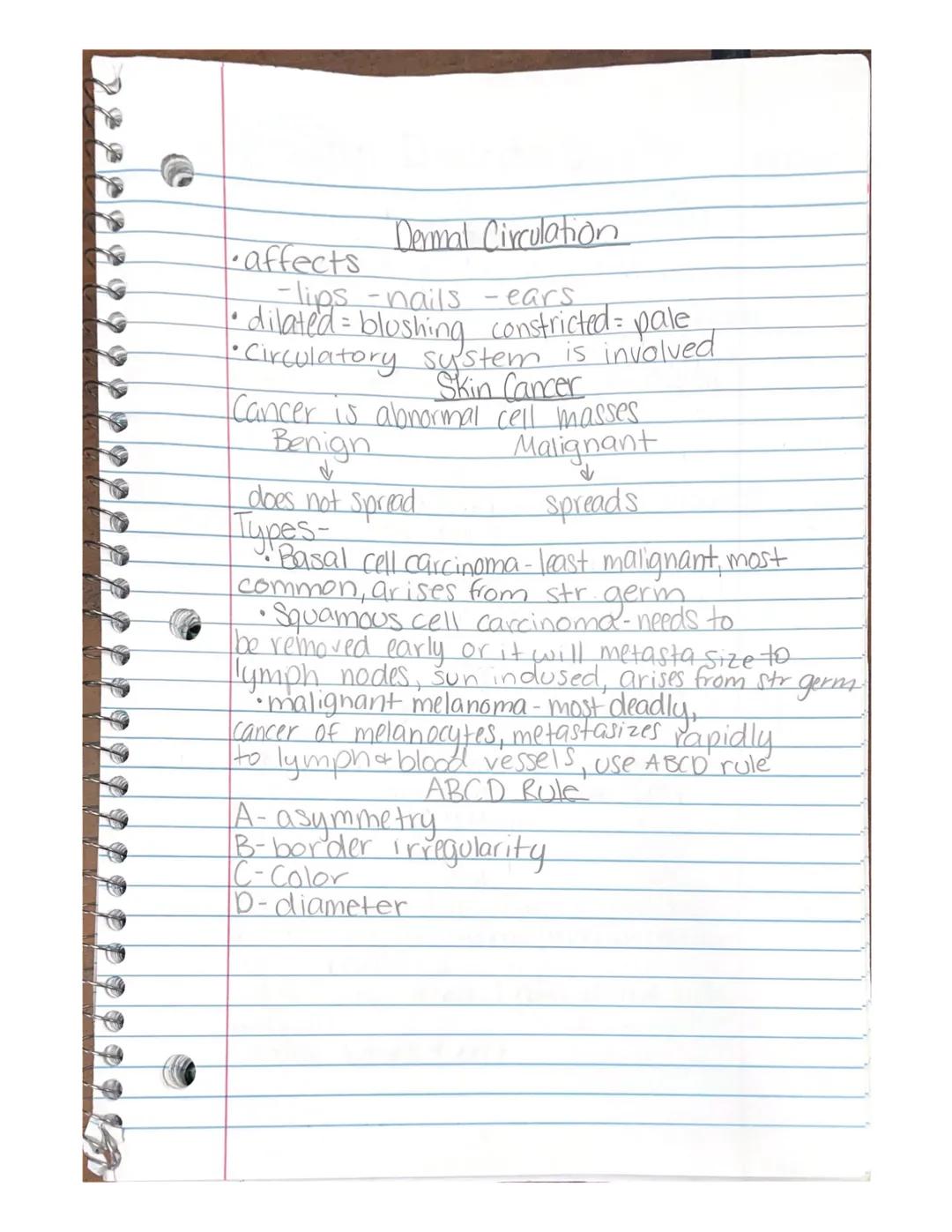
Circulation and Skin Cancer
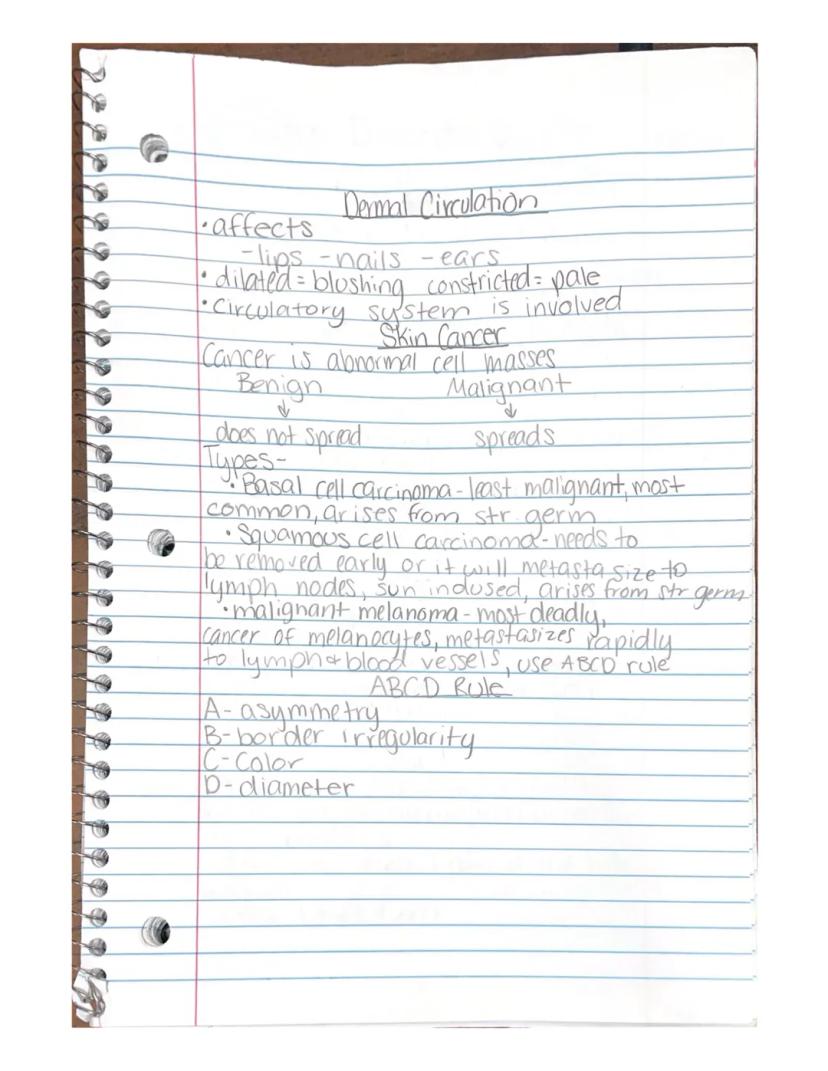
Your skin's appearance can change rapidly through dermal circulation - when blood vessels dilate, you blush, and when they constrict, you look pale. This is particularly visible in areas like your lips, nails, and ears.
Skin cancer develops when skin cells grow abnormally. There are two main categories: benign tumors (which don't spread) and malignant cancers (which can spread throughout the body). The three primary types of skin cancer include basal cell carcinoma (most common but least dangerous), squamous cell carcinoma (needs early removal), and malignant melanoma (the most deadly form).
For melanoma detection, remember the ABCD rule: check for Asymmetry, Border irregularity, Color variations, and Diameter larger than a pencil eraser. This simple check could literally save your life!
Important: Early detection of skin cancer dramatically improves treatment success rates, so regularly examine your skin for changes and protect yourself from excessive UV exposure.
We thought you’d never ask...
What is the Knowunity AI companion?
Our AI companion is specifically built for the needs of students. Based on the millions of content pieces we have on the platform we can provide truly meaningful and relevant answers to students. But its not only about answers, the companion is even more about guiding students through their daily learning challenges, with personalised study plans, quizzes or content pieces in the chat and 100% personalisation based on the students skills and developments.
Where can I download the Knowunity app?
You can download the app in the Google Play Store and in the Apple App Store.
Is Knowunity really free of charge?
That's right! Enjoy free access to study content, connect with fellow students, and get instant help – all at your fingertips.
Similar Content
Most popular content: Integumentary System
5 Biology
Integumentary System
This article provides an overview of the different layers of the skin and their functions, including protection, temperature regulation, and sensory reception.
College572
BiologyThe Integumentary System
Notes on the integumentary system (includes the skin, sweat glands, oil glands, hair, nails) for anatomy and physiology classes.
10th1057
AP BiologyBody Systems Notes for AP Bio
Notes of the Human Organ Systems with diagrams, functions, main organs, and explanations. Includes 10 human organ systems
50521
Health & MedicineIntegumentary Organs Functions
Description of the structure and function of the organs in the integumentary system
9th1573
BiologyANATOMY Unit 2: Integumentary System(Skin)
CONTAINS: skin layers (epidermis, dermis, hypodermis) with in depth descriptions, melanin, melanocytes, keratin. ADDITIONAL: diseases, harmful factors, effects of tattoos, accessory organs of the skin & diagram
10th25446
Most popular content in Health & Medicine
9M
Health & MedicineMedical Terminology Quiz
key concepts in med terminology
11th2030
Health & MedicineMark Klimek Nclex Review
Comphrensive Nclex Review
College781
 Fun Stuff
Anatomy and Physiology Chapter 1
Chpater 1 : The orientation of the body / College Level Anatomy and Physiology
84538
Health & MedicineHow to give CPR
How to give CPR
956
Health & MedicinePharmacology - Descriptions and Terms
Medical Terminology - Learn about descriptions of things related to pharmacology and additional terms about medications.
College1087
Health & MedicineCOVID-19 Informational Slideshow
COVID-19 slideshow about the disease.
1012
Health & MedicineMale Reproductive System
Health PDF
9th441
Health & MedicineMental & Emotional Problems Anxiety & Depression
PDF Health
9th692
Health & MedicineNHA module 1 study guide
Nia module I study guide
11th1532
Most popular content
9O
 AP US History
Origins and Dynamics of the Columbian Exchange
Analyze the ecological and economic motivations behind the initial transfer of goods, people, and diseases between the Old and New Worlds.
9th3,1280
I
AP US HistoryIntroduction to Early Cultural Interactions
Analyze the initial social and religious encounters between Europeans, Africans, and Indigenous peoples in the colonial Americas.
9th2,7730
O
 AP World History
Origins of Ancient River Civilizations
Analyze the environmental factors and technological innovations that led to the rise of early states in Mesopotamia, Egypt, and the Indus Valley.
9th3,1870
M
AP US HistoryMotivations for European Exploration
Analyze the economic, religious, and political factors that drove European powers to the Americas during the 15th and 16th centuries.
9th1,7780
F
 AP Psychology
Foundations of Ethical Guidelines in Research
Practice the core principles of the APA ethical code including informed consent, debriefing, and the role of Institutional Review Boards.
9th1,3360
I
AP US HistoryIntroduction to Native American Societies
Examine the diverse social, political, and economic structures of North American indigenous groups prior to European contact.
9th1,1100
I
AP BiologyIntroduction to Biological Elements of Life
Practice identifying the essential elements including carbon, nitrogen, phosphorus, and sulfur that compose biological macromolecules.
9th1,7390
I
AP US HistoryIntroduction to the Spanish Encomienda System
Explore the fundamental economic and social structures of the Spanish colonial system, focusing on the encomienda and the casta social hierarchy.
9th8890
O
AP World HistoryOrigins and Continuity of the Byzantine Empire
Analyze the political and cultural transitions from the Roman Empire to the Byzantine Empire, focusing on the reign of Justinian I and his code.
9th1,6320
Can't find what you're looking for? Explore other subjects.
Students love us — and so will you.
4.6/5App Store
4.7/5Google Play
The app is very easy to use and well designed. I have found everything I was looking for so far and have been able to learn a lot from the presentations! I will definitely use the app for a class assignment! And of course it also helps a lot as an inspiration.
Stefan SiOS user
This app is really great. There are so many study notes and help [...]. My problem subject is French, for example, and the app has so many options for help. Thanks to this app, I have improved my French. I would recommend it to anyone.
Samantha KlichAndroid user
Wow, I am really amazed. I just tried the app because I've seen it advertised many times and was absolutely stunned. This app is THE HELP you want for school and above all, it offers so many things, such as workouts and fact sheets, which have been VERY helpful to me personally.
AnnaiOS user
Health & Medicine108 views·Updated Jun 17, 2026·3 pagesComprehensive Notes on Anatomy & Physiology
The integumentary system is your body's protective outer layer, including skin, hair, nails, and various glands. This remarkable system not only shields your body but also helps regulate temperature, store chemicals, and even excrete waste. Understanding how this system works...
1
of 3
Sign up to see the content. It's free!
- Access to all documents
- Improve your grades
- Join milions of students
Integumentary System Overview
Your skin is more complex than it appears! It contains four main tissues (epithelial, connective, smooth muscle, and nervous) working together to protect you, help you feel sensations, regulate body temperature, and even synthesize important compounds.
The epidermis, your skin's outer layer, is constantly renewing itself in a 28-day cycle. It's thicker on your palms and soles where you need extra protection. This layer is organized from bottom to top as: Stratum Germinativum, Stratum Spinosum, Stratum Granulosum, Stratum Lucidum, and finally Stratum Corneum.
Vitiligo is a pigmentation disorder where melanocytes are destroyed, creating distinctive light patches on the skin and mucous membranes. You might even notice affected hair turning white as pigment disappears.
Fun Fact: Every month, you essentially get a completely new outer layer of skin as old cells are shed and replaced by new ones from below!
2
of 3Sign up to see the content. It's free!
- Access to all documents
- Improve your grades
- Join milions of students
Skin Layers and Protection
The Stratum Germinativum is your skin's powerhouse - it's the deepest layer where stem cells actively divide. These new cells gradually push upward through the layers. Interestingly, this layer contains melanocytes that produce the pigment giving your skin its color.
As cells move up through the intermediate strata, they begin producing keratin - an incredibly strong protein that makes your skin water-resistant and durable. Keratin doesn't just protect your skin; it's the same protein that forms your hair, nails, calluses, and even animal features like horns and hooves!
By the time cells reach the Stratum Lucidum and Corneum, they're actually dead and ready to be shed. While some sun exposure (about 10 minutes daily) is beneficial, prolonged UV radiation can lead to premature wrinkles and various forms of skin cancer.
Remember: Your skin color comes from two main pigments - melanin (produced by melanocytes and influenced by genetics and sun exposure) and carotene .
3
of 3Sign up to see the content. It's free!
- Access to all documents
- Improve your grades
- Join milions of students
Circulation and Skin Cancer
Your skin's appearance can change rapidly through dermal circulation - when blood vessels dilate, you blush, and when they constrict, you look pale. This is particularly visible in areas like your lips, nails, and ears.
Skin cancer develops when skin cells grow abnormally. There are two main categories: benign tumors (which don't spread) and malignant cancers (which can spread throughout the body). The three primary types of skin cancer include basal cell carcinoma (most common but least dangerous), squamous cell carcinoma (needs early removal), and malignant melanoma (the most deadly form).
For melanoma detection, remember the ABCD rule: check for Asymmetry, Border irregularity, Color variations, and Diameter larger than a pencil eraser. This simple check could literally save your life!
Important: Early detection of skin cancer dramatically improves treatment success rates, so regularly examine your skin for changes and protect yourself from excessive UV exposure.
We thought you’d never ask...
What is the Knowunity AI companion?
Our AI companion is specifically built for the needs of students. Based on the millions of content pieces we have on the platform we can provide truly meaningful and relevant answers to students. But its not only about answers, the companion is even more about guiding students through their daily learning challenges, with personalised study plans, quizzes or content pieces in the chat and 100% personalisation based on the students skills and developments.
Where can I download the Knowunity app?
You can download the app in the Google Play Store and in the Apple App Store.
Is Knowunity really free of charge?
That's right! Enjoy free access to study content, connect with fellow students, and get instant help – all at your fingertips.
Similar Content
Most popular content: Integumentary System
5BiologyIntegumentary System
This article provides an overview of the different layers of the skin and their functions, including protection, temperature regulation, and sensory reception.
College572
BiologyThe Integumentary System
Notes on the integumentary system (includes the skin, sweat glands, oil glands, hair, nails) for anatomy and physiology classes.
10th1057
AP BiologyBody Systems Notes for AP Bio
Notes of the Human Organ Systems with diagrams, functions, main organs, and explanations. Includes 10 human organ systems
50521
Health & MedicineIntegumentary Organs Functions
Description of the structure and function of the organs in the integumentary system
9th1573
BiologyANATOMY Unit 2: Integumentary System(Skin)
CONTAINS: skin layers (epidermis, dermis, hypodermis) with in depth descriptions, melanin, melanocytes, keratin. ADDITIONAL: diseases, harmful factors, effects of tattoos, accessory organs of the skin & diagram
10th25446
Most popular content in Health & Medicine
9M
Health & MedicineMedical Terminology Quiz
key concepts in med terminology
11th2030
Health & MedicineMark Klimek Nclex Review
Comphrensive Nclex Review
College781
Fun StuffAnatomy and Physiology Chapter 1
Chpater 1 : The orientation of the body / College Level Anatomy and Physiology
84538
Health & MedicineHow to give CPR
How to give CPR
956
Health & MedicinePharmacology - Descriptions and Terms
Medical Terminology - Learn about descriptions of things related to pharmacology and additional terms about medications.
College1087
Health & MedicineCOVID-19 Informational Slideshow
COVID-19 slideshow about the disease.
1012
Health & MedicineMale Reproductive System
Health PDF
9th441
Health & MedicineMental & Emotional Problems Anxiety & Depression
PDF Health
9th692
Health & MedicineNHA module 1 study guide
Nia module I study guide
11th1532
Most popular content
9O
AP US HistoryOrigins and Dynamics of the Columbian Exchange
Analyze the ecological and economic motivations behind the initial transfer of goods, people, and diseases between the Old and New Worlds.
9th3,1280
I
AP US HistoryIntroduction to Early Cultural Interactions
Analyze the initial social and religious encounters between Europeans, Africans, and Indigenous peoples in the colonial Americas.
9th2,7730
O
AP World HistoryOrigins of Ancient River Civilizations
Analyze the environmental factors and technological innovations that led to the rise of early states in Mesopotamia, Egypt, and the Indus Valley.
9th3,1870
M
AP US HistoryMotivations for European Exploration
Analyze the economic, religious, and political factors that drove European powers to the Americas during the 15th and 16th centuries.
9th1,7780
F
AP PsychologyFoundations of Ethical Guidelines in Research
Practice the core principles of the APA ethical code including informed consent, debriefing, and the role of Institutional Review Boards.
9th1,3360
I
AP US HistoryIntroduction to Native American Societies
Examine the diverse social, political, and economic structures of North American indigenous groups prior to European contact.
9th1,1100
I
AP BiologyIntroduction to Biological Elements of Life
Practice identifying the essential elements including carbon, nitrogen, phosphorus, and sulfur that compose biological macromolecules.
9th1,7390
I
AP US HistoryIntroduction to the Spanish Encomienda System
Explore the fundamental economic and social structures of the Spanish colonial system, focusing on the encomienda and the casta social hierarchy.
9th8890
O
AP World HistoryOrigins and Continuity of the Byzantine Empire
Analyze the political and cultural transitions from the Roman Empire to the Byzantine Empire, focusing on the reign of Justinian I and his code.
9th1,6320
Can't find what you're looking for? Explore other subjects.
Students love us — and so will you.
4.6/5App Store
4.7/5Google Play
The app is very easy to use and well designed. I have found everything I was looking for so far and have been able to learn a lot from the presentations! I will definitely use the app for a class assignment! And of course it also helps a lot as an inspiration.
Stefan SiOS user
This app is really great. There are so many study notes and help [...]. My problem subject is French, for example, and the app has so many options for help. Thanks to this app, I have improved my French. I would recommend it to anyone.
Samantha KlichAndroid user
Wow, I am really amazed. I just tried the app because I've seen it advertised many times and was absolutely stunned. This app is THE HELP you want for school and above all, it offers so many things, such as workouts and fact sheets, which have been VERY helpful to me personally.
AnnaiOS user