
The human musculoskeletal system is a complex network of bones,...
 Biologia28,211 views·Updated Jun 23, 2026·7 pages
Cześć! Odkryj Funkcje i Budowę Mięśni Szkieletowych oraz Układu Kostnego

Natsese@natsese


1 / 7
1
of 7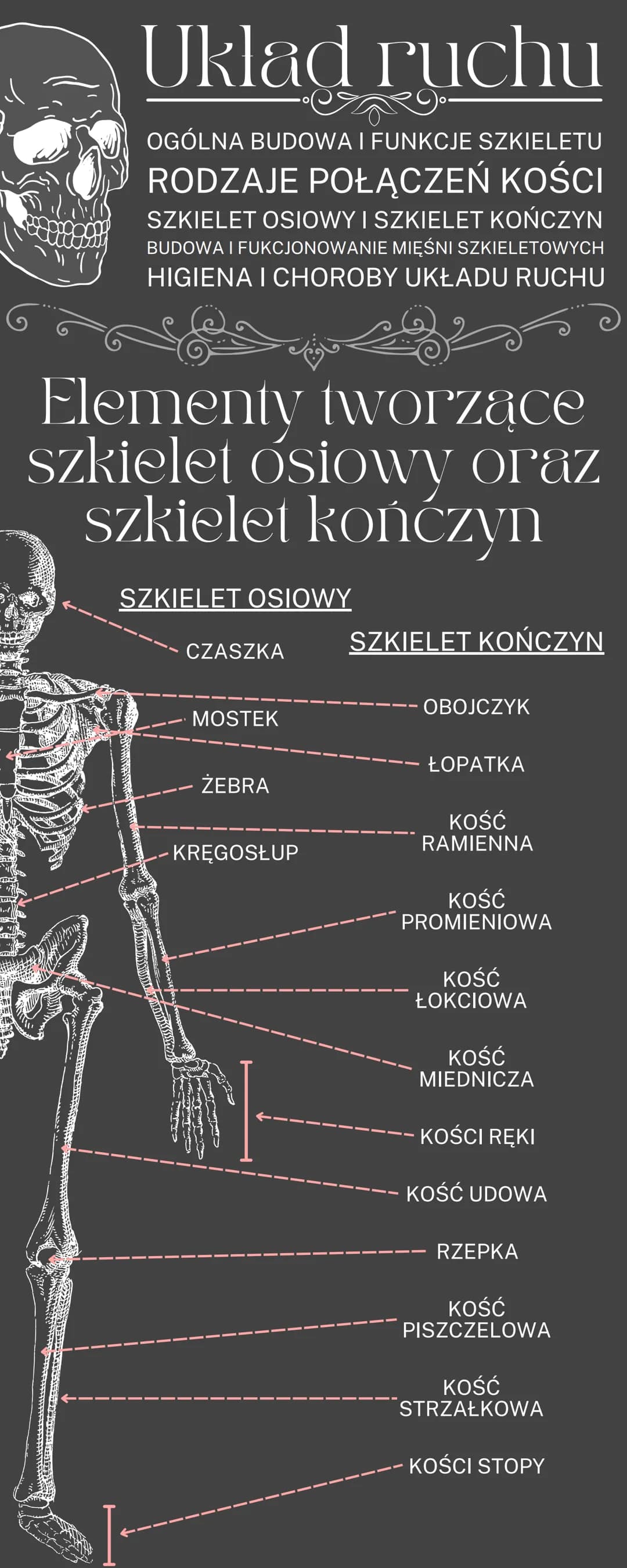
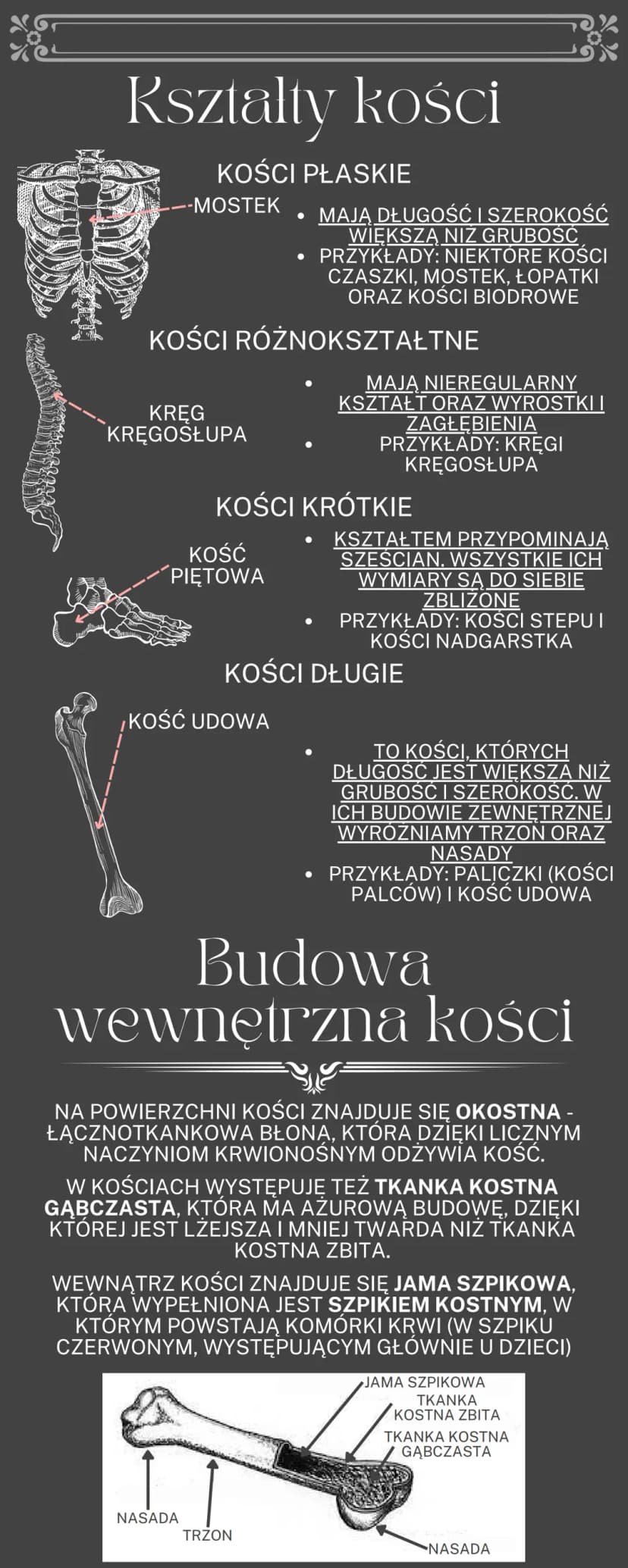
Bone Shapes and Structure
The rodzaje kości (types of bones) in the human body come in various shapes, each suited to its specific function. This section explores the different bone shapes and their internal structure.
Bone shapes are categorized into four main types:
-
Flat bones: These have greater length and width than thickness. Examples include some skull bones, the sternum, scapulae, and hip bones.
-
Irregular bones: These have complex shapes with projections and depressions. Vertebrae are prime examples.
-
Short bones: These are roughly cube-shaped with similar dimensions. Examples include the bones of the wrist and ankle.
-
Long bones: These are longer than they are wide or thick. They have a shaft (diaphysis) and two ends (epiphyses). Examples include finger bones and the femur.
Example: The femur, or thigh bone, is a classic example of a long bone, with a long shaft and expanded ends for joint articulation.
The internal budowa kości człowieka (structure of human bones) is complex:
- The outer surface is covered by the periosteum, a connective tissue membrane rich in blood vessels that nourish the bone.
- Bones contain both compact (dense) and spongy (trabecular) bone tissue.
- The center of long bones contains the medullary cavity filled with bone marrow.
Vocabulary: Bone marrow can be red (hematopoietic) or yellow (fatty). Red bone marrow is primarily found in children and is responsible for blood cell production.
Understanding the various bone shapes and their internal structure is crucial for comprehending how the skeletal system functions as a whole.
2
of 7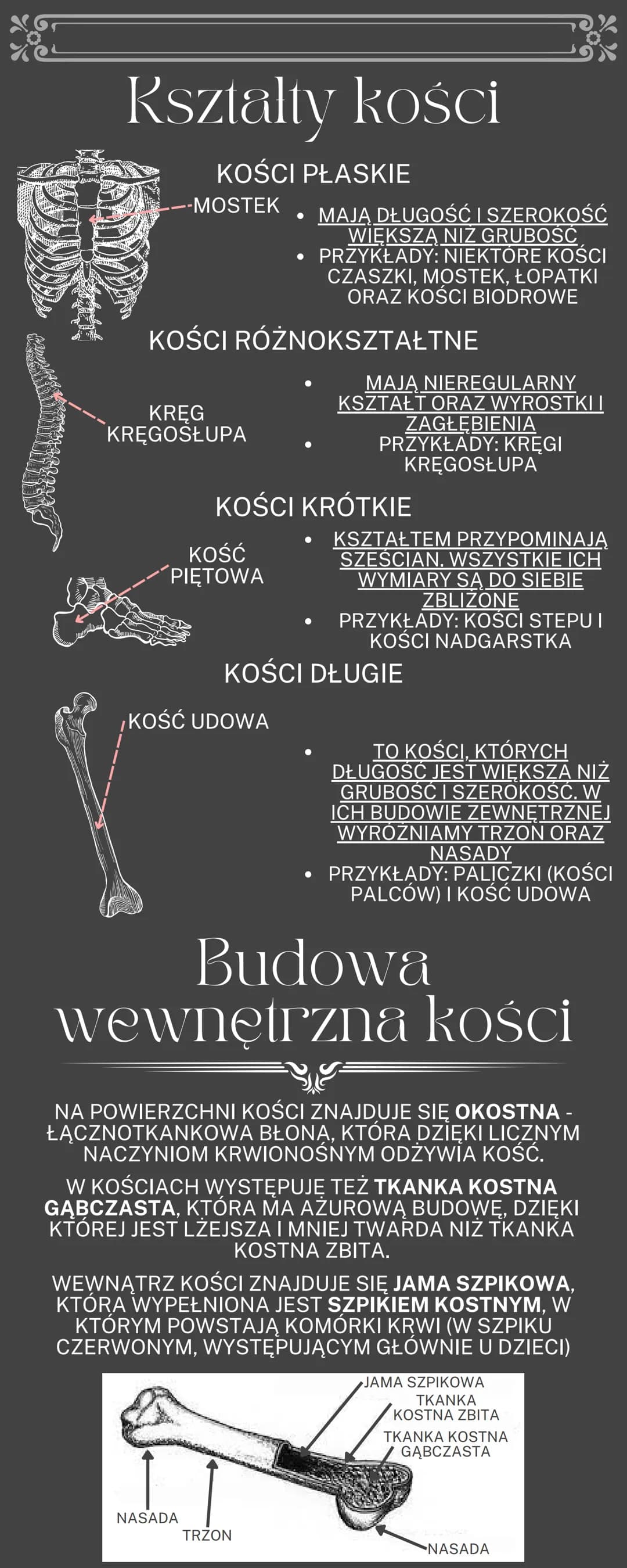
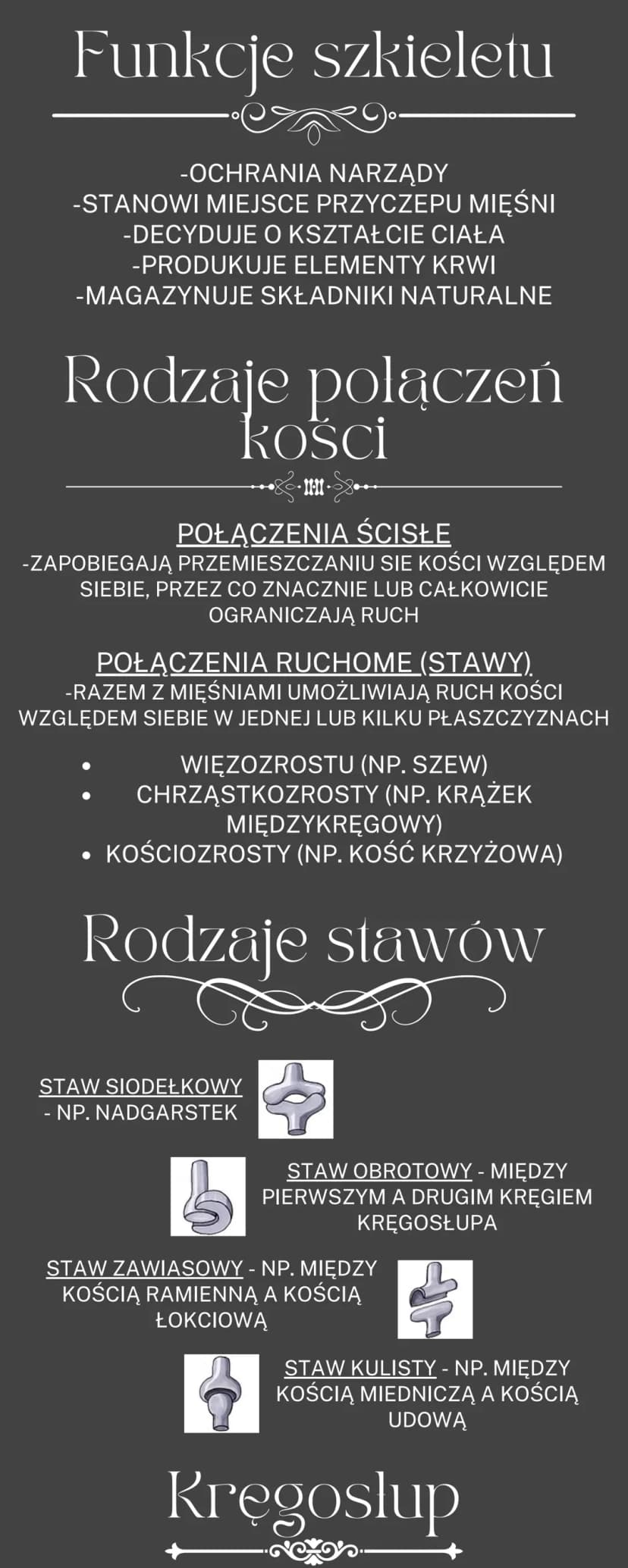
Functions of the Skeleton and Types of Joints
The funkcje szkieletu (functions of the skeleton) are diverse and essential for overall body function. This section outlines the key roles of the skeletal system and introduces the various types of joints that enable movement.
Funkcje szkieletu include:
- Protecting internal organs
- Providing attachment sites for muscles
- Determining body shape
- Producing blood cells
- Storing essential minerals
Highlight: The skeleton not only provides structural support but also plays a crucial role in hematopoiesis (blood cell production) and mineral homeostasis.
Rodzaje połączeń kości i przykłady (Types of bone connections and examples) can be broadly categorized into two main groups:
-
Nieruchome połączenia kości (Immovable joints):
- These prevent bone movement relative to each other, significantly or completely limiting motion.
- Examples include sutures (in the skull), synchondroses (like intervertebral discs), and synostoses (like the sacrum).
-
Połączenia ruchome kości (Movable joints or synovial joints):
- These work with muscles to allow bone movement relative to each other in one or more planes.
- Examples include:
- Saddle joint (e.g., in the wrist)
- Hinge joint (e.g., between the humerus and ulna)
- Pivot joint (e.g., between the first and second cervical vertebrae)
- Ball-and-socket joint (e.g., between the hip bone and femur)
Definition: Synovial joints are characterized by a joint cavity filled with synovial fluid, which reduces friction and provides nutrients to the articular cartilage.
Understanding these functions and joint types is crucial for comprehending how the szkielet człowieka z narządami (human skeleton with organs) works as an integrated system to support life and enable movement.
3
of 7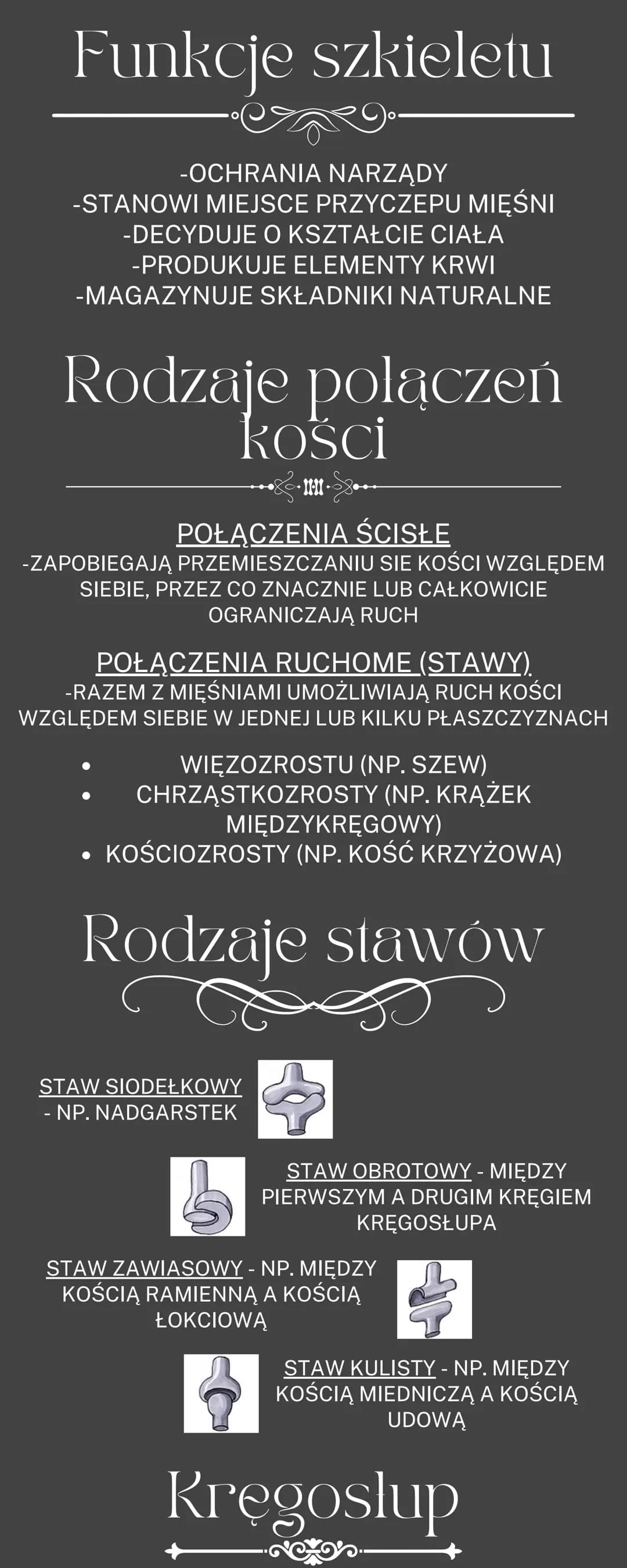
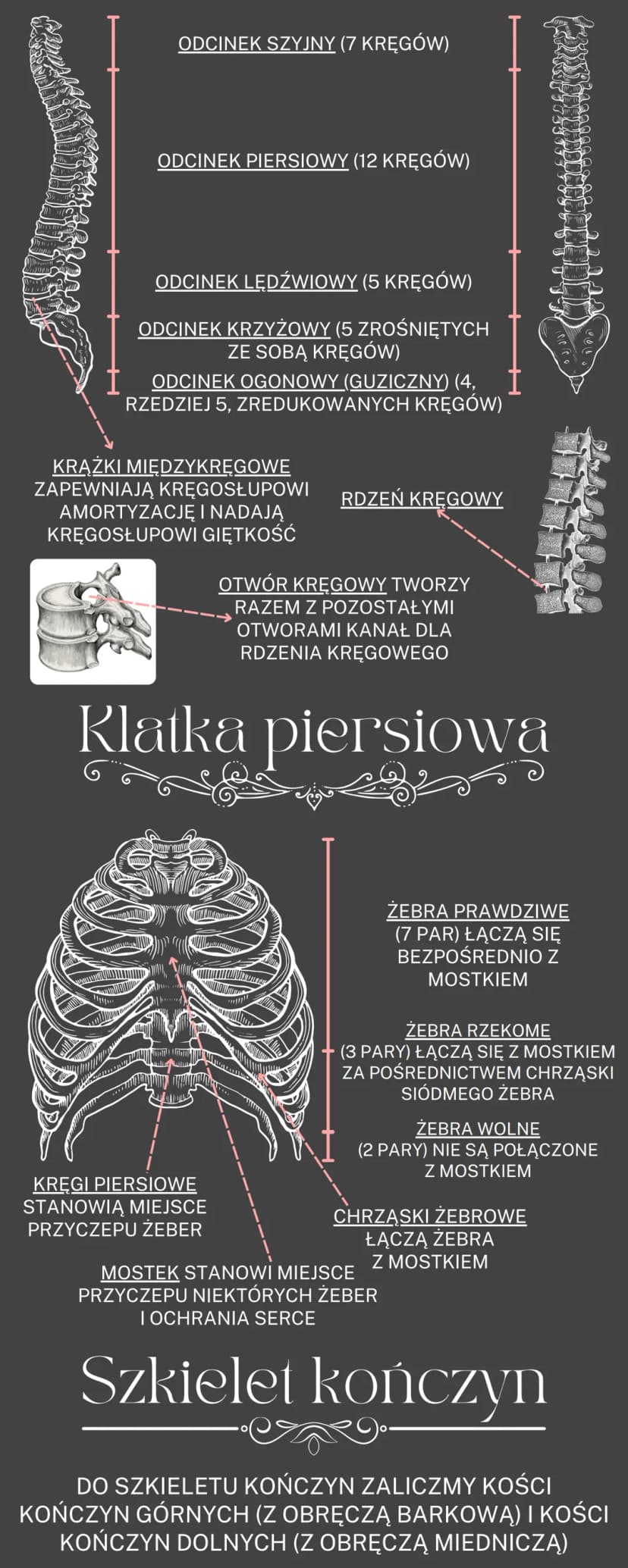
The Spine and Ribcage
The spine and ribcage are crucial components of the axial skeleton, providing support, protection, and flexibility to the human body. This section details the structure of the vertebral column and the thoracic cage.
The szkielet człowieka opis (description of the human skeleton) includes a detailed look at the spine, which consists of:
- Cervical region (7 vertebrae)
- Thoracic region (12 vertebrae)
- Lumbar region (5 vertebrae)
- Sacral region (5 fused vertebrae)
- Coccygeal region
Highlight: Intervertebral discs between the vertebrae provide shock absorption and flexibility to the spine.
Key features of the vertebrae include:
- The vertebral foramen, which forms a canal for the spinal cord
- Thoracic vertebrae, which provide attachment points for ribs
The ribcage, or thoracic cage, is composed of:
- True ribs (7 pairs) directly connected to the sternum
- False ribs (3 pairs) indirectly connected to the sternum via cartilage
- Floating ribs (2 pairs) not connected to the sternum
- The sternum, which provides attachment for some ribs and protects the heart
Vocabulary: Costal cartilages connect the ribs to the sternum, providing flexibility to the ribcage.
The appendicular skeleton, including the limbs and their girdles, connects to the axial skeleton. This includes:
- Upper limbs with the pectoral girdle (shoulder girdle)
- Lower limbs with the pelvic girdle
Understanding the structure and function of the spine and ribcage is essential for comprehending how the szkielet człowieka z narządami opis (description of the human skeleton with organs) provides protection and support for vital internal structures.
4
of 7
Appendicular Skeleton and Skull Structure
This section focuses on the detailed structure of the appendicular skeleton, which includes the limbs and their connecting girdles, as well as the complex composition of the human skull.
The appendicular skeleton consists of:
Upper limb bones:
- Humerus
- Radius
- Ulna
- Carpal bones (wrist)
- Metacarpal bones
- Phalanges (finger bones)
Lower limb bones:
- Femur
- Tibia
- Fibula
- Tarsal bones (ankle)
- Metatarsal bones
- Phalanges (toe bones)
Highlight: The upper limbs also include the clavicles and scapulae, which form the pectoral girdle, while the lower limbs include the pelvic bones that form the pelvic girdle.
The human skull is a complex structure composed of several bones, including:
- Frontal bone
- Parietal bones
- Temporal bones
- Occipital bone
- Sphenoid bone
- Maxilla (upper jaw)
- Mandible (lower jaw)
- Zygomatic bones (cheekbones)
- Nasal bones
Vocabulary: The sutures are the immovable joints between the skull bones, allowing for slight movement in infants but fusing as the individual ages.
Understanding the detailed budowa szkieletu (structure of the skeleton) of the appendicular system and skull is crucial for comprehending how these components work together to support movement and protect vital organs.
5
of 7
Skeletal Muscles and Their Structure
This section delves into the structure and function of skeletal muscles, which work in conjunction with the skeletal system to enable movement. Understanding skeletal muscles is crucial to comprehending co tworzy układ ruchu (what constitutes the musculoskeletal system).
Key skeletal muscles highlighted include:
- Quadriceps femoris
- Trapezius muscle
- Pectoralis major
- Biceps brachii
- Gluteus maximus
- Rectus abdominis
The structure of a skeletal muscle includes:
- Muscle belly - the main contractile part
- Tendons - connective tissue attaching muscle to bone
- Muscle fibers - long, cylindrical cells that make up the muscle
- Myofibrils - contractile units within muscle fibers
Definition: A myofibril is composed of protein filaments, primarily actin and myosin, which are responsible for muscle contraction.
The sarcomere is the basic functional (contractile) unit of skeletal muscle. Sarcomeres repeat regularly along the entire length of the myofibril.
Highlight: Muscle contraction occurs when actin filaments slide between myosin filaments, shortening the sarcomere in response to a nerve impulse.
Most muscles work in pairs because muscles can only pull, not push. This allows for movement in both directions at a joint.
Understanding the structure and function of skeletal muscles is essential for comprehending higiena i choroby układu ruchu (hygiene and diseases of the musculoskeletal system), as proper muscle function is crucial for overall health and mobility.
6
of 7
Muscle Contraction Mechanism
The final page explains how muscles contract and function.
Definition: The sarcomere is the basic functional unit of skeletal muscle, containing actin and myosin filaments.
Highlight: Funkcje mięśni szkieletowych are achieved through coordinated contraction and relaxation of muscle pairs.
Example: The biceps and triceps work as antagonistic pairs to control arm movement.
7
of 7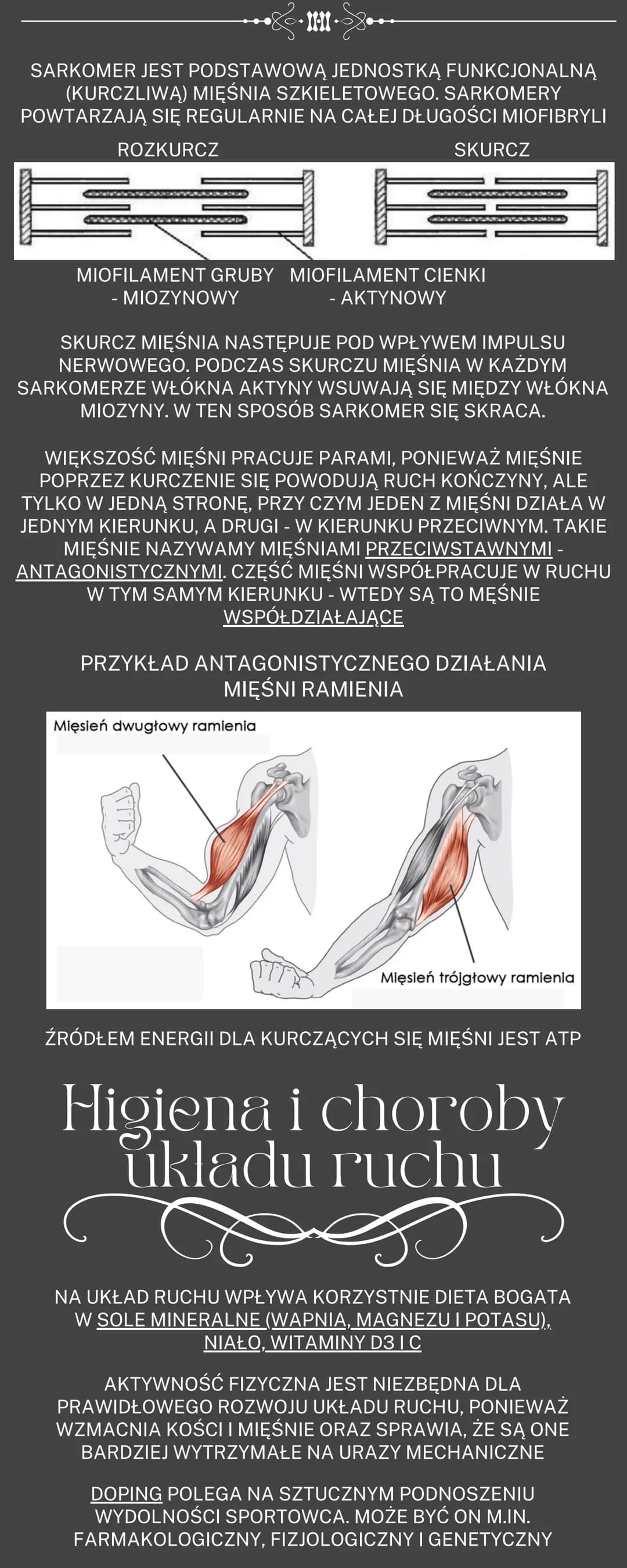
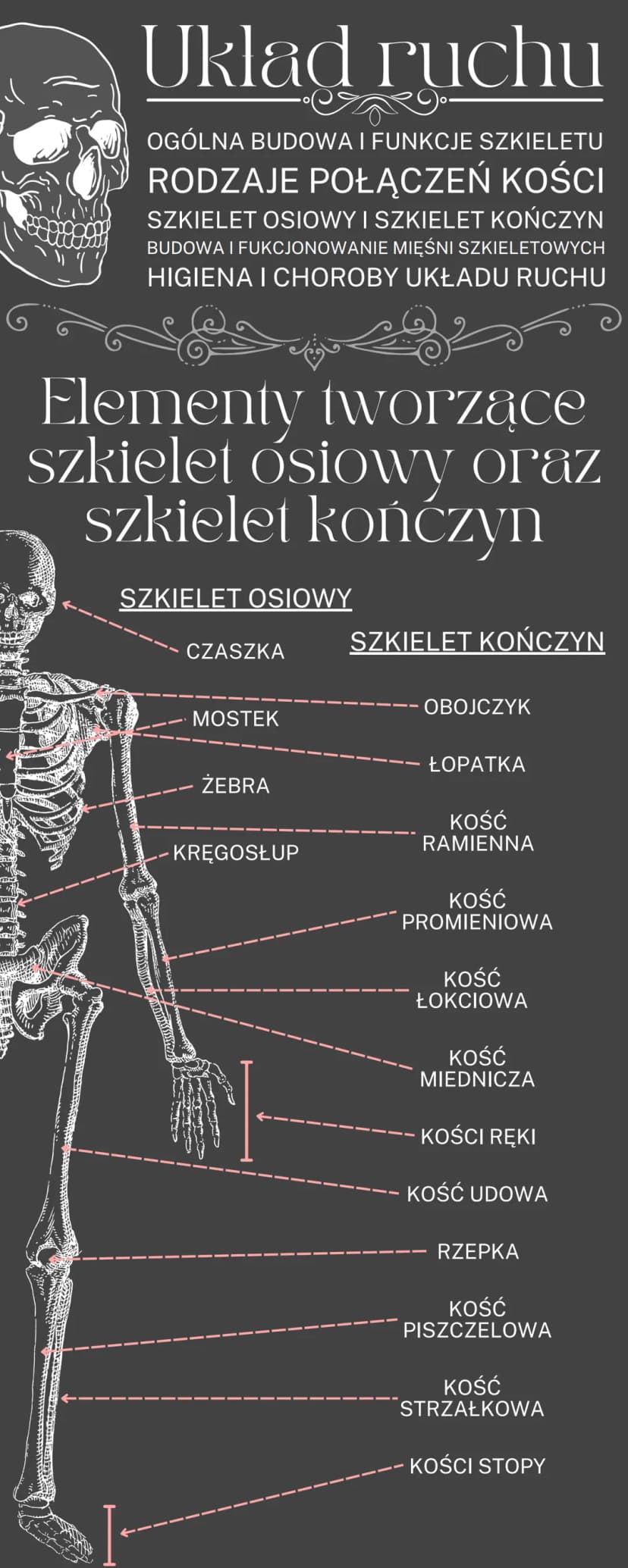
Overview of the Skeletal System
The budowa szkieletu (skeletal structure) forms the framework of the human body and serves several critical functions. This section provides an introduction to the major components and roles of the skeletal system.
The skeletal system is composed of two main divisions:
- The axial skeleton, which includes the skull, spine, ribs, and sternum
- The appendicular skeleton, consisting of the limbs and their connecting girdles
Key elements of the axial skeleton are highlighted, including the skull, sternum, ribs, and vertebral column. For the appendicular skeleton, major bones like the clavicle, scapula, humerus, radius, ulna, pelvic bone, femur, tibia, and fibula are identified.
Highlight: The układ szkieletowy składa się ze szkieletu osiowego i szkieletu kończyn (skeletal system consists of the axial skeleton and appendicular skeleton), working together to provide structure and enable movement.
Definition: The axial skeleton forms the central axis of the body, while the appendicular skeleton includes the limbs and their attachments to the axial skeleton.
This overview provides a foundation for understanding the complex and interconnected nature of the human skeletal system.
We thought you’d never ask...
What is the Knowunity AI companion?
Our AI companion is specifically built for the needs of students. Based on the millions of content pieces we have on the platform we can provide truly meaningful and relevant answers to students. But its not only about answers, the companion is even more about guiding students through their daily learning challenges, with personalised study plans, quizzes or content pieces in the chat and 100% personalisation based on the students skills and developments.
Where can I download the Knowunity app?
You can download the app in the Google Play Store and in the Apple App Store.
Is Knowunity really free of charge?
That's right! Enjoy free access to study content, connect with fellow students, and get instant help – all at your fingertips.
Similar Content
 AP Biology
 Química
Most popular content: Skeletal System
9BiologiaAnatomia Układu Ruchu
Zrozumienie budowy i funkcji układu ruchu w organizmie człowieka. Materiał obejmuje szczegółowe informacje o mięśniach, kościach, stawach oraz ich współpracy. Idealne dla uczniów biologii w liceum. Typ: prezentacja.
211,334272
BiologiaAnatomia i fizjologia człowieka
Kompleksowy przegląd anatomii i fizjologii człowieka, obejmujący układ pokarmowy, krwionośny, nerwowy oraz hormonalny. Idealny materiał do powtórki przed maturą 2023/24. Zawiera kluczowe informacje o strukturze i funkcjach narządów, mechanizmach homeostazy oraz procesach metabolicznych. Doskonałe dla uczniów przygotowujących się do egzaminów.
46,170226
BiologiaAparat ruchu
Aparat ruchu, na podstawie podręcznika do klasy 7 i repetytorium, jezeli notatka Ci się spodoba zostaw serduszko❤️ jezeli są jakieś błędy proszę o poprawienie w komentarzu
72,68590
BiologiaAparat Ruchu Biologia
Podręcznik nowa era wszystko dokładnie opisane
71,32425
BiologiaAnatomia Układu Ruchu
Zrozumienie struktury i funkcji układu ruchu: szkielet, mięśnie, stawy oraz ich rola w ruchu i zdrowiu. Dowiedz się o chorobach układu ruchu, takich jak osteoporoza i skolioza, oraz o znaczeniu tkanki kostnej i mięśniowej. Materiał zawiera szczegółowe informacje o budowie kości, rodzajach stawów i mechanizmach skurczu mięśni. Typ: Podsumowanie.
254122
BiologiaElementy szkieletu
Notatka na podstawie podręcznika Nowej Ery zakres rozszerzony
392731
BiologiaAnatomia Szkieletu Człowieka
Zrozumienie struktury szkieletu człowieka, w tym szkieletu osiowego i kończyn. Omówienie kości czaszki, kręgów oraz miednicy, a także funkcji poszczególnych elementów. Idealne dla uczniów klasy 3 biologii. Materiał zawiera szczegółowe informacje o budowie i funkcji kości, co ułatwia naukę i przygotowanie do egzaminów.
34,986122
BiologiaUkład Ruchu
Układ Ruchu-biologia rozszerzona
31,22024
BiologiaAnatomia Szkieletu Osiowego
Zrozumienie budowy i funkcji szkieletu osiowego, w tym czaszki, klatki piersiowej i kręgosłupa. Dowiedz się o poszczególnych kościach, ich rolach ochronnych oraz połączeniach stawowych. Idealne dla studentów biologii i anatomii.
78,170713
Most popular content in Biologia
9B
Biologiabiologia- ryby klasa 6
Przed odpowiedzią ustnią idealny do powtórki ❤️
64,8014
K
BiologiaKorzeń- organ podziemny rośliny
prawie wszystko w temacie "korzeń- organ podziemny rośliny "
54,3982
R
BiologiaRyby- kręgowce środowisk wodnych
to quiz o rybach z klasy 6
63,5331
BiologiaEkologia
Pojęcia, wykresy i wsztstko czego potrzebujesz😉
86,283174
P
BiologiaPłazy
Biologia klasa 6
62,7133
BiologiaFunkcje i Struktura Układu Nerwowego
Zrozumienie funkcji i struktury układu nerwowego, w tym centralnego i obwodowego układu nerwowego, rodzajów neuronów oraz mechanizmów synaptycznych. Materiał obejmuje również odruchy, regulację autonomiczną oraz rolę neuroprzekaźników. Idealne dla uczniów biologii i studentów medycyny.
228,8981,161
BiologiaMitoza i Mejoza
Zrozumienie cyklu komórkowego: szczegółowe omówienie mitozy i mejozy, ich etapów, znaczenia oraz różnic. Dowiedz się, jak te procesy wpływają na wzrost, rozwój i rozmnażanie organizmów. Idealne dla studentów biologii.
127,0301,566
W
BiologiaWirusy, bakterie, protisty i grzyby - quiz
Puls życia - Dział III - quiz
54,4033
BiologiaUkład nerwowy - poziom rozszerzony
Podział układu, mechanizm przewodzenia impulsu, odruchy, autonomiczny układ
35,239123
Most popular content
9 Język polski
Przedwiośnie: Analiza Tematów
Zanurz się w analizę powieści 'Przedwiośnie' Stefana Żeromskiego. Odkryj kluczowe motywy, takie jak dojrzewanie, rewolucja i podróż, oraz ich znaczenie w kontekście niepodległej Polski. Notatka zawiera szczegółowe omówienie bohaterów, narracji oraz symboliki, co czyni ją idealnym materiałem do nauki i przygotowania do egzaminów.
1181,2427,271
Język polskiAnaliza Lalki Prusa
Szczegółowa analiza powieści 'Lalka' Bolesława Prusa, obejmująca kompozycję, problematykę, głównych bohaterów oraz kontekst społeczny Warszawy lat 70. i 80. XIX wieku. Zawiera omówienie miłości Wokulskiego do Izabeli Łęckiej, różnorodności narracji oraz otwartości zakończenia. Idealna dla studentów literatury i miłośników polskiej prozy.
4133,9114,302
Język polskiAnaliza 'Lalki' Prusa
Szczegółowa analiza powieści 'Lalka' Bolesława Prusa, obejmująca gatunek, czas i miejsce akcji, kluczowych bohaterów, oraz motywy literackie. Zawiera omówienie postaci Stanisława Wokulskiego jako romantyka i pozytywisty oraz realistyczny obraz Warszawy i Paryża. Idealne dla studentów literatury polskiej.
4130,4526,097
W
Język polskiWprowadzenie do lektury Zemsta
Sprawdź znajomość czasu i miejsca akcji oraz głównych wątków komedii Aleksandra Fredry.
85,9710
Język polskiMakbet: Analiza Tragedii Szekspira
Odkryj kluczowe cechy dramatu 'Makbet' Williama Szekspira, w tym złamanie zasady decorum, psychologię postaci oraz tematykę zbrodni i ambicji. Zrozum, jak Szekspir przekształca klasyczną tragedię, wprowadzając elementy fantastyki i psychologii. Idealne dla uczniów i studentów literatury. Typ: analiza literacka.
4104,1894,738
B
Biologiabiologia- ryby klasa 6
Przed odpowiedzią ustnią idealny do powtórki ❤️
64,8014
Język polskiWesele: Analiza Symboli
Zanurz się w głęboką analizę dramatu 'Wesele' Stanisława Wyspiańskiego. Odkryj kluczowe symbole, takie jak chochoł i złoty róg, oraz ich znaczenie w kontekście polskiego społeczeństwa przełomu XIX i XX wieku. Notatka zawiera omówienie genezy, kompozycji, tematów oraz portretu społecznego, co czyni ją idealnym materiałem do nauki i przygotowań do egzaminów.
1183,6957,869
K
BiologiaKorzeń- organ podziemny rośliny
prawie wszystko w temacie "korzeń- organ podziemny rośliny "
54,3982
K
 Technika
Karta rowerowa
UwU
45,4003
Can't find what you're looking for? Explore other subjects.
Students love us — and so will you.
4.6/5App Store
4.7/5Google Play
The app is very easy to use and well designed. I have found everything I was looking for so far and have been able to learn a lot from the presentations! I will definitely use the app for a class assignment! And of course it also helps a lot as an inspiration.
Stefan SiOS user
This app is really great. There are so many study notes and help [...]. My problem subject is French, for example, and the app has so many options for help. Thanks to this app, I have improved my French. I would recommend it to anyone.
Samantha KlichAndroid user
Wow, I am really amazed. I just tried the app because I've seen it advertised many times and was absolutely stunned. This app is THE HELP you want for school and above all, it offers so many things, such as workouts and fact sheets, which have been VERY helpful to me personally.
AnnaiOS user
Biologia28,211 views·Updated Jun 23, 2026·7 pagesCześć! Odkryj Funkcje i Budowę Mięśni Szkieletowych oraz Układu Kostnego
Natsese@natsese
The human musculoskeletal system is a complex network of bones, muscles, and connective tissues that enables movement and provides structural support.
• The Układ kostny człowiekaconsists of both axial and appendicular skeletons, working together to protect vital organs and...
1
of 7
Sign up to see the content. It's free!
- Access to all documents
- Improve your grades
- Join milions of students
Bone Shapes and Structure
The rodzaje kości (types of bones) in the human body come in various shapes, each suited to its specific function. This section explores the different bone shapes and their internal structure.
Bone shapes are categorized into four main types:
-
Flat bones: These have greater length and width than thickness. Examples include some skull bones, the sternum, scapulae, and hip bones.
-
Irregular bones: These have complex shapes with projections and depressions. Vertebrae are prime examples.
-
Short bones: These are roughly cube-shaped with similar dimensions. Examples include the bones of the wrist and ankle.
-
Long bones: These are longer than they are wide or thick. They have a shaft (diaphysis) and two ends (epiphyses). Examples include finger bones and the femur.
Example: The femur, or thigh bone, is a classic example of a long bone, with a long shaft and expanded ends for joint articulation.
The internal budowa kości człowieka (structure of human bones) is complex:
- The outer surface is covered by the periosteum, a connective tissue membrane rich in blood vessels that nourish the bone.
- Bones contain both compact (dense) and spongy (trabecular) bone tissue.
- The center of long bones contains the medullary cavity filled with bone marrow.
Vocabulary: Bone marrow can be red (hematopoietic) or yellow (fatty). Red bone marrow is primarily found in children and is responsible for blood cell production.
Understanding the various bone shapes and their internal structure is crucial for comprehending how the skeletal system functions as a whole.
2
of 7Sign up to see the content. It's free!
- Access to all documents
- Improve your grades
- Join milions of students
Functions of the Skeleton and Types of Joints
The funkcje szkieletu (functions of the skeleton) are diverse and essential for overall body function. This section outlines the key roles of the skeletal system and introduces the various types of joints that enable movement.
Funkcje szkieletu include:
- Protecting internal organs
- Providing attachment sites for muscles
- Determining body shape
- Producing blood cells
- Storing essential minerals
Highlight: The skeleton not only provides structural support but also plays a crucial role in hematopoiesis (blood cell production) and mineral homeostasis.
Rodzaje połączeń kości i przykłady (Types of bone connections and examples) can be broadly categorized into two main groups:
-
Nieruchome połączenia kości (Immovable joints):
- These prevent bone movement relative to each other, significantly or completely limiting motion.
- Examples include sutures (in the skull), synchondroses (like intervertebral discs), and synostoses (like the sacrum).
-
Połączenia ruchome kości (Movable joints or synovial joints):
- These work with muscles to allow bone movement relative to each other in one or more planes.
- Examples include:
- Saddle joint (e.g., in the wrist)
- Hinge joint (e.g., between the humerus and ulna)
- Pivot joint (e.g., between the first and second cervical vertebrae)
- Ball-and-socket joint (e.g., between the hip bone and femur)
Definition: Synovial joints are characterized by a joint cavity filled with synovial fluid, which reduces friction and provides nutrients to the articular cartilage.
Understanding these functions and joint types is crucial for comprehending how the szkielet człowieka z narządami (human skeleton with organs) works as an integrated system to support life and enable movement.
3
of 7Sign up to see the content. It's free!
- Access to all documents
- Improve your grades
- Join milions of students
The Spine and Ribcage
The spine and ribcage are crucial components of the axial skeleton, providing support, protection, and flexibility to the human body. This section details the structure of the vertebral column and the thoracic cage.
The szkielet człowieka opis (description of the human skeleton) includes a detailed look at the spine, which consists of:
- Cervical region (7 vertebrae)
- Thoracic region (12 vertebrae)
- Lumbar region (5 vertebrae)
- Sacral region (5 fused vertebrae)
- Coccygeal region
Highlight: Intervertebral discs between the vertebrae provide shock absorption and flexibility to the spine.
Key features of the vertebrae include:
- The vertebral foramen, which forms a canal for the spinal cord
- Thoracic vertebrae, which provide attachment points for ribs
The ribcage, or thoracic cage, is composed of:
- True ribs (7 pairs) directly connected to the sternum
- False ribs (3 pairs) indirectly connected to the sternum via cartilage
- Floating ribs (2 pairs) not connected to the sternum
- The sternum, which provides attachment for some ribs and protects the heart
Vocabulary: Costal cartilages connect the ribs to the sternum, providing flexibility to the ribcage.
The appendicular skeleton, including the limbs and their girdles, connects to the axial skeleton. This includes:
- Upper limbs with the pectoral girdle (shoulder girdle)
- Lower limbs with the pelvic girdle
Understanding the structure and function of the spine and ribcage is essential for comprehending how the szkielet człowieka z narządami opis (description of the human skeleton with organs) provides protection and support for vital internal structures.
4
of 7Sign up to see the content. It's free!
- Access to all documents
- Improve your grades
- Join milions of students
Appendicular Skeleton and Skull Structure
This section focuses on the detailed structure of the appendicular skeleton, which includes the limbs and their connecting girdles, as well as the complex composition of the human skull.
The appendicular skeleton consists of:
Upper limb bones:
- Humerus
- Radius
- Ulna
- Carpal bones (wrist)
- Metacarpal bones
- Phalanges (finger bones)
Lower limb bones:
- Femur
- Tibia
- Fibula
- Tarsal bones (ankle)
- Metatarsal bones
- Phalanges (toe bones)
Highlight: The upper limbs also include the clavicles and scapulae, which form the pectoral girdle, while the lower limbs include the pelvic bones that form the pelvic girdle.
The human skull is a complex structure composed of several bones, including:
- Frontal bone
- Parietal bones
- Temporal bones
- Occipital bone
- Sphenoid bone
- Maxilla (upper jaw)
- Mandible (lower jaw)
- Zygomatic bones (cheekbones)
- Nasal bones
Vocabulary: The sutures are the immovable joints between the skull bones, allowing for slight movement in infants but fusing as the individual ages.
Understanding the detailed budowa szkieletu (structure of the skeleton) of the appendicular system and skull is crucial for comprehending how these components work together to support movement and protect vital organs.
5
of 7Sign up to see the content. It's free!
- Access to all documents
- Improve your grades
- Join milions of students
Skeletal Muscles and Their Structure
This section delves into the structure and function of skeletal muscles, which work in conjunction with the skeletal system to enable movement. Understanding skeletal muscles is crucial to comprehending co tworzy układ ruchu (what constitutes the musculoskeletal system).
Key skeletal muscles highlighted include:
- Quadriceps femoris
- Trapezius muscle
- Pectoralis major
- Biceps brachii
- Gluteus maximus
- Rectus abdominis
The structure of a skeletal muscle includes:
- Muscle belly - the main contractile part
- Tendons - connective tissue attaching muscle to bone
- Muscle fibers - long, cylindrical cells that make up the muscle
- Myofibrils - contractile units within muscle fibers
Definition: A myofibril is composed of protein filaments, primarily actin and myosin, which are responsible for muscle contraction.
The sarcomere is the basic functional (contractile) unit of skeletal muscle. Sarcomeres repeat regularly along the entire length of the myofibril.
Highlight: Muscle contraction occurs when actin filaments slide between myosin filaments, shortening the sarcomere in response to a nerve impulse.
Most muscles work in pairs because muscles can only pull, not push. This allows for movement in both directions at a joint.
Understanding the structure and function of skeletal muscles is essential for comprehending higiena i choroby układu ruchu (hygiene and diseases of the musculoskeletal system), as proper muscle function is crucial for overall health and mobility.
6
of 7Sign up to see the content. It's free!
- Access to all documents
- Improve your grades
- Join milions of students
Muscle Contraction Mechanism
The final page explains how muscles contract and function.
Definition: The sarcomere is the basic functional unit of skeletal muscle, containing actin and myosin filaments.
Highlight: Funkcje mięśni szkieletowych are achieved through coordinated contraction and relaxation of muscle pairs.
Example: The biceps and triceps work as antagonistic pairs to control arm movement.
7
of 7Sign up to see the content. It's free!
- Access to all documents
- Improve your grades
- Join milions of students
Overview of the Skeletal System
The budowa szkieletu (skeletal structure) forms the framework of the human body and serves several critical functions. This section provides an introduction to the major components and roles of the skeletal system.
The skeletal system is composed of two main divisions:
- The axial skeleton, which includes the skull, spine, ribs, and sternum
- The appendicular skeleton, consisting of the limbs and their connecting girdles
Key elements of the axial skeleton are highlighted, including the skull, sternum, ribs, and vertebral column. For the appendicular skeleton, major bones like the clavicle, scapula, humerus, radius, ulna, pelvic bone, femur, tibia, and fibula are identified.
Highlight: The układ szkieletowy składa się ze szkieletu osiowego i szkieletu kończyn (skeletal system consists of the axial skeleton and appendicular skeleton), working together to provide structure and enable movement.
Definition: The axial skeleton forms the central axis of the body, while the appendicular skeleton includes the limbs and their attachments to the axial skeleton.
This overview provides a foundation for understanding the complex and interconnected nature of the human skeletal system.
We thought you’d never ask...
What is the Knowunity AI companion?
Our AI companion is specifically built for the needs of students. Based on the millions of content pieces we have on the platform we can provide truly meaningful and relevant answers to students. But its not only about answers, the companion is even more about guiding students through their daily learning challenges, with personalised study plans, quizzes or content pieces in the chat and 100% personalisation based on the students skills and developments.
Where can I download the Knowunity app?
You can download the app in the Google Play Store and in the Apple App Store.
Is Knowunity really free of charge?
That's right! Enjoy free access to study content, connect with fellow students, and get instant help – all at your fingertips.
Similar Content
Most popular content: Skeletal System
9BiologiaAnatomia Układu Ruchu
Zrozumienie budowy i funkcji układu ruchu w organizmie człowieka. Materiał obejmuje szczegółowe informacje o mięśniach, kościach, stawach oraz ich współpracy. Idealne dla uczniów biologii w liceum. Typ: prezentacja.
211,334272
BiologiaAnatomia i fizjologia człowieka
Kompleksowy przegląd anatomii i fizjologii człowieka, obejmujący układ pokarmowy, krwionośny, nerwowy oraz hormonalny. Idealny materiał do powtórki przed maturą 2023/24. Zawiera kluczowe informacje o strukturze i funkcjach narządów, mechanizmach homeostazy oraz procesach metabolicznych. Doskonałe dla uczniów przygotowujących się do egzaminów.
46,170226
BiologiaAparat ruchu
Aparat ruchu, na podstawie podręcznika do klasy 7 i repetytorium, jezeli notatka Ci się spodoba zostaw serduszko❤️ jezeli są jakieś błędy proszę o poprawienie w komentarzu
72,68590
BiologiaAparat Ruchu Biologia
Podręcznik nowa era wszystko dokładnie opisane
71,32425
BiologiaAnatomia Układu Ruchu
Zrozumienie struktury i funkcji układu ruchu: szkielet, mięśnie, stawy oraz ich rola w ruchu i zdrowiu. Dowiedz się o chorobach układu ruchu, takich jak osteoporoza i skolioza, oraz o znaczeniu tkanki kostnej i mięśniowej. Materiał zawiera szczegółowe informacje o budowie kości, rodzajach stawów i mechanizmach skurczu mięśni. Typ: Podsumowanie.
254122
BiologiaElementy szkieletu
Notatka na podstawie podręcznika Nowej Ery zakres rozszerzony
392731
BiologiaAnatomia Szkieletu Człowieka
Zrozumienie struktury szkieletu człowieka, w tym szkieletu osiowego i kończyn. Omówienie kości czaszki, kręgów oraz miednicy, a także funkcji poszczególnych elementów. Idealne dla uczniów klasy 3 biologii. Materiał zawiera szczegółowe informacje o budowie i funkcji kości, co ułatwia naukę i przygotowanie do egzaminów.
34,986122
BiologiaUkład Ruchu
Układ Ruchu-biologia rozszerzona
31,22024
BiologiaAnatomia Szkieletu Osiowego
Zrozumienie budowy i funkcji szkieletu osiowego, w tym czaszki, klatki piersiowej i kręgosłupa. Dowiedz się o poszczególnych kościach, ich rolach ochronnych oraz połączeniach stawowych. Idealne dla studentów biologii i anatomii.
78,170713
Most popular content in Biologia
9B
Biologiabiologia- ryby klasa 6
Przed odpowiedzią ustnią idealny do powtórki ❤️
64,8014
K
BiologiaKorzeń- organ podziemny rośliny
prawie wszystko w temacie "korzeń- organ podziemny rośliny "
54,3982
R
BiologiaRyby- kręgowce środowisk wodnych
to quiz o rybach z klasy 6
63,5331
BiologiaEkologia
Pojęcia, wykresy i wsztstko czego potrzebujesz😉
86,283174
P
BiologiaPłazy
Biologia klasa 6
62,7133
BiologiaFunkcje i Struktura Układu Nerwowego
Zrozumienie funkcji i struktury układu nerwowego, w tym centralnego i obwodowego układu nerwowego, rodzajów neuronów oraz mechanizmów synaptycznych. Materiał obejmuje również odruchy, regulację autonomiczną oraz rolę neuroprzekaźników. Idealne dla uczniów biologii i studentów medycyny.
228,8981,161
BiologiaMitoza i Mejoza
Zrozumienie cyklu komórkowego: szczegółowe omówienie mitozy i mejozy, ich etapów, znaczenia oraz różnic. Dowiedz się, jak te procesy wpływają na wzrost, rozwój i rozmnażanie organizmów. Idealne dla studentów biologii.
127,0301,566
W
BiologiaWirusy, bakterie, protisty i grzyby - quiz
Puls życia - Dział III - quiz
54,4033
BiologiaUkład nerwowy - poziom rozszerzony
Podział układu, mechanizm przewodzenia impulsu, odruchy, autonomiczny układ
35,239123
Most popular content
9Język polskiPrzedwiośnie: Analiza Tematów
Zanurz się w analizę powieści 'Przedwiośnie' Stefana Żeromskiego. Odkryj kluczowe motywy, takie jak dojrzewanie, rewolucja i podróż, oraz ich znaczenie w kontekście niepodległej Polski. Notatka zawiera szczegółowe omówienie bohaterów, narracji oraz symboliki, co czyni ją idealnym materiałem do nauki i przygotowania do egzaminów.
1181,2427,271
Język polskiAnaliza Lalki Prusa
Szczegółowa analiza powieści 'Lalka' Bolesława Prusa, obejmująca kompozycję, problematykę, głównych bohaterów oraz kontekst społeczny Warszawy lat 70. i 80. XIX wieku. Zawiera omówienie miłości Wokulskiego do Izabeli Łęckiej, różnorodności narracji oraz otwartości zakończenia. Idealna dla studentów literatury i miłośników polskiej prozy.
4133,9114,302
Język polskiAnaliza 'Lalki' Prusa
Szczegółowa analiza powieści 'Lalka' Bolesława Prusa, obejmująca gatunek, czas i miejsce akcji, kluczowych bohaterów, oraz motywy literackie. Zawiera omówienie postaci Stanisława Wokulskiego jako romantyka i pozytywisty oraz realistyczny obraz Warszawy i Paryża. Idealne dla studentów literatury polskiej.
4130,4526,097
W
Język polskiWprowadzenie do lektury Zemsta
Sprawdź znajomość czasu i miejsca akcji oraz głównych wątków komedii Aleksandra Fredry.
85,9710
Język polskiMakbet: Analiza Tragedii Szekspira
Odkryj kluczowe cechy dramatu 'Makbet' Williama Szekspira, w tym złamanie zasady decorum, psychologię postaci oraz tematykę zbrodni i ambicji. Zrozum, jak Szekspir przekształca klasyczną tragedię, wprowadzając elementy fantastyki i psychologii. Idealne dla uczniów i studentów literatury. Typ: analiza literacka.
4104,1894,738
B
Biologiabiologia- ryby klasa 6
Przed odpowiedzią ustnią idealny do powtórki ❤️
64,8014
Język polskiWesele: Analiza Symboli
Zanurz się w głęboką analizę dramatu 'Wesele' Stanisława Wyspiańskiego. Odkryj kluczowe symbole, takie jak chochoł i złoty róg, oraz ich znaczenie w kontekście polskiego społeczeństwa przełomu XIX i XX wieku. Notatka zawiera omówienie genezy, kompozycji, tematów oraz portretu społecznego, co czyni ją idealnym materiałem do nauki i przygotowań do egzaminów.
1183,6957,869
K
BiologiaKorzeń- organ podziemny rośliny
prawie wszystko w temacie "korzeń- organ podziemny rośliny "
54,3982
K
TechnikaKarta rowerowa
UwU
45,4003
Can't find what you're looking for? Explore other subjects.
Students love us — and so will you.
4.6/5App Store
4.7/5Google Play
The app is very easy to use and well designed. I have found everything I was looking for so far and have been able to learn a lot from the presentations! I will definitely use the app for a class assignment! And of course it also helps a lot as an inspiration.
Stefan SiOS user
This app is really great. There are so many study notes and help [...]. My problem subject is French, for example, and the app has so many options for help. Thanks to this app, I have improved my French. I would recommend it to anyone.
Samantha KlichAndroid user
Wow, I am really amazed. I just tried the app because I've seen it advertised many times and was absolutely stunned. This app is THE HELP you want for school and above all, it offers so many things, such as workouts and fact sheets, which have been VERY helpful to me personally.
AnnaiOS user