
A célula é a unidade básica da vida, a menor...
 Biologia1,927 views·Updated Jun 24, 2026·1 page
Células Eucariontes e Procariontes: Diferenças e Semelhanças
D
Daniela Leite@danielaleite
1
of 1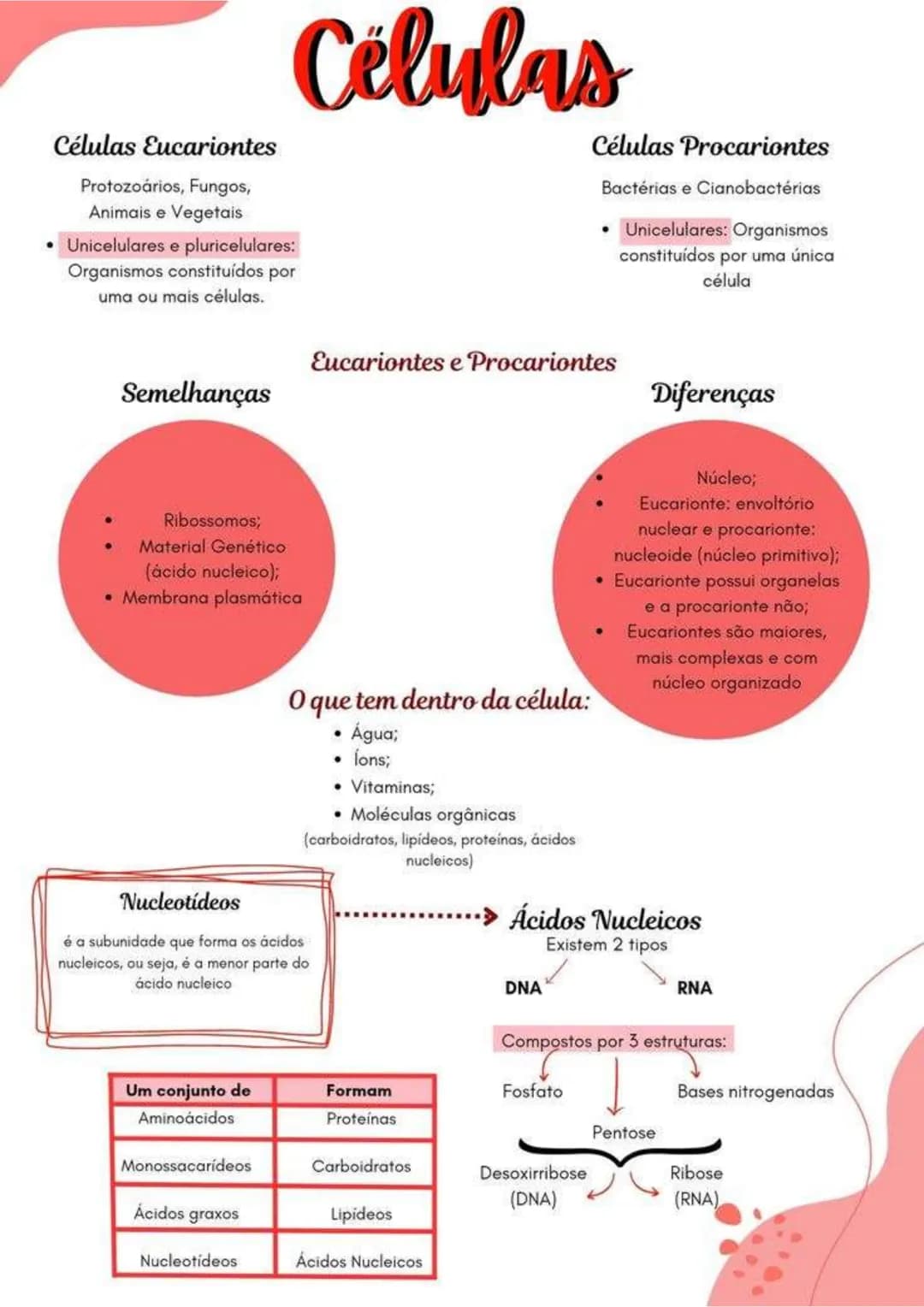
Células: Procariontes e Eucariontes
Existem duas categorias principais de células no mundo vivo. As células procariontes (bactérias e cianobactérias) são sempre unicelulares - organismos formados por uma única célula. Já as células eucariontes (protozoários, fungos, animais e vegetais) podem ser unicelulares ou pluricelulares, formando organismos mais complexos.
Apesar das diferenças, ambos os tipos compartilham algumas estruturas básicas: ribossomos (responsáveis pela produção de proteínas), material genético (ácidos nucleicos) e membrana plasmática (que delimita a célula). A diferença mais marcante está no núcleo - eucariontes possuem núcleo delimitado por membrana, enquanto procariontes têm um nucleoide (núcleo primitivo sem membrana).
As células eucariontes são geralmente maiores, mais complexas e possuem diversas organelas com funções específicas. Já as procariontes são mais simples e não possuem organelas membranosas. Todas as células contêm água, íons, vitaminas e moléculas orgânicas como carboidratos, lipídeos, proteínas e ácidos nucleicos.
Você sabia? Os componentes celulares são formados por unidades menores: aminoácidos formam proteínas, monossacarídeos formam carboidratos, ácidos graxos formam lipídeos e nucleotídeos formam os ácidos nucleicos (DNA e RNA).
Os ácidos nucleicos (DNA e RNA) são compostos por nucleotídeos, que contêm três partes: um grupo fosfato, uma base nitrogenada e uma pentose (desoxirribose no DNA e ribose no RNA). São eles que carregam toda a informação genética necessária para o funcionamento celular.
We thought you’d never ask...
What is the Knowunity AI companion?
Our AI companion is specifically built for the needs of students. Based on the millions of content pieces we have on the platform we can provide truly meaningful and relevant answers to students. But its not only about answers, the companion is even more about guiding students through their daily learning challenges, with personalised study plans, quizzes or content pieces in the chat and 100% personalisation based on the students skills and developments.
Where can I download the Knowunity app?
You can download the app in the Google Play Store and in the Apple App Store.
Is Knowunity really free of charge?
That's right! Enjoy free access to study content, connect with fellow students, and get instant help – all at your fingertips.
Similar Content
 Biology
Most popular content in Biologia
9Biologiasobre celulas eucarionte e procariontes
Este quiz aborda as características e diferenças fundamentais entre células eucariontes e procariontes.
1°EM7000
BiologiaRespiração Celular
Glicólise, Ciclo de Krebs e Cadeia respiratória
1°EM5377
BiologiaResumo de Genética
Conceitos básicos, 1ª lei de Mendel, Sistema RH,Dicas, GenéticaXCromossomos (Mutações e Variações Genéticas).
1°EM1,31525
 Matematica
Cronograma Enem 2025
Cronograma com todos os conteúdos para o Enem. @crismedicina
3°EM11,870335
BiologiaA origem da Vida
A terra primitiva e a origem da vida na biologia.
1°EM75610
BiologiaÁgua e Sais Minerais
Resumo dinâmico sobre água e sais minerais, um norte para o começo dos seus estudos sobre a composição química dos seres vivos.
Univ.2,13742
BiologiaÁcidos Nucleicos
Principais características sobre os ácidos nucleicos
9°1,11221
Biologiarelações ecológicas
relações ecológicas intraespecífica e interespecífica
8°83216
BiologiaÁcidos Nucleicos
resumo sobre ácidos nucleicos
1°EM1,14722
Most popular content
9 História
primeira guerra mundial
Teste seus conhecimentos sobre a primeira guerra mundial, causas da primeira guerra mundial e consequências da Primeira Guerra Mundial, fases da primeira guerra mundial
9°2,7920
Históriailuminismo e pensadores iluministas
Teste seus conhecimentos sobre o Iluminismo e seus principais pensadores, explorando suas ideias e impacto histórico.
8°1,0290
MatematicaPotenciação
Resumo de potenciação - matemática
9°9,354205
F
 Português
Figuras de Linguagem: Identificando em Contexto
Aprenda a identificar as principais figuras de linguagem através de exemplos práticos e exercícios.
8°6740
PortuguêsMAPAS MENTAIS 1 DIA DO ENEM
mapas mentais, sobre os conteúdos que mais caem no 1 dia do ENEM
3°EM7,538287
HistóriaPrimeira Guerra Mundial
Resumo sobre a primeira guerra mundial
6°4,693123
Biologiasobre celulas eucarionte e procariontes
Este quiz aborda as características e diferenças fundamentais entre células eucariontes e procariontes.
1°EM7000
PortuguêsOrações subordinadas substantivas
Português
8°5,88281
M
CiênciaMudanças de Estado Físico da Água
Explore os processos de mudança de estado da água: fusão, ebulição, condensação, solidificação e sublimação.
6°6970
Can't find what you're looking for? Explore other subjects.
Students love us — and so will you.
4.6/5App Store
4.7/5Google Play
The app is very easy to use and well designed. I have found everything I was looking for so far and have been able to learn a lot from the presentations! I will definitely use the app for a class assignment! And of course it also helps a lot as an inspiration.
Stefan SiOS user
This app is really great. There are so many study notes and help [...]. My problem subject is French, for example, and the app has so many options for help. Thanks to this app, I have improved my French. I would recommend it to anyone.
Samantha KlichAndroid user
Wow, I am really amazed. I just tried the app because I've seen it advertised many times and was absolutely stunned. This app is THE HELP you want for school and above all, it offers so many things, such as workouts and fact sheets, which have been VERY helpful to me personally.
AnnaiOS user
Biologia1,927 views·Updated Jun 24, 2026·1 pageCélulas Eucariontes e Procariontes: Diferenças e Semelhanças
D
Daniela Leite@danielaleite
A célula é a unidade básica da vida, a menor estrutura capaz de realizar todas as funções vitais. Existem dois tipos principais: as procariontes e as eucariontes, com diferenças importantes na sua estrutura e organização. Vamos entender como funcionam essas...
1
of 1
Sign up to see the content. It's free!
- Access to all documents
- Improve your grades
- Join milions of students
Células: Procariontes e Eucariontes
Existem duas categorias principais de células no mundo vivo. As células procariontes (bactérias e cianobactérias) são sempre unicelulares - organismos formados por uma única célula. Já as células eucariontes (protozoários, fungos, animais e vegetais) podem ser unicelulares ou pluricelulares, formando organismos mais complexos.
Apesar das diferenças, ambos os tipos compartilham algumas estruturas básicas: ribossomos (responsáveis pela produção de proteínas), material genético (ácidos nucleicos) e membrana plasmática (que delimita a célula). A diferença mais marcante está no núcleo - eucariontes possuem núcleo delimitado por membrana, enquanto procariontes têm um nucleoide (núcleo primitivo sem membrana).
As células eucariontes são geralmente maiores, mais complexas e possuem diversas organelas com funções específicas. Já as procariontes são mais simples e não possuem organelas membranosas. Todas as células contêm água, íons, vitaminas e moléculas orgânicas como carboidratos, lipídeos, proteínas e ácidos nucleicos.
Você sabia? Os componentes celulares são formados por unidades menores: aminoácidos formam proteínas, monossacarídeos formam carboidratos, ácidos graxos formam lipídeos e nucleotídeos formam os ácidos nucleicos (DNA e RNA).
Os ácidos nucleicos (DNA e RNA) são compostos por nucleotídeos, que contêm três partes: um grupo fosfato, uma base nitrogenada e uma pentose (desoxirribose no DNA e ribose no RNA). São eles que carregam toda a informação genética necessária para o funcionamento celular.
We thought you’d never ask...
What is the Knowunity AI companion?
Our AI companion is specifically built for the needs of students. Based on the millions of content pieces we have on the platform we can provide truly meaningful and relevant answers to students. But its not only about answers, the companion is even more about guiding students through their daily learning challenges, with personalised study plans, quizzes or content pieces in the chat and 100% personalisation based on the students skills and developments.
Where can I download the Knowunity app?
You can download the app in the Google Play Store and in the Apple App Store.
Is Knowunity really free of charge?
That's right! Enjoy free access to study content, connect with fellow students, and get instant help – all at your fingertips.
Similar Content
Most popular content in Biologia
9Biologiasobre celulas eucarionte e procariontes
Este quiz aborda as características e diferenças fundamentais entre células eucariontes e procariontes.
1°EM7000
BiologiaRespiração Celular
Glicólise, Ciclo de Krebs e Cadeia respiratória
1°EM5377
BiologiaResumo de Genética
Conceitos básicos, 1ª lei de Mendel, Sistema RH,Dicas, GenéticaXCromossomos (Mutações e Variações Genéticas).
1°EM1,31525
MatematicaCronograma Enem 2025
Cronograma com todos os conteúdos para o Enem. @crismedicina
3°EM11,870335
BiologiaA origem da Vida
A terra primitiva e a origem da vida na biologia.
1°EM75610
BiologiaÁgua e Sais Minerais
Resumo dinâmico sobre água e sais minerais, um norte para o começo dos seus estudos sobre a composição química dos seres vivos.
Univ.2,13742
BiologiaÁcidos Nucleicos
Principais características sobre os ácidos nucleicos
9°1,11221
Biologiarelações ecológicas
relações ecológicas intraespecífica e interespecífica
8°83216
BiologiaÁcidos Nucleicos
resumo sobre ácidos nucleicos
1°EM1,14722
Most popular content
9Históriaprimeira guerra mundial
Teste seus conhecimentos sobre a primeira guerra mundial, causas da primeira guerra mundial e consequências da Primeira Guerra Mundial, fases da primeira guerra mundial
9°2,7920
Históriailuminismo e pensadores iluministas
Teste seus conhecimentos sobre o Iluminismo e seus principais pensadores, explorando suas ideias e impacto histórico.
8°1,0290
MatematicaPotenciação
Resumo de potenciação - matemática
9°9,354205
F
PortuguêsFiguras de Linguagem: Identificando em Contexto
Aprenda a identificar as principais figuras de linguagem através de exemplos práticos e exercícios.
8°6740
PortuguêsMAPAS MENTAIS 1 DIA DO ENEM
mapas mentais, sobre os conteúdos que mais caem no 1 dia do ENEM
3°EM7,538287
HistóriaPrimeira Guerra Mundial
Resumo sobre a primeira guerra mundial
6°4,693123
Biologiasobre celulas eucarionte e procariontes
Este quiz aborda as características e diferenças fundamentais entre células eucariontes e procariontes.
1°EM7000
PortuguêsOrações subordinadas substantivas
Português
8°5,88281
M
CiênciaMudanças de Estado Físico da Água
Explore os processos de mudança de estado da água: fusão, ebulição, condensação, solidificação e sublimação.
6°6970
Can't find what you're looking for? Explore other subjects.
Students love us — and so will you.
4.6/5App Store
4.7/5Google Play
The app is very easy to use and well designed. I have found everything I was looking for so far and have been able to learn a lot from the presentations! I will definitely use the app for a class assignment! And of course it also helps a lot as an inspiration.
Stefan SiOS user
This app is really great. There are so many study notes and help [...]. My problem subject is French, for example, and the app has so many options for help. Thanks to this app, I have improved my French. I would recommend it to anyone.
Samantha KlichAndroid user
Wow, I am really amazed. I just tried the app because I've seen it advertised many times and was absolutely stunned. This app is THE HELP you want for school and above all, it offers so many things, such as workouts and fact sheets, which have been VERY helpful to me personally.
AnnaiOS user