
Preparing for the UPCAT can feel overwhelming, but mastering these...
 Pre-Cal7,072 views·Updated Jun 21, 2026·25 pages
UPCAT Mathematics Reviewer: Key Topics and Practice

chiramisu cake@chiramisucake

1 / 10
1
of 10![# UPCAT REVIEWER : MATHEMATICS UPCAT REVIEWER: MATH
LESSON:
REAL AND
IMAGINARY
NUMBERS
[NATURAL OR COUNTING
NUMBERS]
• used to count objects](/_next/image?url=https%3A%2F%2Fcontent-eu-central-1.knowunity.com%2FCONTENT%2F0197d587-b693-7651-986c-01dfff53b2b8_image_page_1.webp&w=2048&q=75)
UPCAT Math Reviewer Overview
You're about to dive into the core mathematical concepts that frequently appear on the UPCAT. This comprehensive review will help you understand everything from real and imaginary numbers to sequences and series.
The topics are organized logically, starting with number systems and building up to more complex concepts. Each section includes practical examples and problem-solving techniques you'll actually use on test day.
Pro Tip: Focus on understanding the underlying patterns rather than just memorizing formulas - this will help you tackle unfamiliar problems with confidence.
2
of 10![# UPCAT REVIEWER : MATHEMATICS UPCAT REVIEWER: MATH
LESSON:
REAL AND
IMAGINARY
NUMBERS
[NATURAL OR COUNTING
NUMBERS]
• used to count objects](/_next/image?url=https%3A%2F%2Fcontent-eu-central-1.knowunity.com%2FCONTENT%2F0197d587-b693-7651-986c-01dfff53b2b8_image_page_2.webp&w=2048&q=75)
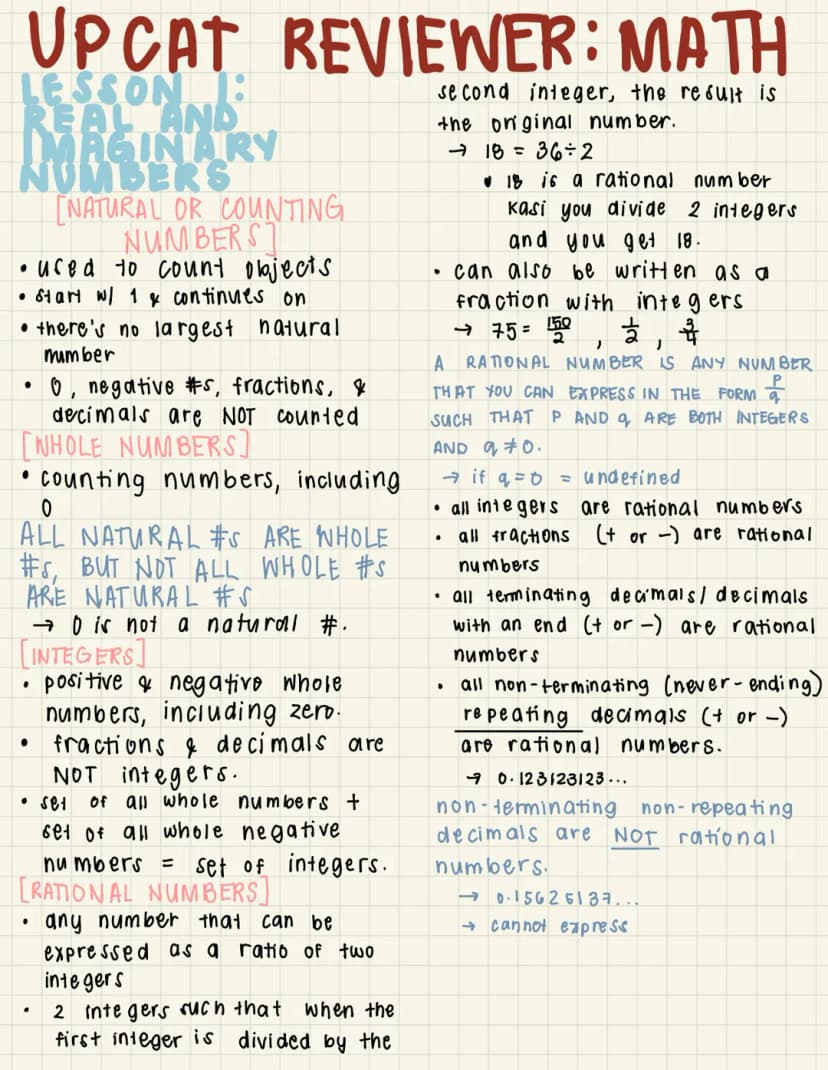
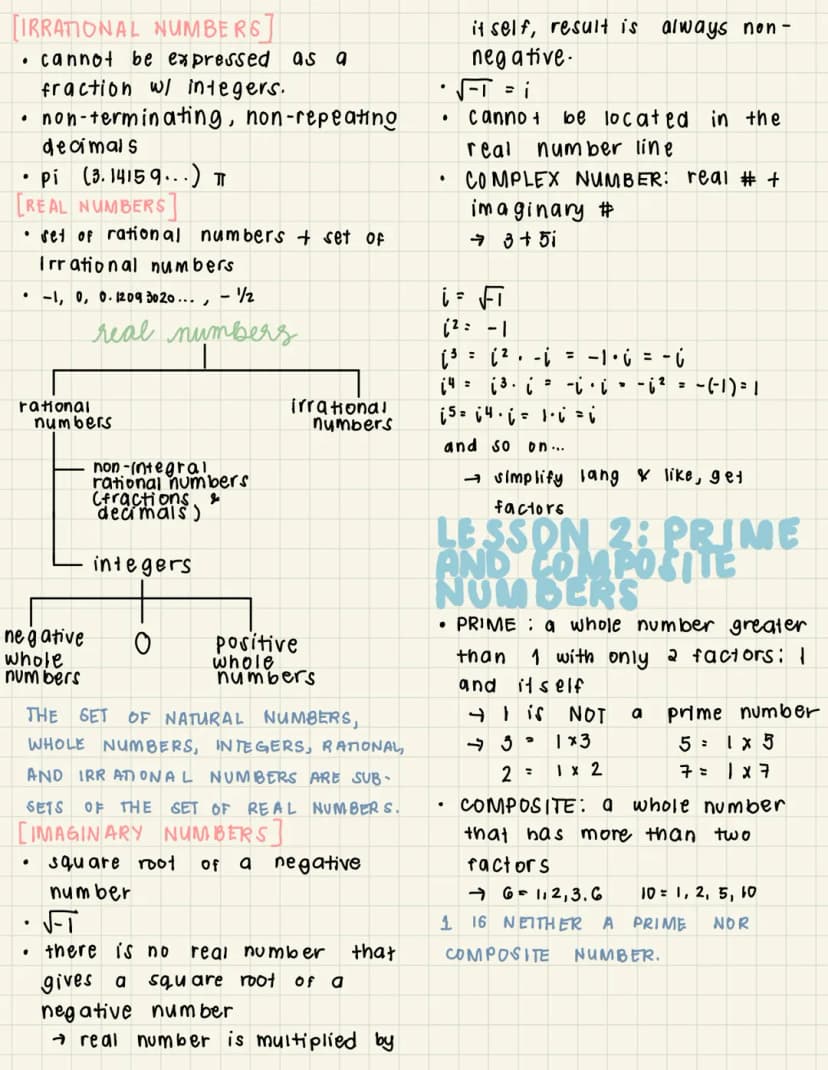
Real and Imaginary Numbers
Understanding number classifications is crucial for solving UPCAT problems correctly. Let's break down the hierarchy from simplest to most complex.
Natural numbers (1, 2, 3, ...) are your basic counting numbers - no zero, no negatives, no fractions. Whole numbers include everything natural numbers have, plus zero. Think of whole numbers as natural numbers' bigger sibling.
Integers expand further to include negative numbers (-3, -2, -1, 0, 1, 2, 3). Rational numbers can be expressed as fractions . This includes terminating decimals like 0.5 and repeating decimals like 0.333...
Irrational numbers like π can't be written as simple fractions - they're non-terminating, non-repeating decimals. Together, rational and irrational numbers form the real numbers.
Imaginary numbers involve √-1, represented as i. Remember: i² = -1, i³ = -i, i⁴ = 1, then the pattern repeats. Complex numbers combine real and imaginary parts .
Quick Check: All natural numbers are whole numbers, but not all whole numbers are natural numbers (because of zero).
3
of 10![# UPCAT REVIEWER : MATHEMATICS UPCAT REVIEWER: MATH
LESSON:
REAL AND
IMAGINARY
NUMBERS
[NATURAL OR COUNTING
NUMBERS]
• used to count objects](/_next/image?url=https%3A%2F%2Fcontent-eu-central-1.knowunity.com%2FCONTENT%2F0197d587-b693-7651-986c-01dfff53b2b8_image_page_3.webp&w=2048&q=75)
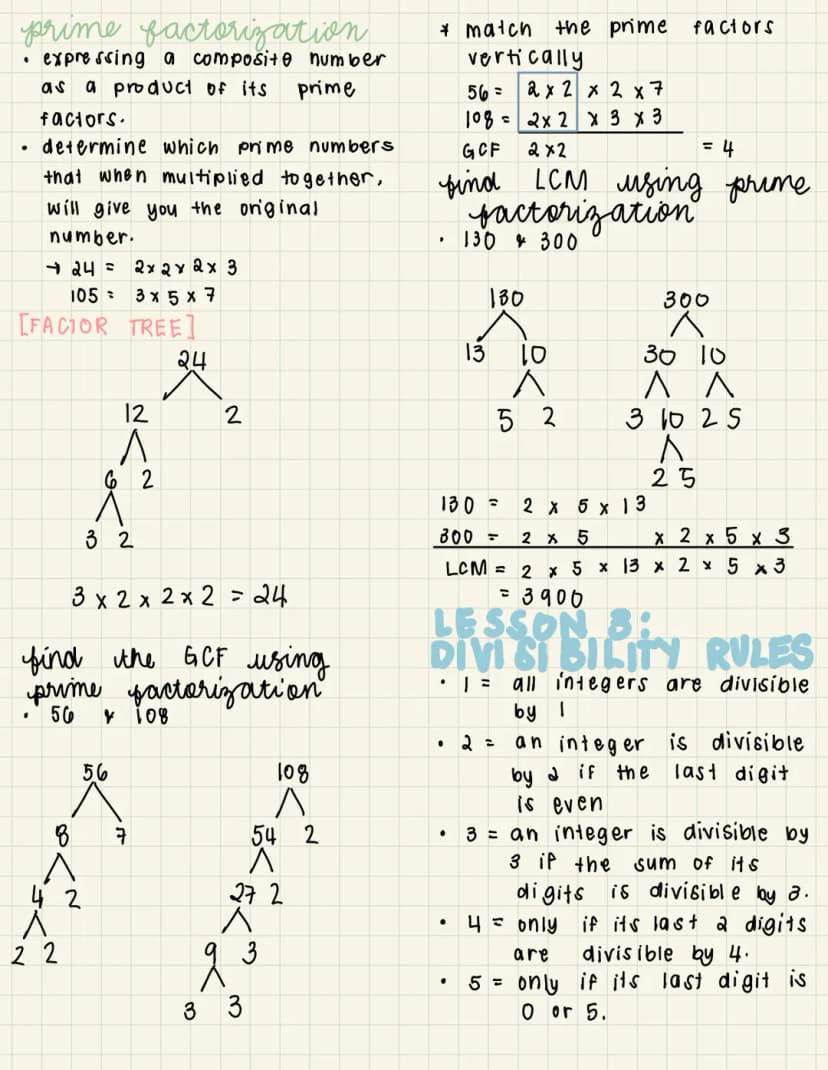
Prime Numbers and Factorization
Prime numbers have exactly two factors: 1 and themselves. Remember, 1 is neither prime nor composite - it's special. Composite numbers have more than two factors.
Prime factorization breaks down composite numbers into their prime building blocks. Use factor trees to make this systematic: keep dividing until you reach all prime factors.
For GCF (Greatest Common Factor), find the prime factorization of both numbers, then multiply the common factors. For LCM (Least Common Multiple), multiply all prime factors, using the highest power of each.
Memory Trick: Prime numbers are like VIPs - they only hang out with 1 and themselves!
4
of 10![# UPCAT REVIEWER : MATHEMATICS UPCAT REVIEWER: MATH
LESSON:
REAL AND
IMAGINARY
NUMBERS
[NATURAL OR COUNTING
NUMBERS]
• used to count objects](/_next/image?url=https%3A%2F%2Fcontent-eu-central-1.knowunity.com%2FCONTENT%2F0197d587-b693-7651-986c-01dfff53b2b8_image_page_4.webp&w=2048&q=75)
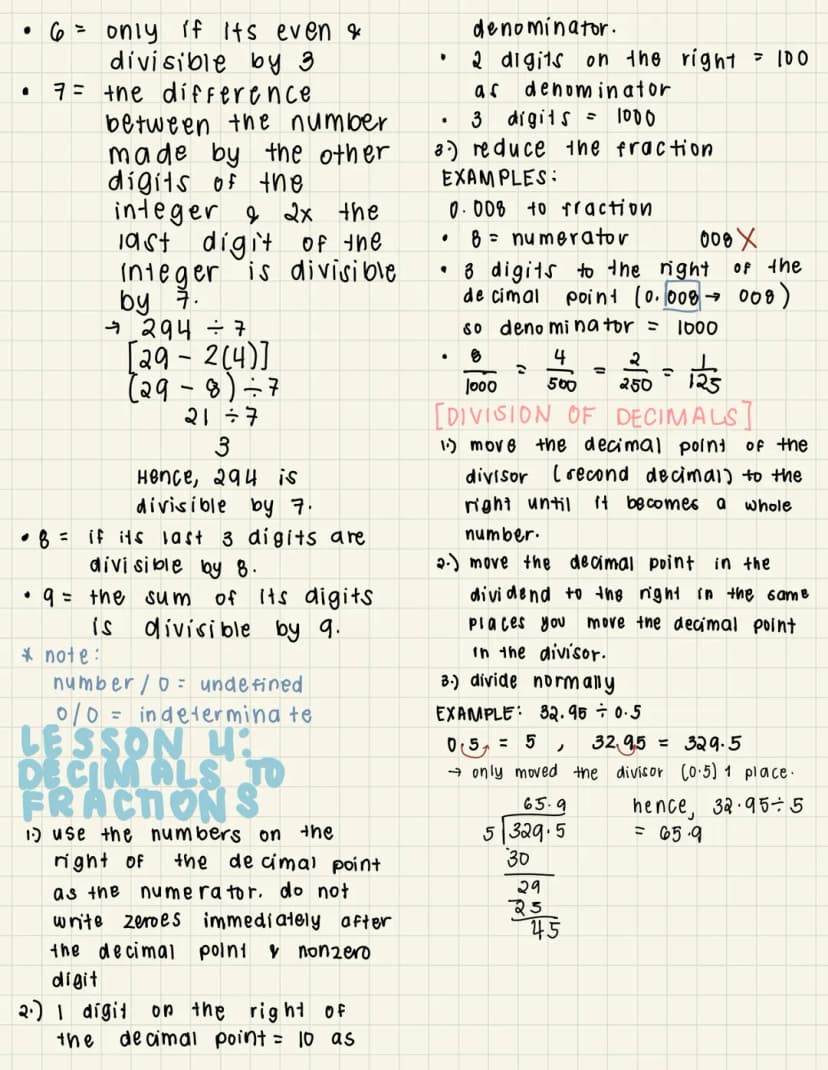
Divisibility Rules and Decimal Operations
Master these divisibility rules for quick mental math: A number is divisible by 2 if it ends in an even digit, by 3 if the sum of its digits is divisible by 3, by 5 if it ends in 0 or 5.
For trickier rules: divisible by 4 if the last two digits are divisible by 4, by 6 if it's even AND divisible by 3, by 9 if the sum of digits is divisible by 9.
Converting decimals to fractions: Use digits after the decimal as numerator, denominator based on decimal places (0.008 = 8/1000). For decimal division, move the decimal point in both numbers to make the divisor whole.
Test Strategy: These divisibility rules can save you tons of time on multiple choice questions!
5
of 10![# UPCAT REVIEWER : MATHEMATICS UPCAT REVIEWER: MATH
LESSON:
REAL AND
IMAGINARY
NUMBERS
[NATURAL OR COUNTING
NUMBERS]
• used to count objects](/_next/image?url=https%3A%2F%2Fcontent-eu-central-1.knowunity.com%2FCONTENT%2F0197d587-b693-7651-986c-01dfff53b2b8_image_page_5.webp&w=2048&q=75)
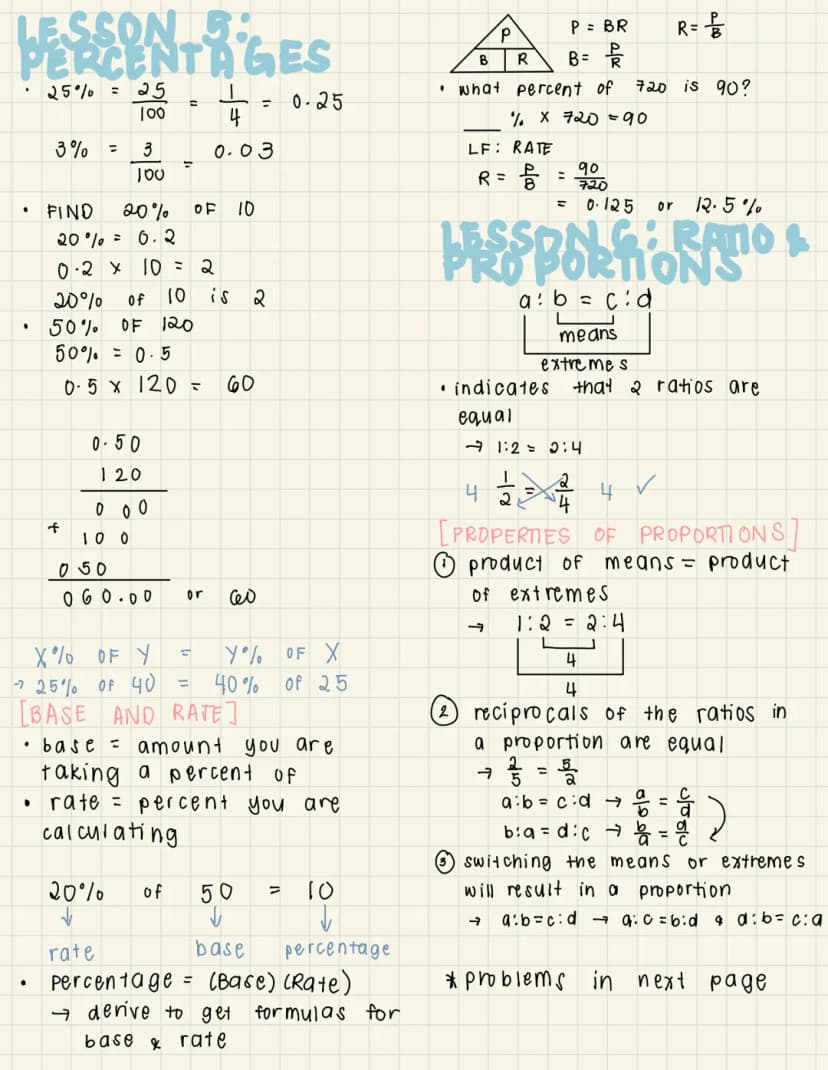
Percentages and Proportions
Percentages are just fractions in disguise: 25% = 25/100 = 1/4 = 0.25. To find a percentage of a number, convert to decimal and multiply .
Here's a cool trick: X% of Y = Y% of X. So 25% of 40 equals 40% of 25 - both equal 10!
Proportions show equal ratios: a:b = c:d. The product of means equals product of extremes . Use this for solving word problems about ratios.
In ratio problems, find the total parts first, then determine what each part represents. If dogs to cats is 1:3 and total is 8, then 1 + 3 = 4 parts, so each part = 2 animals.
Real Life: Proportions are everywhere - cooking recipes, map scales, even social media engagement rates!
6
of 10![# UPCAT REVIEWER : MATHEMATICS UPCAT REVIEWER: MATH
LESSON:
REAL AND
IMAGINARY
NUMBERS
[NATURAL OR COUNTING
NUMBERS]
• used to count objects](/_next/image?url=https%3A%2F%2Fcontent-eu-central-1.knowunity.com%2FCONTENT%2F0197d587-b693-7651-986c-01dfff53b2b8_image_page_6.webp&w=2048&q=75)
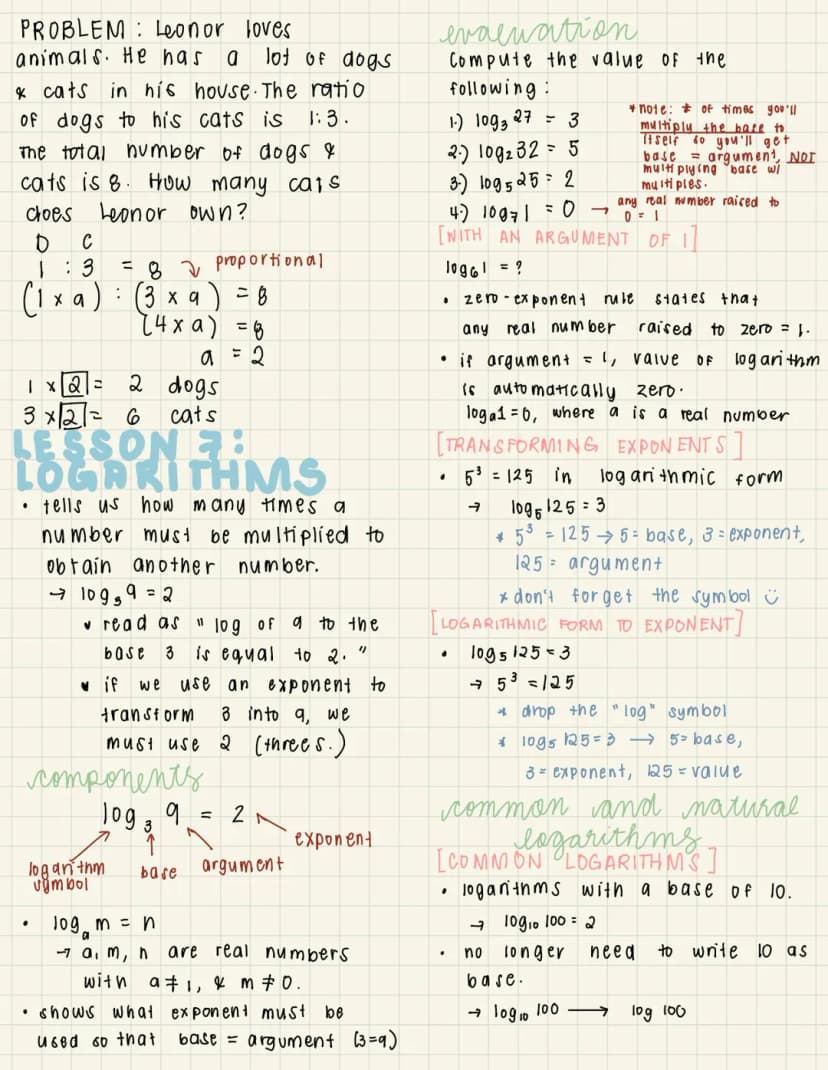
Logarithms Fundamentals
Logarithms answer the question: "What power do I need to get this number?" log₃ 9 = 2 because 3² = 9.
The basic form is log_a m = n, where a is the base, m is the argument, and n is the exponent. Converting between forms: log₅ 125 = 3 becomes 5³ = 125.
Common logarithms use base 10 (written as just "log"). Natural logarithms use base e ≈ 2.718 (written as "ln").
Special cases to remember: log_a 1 = 0 (any number to the power 0 equals 1) and log_a a = 1 (any base to the power 1 equals itself).
Think of it: Logarithms are like "undoing" exponents - they're inverse operations!
7
of 10![# UPCAT REVIEWER : MATHEMATICS UPCAT REVIEWER: MATH
LESSON:
REAL AND
IMAGINARY
NUMBERS
[NATURAL OR COUNTING
NUMBERS]
• used to count objects](/_next/image?url=https%3A%2F%2Fcontent-eu-central-1.knowunity.com%2FCONTENT%2F0197d587-b693-7651-986c-01dfff53b2b8_image_page_7.webp&w=2048&q=75)
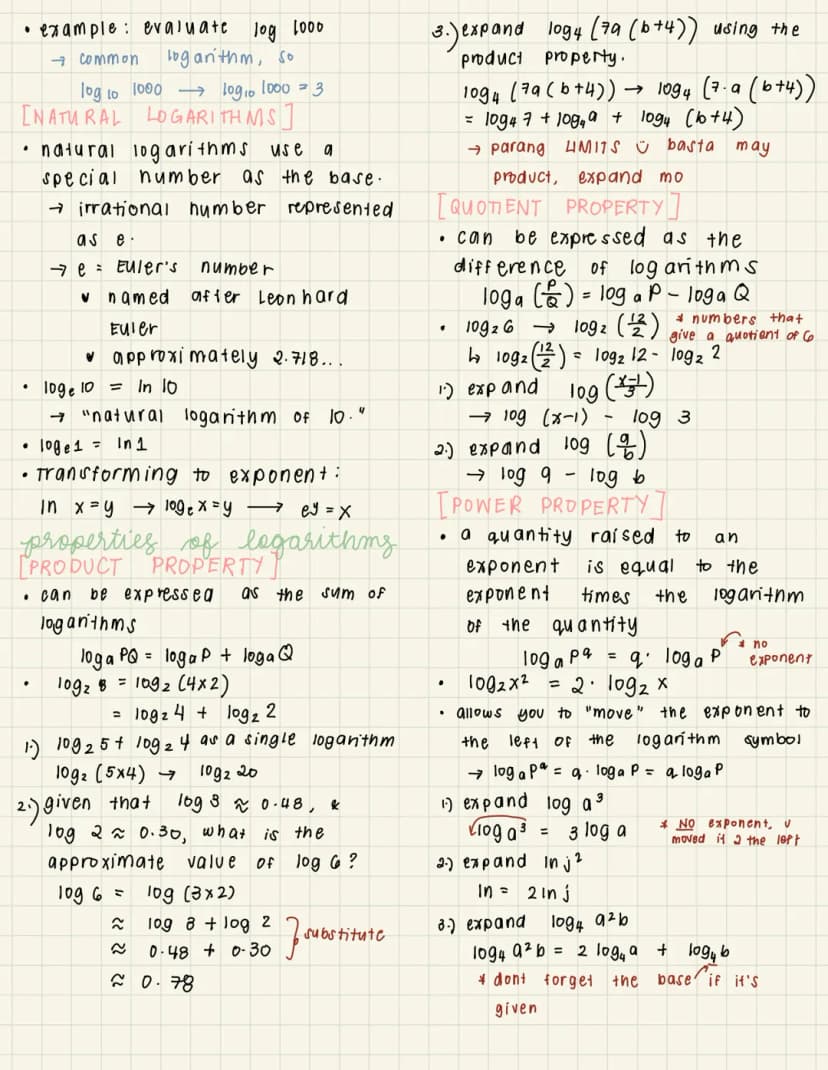
Logarithm Properties and Operations
Master these three key logarithm properties for solving complex problems efficiently.
Product Property: log_a (PQ) = log_a P + log_a Q. Multiplication inside the log becomes addition outside. Quotient Property: log_a = log_a P - log_a Q. Division inside becomes subtraction outside.
Power Property: log_a P^n = n · log_a P. Exponents inside move to the front as multipliers.
When expanding logarithms, apply properties step by step. For log₄(7ab), this becomes log₄ 7 + log₄ a + log₄ b. When simplifying, work backwards - addition becomes multiplication inside the log.
Pro Strategy: These properties turn complicated logarithm problems into manageable arithmetic!
8
of 10![# UPCAT REVIEWER : MATHEMATICS UPCAT REVIEWER: MATH
LESSON:
REAL AND
IMAGINARY
NUMBERS
[NATURAL OR COUNTING
NUMBERS]
• used to count objects](/_next/image?url=https%3A%2F%2Fcontent-eu-central-1.knowunity.com%2FCONTENT%2F0197d587-b693-7651-986c-01dfff53b2b8_image_page_8.webp&w=2048&q=75)
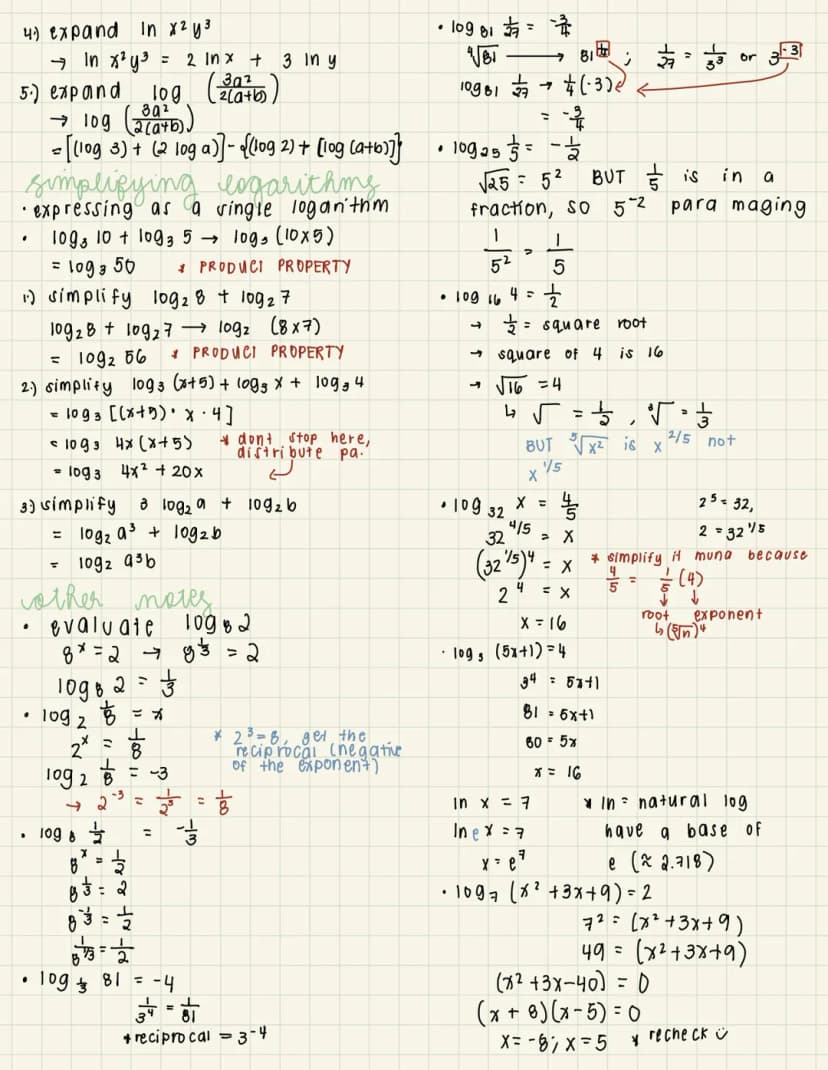
Advanced Logarithm Problem Solving
Solving logarithmic equations requires converting between logarithmic and exponential forms. If log₅ = 4, then 5⁴ = 5x + 1, so 81 = 5x + 1.
For natural logarithm equations like ln x = 7, convert to e^7 = x. Remember that logarithms can't have negative arguments - always check your solutions!
When dealing with logarithm equations with multiple terms, use properties to combine terms first. log₃ + log₃ = 3 becomes log₃ = 3.
Fractional exponents in logarithms represent roots: log₂₅ 5 = 1/2 because √25 = 5, and 25^(1/2) = 5.
Critical Rule: Always verify your answers - negative arguments make logarithms undefined!
9
of 10![# UPCAT REVIEWER : MATHEMATICS UPCAT REVIEWER: MATH
LESSON:
REAL AND
IMAGINARY
NUMBERS
[NATURAL OR COUNTING
NUMBERS]
• used to count objects](/_next/image?url=https%3A%2F%2Fcontent-eu-central-1.knowunity.com%2FCONTENT%2F0197d587-b693-7651-986c-01dfff53b2b8_image_page_9.webp&w=2048&q=75)
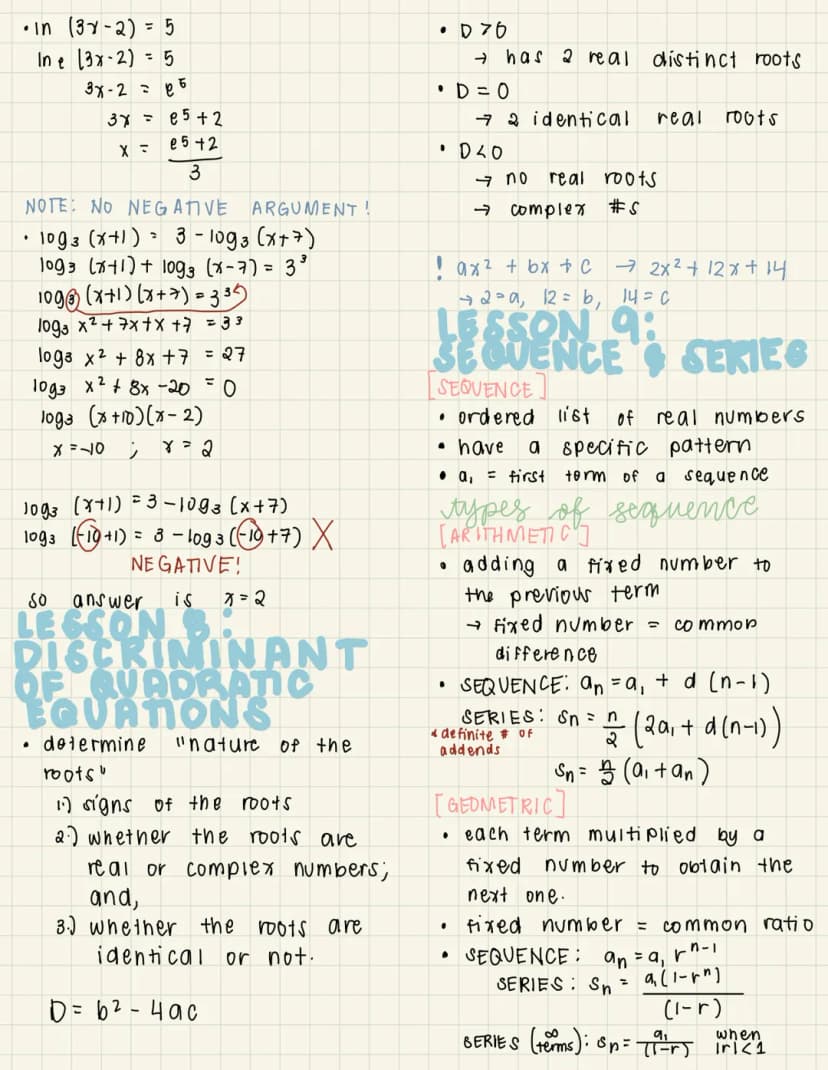
Quadratic Discriminants and Sequences
The discriminant D = b² - 4ac tells you everything about quadratic equation solutions without solving completely.
D > 0: Two different real solutions. D = 0: One repeated real solution. D < 0: No real solutions (complex solutions only).
Sequences are ordered lists following patterns. Arithmetic sequences add the same number each time: aₙ = a₁ + d, where d is the common difference.
Geometric sequences multiply by the same number: aₙ = a₁ · r^, where r is the common ratio.
For series (sums of sequences): Arithmetic series: Sₙ = n/2. Geometric series: Sₙ = a₁/.
Pattern Recognition: Once you identify the sequence type, the formulas do the heavy lifting!
10
of 10![# UPCAT REVIEWER : MATHEMATICS UPCAT REVIEWER: MATH
LESSON:
REAL AND
IMAGINARY
NUMBERS
[NATURAL OR COUNTING
NUMBERS]
• used to count objects](/_next/image?url=https%3A%2F%2Fcontent-eu-central-1.knowunity.com%2FCONTENT%2F0197d587-b693-7651-986c-01dfff53b2b8_image_page_10.webp&w=2048&q=75)
Advanced Problem Solving Strategies
When solving complex logarithmic equations, always isolate terms systematically and check for extraneous solutions.
For equations like ln = 5, convert to exponential form: 3x - 2 = e⁵. Remember to verify that your solution doesn't create negative arguments.
Multi-step logarithm problems often require combining properties. Move all log terms to one side, combine using properties, then convert to exponential form.
In quadratic applications, use the discriminant first to understand what type of solutions to expect. This prevents wasting time on impossible problems.
Sequence problems typically ask for specific terms or sums. Identify whether it's arithmetic or geometric, find the common difference/ratio, then apply the appropriate formula.
Final Tip: Practice identifying problem types quickly - this skill alone can boost your UPCAT math score significantly!
We thought you’d never ask...
What is the Knowunity AI companion?
Our AI companion is specifically built for the needs of students. Based on the millions of content pieces we have on the platform we can provide truly meaningful and relevant answers to students. But its not only about answers, the companion is even more about guiding students through their daily learning challenges, with personalised study plans, quizzes or content pieces in the chat and 100% personalisation based on the students skills and developments.
Where can I download the Knowunity app?
You can download the app in the Google Play Store and in the Apple App Store.
Is Knowunity really free of charge?
That's right! Enjoy free access to study content, connect with fellow students, and get instant help – all at your fingertips.
Similar Content
Most popular content in GenMath
4 GenMath
TRIGONOMETRY COMPLETE REVIEWER
COMPLETE AND ORGANIZED REVIEWER IN TRIGONOMETRY
G111,39518
GenMathBASIC CALCULUS (SHS 11-STEM)
BASIC CALCULUS FOR SHS 11-STEM
G121,32420
Pre-CalPreCal Q3
Pre-Calculus Reviewer for Exam
G126418
Pre-CalConic Sections : CIRCLE
One of the lessons in the subject of Pre Calculus are Conic Sections. The topic is Circle and talks about how to get the Standard Form and General Form given center and its radius. Happy reading!
G114788
Most popular content
9MathMathematics Grade 10 Quarter 1
Grade 10 Math topics
G1010,218250
 Iba pa
El Filibusterismo (FILIPINO 10)
Kilalanin ang mga karakter at alamin ang mga pangyayari mula Kabanata 1 hanggang 39.
G1011,163239
 Science
Science 9 Quarter 1 Lesson 1
Topics: The Respiratory System and The Circulatory System
G911,069383
 Gen Physics
General Physics 1, First Sem
Units of Measurement, Vectors, and Kinematics. All with formulas
G116,247168
 Filipino
Filipino 8 Reviewer
Filipino Reviewer for 4th Quarter for Grade 8 students
G88,088127
ScienceSCIENCE Grade 9 Quarter 3 Reviewer
All about the lessons in Grade 9 Quarter 3 SCIENCE, all complete, highlighted, printable, and has extra informations.
G914,627303
OtherIntroduction to Philosophy - 1st Semester, Grade 12
A summarized notes for Grade 12 students. Easier learning for the 1st semester’s Philosophy subject.
G123,93956
ScienceThe Human Digestive System
Science Grade 8 1st Quarter Lesson
G84,78386
GenMathGeneral Mathematics
Notes including the following: Simple and Compound Interest, Simple Annuity, Simple Annuity Due, Regular Payment of an Annuity, Propositions and Symbols, and Truth Table.
G114,25865
Can't find what you're looking for? Explore other subjects.
Students love us — and so will you.
4.6/5App Store
4.7/5Google Play
The app is very easy to use and well designed. I have found everything I was looking for so far and have been able to learn a lot from the presentations! I will definitely use the app for a class assignment! And of course it also helps a lot as an inspiration.
Stefan SiOS user
This app is really great. There are so many study notes and help [...]. My problem subject is French, for example, and the app has so many options for help. Thanks to this app, I have improved my French. I would recommend it to anyone.
Samantha KlichAndroid user
Wow, I am really amazed. I just tried the app because I've seen it advertised many times and was absolutely stunned. This app is THE HELP you want for school and above all, it offers so many things, such as workouts and fact sheets, which have been VERY helpful to me personally.
AnnaiOS user
Pre-Cal7,072 views·Updated Jun 21, 2026·25 pagesUPCAT Mathematics Reviewer: Key Topics and Practice
chiramisu cake@chiramisucake
Preparing for the UPCAT can feel overwhelming, but mastering these fundamental math concepts will give you a solid foundation. This reviewer covers everything from basic number systems to advanced topics like logarithms and sequences - all the essential math you...
1
of 10
Sign up to see the content. It's free!
- Access to all documents
- Improve your grades
- Join milions of students
UPCAT Math Reviewer Overview
You're about to dive into the core mathematical concepts that frequently appear on the UPCAT. This comprehensive review will help you understand everything from real and imaginary numbers to sequences and series.
The topics are organized logically, starting with number systems and building up to more complex concepts. Each section includes practical examples and problem-solving techniques you'll actually use on test day.
Pro Tip: Focus on understanding the underlying patterns rather than just memorizing formulas - this will help you tackle unfamiliar problems with confidence.
2
of 10Sign up to see the content. It's free!
- Access to all documents
- Improve your grades
- Join milions of students
Real and Imaginary Numbers
Understanding number classifications is crucial for solving UPCAT problems correctly. Let's break down the hierarchy from simplest to most complex.
Natural numbers (1, 2, 3, ...) are your basic counting numbers - no zero, no negatives, no fractions. Whole numbers include everything natural numbers have, plus zero. Think of whole numbers as natural numbers' bigger sibling.
Integers expand further to include negative numbers (-3, -2, -1, 0, 1, 2, 3). Rational numbers can be expressed as fractions . This includes terminating decimals like 0.5 and repeating decimals like 0.333...
Irrational numbers like π can't be written as simple fractions - they're non-terminating, non-repeating decimals. Together, rational and irrational numbers form the real numbers.
Imaginary numbers involve √-1, represented as i. Remember: i² = -1, i³ = -i, i⁴ = 1, then the pattern repeats. Complex numbers combine real and imaginary parts .
Quick Check: All natural numbers are whole numbers, but not all whole numbers are natural numbers (because of zero).
3
of 10Sign up to see the content. It's free!
- Access to all documents
- Improve your grades
- Join milions of students
Prime Numbers and Factorization
Prime numbers have exactly two factors: 1 and themselves. Remember, 1 is neither prime nor composite - it's special. Composite numbers have more than two factors.
Prime factorization breaks down composite numbers into their prime building blocks. Use factor trees to make this systematic: keep dividing until you reach all prime factors.
For GCF (Greatest Common Factor), find the prime factorization of both numbers, then multiply the common factors. For LCM (Least Common Multiple), multiply all prime factors, using the highest power of each.
Memory Trick: Prime numbers are like VIPs - they only hang out with 1 and themselves!
4
of 10Sign up to see the content. It's free!
- Access to all documents
- Improve your grades
- Join milions of students
Divisibility Rules and Decimal Operations
Master these divisibility rules for quick mental math: A number is divisible by 2 if it ends in an even digit, by 3 if the sum of its digits is divisible by 3, by 5 if it ends in 0 or 5.
For trickier rules: divisible by 4 if the last two digits are divisible by 4, by 6 if it's even AND divisible by 3, by 9 if the sum of digits is divisible by 9.
Converting decimals to fractions: Use digits after the decimal as numerator, denominator based on decimal places (0.008 = 8/1000). For decimal division, move the decimal point in both numbers to make the divisor whole.
Test Strategy: These divisibility rules can save you tons of time on multiple choice questions!
5
of 10Sign up to see the content. It's free!
- Access to all documents
- Improve your grades
- Join milions of students
Percentages and Proportions
Percentages are just fractions in disguise: 25% = 25/100 = 1/4 = 0.25. To find a percentage of a number, convert to decimal and multiply .
Here's a cool trick: X% of Y = Y% of X. So 25% of 40 equals 40% of 25 - both equal 10!
Proportions show equal ratios: a:b = c:d. The product of means equals product of extremes . Use this for solving word problems about ratios.
In ratio problems, find the total parts first, then determine what each part represents. If dogs to cats is 1:3 and total is 8, then 1 + 3 = 4 parts, so each part = 2 animals.
Real Life: Proportions are everywhere - cooking recipes, map scales, even social media engagement rates!
6
of 10Sign up to see the content. It's free!
- Access to all documents
- Improve your grades
- Join milions of students
Logarithms Fundamentals
Logarithms answer the question: "What power do I need to get this number?" log₃ 9 = 2 because 3² = 9.
The basic form is log_a m = n, where a is the base, m is the argument, and n is the exponent. Converting between forms: log₅ 125 = 3 becomes 5³ = 125.
Common logarithms use base 10 (written as just "log"). Natural logarithms use base e ≈ 2.718 (written as "ln").
Special cases to remember: log_a 1 = 0 (any number to the power 0 equals 1) and log_a a = 1 (any base to the power 1 equals itself).
Think of it: Logarithms are like "undoing" exponents - they're inverse operations!
7
of 10Sign up to see the content. It's free!
- Access to all documents
- Improve your grades
- Join milions of students
Logarithm Properties and Operations
Master these three key logarithm properties for solving complex problems efficiently.
Product Property: log_a (PQ) = log_a P + log_a Q. Multiplication inside the log becomes addition outside. Quotient Property: log_a = log_a P - log_a Q. Division inside becomes subtraction outside.
Power Property: log_a P^n = n · log_a P. Exponents inside move to the front as multipliers.
When expanding logarithms, apply properties step by step. For log₄(7ab), this becomes log₄ 7 + log₄ a + log₄ b. When simplifying, work backwards - addition becomes multiplication inside the log.
Pro Strategy: These properties turn complicated logarithm problems into manageable arithmetic!
8
of 10Sign up to see the content. It's free!
- Access to all documents
- Improve your grades
- Join milions of students
Advanced Logarithm Problem Solving
Solving logarithmic equations requires converting between logarithmic and exponential forms. If log₅ = 4, then 5⁴ = 5x + 1, so 81 = 5x + 1.
For natural logarithm equations like ln x = 7, convert to e^7 = x. Remember that logarithms can't have negative arguments - always check your solutions!
When dealing with logarithm equations with multiple terms, use properties to combine terms first. log₃ + log₃ = 3 becomes log₃ = 3.
Fractional exponents in logarithms represent roots: log₂₅ 5 = 1/2 because √25 = 5, and 25^(1/2) = 5.
Critical Rule: Always verify your answers - negative arguments make logarithms undefined!
9
of 10Sign up to see the content. It's free!
- Access to all documents
- Improve your grades
- Join milions of students
Quadratic Discriminants and Sequences
The discriminant D = b² - 4ac tells you everything about quadratic equation solutions without solving completely.
D > 0: Two different real solutions. D = 0: One repeated real solution. D < 0: No real solutions (complex solutions only).
Sequences are ordered lists following patterns. Arithmetic sequences add the same number each time: aₙ = a₁ + d, where d is the common difference.
Geometric sequences multiply by the same number: aₙ = a₁ · r^, where r is the common ratio.
For series (sums of sequences): Arithmetic series: Sₙ = n/2. Geometric series: Sₙ = a₁/.
Pattern Recognition: Once you identify the sequence type, the formulas do the heavy lifting!
10
of 10Sign up to see the content. It's free!
- Access to all documents
- Improve your grades
- Join milions of students
Advanced Problem Solving Strategies
When solving complex logarithmic equations, always isolate terms systematically and check for extraneous solutions.
For equations like ln = 5, convert to exponential form: 3x - 2 = e⁵. Remember to verify that your solution doesn't create negative arguments.
Multi-step logarithm problems often require combining properties. Move all log terms to one side, combine using properties, then convert to exponential form.
In quadratic applications, use the discriminant first to understand what type of solutions to expect. This prevents wasting time on impossible problems.
Sequence problems typically ask for specific terms or sums. Identify whether it's arithmetic or geometric, find the common difference/ratio, then apply the appropriate formula.
Final Tip: Practice identifying problem types quickly - this skill alone can boost your UPCAT math score significantly!
We thought you’d never ask...
What is the Knowunity AI companion?
Our AI companion is specifically built for the needs of students. Based on the millions of content pieces we have on the platform we can provide truly meaningful and relevant answers to students. But its not only about answers, the companion is even more about guiding students through their daily learning challenges, with personalised study plans, quizzes or content pieces in the chat and 100% personalisation based on the students skills and developments.
Where can I download the Knowunity app?
You can download the app in the Google Play Store and in the Apple App Store.
Is Knowunity really free of charge?
That's right! Enjoy free access to study content, connect with fellow students, and get instant help – all at your fingertips.
Similar Content
Most popular content in GenMath
4GenMathTRIGONOMETRY COMPLETE REVIEWER
COMPLETE AND ORGANIZED REVIEWER IN TRIGONOMETRY
G111,39518
GenMathBASIC CALCULUS (SHS 11-STEM)
BASIC CALCULUS FOR SHS 11-STEM
G121,32420
Pre-CalPreCal Q3
Pre-Calculus Reviewer for Exam
G126418
Pre-CalConic Sections : CIRCLE
One of the lessons in the subject of Pre Calculus are Conic Sections. The topic is Circle and talks about how to get the Standard Form and General Form given center and its radius. Happy reading!
G114788
Most popular content
9MathMathematics Grade 10 Quarter 1
Grade 10 Math topics
G1010,218250
Iba paEl Filibusterismo (FILIPINO 10)
Kilalanin ang mga karakter at alamin ang mga pangyayari mula Kabanata 1 hanggang 39.
G1011,163239
ScienceScience 9 Quarter 1 Lesson 1
Topics: The Respiratory System and The Circulatory System
G911,069383
Gen PhysicsGeneral Physics 1, First Sem
Units of Measurement, Vectors, and Kinematics. All with formulas
G116,247168
FilipinoFilipino 8 Reviewer
Filipino Reviewer for 4th Quarter for Grade 8 students
G88,088127
ScienceSCIENCE Grade 9 Quarter 3 Reviewer
All about the lessons in Grade 9 Quarter 3 SCIENCE, all complete, highlighted, printable, and has extra informations.
G914,627303
OtherIntroduction to Philosophy - 1st Semester, Grade 12
A summarized notes for Grade 12 students. Easier learning for the 1st semester’s Philosophy subject.
G123,93956
ScienceThe Human Digestive System
Science Grade 8 1st Quarter Lesson
G84,78386
GenMathGeneral Mathematics
Notes including the following: Simple and Compound Interest, Simple Annuity, Simple Annuity Due, Regular Payment of an Annuity, Propositions and Symbols, and Truth Table.
G114,25865
Can't find what you're looking for? Explore other subjects.
Students love us — and so will you.
4.6/5App Store
4.7/5Google Play
The app is very easy to use and well designed. I have found everything I was looking for so far and have been able to learn a lot from the presentations! I will definitely use the app for a class assignment! And of course it also helps a lot as an inspiration.
Stefan SiOS user
This app is really great. There are so many study notes and help [...]. My problem subject is French, for example, and the app has so many options for help. Thanks to this app, I have improved my French. I would recommend it to anyone.
Samantha KlichAndroid user
Wow, I am really amazed. I just tried the app because I've seen it advertised many times and was absolutely stunned. This app is THE HELP you want for school and above all, it offers so many things, such as workouts and fact sheets, which have been VERY helpful to me personally.
AnnaiOS user