

The Alphabet of Lines is a fundamental system of line...
 Fun Stuff42 views·Updated Jun 8, 2026·3 pages
Exploring Line Types in Drafting: Alphabet of Lines
1 / 3
1
of 3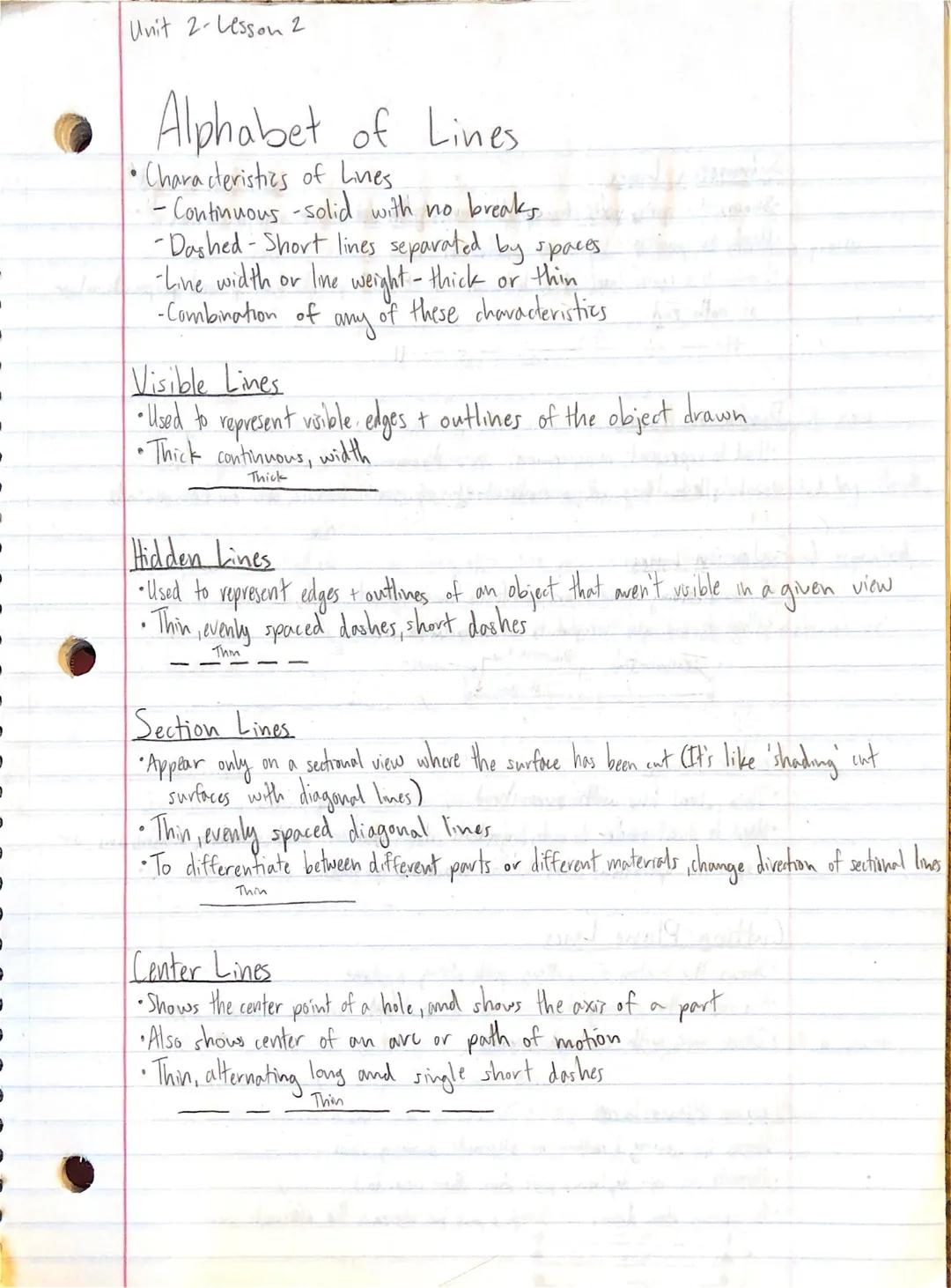
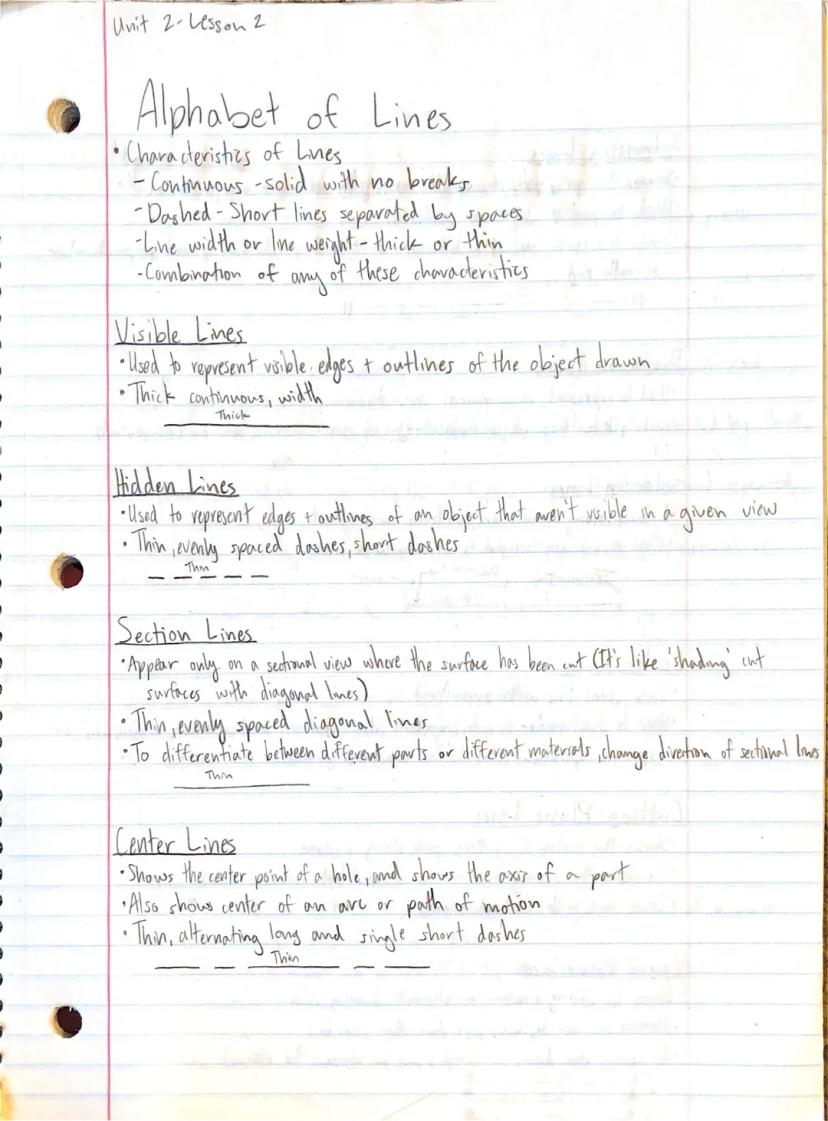
Line Characteristics and Visible Elements
Technical drawings use different line styles to represent various aspects of an object. Lines can be continuous (solid), dashed (separated by spaces), and vary in line weight (thick or thin) to communicate specific information.
Visible lines are thick, continuous lines that represent the edges and outlines you can actually see on an object. Think of these as the lines you would trace if you were holding the object in front of you.
Hidden lines show edges that exist but can't be seen from your viewing angle—they're behind the object or inside it. These appear as thin, evenly spaced short dashes on your drawing.
Section lines (thin diagonal lines) appear only when showing a "cut" surface in sectional views. They help identify different parts or materials by changing direction of the diagonal pattern.
Pro Tip: When using center lines to mark the middle of circles or holes, make sure the long dash extends beyond the feature, making it easier to locate the exact center point.
2
of 3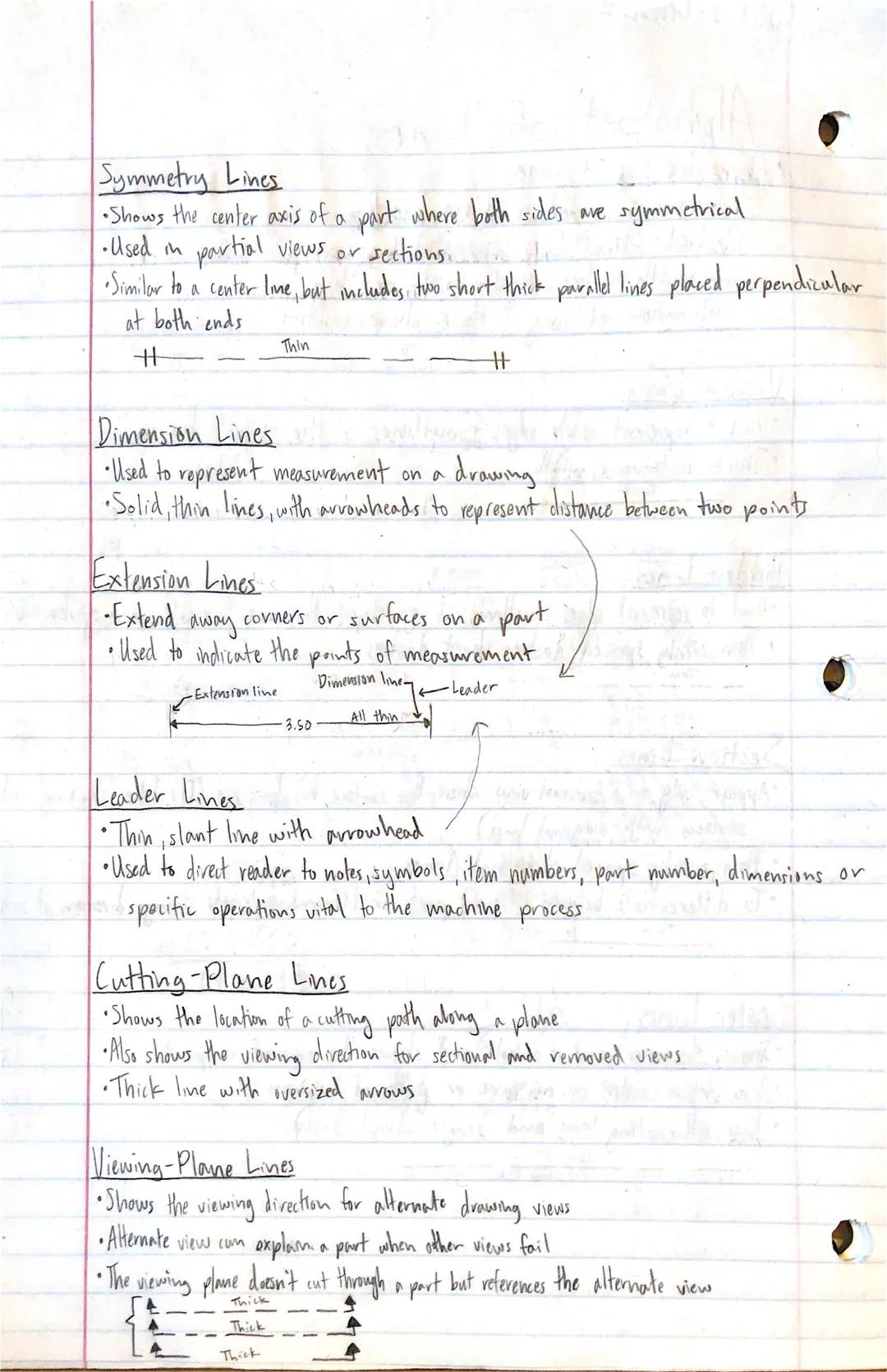
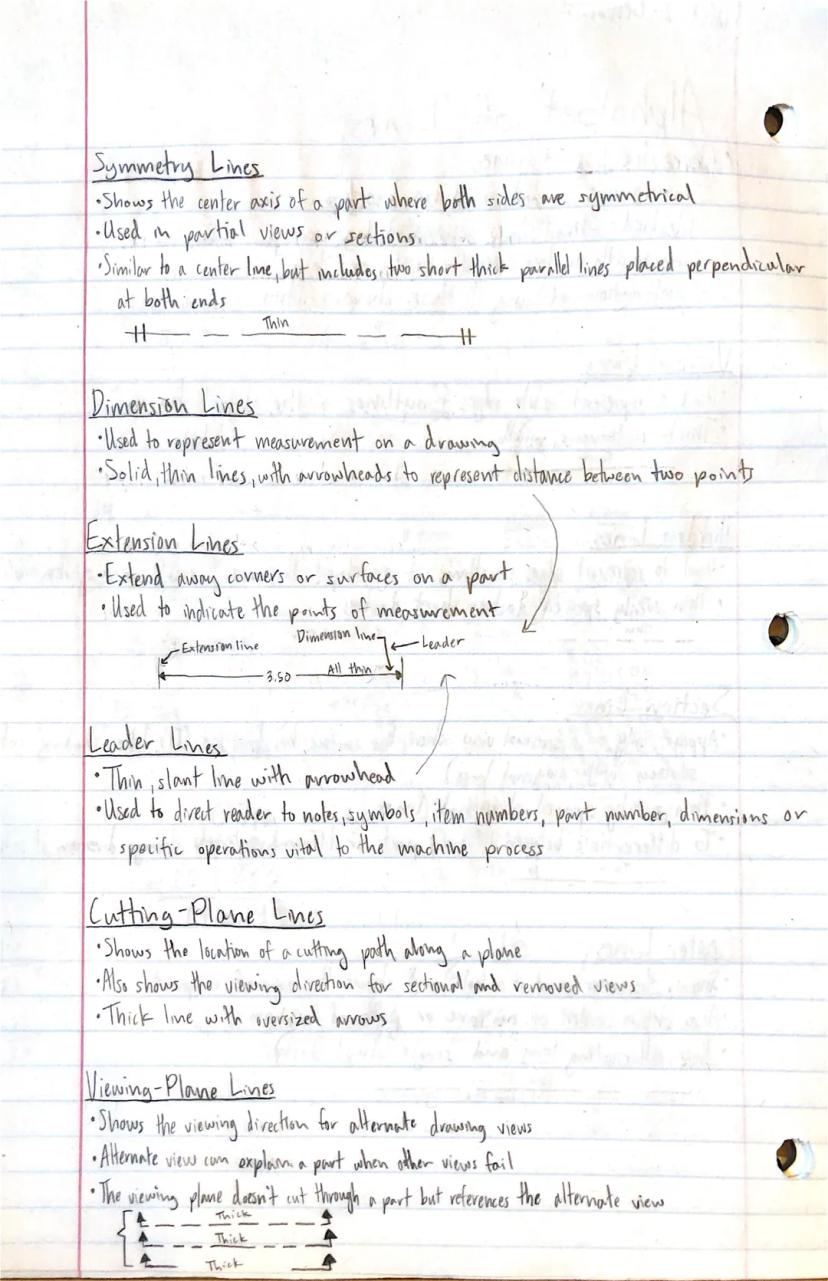
Specialized Line Types for Measurements and References
Symmetry lines indicate when both sides of a part mirror each other. They look similar to center lines but have two short thick parallel lines placed at both ends. These are useful in partial views where showing the complete object isn't necessary.
Dimension lines and extension lines work together to communicate measurements. Dimension lines (thin with arrowheads) show the actual measurement, while extension lines extend from the object to show exactly what's being measured.
Leader lines are thin slanted lines with arrowheads that point to specific features needing explanation. They connect notes, symbols, or part numbers to the exact location they reference.
Cutting-plane lines and viewing-plane lines help readers understand different perspectives. Cutting-plane lines (thick with oversized arrows) show where a part is "cut" for sectional views, while viewing-plane lines indicate the direction to look at for alternate views.
Remember: The thickness of lines isn't random—it creates a visual hierarchy that helps your brain quickly interpret what's most important on a technical drawing.
3
of 3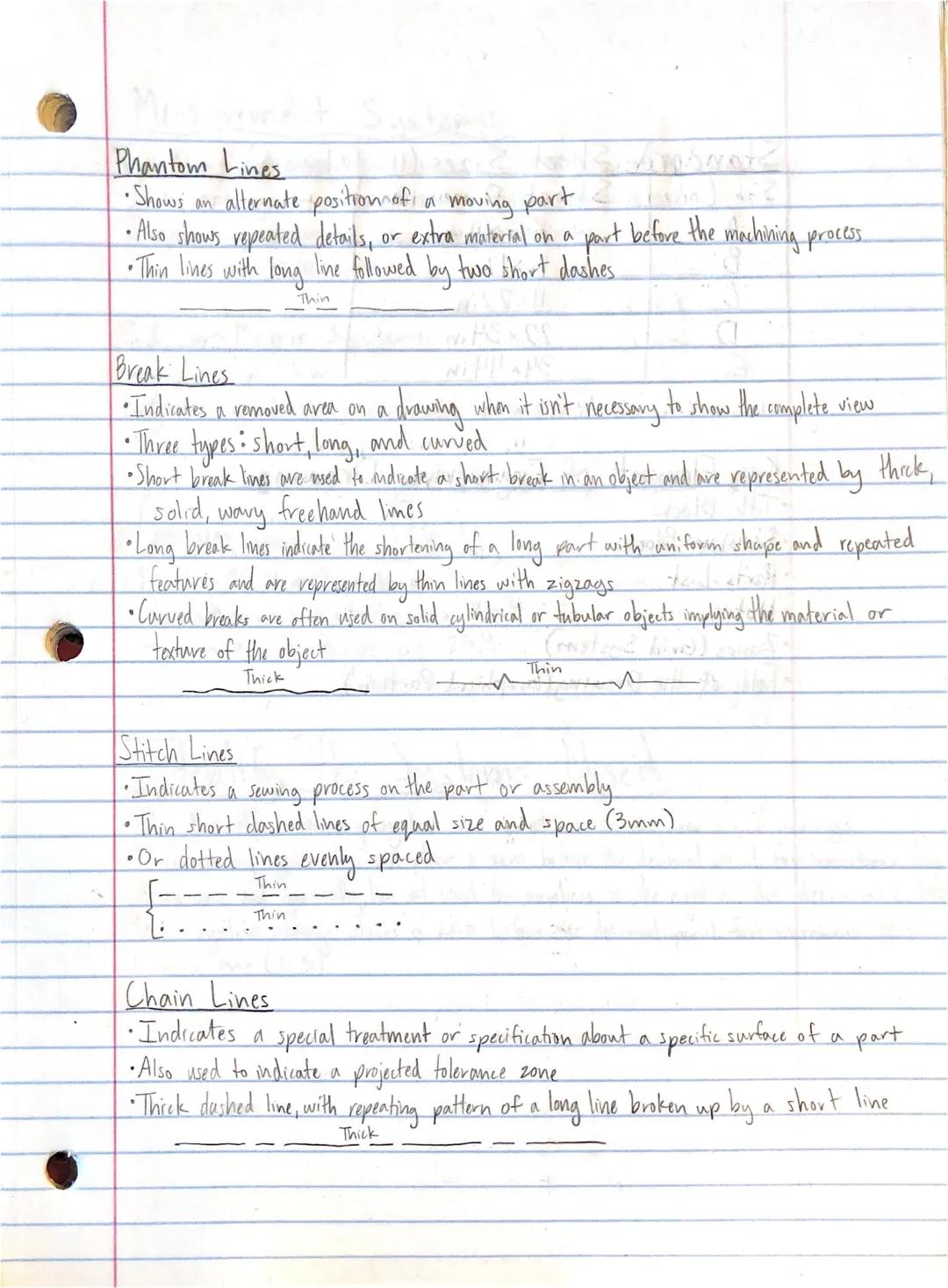
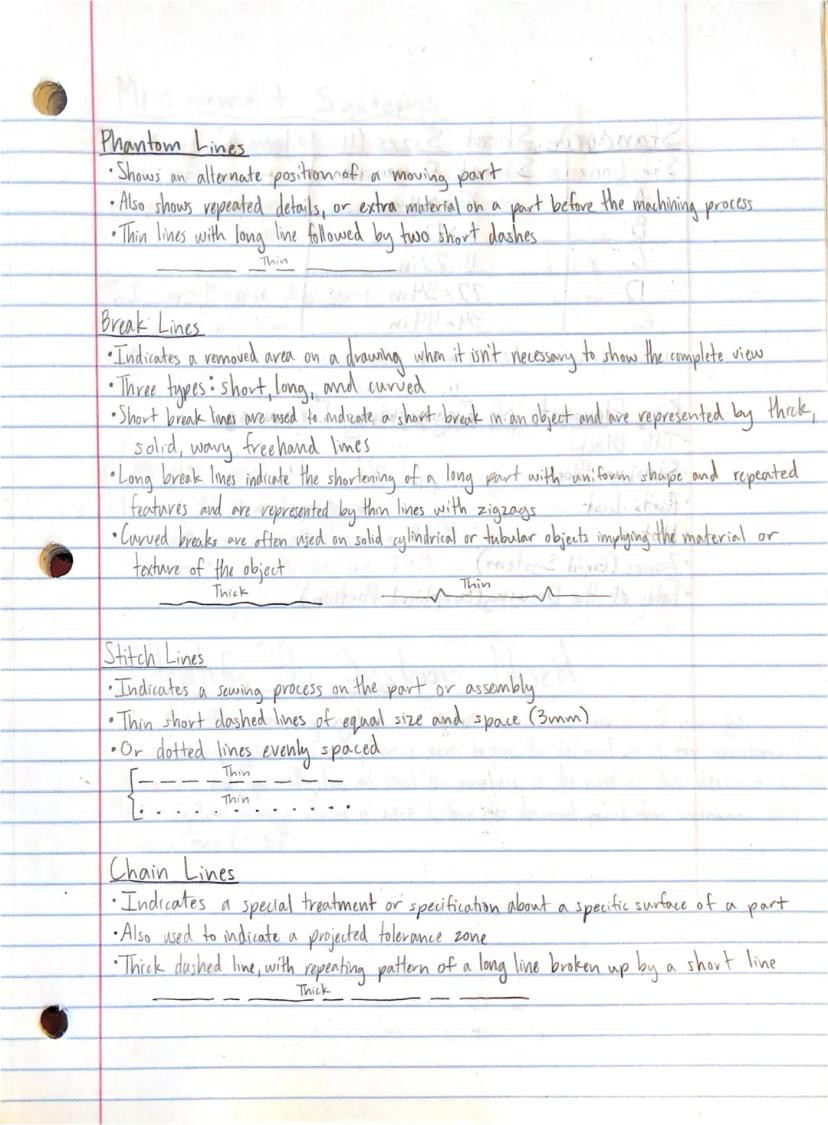
Specialty Lines for Special Situations
Phantom lines (thin lines with one long line followed by two short dashes) show alternative positions of moving parts or extra material before machining. They help you visualize movement or material changes without cluttering the drawing.
Break lines indicate when parts of an object have been removed from the drawing. They come in three types:
- Short break lines: thick, wavy freehand lines for small breaks
- Long break lines: thin lines with zigzags for lengthy uniform parts
- Curved break lines: used on cylindrical objects to suggest material texture
Stitch lines represent sewing processes on parts or assemblies. These thin, short dashed lines (3mm) of equal size and spacing show where components will be stitched together.
Chain lines are thick dashed lines with a repeating pattern of a long line broken by a short line. They indicate special treatments for specific surfaces or projected tolerance zones.
Quick Check: If you're ever confused about which line to use, ask yourself what information you need to communicate—is it visible, hidden, a measurement, or a special instruction?
We thought you’d never ask...
What is the Knowunity AI companion?
Our AI companion is specifically built for the needs of students. Based on the millions of content pieces we have on the platform we can provide truly meaningful and relevant answers to students. But its not only about answers, the companion is even more about guiding students through their daily learning challenges, with personalised study plans, quizzes or content pieces in the chat and 100% personalisation based on the students skills and developments.
Where can I download the Knowunity app?
You can download the app in the Google Play Store and in the Apple App Store.
Is Knowunity really free of charge?
That's right! Enjoy free access to study content, connect with fellow students, and get instant help – all at your fingertips.
Similar Content
 Art & Design
Most popular content in Fun Stuff
9S
Fun StuffSuper Easy Quiz (+)
Are you smarter than a 3rd grader in math? Let’s see.
6th2120
Fun StuffAnatomy and Physiology Chapter 1
Chpater 1 : The orientation of the body / College Level Anatomy and Physiology
84538
Fun Stuff🌈 LGBTQ+ Pride Flags: Context & Symbolism
Use this Know as a quick reference to identify all of the different Pride flags and learn about their context & symbolism
9th36517
Fun StuffALL ABOUT PHILOSOPHY
This document tackles my impression towards "pilosopo" people, what does it mean to love wisdom, implication of face value, and the significance of impartiality.
582
Fun StuffSchool Law
Notes on school law chapter 8 intro to education
10th511
Fun StuffPhilosophy of Education
Notes on chapter 6- philosophy of education for intro to EDUC
10th752
Fun StuffDMV Practice Test 1
First set of Questions from DMV Handbook
1,023128
Fun StuffIntro to Python Pt 1
This is a summary of the basics of python such as variables, print, and if statements.
10th2715
Fun StuffMicroEconomics
Economics
1436
Most popular content
9O
 AP US History
Origins and Dynamics of the Columbian Exchange
Analyze the ecological and economic motivations behind the initial transfer of goods, people, and diseases between the Old and New Worlds.
9th3,1280
I
AP US HistoryIntroduction to Early Cultural Interactions
Analyze the initial social and religious encounters between Europeans, Africans, and Indigenous peoples in the colonial Americas.
9th2,7730
O
 AP World History
Origins of Ancient River Civilizations
Analyze the environmental factors and technological innovations that led to the rise of early states in Mesopotamia, Egypt, and the Indus Valley.
9th3,1870
M
AP US HistoryMotivations for European Exploration
Analyze the economic, religious, and political factors that drove European powers to the Americas during the 15th and 16th centuries.
9th1,7780
F
 AP Psychology
Foundations of Ethical Guidelines in Research
Practice the core principles of the APA ethical code including informed consent, debriefing, and the role of Institutional Review Boards.
9th1,3360
I
AP US HistoryIntroduction to Native American Societies
Examine the diverse social, political, and economic structures of North American indigenous groups prior to European contact.
9th1,1100
I
 AP Biology
Introduction to Biological Elements of Life
Practice identifying the essential elements including carbon, nitrogen, phosphorus, and sulfur that compose biological macromolecules.
9th1,7390
I
AP US HistoryIntroduction to the Spanish Encomienda System
Explore the fundamental economic and social structures of the Spanish colonial system, focusing on the encomienda and the casta social hierarchy.
9th8890
O
AP World HistoryOrigins and Continuity of the Byzantine Empire
Analyze the political and cultural transitions from the Roman Empire to the Byzantine Empire, focusing on the reign of Justinian I and his code.
9th1,6320
Can't find what you're looking for? Explore other subjects.
Students love us — and so will you.
4.6/5App Store
4.7/5Google Play
The app is very easy to use and well designed. I have found everything I was looking for so far and have been able to learn a lot from the presentations! I will definitely use the app for a class assignment! And of course it also helps a lot as an inspiration.
Stefan SiOS user
This app is really great. There are so many study notes and help [...]. My problem subject is French, for example, and the app has so many options for help. Thanks to this app, I have improved my French. I would recommend it to anyone.
Samantha KlichAndroid user
Wow, I am really amazed. I just tried the app because I've seen it advertised many times and was absolutely stunned. This app is THE HELP you want for school and above all, it offers so many things, such as workouts and fact sheets, which have been VERY helpful to me personally.
AnnaiOS user
Fun Stuff42 views·Updated Jun 8, 2026·3 pagesExploring Line Types in Drafting: Alphabet of Lines
The Alphabet of Lines is a fundamental system of line types used in technical drawing and engineering graphics. These standardized lines help communicate different features of an object, whether they're visible, hidden, or represent specific measurements or instructions. Understanding these...
1
of 3
Sign up to see the content. It's free!
- Access to all documents
- Improve your grades
- Join milions of students
Line Characteristics and Visible Elements
Technical drawings use different line styles to represent various aspects of an object. Lines can be continuous (solid), dashed (separated by spaces), and vary in line weight (thick or thin) to communicate specific information.
Visible lines are thick, continuous lines that represent the edges and outlines you can actually see on an object. Think of these as the lines you would trace if you were holding the object in front of you.
Hidden lines show edges that exist but can't be seen from your viewing angle—they're behind the object or inside it. These appear as thin, evenly spaced short dashes on your drawing.
Section lines (thin diagonal lines) appear only when showing a "cut" surface in sectional views. They help identify different parts or materials by changing direction of the diagonal pattern.
Pro Tip: When using center lines to mark the middle of circles or holes, make sure the long dash extends beyond the feature, making it easier to locate the exact center point.
2
of 3Sign up to see the content. It's free!
- Access to all documents
- Improve your grades
- Join milions of students
Specialized Line Types for Measurements and References
Symmetry lines indicate when both sides of a part mirror each other. They look similar to center lines but have two short thick parallel lines placed at both ends. These are useful in partial views where showing the complete object isn't necessary.
Dimension lines and extension lines work together to communicate measurements. Dimension lines (thin with arrowheads) show the actual measurement, while extension lines extend from the object to show exactly what's being measured.
Leader lines are thin slanted lines with arrowheads that point to specific features needing explanation. They connect notes, symbols, or part numbers to the exact location they reference.
Cutting-plane lines and viewing-plane lines help readers understand different perspectives. Cutting-plane lines (thick with oversized arrows) show where a part is "cut" for sectional views, while viewing-plane lines indicate the direction to look at for alternate views.
Remember: The thickness of lines isn't random—it creates a visual hierarchy that helps your brain quickly interpret what's most important on a technical drawing.
3
of 3Sign up to see the content. It's free!
- Access to all documents
- Improve your grades
- Join milions of students
Specialty Lines for Special Situations
Phantom lines (thin lines with one long line followed by two short dashes) show alternative positions of moving parts or extra material before machining. They help you visualize movement or material changes without cluttering the drawing.
Break lines indicate when parts of an object have been removed from the drawing. They come in three types:
- Short break lines: thick, wavy freehand lines for small breaks
- Long break lines: thin lines with zigzags for lengthy uniform parts
- Curved break lines: used on cylindrical objects to suggest material texture
Stitch lines represent sewing processes on parts or assemblies. These thin, short dashed lines (3mm) of equal size and spacing show where components will be stitched together.
Chain lines are thick dashed lines with a repeating pattern of a long line broken by a short line. They indicate special treatments for specific surfaces or projected tolerance zones.
Quick Check: If you're ever confused about which line to use, ask yourself what information you need to communicate—is it visible, hidden, a measurement, or a special instruction?
We thought you’d never ask...
What is the Knowunity AI companion?
Our AI companion is specifically built for the needs of students. Based on the millions of content pieces we have on the platform we can provide truly meaningful and relevant answers to students. But its not only about answers, the companion is even more about guiding students through their daily learning challenges, with personalised study plans, quizzes or content pieces in the chat and 100% personalisation based on the students skills and developments.
Where can I download the Knowunity app?
You can download the app in the Google Play Store and in the Apple App Store.
Is Knowunity really free of charge?
That's right! Enjoy free access to study content, connect with fellow students, and get instant help – all at your fingertips.
Similar Content
Most popular content in Fun Stuff
9S
Fun StuffSuper Easy Quiz (+)
Are you smarter than a 3rd grader in math? Let’s see.
6th2120
Fun StuffAnatomy and Physiology Chapter 1
Chpater 1 : The orientation of the body / College Level Anatomy and Physiology
84538
Fun Stuff🌈 LGBTQ+ Pride Flags: Context & Symbolism
Use this Know as a quick reference to identify all of the different Pride flags and learn about their context & symbolism
9th36517
Fun StuffALL ABOUT PHILOSOPHY
This document tackles my impression towards "pilosopo" people, what does it mean to love wisdom, implication of face value, and the significance of impartiality.
582
Fun StuffSchool Law
Notes on school law chapter 8 intro to education
10th511
Fun StuffPhilosophy of Education
Notes on chapter 6- philosophy of education for intro to EDUC
10th752
Fun StuffDMV Practice Test 1
First set of Questions from DMV Handbook
1,023128
Fun StuffIntro to Python Pt 1
This is a summary of the basics of python such as variables, print, and if statements.
10th2715
Fun StuffMicroEconomics
Economics
1436
Most popular content
9O
AP US HistoryOrigins and Dynamics of the Columbian Exchange
Analyze the ecological and economic motivations behind the initial transfer of goods, people, and diseases between the Old and New Worlds.
9th3,1280
I
AP US HistoryIntroduction to Early Cultural Interactions
Analyze the initial social and religious encounters between Europeans, Africans, and Indigenous peoples in the colonial Americas.
9th2,7730
O
AP World HistoryOrigins of Ancient River Civilizations
Analyze the environmental factors and technological innovations that led to the rise of early states in Mesopotamia, Egypt, and the Indus Valley.
9th3,1870
M
AP US HistoryMotivations for European Exploration
Analyze the economic, religious, and political factors that drove European powers to the Americas during the 15th and 16th centuries.
9th1,7780
F
AP PsychologyFoundations of Ethical Guidelines in Research
Practice the core principles of the APA ethical code including informed consent, debriefing, and the role of Institutional Review Boards.
9th1,3360
I
AP US HistoryIntroduction to Native American Societies
Examine the diverse social, political, and economic structures of North American indigenous groups prior to European contact.
9th1,1100
I
AP BiologyIntroduction to Biological Elements of Life
Practice identifying the essential elements including carbon, nitrogen, phosphorus, and sulfur that compose biological macromolecules.
9th1,7390
I
AP US HistoryIntroduction to the Spanish Encomienda System
Explore the fundamental economic and social structures of the Spanish colonial system, focusing on the encomienda and the casta social hierarchy.
9th8890
O
AP World HistoryOrigins and Continuity of the Byzantine Empire
Analyze the political and cultural transitions from the Roman Empire to the Byzantine Empire, focusing on the reign of Justinian I and his code.
9th1,6320
Can't find what you're looking for? Explore other subjects.
Students love us — and so will you.
4.6/5App Store
4.7/5Google Play
The app is very easy to use and well designed. I have found everything I was looking for so far and have been able to learn a lot from the presentations! I will definitely use the app for a class assignment! And of course it also helps a lot as an inspiration.
Stefan SiOS user
This app is really great. There are so many study notes and help [...]. My problem subject is French, for example, and the app has so many options for help. Thanks to this app, I have improved my French. I would recommend it to anyone.
Samantha KlichAndroid user
Wow, I am really amazed. I just tried the app because I've seen it advertised many times and was absolutely stunned. This app is THE HELP you want for school and above all, it offers so many things, such as workouts and fact sheets, which have been VERY helpful to me personally.
AnnaiOS user