
Land-based empires dominated world politics from 1450-1750, expanding their territories...
 AP World History55 views·Updated Jun 7, 2026·3 pages
The Growth of Major Land Empires: Ottoman, Safavid, Mughal, and Qing
K
Kaitlyn@aitlyn_kjzcqssbsciny
1 / 3
1
of 3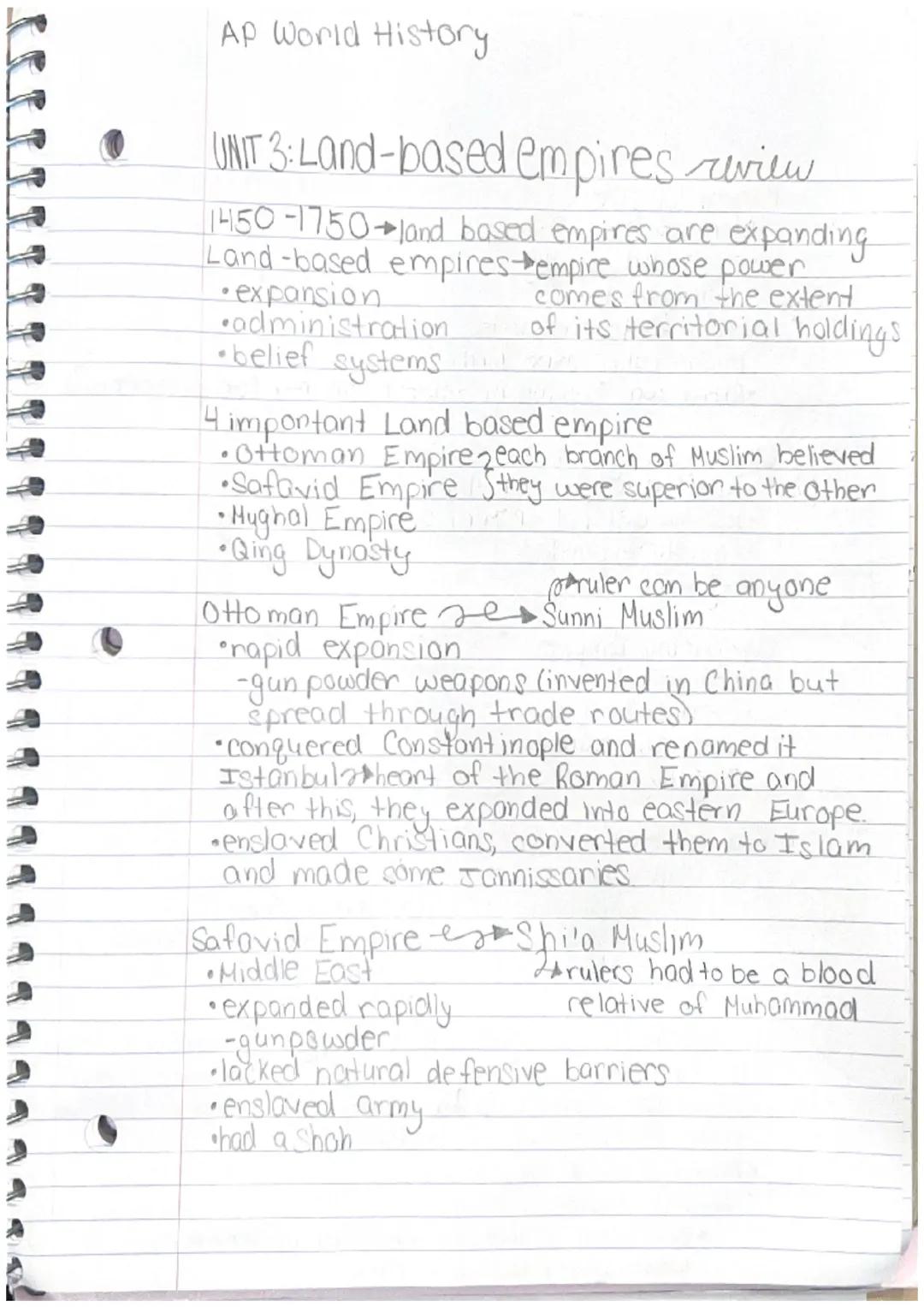
Major Land-Based Empires (1450-1750)
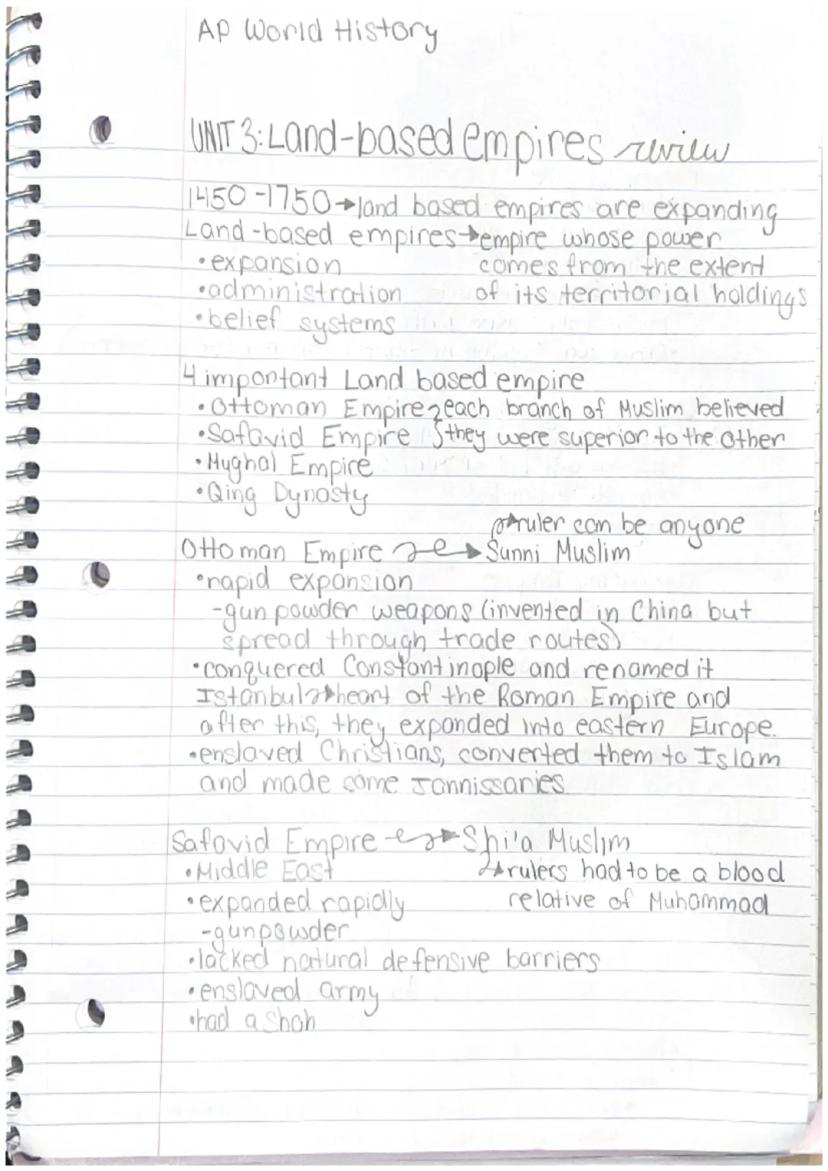
Ever wonder how empires became so powerful centuries ago? Land-based empires gained their strength through territorial expansion, administrative systems, and promoting specific belief systems. These massive political entities dominated the world stage during the early modern period.
The Ottoman Empire, ruled by Sunni Muslims, expanded rapidly using gunpowder weapons that had spread through trade routes from China. They conquered Constantinople (renaming it Istanbul), the heart of the former Roman Empire, before pushing into Eastern Europe. The Ottomans enslaved Christians, converted them to Islam, and trained some as elite Janissaries for their military.
The Safavid Empire practiced Shi'a Islam and controlled much of the Middle East. Unlike the Ottomans, Safavid rulers had to be blood relatives of Muhammad. They also expanded quickly using gunpowder technology but faced challenges due to a lack of natural defensive barriers. The Safavids were ruled by a Shah and maintained an enslaved army.
Did You Know? While both the Ottoman and Safavid empires were Islamic, their different branches of Islam (Sunni vs. Shi'a) created intense rivalries and conflicts between these powerful neighbors.
2
of 3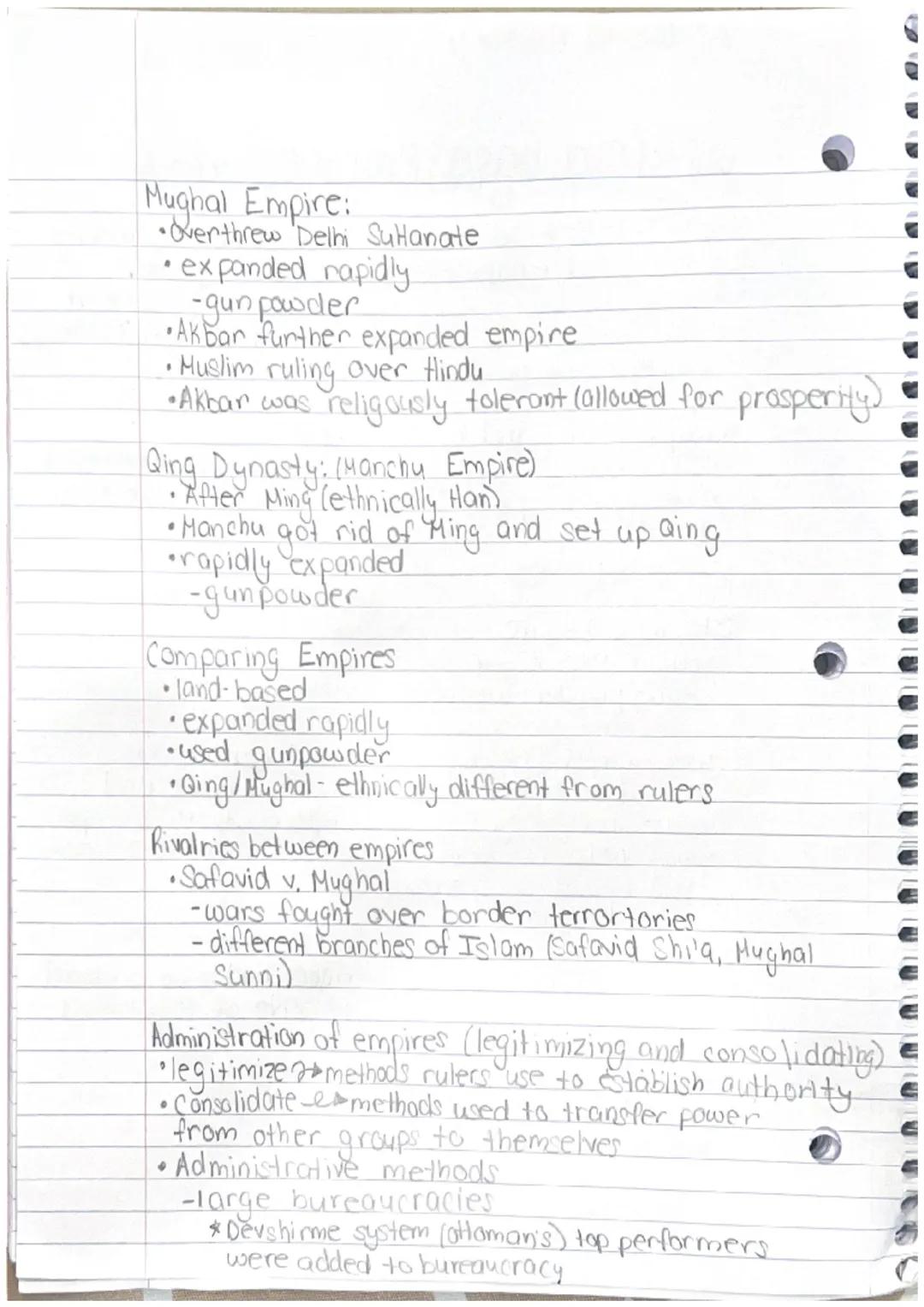
Empire Expansion and Administration
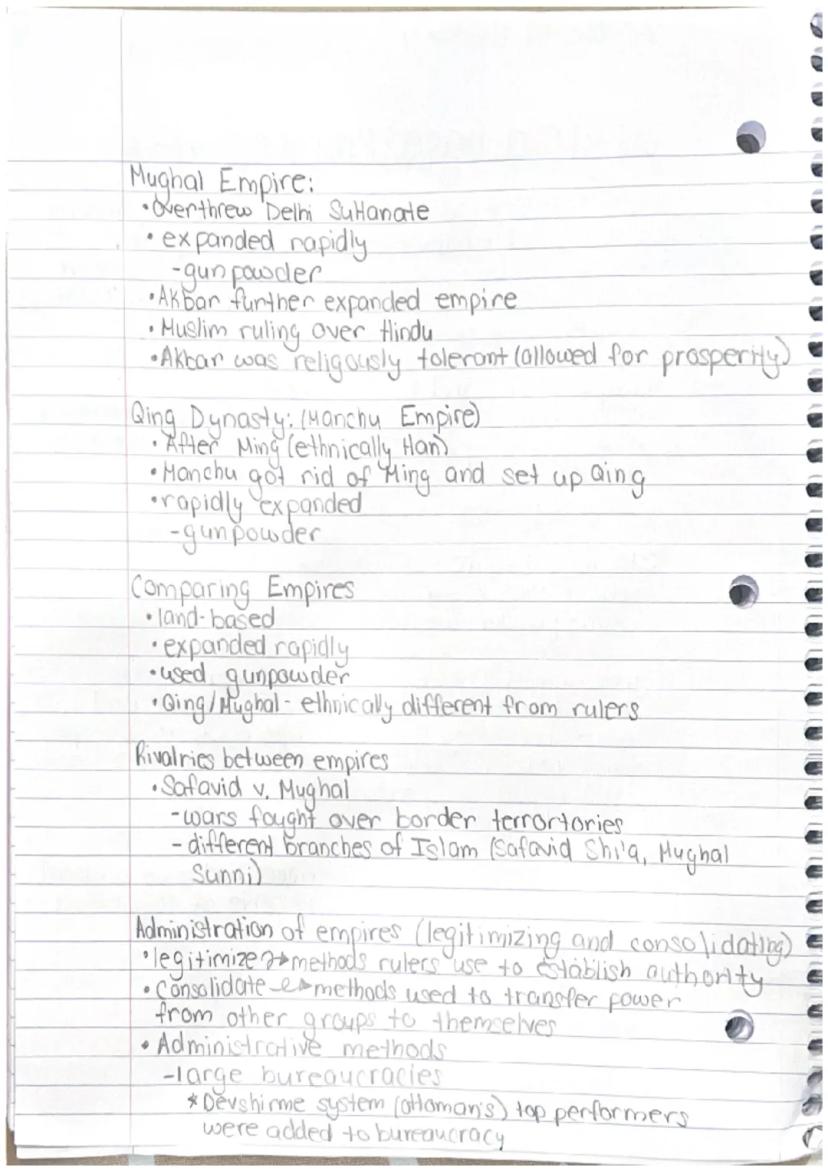
The Mughal Empire overthrew the Delhi Sultanate and rapidly grew through military campaigns. Under Emperor Akbar, the empire thrived due to his religious tolerance—allowing prosperity despite being Muslim rulers governing a predominantly Hindu population.
The Qing Dynasty replaced the ethnically Han Ming Dynasty in China. The Manchu people established the Qing and, like other land empires of this period, expanded quickly by leveraging gunpowder technology.
All these land-based empires shared common features: rapid expansion, effective use of gunpowder weapons, and (in the case of the Qing and Mughals) rulers who were ethnically different from most of their subjects. Their rivalries often centered on border disputes and religious differences.
To maintain control, empires developed sophisticated administrative methods including large bureaucracies. The Ottomans implemented the Devshirme system, where promising enslaved Christians were trained for government positions. Military professionals like the Janissaries became crucial to imperial power.
Remember This: Rulers had to both "legitimize" their authority (establish why they deserved to rule) and "consolidate" their power (transfer authority from other groups to themselves) to maintain stable empires.
3
of 3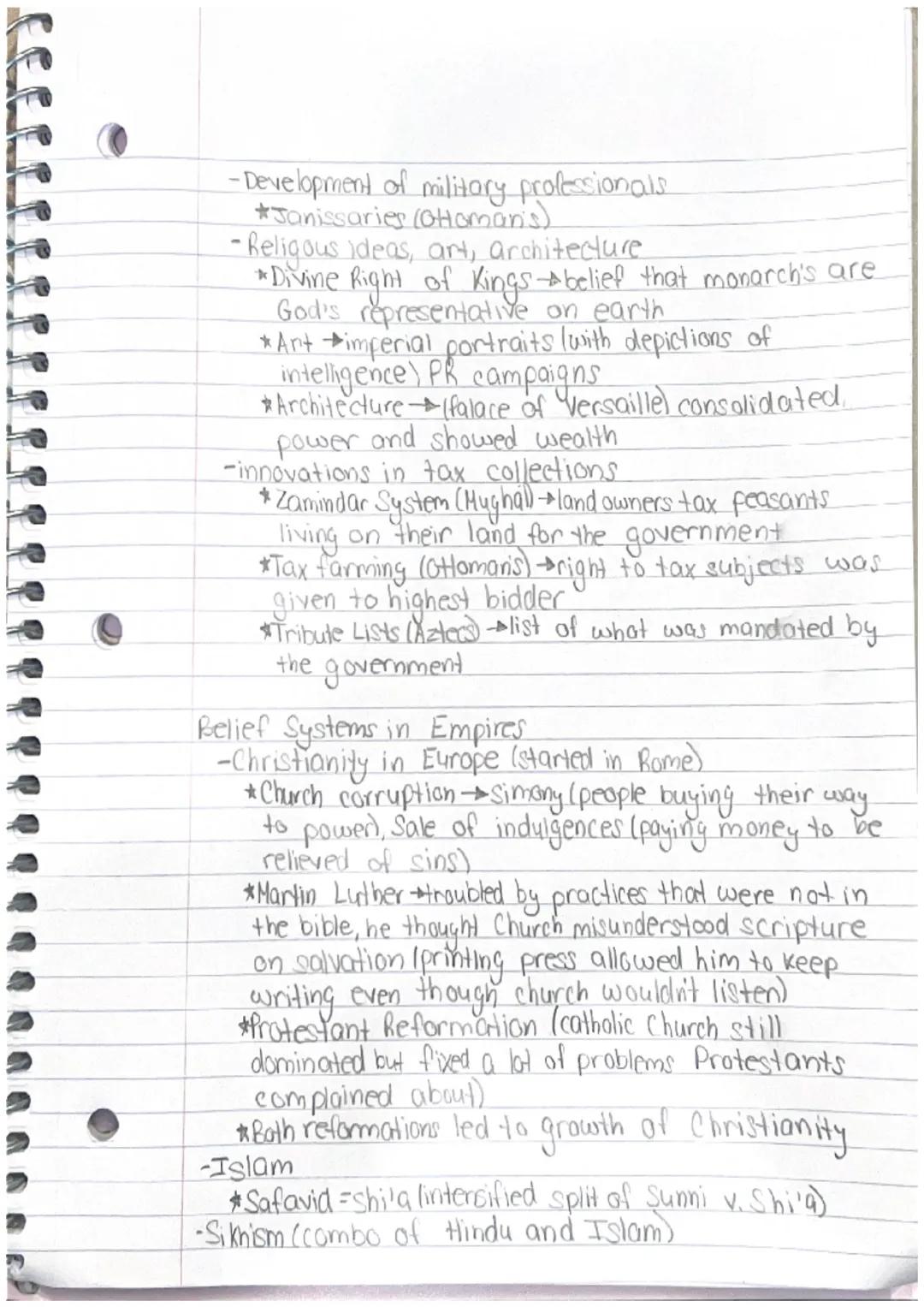
Empire Building and Religious Systems
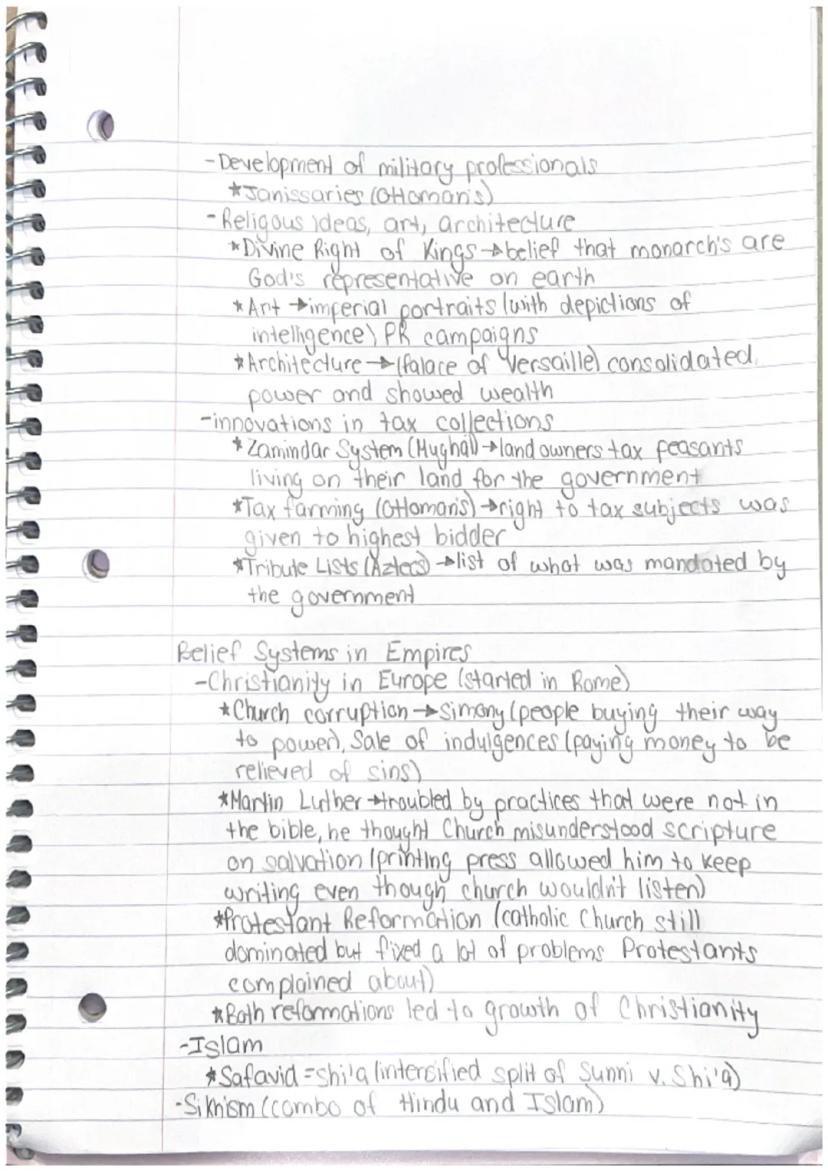
Empires used various techniques to strengthen their rule. They created religious justifications like the Divine Right of Kings, claiming monarchs represented God on earth. Imperial portraits depicting rulers as wise and powerful served as early public relations campaigns, while impressive architecture like the Palace of Versailles demonstrated wealth and consolidated power.
Tax collection innovations helped fund these massive states. The Mughals used the Zamindar System, where landowners collected taxes from peasants. The Ottomans practiced tax farming, auctioning tax collection rights to the highest bidder. The Aztecs maintained tribute lists detailing what subjects owed to the government.
Religious systems underwent significant changes during this period. In Europe, Christianity faced challenges due to church corruption including simony (selling church positions) and indulgences (paying to be relieved of sins). Martin Luther's criticisms, spread through the new printing press technology, sparked the Protestant Reformation.
Islam developed differently across empires. The Safavids' embrace of Shi'a Islam intensified the split with Sunni Muslims. Meanwhile, Sikhism emerged as a new faith combining elements of Hinduism and Islam.
Big Picture: While these empires often used similar techniques to maintain power, their different religious and cultural foundations led to unique governing styles and societal structures.
We thought you’d never ask...
What is the Knowunity AI companion?
Our AI companion is specifically built for the needs of students. Based on the millions of content pieces we have on the platform we can provide truly meaningful and relevant answers to students. But its not only about answers, the companion is even more about guiding students through their daily learning challenges, with personalised study plans, quizzes or content pieces in the chat and 100% personalisation based on the students skills and developments.
Where can I download the Knowunity app?
You can download the app in the Google Play Store and in the Apple App Store.
Is Knowunity really free of charge?
That's right! Enjoy free access to study content, connect with fellow students, and get instant help – all at your fingertips.
Similar Content
Most popular content: Gunpowder Empires
2Most popular content in AP World History
9O
AP World HistoryOrigins of Ancient River Civilizations
Analyze the environmental factors and technological innovations that led to the rise of early states in Mesopotamia, Egypt, and the Indus Valley.
9th3,1870
O
AP World HistoryOrigins and Continuity of the Byzantine Empire
Analyze the political and cultural transitions from the Roman Empire to the Byzantine Empire, focusing on the reign of Justinian I and his code.
9th1,6320
O
AP World HistoryOrigins of African State Building (1200-1450)
Analyze how trade networks and environmental factors influenced the formation of early states like Great Zimbabwe and the Swahili city-states.
9th9700
I
AP World HistoryIntroduction to Classical Civilizations
Master fundamental concepts, geographic locations, and the defining characteristics of major empires like Rome, Han China, and Maurya India.
9th7540
O
AP World HistoryOrigins of Indigenous Americas State Building
Analyze the foundational governance structures and environmental adaptations of the Maya, Aztec, and Inca civilizations between 1200 and 1450.
9th5070
1
AP World History1200-1450 CE quiz 1
Quiz on information about developments in East Asia, South Asia, the Middle East, and Europe at the time
10th2430
O
AP World HistoryOrigins of Economic Exchange Networks
Practice identifying the foundational environmental and technological factors that enabled Silk Road, Indian Ocean, and Trans-Saharan trade.
9th3370
S
AP World HistoryState Building in East Asia Developments
Analyze the administrative methods, such as the Confucian bureaucracy and tributary system, used by the Song Dynasty to maintain political power.
9th2730
I
AP World HistoryIntroduction to State Building and Administration
Practice analyzing how land-based empires used bureaucracies and military elites to consolidate power between 1450 and 1750.
9th2600
Most popular content
9O
 AP US History
Origins and Dynamics of the Columbian Exchange
Analyze the ecological and economic motivations behind the initial transfer of goods, people, and diseases between the Old and New Worlds.
9th3,1280
I
AP US HistoryIntroduction to Early Cultural Interactions
Analyze the initial social and religious encounters between Europeans, Africans, and Indigenous peoples in the colonial Americas.
9th2,7730
O
AP World HistoryOrigins of Ancient River Civilizations
Analyze the environmental factors and technological innovations that led to the rise of early states in Mesopotamia, Egypt, and the Indus Valley.
9th3,1870
M
AP US HistoryMotivations for European Exploration
Analyze the economic, religious, and political factors that drove European powers to the Americas during the 15th and 16th centuries.
9th1,7780
F
 AP Psychology
Foundations of Ethical Guidelines in Research
Practice the core principles of the APA ethical code including informed consent, debriefing, and the role of Institutional Review Boards.
9th1,3360
I
AP US HistoryIntroduction to Native American Societies
Examine the diverse social, political, and economic structures of North American indigenous groups prior to European contact.
9th1,1100
I
 AP Biology
Introduction to Biological Elements of Life
Practice identifying the essential elements including carbon, nitrogen, phosphorus, and sulfur that compose biological macromolecules.
9th1,7390
I
AP US HistoryIntroduction to the Spanish Encomienda System
Explore the fundamental economic and social structures of the Spanish colonial system, focusing on the encomienda and the casta social hierarchy.
9th8890
O
AP World HistoryOrigins and Continuity of the Byzantine Empire
Analyze the political and cultural transitions from the Roman Empire to the Byzantine Empire, focusing on the reign of Justinian I and his code.
9th1,6320
Can't find what you're looking for? Explore other subjects.
Students love us — and so will you.
4.6/5App Store
4.7/5Google Play
The app is very easy to use and well designed. I have found everything I was looking for so far and have been able to learn a lot from the presentations! I will definitely use the app for a class assignment! And of course it also helps a lot as an inspiration.
Stefan SiOS user
This app is really great. There are so many study notes and help [...]. My problem subject is French, for example, and the app has so many options for help. Thanks to this app, I have improved my French. I would recommend it to anyone.
Samantha KlichAndroid user
Wow, I am really amazed. I just tried the app because I've seen it advertised many times and was absolutely stunned. This app is THE HELP you want for school and above all, it offers so many things, such as workouts and fact sheets, which have been VERY helpful to me personally.
AnnaiOS user
AP World History55 views·Updated Jun 7, 2026·3 pagesThe Growth of Major Land Empires: Ottoman, Safavid, Mughal, and Qing
K
Kaitlyn@aitlyn_kjzcqssbsciny
Land-based empires dominated world politics from 1450-1750, expanding their territories through military might and administrative systems. During this era, the Ottoman Empire, Safavid Empire, Mughal Empire, and Qing Dynasty emerged as powerful forces, each with unique governing approaches and religious...
1
of 3
Sign up to see the content. It's free!
- Access to all documents
- Improve your grades
- Join milions of students
Major Land-Based Empires (1450-1750)
Ever wonder how empires became so powerful centuries ago? Land-based empires gained their strength through territorial expansion, administrative systems, and promoting specific belief systems. These massive political entities dominated the world stage during the early modern period.
The Ottoman Empire, ruled by Sunni Muslims, expanded rapidly using gunpowder weapons that had spread through trade routes from China. They conquered Constantinople (renaming it Istanbul), the heart of the former Roman Empire, before pushing into Eastern Europe. The Ottomans enslaved Christians, converted them to Islam, and trained some as elite Janissaries for their military.
The Safavid Empire practiced Shi'a Islam and controlled much of the Middle East. Unlike the Ottomans, Safavid rulers had to be blood relatives of Muhammad. They also expanded quickly using gunpowder technology but faced challenges due to a lack of natural defensive barriers. The Safavids were ruled by a Shah and maintained an enslaved army.
Did You Know? While both the Ottoman and Safavid empires were Islamic, their different branches of Islam (Sunni vs. Shi'a) created intense rivalries and conflicts between these powerful neighbors.
2
of 3Sign up to see the content. It's free!
- Access to all documents
- Improve your grades
- Join milions of students
Empire Expansion and Administration
The Mughal Empire overthrew the Delhi Sultanate and rapidly grew through military campaigns. Under Emperor Akbar, the empire thrived due to his religious tolerance—allowing prosperity despite being Muslim rulers governing a predominantly Hindu population.
The Qing Dynasty replaced the ethnically Han Ming Dynasty in China. The Manchu people established the Qing and, like other land empires of this period, expanded quickly by leveraging gunpowder technology.
All these land-based empires shared common features: rapid expansion, effective use of gunpowder weapons, and (in the case of the Qing and Mughals) rulers who were ethnically different from most of their subjects. Their rivalries often centered on border disputes and religious differences.
To maintain control, empires developed sophisticated administrative methods including large bureaucracies. The Ottomans implemented the Devshirme system, where promising enslaved Christians were trained for government positions. Military professionals like the Janissaries became crucial to imperial power.
Remember This: Rulers had to both "legitimize" their authority (establish why they deserved to rule) and "consolidate" their power (transfer authority from other groups to themselves) to maintain stable empires.
3
of 3Sign up to see the content. It's free!
- Access to all documents
- Improve your grades
- Join milions of students
Empire Building and Religious Systems
Empires used various techniques to strengthen their rule. They created religious justifications like the Divine Right of Kings, claiming monarchs represented God on earth. Imperial portraits depicting rulers as wise and powerful served as early public relations campaigns, while impressive architecture like the Palace of Versailles demonstrated wealth and consolidated power.
Tax collection innovations helped fund these massive states. The Mughals used the Zamindar System, where landowners collected taxes from peasants. The Ottomans practiced tax farming, auctioning tax collection rights to the highest bidder. The Aztecs maintained tribute lists detailing what subjects owed to the government.
Religious systems underwent significant changes during this period. In Europe, Christianity faced challenges due to church corruption including simony (selling church positions) and indulgences (paying to be relieved of sins). Martin Luther's criticisms, spread through the new printing press technology, sparked the Protestant Reformation.
Islam developed differently across empires. The Safavids' embrace of Shi'a Islam intensified the split with Sunni Muslims. Meanwhile, Sikhism emerged as a new faith combining elements of Hinduism and Islam.
Big Picture: While these empires often used similar techniques to maintain power, their different religious and cultural foundations led to unique governing styles and societal structures.
We thought you’d never ask...
What is the Knowunity AI companion?
Our AI companion is specifically built for the needs of students. Based on the millions of content pieces we have on the platform we can provide truly meaningful and relevant answers to students. But its not only about answers, the companion is even more about guiding students through their daily learning challenges, with personalised study plans, quizzes or content pieces in the chat and 100% personalisation based on the students skills and developments.
Where can I download the Knowunity app?
You can download the app in the Google Play Store and in the Apple App Store.
Is Knowunity really free of charge?
That's right! Enjoy free access to study content, connect with fellow students, and get instant help – all at your fingertips.
Similar Content
Most popular content: Gunpowder Empires
2Most popular content in AP World History
9O
AP World HistoryOrigins of Ancient River Civilizations
Analyze the environmental factors and technological innovations that led to the rise of early states in Mesopotamia, Egypt, and the Indus Valley.
9th3,1870
O
AP World HistoryOrigins and Continuity of the Byzantine Empire
Analyze the political and cultural transitions from the Roman Empire to the Byzantine Empire, focusing on the reign of Justinian I and his code.
9th1,6320
O
AP World HistoryOrigins of African State Building (1200-1450)
Analyze how trade networks and environmental factors influenced the formation of early states like Great Zimbabwe and the Swahili city-states.
9th9700
I
AP World HistoryIntroduction to Classical Civilizations
Master fundamental concepts, geographic locations, and the defining characteristics of major empires like Rome, Han China, and Maurya India.
9th7540
O
AP World HistoryOrigins of Indigenous Americas State Building
Analyze the foundational governance structures and environmental adaptations of the Maya, Aztec, and Inca civilizations between 1200 and 1450.
9th5070
1
AP World History1200-1450 CE quiz 1
Quiz on information about developments in East Asia, South Asia, the Middle East, and Europe at the time
10th2430
O
AP World HistoryOrigins of Economic Exchange Networks
Practice identifying the foundational environmental and technological factors that enabled Silk Road, Indian Ocean, and Trans-Saharan trade.
9th3370
S
AP World HistoryState Building in East Asia Developments
Analyze the administrative methods, such as the Confucian bureaucracy and tributary system, used by the Song Dynasty to maintain political power.
9th2730
I
AP World HistoryIntroduction to State Building and Administration
Practice analyzing how land-based empires used bureaucracies and military elites to consolidate power between 1450 and 1750.
9th2600
Most popular content
9O
AP US HistoryOrigins and Dynamics of the Columbian Exchange
Analyze the ecological and economic motivations behind the initial transfer of goods, people, and diseases between the Old and New Worlds.
9th3,1280
I
AP US HistoryIntroduction to Early Cultural Interactions
Analyze the initial social and religious encounters between Europeans, Africans, and Indigenous peoples in the colonial Americas.
9th2,7730
O
AP World HistoryOrigins of Ancient River Civilizations
Analyze the environmental factors and technological innovations that led to the rise of early states in Mesopotamia, Egypt, and the Indus Valley.
9th3,1870
M
AP US HistoryMotivations for European Exploration
Analyze the economic, religious, and political factors that drove European powers to the Americas during the 15th and 16th centuries.
9th1,7780
F
AP PsychologyFoundations of Ethical Guidelines in Research
Practice the core principles of the APA ethical code including informed consent, debriefing, and the role of Institutional Review Boards.
9th1,3360
I
AP US HistoryIntroduction to Native American Societies
Examine the diverse social, political, and economic structures of North American indigenous groups prior to European contact.
9th1,1100
I
AP BiologyIntroduction to Biological Elements of Life
Practice identifying the essential elements including carbon, nitrogen, phosphorus, and sulfur that compose biological macromolecules.
9th1,7390
I
AP US HistoryIntroduction to the Spanish Encomienda System
Explore the fundamental economic and social structures of the Spanish colonial system, focusing on the encomienda and the casta social hierarchy.
9th8890
O
AP World HistoryOrigins and Continuity of the Byzantine Empire
Analyze the political and cultural transitions from the Roman Empire to the Byzantine Empire, focusing on the reign of Justinian I and his code.
9th1,6320
Can't find what you're looking for? Explore other subjects.
Students love us — and so will you.
4.6/5App Store
4.7/5Google Play
The app is very easy to use and well designed. I have found everything I was looking for so far and have been able to learn a lot from the presentations! I will definitely use the app for a class assignment! And of course it also helps a lot as an inspiration.
Stefan SiOS user
This app is really great. There are so many study notes and help [...]. My problem subject is French, for example, and the app has so many options for help. Thanks to this app, I have improved my French. I would recommend it to anyone.
Samantha KlichAndroid user
Wow, I am really amazed. I just tried the app because I've seen it advertised many times and was absolutely stunned. This app is THE HELP you want for school and above all, it offers so many things, such as workouts and fact sheets, which have been VERY helpful to me personally.
AnnaiOS user