
Welcome to your World History review covering key developments across...
 AP World History523 views·Updated Jun 8, 2026·3 pages
Unit 1 Review: AP World History Prep

skoot@skoot

1 / 3
1
of 3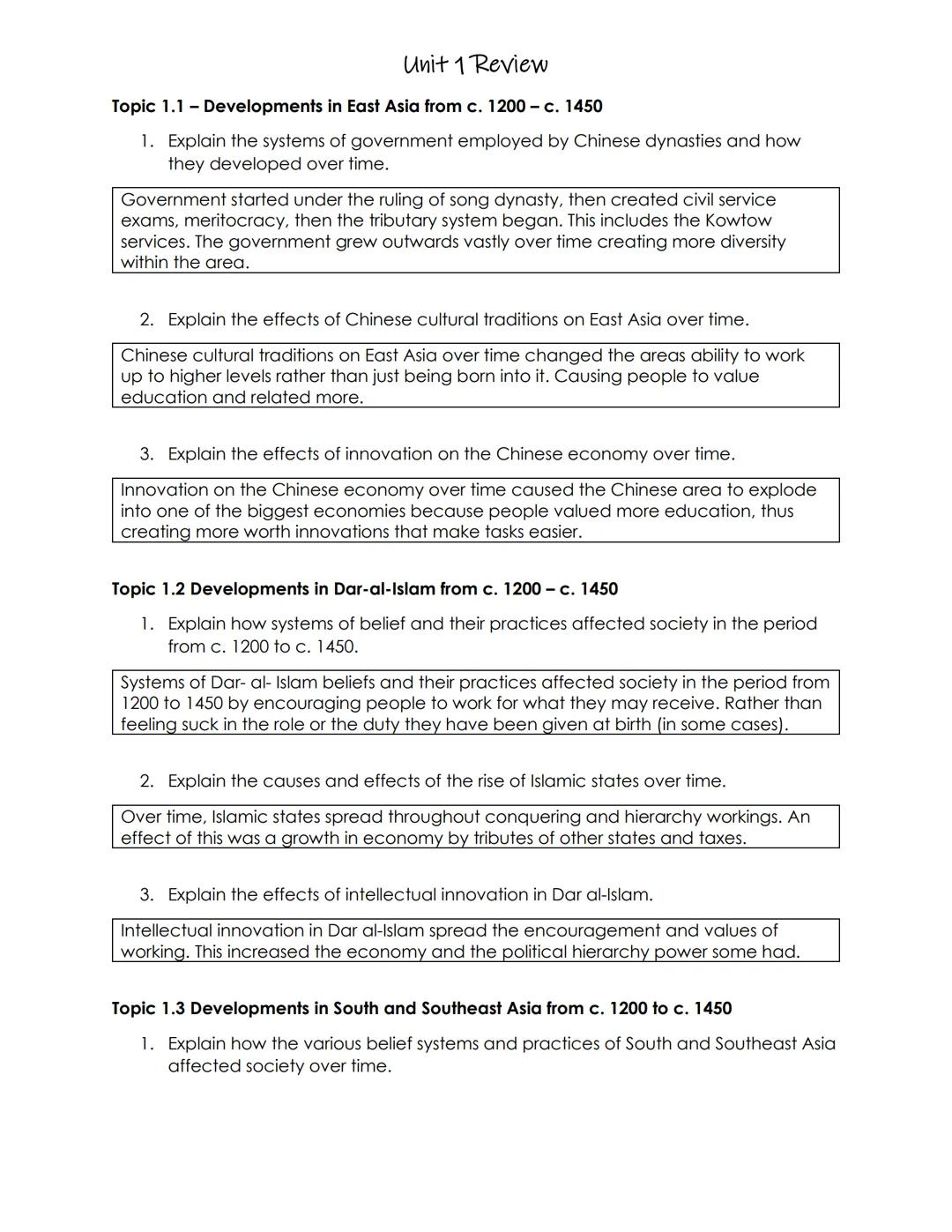
East Asia and Islamic World
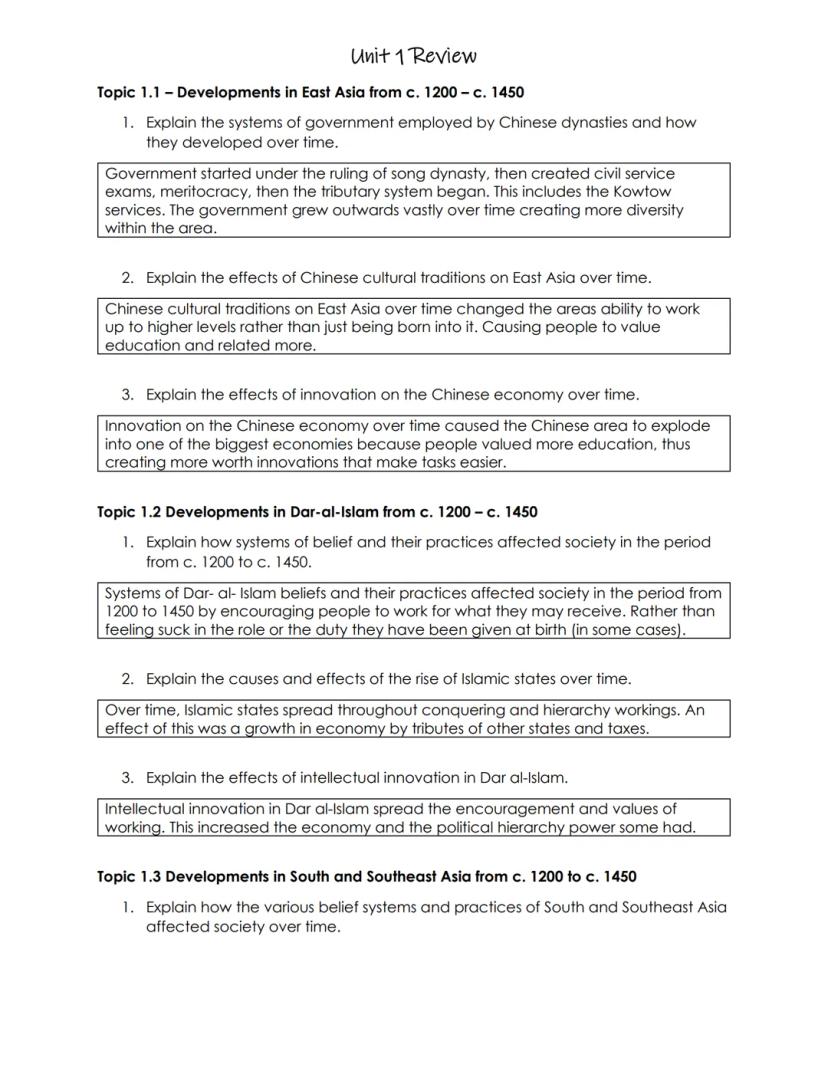
Chinese dynasties evolved from the Song Dynasty's civil service exams to create a meritocracy based on education rather than birth status. This system spread through the tributary system, where neighboring states paid homage (including the Kowtow ritual) in exchange for trade privileges and protection. These cultural traditions transformed East Asia by emphasizing education and creating social mobility.
China's economy flourished during this period thanks to innovations that streamlined production and commerce. As people valued education more, they developed new technologies that made daily tasks easier, establishing China as one of the world's dominant economic powers.
In the Islamic world , religious beliefs encouraged social advancement through personal achievement rather than accepting predetermined roles. Islamic states expanded through conquest and developed sophisticated political hierarchies, collecting tributes and taxes that strengthened their economies.
Did you know? Both Chinese and Islamic societies of this period valued education and merit-based advancement, creating opportunities for talented individuals regardless of birth status - a revolutionary concept for the medieval world!
2
of 3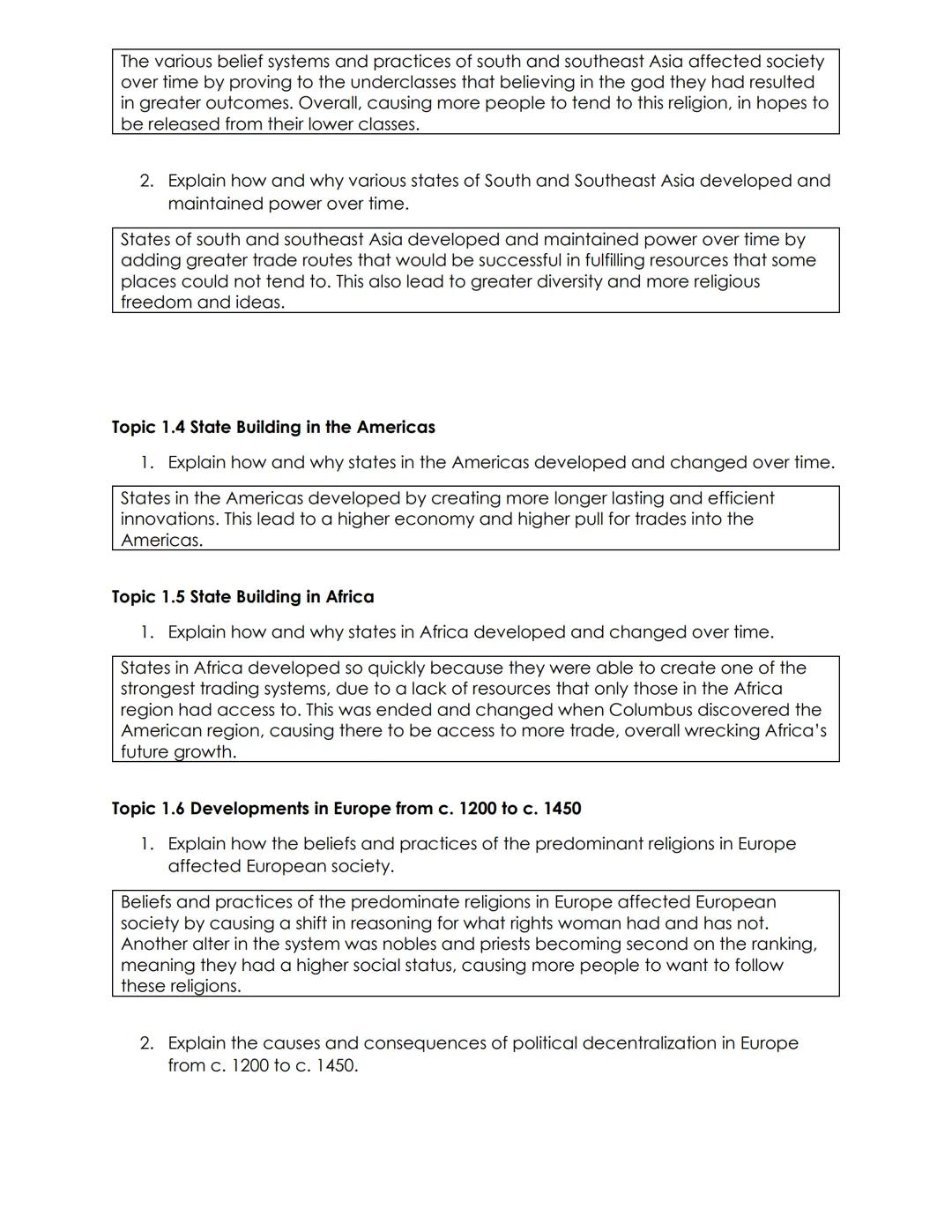
South/Southeast Asia and the Americas
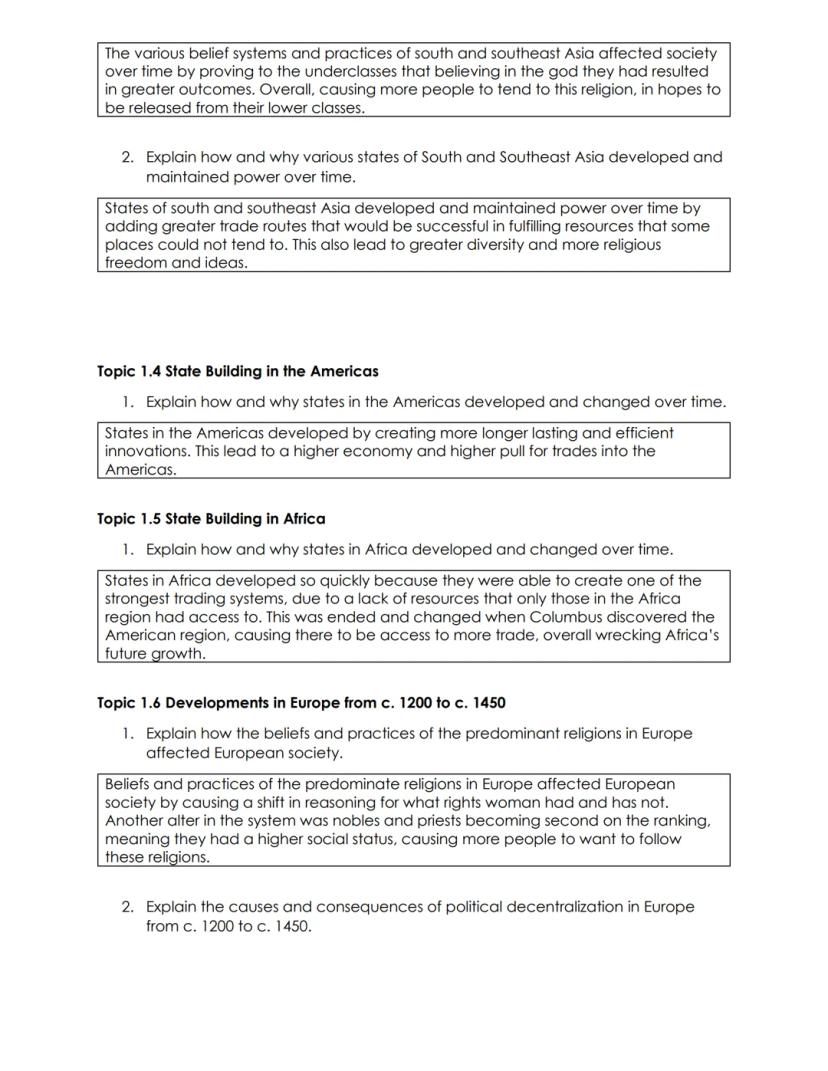
In South and Southeast Asia, belief systems profoundly shaped society by offering lower classes hope for spiritual advancement. Many embraced these religions seeking liberation from their social standing. The region's states maintained power by developing extensive trade networks that connected resource-rich areas with markets, promoting religious tolerance and cultural exchange along these routes.
States in the Americas underwent significant transformation during this period through technological innovation. They developed more durable tools and efficient agricultural methods that boosted economic output. These advancements made American states more attractive trading partners and accelerated their development.
African states thrived by controlling exclusive resources that were unavailable elsewhere. They established robust trading systems that brought tremendous wealth to the region. However, this prosperity faced challenges when Columbus's voyages opened new trade routes, redirecting commerce away from Africa and dramatically altering its growth trajectory.
Think about it: Trade was the great equalizer of the medieval world - regions that controlled unique resources or strategic routes gained power regardless of their military might. How might this compare to economic power today?
3
of 3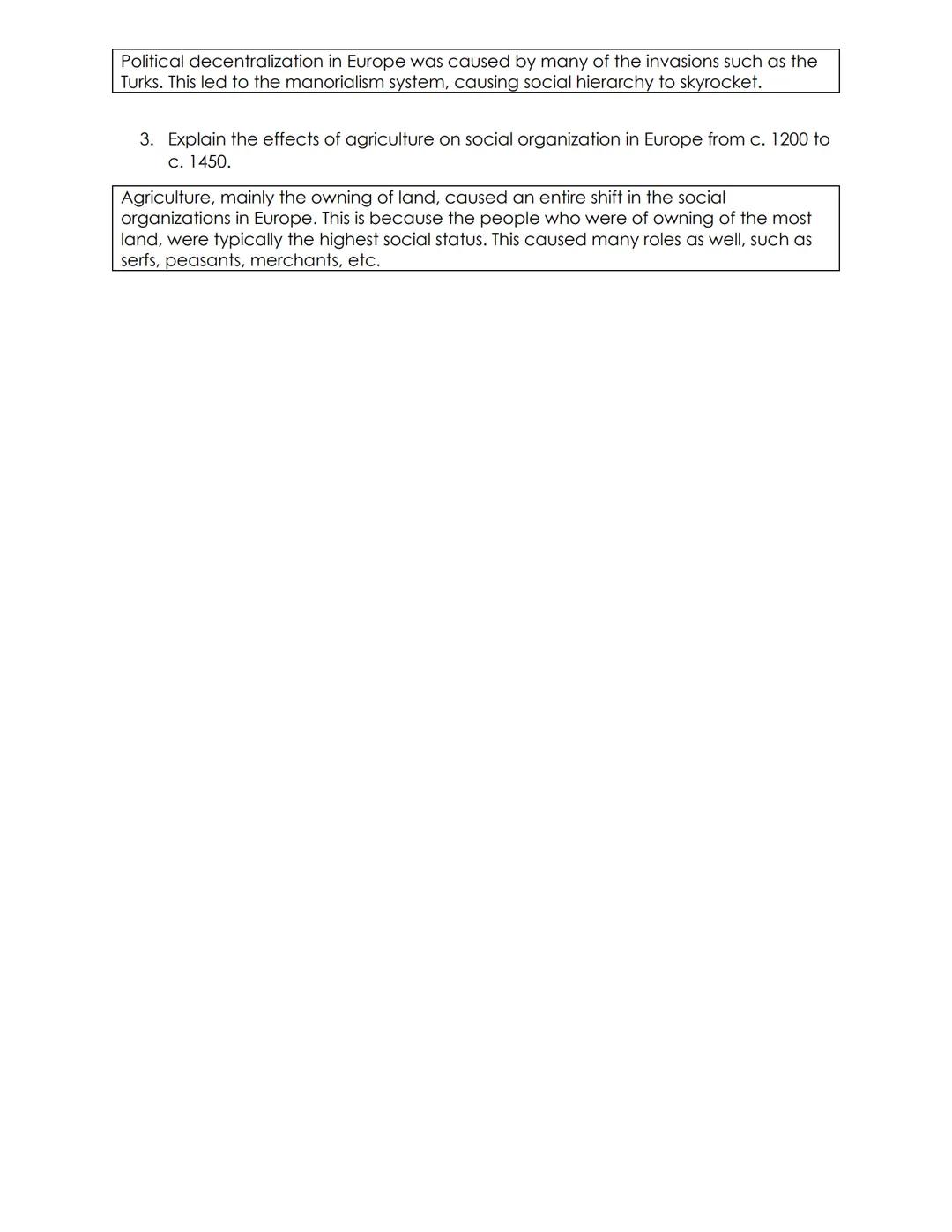
European Developments
Europe's dominant religions significantly influenced social structures, particularly regarding women's roles and rights. The system elevated nobles and priests to privileged positions in the social hierarchy, motivating more people to adhere to these faiths for potential social advancement.
Political power in Europe became increasingly decentralized following invasions, particularly by Turkish forces. This fragmentation led to the rise of manorialism, a system where local lords controlled territories with minimal central authority, intensifying social stratification throughout the continent.
Agricultural control, especially land ownership, fundamentally reshaped European society during this period. Those who owned the most land typically held the highest social status, creating a rigid structure of roles including serfs, peasants, merchants, and nobles. This land-based hierarchy would define European social organization for centuries.
Connection point: Compare how different regions created social hierarchies - China used education and exams, Islamic states used religious devotion, and Europe primarily used land ownership. Which system would have offered more opportunity to someone born poor?
We thought you’d never ask...
What is the Knowunity AI companion?
Our AI companion is specifically built for the needs of students. Based on the millions of content pieces we have on the platform we can provide truly meaningful and relevant answers to students. But its not only about answers, the companion is even more about guiding students through their daily learning challenges, with personalised study plans, quizzes or content pieces in the chat and 100% personalisation based on the students skills and developments.
Where can I download the Knowunity app?
You can download the app in the Google Play Store and in the Apple App Store.
Is Knowunity really free of charge?
That's right! Enjoy free access to study content, connect with fellow students, and get instant help – all at your fingertips.
Similar Content
Most popular content in AP World History
9O
AP World HistoryOrigins of Ancient River Civilizations
Analyze the environmental factors and technological innovations that led to the rise of early states in Mesopotamia, Egypt, and the Indus Valley.
9th3,1870
O
AP World HistoryOrigins and Continuity of the Byzantine Empire
Analyze the political and cultural transitions from the Roman Empire to the Byzantine Empire, focusing on the reign of Justinian I and his code.
9th1,6320
O
AP World HistoryOrigins of African State Building (1200-1450)
Analyze how trade networks and environmental factors influenced the formation of early states like Great Zimbabwe and the Swahili city-states.
9th9700
I
AP World HistoryIntroduction to Classical Civilizations
Master fundamental concepts, geographic locations, and the defining characteristics of major empires like Rome, Han China, and Maurya India.
9th7540
O
AP World HistoryOrigins of Indigenous Americas State Building
Analyze the foundational governance structures and environmental adaptations of the Maya, Aztec, and Inca civilizations between 1200 and 1450.
9th5070
1
AP World History1200-1450 CE quiz 1
Quiz on information about developments in East Asia, South Asia, the Middle East, and Europe at the time
10th2430
O
AP World HistoryOrigins of Economic Exchange Networks
Practice identifying the foundational environmental and technological factors that enabled Silk Road, Indian Ocean, and Trans-Saharan trade.
9th3370
S
AP World HistoryState Building in East Asia Developments
Analyze the administrative methods, such as the Confucian bureaucracy and tributary system, used by the Song Dynasty to maintain political power.
9th2730
I
AP World HistoryIntroduction to State Building and Administration
Practice analyzing how land-based empires used bureaucracies and military elites to consolidate power between 1450 and 1750.
9th2600
Most popular content
9O
 AP US History
Origins and Dynamics of the Columbian Exchange
Analyze the ecological and economic motivations behind the initial transfer of goods, people, and diseases between the Old and New Worlds.
9th3,1280
I
AP US HistoryIntroduction to Early Cultural Interactions
Analyze the initial social and religious encounters between Europeans, Africans, and Indigenous peoples in the colonial Americas.
9th2,7730
O
AP World HistoryOrigins of Ancient River Civilizations
Analyze the environmental factors and technological innovations that led to the rise of early states in Mesopotamia, Egypt, and the Indus Valley.
9th3,1870
M
AP US HistoryMotivations for European Exploration
Analyze the economic, religious, and political factors that drove European powers to the Americas during the 15th and 16th centuries.
9th1,7780
F
 AP Psychology
Foundations of Ethical Guidelines in Research
Practice the core principles of the APA ethical code including informed consent, debriefing, and the role of Institutional Review Boards.
9th1,3360
I
AP US HistoryIntroduction to Native American Societies
Examine the diverse social, political, and economic structures of North American indigenous groups prior to European contact.
9th1,1100
I
 AP Biology
Introduction to Biological Elements of Life
Practice identifying the essential elements including carbon, nitrogen, phosphorus, and sulfur that compose biological macromolecules.
9th1,7390
I
AP US HistoryIntroduction to the Spanish Encomienda System
Explore the fundamental economic and social structures of the Spanish colonial system, focusing on the encomienda and the casta social hierarchy.
9th8890
O
AP World HistoryOrigins and Continuity of the Byzantine Empire
Analyze the political and cultural transitions from the Roman Empire to the Byzantine Empire, focusing on the reign of Justinian I and his code.
9th1,6320
Can't find what you're looking for? Explore other subjects.
Students love us — and so will you.
4.6/5App Store
4.7/5Google Play
The app is very easy to use and well designed. I have found everything I was looking for so far and have been able to learn a lot from the presentations! I will definitely use the app for a class assignment! And of course it also helps a lot as an inspiration.
Stefan SiOS user
This app is really great. There are so many study notes and help [...]. My problem subject is French, for example, and the app has so many options for help. Thanks to this app, I have improved my French. I would recommend it to anyone.
Samantha KlichAndroid user
Wow, I am really amazed. I just tried the app because I've seen it advertised many times and was absolutely stunned. This app is THE HELP you want for school and above all, it offers so many things, such as workouts and fact sheets, which have been VERY helpful to me personally.
AnnaiOS user
AP World History523 views·Updated Jun 8, 2026·3 pagesUnit 1 Review: AP World History Prep
skoot@skoot
Welcome to your World History review covering key developments across major regions from 1200-1450 CE. This period saw the rise of powerful empires, evolving political systems, and expanding trade networks that transformed societies across Asia, Africa, Europe, and the Americas.
1
of 3
Sign up to see the content. It's free!
- Access to all documents
- Improve your grades
- Join milions of students
East Asia and Islamic World
Chinese dynasties evolved from the Song Dynasty's civil service exams to create a meritocracy based on education rather than birth status. This system spread through the tributary system, where neighboring states paid homage (including the Kowtow ritual) in exchange for trade privileges and protection. These cultural traditions transformed East Asia by emphasizing education and creating social mobility.
China's economy flourished during this period thanks to innovations that streamlined production and commerce. As people valued education more, they developed new technologies that made daily tasks easier, establishing China as one of the world's dominant economic powers.
In the Islamic world , religious beliefs encouraged social advancement through personal achievement rather than accepting predetermined roles. Islamic states expanded through conquest and developed sophisticated political hierarchies, collecting tributes and taxes that strengthened their economies.
Did you know? Both Chinese and Islamic societies of this period valued education and merit-based advancement, creating opportunities for talented individuals regardless of birth status - a revolutionary concept for the medieval world!
2
of 3Sign up to see the content. It's free!
- Access to all documents
- Improve your grades
- Join milions of students
South/Southeast Asia and the Americas
In South and Southeast Asia, belief systems profoundly shaped society by offering lower classes hope for spiritual advancement. Many embraced these religions seeking liberation from their social standing. The region's states maintained power by developing extensive trade networks that connected resource-rich areas with markets, promoting religious tolerance and cultural exchange along these routes.
States in the Americas underwent significant transformation during this period through technological innovation. They developed more durable tools and efficient agricultural methods that boosted economic output. These advancements made American states more attractive trading partners and accelerated their development.
African states thrived by controlling exclusive resources that were unavailable elsewhere. They established robust trading systems that brought tremendous wealth to the region. However, this prosperity faced challenges when Columbus's voyages opened new trade routes, redirecting commerce away from Africa and dramatically altering its growth trajectory.
Think about it: Trade was the great equalizer of the medieval world - regions that controlled unique resources or strategic routes gained power regardless of their military might. How might this compare to economic power today?
3
of 3Sign up to see the content. It's free!
- Access to all documents
- Improve your grades
- Join milions of students
European Developments
Europe's dominant religions significantly influenced social structures, particularly regarding women's roles and rights. The system elevated nobles and priests to privileged positions in the social hierarchy, motivating more people to adhere to these faiths for potential social advancement.
Political power in Europe became increasingly decentralized following invasions, particularly by Turkish forces. This fragmentation led to the rise of manorialism, a system where local lords controlled territories with minimal central authority, intensifying social stratification throughout the continent.
Agricultural control, especially land ownership, fundamentally reshaped European society during this period. Those who owned the most land typically held the highest social status, creating a rigid structure of roles including serfs, peasants, merchants, and nobles. This land-based hierarchy would define European social organization for centuries.
Connection point: Compare how different regions created social hierarchies - China used education and exams, Islamic states used religious devotion, and Europe primarily used land ownership. Which system would have offered more opportunity to someone born poor?
We thought you’d never ask...
What is the Knowunity AI companion?
Our AI companion is specifically built for the needs of students. Based on the millions of content pieces we have on the platform we can provide truly meaningful and relevant answers to students. But its not only about answers, the companion is even more about guiding students through their daily learning challenges, with personalised study plans, quizzes or content pieces in the chat and 100% personalisation based on the students skills and developments.
Where can I download the Knowunity app?
You can download the app in the Google Play Store and in the Apple App Store.
Is Knowunity really free of charge?
That's right! Enjoy free access to study content, connect with fellow students, and get instant help – all at your fingertips.
Similar Content
Most popular content in AP World History
9O
AP World HistoryOrigins of Ancient River Civilizations
Analyze the environmental factors and technological innovations that led to the rise of early states in Mesopotamia, Egypt, and the Indus Valley.
9th3,1870
O
AP World HistoryOrigins and Continuity of the Byzantine Empire
Analyze the political and cultural transitions from the Roman Empire to the Byzantine Empire, focusing on the reign of Justinian I and his code.
9th1,6320
O
AP World HistoryOrigins of African State Building (1200-1450)
Analyze how trade networks and environmental factors influenced the formation of early states like Great Zimbabwe and the Swahili city-states.
9th9700
I
AP World HistoryIntroduction to Classical Civilizations
Master fundamental concepts, geographic locations, and the defining characteristics of major empires like Rome, Han China, and Maurya India.
9th7540
O
AP World HistoryOrigins of Indigenous Americas State Building
Analyze the foundational governance structures and environmental adaptations of the Maya, Aztec, and Inca civilizations between 1200 and 1450.
9th5070
1
AP World History1200-1450 CE quiz 1
Quiz on information about developments in East Asia, South Asia, the Middle East, and Europe at the time
10th2430
O
AP World HistoryOrigins of Economic Exchange Networks
Practice identifying the foundational environmental and technological factors that enabled Silk Road, Indian Ocean, and Trans-Saharan trade.
9th3370
S
AP World HistoryState Building in East Asia Developments
Analyze the administrative methods, such as the Confucian bureaucracy and tributary system, used by the Song Dynasty to maintain political power.
9th2730
I
AP World HistoryIntroduction to State Building and Administration
Practice analyzing how land-based empires used bureaucracies and military elites to consolidate power between 1450 and 1750.
9th2600
Most popular content
9O
AP US HistoryOrigins and Dynamics of the Columbian Exchange
Analyze the ecological and economic motivations behind the initial transfer of goods, people, and diseases between the Old and New Worlds.
9th3,1280
I
AP US HistoryIntroduction to Early Cultural Interactions
Analyze the initial social and religious encounters between Europeans, Africans, and Indigenous peoples in the colonial Americas.
9th2,7730
O
AP World HistoryOrigins of Ancient River Civilizations
Analyze the environmental factors and technological innovations that led to the rise of early states in Mesopotamia, Egypt, and the Indus Valley.
9th3,1870
M
AP US HistoryMotivations for European Exploration
Analyze the economic, religious, and political factors that drove European powers to the Americas during the 15th and 16th centuries.
9th1,7780
F
AP PsychologyFoundations of Ethical Guidelines in Research
Practice the core principles of the APA ethical code including informed consent, debriefing, and the role of Institutional Review Boards.
9th1,3360
I
AP US HistoryIntroduction to Native American Societies
Examine the diverse social, political, and economic structures of North American indigenous groups prior to European contact.
9th1,1100
I
AP BiologyIntroduction to Biological Elements of Life
Practice identifying the essential elements including carbon, nitrogen, phosphorus, and sulfur that compose biological macromolecules.
9th1,7390
I
AP US HistoryIntroduction to the Spanish Encomienda System
Explore the fundamental economic and social structures of the Spanish colonial system, focusing on the encomienda and the casta social hierarchy.
9th8890
O
AP World HistoryOrigins and Continuity of the Byzantine Empire
Analyze the political and cultural transitions from the Roman Empire to the Byzantine Empire, focusing on the reign of Justinian I and his code.
9th1,6320
Can't find what you're looking for? Explore other subjects.
Students love us — and so will you.
4.6/5App Store
4.7/5Google Play
The app is very easy to use and well designed. I have found everything I was looking for so far and have been able to learn a lot from the presentations! I will definitely use the app for a class assignment! And of course it also helps a lot as an inspiration.
Stefan SiOS user
This app is really great. There are so many study notes and help [...]. My problem subject is French, for example, and the app has so many options for help. Thanks to this app, I have improved my French. I would recommend it to anyone.
Samantha KlichAndroid user
Wow, I am really amazed. I just tried the app because I've seen it advertised many times and was absolutely stunned. This app is THE HELP you want for school and above all, it offers so many things, such as workouts and fact sheets, which have been VERY helpful to me personally.
AnnaiOS user