
Spain and Portugal were pioneers in global trade during 1450-1750,...
 AP World History49 views·Updated Jun 13, 2026·3 pages
Spain and Portugal's History: 1450-1750 Overview

Kiki@kikiwikii
1 / 3
1
of 3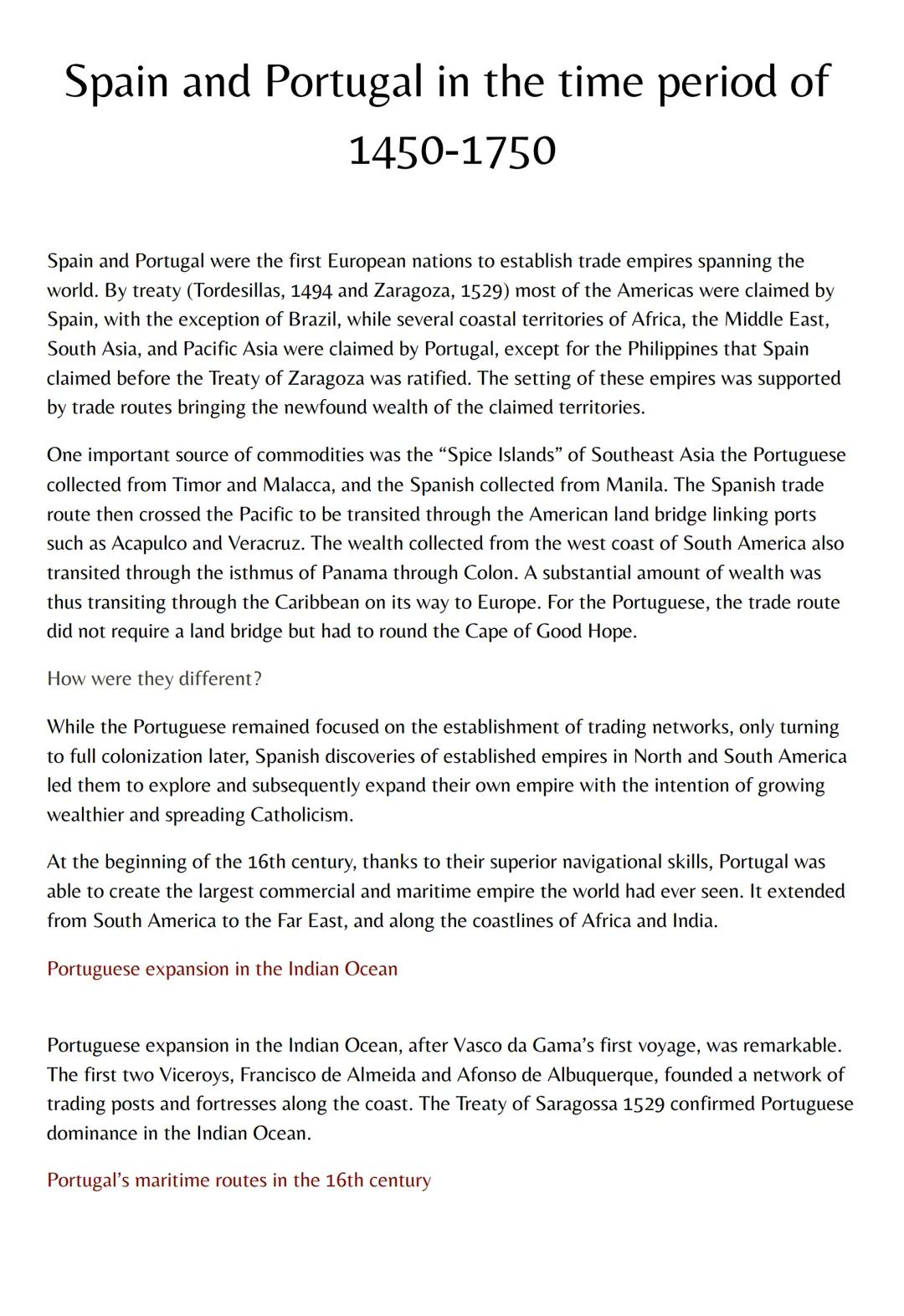
Spanish and Portuguese Empires: Foundations
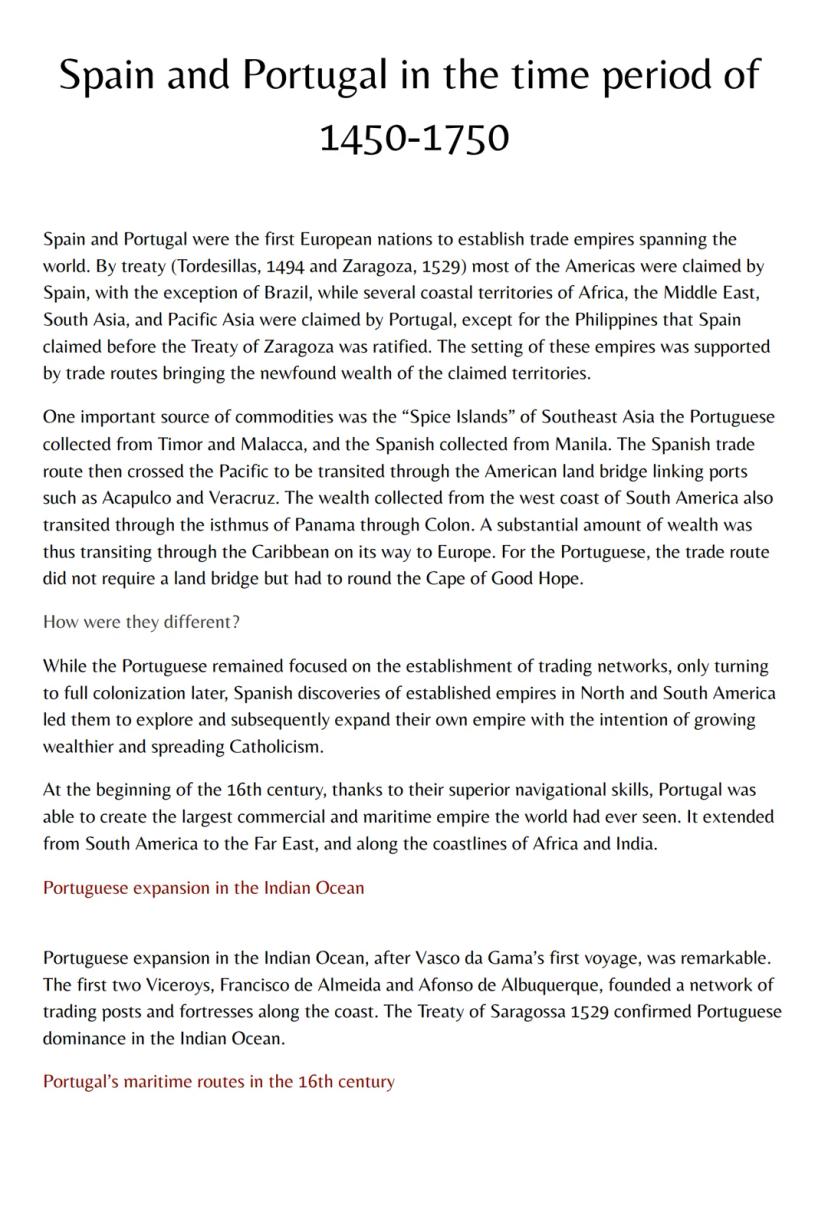
The year 1494 marked a pivotal moment in world history when Spain and Portugal officially divided the globe between them through the Treaty of Tordesillas. This agreement gave Spain rights to most of the Americas (except Brazil), while Portugal claimed territories across Africa, the Middle East, South Asia, and parts of the Pacific. The Philippines remained a Spanish territory following the Treaty of Zaragoza in 1529.
These empires were built on sophisticated trade networks that transported valuable commodities across vast distances. The "Spice Islands" of Southeast Asia provided lucrative goods that the Portuguese collected from Timor and Malacca, while Spain gathered resources from Manila. Spanish ships then crossed the Pacific to ports like Acapulco and Veracruz, creating a complex trade system through the Caribbean.
The two empires developed different approaches to expansion. Portugal initially focused on establishing trading networks before turning to full colonization. Their superior navigational skills helped them create what was then the world's largest maritime empire, stretching from South America to the Far East. Meanwhile, Spain discovered established civilizations in the Americas and pursued colonization with dual goals of wealth accumulation and spreading Catholicism.
Did you know? Portuguese explorer Vasco da Gama's voyages transformed global trade by establishing a direct sea route to India, allowing Portugal to bypass Arab intermediaries who had previously controlled these valuable trade connections.
2
of 3
Conquests and Territorial Organization
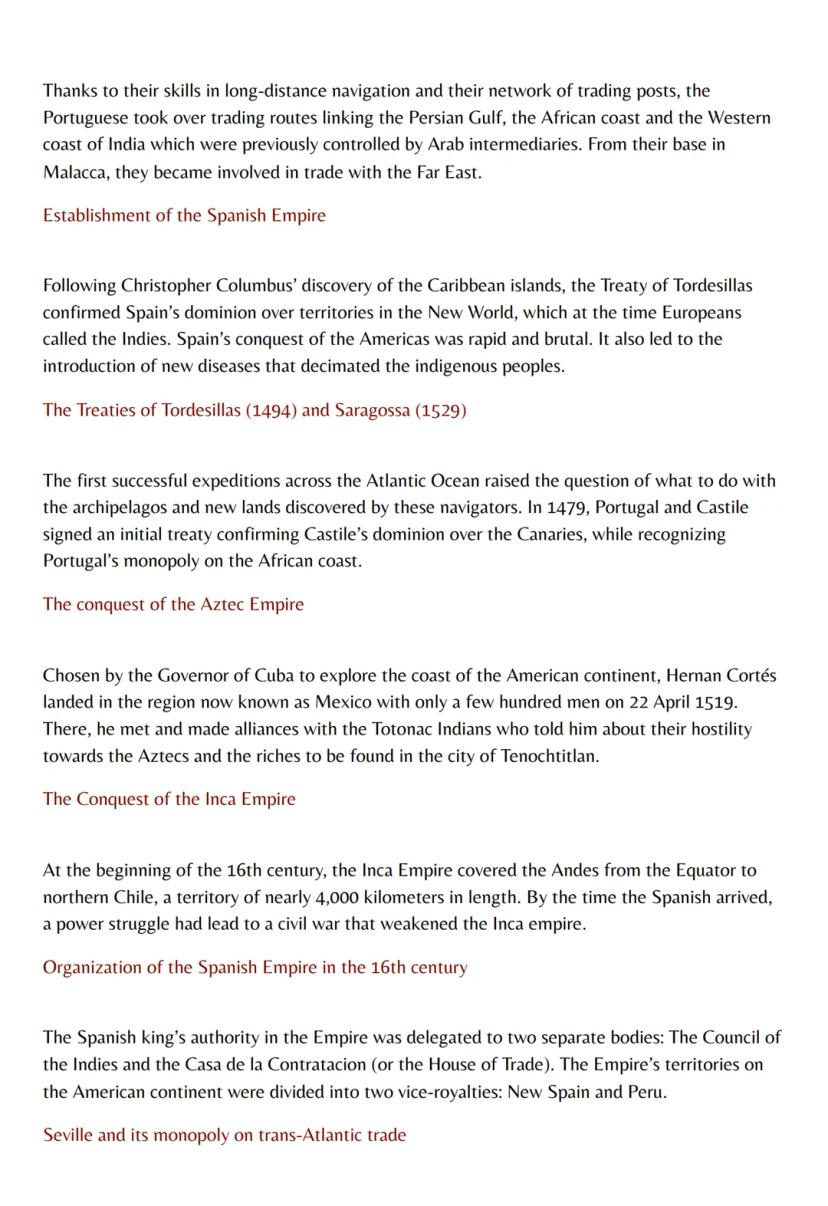
Spain's conquest of the Americas was astonishingly swift and brutal. After Columbus discovered Caribbean islands, Spanish conquistadors quickly moved to the mainland with devastating consequences. Hernán Cortés landed in modern-day Mexico in 1519 with only a few hundred men but managed to topple the mighty Aztec Empire by exploiting local conflicts and forming alliances with groups like the Totonac people who resented Aztec rule.
The Inca Empire faced a similar fate. Spanning nearly 4,000 kilometers along the Andes from Ecuador to northern Chile, this powerful civilization was weakened by internal civil war when the Spanish arrived. This political instability gave Spanish forces the opening they needed to conquer one of the world's largest empires.
To administer their vast new territories, the Spanish created a sophisticated governmental structure. The king's authority was delegated to two main bodies: the Council of the Indies and the Casa de la Contratación (House of Trade). The American territories were divided into two vice-royalties: New Spain (covering Mexico, Central America, and the Caribbean) and Peru (covering most of South America).
Important! European diseases like smallpox played a devastating role in the Spanish conquests, killing millions of indigenous people who had no immunity to these previously unknown illnesses.
3
of 3
Trade Networks and Economic Impact
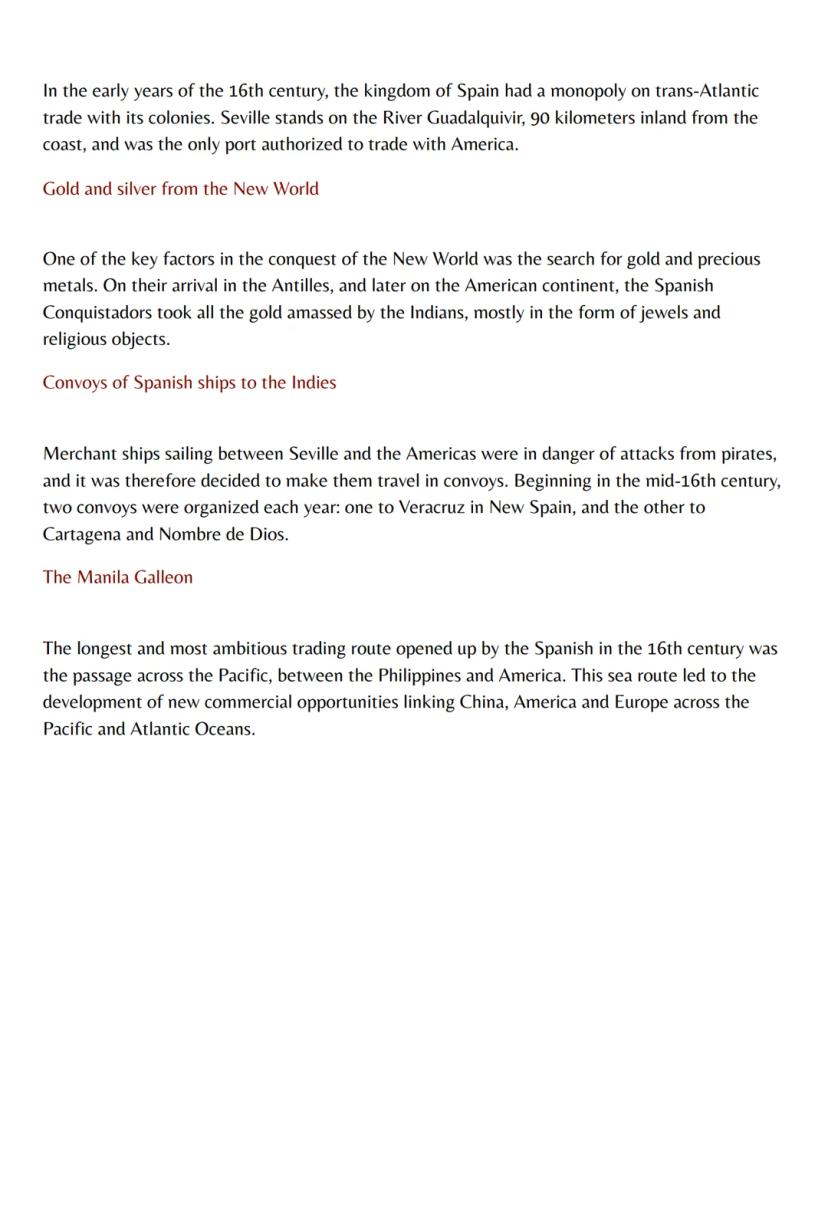
Gold and silver were primary motivations behind the conquest of the New World. When Spanish conquistadors arrived in the Americas, they immediately seized precious metals from indigenous peoples, often taking religious artifacts and jewelry. This wealth transfer fundamentally altered the European economy.
Spain established a strict monopoly on trans-Atlantic trade with its colonies. Seville, located 90 kilometers inland on the Guadalquivir River, became the sole authorized port for American trade. This system concentrated enormous wealth but also created vulnerabilities.
To protect merchant ships from pirate attacks, Spain organized convoy systems beginning in the mid-16th century. Two major convoys sailed annually: one to Veracruz in New Spain and another to Cartagena and Nombre de Dios. These heavily guarded fleets transported the riches of the Americas back to Spain.
Perhaps the most ambitious trading route was the Manila Galleon, which crossed the Pacific between the Philippines and America. This incredible sea route connected China, America, and Europe across two oceans, creating the first truly global trading network in history.
Think about it: The Spanish and Portuguese empires created the first global economy. How might today's world be different if these early trade networks had never developed?
We thought you’d never ask...
What is the Knowunity AI companion?
Our AI companion is specifically built for the needs of students. Based on the millions of content pieces we have on the platform we can provide truly meaningful and relevant answers to students. But its not only about answers, the companion is even more about guiding students through their daily learning challenges, with personalised study plans, quizzes or content pieces in the chat and 100% personalisation based on the students skills and developments.
Where can I download the Knowunity app?
You can download the app in the Google Play Store and in the Apple App Store.
Is Knowunity really free of charge?
That's right! Enjoy free access to study content, connect with fellow students, and get instant help – all at your fingertips.
Most popular content in AP World History
9O
AP World HistoryOrigins of Ancient River Civilizations
Analyze the environmental factors and technological innovations that led to the rise of early states in Mesopotamia, Egypt, and the Indus Valley.
9th3,1870
O
AP World HistoryOrigins and Continuity of the Byzantine Empire
Analyze the political and cultural transitions from the Roman Empire to the Byzantine Empire, focusing on the reign of Justinian I and his code.
9th1,6320
O
AP World HistoryOrigins of African State Building (1200-1450)
Analyze how trade networks and environmental factors influenced the formation of early states like Great Zimbabwe and the Swahili city-states.
9th9700
I
AP World HistoryIntroduction to Classical Civilizations
Master fundamental concepts, geographic locations, and the defining characteristics of major empires like Rome, Han China, and Maurya India.
9th7540
O
AP World HistoryOrigins of Indigenous Americas State Building
Analyze the foundational governance structures and environmental adaptations of the Maya, Aztec, and Inca civilizations between 1200 and 1450.
9th5070
1
AP World History1200-1450 CE quiz 1
Quiz on information about developments in East Asia, South Asia, the Middle East, and Europe at the time
10th2430
O
AP World HistoryOrigins of Economic Exchange Networks
Practice identifying the foundational environmental and technological factors that enabled Silk Road, Indian Ocean, and Trans-Saharan trade.
9th3370
S
AP World HistoryState Building in East Asia Developments
Analyze the administrative methods, such as the Confucian bureaucracy and tributary system, used by the Song Dynasty to maintain political power.
9th2730
I
AP World HistoryIntroduction to State Building and Administration
Practice analyzing how land-based empires used bureaucracies and military elites to consolidate power between 1450 and 1750.
9th2600
Most popular content
9O
 AP US History
Origins and Dynamics of the Columbian Exchange
Analyze the ecological and economic motivations behind the initial transfer of goods, people, and diseases between the Old and New Worlds.
9th3,1280
I
AP US HistoryIntroduction to Early Cultural Interactions
Analyze the initial social and religious encounters between Europeans, Africans, and Indigenous peoples in the colonial Americas.
9th2,7730
O
AP World HistoryOrigins of Ancient River Civilizations
Analyze the environmental factors and technological innovations that led to the rise of early states in Mesopotamia, Egypt, and the Indus Valley.
9th3,1870
M
AP US HistoryMotivations for European Exploration
Analyze the economic, religious, and political factors that drove European powers to the Americas during the 15th and 16th centuries.
9th1,7780
F
 AP Psychology
Foundations of Ethical Guidelines in Research
Practice the core principles of the APA ethical code including informed consent, debriefing, and the role of Institutional Review Boards.
9th1,3360
I
AP US HistoryIntroduction to Native American Societies
Examine the diverse social, political, and economic structures of North American indigenous groups prior to European contact.
9th1,1100
I
 AP Biology
Introduction to Biological Elements of Life
Practice identifying the essential elements including carbon, nitrogen, phosphorus, and sulfur that compose biological macromolecules.
9th1,7390
I
AP US HistoryIntroduction to the Spanish Encomienda System
Explore the fundamental economic and social structures of the Spanish colonial system, focusing on the encomienda and the casta social hierarchy.
9th8890
O
AP World HistoryOrigins and Continuity of the Byzantine Empire
Analyze the political and cultural transitions from the Roman Empire to the Byzantine Empire, focusing on the reign of Justinian I and his code.
9th1,6320
Can't find what you're looking for? Explore other subjects.
Students love us — and so will you.
4.6/5App Store
4.7/5Google Play
The app is very easy to use and well designed. I have found everything I was looking for so far and have been able to learn a lot from the presentations! I will definitely use the app for a class assignment! And of course it also helps a lot as an inspiration.
Stefan SiOS user
This app is really great. There are so many study notes and help [...]. My problem subject is French, for example, and the app has so many options for help. Thanks to this app, I have improved my French. I would recommend it to anyone.
Samantha KlichAndroid user
Wow, I am really amazed. I just tried the app because I've seen it advertised many times and was absolutely stunned. This app is THE HELP you want for school and above all, it offers so many things, such as workouts and fact sheets, which have been VERY helpful to me personally.
AnnaiOS user
AP World History49 views·Updated Jun 13, 2026·3 pagesSpain and Portugal's History: 1450-1750 Overview
Kiki@kikiwikii
Spain and Portugal were pioneers in global trade during 1450-1750, establishing the first worldwide empires through strategic treaties and maritime expertise. They divided newly discovered territories between them, with Spain claiming most of the Americas while Portugal focused on coastal...
1
of 3
Sign up to see the content. It's free!
- Access to all documents
- Improve your grades
- Join milions of students
Spanish and Portuguese Empires: Foundations
The year 1494 marked a pivotal moment in world history when Spain and Portugal officially divided the globe between them through the Treaty of Tordesillas. This agreement gave Spain rights to most of the Americas (except Brazil), while Portugal claimed territories across Africa, the Middle East, South Asia, and parts of the Pacific. The Philippines remained a Spanish territory following the Treaty of Zaragoza in 1529.
These empires were built on sophisticated trade networks that transported valuable commodities across vast distances. The "Spice Islands" of Southeast Asia provided lucrative goods that the Portuguese collected from Timor and Malacca, while Spain gathered resources from Manila. Spanish ships then crossed the Pacific to ports like Acapulco and Veracruz, creating a complex trade system through the Caribbean.
The two empires developed different approaches to expansion. Portugal initially focused on establishing trading networks before turning to full colonization. Their superior navigational skills helped them create what was then the world's largest maritime empire, stretching from South America to the Far East. Meanwhile, Spain discovered established civilizations in the Americas and pursued colonization with dual goals of wealth accumulation and spreading Catholicism.
Did you know? Portuguese explorer Vasco da Gama's voyages transformed global trade by establishing a direct sea route to India, allowing Portugal to bypass Arab intermediaries who had previously controlled these valuable trade connections.
2
of 3Sign up to see the content. It's free!
- Access to all documents
- Improve your grades
- Join milions of students
Conquests and Territorial Organization
Spain's conquest of the Americas was astonishingly swift and brutal. After Columbus discovered Caribbean islands, Spanish conquistadors quickly moved to the mainland with devastating consequences. Hernán Cortés landed in modern-day Mexico in 1519 with only a few hundred men but managed to topple the mighty Aztec Empire by exploiting local conflicts and forming alliances with groups like the Totonac people who resented Aztec rule.
The Inca Empire faced a similar fate. Spanning nearly 4,000 kilometers along the Andes from Ecuador to northern Chile, this powerful civilization was weakened by internal civil war when the Spanish arrived. This political instability gave Spanish forces the opening they needed to conquer one of the world's largest empires.
To administer their vast new territories, the Spanish created a sophisticated governmental structure. The king's authority was delegated to two main bodies: the Council of the Indies and the Casa de la Contratación (House of Trade). The American territories were divided into two vice-royalties: New Spain (covering Mexico, Central America, and the Caribbean) and Peru (covering most of South America).
Important! European diseases like smallpox played a devastating role in the Spanish conquests, killing millions of indigenous people who had no immunity to these previously unknown illnesses.
3
of 3Sign up to see the content. It's free!
- Access to all documents
- Improve your grades
- Join milions of students
Trade Networks and Economic Impact
Gold and silver were primary motivations behind the conquest of the New World. When Spanish conquistadors arrived in the Americas, they immediately seized precious metals from indigenous peoples, often taking religious artifacts and jewelry. This wealth transfer fundamentally altered the European economy.
Spain established a strict monopoly on trans-Atlantic trade with its colonies. Seville, located 90 kilometers inland on the Guadalquivir River, became the sole authorized port for American trade. This system concentrated enormous wealth but also created vulnerabilities.
To protect merchant ships from pirate attacks, Spain organized convoy systems beginning in the mid-16th century. Two major convoys sailed annually: one to Veracruz in New Spain and another to Cartagena and Nombre de Dios. These heavily guarded fleets transported the riches of the Americas back to Spain.
Perhaps the most ambitious trading route was the Manila Galleon, which crossed the Pacific between the Philippines and America. This incredible sea route connected China, America, and Europe across two oceans, creating the first truly global trading network in history.
Think about it: The Spanish and Portuguese empires created the first global economy. How might today's world be different if these early trade networks had never developed?
We thought you’d never ask...
What is the Knowunity AI companion?
Our AI companion is specifically built for the needs of students. Based on the millions of content pieces we have on the platform we can provide truly meaningful and relevant answers to students. But its not only about answers, the companion is even more about guiding students through their daily learning challenges, with personalised study plans, quizzes or content pieces in the chat and 100% personalisation based on the students skills and developments.
Where can I download the Knowunity app?
You can download the app in the Google Play Store and in the Apple App Store.
Is Knowunity really free of charge?
That's right! Enjoy free access to study content, connect with fellow students, and get instant help – all at your fingertips.
Most popular content in AP World History
9O
AP World HistoryOrigins of Ancient River Civilizations
Analyze the environmental factors and technological innovations that led to the rise of early states in Mesopotamia, Egypt, and the Indus Valley.
9th3,1870
O
AP World HistoryOrigins and Continuity of the Byzantine Empire
Analyze the political and cultural transitions from the Roman Empire to the Byzantine Empire, focusing on the reign of Justinian I and his code.
9th1,6320
O
AP World HistoryOrigins of African State Building (1200-1450)
Analyze how trade networks and environmental factors influenced the formation of early states like Great Zimbabwe and the Swahili city-states.
9th9700
I
AP World HistoryIntroduction to Classical Civilizations
Master fundamental concepts, geographic locations, and the defining characteristics of major empires like Rome, Han China, and Maurya India.
9th7540
O
AP World HistoryOrigins of Indigenous Americas State Building
Analyze the foundational governance structures and environmental adaptations of the Maya, Aztec, and Inca civilizations between 1200 and 1450.
9th5070
1
AP World History1200-1450 CE quiz 1
Quiz on information about developments in East Asia, South Asia, the Middle East, and Europe at the time
10th2430
O
AP World HistoryOrigins of Economic Exchange Networks
Practice identifying the foundational environmental and technological factors that enabled Silk Road, Indian Ocean, and Trans-Saharan trade.
9th3370
S
AP World HistoryState Building in East Asia Developments
Analyze the administrative methods, such as the Confucian bureaucracy and tributary system, used by the Song Dynasty to maintain political power.
9th2730
I
AP World HistoryIntroduction to State Building and Administration
Practice analyzing how land-based empires used bureaucracies and military elites to consolidate power between 1450 and 1750.
9th2600
Most popular content
9O
AP US HistoryOrigins and Dynamics of the Columbian Exchange
Analyze the ecological and economic motivations behind the initial transfer of goods, people, and diseases between the Old and New Worlds.
9th3,1280
I
AP US HistoryIntroduction to Early Cultural Interactions
Analyze the initial social and religious encounters between Europeans, Africans, and Indigenous peoples in the colonial Americas.
9th2,7730
O
AP World HistoryOrigins of Ancient River Civilizations
Analyze the environmental factors and technological innovations that led to the rise of early states in Mesopotamia, Egypt, and the Indus Valley.
9th3,1870
M
AP US HistoryMotivations for European Exploration
Analyze the economic, religious, and political factors that drove European powers to the Americas during the 15th and 16th centuries.
9th1,7780
F
AP PsychologyFoundations of Ethical Guidelines in Research
Practice the core principles of the APA ethical code including informed consent, debriefing, and the role of Institutional Review Boards.
9th1,3360
I
AP US HistoryIntroduction to Native American Societies
Examine the diverse social, political, and economic structures of North American indigenous groups prior to European contact.
9th1,1100
I
AP BiologyIntroduction to Biological Elements of Life
Practice identifying the essential elements including carbon, nitrogen, phosphorus, and sulfur that compose biological macromolecules.
9th1,7390
I
AP US HistoryIntroduction to the Spanish Encomienda System
Explore the fundamental economic and social structures of the Spanish colonial system, focusing on the encomienda and the casta social hierarchy.
9th8890
O
AP World HistoryOrigins and Continuity of the Byzantine Empire
Analyze the political and cultural transitions from the Roman Empire to the Byzantine Empire, focusing on the reign of Justinian I and his code.
9th1,6320
Can't find what you're looking for? Explore other subjects.
Students love us — and so will you.
4.6/5App Store
4.7/5Google Play
The app is very easy to use and well designed. I have found everything I was looking for so far and have been able to learn a lot from the presentations! I will definitely use the app for a class assignment! And of course it also helps a lot as an inspiration.
Stefan SiOS user
This app is really great. There are so many study notes and help [...]. My problem subject is French, for example, and the app has so many options for help. Thanks to this app, I have improved my French. I would recommend it to anyone.
Samantha KlichAndroid user
Wow, I am really amazed. I just tried the app because I've seen it advertised many times and was absolutely stunned. This app is THE HELP you want for school and above all, it offers so many things, such as workouts and fact sheets, which have been VERY helpful to me personally.
AnnaiOS user