
The intellectual and scientific revolution across Asia, Middle East, and...
 AP World History110 views·Updated Jun 13, 2026·8 pages
Exploring Traditional Chinese Medicine: Herbs, Benefits, and Inventions
D
Double00@0000_happy
1 / 8
1
of 8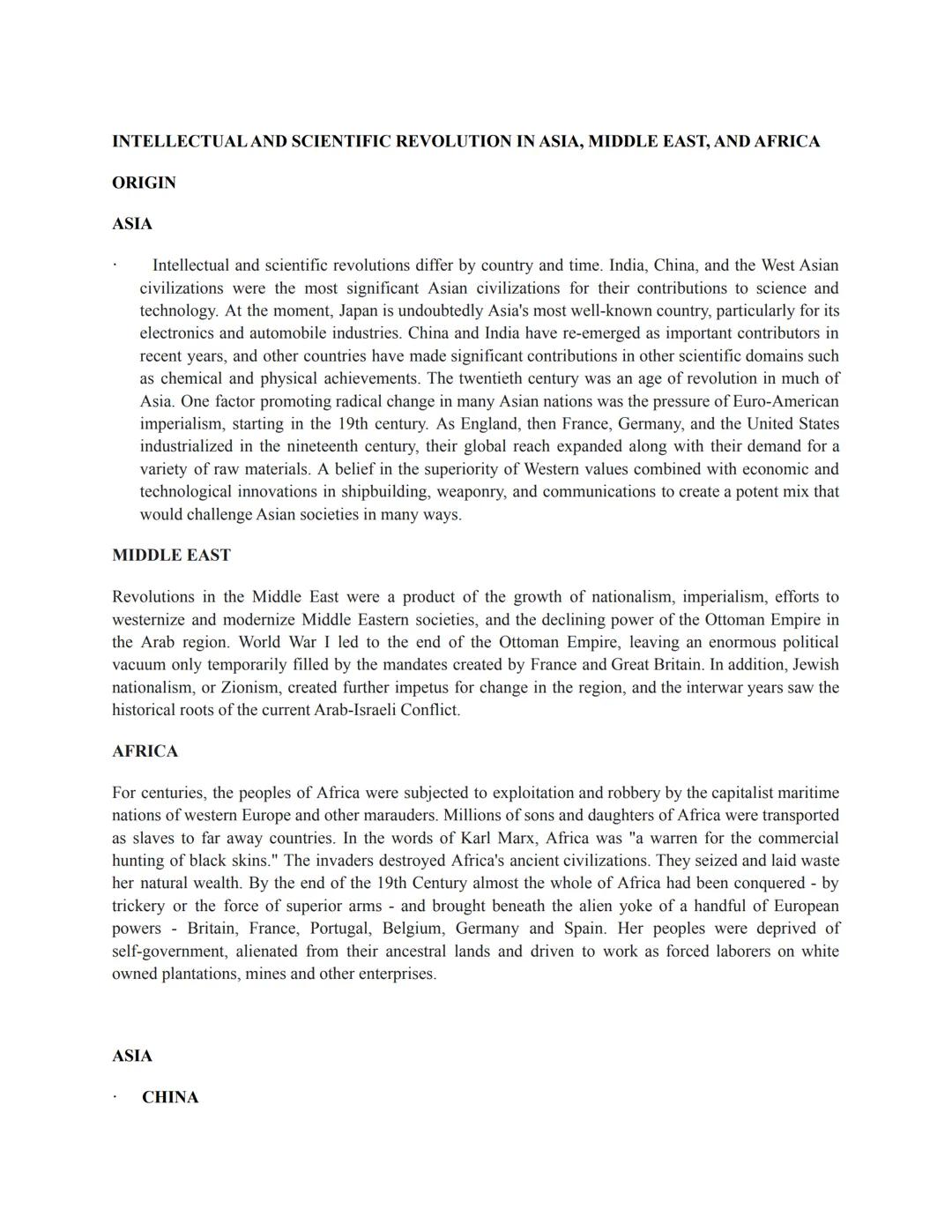
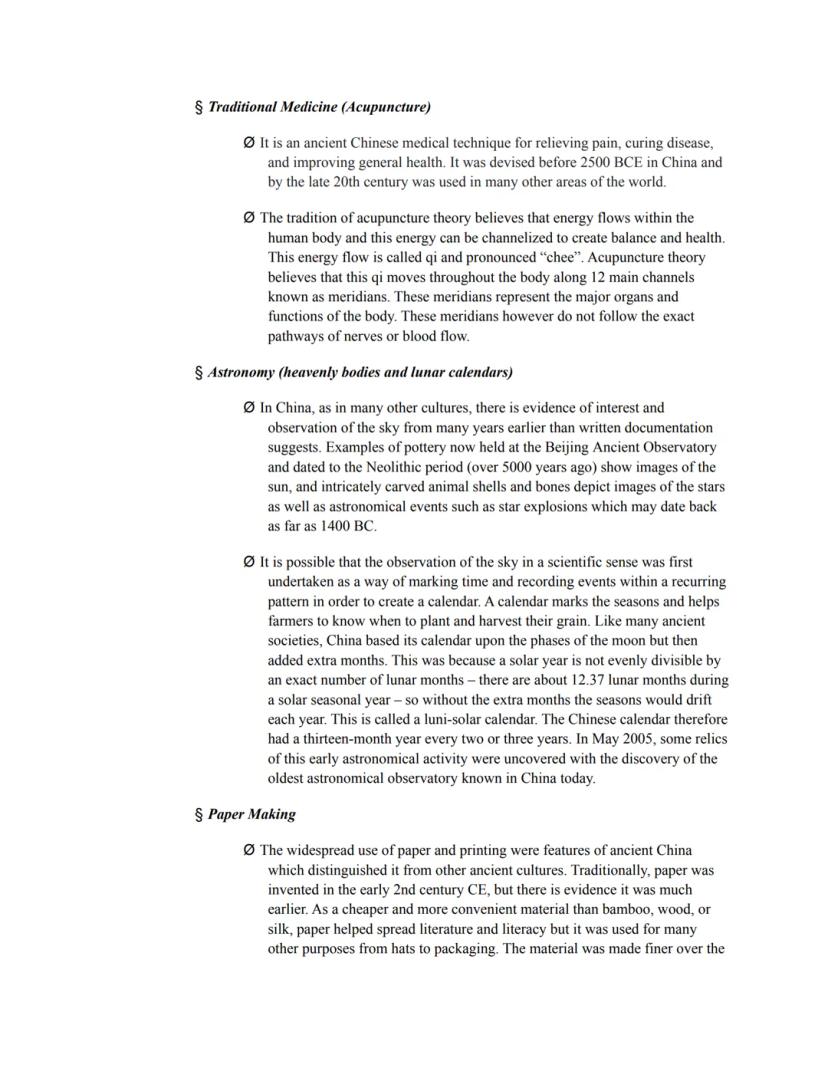
Traditional Chinese Medicine and Scientific Advances
The second page details significant Chinese contributions to medicine and science, particularly focusing on traditional chinese medicine and astronomy.
Vocabulary: Qi (pronounced "chee") - The vital energy flow believed to move through the body in Traditional Chinese Medicine.
Definition: Meridians are the 12 main channels through which qi flows in the body, corresponding to major organs and bodily functions.
Highlight: Chinese astronomical observations date back to the Neolithic period, over 5000 years ago.
Example: The Chinese luni-solar calendar, which added extra months every few years to align with solar seasons, demonstrates advanced astronomical understanding.
Quote: "The widespread use of paper and printing were features of ancient China which distinguished it from other ancient cultures."
2
of 8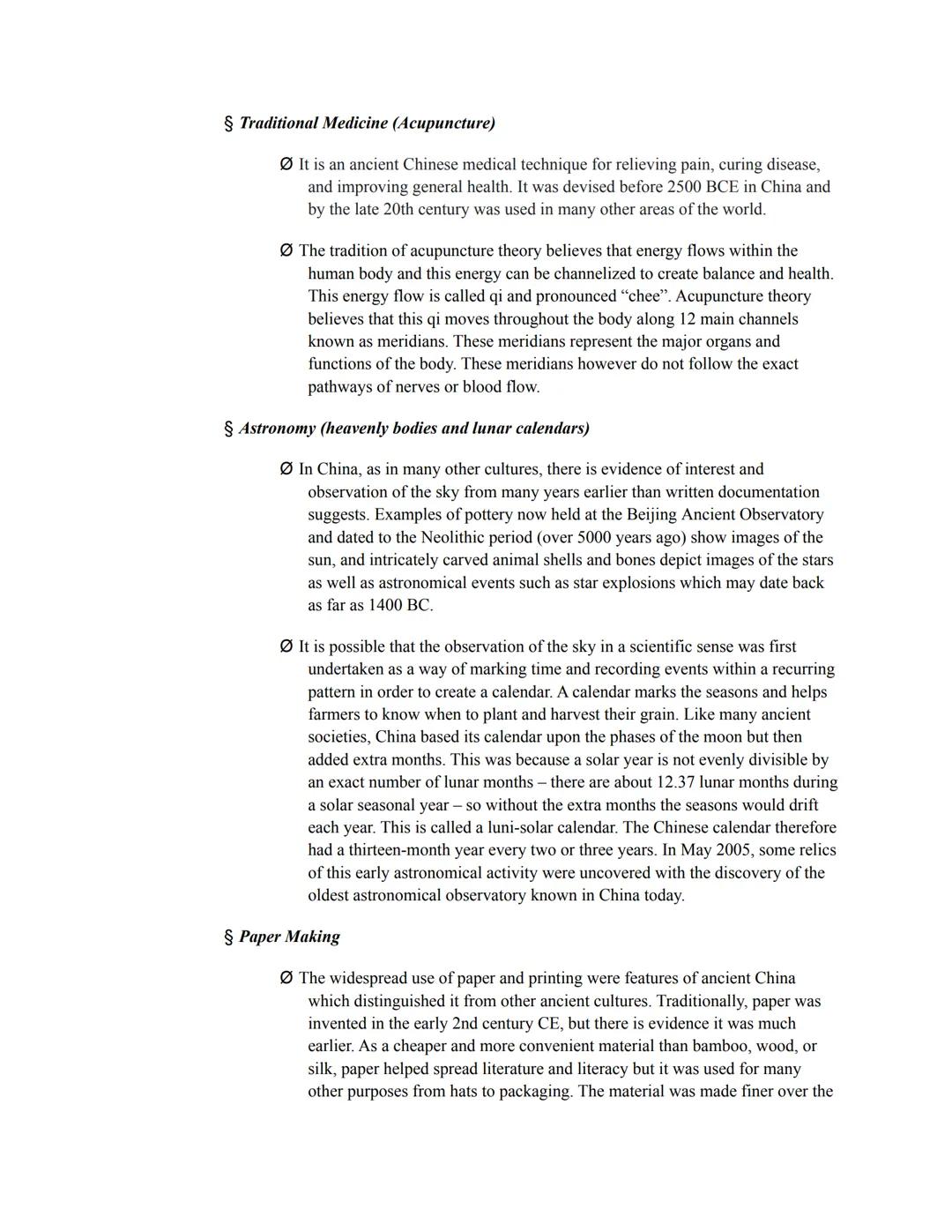
Traditional Chinese Medicine and Acupuncture
This section explores the ancient practice of acupuncture, a cornerstone of traditional chinese medicine. The text details how this healing method predates 2500 BCE and explains its fundamental principles.
Definition: Acupuncture is an ancient Chinese medical technique for pain relief, disease treatment, and health improvement.
Vocabulary: Qi (pronounced "chee") - the vital energy flow through the body along 12 main meridians.
Highlight: The system of meridians corresponds to major organs and bodily functions, forming the basis of traditional Chinese medical theory.
3
of 8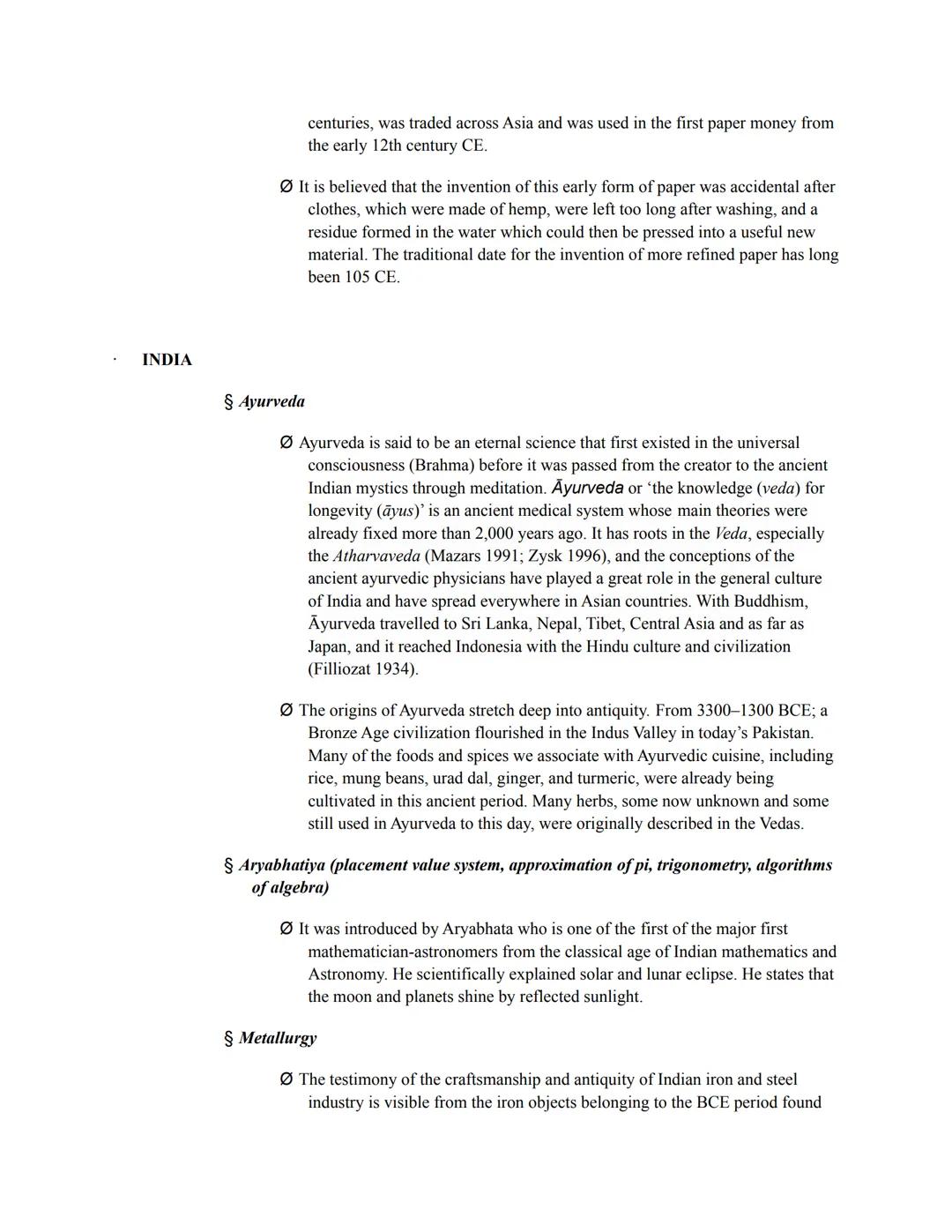
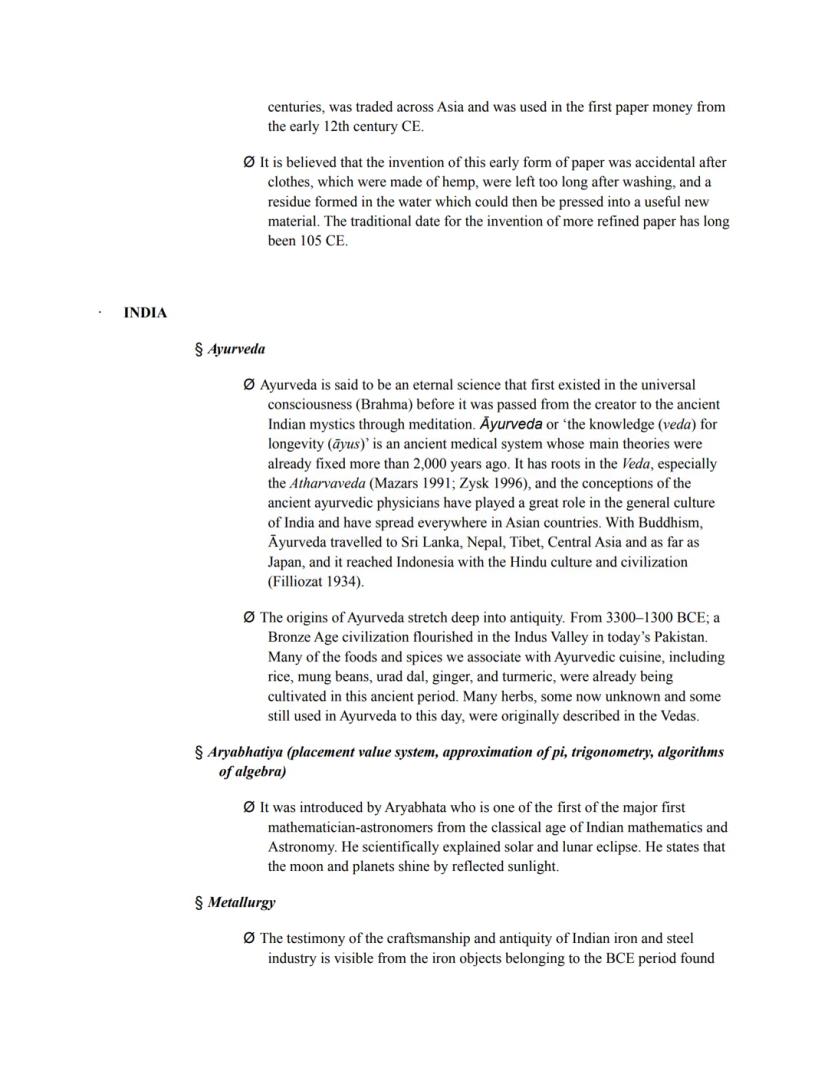
Indian Contributions and Ayurveda
The section discusses early Indian innovations, including paper money development and the ancient medical science of Ayurveda. The text explains how paper-making techniques evolved from hemp processing and details Ayurveda's origins in universal consciousness.
Example: Early paper money from the 12th century CE utilized Indian paper-making techniques.
Definition: Ayurveda is described as an eternal science originating from universal consciousness (Brahma).
4
of 8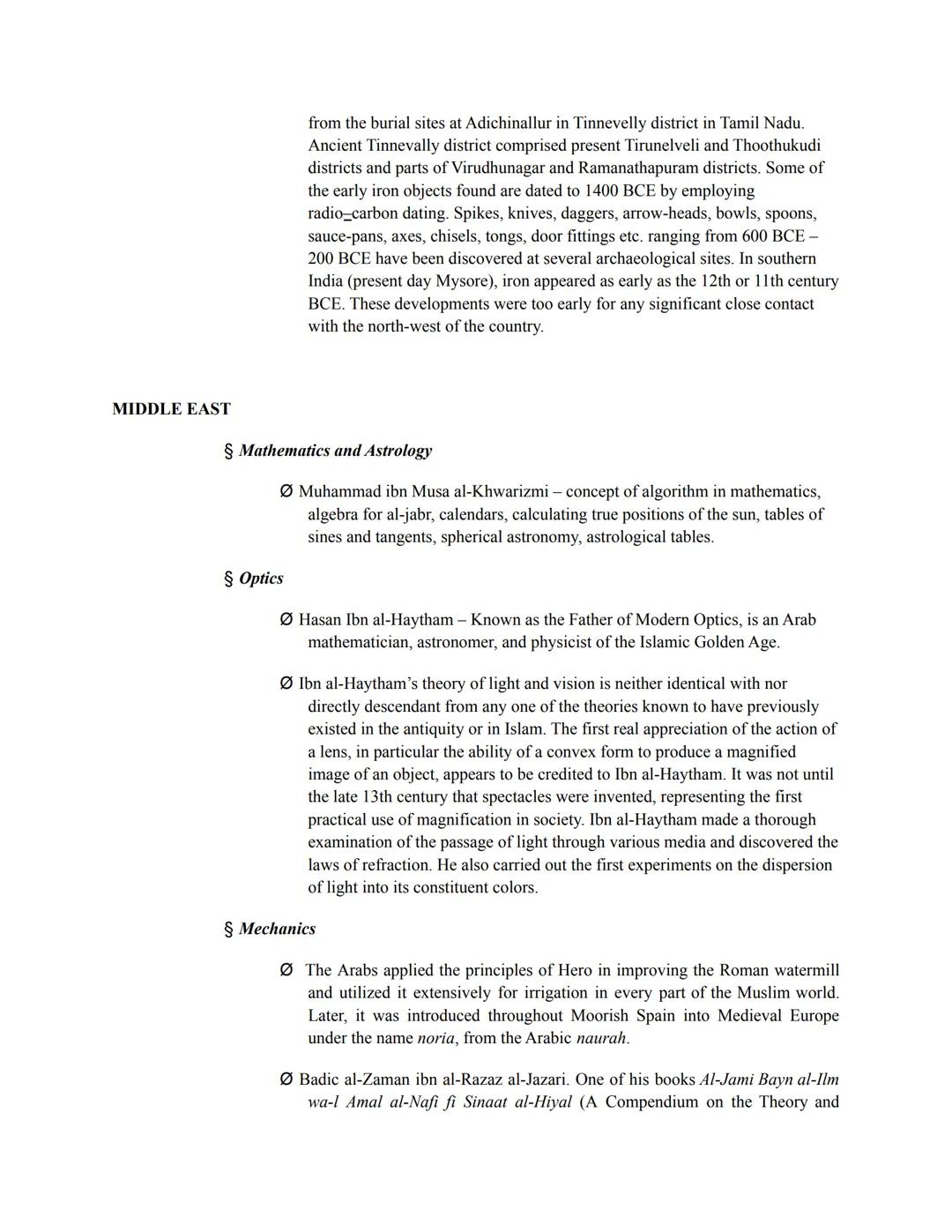
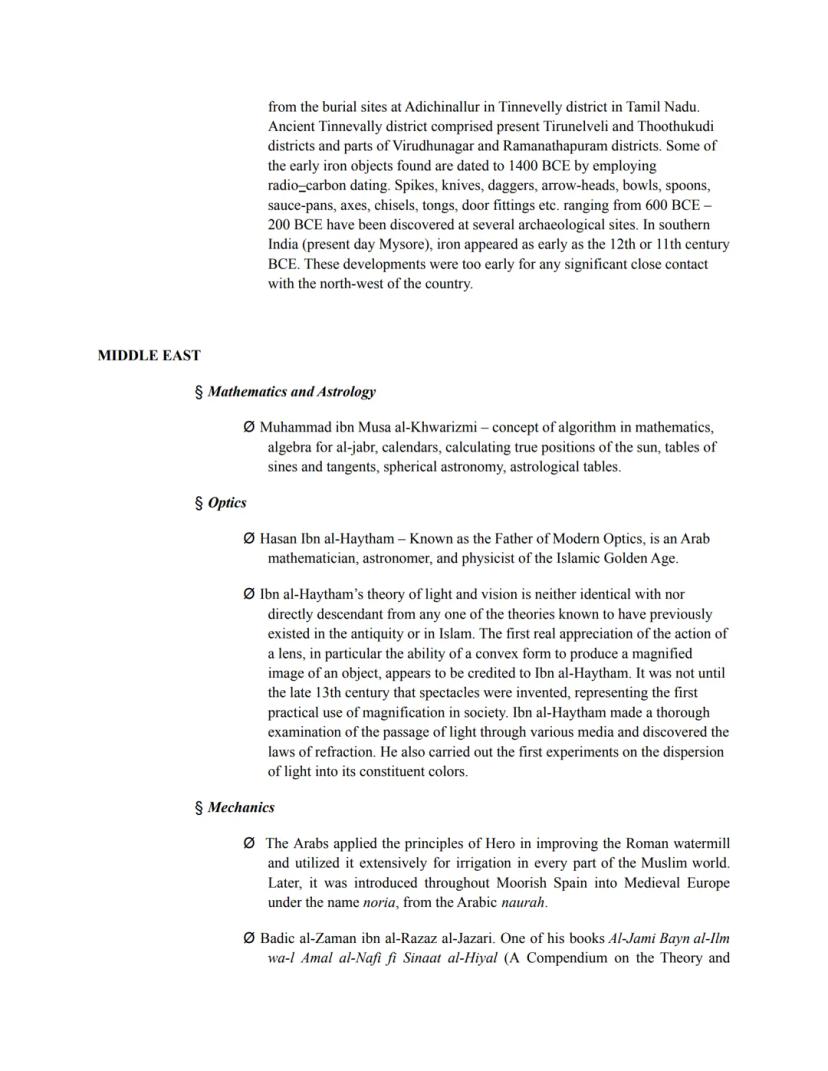
Middle Eastern Metallurgy
This section focuses on early metallurgical developments, particularly in iron working. The archaeological evidence from Tamil Nadu demonstrates sophisticated metal crafting dating back to 1400 BCE.
Example: Archaeological findings include spikes, knives, daggers, and various tools from 600 BCE - 200 BCE.
Highlight: Iron technology appeared in southern India as early as the 12th or 11th century BCE.
5
of 8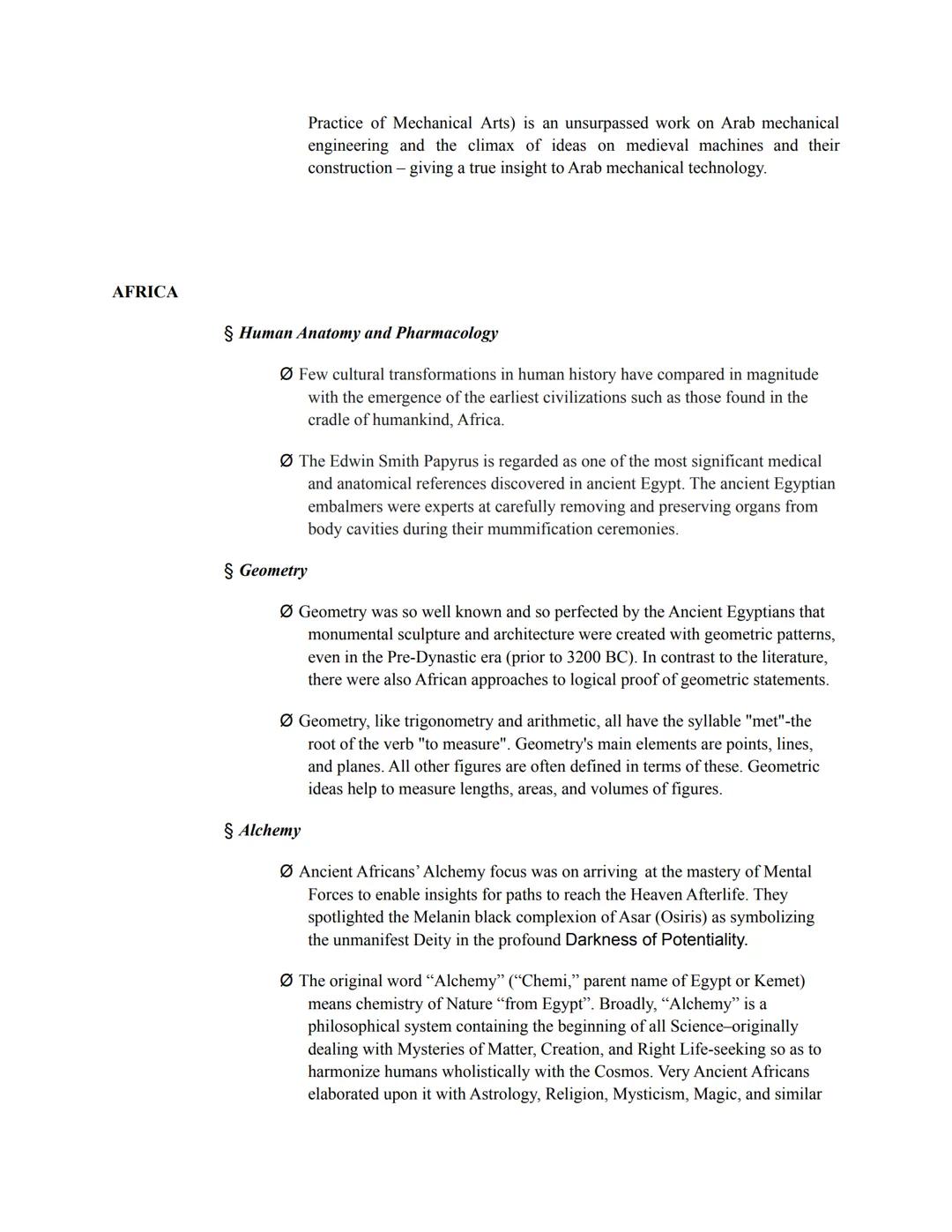
African Scientific Achievements
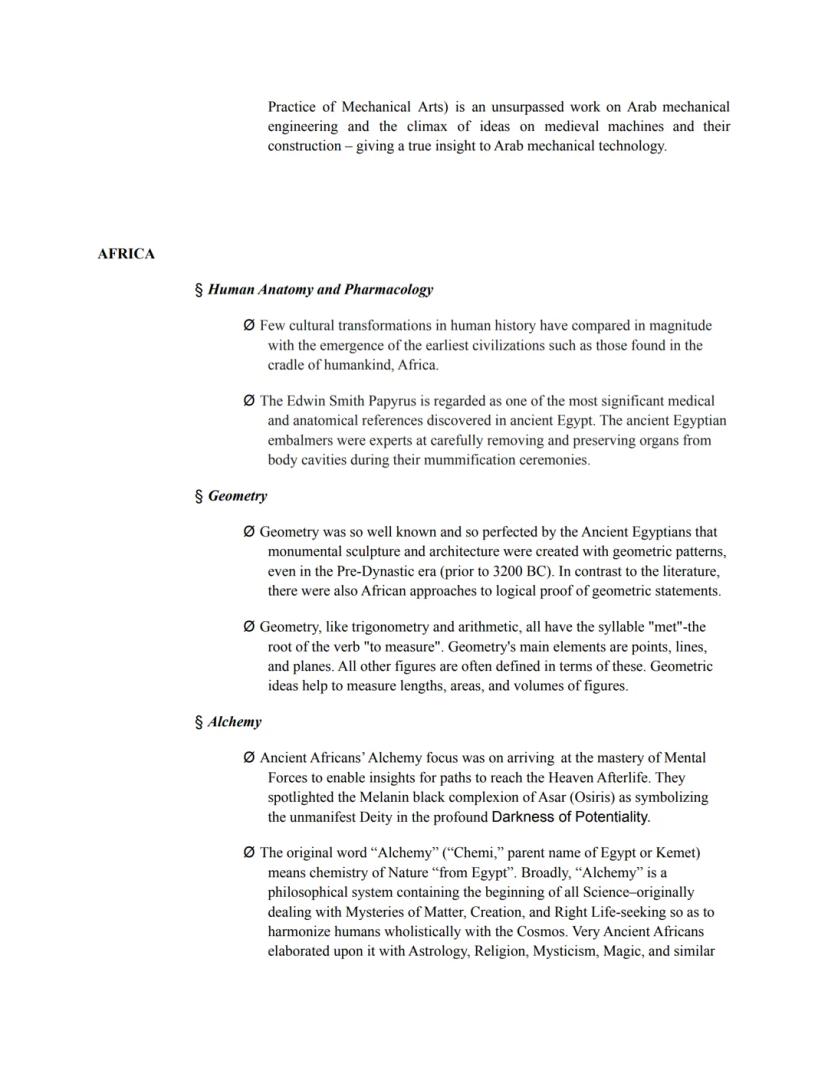
The text explores Africa's contributions to human knowledge, particularly in medicine and anatomy. The Edwin Smith Papyrus represents a significant medical advancement from ancient Egypt.
Quote: "Few cultural transformations in human history have compared in magnitude with the emergence of the earliest civilizations such as those found in the cradle of humankind, Africa."
6
of 8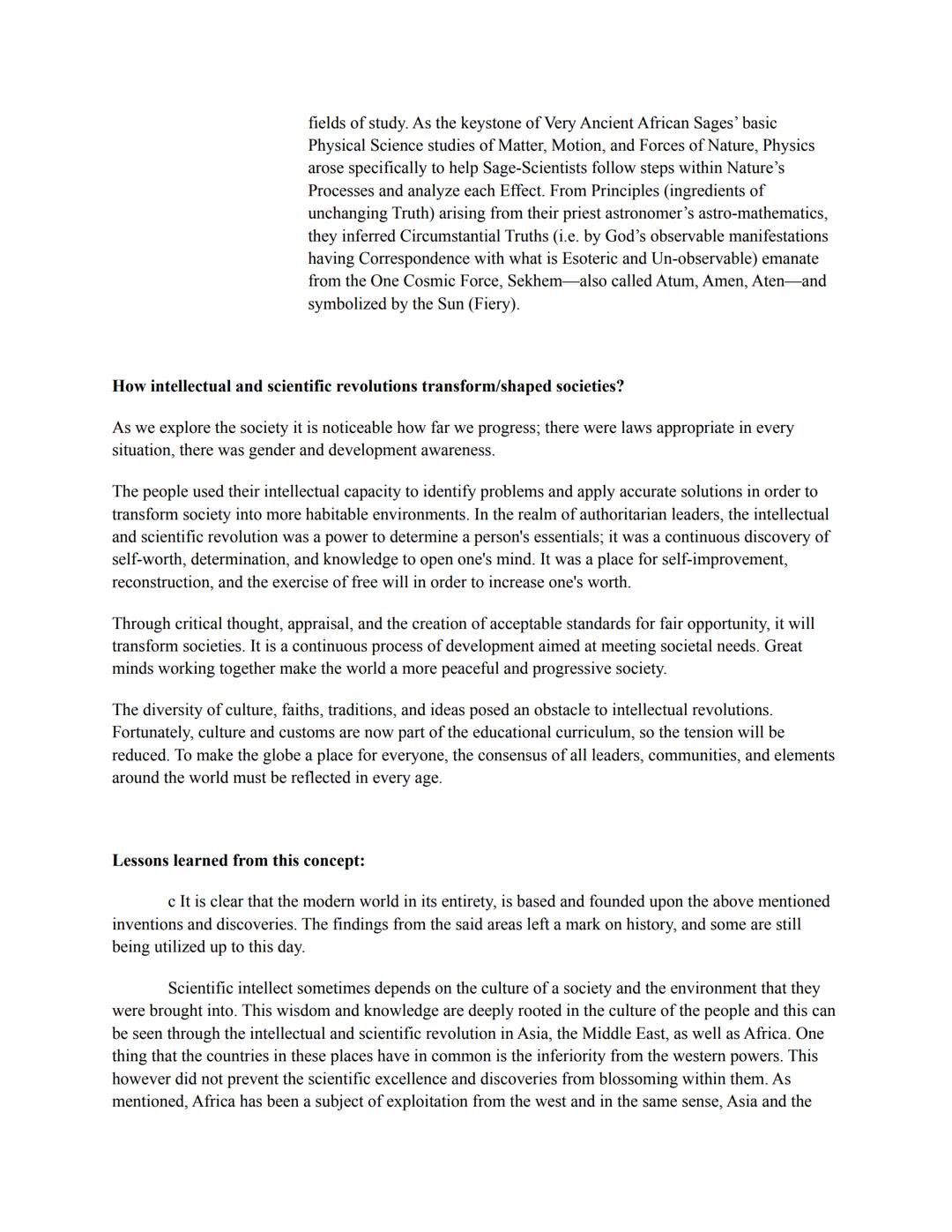
African Physics and Natural Philosophy
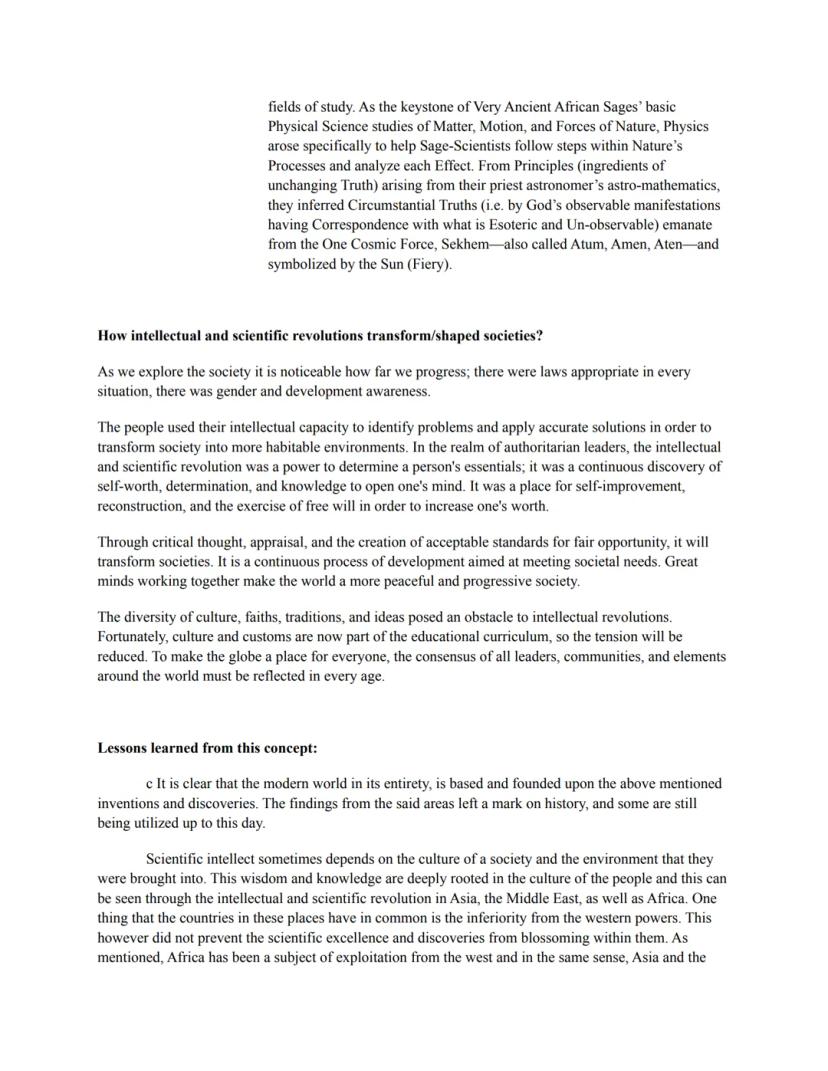
This section details African contributions to physics and natural philosophy, particularly through the work of Ancient African Sages.
Vocabulary: Sekhem - the One Cosmic Force, also known as Atum, Amen, or Aten.
Highlight: African physics arose from studying matter, motion, and natural forces, guided by astronomical observations.
7
of 8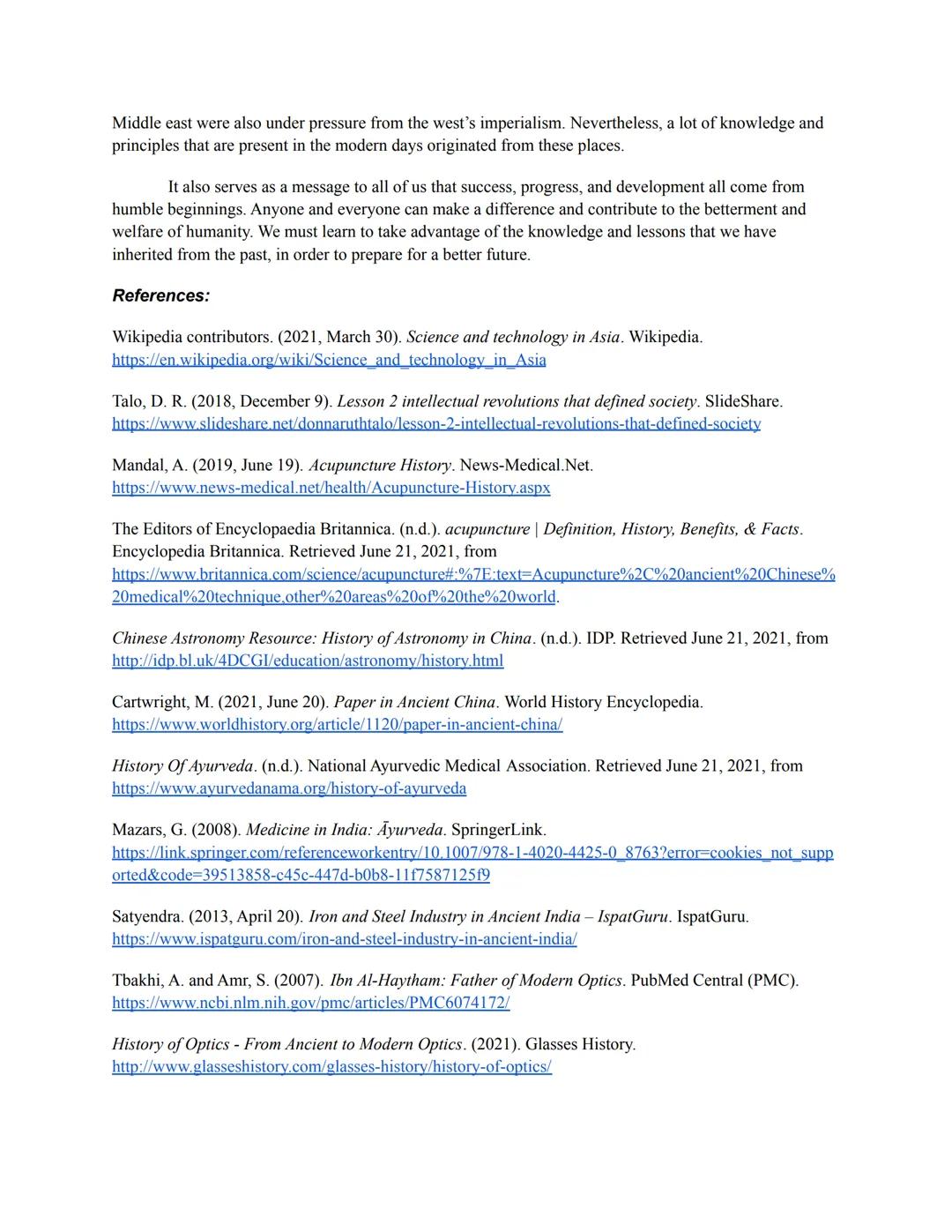
Legacy and Modern Implications
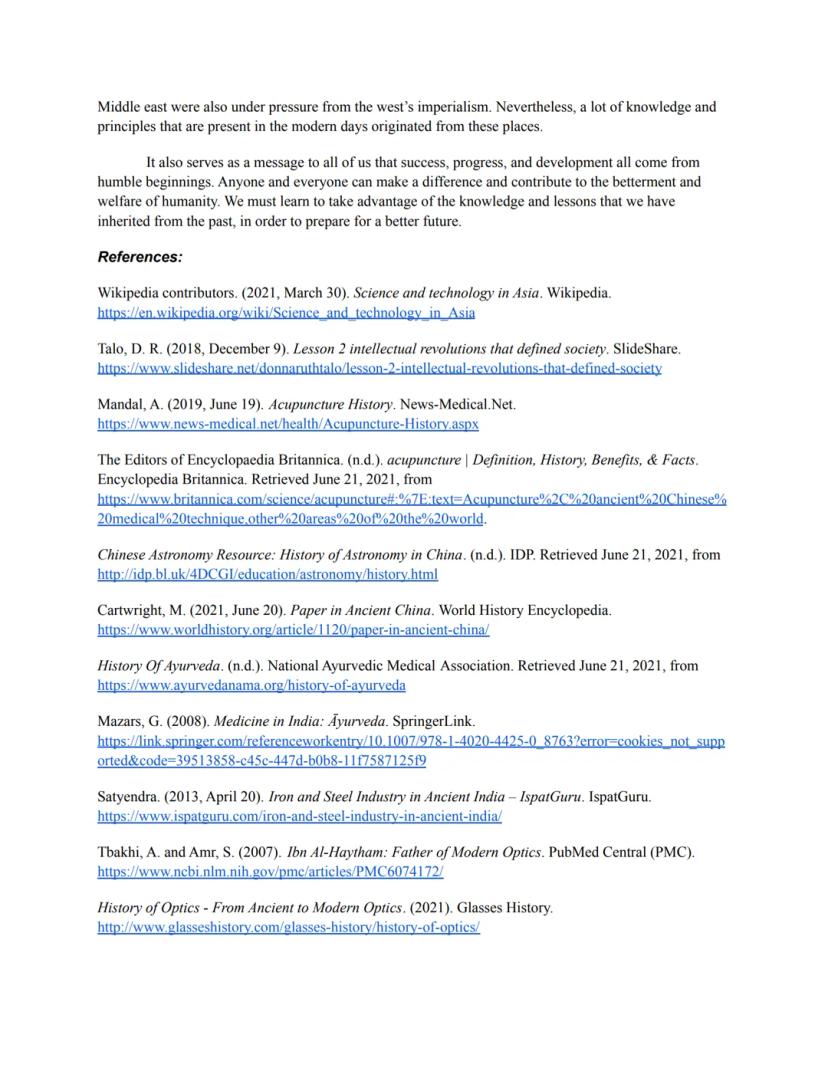
The text reflects on how historical developments influence modern science and technology. Despite western imperialism's pressure, these regions' knowledge and principles continue to shape contemporary understanding.
Quote: "Success, progress, and development all come from humble beginnings."
8
of 8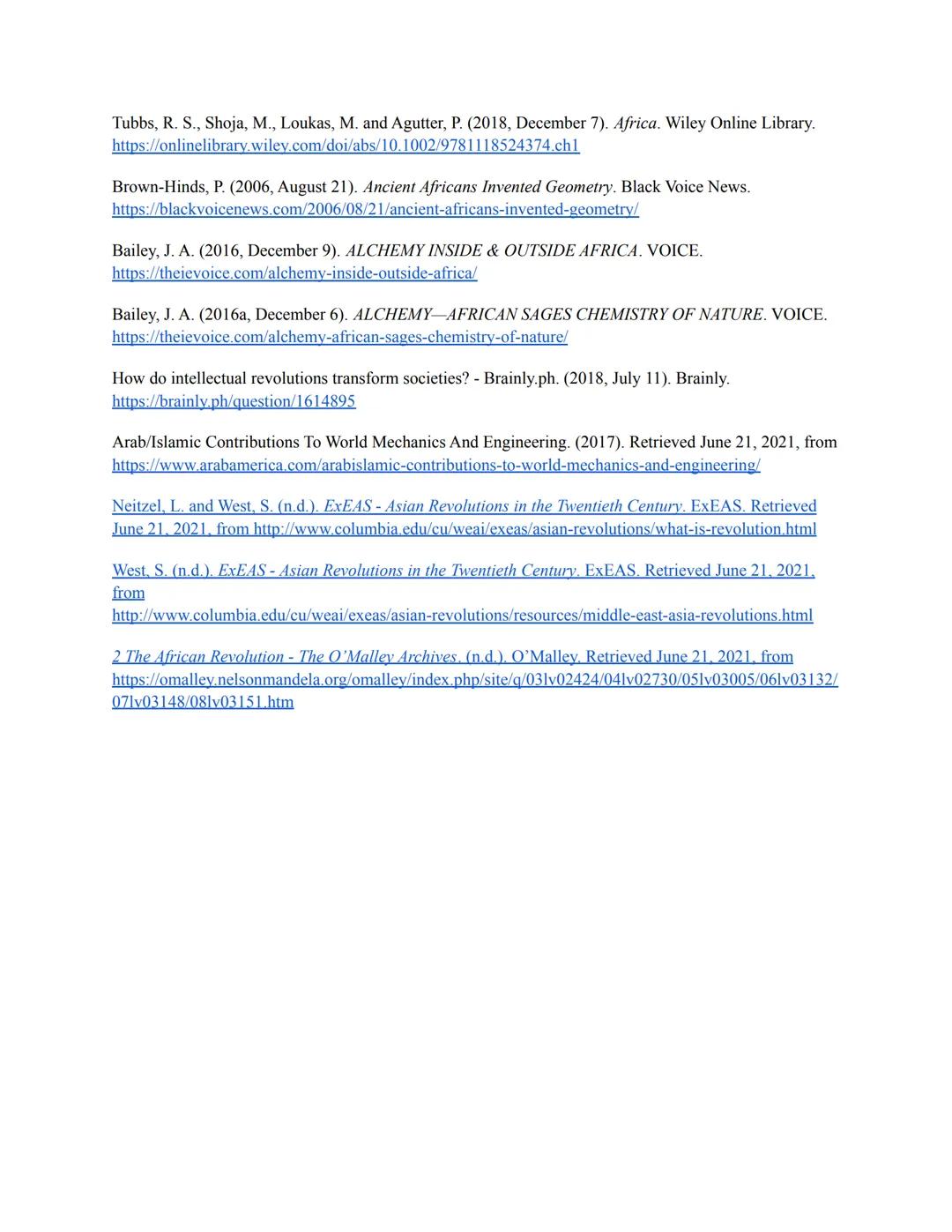
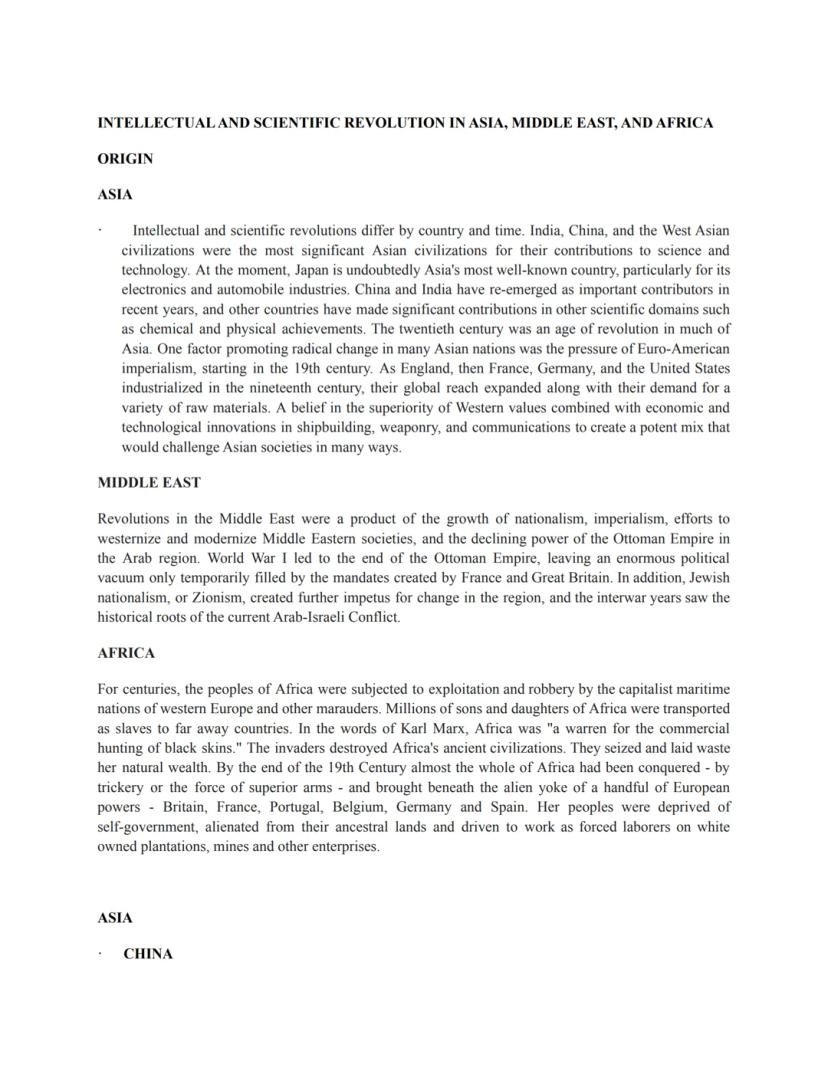
Origins of Scientific Revolution
The first page explores how intellectual and scientific revolutions manifested differently across Asia, the Middle East, and Africa. Each region experienced unique catalysts and challenges that shaped their scientific development.
Highlight: Euro-American imperialism significantly influenced Asian scientific development during the 19th century.
Definition: Imperialism refers to the policy of extending a country's power through colonization, military force, or other means.
Quote: "Africa was a warren for the commercial hunting of black skins" - Karl Marx, highlighting the exploitation of African resources and people.
Example: The pressure of Western imperialism led to technological adaptations in shipbuilding, weaponry, and communications across Asian societies.
We thought you’d never ask...
What is the Knowunity AI companion?
Our AI companion is specifically built for the needs of students. Based on the millions of content pieces we have on the platform we can provide truly meaningful and relevant answers to students. But its not only about answers, the companion is even more about guiding students through their daily learning challenges, with personalised study plans, quizzes or content pieces in the chat and 100% personalisation based on the students skills and developments.
Where can I download the Knowunity app?
You can download the app in the Google Play Store and in the Apple App Store.
Is Knowunity really free of charge?
That's right! Enjoy free access to study content, connect with fellow students, and get instant help – all at your fingertips.
Similar Content
Most popular content in AP World History
9O
AP World HistoryOrigins of Ancient River Civilizations
Analyze the environmental factors and technological innovations that led to the rise of early states in Mesopotamia, Egypt, and the Indus Valley.
9th3,1870
O
AP World HistoryOrigins and Continuity of the Byzantine Empire
Analyze the political and cultural transitions from the Roman Empire to the Byzantine Empire, focusing on the reign of Justinian I and his code.
9th1,6320
O
AP World HistoryOrigins of African State Building (1200-1450)
Analyze how trade networks and environmental factors influenced the formation of early states like Great Zimbabwe and the Swahili city-states.
9th9700
I
AP World HistoryIntroduction to Classical Civilizations
Master fundamental concepts, geographic locations, and the defining characteristics of major empires like Rome, Han China, and Maurya India.
9th7540
O
AP World HistoryOrigins of Indigenous Americas State Building
Analyze the foundational governance structures and environmental adaptations of the Maya, Aztec, and Inca civilizations between 1200 and 1450.
9th5070
1
AP World History1200-1450 CE quiz 1
Quiz on information about developments in East Asia, South Asia, the Middle East, and Europe at the time
10th2430
O
AP World HistoryOrigins of Economic Exchange Networks
Practice identifying the foundational environmental and technological factors that enabled Silk Road, Indian Ocean, and Trans-Saharan trade.
9th3370
S
AP World HistoryState Building in East Asia Developments
Analyze the administrative methods, such as the Confucian bureaucracy and tributary system, used by the Song Dynasty to maintain political power.
9th2730
I
AP World HistoryIntroduction to State Building and Administration
Practice analyzing how land-based empires used bureaucracies and military elites to consolidate power between 1450 and 1750.
9th2600
Most popular content
9O
 AP US History
Origins and Dynamics of the Columbian Exchange
Analyze the ecological and economic motivations behind the initial transfer of goods, people, and diseases between the Old and New Worlds.
9th3,1280
I
AP US HistoryIntroduction to Early Cultural Interactions
Analyze the initial social and religious encounters between Europeans, Africans, and Indigenous peoples in the colonial Americas.
9th2,7730
O
AP World HistoryOrigins of Ancient River Civilizations
Analyze the environmental factors and technological innovations that led to the rise of early states in Mesopotamia, Egypt, and the Indus Valley.
9th3,1870
M
AP US HistoryMotivations for European Exploration
Analyze the economic, religious, and political factors that drove European powers to the Americas during the 15th and 16th centuries.
9th1,7780
F
 AP Psychology
Foundations of Ethical Guidelines in Research
Practice the core principles of the APA ethical code including informed consent, debriefing, and the role of Institutional Review Boards.
9th1,3360
I
AP US HistoryIntroduction to Native American Societies
Examine the diverse social, political, and economic structures of North American indigenous groups prior to European contact.
9th1,1100
I
 AP Biology
Introduction to Biological Elements of Life
Practice identifying the essential elements including carbon, nitrogen, phosphorus, and sulfur that compose biological macromolecules.
9th1,7390
I
AP US HistoryIntroduction to the Spanish Encomienda System
Explore the fundamental economic and social structures of the Spanish colonial system, focusing on the encomienda and the casta social hierarchy.
9th8890
O
AP World HistoryOrigins and Continuity of the Byzantine Empire
Analyze the political and cultural transitions from the Roman Empire to the Byzantine Empire, focusing on the reign of Justinian I and his code.
9th1,6320
Can't find what you're looking for? Explore other subjects.
Students love us — and so will you.
4.6/5App Store
4.7/5Google Play
The app is very easy to use and well designed. I have found everything I was looking for so far and have been able to learn a lot from the presentations! I will definitely use the app for a class assignment! And of course it also helps a lot as an inspiration.
Stefan SiOS user
This app is really great. There are so many study notes and help [...]. My problem subject is French, for example, and the app has so many options for help. Thanks to this app, I have improved my French. I would recommend it to anyone.
Samantha KlichAndroid user
Wow, I am really amazed. I just tried the app because I've seen it advertised many times and was absolutely stunned. This app is THE HELP you want for school and above all, it offers so many things, such as workouts and fact sheets, which have been VERY helpful to me personally.
AnnaiOS user
AP World History110 views·Updated Jun 13, 2026·8 pagesExploring Traditional Chinese Medicine: Herbs, Benefits, and Inventions
D
Double00@0000_happy
The intellectual and scientific revolution across Asia, Middle East, and Africa has profoundly shaped modern civilization through groundbreaking discoveries and innovations. These regions were pioneers in fields ranging from medicine to mathematics, establishing foundations that continue to influence contemporary science...
1
of 8
Sign up to see the content. It's free!
- Access to all documents
- Improve your grades
- Join milions of students
Traditional Chinese Medicine and Scientific Advances
The second page details significant Chinese contributions to medicine and science, particularly focusing on traditional chinese medicine and astronomy.
Vocabulary: Qi (pronounced "chee") - The vital energy flow believed to move through the body in Traditional Chinese Medicine.
Definition: Meridians are the 12 main channels through which qi flows in the body, corresponding to major organs and bodily functions.
Highlight: Chinese astronomical observations date back to the Neolithic period, over 5000 years ago.
Example: The Chinese luni-solar calendar, which added extra months every few years to align with solar seasons, demonstrates advanced astronomical understanding.
Quote: "The widespread use of paper and printing were features of ancient China which distinguished it from other ancient cultures."
2
of 8Sign up to see the content. It's free!
- Access to all documents
- Improve your grades
- Join milions of students
Traditional Chinese Medicine and Acupuncture
This section explores the ancient practice of acupuncture, a cornerstone of traditional chinese medicine. The text details how this healing method predates 2500 BCE and explains its fundamental principles.
Definition: Acupuncture is an ancient Chinese medical technique for pain relief, disease treatment, and health improvement.
Vocabulary: Qi (pronounced "chee") - the vital energy flow through the body along 12 main meridians.
Highlight: The system of meridians corresponds to major organs and bodily functions, forming the basis of traditional Chinese medical theory.
3
of 8Sign up to see the content. It's free!
- Access to all documents
- Improve your grades
- Join milions of students
Indian Contributions and Ayurveda
The section discusses early Indian innovations, including paper money development and the ancient medical science of Ayurveda. The text explains how paper-making techniques evolved from hemp processing and details Ayurveda's origins in universal consciousness.
Example: Early paper money from the 12th century CE utilized Indian paper-making techniques.
Definition: Ayurveda is described as an eternal science originating from universal consciousness (Brahma).
4
of 8Sign up to see the content. It's free!
- Access to all documents
- Improve your grades
- Join milions of students
Middle Eastern Metallurgy
This section focuses on early metallurgical developments, particularly in iron working. The archaeological evidence from Tamil Nadu demonstrates sophisticated metal crafting dating back to 1400 BCE.
Example: Archaeological findings include spikes, knives, daggers, and various tools from 600 BCE - 200 BCE.
Highlight: Iron technology appeared in southern India as early as the 12th or 11th century BCE.
5
of 8Sign up to see the content. It's free!
- Access to all documents
- Improve your grades
- Join milions of students
African Scientific Achievements
The text explores Africa's contributions to human knowledge, particularly in medicine and anatomy. The Edwin Smith Papyrus represents a significant medical advancement from ancient Egypt.
Quote: "Few cultural transformations in human history have compared in magnitude with the emergence of the earliest civilizations such as those found in the cradle of humankind, Africa."
6
of 8Sign up to see the content. It's free!
- Access to all documents
- Improve your grades
- Join milions of students
African Physics and Natural Philosophy
This section details African contributions to physics and natural philosophy, particularly through the work of Ancient African Sages.
Vocabulary: Sekhem - the One Cosmic Force, also known as Atum, Amen, or Aten.
Highlight: African physics arose from studying matter, motion, and natural forces, guided by astronomical observations.
7
of 8Sign up to see the content. It's free!
- Access to all documents
- Improve your grades
- Join milions of students
Legacy and Modern Implications
The text reflects on how historical developments influence modern science and technology. Despite western imperialism's pressure, these regions' knowledge and principles continue to shape contemporary understanding.
Quote: "Success, progress, and development all come from humble beginnings."
8
of 8Sign up to see the content. It's free!
- Access to all documents
- Improve your grades
- Join milions of students
Origins of Scientific Revolution
The first page explores how intellectual and scientific revolutions manifested differently across Asia, the Middle East, and Africa. Each region experienced unique catalysts and challenges that shaped their scientific development.
Highlight: Euro-American imperialism significantly influenced Asian scientific development during the 19th century.
Definition: Imperialism refers to the policy of extending a country's power through colonization, military force, or other means.
Quote: "Africa was a warren for the commercial hunting of black skins" - Karl Marx, highlighting the exploitation of African resources and people.
Example: The pressure of Western imperialism led to technological adaptations in shipbuilding, weaponry, and communications across Asian societies.
We thought you’d never ask...
What is the Knowunity AI companion?
Our AI companion is specifically built for the needs of students. Based on the millions of content pieces we have on the platform we can provide truly meaningful and relevant answers to students. But its not only about answers, the companion is even more about guiding students through their daily learning challenges, with personalised study plans, quizzes or content pieces in the chat and 100% personalisation based on the students skills and developments.
Where can I download the Knowunity app?
You can download the app in the Google Play Store and in the Apple App Store.
Is Knowunity really free of charge?
That's right! Enjoy free access to study content, connect with fellow students, and get instant help – all at your fingertips.
Similar Content
Most popular content in AP World History
9O
AP World HistoryOrigins of Ancient River Civilizations
Analyze the environmental factors and technological innovations that led to the rise of early states in Mesopotamia, Egypt, and the Indus Valley.
9th3,1870
O
AP World HistoryOrigins and Continuity of the Byzantine Empire
Analyze the political and cultural transitions from the Roman Empire to the Byzantine Empire, focusing on the reign of Justinian I and his code.
9th1,6320
O
AP World HistoryOrigins of African State Building (1200-1450)
Analyze how trade networks and environmental factors influenced the formation of early states like Great Zimbabwe and the Swahili city-states.
9th9700
I
AP World HistoryIntroduction to Classical Civilizations
Master fundamental concepts, geographic locations, and the defining characteristics of major empires like Rome, Han China, and Maurya India.
9th7540
O
AP World HistoryOrigins of Indigenous Americas State Building
Analyze the foundational governance structures and environmental adaptations of the Maya, Aztec, and Inca civilizations between 1200 and 1450.
9th5070
1
AP World History1200-1450 CE quiz 1
Quiz on information about developments in East Asia, South Asia, the Middle East, and Europe at the time
10th2430
O
AP World HistoryOrigins of Economic Exchange Networks
Practice identifying the foundational environmental and technological factors that enabled Silk Road, Indian Ocean, and Trans-Saharan trade.
9th3370
S
AP World HistoryState Building in East Asia Developments
Analyze the administrative methods, such as the Confucian bureaucracy and tributary system, used by the Song Dynasty to maintain political power.
9th2730
I
AP World HistoryIntroduction to State Building and Administration
Practice analyzing how land-based empires used bureaucracies and military elites to consolidate power between 1450 and 1750.
9th2600
Most popular content
9O
AP US HistoryOrigins and Dynamics of the Columbian Exchange
Analyze the ecological and economic motivations behind the initial transfer of goods, people, and diseases between the Old and New Worlds.
9th3,1280
I
AP US HistoryIntroduction to Early Cultural Interactions
Analyze the initial social and religious encounters between Europeans, Africans, and Indigenous peoples in the colonial Americas.
9th2,7730
O
AP World HistoryOrigins of Ancient River Civilizations
Analyze the environmental factors and technological innovations that led to the rise of early states in Mesopotamia, Egypt, and the Indus Valley.
9th3,1870
M
AP US HistoryMotivations for European Exploration
Analyze the economic, religious, and political factors that drove European powers to the Americas during the 15th and 16th centuries.
9th1,7780
F
AP PsychologyFoundations of Ethical Guidelines in Research
Practice the core principles of the APA ethical code including informed consent, debriefing, and the role of Institutional Review Boards.
9th1,3360
I
AP US HistoryIntroduction to Native American Societies
Examine the diverse social, political, and economic structures of North American indigenous groups prior to European contact.
9th1,1100
I
AP BiologyIntroduction to Biological Elements of Life
Practice identifying the essential elements including carbon, nitrogen, phosphorus, and sulfur that compose biological macromolecules.
9th1,7390
I
AP US HistoryIntroduction to the Spanish Encomienda System
Explore the fundamental economic and social structures of the Spanish colonial system, focusing on the encomienda and the casta social hierarchy.
9th8890
O
AP World HistoryOrigins and Continuity of the Byzantine Empire
Analyze the political and cultural transitions from the Roman Empire to the Byzantine Empire, focusing on the reign of Justinian I and his code.
9th1,6320
Can't find what you're looking for? Explore other subjects.
Students love us — and so will you.
4.6/5App Store
4.7/5Google Play
The app is very easy to use and well designed. I have found everything I was looking for so far and have been able to learn a lot from the presentations! I will definitely use the app for a class assignment! And of course it also helps a lot as an inspiration.
Stefan SiOS user
This app is really great. There are so many study notes and help [...]. My problem subject is French, for example, and the app has so many options for help. Thanks to this app, I have improved my French. I would recommend it to anyone.
Samantha KlichAndroid user
Wow, I am really amazed. I just tried the app because I've seen it advertised many times and was absolutely stunned. This app is THE HELP you want for school and above all, it offers so many things, such as workouts and fact sheets, which have been VERY helpful to me personally.
AnnaiOS user