
The Epic of Gilgamesh is one of the world's oldest...
 AP World History107 views·Updated Jun 11, 2026·2 pages
Understanding Confucianism: Definition and Origins
L
Leilani Mcdonald@leilanimcdonald_olxd
1
of 2
Gilgamesh: The Divine Ruler and His Meeting with Enkidu
Ever wonder what happens when a part-human, part-god ruler gets too powerful? The Epic of Gilgamesh shows us exactly that! Gilgamesh, who was two-thirds god and one-third human, ruled the city of Uruk in ancient Babylon with impressive but harsh authority. He built magnificent cities but was cruel to his people.
The god Anu heard the people's complaints and created a solution: a wild man named Enkidu who lived among animals. Before meeting Gilgamesh, Enkidu was introduced to civilization by shepherds who taught him how to speak, eat, and behave like a human. Gilgamesh had dreams about competing with "an axe" (representing Enkidu), which his mother interpreted as the coming of a powerful rival.
When Enkidu finally arrived in Uruk, he challenged Gilgamesh to a fight. Despite Gilgamesh winning this battle, the two became inseparable friends instead of enemies. This friendship would change both of their lives dramatically, leading them to dangerous adventures together.
Did you know? The Epic of Gilgamesh isn't just a story - it's preserved on ancient clay tablets and is considered the earliest surviving great work of literature in human history!
2
of 2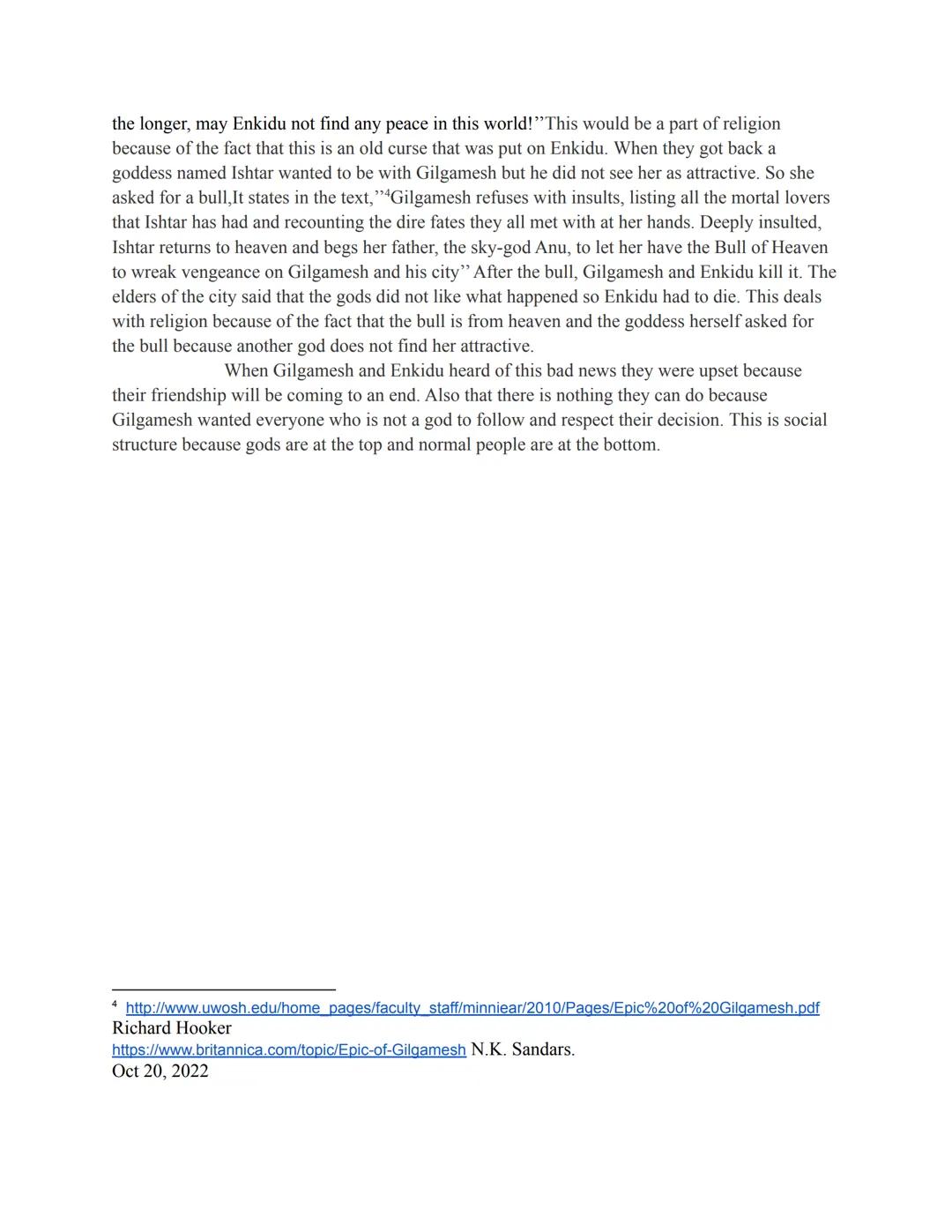
Adventures and Tragedy
The friendship between Gilgamesh and Enkidu leads to an epic adventure when they decide to journey to the Forest of Cedar to slay the monster Humbaba. Although Enkidu is reluctant (he knows the dangers better than anyone), they proceed with their quest. After defeating Humbaba and cutting off his head, they return to Uruk triumphant—but with a terrible curse placed upon Enkidu.
Back in Uruk, the goddess Ishtar becomes interested in Gilgamesh, but he rejects her advances. Furious at this rejection, Ishtar asks her father, the sky-god Anu, to send the Bull of Heaven to punish Gilgamesh. When Gilgamesh and Enkidu kill the sacred bull, the gods decree that someone must pay for this offense—and Enkidu is chosen to die.
This devastating news reveals the rigid social structure of their world. The gods stand at the top of society with absolute authority, while even heroic mortals must submit to divine judgment. Gilgamesh, despite his partial divinity and power, cannot save his friend from the gods' decree.
Think about it: The Epic of Gilgamesh explores timeless human concerns like friendship, mortality, and the search for meaning. How do these same themes appear in stories we tell today?
We thought you’d never ask...
What is the Knowunity AI companion?
Our AI companion is specifically built for the needs of students. Based on the millions of content pieces we have on the platform we can provide truly meaningful and relevant answers to students. But its not only about answers, the companion is even more about guiding students through their daily learning challenges, with personalised study plans, quizzes or content pieces in the chat and 100% personalisation based on the students skills and developments.
Where can I download the Knowunity app?
You can download the app in the Google Play Store and in the Apple App Store.
Is Knowunity really free of charge?
That's right! Enjoy free access to study content, connect with fellow students, and get instant help – all at your fingertips.
Similar Content
Most popular content in AP World History
9O
AP World HistoryOrigins of Ancient River Civilizations
Analyze the environmental factors and technological innovations that led to the rise of early states in Mesopotamia, Egypt, and the Indus Valley.
9th3,1870
O
AP World HistoryOrigins and Continuity of the Byzantine Empire
Analyze the political and cultural transitions from the Roman Empire to the Byzantine Empire, focusing on the reign of Justinian I and his code.
9th1,6320
O
AP World HistoryOrigins of African State Building (1200-1450)
Analyze how trade networks and environmental factors influenced the formation of early states like Great Zimbabwe and the Swahili city-states.
9th9700
I
AP World HistoryIntroduction to Classical Civilizations
Master fundamental concepts, geographic locations, and the defining characteristics of major empires like Rome, Han China, and Maurya India.
9th7540
O
AP World HistoryOrigins of Indigenous Americas State Building
Analyze the foundational governance structures and environmental adaptations of the Maya, Aztec, and Inca civilizations between 1200 and 1450.
9th5070
1
AP World History1200-1450 CE quiz 1
Quiz on information about developments in East Asia, South Asia, the Middle East, and Europe at the time
10th2430
O
AP World HistoryOrigins of Economic Exchange Networks
Practice identifying the foundational environmental and technological factors that enabled Silk Road, Indian Ocean, and Trans-Saharan trade.
9th3370
S
AP World HistoryState Building in East Asia Developments
Analyze the administrative methods, such as the Confucian bureaucracy and tributary system, used by the Song Dynasty to maintain political power.
9th2730
I
AP World HistoryIntroduction to State Building and Administration
Practice analyzing how land-based empires used bureaucracies and military elites to consolidate power between 1450 and 1750.
9th2600
Most popular content
9O
 AP US History
Origins and Dynamics of the Columbian Exchange
Analyze the ecological and economic motivations behind the initial transfer of goods, people, and diseases between the Old and New Worlds.
9th3,1280
I
AP US HistoryIntroduction to Early Cultural Interactions
Analyze the initial social and religious encounters between Europeans, Africans, and Indigenous peoples in the colonial Americas.
9th2,7730
O
AP World HistoryOrigins of Ancient River Civilizations
Analyze the environmental factors and technological innovations that led to the rise of early states in Mesopotamia, Egypt, and the Indus Valley.
9th3,1870
M
AP US HistoryMotivations for European Exploration
Analyze the economic, religious, and political factors that drove European powers to the Americas during the 15th and 16th centuries.
9th1,7780
F
 AP Psychology
Foundations of Ethical Guidelines in Research
Practice the core principles of the APA ethical code including informed consent, debriefing, and the role of Institutional Review Boards.
9th1,3360
I
AP US HistoryIntroduction to Native American Societies
Examine the diverse social, political, and economic structures of North American indigenous groups prior to European contact.
9th1,1100
I
 AP Biology
Introduction to Biological Elements of Life
Practice identifying the essential elements including carbon, nitrogen, phosphorus, and sulfur that compose biological macromolecules.
9th1,7390
I
AP US HistoryIntroduction to the Spanish Encomienda System
Explore the fundamental economic and social structures of the Spanish colonial system, focusing on the encomienda and the casta social hierarchy.
9th8890
O
AP World HistoryOrigins and Continuity of the Byzantine Empire
Analyze the political and cultural transitions from the Roman Empire to the Byzantine Empire, focusing on the reign of Justinian I and his code.
9th1,6320
Can't find what you're looking for? Explore other subjects.
Students love us — and so will you.
4.6/5App Store
4.7/5Google Play
The app is very easy to use and well designed. I have found everything I was looking for so far and have been able to learn a lot from the presentations! I will definitely use the app for a class assignment! And of course it also helps a lot as an inspiration.
Stefan SiOS user
This app is really great. There are so many study notes and help [...]. My problem subject is French, for example, and the app has so many options for help. Thanks to this app, I have improved my French. I would recommend it to anyone.
Samantha KlichAndroid user
Wow, I am really amazed. I just tried the app because I've seen it advertised many times and was absolutely stunned. This app is THE HELP you want for school and above all, it offers so many things, such as workouts and fact sheets, which have been VERY helpful to me personally.
AnnaiOS user
AP World History107 views·Updated Jun 11, 2026·2 pagesUnderstanding Confucianism: Definition and Origins
L
Leilani Mcdonald@leilanimcdonald_olxd
The Epic of Gilgamesh is one of the world's oldest written stories, dating back to ancient Mesopotamia around 2700 BCE. This tale follows the journey of Gilgamesh, a semi-divine king of Uruk who struggles with power, friendship, and mortality. The...
1
of 2
Sign up to see the content. It's free!
- Access to all documents
- Improve your grades
- Join milions of students
Gilgamesh: The Divine Ruler and His Meeting with Enkidu
Ever wonder what happens when a part-human, part-god ruler gets too powerful? The Epic of Gilgamesh shows us exactly that! Gilgamesh, who was two-thirds god and one-third human, ruled the city of Uruk in ancient Babylon with impressive but harsh authority. He built magnificent cities but was cruel to his people.
The god Anu heard the people's complaints and created a solution: a wild man named Enkidu who lived among animals. Before meeting Gilgamesh, Enkidu was introduced to civilization by shepherds who taught him how to speak, eat, and behave like a human. Gilgamesh had dreams about competing with "an axe" (representing Enkidu), which his mother interpreted as the coming of a powerful rival.
When Enkidu finally arrived in Uruk, he challenged Gilgamesh to a fight. Despite Gilgamesh winning this battle, the two became inseparable friends instead of enemies. This friendship would change both of their lives dramatically, leading them to dangerous adventures together.
Did you know? The Epic of Gilgamesh isn't just a story - it's preserved on ancient clay tablets and is considered the earliest surviving great work of literature in human history!
2
of 2Sign up to see the content. It's free!
- Access to all documents
- Improve your grades
- Join milions of students
Adventures and Tragedy
The friendship between Gilgamesh and Enkidu leads to an epic adventure when they decide to journey to the Forest of Cedar to slay the monster Humbaba. Although Enkidu is reluctant (he knows the dangers better than anyone), they proceed with their quest. After defeating Humbaba and cutting off his head, they return to Uruk triumphant—but with a terrible curse placed upon Enkidu.
Back in Uruk, the goddess Ishtar becomes interested in Gilgamesh, but he rejects her advances. Furious at this rejection, Ishtar asks her father, the sky-god Anu, to send the Bull of Heaven to punish Gilgamesh. When Gilgamesh and Enkidu kill the sacred bull, the gods decree that someone must pay for this offense—and Enkidu is chosen to die.
This devastating news reveals the rigid social structure of their world. The gods stand at the top of society with absolute authority, while even heroic mortals must submit to divine judgment. Gilgamesh, despite his partial divinity and power, cannot save his friend from the gods' decree.
Think about it: The Epic of Gilgamesh explores timeless human concerns like friendship, mortality, and the search for meaning. How do these same themes appear in stories we tell today?
We thought you’d never ask...
What is the Knowunity AI companion?
Our AI companion is specifically built for the needs of students. Based on the millions of content pieces we have on the platform we can provide truly meaningful and relevant answers to students. But its not only about answers, the companion is even more about guiding students through their daily learning challenges, with personalised study plans, quizzes or content pieces in the chat and 100% personalisation based on the students skills and developments.
Where can I download the Knowunity app?
You can download the app in the Google Play Store and in the Apple App Store.
Is Knowunity really free of charge?
That's right! Enjoy free access to study content, connect with fellow students, and get instant help – all at your fingertips.
Similar Content
Most popular content in AP World History
9O
AP World HistoryOrigins of Ancient River Civilizations
Analyze the environmental factors and technological innovations that led to the rise of early states in Mesopotamia, Egypt, and the Indus Valley.
9th3,1870
O
AP World HistoryOrigins and Continuity of the Byzantine Empire
Analyze the political and cultural transitions from the Roman Empire to the Byzantine Empire, focusing on the reign of Justinian I and his code.
9th1,6320
O
AP World HistoryOrigins of African State Building (1200-1450)
Analyze how trade networks and environmental factors influenced the formation of early states like Great Zimbabwe and the Swahili city-states.
9th9700
I
AP World HistoryIntroduction to Classical Civilizations
Master fundamental concepts, geographic locations, and the defining characteristics of major empires like Rome, Han China, and Maurya India.
9th7540
O
AP World HistoryOrigins of Indigenous Americas State Building
Analyze the foundational governance structures and environmental adaptations of the Maya, Aztec, and Inca civilizations between 1200 and 1450.
9th5070
1
AP World History1200-1450 CE quiz 1
Quiz on information about developments in East Asia, South Asia, the Middle East, and Europe at the time
10th2430
O
AP World HistoryOrigins of Economic Exchange Networks
Practice identifying the foundational environmental and technological factors that enabled Silk Road, Indian Ocean, and Trans-Saharan trade.
9th3370
S
AP World HistoryState Building in East Asia Developments
Analyze the administrative methods, such as the Confucian bureaucracy and tributary system, used by the Song Dynasty to maintain political power.
9th2730
I
AP World HistoryIntroduction to State Building and Administration
Practice analyzing how land-based empires used bureaucracies and military elites to consolidate power between 1450 and 1750.
9th2600
Most popular content
9O
AP US HistoryOrigins and Dynamics of the Columbian Exchange
Analyze the ecological and economic motivations behind the initial transfer of goods, people, and diseases between the Old and New Worlds.
9th3,1280
I
AP US HistoryIntroduction to Early Cultural Interactions
Analyze the initial social and religious encounters between Europeans, Africans, and Indigenous peoples in the colonial Americas.
9th2,7730
O
AP World HistoryOrigins of Ancient River Civilizations
Analyze the environmental factors and technological innovations that led to the rise of early states in Mesopotamia, Egypt, and the Indus Valley.
9th3,1870
M
AP US HistoryMotivations for European Exploration
Analyze the economic, religious, and political factors that drove European powers to the Americas during the 15th and 16th centuries.
9th1,7780
F
AP PsychologyFoundations of Ethical Guidelines in Research
Practice the core principles of the APA ethical code including informed consent, debriefing, and the role of Institutional Review Boards.
9th1,3360
I
AP US HistoryIntroduction to Native American Societies
Examine the diverse social, political, and economic structures of North American indigenous groups prior to European contact.
9th1,1100
I
AP BiologyIntroduction to Biological Elements of Life
Practice identifying the essential elements including carbon, nitrogen, phosphorus, and sulfur that compose biological macromolecules.
9th1,7390
I
AP US HistoryIntroduction to the Spanish Encomienda System
Explore the fundamental economic and social structures of the Spanish colonial system, focusing on the encomienda and the casta social hierarchy.
9th8890
O
AP World HistoryOrigins and Continuity of the Byzantine Empire
Analyze the political and cultural transitions from the Roman Empire to the Byzantine Empire, focusing on the reign of Justinian I and his code.
9th1,6320
Can't find what you're looking for? Explore other subjects.
Students love us — and so will you.
4.6/5App Store
4.7/5Google Play
The app is very easy to use and well designed. I have found everything I was looking for so far and have been able to learn a lot from the presentations! I will definitely use the app for a class assignment! And of course it also helps a lot as an inspiration.
Stefan SiOS user
This app is really great. There are so many study notes and help [...]. My problem subject is French, for example, and the app has so many options for help. Thanks to this app, I have improved my French. I would recommend it to anyone.
Samantha KlichAndroid user
Wow, I am really amazed. I just tried the app because I've seen it advertised many times and was absolutely stunned. This app is THE HELP you want for school and above all, it offers so many things, such as workouts and fact sheets, which have been VERY helpful to me personally.
AnnaiOS user