
Welcome to WHAP Unit 1, where we'll explore major developments...
 AP World History271 views·Updated Jun 12, 2026·6 pages
AP World History Unit 1: Comprehensive Review

🌟Layla🌟@laylabeli



1 / 6
1
of 6
Developments in East Asia
Ever wonder how ancient China became so powerful? The Song Dynasty created a highly centralized government based on Confucianism, which emphasized social hierarchy, filial piety (respect and obedience to elders), and ancestor veneration.
The Chinese developed an impressive meritocracy through civil service exams that tested knowledge of Confucian classics. This system allowed talented individuals to rise to government positions regardless of background. China's influence spread to neighboring regions—Korea adopted a similar merit-based exam system while Japan adapted elements of Chinese culture into their feudal system.
A major agricultural breakthrough came with Champa rice, which produced larger harvests and supported population growth. The Chinese also pioneered technologies like the compass, advanced navigation techniques, and gunpowder.
Did you know? Neo-Confucianism emerged during this period as a response to Buddhism's growing influence, attempting to restore traditional Confucian values while incorporating some Buddhist and Daoist concepts.
2
of 6
Developments in Dar Al-Islam
Imagine a time when the Islamic world was the center of learning and innovation! Dar al-Islam ("House of Islam") stretched across Southwest Asia and Northern Africa, united by the Islamic faith despite political changes.
After the Abbasid Caliphate fragmented, the Seljuk Turks established their own empire. Later, the Mongols delivered a devastating blow with the Siege of Baghdad in 1258, destroying the famous House of Wisdom where scholars had preserved and advanced ancient knowledge.
Islamic civilization expanded through the "three M's": Military conquest, Missionaries spreading the faith, and Merchants establishing trade networks. This period saw incredible intellectual achievements, including Nasir al-Din al-Tusi's development of trigonometry and significant advances in astronomy.
Cool fact: Unlike in some other civilizations, women in Islamic societies enjoyed certain rights like property ownership and inheritance, contrasting with practices like foot-binding in China.
3
of 6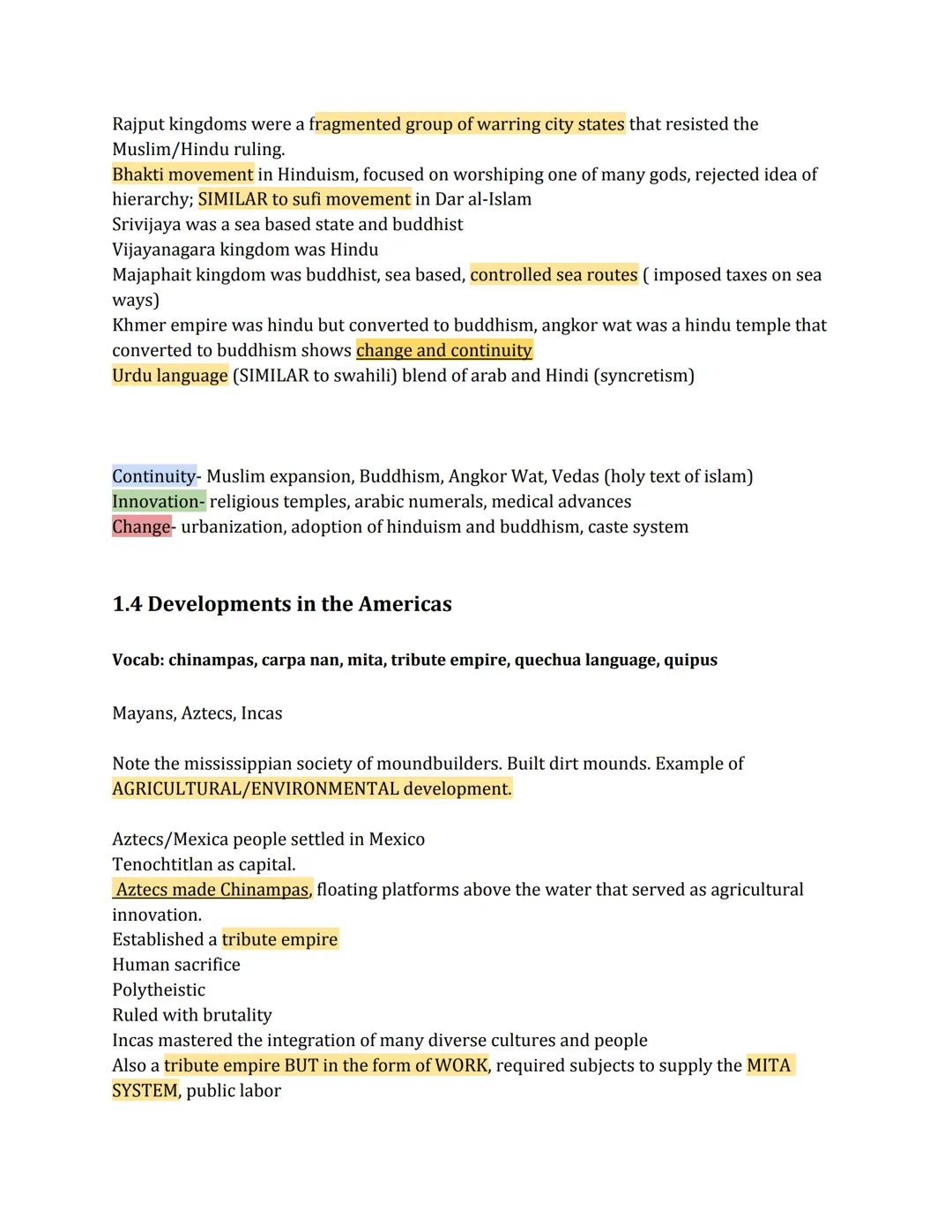
Developments in South and Southeast Asia
What happens when powerful religions meet? South and Southeast Asia became a fascinating crossroads where Hinduism, Buddhism, and Islam all competed for influence.
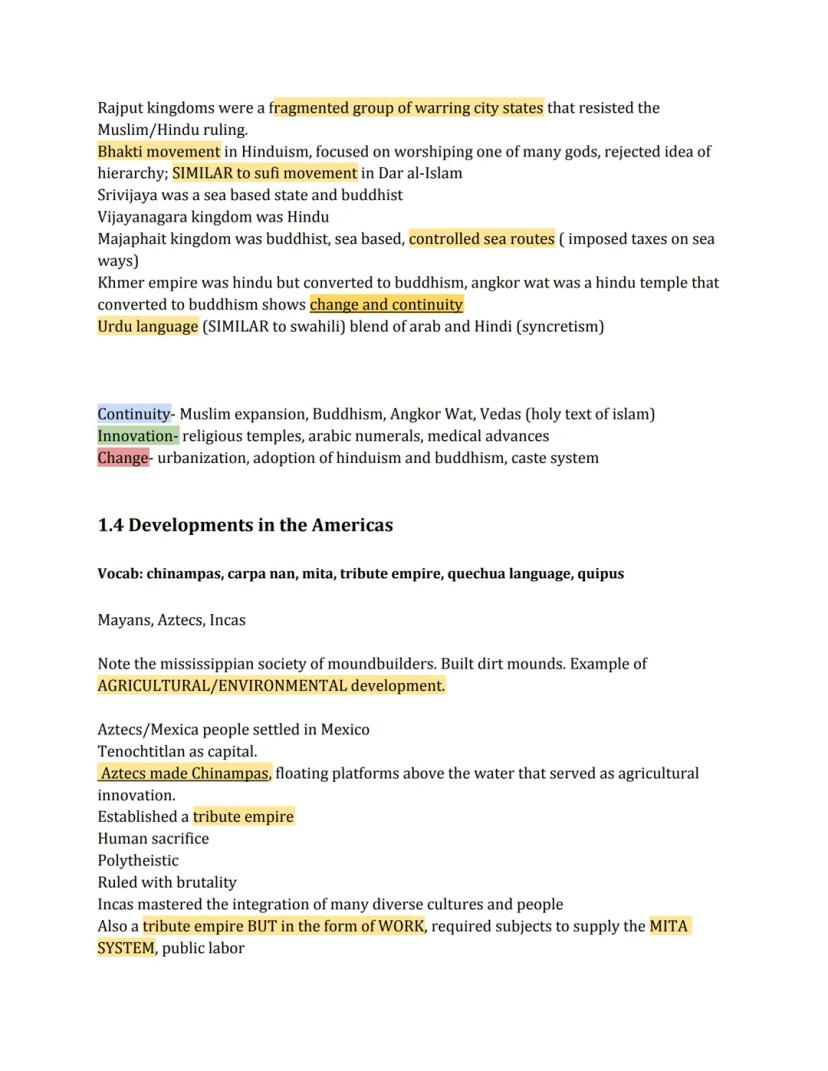
The Delhi Sultanate, established by Turkic Muslim invaders, imposed the jizya tax on non-Muslims. Meanwhile, the Bhakti movement within Hinduism gained popularity by focusing on devotion to a single deity and rejecting rigid hierarchies—similar to the Sufi movement in Islam.
Southeast Asian kingdoms like Srivijaya and Majapahit built powerful sea-based empires, controlling important trade routes. The Khmer Empire constructed the impressive Angkor Wat, originally a Hindu temple that later converted to Buddhism, reflecting the region's religious shifts.
Mind-blowing connection: The Urdu language developed during this period as a blend of Arabic and Hindi—a perfect example of cultural syncretism that shows how civilizations influenced each other!
4
of 6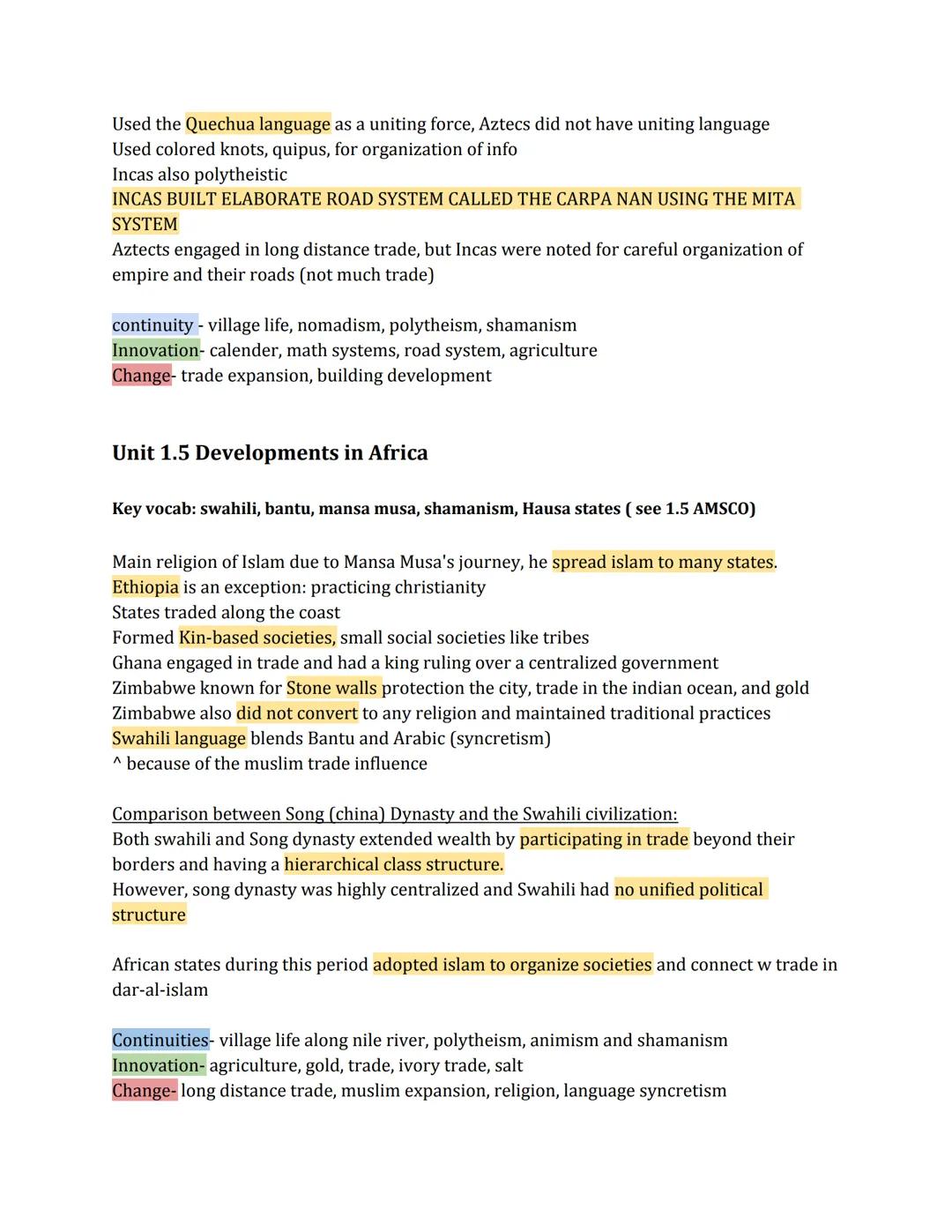
Developments in the Americas
How did civilizations thrive in the Americas without contact with the rest of the world? The Aztec, Inca, and Maya developed impressive societies with unique innovations.
The Aztecs built their capital Tenochtitlan using chinampas (floating garden platforms) for agriculture. They established a tribute empire where conquered peoples paid taxes, and practiced religious rituals including human sacrifice to appease their gods.
The Incas mastered the art of governing diverse populations across challenging terrain. They built the remarkable Carpa Nan road system using the mita labor system (required public work). Instead of a writing system, they used quipus (knotted cords) to record information and spoke Quechua as a unifying language.
Amazing achievement: The Mississippian mound-builder societies in North America constructed enormous earthen structures for ceremonial purposes, demonstrating sophisticated engineering skills without metal tools!
5
of 6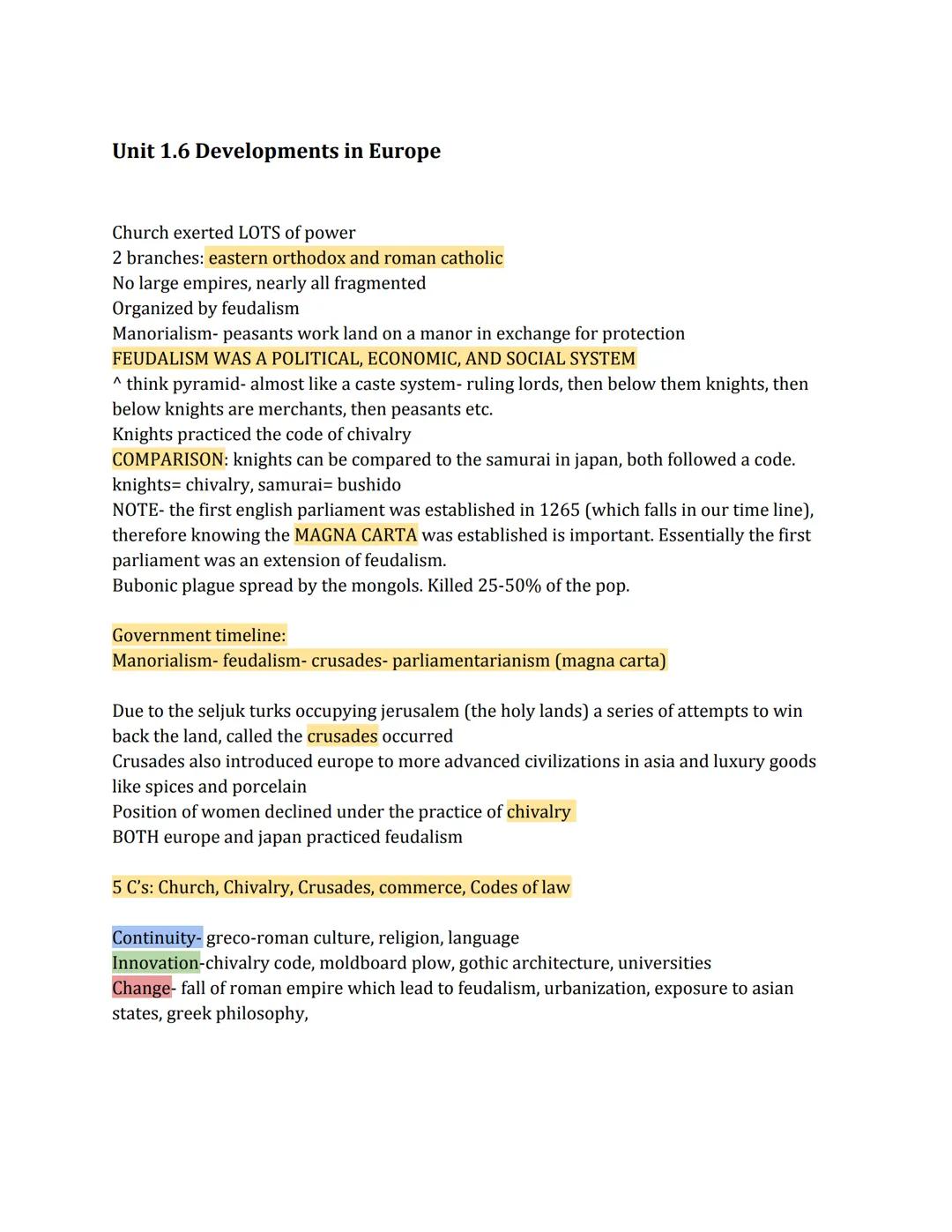
Developments in Africa
Think Africa was isolated? Think again! African civilizations were dynamic centers of trade and culture during this period.
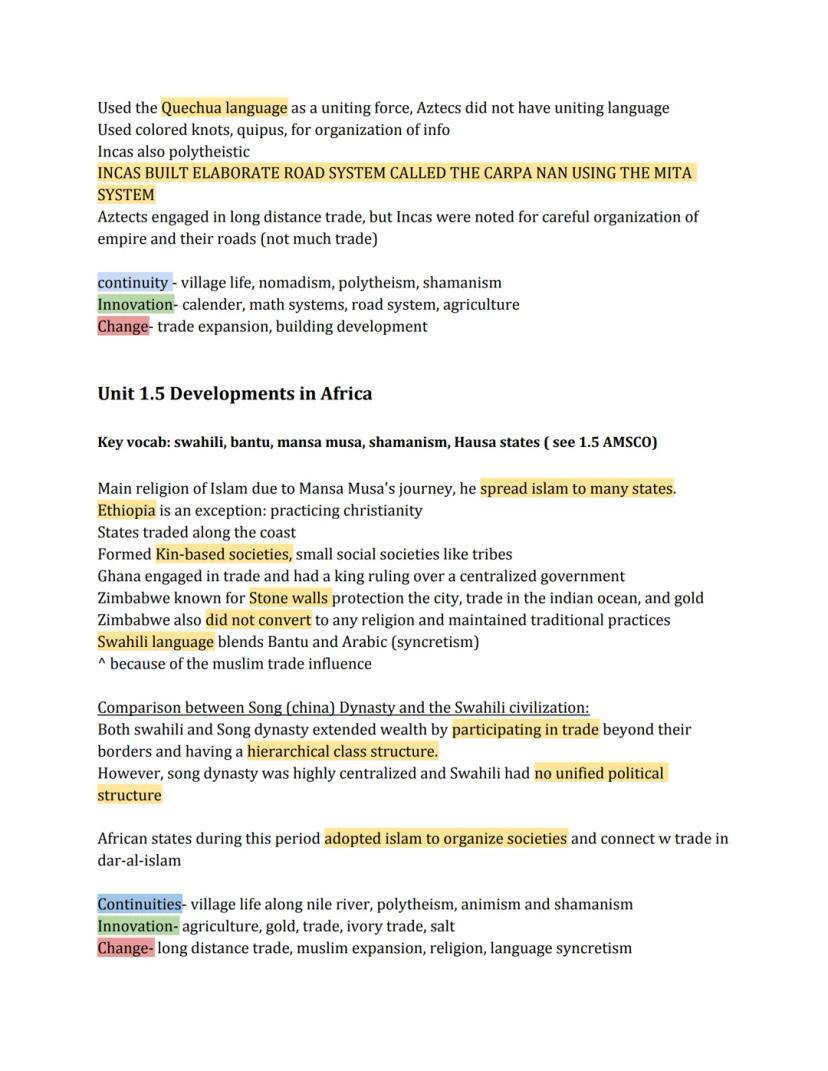
States along the coast engaged in extensive trade networks. The famous ruler Mansa Musa of Mali helped spread Islam throughout West Africa during his legendary pilgrimage to Mecca, where he distributed so much gold that he caused inflation! Meanwhile, Great Zimbabwe built impressive stone walls and traded gold across the Indian Ocean.
Small kin-based societies existed alongside powerful kingdoms. The Swahili language developed as a blend of Bantu and Arabic, reflecting the influence of Muslim traders along the eastern coast. Unlike the highly centralized Song Dynasty in China, Swahili civilization had no unified political structure but still prospered through trade.
Fascinating contrast: While many African states adopted Islam through trade connections, Ethiopia remained a Christian stronghold, showing the diverse religious landscape of the continent.
6
of 6
Developments in Europe
Did you know medieval Europe was actually quite fragmented? Unlike the powerful empires elsewhere, Europe consisted of numerous small kingdoms organized under feudalism.
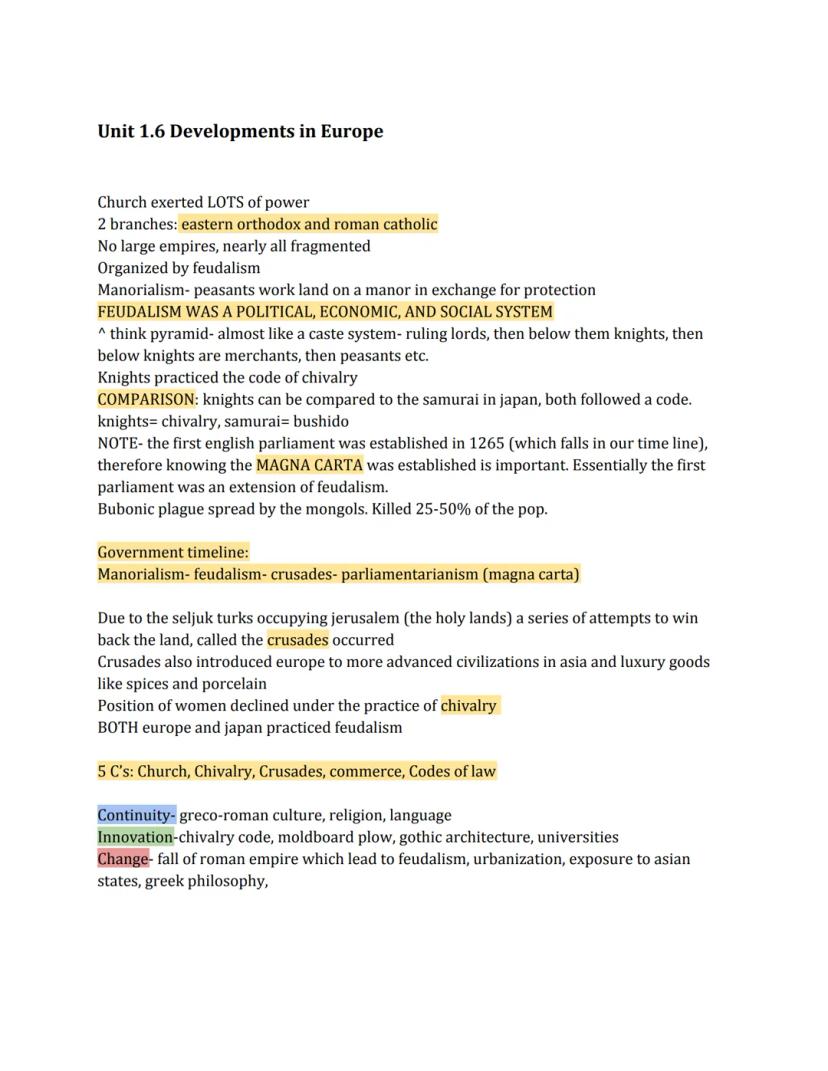
The Christian Church dominated European life, split between Roman Catholic and Eastern Orthodox branches. Society followed a strict hierarchy with lords at the top, knights in the middle, and peasants at the bottom. Knights followed the code of chivalry, similar to how Japanese samurai followed bushido.
A major turning point came with the Crusades, launched to reclaim Jerusalem from the Seljuk Turks. These military campaigns unexpectedly introduced Europeans to more advanced civilizations and luxury goods from Asia. Meanwhile, the Magna Carta of 1265 established the first English Parliament, limiting royal power.
Dramatic impact: The bubonic plague, spread in part by Mongol conquests, killed 25-50% of Europe's population, causing massive social upheaval and labor shortages that eventually helped end the feudal system.
We thought you’d never ask...
What is the Knowunity AI companion?
Our AI companion is specifically built for the needs of students. Based on the millions of content pieces we have on the platform we can provide truly meaningful and relevant answers to students. But its not only about answers, the companion is even more about guiding students through their daily learning challenges, with personalised study plans, quizzes or content pieces in the chat and 100% personalisation based on the students skills and developments.
Where can I download the Knowunity app?
You can download the app in the Google Play Store and in the Apple App Store.
Is Knowunity really free of charge?
That's right! Enjoy free access to study content, connect with fellow students, and get instant help – all at your fingertips.
Similar Content
Most popular content in AP World History
9O
AP World HistoryOrigins of Ancient River Civilizations
Analyze the environmental factors and technological innovations that led to the rise of early states in Mesopotamia, Egypt, and the Indus Valley.
9th3,1870
O
AP World HistoryOrigins and Continuity of the Byzantine Empire
Analyze the political and cultural transitions from the Roman Empire to the Byzantine Empire, focusing on the reign of Justinian I and his code.
9th1,6320
O
AP World HistoryOrigins of African State Building (1200-1450)
Analyze how trade networks and environmental factors influenced the formation of early states like Great Zimbabwe and the Swahili city-states.
9th9700
I
AP World HistoryIntroduction to Classical Civilizations
Master fundamental concepts, geographic locations, and the defining characteristics of major empires like Rome, Han China, and Maurya India.
9th7540
O
AP World HistoryOrigins of Indigenous Americas State Building
Analyze the foundational governance structures and environmental adaptations of the Maya, Aztec, and Inca civilizations between 1200 and 1450.
9th5070
1
AP World History1200-1450 CE quiz 1
Quiz on information about developments in East Asia, South Asia, the Middle East, and Europe at the time
10th2430
O
AP World HistoryOrigins of Economic Exchange Networks
Practice identifying the foundational environmental and technological factors that enabled Silk Road, Indian Ocean, and Trans-Saharan trade.
9th3370
S
AP World HistoryState Building in East Asia Developments
Analyze the administrative methods, such as the Confucian bureaucracy and tributary system, used by the Song Dynasty to maintain political power.
9th2730
I
AP World HistoryIntroduction to State Building and Administration
Practice analyzing how land-based empires used bureaucracies and military elites to consolidate power between 1450 and 1750.
9th2600
Most popular content
9O
 AP US History
Origins and Dynamics of the Columbian Exchange
Analyze the ecological and economic motivations behind the initial transfer of goods, people, and diseases between the Old and New Worlds.
9th3,1280
I
AP US HistoryIntroduction to Early Cultural Interactions
Analyze the initial social and religious encounters between Europeans, Africans, and Indigenous peoples in the colonial Americas.
9th2,7730
O
AP World HistoryOrigins of Ancient River Civilizations
Analyze the environmental factors and technological innovations that led to the rise of early states in Mesopotamia, Egypt, and the Indus Valley.
9th3,1870
M
AP US HistoryMotivations for European Exploration
Analyze the economic, religious, and political factors that drove European powers to the Americas during the 15th and 16th centuries.
9th1,7780
F
 AP Psychology
Foundations of Ethical Guidelines in Research
Practice the core principles of the APA ethical code including informed consent, debriefing, and the role of Institutional Review Boards.
9th1,3360
I
AP US HistoryIntroduction to Native American Societies
Examine the diverse social, political, and economic structures of North American indigenous groups prior to European contact.
9th1,1100
I
 AP Biology
Introduction to Biological Elements of Life
Practice identifying the essential elements including carbon, nitrogen, phosphorus, and sulfur that compose biological macromolecules.
9th1,7390
I
AP US HistoryIntroduction to the Spanish Encomienda System
Explore the fundamental economic and social structures of the Spanish colonial system, focusing on the encomienda and the casta social hierarchy.
9th8890
O
AP World HistoryOrigins and Continuity of the Byzantine Empire
Analyze the political and cultural transitions from the Roman Empire to the Byzantine Empire, focusing on the reign of Justinian I and his code.
9th1,6320
Can't find what you're looking for? Explore other subjects.
Students love us — and so will you.
4.6/5App Store
4.7/5Google Play
The app is very easy to use and well designed. I have found everything I was looking for so far and have been able to learn a lot from the presentations! I will definitely use the app for a class assignment! And of course it also helps a lot as an inspiration.
Stefan SiOS user
This app is really great. There are so many study notes and help [...]. My problem subject is French, for example, and the app has so many options for help. Thanks to this app, I have improved my French. I would recommend it to anyone.
Samantha KlichAndroid user
Wow, I am really amazed. I just tried the app because I've seen it advertised many times and was absolutely stunned. This app is THE HELP you want for school and above all, it offers so many things, such as workouts and fact sheets, which have been VERY helpful to me personally.
AnnaiOS user
AP World History271 views·Updated Jun 12, 2026·6 pagesAP World History Unit 1: Comprehensive Review
🌟Layla🌟@laylabeli
Welcome to WHAP Unit 1, where we'll explore major developments across civilizations from 1200-1450 CE. This period saw the rise of powerful states, religious transformations, and impressive technological advancements that shaped human history. Understanding these early global developments will help...
1
of 6
Sign up to see the content. It's free!
- Access to all documents
- Improve your grades
- Join milions of students
Developments in East Asia
Ever wonder how ancient China became so powerful? The Song Dynasty created a highly centralized government based on Confucianism, which emphasized social hierarchy, filial piety (respect and obedience to elders), and ancestor veneration.
The Chinese developed an impressive meritocracy through civil service exams that tested knowledge of Confucian classics. This system allowed talented individuals to rise to government positions regardless of background. China's influence spread to neighboring regions—Korea adopted a similar merit-based exam system while Japan adapted elements of Chinese culture into their feudal system.
A major agricultural breakthrough came with Champa rice, which produced larger harvests and supported population growth. The Chinese also pioneered technologies like the compass, advanced navigation techniques, and gunpowder.
Did you know? Neo-Confucianism emerged during this period as a response to Buddhism's growing influence, attempting to restore traditional Confucian values while incorporating some Buddhist and Daoist concepts.
2
of 6Sign up to see the content. It's free!
- Access to all documents
- Improve your grades
- Join milions of students
Developments in Dar Al-Islam
Imagine a time when the Islamic world was the center of learning and innovation! Dar al-Islam ("House of Islam") stretched across Southwest Asia and Northern Africa, united by the Islamic faith despite political changes.
After the Abbasid Caliphate fragmented, the Seljuk Turks established their own empire. Later, the Mongols delivered a devastating blow with the Siege of Baghdad in 1258, destroying the famous House of Wisdom where scholars had preserved and advanced ancient knowledge.
Islamic civilization expanded through the "three M's": Military conquest, Missionaries spreading the faith, and Merchants establishing trade networks. This period saw incredible intellectual achievements, including Nasir al-Din al-Tusi's development of trigonometry and significant advances in astronomy.
Cool fact: Unlike in some other civilizations, women in Islamic societies enjoyed certain rights like property ownership and inheritance, contrasting with practices like foot-binding in China.
3
of 6Sign up to see the content. It's free!
- Access to all documents
- Improve your grades
- Join milions of students
Developments in South and Southeast Asia
What happens when powerful religions meet? South and Southeast Asia became a fascinating crossroads where Hinduism, Buddhism, and Islam all competed for influence.
The Delhi Sultanate, established by Turkic Muslim invaders, imposed the jizya tax on non-Muslims. Meanwhile, the Bhakti movement within Hinduism gained popularity by focusing on devotion to a single deity and rejecting rigid hierarchies—similar to the Sufi movement in Islam.
Southeast Asian kingdoms like Srivijaya and Majapahit built powerful sea-based empires, controlling important trade routes. The Khmer Empire constructed the impressive Angkor Wat, originally a Hindu temple that later converted to Buddhism, reflecting the region's religious shifts.
Mind-blowing connection: The Urdu language developed during this period as a blend of Arabic and Hindi—a perfect example of cultural syncretism that shows how civilizations influenced each other!
4
of 6Sign up to see the content. It's free!
- Access to all documents
- Improve your grades
- Join milions of students
Developments in the Americas
How did civilizations thrive in the Americas without contact with the rest of the world? The Aztec, Inca, and Maya developed impressive societies with unique innovations.
The Aztecs built their capital Tenochtitlan using chinampas (floating garden platforms) for agriculture. They established a tribute empire where conquered peoples paid taxes, and practiced religious rituals including human sacrifice to appease their gods.
The Incas mastered the art of governing diverse populations across challenging terrain. They built the remarkable Carpa Nan road system using the mita labor system (required public work). Instead of a writing system, they used quipus (knotted cords) to record information and spoke Quechua as a unifying language.
Amazing achievement: The Mississippian mound-builder societies in North America constructed enormous earthen structures for ceremonial purposes, demonstrating sophisticated engineering skills without metal tools!
5
of 6Sign up to see the content. It's free!
- Access to all documents
- Improve your grades
- Join milions of students
Developments in Africa
Think Africa was isolated? Think again! African civilizations were dynamic centers of trade and culture during this period.
States along the coast engaged in extensive trade networks. The famous ruler Mansa Musa of Mali helped spread Islam throughout West Africa during his legendary pilgrimage to Mecca, where he distributed so much gold that he caused inflation! Meanwhile, Great Zimbabwe built impressive stone walls and traded gold across the Indian Ocean.
Small kin-based societies existed alongside powerful kingdoms. The Swahili language developed as a blend of Bantu and Arabic, reflecting the influence of Muslim traders along the eastern coast. Unlike the highly centralized Song Dynasty in China, Swahili civilization had no unified political structure but still prospered through trade.
Fascinating contrast: While many African states adopted Islam through trade connections, Ethiopia remained a Christian stronghold, showing the diverse religious landscape of the continent.
6
of 6Sign up to see the content. It's free!
- Access to all documents
- Improve your grades
- Join milions of students
Developments in Europe
Did you know medieval Europe was actually quite fragmented? Unlike the powerful empires elsewhere, Europe consisted of numerous small kingdoms organized under feudalism.
The Christian Church dominated European life, split between Roman Catholic and Eastern Orthodox branches. Society followed a strict hierarchy with lords at the top, knights in the middle, and peasants at the bottom. Knights followed the code of chivalry, similar to how Japanese samurai followed bushido.
A major turning point came with the Crusades, launched to reclaim Jerusalem from the Seljuk Turks. These military campaigns unexpectedly introduced Europeans to more advanced civilizations and luxury goods from Asia. Meanwhile, the Magna Carta of 1265 established the first English Parliament, limiting royal power.
Dramatic impact: The bubonic plague, spread in part by Mongol conquests, killed 25-50% of Europe's population, causing massive social upheaval and labor shortages that eventually helped end the feudal system.
We thought you’d never ask...
What is the Knowunity AI companion?
Our AI companion is specifically built for the needs of students. Based on the millions of content pieces we have on the platform we can provide truly meaningful and relevant answers to students. But its not only about answers, the companion is even more about guiding students through their daily learning challenges, with personalised study plans, quizzes or content pieces in the chat and 100% personalisation based on the students skills and developments.
Where can I download the Knowunity app?
You can download the app in the Google Play Store and in the Apple App Store.
Is Knowunity really free of charge?
That's right! Enjoy free access to study content, connect with fellow students, and get instant help – all at your fingertips.
Similar Content
Most popular content in AP World History
9O
AP World HistoryOrigins of Ancient River Civilizations
Analyze the environmental factors and technological innovations that led to the rise of early states in Mesopotamia, Egypt, and the Indus Valley.
9th3,1870
O
AP World HistoryOrigins and Continuity of the Byzantine Empire
Analyze the political and cultural transitions from the Roman Empire to the Byzantine Empire, focusing on the reign of Justinian I and his code.
9th1,6320
O
AP World HistoryOrigins of African State Building (1200-1450)
Analyze how trade networks and environmental factors influenced the formation of early states like Great Zimbabwe and the Swahili city-states.
9th9700
I
AP World HistoryIntroduction to Classical Civilizations
Master fundamental concepts, geographic locations, and the defining characteristics of major empires like Rome, Han China, and Maurya India.
9th7540
O
AP World HistoryOrigins of Indigenous Americas State Building
Analyze the foundational governance structures and environmental adaptations of the Maya, Aztec, and Inca civilizations between 1200 and 1450.
9th5070
1
AP World History1200-1450 CE quiz 1
Quiz on information about developments in East Asia, South Asia, the Middle East, and Europe at the time
10th2430
O
AP World HistoryOrigins of Economic Exchange Networks
Practice identifying the foundational environmental and technological factors that enabled Silk Road, Indian Ocean, and Trans-Saharan trade.
9th3370
S
AP World HistoryState Building in East Asia Developments
Analyze the administrative methods, such as the Confucian bureaucracy and tributary system, used by the Song Dynasty to maintain political power.
9th2730
I
AP World HistoryIntroduction to State Building and Administration
Practice analyzing how land-based empires used bureaucracies and military elites to consolidate power between 1450 and 1750.
9th2600
Most popular content
9O
AP US HistoryOrigins and Dynamics of the Columbian Exchange
Analyze the ecological and economic motivations behind the initial transfer of goods, people, and diseases between the Old and New Worlds.
9th3,1280
I
AP US HistoryIntroduction to Early Cultural Interactions
Analyze the initial social and religious encounters between Europeans, Africans, and Indigenous peoples in the colonial Americas.
9th2,7730
O
AP World HistoryOrigins of Ancient River Civilizations
Analyze the environmental factors and technological innovations that led to the rise of early states in Mesopotamia, Egypt, and the Indus Valley.
9th3,1870
M
AP US HistoryMotivations for European Exploration
Analyze the economic, religious, and political factors that drove European powers to the Americas during the 15th and 16th centuries.
9th1,7780
F
AP PsychologyFoundations of Ethical Guidelines in Research
Practice the core principles of the APA ethical code including informed consent, debriefing, and the role of Institutional Review Boards.
9th1,3360
I
AP US HistoryIntroduction to Native American Societies
Examine the diverse social, political, and economic structures of North American indigenous groups prior to European contact.
9th1,1100
I
AP BiologyIntroduction to Biological Elements of Life
Practice identifying the essential elements including carbon, nitrogen, phosphorus, and sulfur that compose biological macromolecules.
9th1,7390
I
AP US HistoryIntroduction to the Spanish Encomienda System
Explore the fundamental economic and social structures of the Spanish colonial system, focusing on the encomienda and the casta social hierarchy.
9th8890
O
AP World HistoryOrigins and Continuity of the Byzantine Empire
Analyze the political and cultural transitions from the Roman Empire to the Byzantine Empire, focusing on the reign of Justinian I and his code.
9th1,6320
Can't find what you're looking for? Explore other subjects.
Students love us — and so will you.
4.6/5App Store
4.7/5Google Play
The app is very easy to use and well designed. I have found everything I was looking for so far and have been able to learn a lot from the presentations! I will definitely use the app for a class assignment! And of course it also helps a lot as an inspiration.
Stefan SiOS user
This app is really great. There are so many study notes and help [...]. My problem subject is French, for example, and the app has so many options for help. Thanks to this app, I have improved my French. I would recommend it to anyone.
Samantha KlichAndroid user
Wow, I am really amazed. I just tried the app because I've seen it advertised many times and was absolutely stunned. This app is THE HELP you want for school and above all, it offers so many things, such as workouts and fact sheets, which have been VERY helpful to me personally.
AnnaiOS user