

Get ready to dive into the key events and concepts...
 AP US History125 views·Updated Jun 10, 2026·2 pages
APUSH Unit 2 Study Guide: Causes of the American Revolution
1
of 2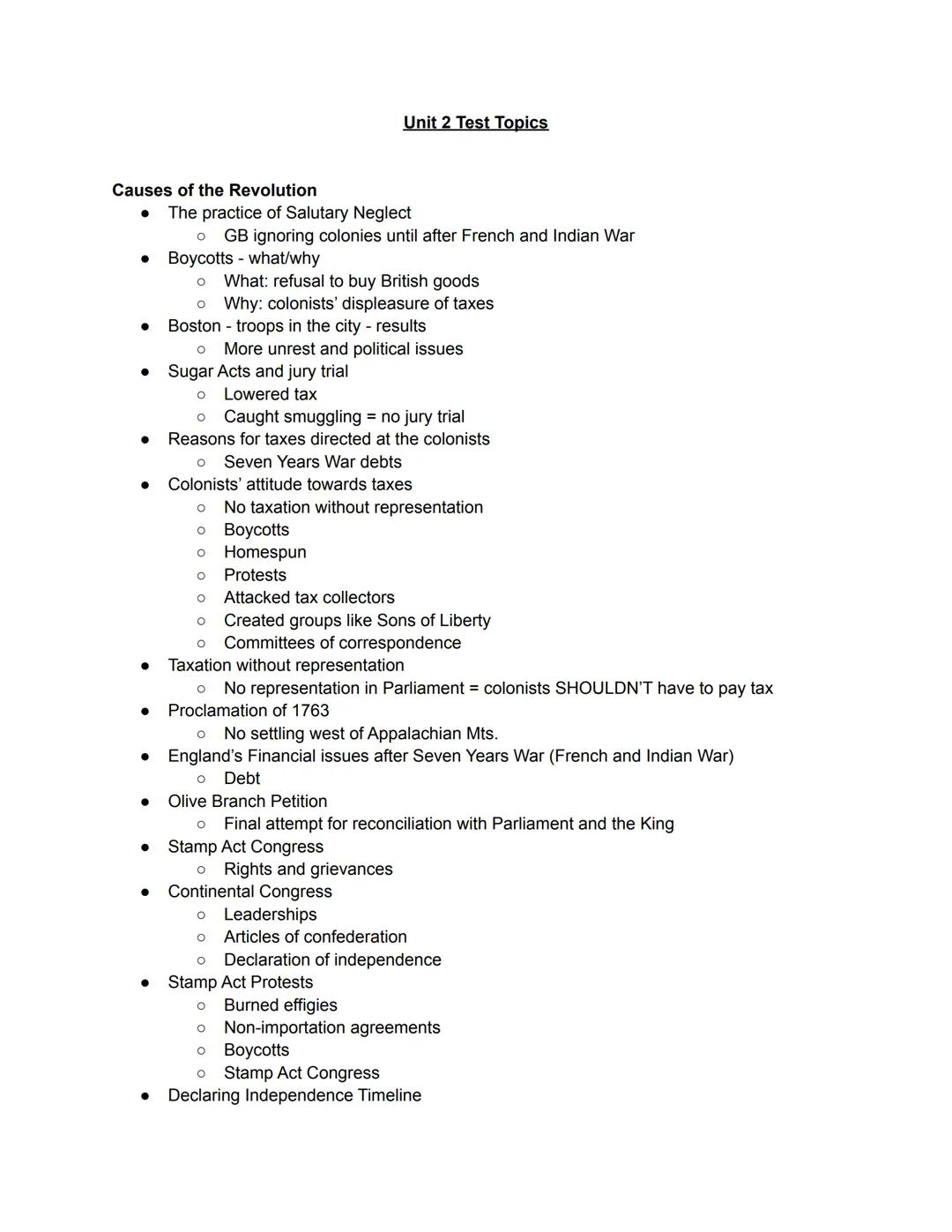
Causes of the American Revolution
The American Revolution began brewing after the French and Indian War when Britain ended its policy of Salutary Neglect and started enforcing control over the colonies. Following expensive war debts, Britain imposed new taxes like the Sugar Act, which lowered tax rates but removed jury trials for smugglers—a move colonists saw as an attack on their rights.
Colonial resistance took many forms. "No taxation without representation" became their rallying cry, arguing that without representatives in Parliament, they shouldn't pay British taxes. Colonists organized boycotts of British goods, wore homespun cloth instead of British textiles, and formed groups like the Sons of Liberty to coordinate resistance.
British policies continued to provoke colonial anger. The Proclamation of 1763 prohibited settlement west of the Appalachian Mountains, frustrating colonists who wanted to expand westward. As tensions escalated, colonial leaders formed the Stamp Act Congress to list their grievances, and later organized the Continental Congress which eventually produced the Declaration of Independence.
Remember This! The colonists tried peaceful solutions first—the Olive Branch Petition was their final attempt at reconciliation with Britain before deciding independence was necessary.
The path to revolution accelerated after the Boston Massacre, where British troops stationed in Boston fired on colonists, further inflaming tensions. Organized resistance through Committees of Correspondence helped colonies communicate and coordinate their responses to British actions, creating a unified colonial voice.
2
of 2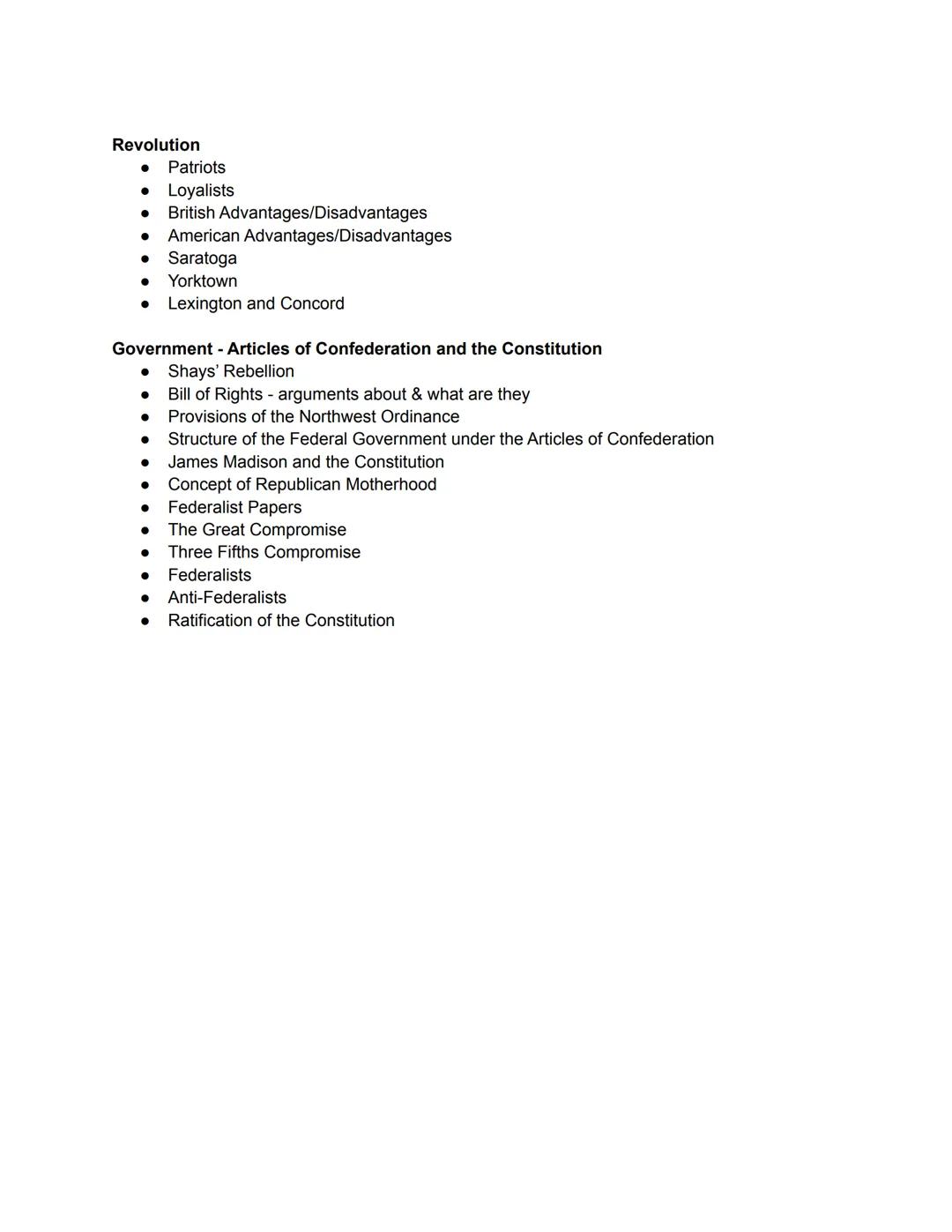
The Revolution and Creating a New Government
The American Revolution divided colonists into Patriots who supported independence and Loyalists who remained faithful to Britain. Both sides had distinct advantages—Britain possessed a professional army and naval power, while Americans had home-field knowledge, motivation, and eventually foreign support from France. The American victory at Saratoga proved pivotal in securing this French alliance.
After winning independence at Yorktown, Americans created their first national framework with the Articles of Confederation, which established a weak central government with no taxing power. This weakness became apparent during Shays' Rebellion, when the government couldn't respond effectively to an uprising of indebted farmers in Massachusetts.
The Constitutional Convention addressed these problems through crucial compromises. The Great Compromise balanced representation between large and small states, while the Three-Fifths Compromise addressed the counting of enslaved people for representation. The debate over ratification divided Americans into Federalists who supported the Constitution and Anti-Federalists who feared centralized power.
Make the Connection: The Bill of Rights was added to protect individual liberties and secure Anti-Federalist support for the Constitution. These first ten amendments continue to safeguard American freedoms today!
James Madison, known as the "Father of the Constitution," alongside Alexander Hamilton and John Jay, wrote the Federalist Papers to argue for ratification. Meanwhile, the Northwest Ordinance established an organized process for creating new states, prohibiting slavery in these territories and setting a precedent for westward expansion under the new government.
We thought you’d never ask...
What is the Knowunity AI companion?
Our AI companion is specifically built for the needs of students. Based on the millions of content pieces we have on the platform we can provide truly meaningful and relevant answers to students. But its not only about answers, the companion is even more about guiding students through their daily learning challenges, with personalised study plans, quizzes or content pieces in the chat and 100% personalisation based on the students skills and developments.
Where can I download the Knowunity app?
You can download the app in the Google Play Store and in the Apple App Store.
Is Knowunity really free of charge?
That's right! Enjoy free access to study content, connect with fellow students, and get instant help – all at your fingertips.
Similar Content
Most popular content: Revolutionary War
1Most popular content in AP US History
9O
AP US HistoryOrigins and Dynamics of the Columbian Exchange
Analyze the ecological and economic motivations behind the initial transfer of goods, people, and diseases between the Old and New Worlds.
9th3,1280
I
AP US HistoryIntroduction to Early Cultural Interactions
Analyze the initial social and religious encounters between Europeans, Africans, and Indigenous peoples in the colonial Americas.
9th2,7730
M
AP US HistoryMotivations for European Exploration
Analyze the economic, religious, and political factors that drove European powers to the Americas during the 15th and 16th centuries.
9th1,7780
I
AP US HistoryIntroduction to Native American Societies
Examine the diverse social, political, and economic structures of North American indigenous groups prior to European contact.
9th1,1100
I
AP US HistoryIntroduction to the Spanish Encomienda System
Explore the fundamental economic and social structures of the Spanish colonial system, focusing on the encomienda and the casta social hierarchy.
9th8890
M
AP US HistoryMotivations for European Colonization
Analyze the differing economic, religious, and social goals that drove Spanish, French, Dutch, and British expansion in the New World.
9th7570
W
AP US HistoryWeaknesses of the Articles of Confederation
Analyze the structural deficiencies of the first national government, focusing on fiscal instability and the lack of executive authority.
9th7700
I
AP US HistoryInitial Native-European Contacts and Perceptions
Analyze primary sources from the 15th and 16th centuries to compare Spanish, French, and English initial interactions with indigenous populations.
9th6370
AP US HistoryUnit 1: Apush
1491-1607
11th1,0059
Most popular content
9O
AP US HistoryOrigins and Dynamics of the Columbian Exchange
Analyze the ecological and economic motivations behind the initial transfer of goods, people, and diseases between the Old and New Worlds.
9th3,1280
I
AP US HistoryIntroduction to Early Cultural Interactions
Analyze the initial social and religious encounters between Europeans, Africans, and Indigenous peoples in the colonial Americas.
9th2,7730
O
 AP World History
Origins of Ancient River Civilizations
Analyze the environmental factors and technological innovations that led to the rise of early states in Mesopotamia, Egypt, and the Indus Valley.
9th3,1870
M
AP US HistoryMotivations for European Exploration
Analyze the economic, religious, and political factors that drove European powers to the Americas during the 15th and 16th centuries.
9th1,7780
F
 AP Psychology
Foundations of Ethical Guidelines in Research
Practice the core principles of the APA ethical code including informed consent, debriefing, and the role of Institutional Review Boards.
9th1,3360
I
AP US HistoryIntroduction to Native American Societies
Examine the diverse social, political, and economic structures of North American indigenous groups prior to European contact.
9th1,1100
I
 AP Biology
Introduction to Biological Elements of Life
Practice identifying the essential elements including carbon, nitrogen, phosphorus, and sulfur that compose biological macromolecules.
9th1,7390
I
AP US HistoryIntroduction to the Spanish Encomienda System
Explore the fundamental economic and social structures of the Spanish colonial system, focusing on the encomienda and the casta social hierarchy.
9th8890
O
AP World HistoryOrigins and Continuity of the Byzantine Empire
Analyze the political and cultural transitions from the Roman Empire to the Byzantine Empire, focusing on the reign of Justinian I and his code.
9th1,6320
Can't find what you're looking for? Explore other subjects.
Students love us — and so will you.
4.6/5App Store
4.7/5Google Play
The app is very easy to use and well designed. I have found everything I was looking for so far and have been able to learn a lot from the presentations! I will definitely use the app for a class assignment! And of course it also helps a lot as an inspiration.
Stefan SiOS user
This app is really great. There are so many study notes and help [...]. My problem subject is French, for example, and the app has so many options for help. Thanks to this app, I have improved my French. I would recommend it to anyone.
Samantha KlichAndroid user
Wow, I am really amazed. I just tried the app because I've seen it advertised many times and was absolutely stunned. This app is THE HELP you want for school and above all, it offers so many things, such as workouts and fact sheets, which have been VERY helpful to me personally.
AnnaiOS user
AP US History125 views·Updated Jun 10, 2026·2 pagesAPUSH Unit 2 Study Guide: Causes of the American Revolution
Get ready to dive into the key events and concepts of the American Revolution and the formation of the United States government. This summary covers the major causes that sparked colonial rebellion, the Revolution itself, and how Americans created their...
1
of 2
Sign up to see the content. It's free!
- Access to all documents
- Improve your grades
- Join milions of students
Causes of the American Revolution
The American Revolution began brewing after the French and Indian War when Britain ended its policy of Salutary Neglect and started enforcing control over the colonies. Following expensive war debts, Britain imposed new taxes like the Sugar Act, which lowered tax rates but removed jury trials for smugglers—a move colonists saw as an attack on their rights.
Colonial resistance took many forms. "No taxation without representation" became their rallying cry, arguing that without representatives in Parliament, they shouldn't pay British taxes. Colonists organized boycotts of British goods, wore homespun cloth instead of British textiles, and formed groups like the Sons of Liberty to coordinate resistance.
British policies continued to provoke colonial anger. The Proclamation of 1763 prohibited settlement west of the Appalachian Mountains, frustrating colonists who wanted to expand westward. As tensions escalated, colonial leaders formed the Stamp Act Congress to list their grievances, and later organized the Continental Congress which eventually produced the Declaration of Independence.
Remember This! The colonists tried peaceful solutions first—the Olive Branch Petition was their final attempt at reconciliation with Britain before deciding independence was necessary.
The path to revolution accelerated after the Boston Massacre, where British troops stationed in Boston fired on colonists, further inflaming tensions. Organized resistance through Committees of Correspondence helped colonies communicate and coordinate their responses to British actions, creating a unified colonial voice.
2
of 2Sign up to see the content. It's free!
- Access to all documents
- Improve your grades
- Join milions of students
The Revolution and Creating a New Government
The American Revolution divided colonists into Patriots who supported independence and Loyalists who remained faithful to Britain. Both sides had distinct advantages—Britain possessed a professional army and naval power, while Americans had home-field knowledge, motivation, and eventually foreign support from France. The American victory at Saratoga proved pivotal in securing this French alliance.
After winning independence at Yorktown, Americans created their first national framework with the Articles of Confederation, which established a weak central government with no taxing power. This weakness became apparent during Shays' Rebellion, when the government couldn't respond effectively to an uprising of indebted farmers in Massachusetts.
The Constitutional Convention addressed these problems through crucial compromises. The Great Compromise balanced representation between large and small states, while the Three-Fifths Compromise addressed the counting of enslaved people for representation. The debate over ratification divided Americans into Federalists who supported the Constitution and Anti-Federalists who feared centralized power.
Make the Connection: The Bill of Rights was added to protect individual liberties and secure Anti-Federalist support for the Constitution. These first ten amendments continue to safeguard American freedoms today!
James Madison, known as the "Father of the Constitution," alongside Alexander Hamilton and John Jay, wrote the Federalist Papers to argue for ratification. Meanwhile, the Northwest Ordinance established an organized process for creating new states, prohibiting slavery in these territories and setting a precedent for westward expansion under the new government.
We thought you’d never ask...
What is the Knowunity AI companion?
Our AI companion is specifically built for the needs of students. Based on the millions of content pieces we have on the platform we can provide truly meaningful and relevant answers to students. But its not only about answers, the companion is even more about guiding students through their daily learning challenges, with personalised study plans, quizzes or content pieces in the chat and 100% personalisation based on the students skills and developments.
Where can I download the Knowunity app?
You can download the app in the Google Play Store and in the Apple App Store.
Is Knowunity really free of charge?
That's right! Enjoy free access to study content, connect with fellow students, and get instant help – all at your fingertips.
Similar Content
Most popular content: Revolutionary War
1Most popular content in AP US History
9O
AP US HistoryOrigins and Dynamics of the Columbian Exchange
Analyze the ecological and economic motivations behind the initial transfer of goods, people, and diseases between the Old and New Worlds.
9th3,1280
I
AP US HistoryIntroduction to Early Cultural Interactions
Analyze the initial social and religious encounters between Europeans, Africans, and Indigenous peoples in the colonial Americas.
9th2,7730
M
AP US HistoryMotivations for European Exploration
Analyze the economic, religious, and political factors that drove European powers to the Americas during the 15th and 16th centuries.
9th1,7780
I
AP US HistoryIntroduction to Native American Societies
Examine the diverse social, political, and economic structures of North American indigenous groups prior to European contact.
9th1,1100
I
AP US HistoryIntroduction to the Spanish Encomienda System
Explore the fundamental economic and social structures of the Spanish colonial system, focusing on the encomienda and the casta social hierarchy.
9th8890
M
AP US HistoryMotivations for European Colonization
Analyze the differing economic, religious, and social goals that drove Spanish, French, Dutch, and British expansion in the New World.
9th7570
W
AP US HistoryWeaknesses of the Articles of Confederation
Analyze the structural deficiencies of the first national government, focusing on fiscal instability and the lack of executive authority.
9th7700
I
AP US HistoryInitial Native-European Contacts and Perceptions
Analyze primary sources from the 15th and 16th centuries to compare Spanish, French, and English initial interactions with indigenous populations.
9th6370
AP US HistoryUnit 1: Apush
1491-1607
11th1,0059
Most popular content
9O
AP US HistoryOrigins and Dynamics of the Columbian Exchange
Analyze the ecological and economic motivations behind the initial transfer of goods, people, and diseases between the Old and New Worlds.
9th3,1280
I
AP US HistoryIntroduction to Early Cultural Interactions
Analyze the initial social and religious encounters between Europeans, Africans, and Indigenous peoples in the colonial Americas.
9th2,7730
O
AP World HistoryOrigins of Ancient River Civilizations
Analyze the environmental factors and technological innovations that led to the rise of early states in Mesopotamia, Egypt, and the Indus Valley.
9th3,1870
M
AP US HistoryMotivations for European Exploration
Analyze the economic, religious, and political factors that drove European powers to the Americas during the 15th and 16th centuries.
9th1,7780
F
AP PsychologyFoundations of Ethical Guidelines in Research
Practice the core principles of the APA ethical code including informed consent, debriefing, and the role of Institutional Review Boards.
9th1,3360
I
AP US HistoryIntroduction to Native American Societies
Examine the diverse social, political, and economic structures of North American indigenous groups prior to European contact.
9th1,1100
I
AP BiologyIntroduction to Biological Elements of Life
Practice identifying the essential elements including carbon, nitrogen, phosphorus, and sulfur that compose biological macromolecules.
9th1,7390
I
AP US HistoryIntroduction to the Spanish Encomienda System
Explore the fundamental economic and social structures of the Spanish colonial system, focusing on the encomienda and the casta social hierarchy.
9th8890
O
AP World HistoryOrigins and Continuity of the Byzantine Empire
Analyze the political and cultural transitions from the Roman Empire to the Byzantine Empire, focusing on the reign of Justinian I and his code.
9th1,6320
Can't find what you're looking for? Explore other subjects.
Students love us — and so will you.
4.6/5App Store
4.7/5Google Play
The app is very easy to use and well designed. I have found everything I was looking for so far and have been able to learn a lot from the presentations! I will definitely use the app for a class assignment! And of course it also helps a lot as an inspiration.
Stefan SiOS user
This app is really great. There are so many study notes and help [...]. My problem subject is French, for example, and the app has so many options for help. Thanks to this app, I have improved my French. I would recommend it to anyone.
Samantha KlichAndroid user
Wow, I am really amazed. I just tried the app because I've seen it advertised many times and was absolutely stunned. This app is THE HELP you want for school and above all, it offers so many things, such as workouts and fact sheets, which have been VERY helpful to me personally.
AnnaiOS user