
The American Civil War was a brutal conflict that tore...
 AP US History139 views·Updated Jun 19, 2026·33 pages
American Civil War Overview
J
Jenny@jenny_mgrj
1 / 10
1
of 10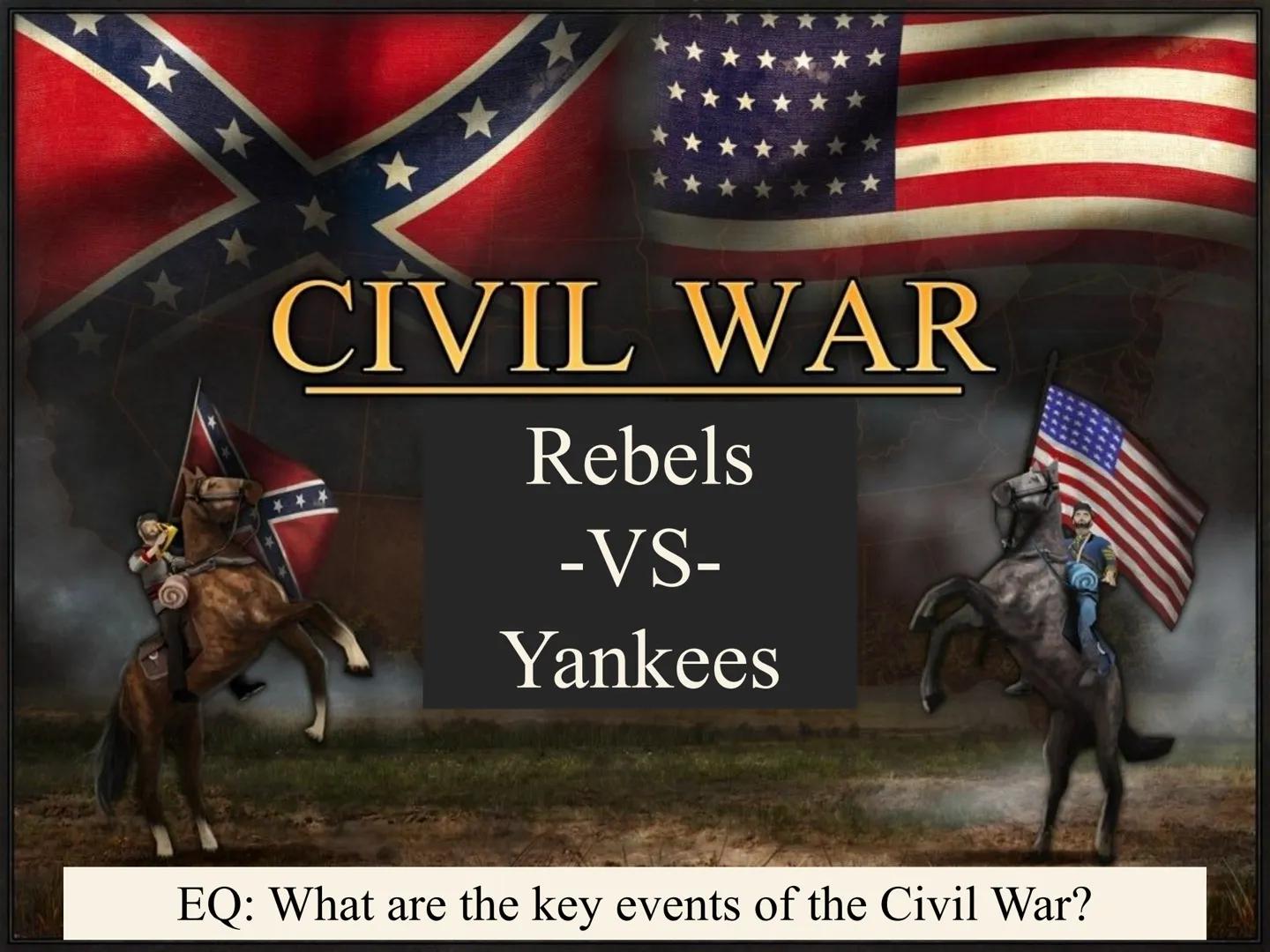
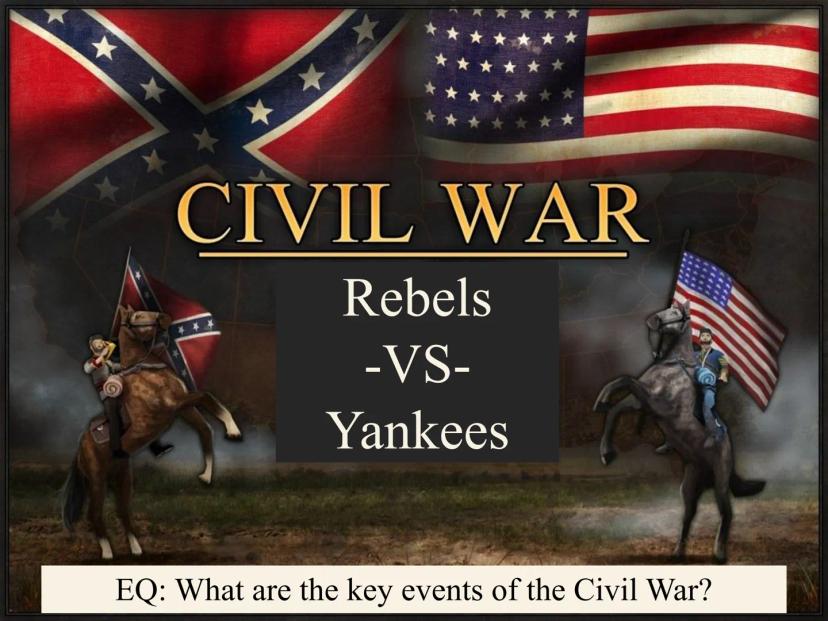
Civil War: Rebels vs. Yankees
The American Civil War represents one of the most pivotal chapters in our nation's history. This devastating conflict saw Americans fighting Americans - Rebels against Yankees - in a struggle that would determine the future of our country.
You'll discover how this conflict fundamentally changed America's path forward. The essential question we'll explore is: What were the key events that shaped the Civil War?
Think About It: When you hear "Civil War," what images come to mind? The decisions made during this conflict continue to shape American society today.
2
of 10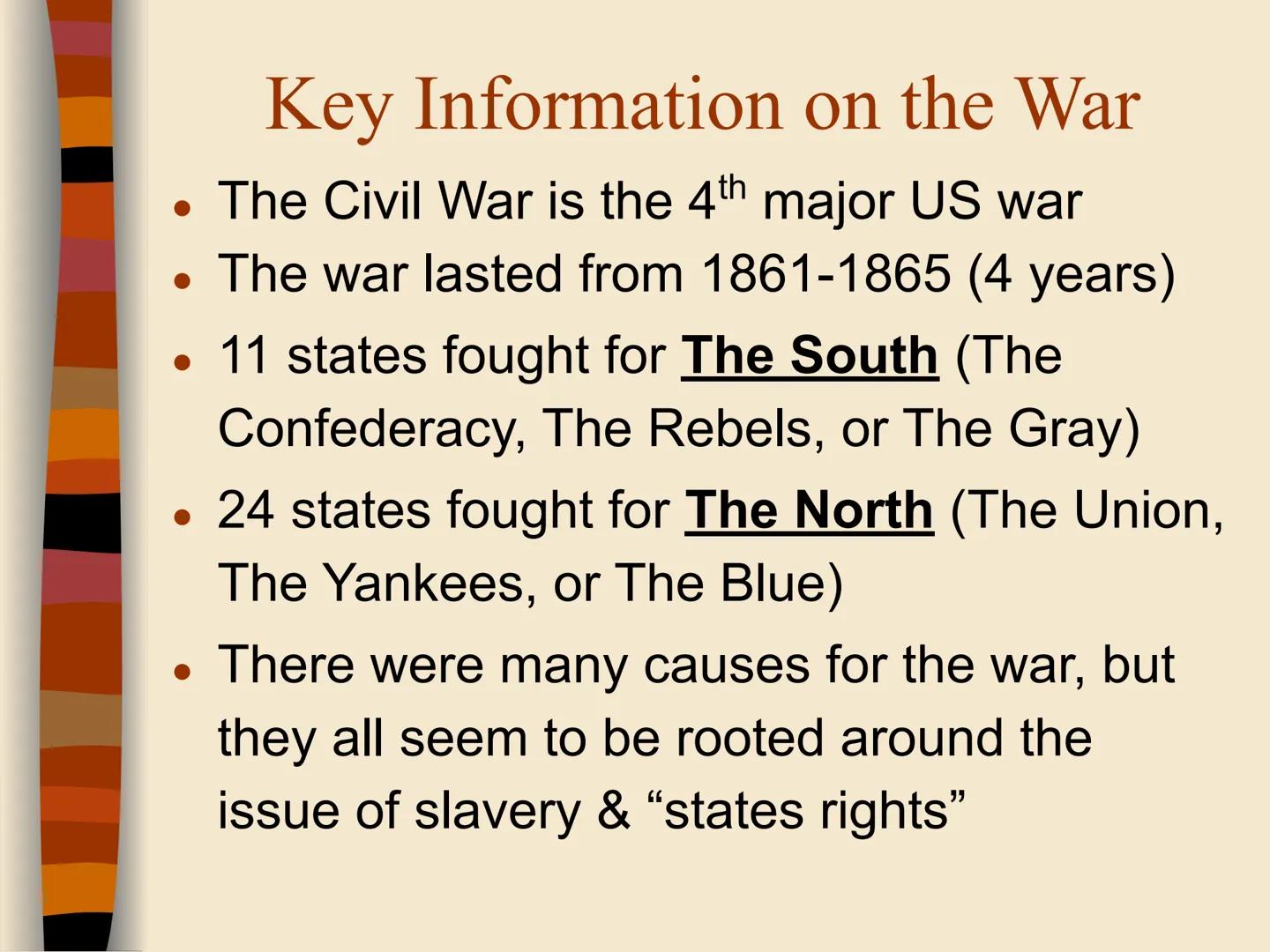
Key Information on the War
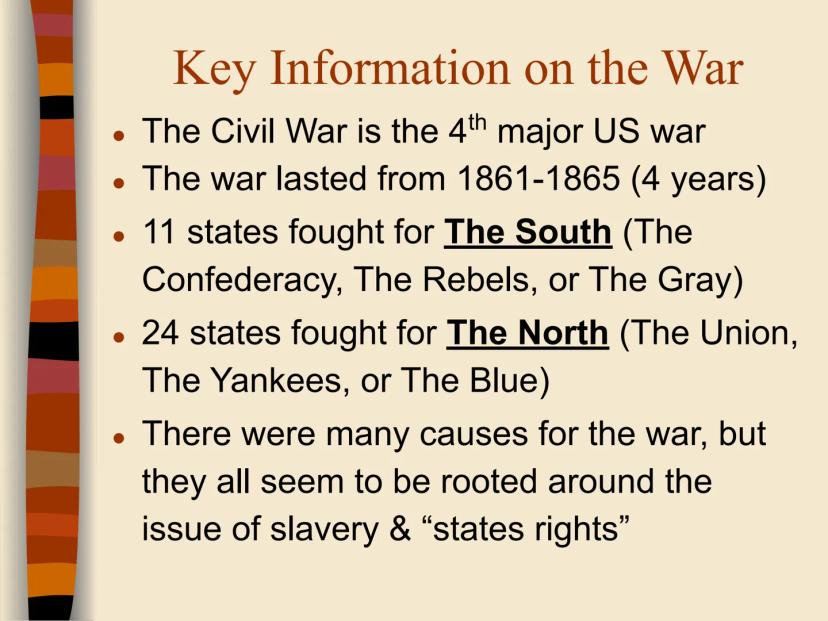
The Civil War stands as the fourth major conflict in American history, lasting four years from 1861 to 1865. This wasn't just a small dispute - it involved the entire nation taking sides.
The South (also known as The Confederacy, The Rebels, or The Gray) consisted of 11 states fighting against the North (The Union, The Yankees, or The Blue) which comprised 24 states. The numerical advantage clearly favored the Union from the beginning.
While historians discuss many causes for this devastating conflict, at the heart of these tensions was the issue of slavery and what the South termed "states' rights." This fundamental disagreement about America's future led to the bloodiest conflict on American soil.
Important Context: When people talked about "states' rights" during this period, they were primarily referring to the right to maintain slavery, which was central to the Southern economy and society.
3
of 10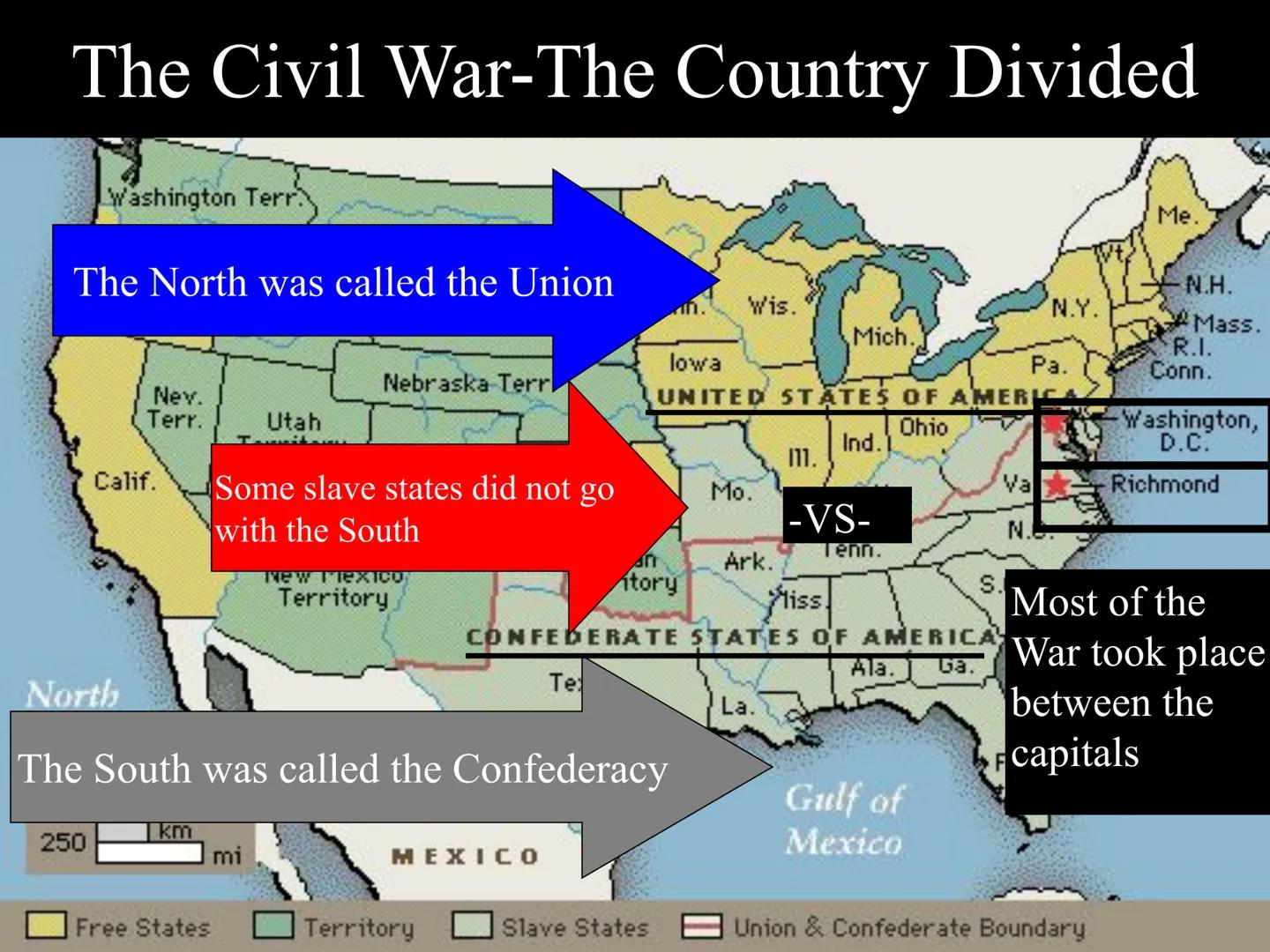
The Civil War-The Country Divided
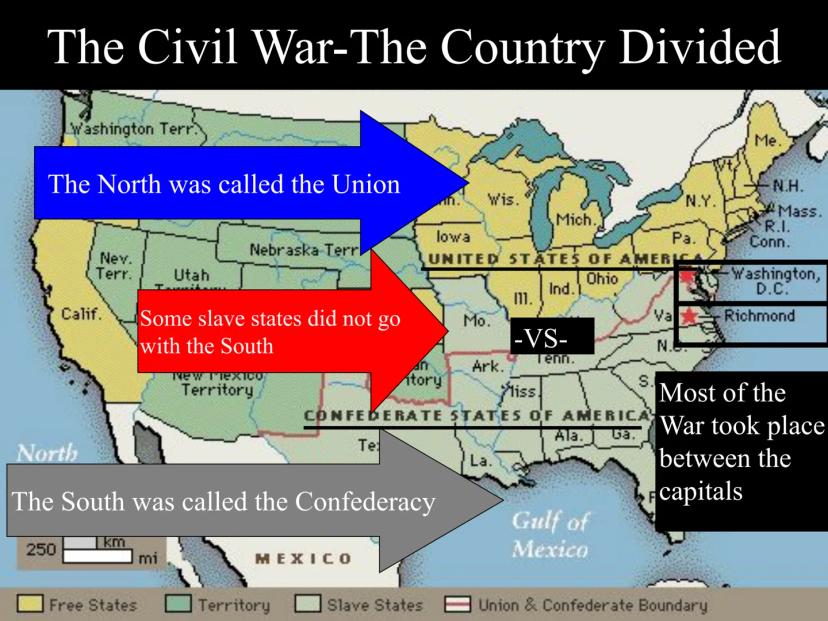
Looking at a map of America during the Civil War shows how deeply divided our nation became. The Northern states formed the Union, with Washington D.C. as their capital, while the Southern states created the Confederate States of America, establishing Richmond, Virginia as their capital.
Interestingly, not all slave states joined the Confederacy. Border states like Missouri, Kentucky, Maryland, and Delaware remained with the Union despite allowing slavery, creating a complicated political landscape.
Most of the fighting occurred in the territory between these two capitals, turning peaceful farmland and towns into battlegrounds. The geography of the conflict meant that Southern states bore the brunt of the physical devastation.
Geographic Insight: The location of the war primarily in Southern territory meant that Southern infrastructure, cities, and farms suffered tremendous damage, creating economic hardships that would last for generations.
4
of 10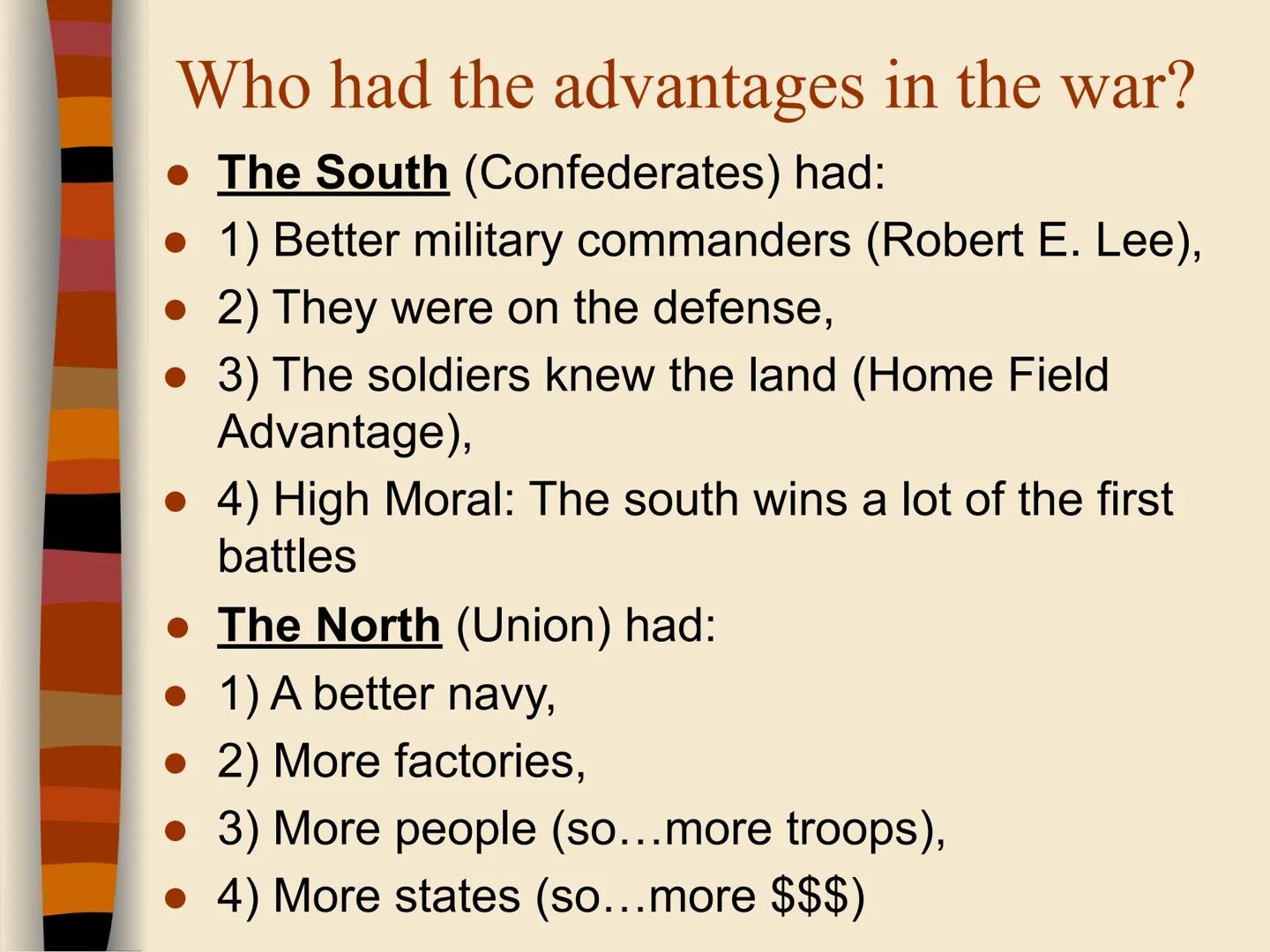
Who Had the Advantages in the War?
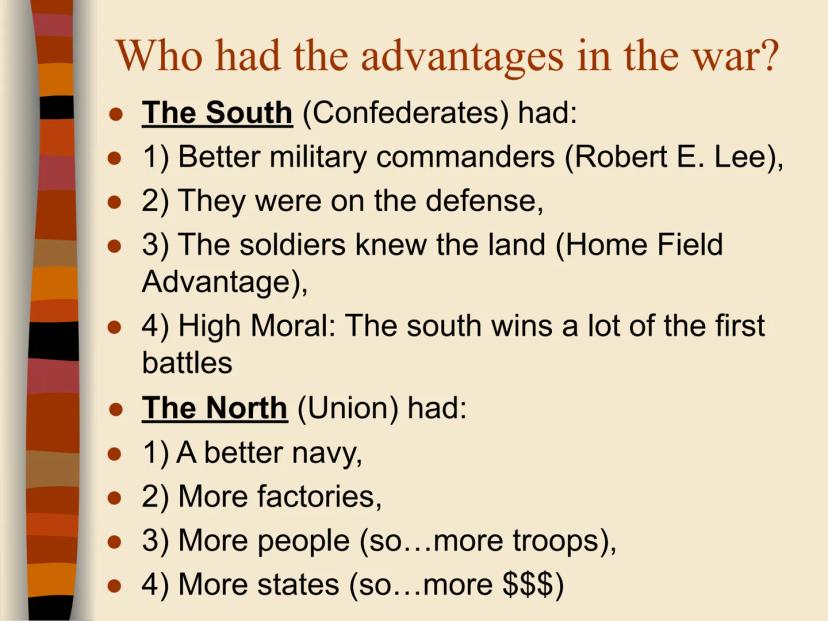
The Confederate South entered the war with several significant advantages. They had superior military leadership, particularly in General Robert E. Lee, who was considered the best commander of his day. Fighting defensively on familiar territory gave Southern soldiers a home-field advantage, and early victories boosted their morale.
However, the Union North possessed overwhelming material advantages that would ultimately prove decisive. The North's superior navy controlled the coastline and major rivers. Their industrial capacity far exceeded the South's primarily agricultural economy, allowing them to produce more weapons and supplies.
The North's larger population provided more soldiers for the war effort, and having more states meant greater financial resources to fund the prolonged conflict. These advantages would eventually overcome the South's initial military successes.
Critical Understanding: Wars aren't just won by courage and military skill - resources, manufacturing capacity, and population size often determine the ultimate outcome of extended conflicts.
5
of 10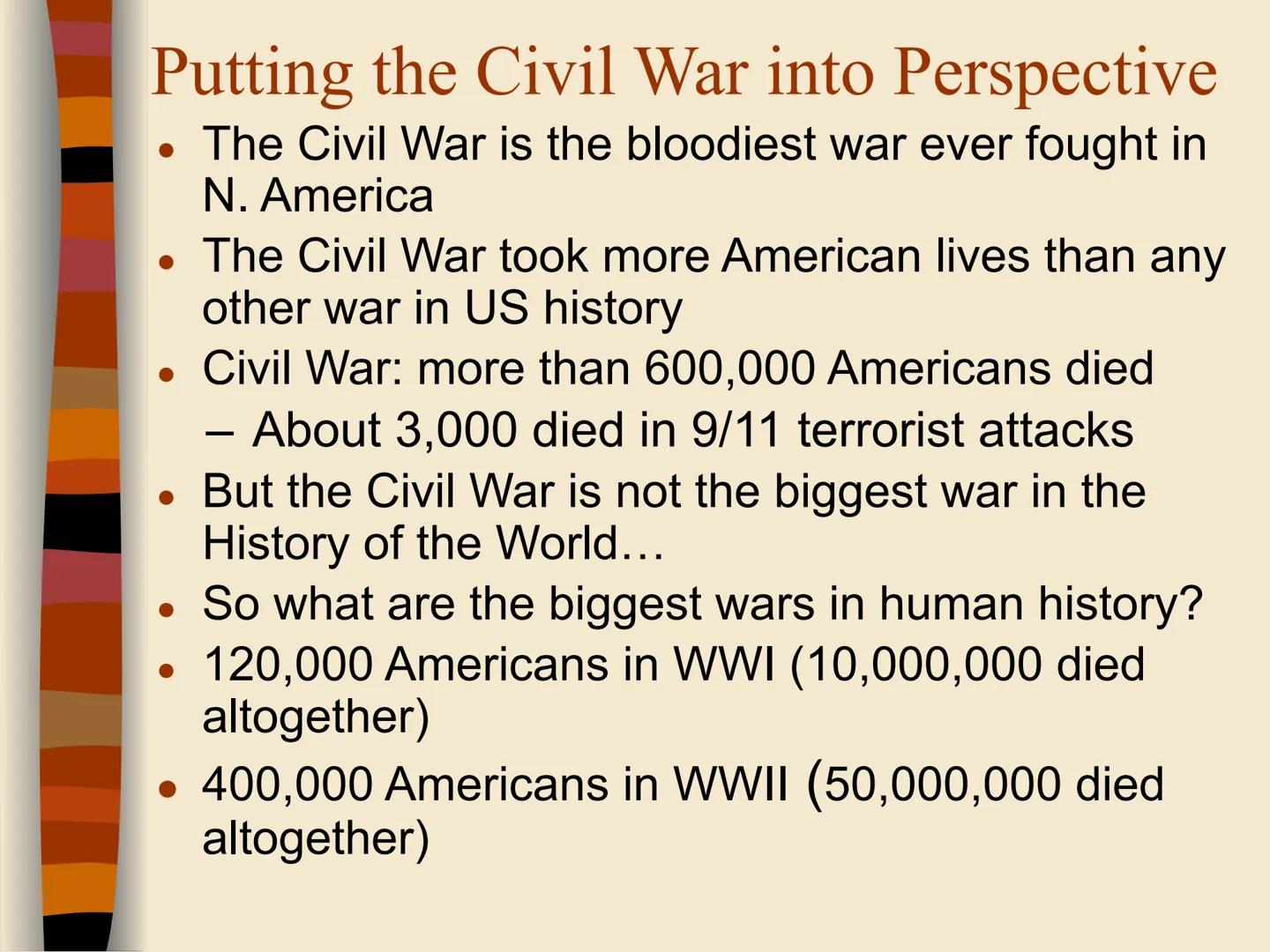
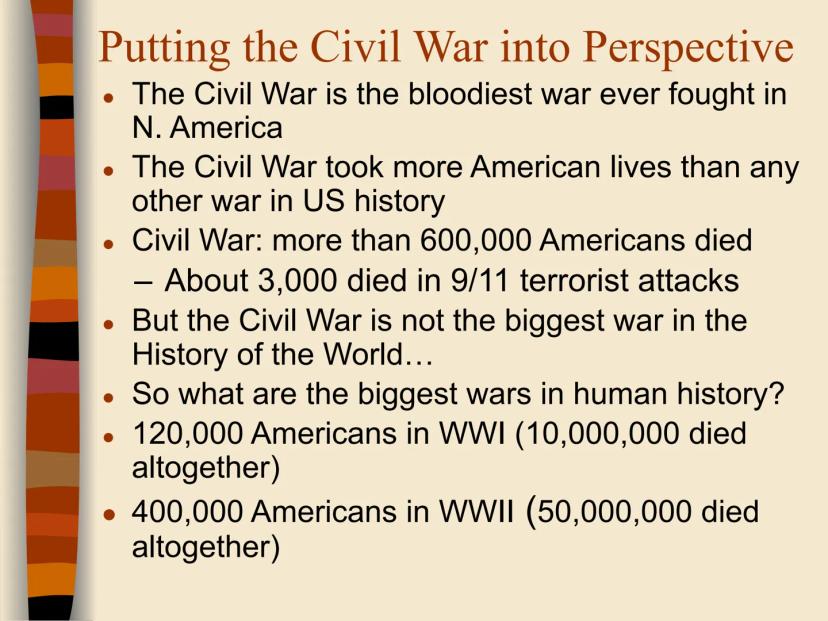
Putting the Civil War into Perspective
The Civil War stands as the bloodiest conflict ever fought on North American soil. With over 600,000 American deaths, it claimed more American lives than any other war in our history. To put this in perspective, that's 200 times the number who died in the September 11 attacks.
However, when looking at global warfare, the Civil War isn't the largest in world history. World War I claimed approximately 10 million lives worldwide (including 120,000 Americans), while World War II resulted in an astonishing 50 million deaths globally (with 400,000 American casualties).
These numbers aren't just statistics - they represent real people with families, hopes, and dreams. The scale of loss during the Civil War fundamentally changed how Americans viewed war and created lasting divisions that would take generations to heal.
Sobering Reality: More Americans died in the Civil War than in all other American wars combined until the Vietnam War. This massive loss of life affected nearly every family in both North and South.
6
of 10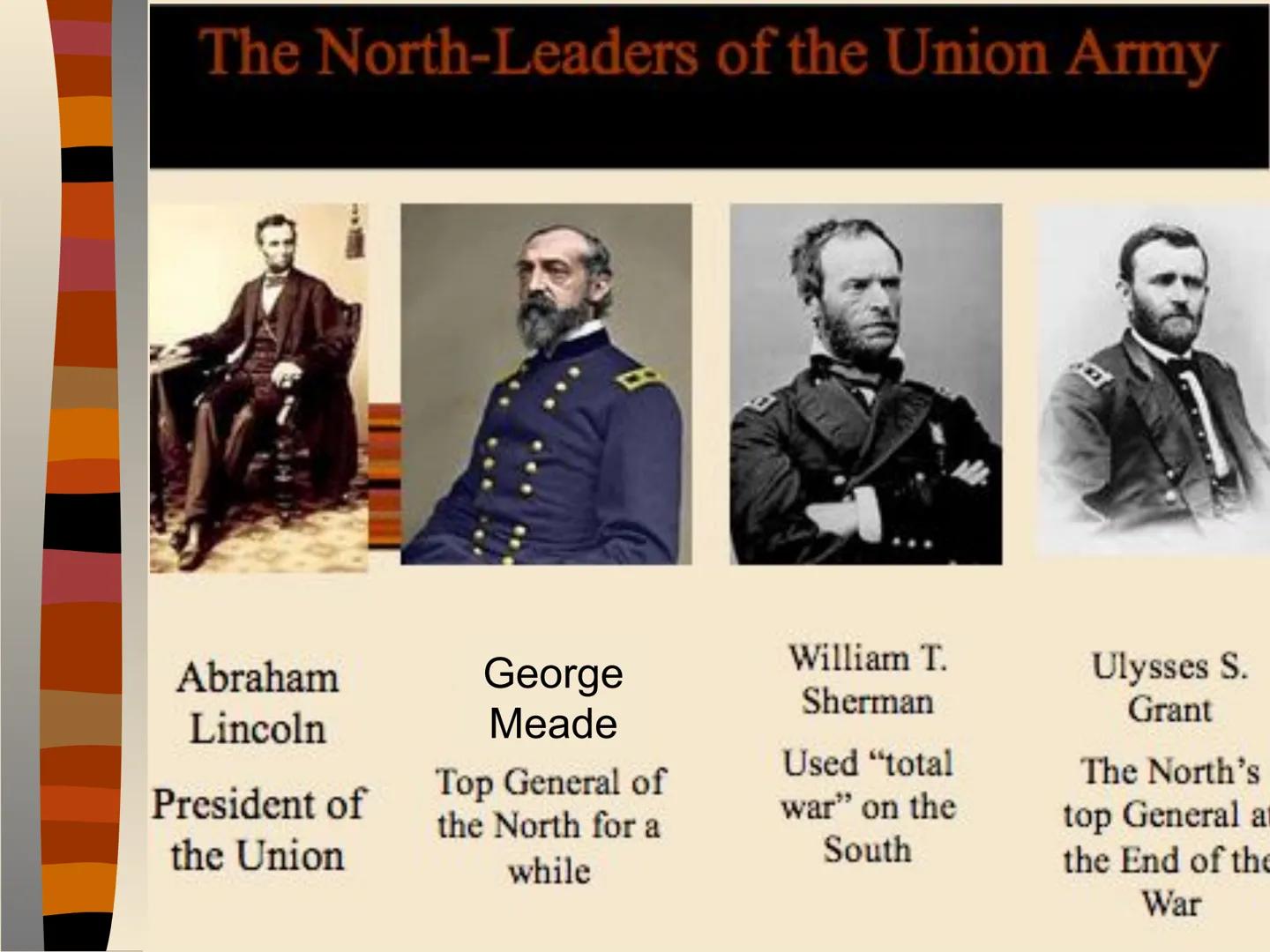
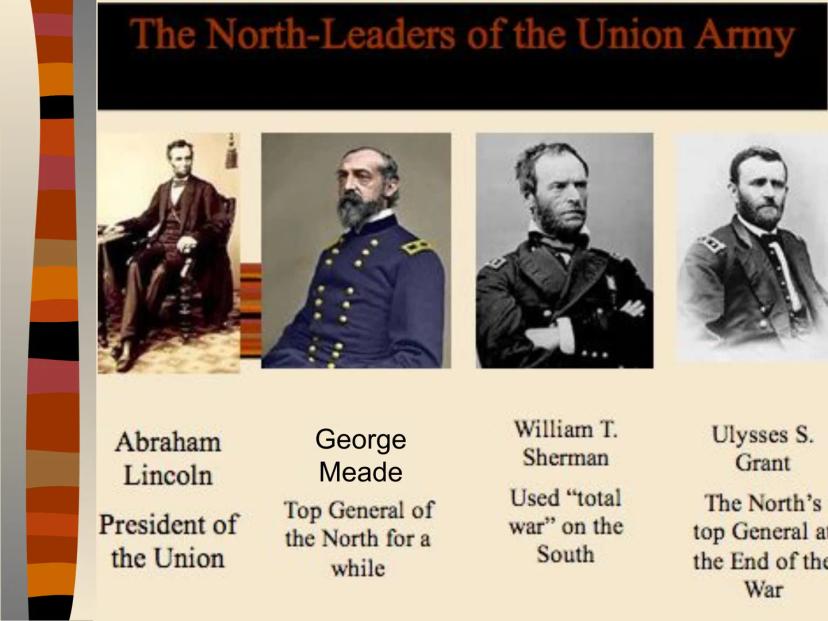
The North-Leaders of the Union Army
The Union's war effort was led by President Abraham Lincoln, whose determination to preserve the Union guided Northern strategy throughout the conflict. His leadership proved crucial in the North's eventual victory.
The North cycled through several military commanders before finding effective leadership. General George Meade led the Union to a crucial victory at Gettysburg, turning the tide of the war in the North's favor.
General William T. Sherman became infamous for his "total war" strategy, which involved destroying Southern infrastructure and resources to break the Confederacy's will to fight. His March to the Sea through Georgia devastated the Southern heartland.
The North's most successful commander, Ulysses S. Grant, eventually rose to become the top general. His willingness to accept casualties in pursuit of victory, coupled with his understanding of modern warfare, ultimately led to the Union's success.
Leadership Insight: Lincoln struggled to find effective military leadership until later in the war when Grant's aggressive approach finally matched the president's strategic vision.
7
of 10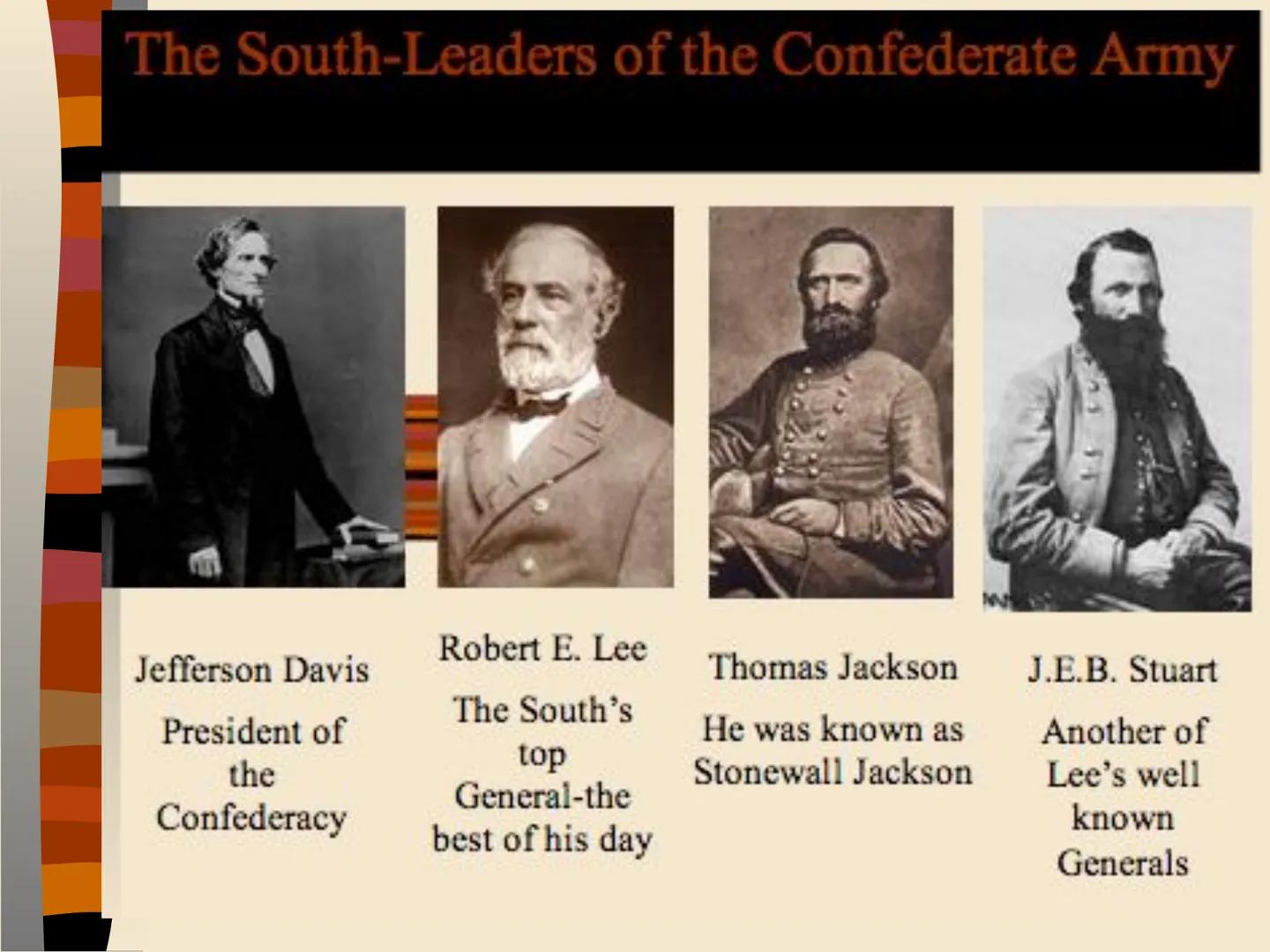
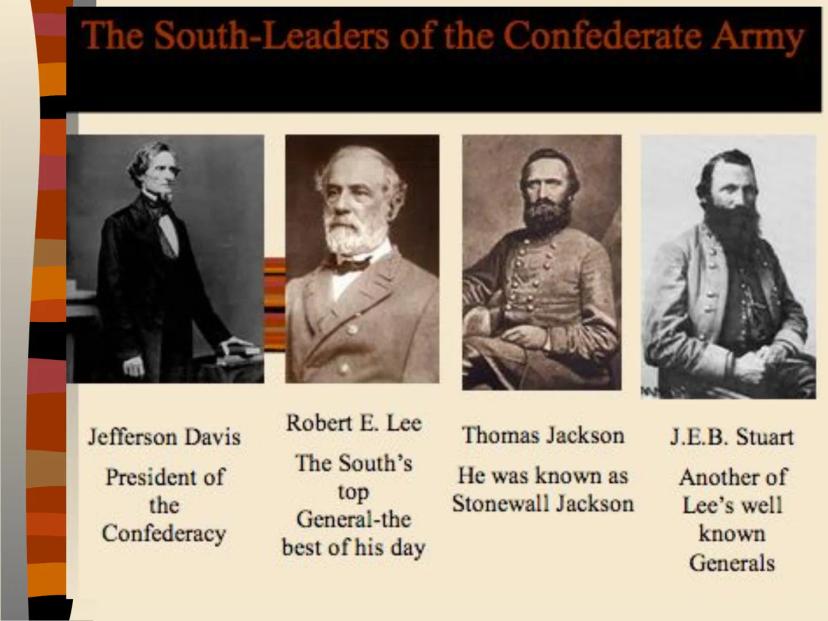
The South-Leaders of the Confederate Army
Jefferson Davis served as President of the Confederacy, guiding the South's political and military strategy. Though a skilled politician, he faced enormous challenges in creating a functioning government during wartime.
The South's greatest military asset was General Robert E. Lee, considered the finest commander of his generation. His tactical brilliance allowed the outnumbered Confederacy to win several major battles despite having fewer resources.
Thomas "Stonewall" Jackson earned his nickname by standing firm during the Battle of Bull Run, and became one of Lee's most trusted generals. His unexpected death from friendly fire in 1863 was a devastating blow to Southern leadership.
J.E.B. Stuart commanded the Confederate cavalry with flair and daring. His reconnaissance abilities provided Lee with crucial intelligence, though his absence during the critical Battle of Gettysburg may have contributed to the Confederate defeat.
Military Context: The South's military leaders often outperformed their Northern counterparts in the war's early stages, but couldn't overcome the North's significant advantages in troops and resources.
8
of 10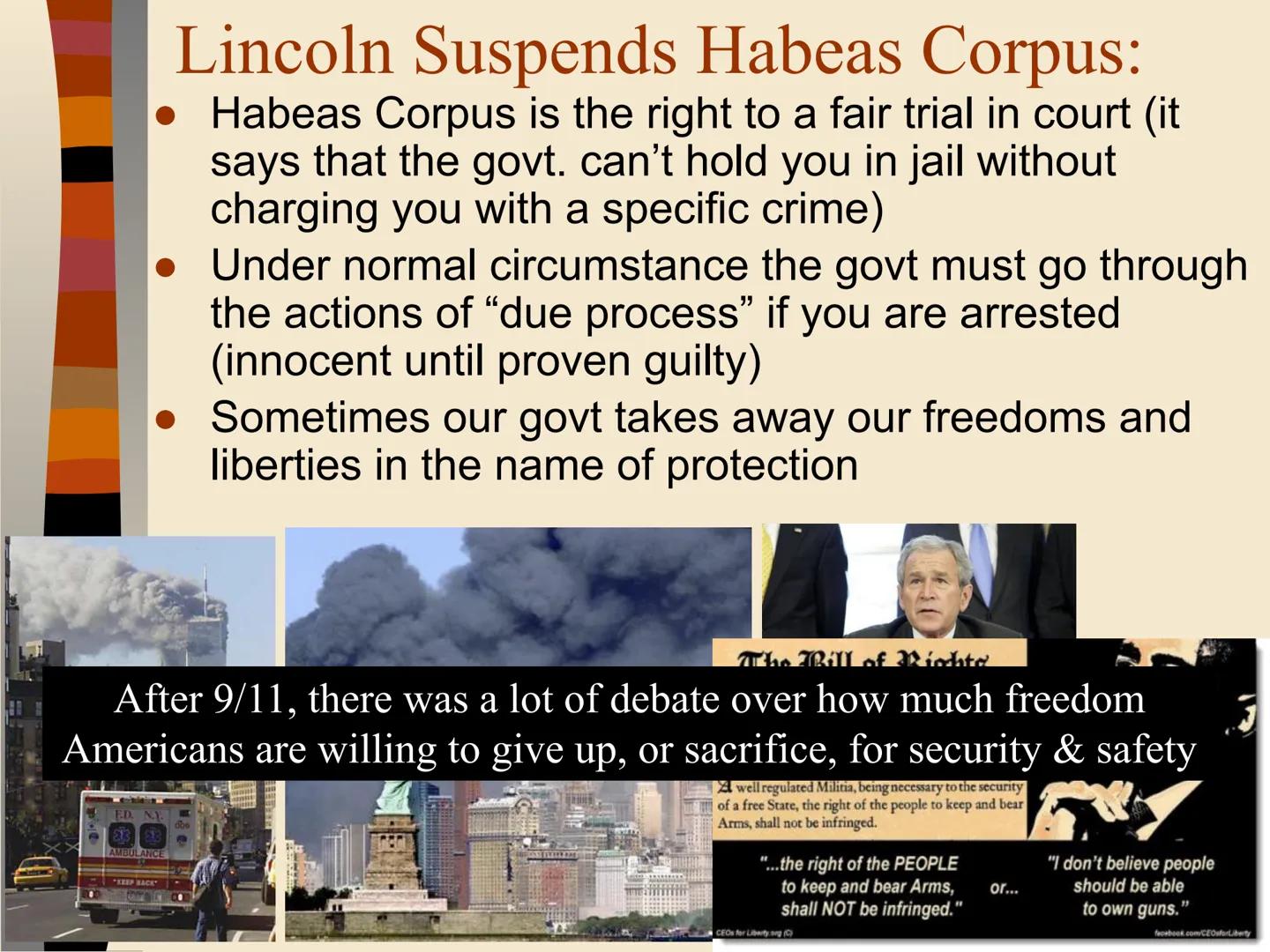
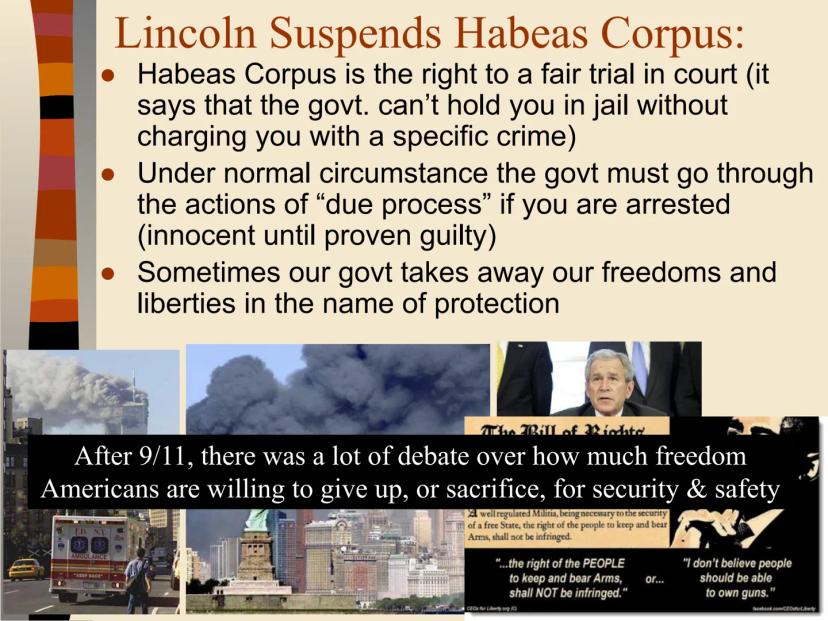
Lincoln Suspends Habeas Corpus
During the Civil War, President Lincoln made the controversial decision to suspend habeas corpus, a fundamental legal right that prevents the government from holding citizens without charging them with a specific crime. This suspension allowed the government to detain suspected Confederate sympathizers without trial.
Under normal circumstances, the government must follow "due process" when arresting someone - you're innocent until proven guilty. Lincoln argued that this emergency measure was necessary to protect the Union during the rebellion.
This historical example shows how governments sometimes restrict civil liberties during national emergencies, claiming it's necessary for security. Similar debates emerged after the 9/11 attacks about balancing freedom and safety.
Constitutional Question: Lincoln's suspension of habeas corpus raises an important question we still debate today: How do we balance individual rights with national security during times of crisis?
9
of 10
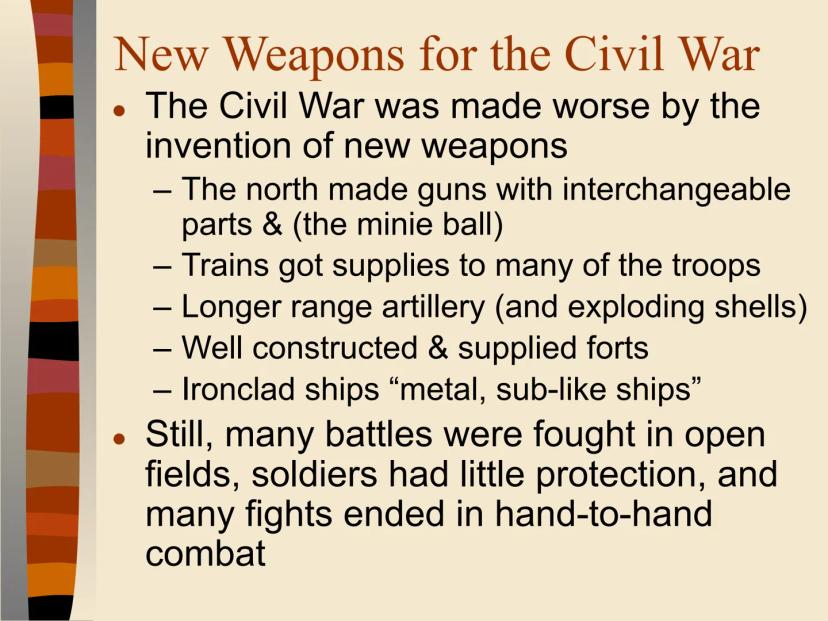
New Weapons for the Civil War
The Civil War coincided with rapid technological advancements that made warfare deadlier than ever before. The North's industrial capacity allowed them to mass-produce weapons with interchangeable parts, and the devastating "minie ball" bullet caused horrible wounds that were difficult to treat with 19th century medicine.
Modern infrastructure played a crucial role in the conflict. Railroads transported troops and supplies to battlefronts more efficiently than in previous wars. Artillery with longer ranges and explosive shells increased battlefield lethality, while well-constructed forts provided strategic defensive positions.
Naval warfare advanced dramatically with ironclad ships - metal-armored vessels that resembled early submarines and were resistant to traditional cannon fire. Despite these innovations, many battles still devolved into open-field combat with minimal protection, and soldiers often engaged in brutal hand-to-hand fighting.
Technological Impact: The Civil War occurred during the early industrial age, creating a deadly combination of modern weapons technology with outdated battlefield tactics that contributed to the massive casualty rates.
10
of 10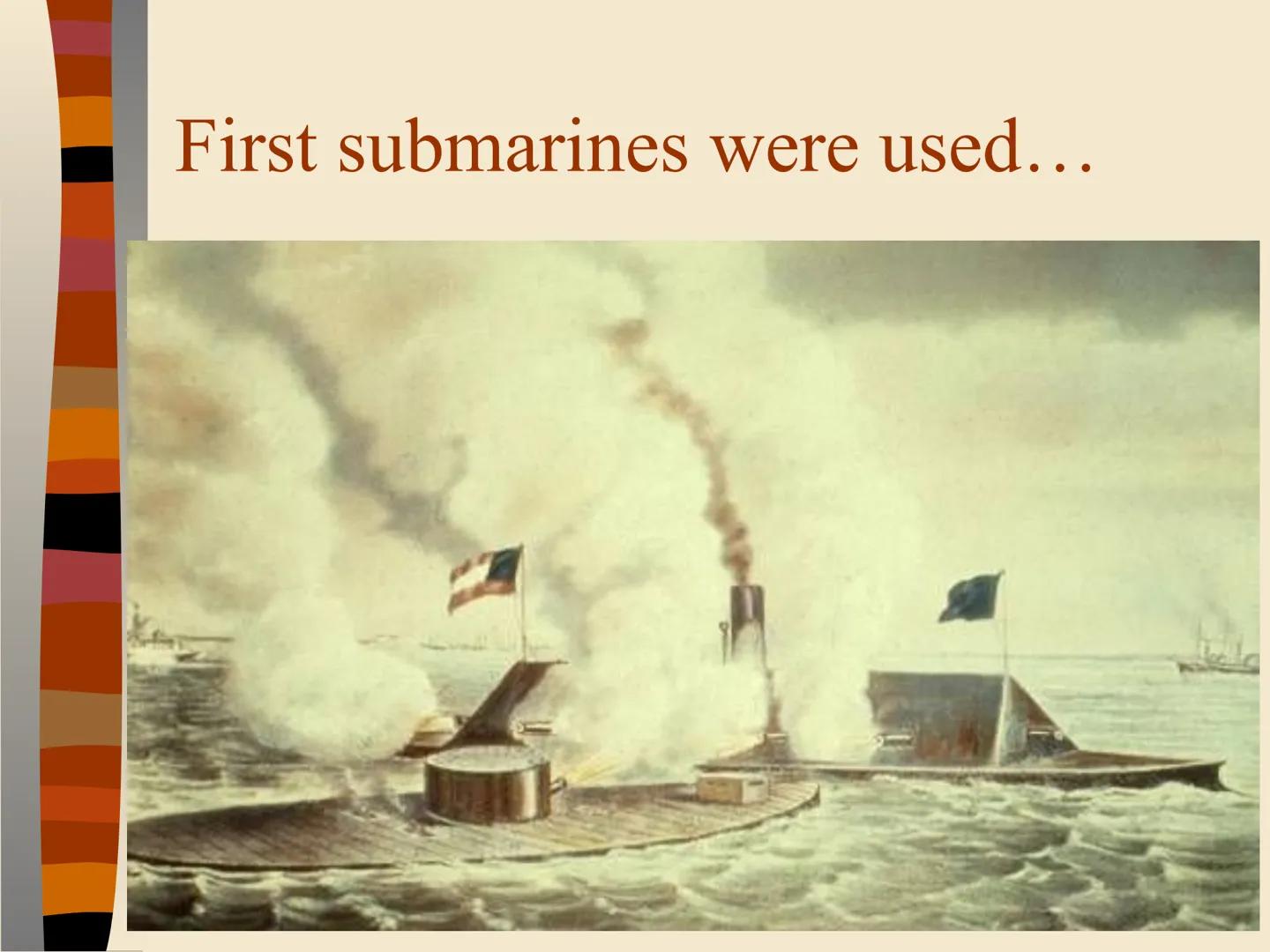
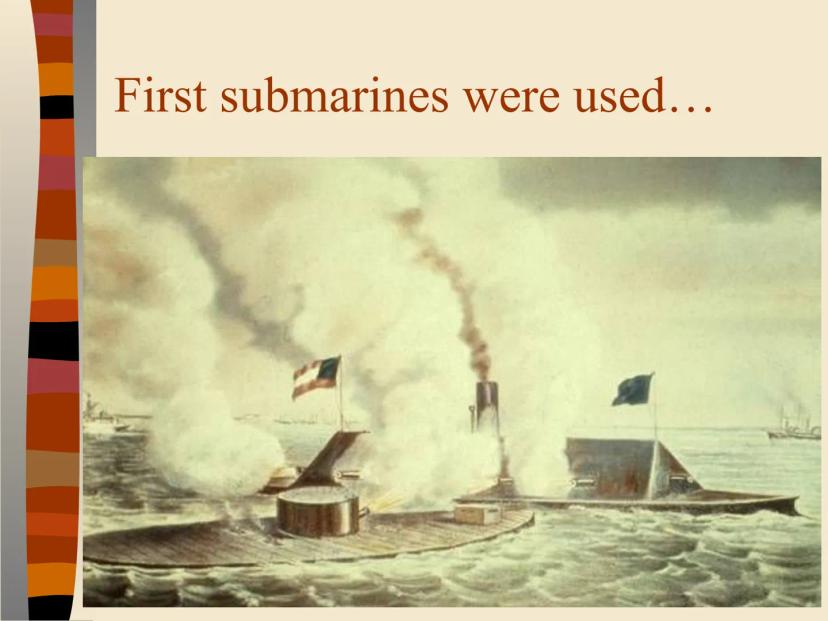
First Submarines Were Used
The Civil War saw the first effective use of submarine technology in combat. The Confederate submarine H.L. Hunley made history as the first submarine to successfully sink an enemy warship, though the vessel and its crew were lost in the attack.
These early submarines were primitive by today's standards - human-powered, dangerous to operate, and offering little protection for their crews. Nevertheless, they represented a revolutionary approach to naval warfare.
This innovation reflected the desperation of the Confederate navy, which was vastly outnumbered by Union vessels. Unable to compete in traditional naval combat, the South turned to experimental technologies like submarines and naval mines to try to even the odds.
Innovation in Warfare: The Civil War accelerated military technology development, introducing concepts like submarine warfare that would become central to future conflicts. This shows how necessity drives innovation during wartime.
We thought you’d never ask...
What is the Knowunity AI companion?
Our AI companion is specifically built for the needs of students. Based on the millions of content pieces we have on the platform we can provide truly meaningful and relevant answers to students. But its not only about answers, the companion is even more about guiding students through their daily learning challenges, with personalised study plans, quizzes or content pieces in the chat and 100% personalisation based on the students skills and developments.
Where can I download the Knowunity app?
You can download the app in the Google Play Store and in the Apple App Store.
Is Knowunity really free of charge?
That's right! Enjoy free access to study content, connect with fellow students, and get instant help – all at your fingertips.
Most popular content: Civil War
1Most popular content in AP US History
9O
AP US HistoryOrigins and Dynamics of the Columbian Exchange
Analyze the ecological and economic motivations behind the initial transfer of goods, people, and diseases between the Old and New Worlds.
9th3,1280
I
AP US HistoryIntroduction to Early Cultural Interactions
Analyze the initial social and religious encounters between Europeans, Africans, and Indigenous peoples in the colonial Americas.
9th2,7730
M
AP US HistoryMotivations for European Exploration
Analyze the economic, religious, and political factors that drove European powers to the Americas during the 15th and 16th centuries.
9th1,7780
I
AP US HistoryIntroduction to Native American Societies
Examine the diverse social, political, and economic structures of North American indigenous groups prior to European contact.
9th1,1100
I
AP US HistoryIntroduction to the Spanish Encomienda System
Explore the fundamental economic and social structures of the Spanish colonial system, focusing on the encomienda and the casta social hierarchy.
9th8890
M
AP US HistoryMotivations for European Colonization
Analyze the differing economic, religious, and social goals that drove Spanish, French, Dutch, and British expansion in the New World.
9th7570
W
AP US HistoryWeaknesses of the Articles of Confederation
Analyze the structural deficiencies of the first national government, focusing on fiscal instability and the lack of executive authority.
9th7700
I
AP US HistoryInitial Native-European Contacts and Perceptions
Analyze primary sources from the 15th and 16th centuries to compare Spanish, French, and English initial interactions with indigenous populations.
9th6370
AP US HistoryUnit 1: Apush
1491-1607
11th1,0059
Most popular content
9O
AP US HistoryOrigins and Dynamics of the Columbian Exchange
Analyze the ecological and economic motivations behind the initial transfer of goods, people, and diseases between the Old and New Worlds.
9th3,1280
I
AP US HistoryIntroduction to Early Cultural Interactions
Analyze the initial social and religious encounters between Europeans, Africans, and Indigenous peoples in the colonial Americas.
9th2,7730
O
 AP World History
Origins of Ancient River Civilizations
Analyze the environmental factors and technological innovations that led to the rise of early states in Mesopotamia, Egypt, and the Indus Valley.
9th3,1870
M
AP US HistoryMotivations for European Exploration
Analyze the economic, religious, and political factors that drove European powers to the Americas during the 15th and 16th centuries.
9th1,7780
F
 AP Psychology
Foundations of Ethical Guidelines in Research
Practice the core principles of the APA ethical code including informed consent, debriefing, and the role of Institutional Review Boards.
9th1,3360
I
AP US HistoryIntroduction to Native American Societies
Examine the diverse social, political, and economic structures of North American indigenous groups prior to European contact.
9th1,1100
I
 AP Biology
Introduction to Biological Elements of Life
Practice identifying the essential elements including carbon, nitrogen, phosphorus, and sulfur that compose biological macromolecules.
9th1,7390
I
AP US HistoryIntroduction to the Spanish Encomienda System
Explore the fundamental economic and social structures of the Spanish colonial system, focusing on the encomienda and the casta social hierarchy.
9th8890
O
AP World HistoryOrigins and Continuity of the Byzantine Empire
Analyze the political and cultural transitions from the Roman Empire to the Byzantine Empire, focusing on the reign of Justinian I and his code.
9th1,6320
Can't find what you're looking for? Explore other subjects.
Students love us — and so will you.
4.6/5App Store
4.7/5Google Play
The app is very easy to use and well designed. I have found everything I was looking for so far and have been able to learn a lot from the presentations! I will definitely use the app for a class assignment! And of course it also helps a lot as an inspiration.
Stefan SiOS user
This app is really great. There are so many study notes and help [...]. My problem subject is French, for example, and the app has so many options for help. Thanks to this app, I have improved my French. I would recommend it to anyone.
Samantha KlichAndroid user
Wow, I am really amazed. I just tried the app because I've seen it advertised many times and was absolutely stunned. This app is THE HELP you want for school and above all, it offers so many things, such as workouts and fact sheets, which have been VERY helpful to me personally.
AnnaiOS user
AP US History139 views·Updated Jun 19, 2026·33 pagesAmerican Civil War Overview
J
Jenny@jenny_mgrj
The American Civil War was a brutal conflict that tore the nation apart from 1861 to 1865. This devastating war pitted the Northern Union against the Southern Confederacy in a struggle that ultimately centered around slavery and states' rights, becoming...
1
of 10
Sign up to see the content. It's free!
- Access to all documents
- Improve your grades
- Join milions of students
Civil War: Rebels vs. Yankees
The American Civil War represents one of the most pivotal chapters in our nation's history. This devastating conflict saw Americans fighting Americans - Rebels against Yankees - in a struggle that would determine the future of our country.
You'll discover how this conflict fundamentally changed America's path forward. The essential question we'll explore is: What were the key events that shaped the Civil War?
Think About It: When you hear "Civil War," what images come to mind? The decisions made during this conflict continue to shape American society today.
2
of 10Sign up to see the content. It's free!
- Access to all documents
- Improve your grades
- Join milions of students
Key Information on the War
The Civil War stands as the fourth major conflict in American history, lasting four years from 1861 to 1865. This wasn't just a small dispute - it involved the entire nation taking sides.
The South (also known as The Confederacy, The Rebels, or The Gray) consisted of 11 states fighting against the North (The Union, The Yankees, or The Blue) which comprised 24 states. The numerical advantage clearly favored the Union from the beginning.
While historians discuss many causes for this devastating conflict, at the heart of these tensions was the issue of slavery and what the South termed "states' rights." This fundamental disagreement about America's future led to the bloodiest conflict on American soil.
Important Context: When people talked about "states' rights" during this period, they were primarily referring to the right to maintain slavery, which was central to the Southern economy and society.
3
of 10Sign up to see the content. It's free!
- Access to all documents
- Improve your grades
- Join milions of students
The Civil War-The Country Divided
Looking at a map of America during the Civil War shows how deeply divided our nation became. The Northern states formed the Union, with Washington D.C. as their capital, while the Southern states created the Confederate States of America, establishing Richmond, Virginia as their capital.
Interestingly, not all slave states joined the Confederacy. Border states like Missouri, Kentucky, Maryland, and Delaware remained with the Union despite allowing slavery, creating a complicated political landscape.
Most of the fighting occurred in the territory between these two capitals, turning peaceful farmland and towns into battlegrounds. The geography of the conflict meant that Southern states bore the brunt of the physical devastation.
Geographic Insight: The location of the war primarily in Southern territory meant that Southern infrastructure, cities, and farms suffered tremendous damage, creating economic hardships that would last for generations.
4
of 10Sign up to see the content. It's free!
- Access to all documents
- Improve your grades
- Join milions of students
Who Had the Advantages in the War?
The Confederate South entered the war with several significant advantages. They had superior military leadership, particularly in General Robert E. Lee, who was considered the best commander of his day. Fighting defensively on familiar territory gave Southern soldiers a home-field advantage, and early victories boosted their morale.
However, the Union North possessed overwhelming material advantages that would ultimately prove decisive. The North's superior navy controlled the coastline and major rivers. Their industrial capacity far exceeded the South's primarily agricultural economy, allowing them to produce more weapons and supplies.
The North's larger population provided more soldiers for the war effort, and having more states meant greater financial resources to fund the prolonged conflict. These advantages would eventually overcome the South's initial military successes.
Critical Understanding: Wars aren't just won by courage and military skill - resources, manufacturing capacity, and population size often determine the ultimate outcome of extended conflicts.
5
of 10Sign up to see the content. It's free!
- Access to all documents
- Improve your grades
- Join milions of students
Putting the Civil War into Perspective
The Civil War stands as the bloodiest conflict ever fought on North American soil. With over 600,000 American deaths, it claimed more American lives than any other war in our history. To put this in perspective, that's 200 times the number who died in the September 11 attacks.
However, when looking at global warfare, the Civil War isn't the largest in world history. World War I claimed approximately 10 million lives worldwide (including 120,000 Americans), while World War II resulted in an astonishing 50 million deaths globally (with 400,000 American casualties).
These numbers aren't just statistics - they represent real people with families, hopes, and dreams. The scale of loss during the Civil War fundamentally changed how Americans viewed war and created lasting divisions that would take generations to heal.
Sobering Reality: More Americans died in the Civil War than in all other American wars combined until the Vietnam War. This massive loss of life affected nearly every family in both North and South.
6
of 10Sign up to see the content. It's free!
- Access to all documents
- Improve your grades
- Join milions of students
The North-Leaders of the Union Army
The Union's war effort was led by President Abraham Lincoln, whose determination to preserve the Union guided Northern strategy throughout the conflict. His leadership proved crucial in the North's eventual victory.
The North cycled through several military commanders before finding effective leadership. General George Meade led the Union to a crucial victory at Gettysburg, turning the tide of the war in the North's favor.
General William T. Sherman became infamous for his "total war" strategy, which involved destroying Southern infrastructure and resources to break the Confederacy's will to fight. His March to the Sea through Georgia devastated the Southern heartland.
The North's most successful commander, Ulysses S. Grant, eventually rose to become the top general. His willingness to accept casualties in pursuit of victory, coupled with his understanding of modern warfare, ultimately led to the Union's success.
Leadership Insight: Lincoln struggled to find effective military leadership until later in the war when Grant's aggressive approach finally matched the president's strategic vision.
7
of 10Sign up to see the content. It's free!
- Access to all documents
- Improve your grades
- Join milions of students
The South-Leaders of the Confederate Army
Jefferson Davis served as President of the Confederacy, guiding the South's political and military strategy. Though a skilled politician, he faced enormous challenges in creating a functioning government during wartime.
The South's greatest military asset was General Robert E. Lee, considered the finest commander of his generation. His tactical brilliance allowed the outnumbered Confederacy to win several major battles despite having fewer resources.
Thomas "Stonewall" Jackson earned his nickname by standing firm during the Battle of Bull Run, and became one of Lee's most trusted generals. His unexpected death from friendly fire in 1863 was a devastating blow to Southern leadership.
J.E.B. Stuart commanded the Confederate cavalry with flair and daring. His reconnaissance abilities provided Lee with crucial intelligence, though his absence during the critical Battle of Gettysburg may have contributed to the Confederate defeat.
Military Context: The South's military leaders often outperformed their Northern counterparts in the war's early stages, but couldn't overcome the North's significant advantages in troops and resources.
8
of 10Sign up to see the content. It's free!
- Access to all documents
- Improve your grades
- Join milions of students
Lincoln Suspends Habeas Corpus
During the Civil War, President Lincoln made the controversial decision to suspend habeas corpus, a fundamental legal right that prevents the government from holding citizens without charging them with a specific crime. This suspension allowed the government to detain suspected Confederate sympathizers without trial.
Under normal circumstances, the government must follow "due process" when arresting someone - you're innocent until proven guilty. Lincoln argued that this emergency measure was necessary to protect the Union during the rebellion.
This historical example shows how governments sometimes restrict civil liberties during national emergencies, claiming it's necessary for security. Similar debates emerged after the 9/11 attacks about balancing freedom and safety.
Constitutional Question: Lincoln's suspension of habeas corpus raises an important question we still debate today: How do we balance individual rights with national security during times of crisis?
9
of 10Sign up to see the content. It's free!
- Access to all documents
- Improve your grades
- Join milions of students
New Weapons for the Civil War
The Civil War coincided with rapid technological advancements that made warfare deadlier than ever before. The North's industrial capacity allowed them to mass-produce weapons with interchangeable parts, and the devastating "minie ball" bullet caused horrible wounds that were difficult to treat with 19th century medicine.
Modern infrastructure played a crucial role in the conflict. Railroads transported troops and supplies to battlefronts more efficiently than in previous wars. Artillery with longer ranges and explosive shells increased battlefield lethality, while well-constructed forts provided strategic defensive positions.
Naval warfare advanced dramatically with ironclad ships - metal-armored vessels that resembled early submarines and were resistant to traditional cannon fire. Despite these innovations, many battles still devolved into open-field combat with minimal protection, and soldiers often engaged in brutal hand-to-hand fighting.
Technological Impact: The Civil War occurred during the early industrial age, creating a deadly combination of modern weapons technology with outdated battlefield tactics that contributed to the massive casualty rates.
10
of 10Sign up to see the content. It's free!
- Access to all documents
- Improve your grades
- Join milions of students
First Submarines Were Used
The Civil War saw the first effective use of submarine technology in combat. The Confederate submarine H.L. Hunley made history as the first submarine to successfully sink an enemy warship, though the vessel and its crew were lost in the attack.
These early submarines were primitive by today's standards - human-powered, dangerous to operate, and offering little protection for their crews. Nevertheless, they represented a revolutionary approach to naval warfare.
This innovation reflected the desperation of the Confederate navy, which was vastly outnumbered by Union vessels. Unable to compete in traditional naval combat, the South turned to experimental technologies like submarines and naval mines to try to even the odds.
Innovation in Warfare: The Civil War accelerated military technology development, introducing concepts like submarine warfare that would become central to future conflicts. This shows how necessity drives innovation during wartime.
We thought you’d never ask...
What is the Knowunity AI companion?
Our AI companion is specifically built for the needs of students. Based on the millions of content pieces we have on the platform we can provide truly meaningful and relevant answers to students. But its not only about answers, the companion is even more about guiding students through their daily learning challenges, with personalised study plans, quizzes or content pieces in the chat and 100% personalisation based on the students skills and developments.
Where can I download the Knowunity app?
You can download the app in the Google Play Store and in the Apple App Store.
Is Knowunity really free of charge?
That's right! Enjoy free access to study content, connect with fellow students, and get instant help – all at your fingertips.
Most popular content: Civil War
1Most popular content in AP US History
9O
AP US HistoryOrigins and Dynamics of the Columbian Exchange
Analyze the ecological and economic motivations behind the initial transfer of goods, people, and diseases between the Old and New Worlds.
9th3,1280
I
AP US HistoryIntroduction to Early Cultural Interactions
Analyze the initial social and religious encounters between Europeans, Africans, and Indigenous peoples in the colonial Americas.
9th2,7730
M
AP US HistoryMotivations for European Exploration
Analyze the economic, religious, and political factors that drove European powers to the Americas during the 15th and 16th centuries.
9th1,7780
I
AP US HistoryIntroduction to Native American Societies
Examine the diverse social, political, and economic structures of North American indigenous groups prior to European contact.
9th1,1100
I
AP US HistoryIntroduction to the Spanish Encomienda System
Explore the fundamental economic and social structures of the Spanish colonial system, focusing on the encomienda and the casta social hierarchy.
9th8890
M
AP US HistoryMotivations for European Colonization
Analyze the differing economic, religious, and social goals that drove Spanish, French, Dutch, and British expansion in the New World.
9th7570
W
AP US HistoryWeaknesses of the Articles of Confederation
Analyze the structural deficiencies of the first national government, focusing on fiscal instability and the lack of executive authority.
9th7700
I
AP US HistoryInitial Native-European Contacts and Perceptions
Analyze primary sources from the 15th and 16th centuries to compare Spanish, French, and English initial interactions with indigenous populations.
9th6370
AP US HistoryUnit 1: Apush
1491-1607
11th1,0059
Most popular content
9O
AP US HistoryOrigins and Dynamics of the Columbian Exchange
Analyze the ecological and economic motivations behind the initial transfer of goods, people, and diseases between the Old and New Worlds.
9th3,1280
I
AP US HistoryIntroduction to Early Cultural Interactions
Analyze the initial social and religious encounters between Europeans, Africans, and Indigenous peoples in the colonial Americas.
9th2,7730
O
AP World HistoryOrigins of Ancient River Civilizations
Analyze the environmental factors and technological innovations that led to the rise of early states in Mesopotamia, Egypt, and the Indus Valley.
9th3,1870
M
AP US HistoryMotivations for European Exploration
Analyze the economic, religious, and political factors that drove European powers to the Americas during the 15th and 16th centuries.
9th1,7780
F
AP PsychologyFoundations of Ethical Guidelines in Research
Practice the core principles of the APA ethical code including informed consent, debriefing, and the role of Institutional Review Boards.
9th1,3360
I
AP US HistoryIntroduction to Native American Societies
Examine the diverse social, political, and economic structures of North American indigenous groups prior to European contact.
9th1,1100
I
AP BiologyIntroduction to Biological Elements of Life
Practice identifying the essential elements including carbon, nitrogen, phosphorus, and sulfur that compose biological macromolecules.
9th1,7390
I
AP US HistoryIntroduction to the Spanish Encomienda System
Explore the fundamental economic and social structures of the Spanish colonial system, focusing on the encomienda and the casta social hierarchy.
9th8890
O
AP World HistoryOrigins and Continuity of the Byzantine Empire
Analyze the political and cultural transitions from the Roman Empire to the Byzantine Empire, focusing on the reign of Justinian I and his code.
9th1,6320
Can't find what you're looking for? Explore other subjects.
Students love us — and so will you.
4.6/5App Store
4.7/5Google Play
The app is very easy to use and well designed. I have found everything I was looking for so far and have been able to learn a lot from the presentations! I will definitely use the app for a class assignment! And of course it also helps a lot as an inspiration.
Stefan SiOS user
This app is really great. There are so many study notes and help [...]. My problem subject is French, for example, and the app has so many options for help. Thanks to this app, I have improved my French. I would recommend it to anyone.
Samantha KlichAndroid user
Wow, I am really amazed. I just tried the app because I've seen it advertised many times and was absolutely stunned. This app is THE HELP you want for school and above all, it offers so many things, such as workouts and fact sheets, which have been VERY helpful to me personally.
AnnaiOS user