

European colonization of the Americas was driven by three primary...
 AP US History35 views·Updated Jun 14, 2026·3 pages
European Colonization and Its Global Impact
1 / 3
1
of 3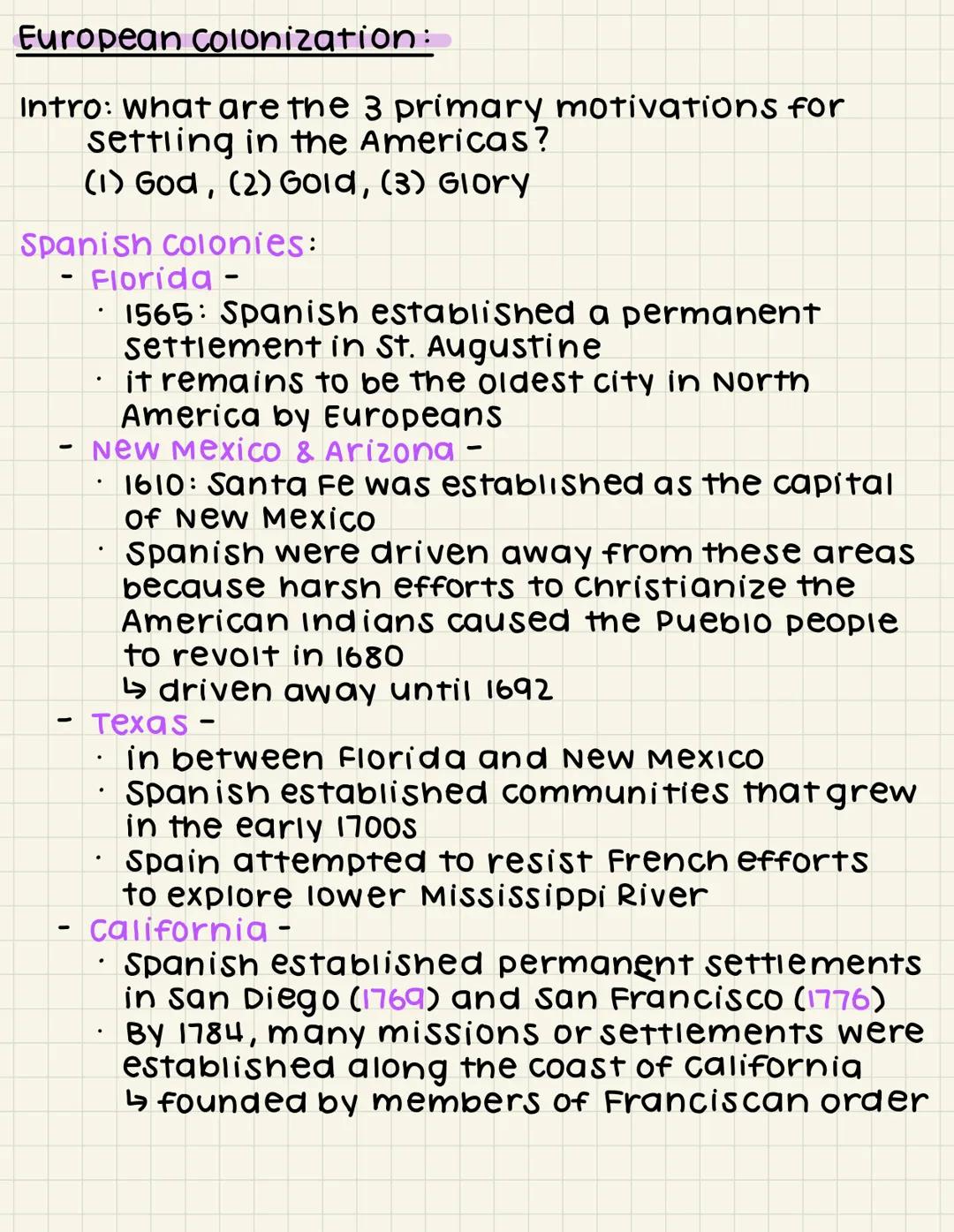
Spanish Colonial Settlements in North America
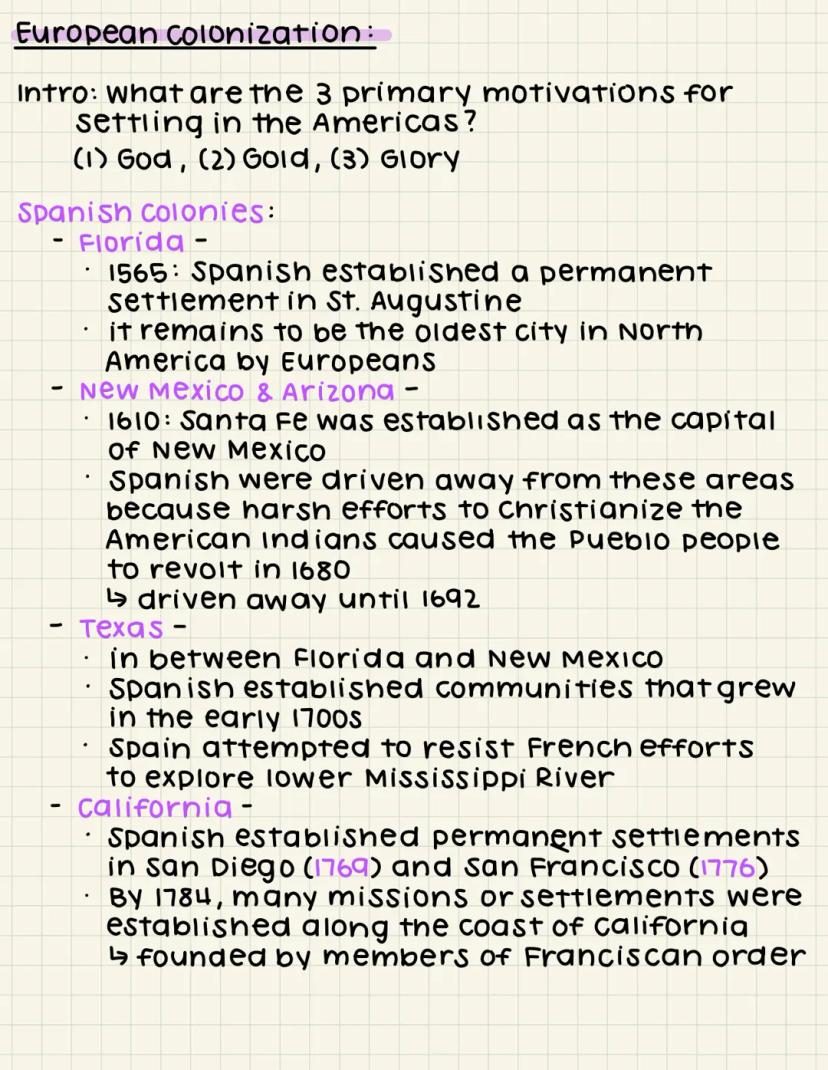
Spanish colonizers were among the first Europeans to establish permanent settlements in North America. In 1565, they founded St. Augustine in Florida, which remains the oldest European-established city in North America. This marked the beginning of Spain's extensive colonial presence.
In the Southwest, Santa Fe became the capital of New Mexico in 1610, though Spanish control wasn't always stable. The harsh efforts to convert the American Indians to Christianity led to the Pueblo Revolt in 1680, driving Spanish settlers away until they returned in 1692.
Spanish influence extended to Texas in the early 1700s, where they established communities partly to resist French exploration of the lower Mississippi. In California, permanent settlements arose in San Diego (1769) and San Francisco (1776), with Franciscan missionaries establishing many settlements along the California coast by 1784.
Did you know? The Spanish colonial system centered around missions - settlement communities focused on converting native peoples to Christianity while establishing Spanish cultural and economic control.
2
of 3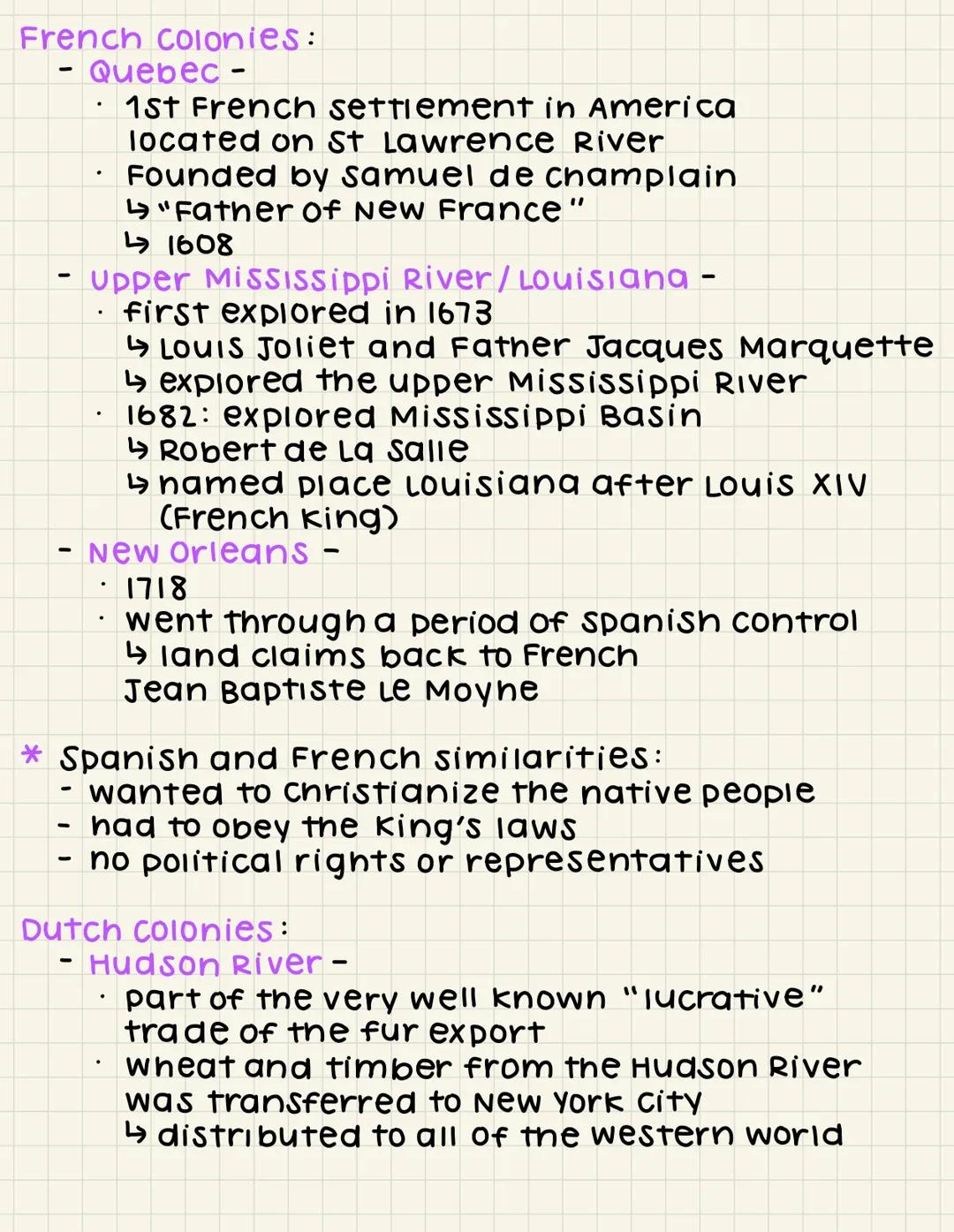
French and Dutch Colonial Territories
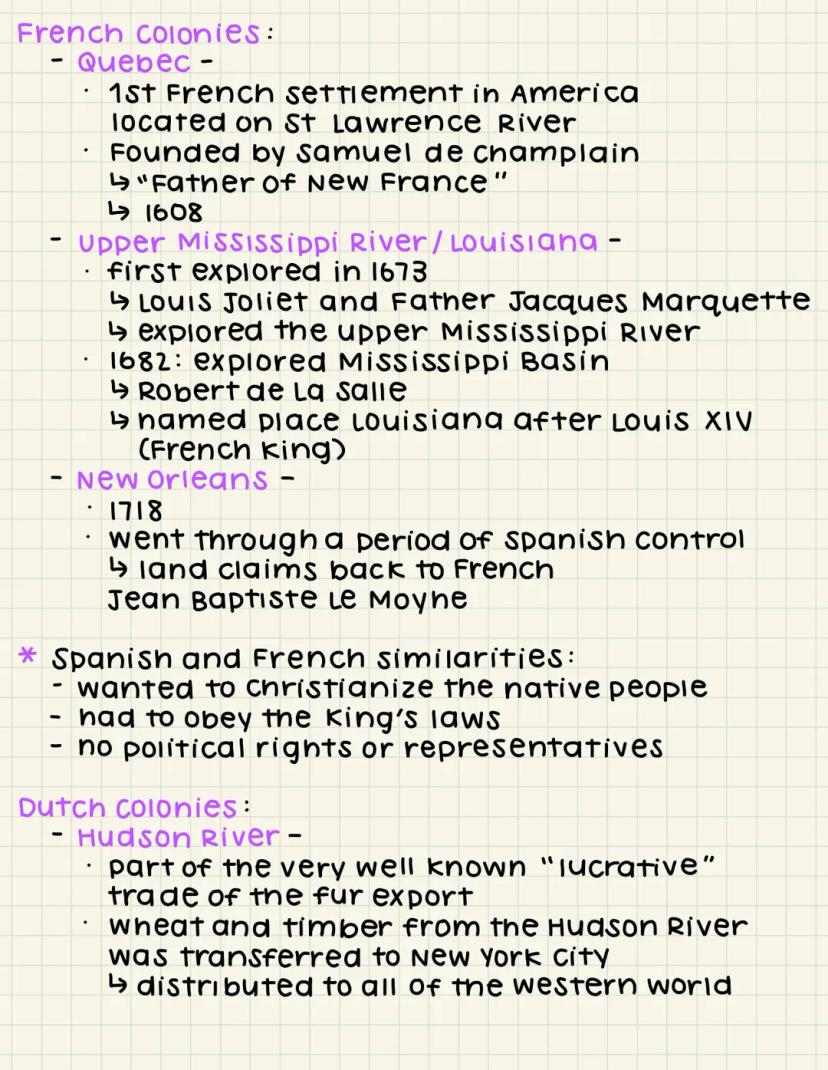
The French established their first North American settlement at Quebec in 1608, founded by Samuel de Champlain, known as the "Father of New France." French exploration expanded when Louis Joliet and Father Jacques Marquette explored the upper Mississippi River in 1673, followed by Robert de La Salle's exploration of the Mississippi Basin in 1682, which he named Louisiana after the French king.
New Orleans, founded in 1718 by Jean Baptiste le Moyne, became a key French settlement, though it temporarily fell under Spanish control before returning to France. Like the Spanish colonies, French settlements aimed to Christianize native peoples and operated under royal authority with no political rights for colonists.
The Dutch established their presence along the Hudson River, developing a profitable fur trade and exporting wheat and timber from the region to New York City and beyond. In the 17th century, they founded New Amsterdam at the southern tip of Manhattan Island to protect their trading interests on the Hudson River.
Remember this! While Spanish and French colonies focused on religious conversion of natives, Dutch colonies were primarily established as commercial trading posts rather than settlement colonies.
3
of 3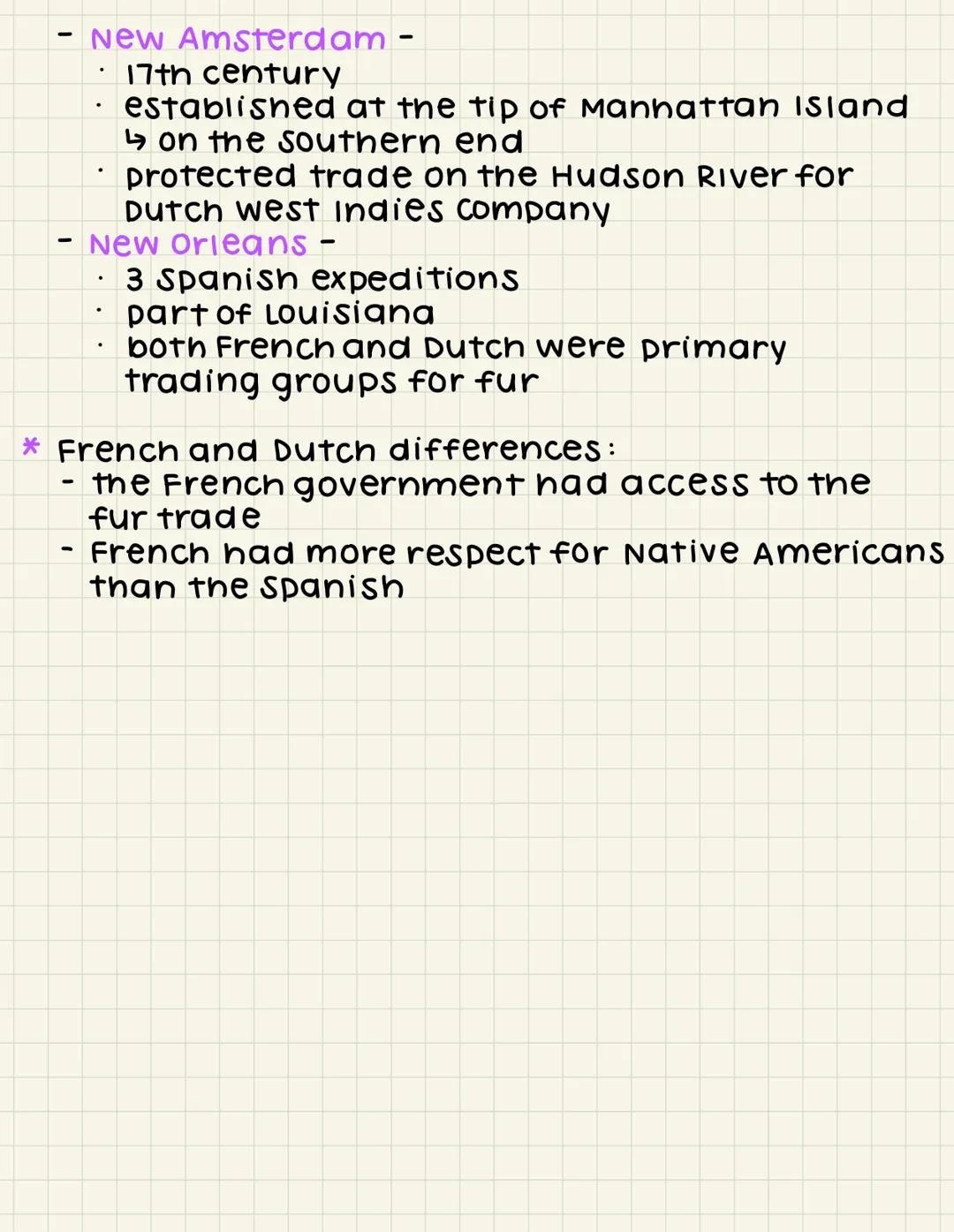
Colonial Powers: Differences and Similarities
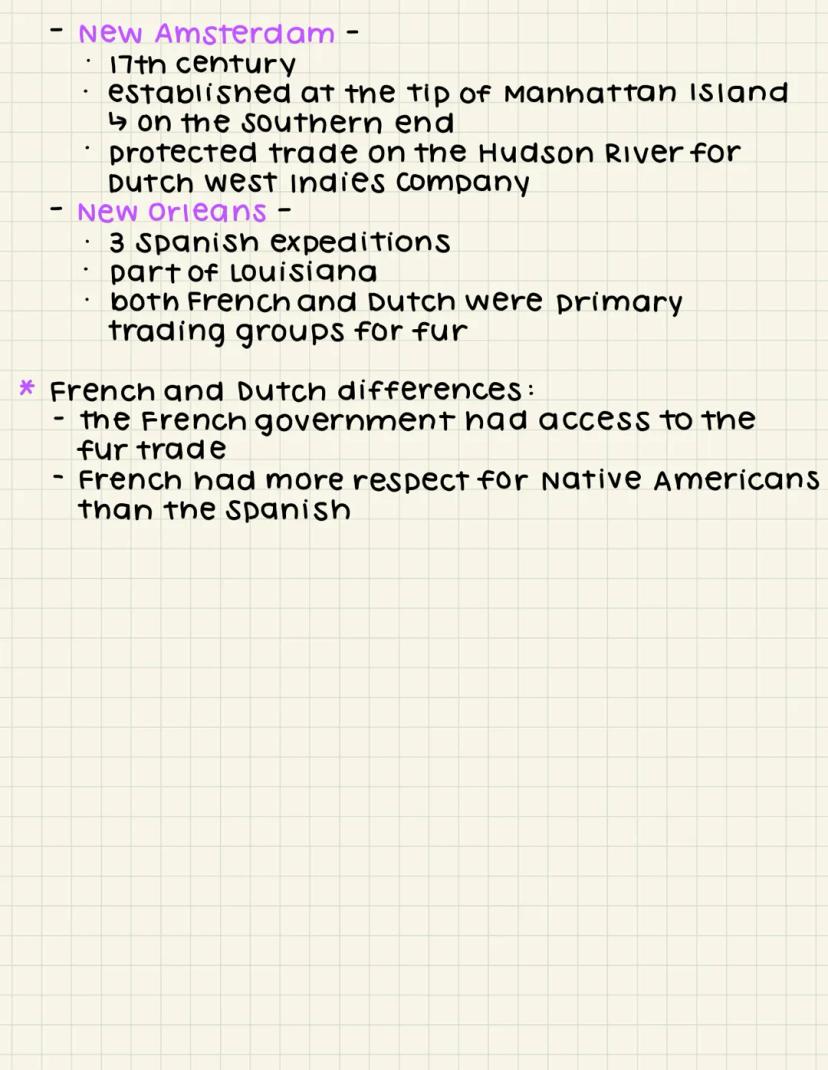
New Amsterdam served as the Dutch West Indies Company's main outpost, strategically positioned to control Hudson River trade. The settlement was crucial for Dutch commercial interests in North America during the 17th century.
In Louisiana, three Spanish expeditions attempted to establish control, but the region remained primarily influenced by French culture. Both the French and Dutch developed extensive fur trading networks, though their approaches differed in significant ways.
Unlike the Spanish, the French government maintained direct access to the fur trade, treating it as a royal monopoly. Another key difference was that French colonizers generally showed more respect toward Native Americans compared to the Spanish, often forming trade alliances rather than focusing solely on conquest and conversion.
Learning tip: When studying colonial powers, focus on their different motivations: Spain emphasized religious conversion and gold extraction, France prioritized trade networks and alliances, and the Dutch concentrated almost exclusively on commercial interests.
We thought you’d never ask...
What is the Knowunity AI companion?
Our AI companion is specifically built for the needs of students. Based on the millions of content pieces we have on the platform we can provide truly meaningful and relevant answers to students. But its not only about answers, the companion is even more about guiding students through their daily learning challenges, with personalised study plans, quizzes or content pieces in the chat and 100% personalisation based on the students skills and developments.
Where can I download the Knowunity app?
You can download the app in the Google Play Store and in the Apple App Store.
Is Knowunity really free of charge?
That's right! Enjoy free access to study content, connect with fellow students, and get instant help – all at your fingertips.
Most popular content in AP US History
9O
AP US HistoryOrigins and Dynamics of the Columbian Exchange
Analyze the ecological and economic motivations behind the initial transfer of goods, people, and diseases between the Old and New Worlds.
9th3,1280
I
AP US HistoryIntroduction to Early Cultural Interactions
Analyze the initial social and religious encounters between Europeans, Africans, and Indigenous peoples in the colonial Americas.
9th2,7730
M
AP US HistoryMotivations for European Exploration
Analyze the economic, religious, and political factors that drove European powers to the Americas during the 15th and 16th centuries.
9th1,7780
I
AP US HistoryIntroduction to Native American Societies
Examine the diverse social, political, and economic structures of North American indigenous groups prior to European contact.
9th1,1100
I
AP US HistoryIntroduction to the Spanish Encomienda System
Explore the fundamental economic and social structures of the Spanish colonial system, focusing on the encomienda and the casta social hierarchy.
9th8890
M
AP US HistoryMotivations for European Colonization
Analyze the differing economic, religious, and social goals that drove Spanish, French, Dutch, and British expansion in the New World.
9th7570
W
AP US HistoryWeaknesses of the Articles of Confederation
Analyze the structural deficiencies of the first national government, focusing on fiscal instability and the lack of executive authority.
9th7700
I
AP US HistoryInitial Native-European Contacts and Perceptions
Analyze primary sources from the 15th and 16th centuries to compare Spanish, French, and English initial interactions with indigenous populations.
9th6370
AP US HistoryUnit 1: Apush
1491-1607
11th1,0059
Most popular content
9O
AP US HistoryOrigins and Dynamics of the Columbian Exchange
Analyze the ecological and economic motivations behind the initial transfer of goods, people, and diseases between the Old and New Worlds.
9th3,1280
I
AP US HistoryIntroduction to Early Cultural Interactions
Analyze the initial social and religious encounters between Europeans, Africans, and Indigenous peoples in the colonial Americas.
9th2,7730
O
 AP World History
Origins of Ancient River Civilizations
Analyze the environmental factors and technological innovations that led to the rise of early states in Mesopotamia, Egypt, and the Indus Valley.
9th3,1870
M
AP US HistoryMotivations for European Exploration
Analyze the economic, religious, and political factors that drove European powers to the Americas during the 15th and 16th centuries.
9th1,7780
F
 AP Psychology
Foundations of Ethical Guidelines in Research
Practice the core principles of the APA ethical code including informed consent, debriefing, and the role of Institutional Review Boards.
9th1,3360
I
AP US HistoryIntroduction to Native American Societies
Examine the diverse social, political, and economic structures of North American indigenous groups prior to European contact.
9th1,1100
I
 AP Biology
Introduction to Biological Elements of Life
Practice identifying the essential elements including carbon, nitrogen, phosphorus, and sulfur that compose biological macromolecules.
9th1,7390
I
AP US HistoryIntroduction to the Spanish Encomienda System
Explore the fundamental economic and social structures of the Spanish colonial system, focusing on the encomienda and the casta social hierarchy.
9th8890
O
AP World HistoryOrigins and Continuity of the Byzantine Empire
Analyze the political and cultural transitions from the Roman Empire to the Byzantine Empire, focusing on the reign of Justinian I and his code.
9th1,6320
Can't find what you're looking for? Explore other subjects.
Students love us — and so will you.
4.6/5App Store
4.7/5Google Play
The app is very easy to use and well designed. I have found everything I was looking for so far and have been able to learn a lot from the presentations! I will definitely use the app for a class assignment! And of course it also helps a lot as an inspiration.
Stefan SiOS user
This app is really great. There are so many study notes and help [...]. My problem subject is French, for example, and the app has so many options for help. Thanks to this app, I have improved my French. I would recommend it to anyone.
Samantha KlichAndroid user
Wow, I am really amazed. I just tried the app because I've seen it advertised many times and was absolutely stunned. This app is THE HELP you want for school and above all, it offers so many things, such as workouts and fact sheets, which have been VERY helpful to me personally.
AnnaiOS user
AP US History35 views·Updated Jun 14, 2026·3 pagesEuropean Colonization and Its Global Impact
European colonization of the Americas was driven by three primary motivations: God (religious conversion), Gold (economic gain), and Glory (national prestige). Different European powers established distinct colonial territories across North America, each with their own approaches to settlement, trade, and...
1
of 3
Sign up to see the content. It's free!
- Access to all documents
- Improve your grades
- Join milions of students
Spanish Colonial Settlements in North America
Spanish colonizers were among the first Europeans to establish permanent settlements in North America. In 1565, they founded St. Augustine in Florida, which remains the oldest European-established city in North America. This marked the beginning of Spain's extensive colonial presence.
In the Southwest, Santa Fe became the capital of New Mexico in 1610, though Spanish control wasn't always stable. The harsh efforts to convert the American Indians to Christianity led to the Pueblo Revolt in 1680, driving Spanish settlers away until they returned in 1692.
Spanish influence extended to Texas in the early 1700s, where they established communities partly to resist French exploration of the lower Mississippi. In California, permanent settlements arose in San Diego (1769) and San Francisco (1776), with Franciscan missionaries establishing many settlements along the California coast by 1784.
Did you know? The Spanish colonial system centered around missions - settlement communities focused on converting native peoples to Christianity while establishing Spanish cultural and economic control.
2
of 3Sign up to see the content. It's free!
- Access to all documents
- Improve your grades
- Join milions of students
French and Dutch Colonial Territories
The French established their first North American settlement at Quebec in 1608, founded by Samuel de Champlain, known as the "Father of New France." French exploration expanded when Louis Joliet and Father Jacques Marquette explored the upper Mississippi River in 1673, followed by Robert de La Salle's exploration of the Mississippi Basin in 1682, which he named Louisiana after the French king.
New Orleans, founded in 1718 by Jean Baptiste le Moyne, became a key French settlement, though it temporarily fell under Spanish control before returning to France. Like the Spanish colonies, French settlements aimed to Christianize native peoples and operated under royal authority with no political rights for colonists.
The Dutch established their presence along the Hudson River, developing a profitable fur trade and exporting wheat and timber from the region to New York City and beyond. In the 17th century, they founded New Amsterdam at the southern tip of Manhattan Island to protect their trading interests on the Hudson River.
Remember this! While Spanish and French colonies focused on religious conversion of natives, Dutch colonies were primarily established as commercial trading posts rather than settlement colonies.
3
of 3Sign up to see the content. It's free!
- Access to all documents
- Improve your grades
- Join milions of students
Colonial Powers: Differences and Similarities
New Amsterdam served as the Dutch West Indies Company's main outpost, strategically positioned to control Hudson River trade. The settlement was crucial for Dutch commercial interests in North America during the 17th century.
In Louisiana, three Spanish expeditions attempted to establish control, but the region remained primarily influenced by French culture. Both the French and Dutch developed extensive fur trading networks, though their approaches differed in significant ways.
Unlike the Spanish, the French government maintained direct access to the fur trade, treating it as a royal monopoly. Another key difference was that French colonizers generally showed more respect toward Native Americans compared to the Spanish, often forming trade alliances rather than focusing solely on conquest and conversion.
Learning tip: When studying colonial powers, focus on their different motivations: Spain emphasized religious conversion and gold extraction, France prioritized trade networks and alliances, and the Dutch concentrated almost exclusively on commercial interests.
We thought you’d never ask...
What is the Knowunity AI companion?
Our AI companion is specifically built for the needs of students. Based on the millions of content pieces we have on the platform we can provide truly meaningful and relevant answers to students. But its not only about answers, the companion is even more about guiding students through their daily learning challenges, with personalised study plans, quizzes or content pieces in the chat and 100% personalisation based on the students skills and developments.
Where can I download the Knowunity app?
You can download the app in the Google Play Store and in the Apple App Store.
Is Knowunity really free of charge?
That's right! Enjoy free access to study content, connect with fellow students, and get instant help – all at your fingertips.
Most popular content in AP US History
9O
AP US HistoryOrigins and Dynamics of the Columbian Exchange
Analyze the ecological and economic motivations behind the initial transfer of goods, people, and diseases between the Old and New Worlds.
9th3,1280
I
AP US HistoryIntroduction to Early Cultural Interactions
Analyze the initial social and religious encounters between Europeans, Africans, and Indigenous peoples in the colonial Americas.
9th2,7730
M
AP US HistoryMotivations for European Exploration
Analyze the economic, religious, and political factors that drove European powers to the Americas during the 15th and 16th centuries.
9th1,7780
I
AP US HistoryIntroduction to Native American Societies
Examine the diverse social, political, and economic structures of North American indigenous groups prior to European contact.
9th1,1100
I
AP US HistoryIntroduction to the Spanish Encomienda System
Explore the fundamental economic and social structures of the Spanish colonial system, focusing on the encomienda and the casta social hierarchy.
9th8890
M
AP US HistoryMotivations for European Colonization
Analyze the differing economic, religious, and social goals that drove Spanish, French, Dutch, and British expansion in the New World.
9th7570
W
AP US HistoryWeaknesses of the Articles of Confederation
Analyze the structural deficiencies of the first national government, focusing on fiscal instability and the lack of executive authority.
9th7700
I
AP US HistoryInitial Native-European Contacts and Perceptions
Analyze primary sources from the 15th and 16th centuries to compare Spanish, French, and English initial interactions with indigenous populations.
9th6370
AP US HistoryUnit 1: Apush
1491-1607
11th1,0059
Most popular content
9O
AP US HistoryOrigins and Dynamics of the Columbian Exchange
Analyze the ecological and economic motivations behind the initial transfer of goods, people, and diseases between the Old and New Worlds.
9th3,1280
I
AP US HistoryIntroduction to Early Cultural Interactions
Analyze the initial social and religious encounters between Europeans, Africans, and Indigenous peoples in the colonial Americas.
9th2,7730
O
AP World HistoryOrigins of Ancient River Civilizations
Analyze the environmental factors and technological innovations that led to the rise of early states in Mesopotamia, Egypt, and the Indus Valley.
9th3,1870
M
AP US HistoryMotivations for European Exploration
Analyze the economic, religious, and political factors that drove European powers to the Americas during the 15th and 16th centuries.
9th1,7780
F
AP PsychologyFoundations of Ethical Guidelines in Research
Practice the core principles of the APA ethical code including informed consent, debriefing, and the role of Institutional Review Boards.
9th1,3360
I
AP US HistoryIntroduction to Native American Societies
Examine the diverse social, political, and economic structures of North American indigenous groups prior to European contact.
9th1,1100
I
AP BiologyIntroduction to Biological Elements of Life
Practice identifying the essential elements including carbon, nitrogen, phosphorus, and sulfur that compose biological macromolecules.
9th1,7390
I
AP US HistoryIntroduction to the Spanish Encomienda System
Explore the fundamental economic and social structures of the Spanish colonial system, focusing on the encomienda and the casta social hierarchy.
9th8890
O
AP World HistoryOrigins and Continuity of the Byzantine Empire
Analyze the political and cultural transitions from the Roman Empire to the Byzantine Empire, focusing on the reign of Justinian I and his code.
9th1,6320
Can't find what you're looking for? Explore other subjects.
Students love us — and so will you.
4.6/5App Store
4.7/5Google Play
The app is very easy to use and well designed. I have found everything I was looking for so far and have been able to learn a lot from the presentations! I will definitely use the app for a class assignment! And of course it also helps a lot as an inspiration.
Stefan SiOS user
This app is really great. There are so many study notes and help [...]. My problem subject is French, for example, and the app has so many options for help. Thanks to this app, I have improved my French. I would recommend it to anyone.
Samantha KlichAndroid user
Wow, I am really amazed. I just tried the app because I've seen it advertised many times and was absolutely stunned. This app is THE HELP you want for school and above all, it offers so many things, such as workouts and fact sheets, which have been VERY helpful to me personally.
AnnaiOS user