
The Cold War era fundamentally shaped American domestic and foreign...
 AP US History429 views·Updated Jun 18, 2026·9 pages
How the Cold War Changed US Immigration, Scared America, and Led to Vietnam War

Tiya@tiya_2006


1 / 9
1
of 9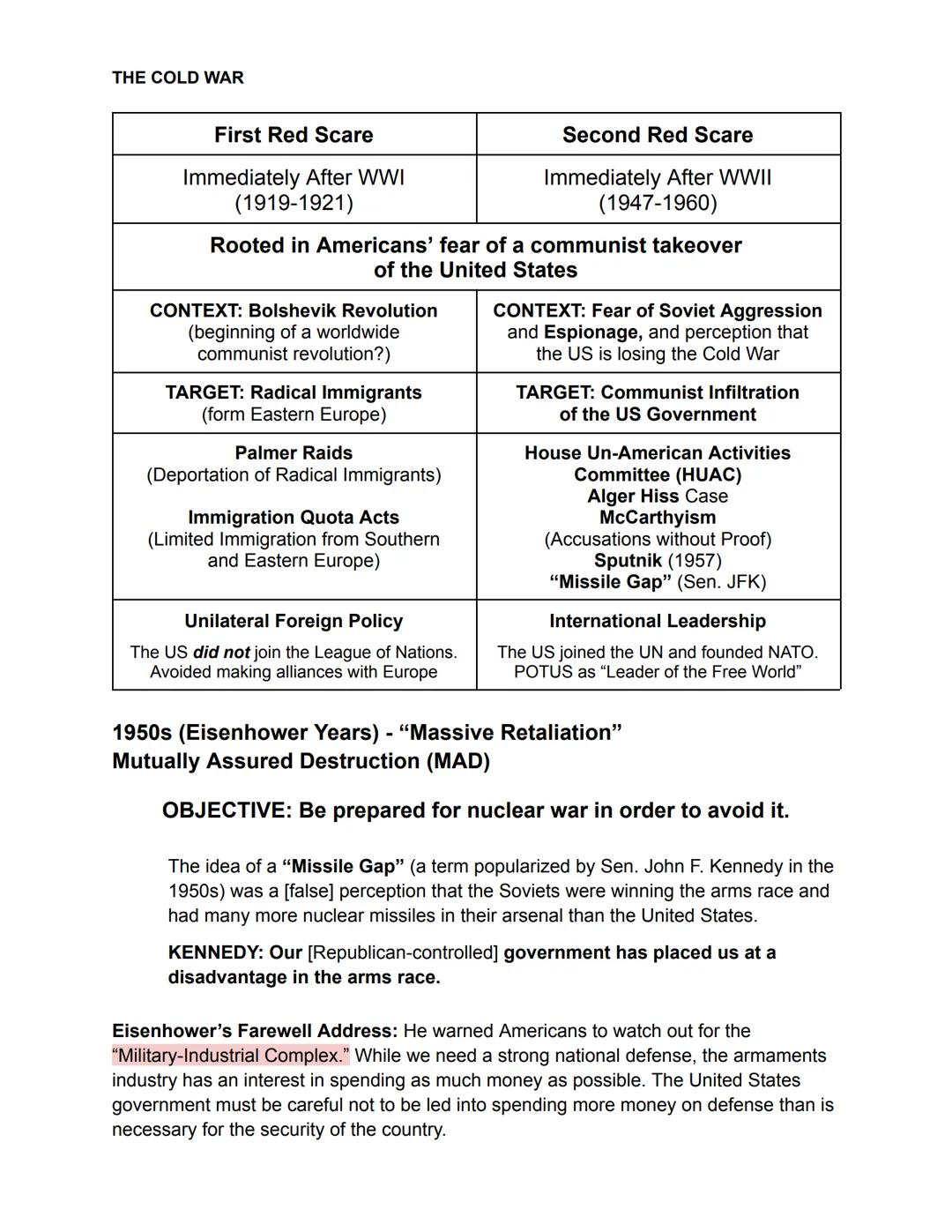
Post-WWII and Second Red Scare
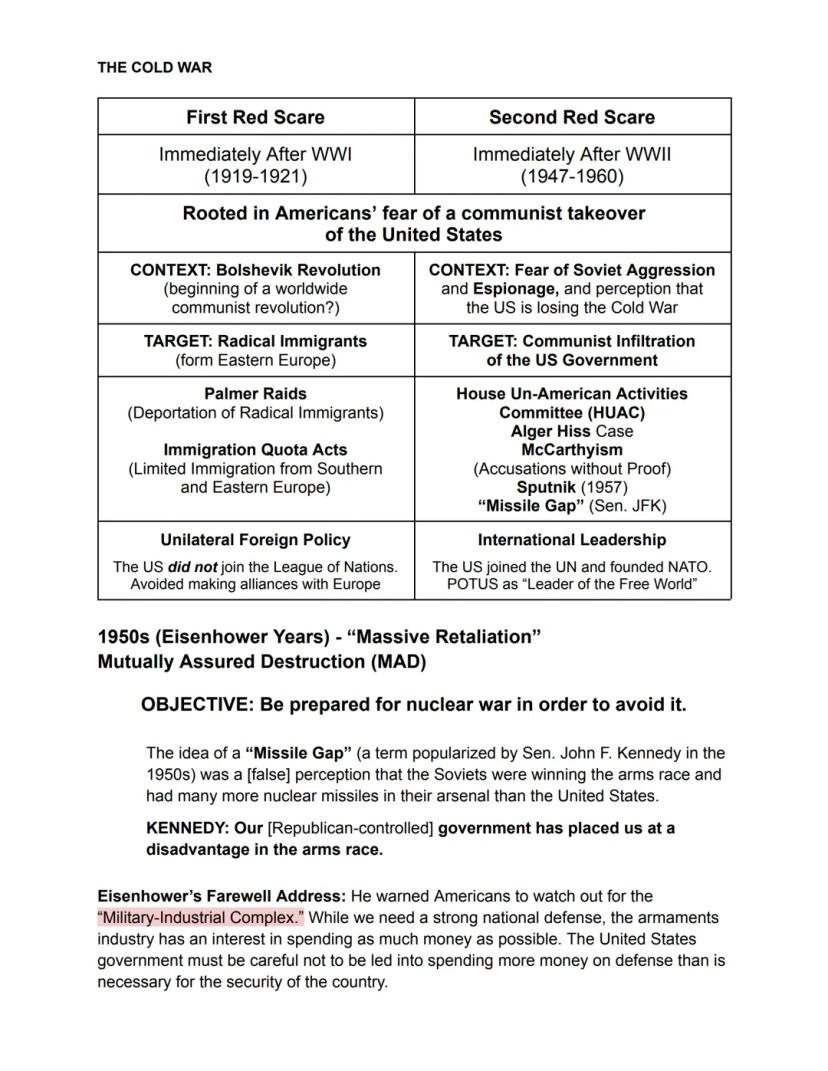
The Second Red Scare period marked a significant shift in American foreign policy approach. The United States abandoned its previous isolationist stance and emerged as a global leader.
Vocabulary: Mutually Assured Destruction (MAD) - A doctrine of military strategy in which full-scale use of nuclear weapons by opposing sides would result in the destruction of both parties.
Quote: "Our government has placed us at a disadvantage in the arms race." - John F. Kennedy
Highlight: The concept of the "Missile Gap," though later proven false, significantly influenced American military spending and public perception of Soviet capabilities.
2
of 9
Vietnam War and Military Strategy
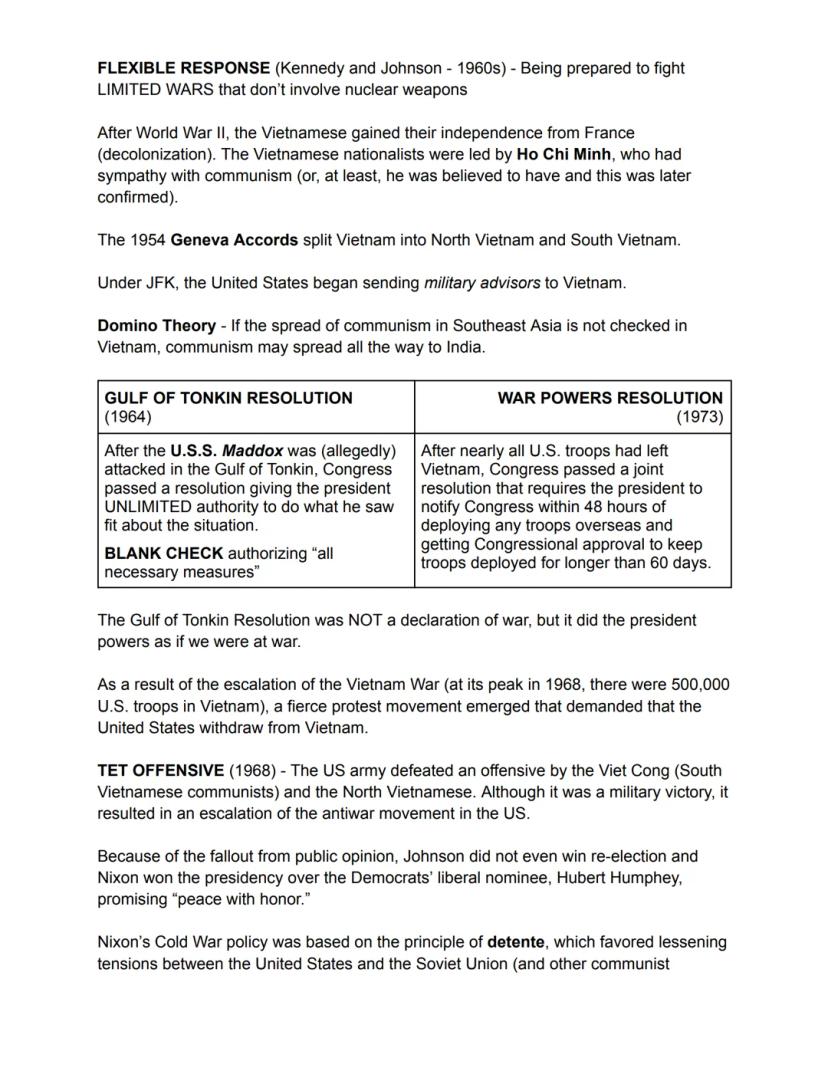
The 1960s saw a shift from Massive Retaliation to Flexible Response under Kennedy and Johnson. This period was marked by significant involvement in Vietnam and the implementation of the Domino Theory.
Definition: The Domino Theory suggested that if one country fell to communism, neighboring states would follow in a domino effect.
Highlight: The Gulf of Tonkin Resolution and Vietnam War escalation provided the president with unprecedented war powers, effectively serving as a "blank check" for military action.
Example: At its peak in 1968, American troop presence in Vietnam reached 500,000, leading to widespread domestic protests.
3
of 9
Détente and Late Cold War Period
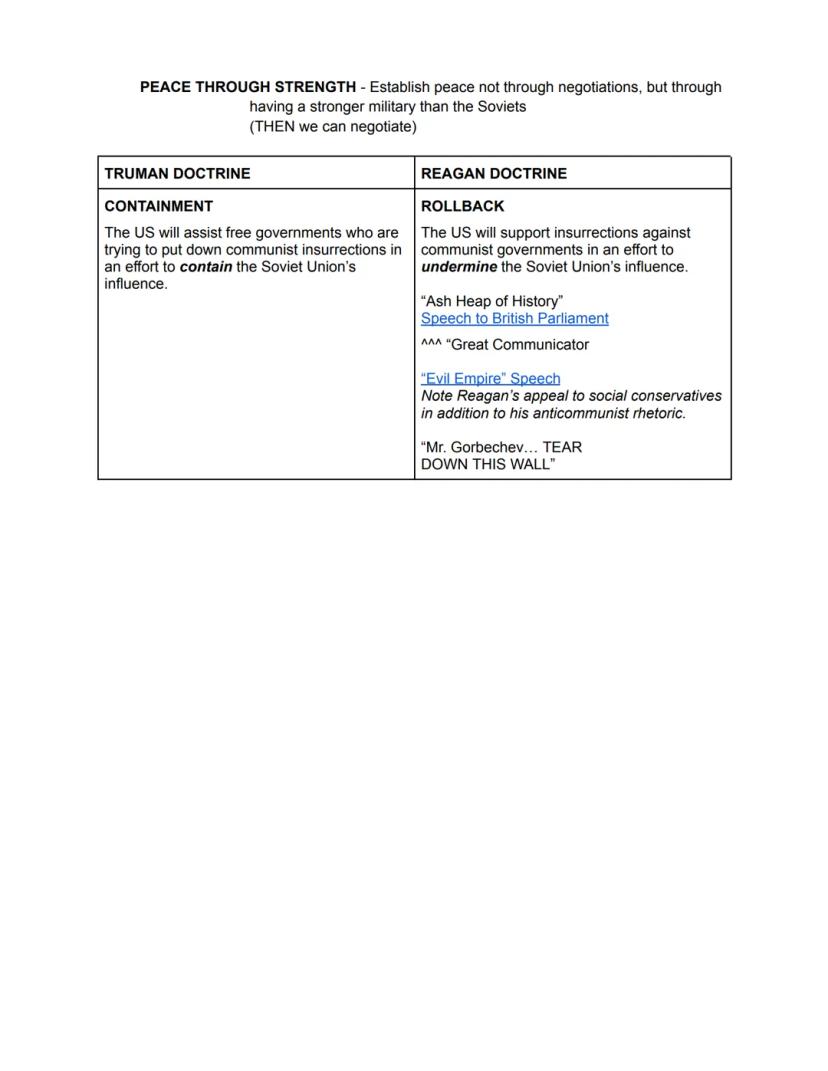
The 1970s marked a significant shift in Cold War strategy with the implementation of détente under Nixon, focusing on reducing tensions with communist nations.
Vocabulary: Détente - A period of reduced tension and improved relations between the United States and Soviet Union.
Highlight: The Strategic Arms Limitation Talks (SALT) represented a major effort to reduce nuclear arsenals and decrease Cold War tensions.
4
of 9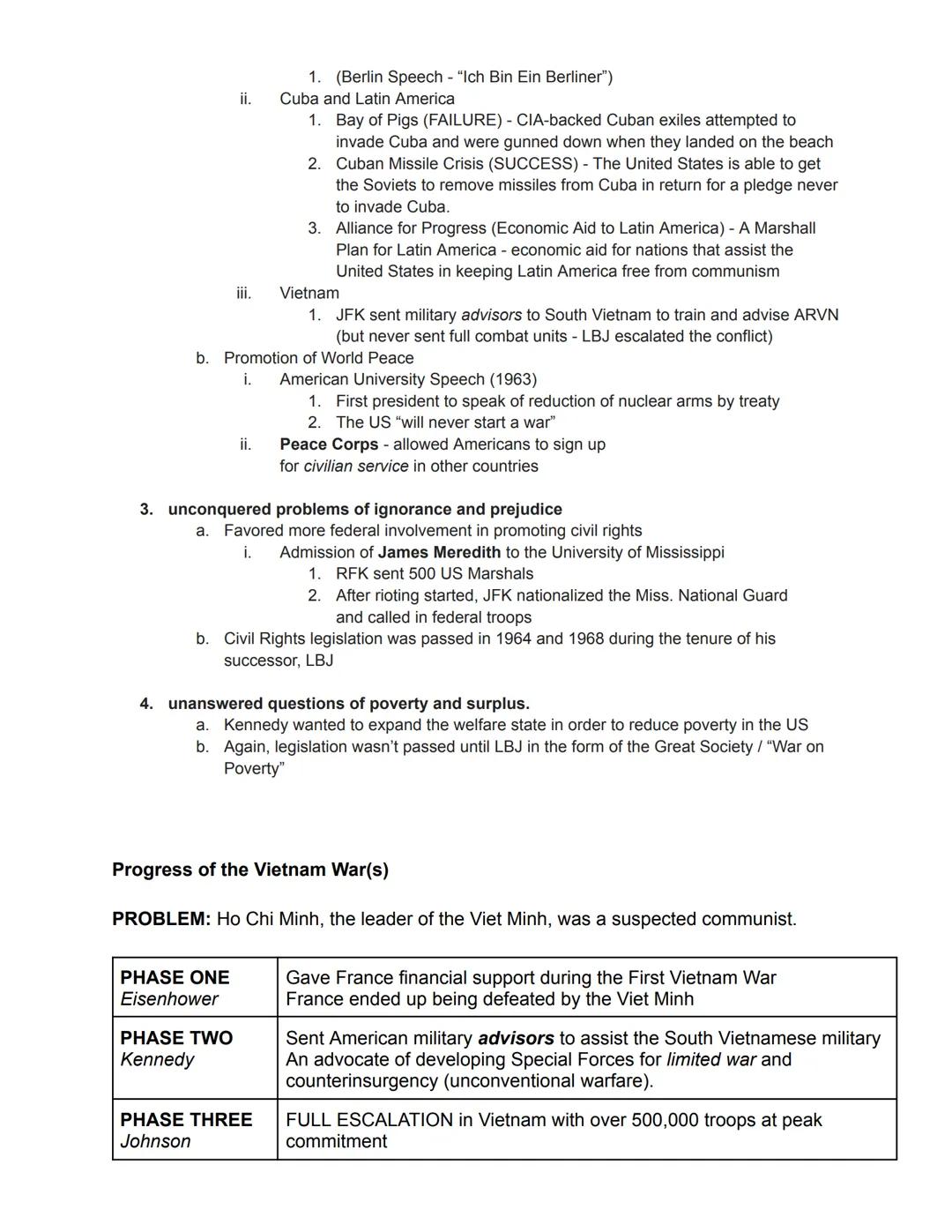
The End of the Cold War
The late 1980s and early 1990s witnessed the dramatic collapse of communist regimes across Eastern Europe and the Soviet Union.
Highlight: The fall of the Berlin Wall in 1989 symbolized the end of communist control in Eastern Europe.
Example: The dissolution of the Soviet Union in 1991 resulted in the independence of numerous nations and the establishment of democratic governments.
5
of 9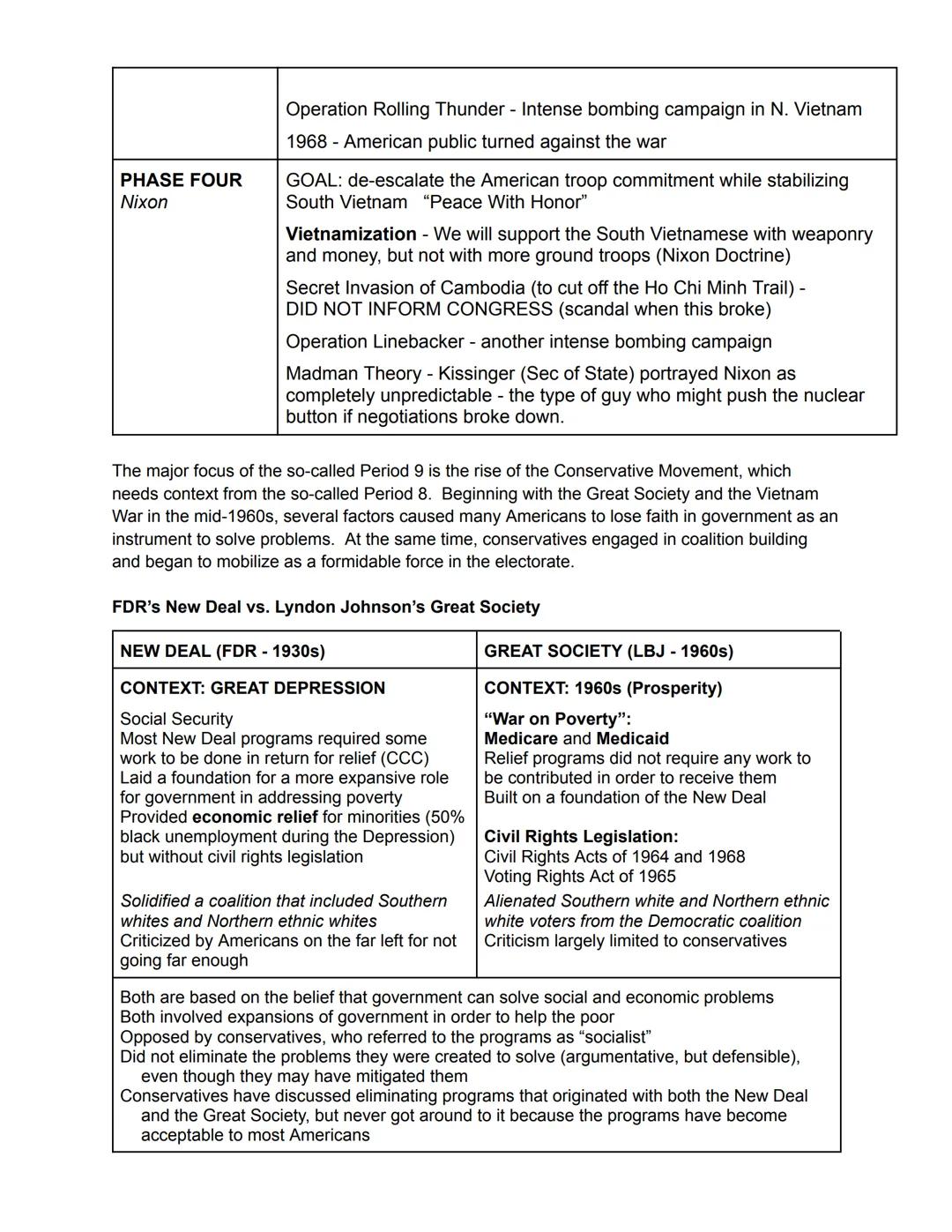
Nixon's Vietnam Strategy
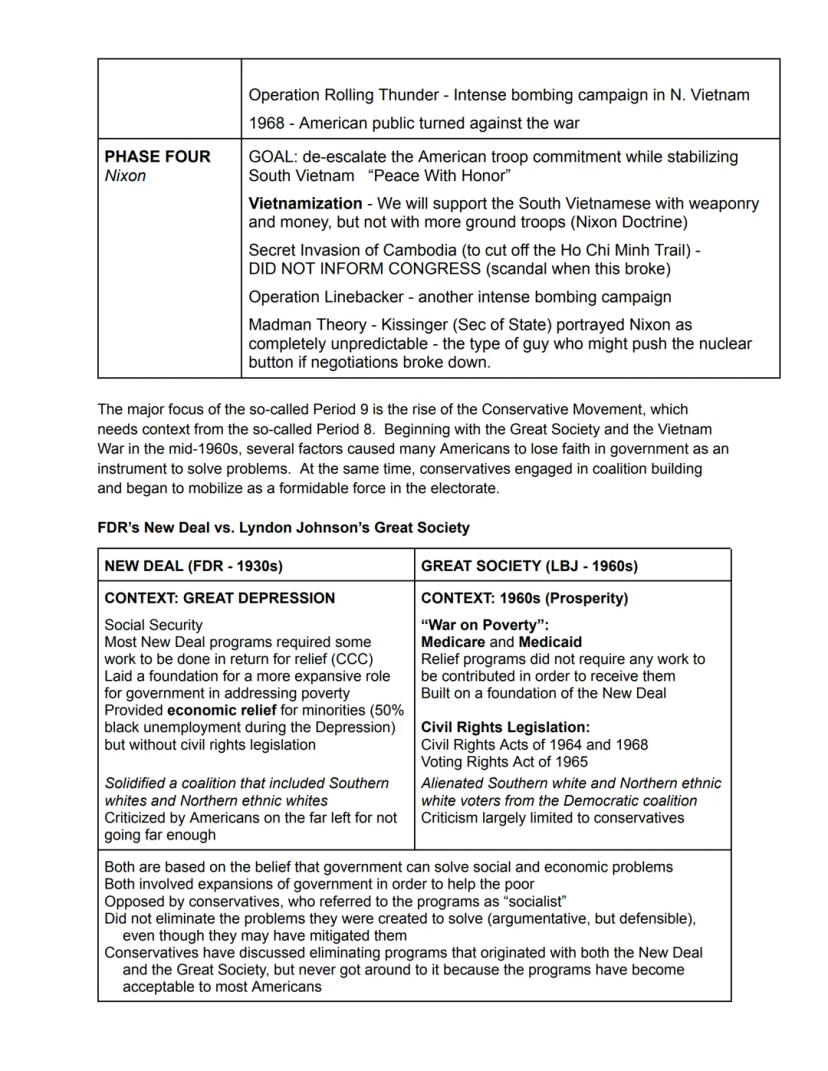
Nixon's administration pursued a policy of "Peace With Honor" through Vietnamization and various military operations.
Definition: Vietnamization involved gradually withdrawing American troops while providing support to South Vietnam.
Example: Operation Rolling Thunder and Operation Linebacker represented major bombing campaigns.
6
of 9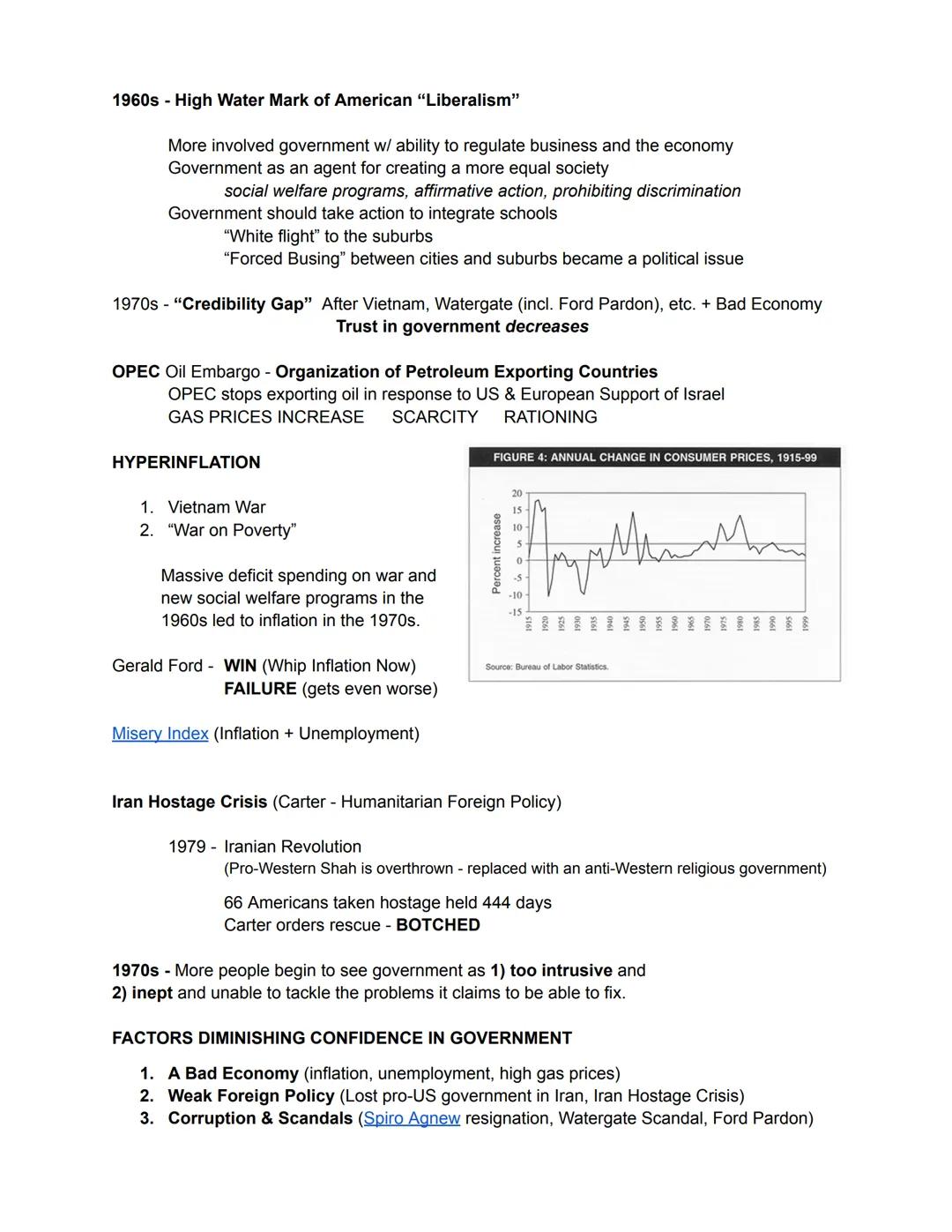
Domestic Social Changes
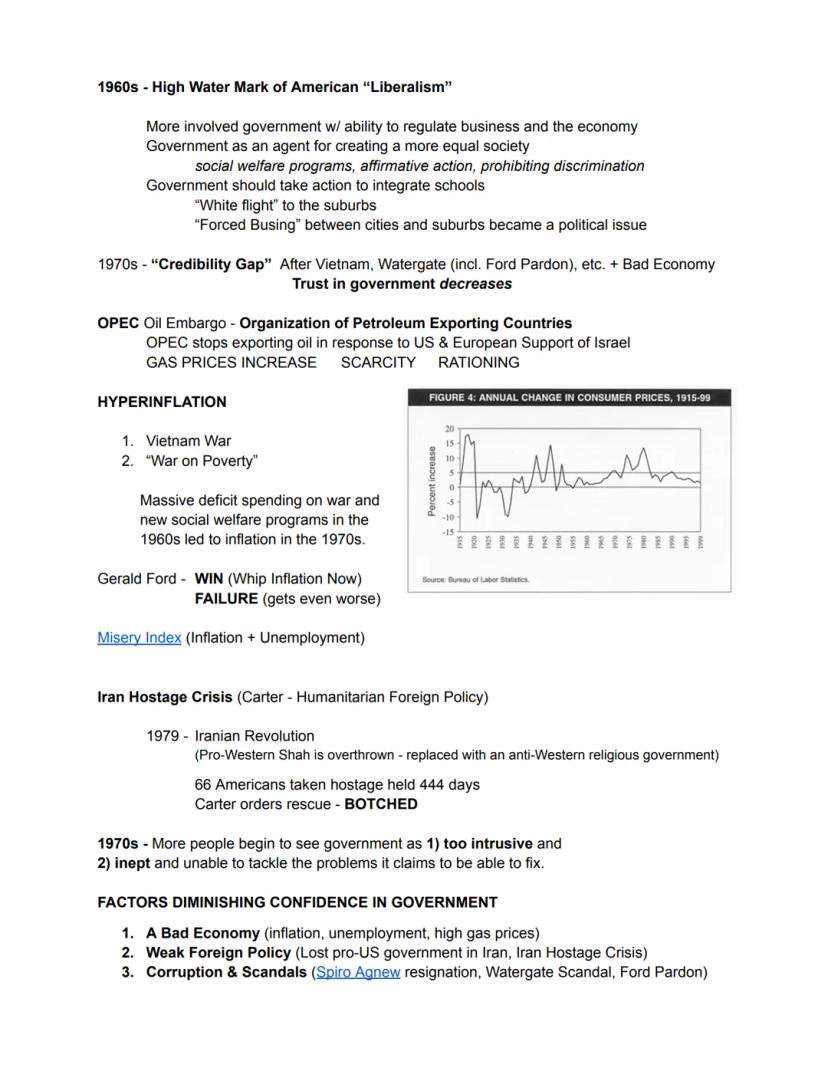
The 1960s represented the peak of American liberalism, characterized by expanded government involvement and social welfare programs.
Highlight: Issues like school integration and "forced busing" became significant political controversies.
Vocabulary: "White flight" referred to the mass exodus of white residents from urban areas to suburbs.
7
of 9
Conservative Movement
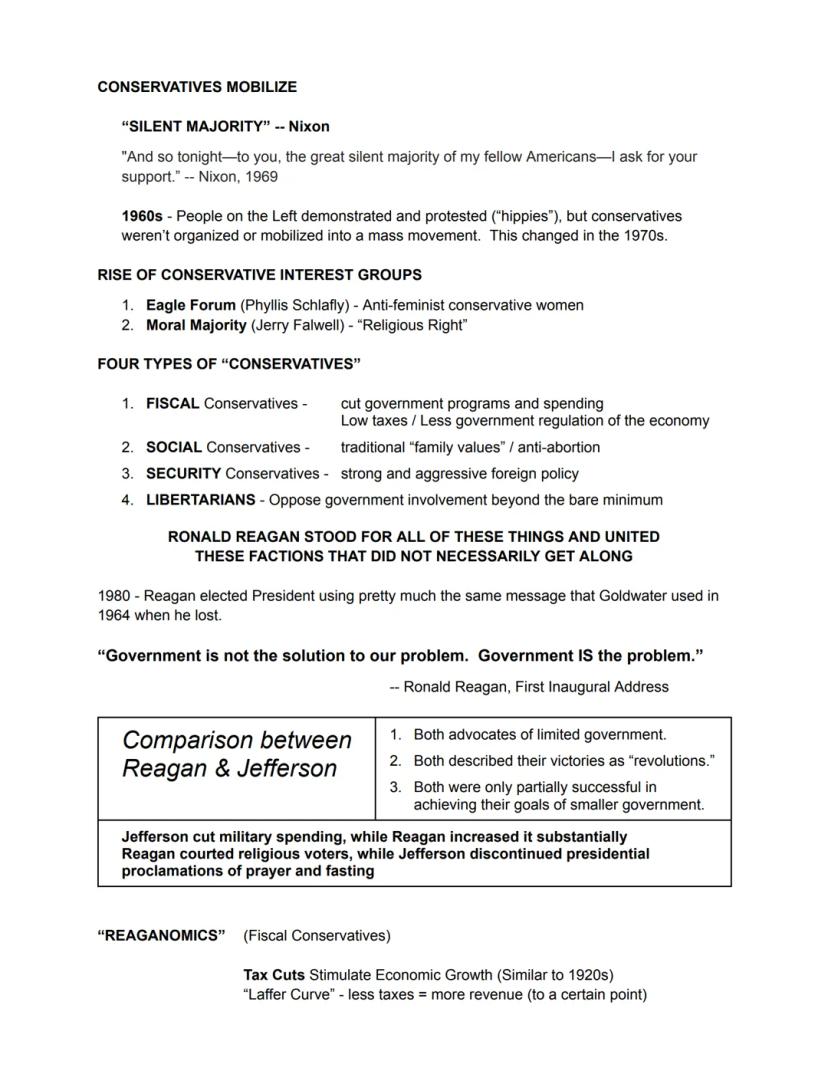
The 1970s saw the rise of organized conservative movements and interest groups.
Quote: "And so tonight to you, the great silent majority of my fellow Americans-I ask for your support." - Nixon, 1969
Example: The Eagle Forum and Moral Majority emerged as influential conservative organizations.
8
of 9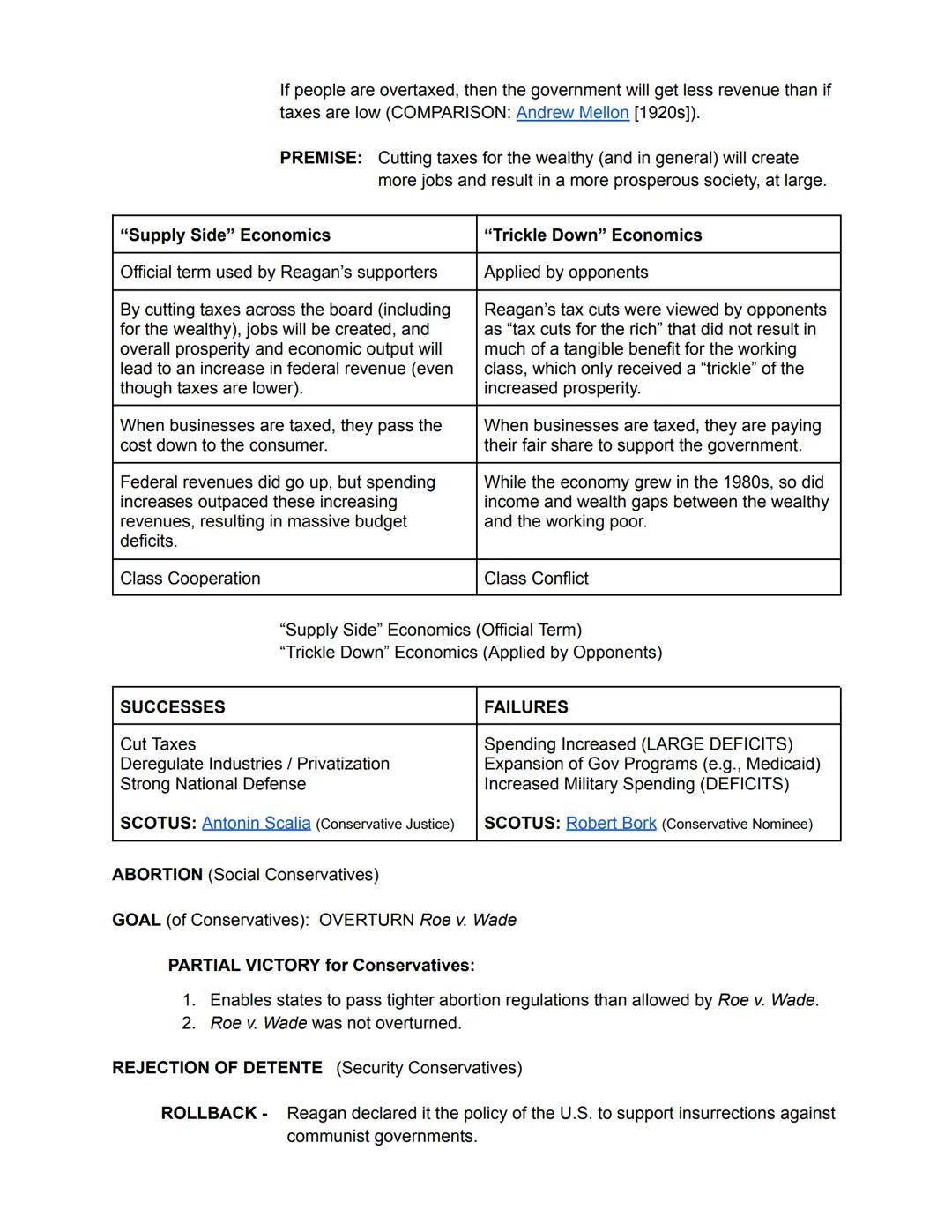
Economic Policy
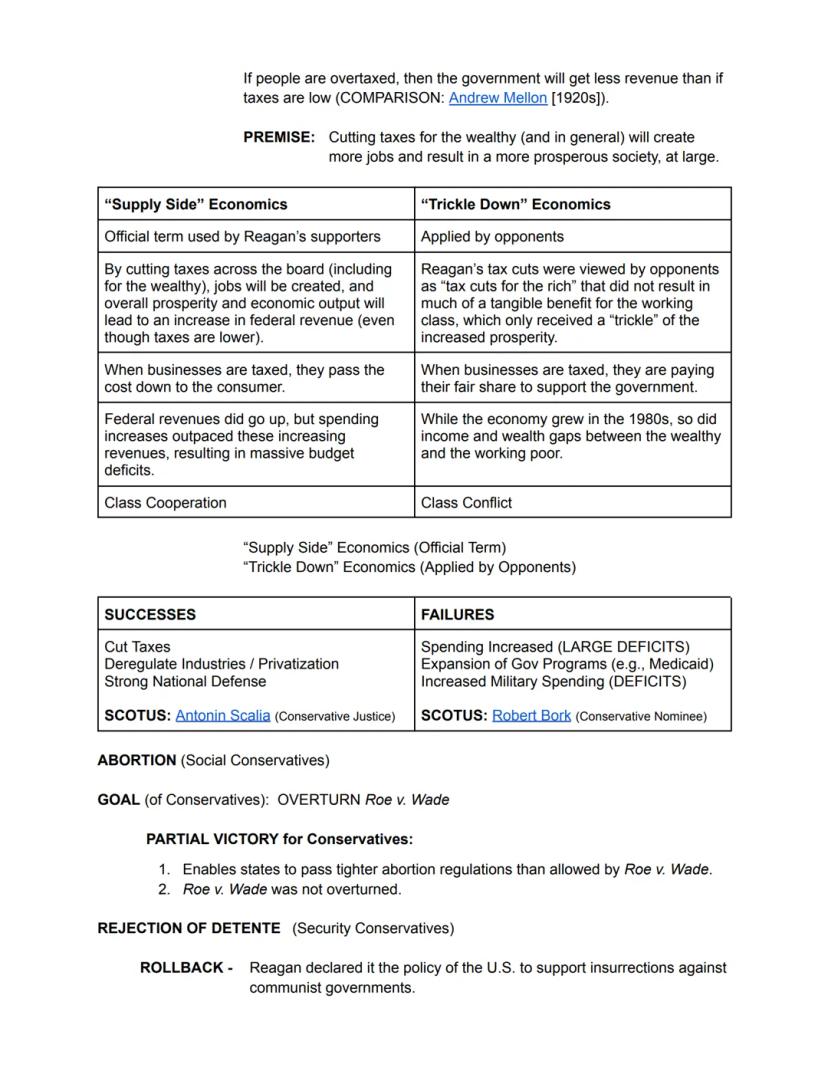
Reagan's administration introduced "Supply Side" economics, emphasizing tax cuts and reduced government intervention.
Definition: Supply Side Economics proposed that reducing taxes would stimulate economic growth and ultimately increase government revenue.
9
of 9
First Red Scare and Early Cold War Period
The immediate aftermath of World War I saw the emergence of intense anti-communist sentiment in the United States. This period was characterized by fear of a potential communist takeover, triggered by the Bolshevik Revolution in Russia.
Definition: The First Red Scare (1919-1921) was a period of intense anti-communist sentiment and fear of radical political change in the United States.
Example: The Palmer Raids resulted in the deportation of suspected radical immigrants, particularly those from Eastern Europe.
Highlight: The Cold War impact on US immigration policies was evident through the Immigration Quota Acts, which specifically restricted immigration from Southern and Eastern Europe.
We thought you’d never ask...
What is the Knowunity AI companion?
Our AI companion is specifically built for the needs of students. Based on the millions of content pieces we have on the platform we can provide truly meaningful and relevant answers to students. But its not only about answers, the companion is even more about guiding students through their daily learning challenges, with personalised study plans, quizzes or content pieces in the chat and 100% personalisation based on the students skills and developments.
Where can I download the Knowunity app?
You can download the app in the Google Play Store and in the Apple App Store.
Is Knowunity really free of charge?
That's right! Enjoy free access to study content, connect with fellow students, and get instant help – all at your fingertips.
Similar Content
Most popular content in AP US History
9O
AP US HistoryOrigins and Dynamics of the Columbian Exchange
Analyze the ecological and economic motivations behind the initial transfer of goods, people, and diseases between the Old and New Worlds.
9th3,1280
I
AP US HistoryIntroduction to Early Cultural Interactions
Analyze the initial social and religious encounters between Europeans, Africans, and Indigenous peoples in the colonial Americas.
9th2,7730
M
AP US HistoryMotivations for European Exploration
Analyze the economic, religious, and political factors that drove European powers to the Americas during the 15th and 16th centuries.
9th1,7780
I
AP US HistoryIntroduction to Native American Societies
Examine the diverse social, political, and economic structures of North American indigenous groups prior to European contact.
9th1,1100
I
AP US HistoryIntroduction to the Spanish Encomienda System
Explore the fundamental economic and social structures of the Spanish colonial system, focusing on the encomienda and the casta social hierarchy.
9th8890
M
AP US HistoryMotivations for European Colonization
Analyze the differing economic, religious, and social goals that drove Spanish, French, Dutch, and British expansion in the New World.
9th7570
W
AP US HistoryWeaknesses of the Articles of Confederation
Analyze the structural deficiencies of the first national government, focusing on fiscal instability and the lack of executive authority.
9th7700
I
AP US HistoryInitial Native-European Contacts and Perceptions
Analyze primary sources from the 15th and 16th centuries to compare Spanish, French, and English initial interactions with indigenous populations.
9th6370
AP US HistoryUnit 1: Apush
1491-1607
11th1,0059
Most popular content
9O
AP US HistoryOrigins and Dynamics of the Columbian Exchange
Analyze the ecological and economic motivations behind the initial transfer of goods, people, and diseases between the Old and New Worlds.
9th3,1280
I
AP US HistoryIntroduction to Early Cultural Interactions
Analyze the initial social and religious encounters between Europeans, Africans, and Indigenous peoples in the colonial Americas.
9th2,7730
O
 AP World History
Origins of Ancient River Civilizations
Analyze the environmental factors and technological innovations that led to the rise of early states in Mesopotamia, Egypt, and the Indus Valley.
9th3,1870
M
AP US HistoryMotivations for European Exploration
Analyze the economic, religious, and political factors that drove European powers to the Americas during the 15th and 16th centuries.
9th1,7780
F
 AP Psychology
Foundations of Ethical Guidelines in Research
Practice the core principles of the APA ethical code including informed consent, debriefing, and the role of Institutional Review Boards.
9th1,3360
I
AP US HistoryIntroduction to Native American Societies
Examine the diverse social, political, and economic structures of North American indigenous groups prior to European contact.
9th1,1100
I
 AP Biology
Introduction to Biological Elements of Life
Practice identifying the essential elements including carbon, nitrogen, phosphorus, and sulfur that compose biological macromolecules.
9th1,7390
I
AP US HistoryIntroduction to the Spanish Encomienda System
Explore the fundamental economic and social structures of the Spanish colonial system, focusing on the encomienda and the casta social hierarchy.
9th8890
O
AP World HistoryOrigins and Continuity of the Byzantine Empire
Analyze the political and cultural transitions from the Roman Empire to the Byzantine Empire, focusing on the reign of Justinian I and his code.
9th1,6320
Can't find what you're looking for? Explore other subjects.
Students love us — and so will you.
4.6/5App Store
4.7/5Google Play
The app is very easy to use and well designed. I have found everything I was looking for so far and have been able to learn a lot from the presentations! I will definitely use the app for a class assignment! And of course it also helps a lot as an inspiration.
Stefan SiOS user
This app is really great. There are so many study notes and help [...]. My problem subject is French, for example, and the app has so many options for help. Thanks to this app, I have improved my French. I would recommend it to anyone.
Samantha KlichAndroid user
Wow, I am really amazed. I just tried the app because I've seen it advertised many times and was absolutely stunned. This app is THE HELP you want for school and above all, it offers so many things, such as workouts and fact sheets, which have been VERY helpful to me personally.
AnnaiOS user
AP US History429 views·Updated Jun 18, 2026·9 pagesHow the Cold War Changed US Immigration, Scared America, and Led to Vietnam War
Tiya@tiya_2006
The Cold War era fundamentally shaped American domestic and foreign policy, marked by intense anti-communist sentiment and significant policy shifts. The period witnessed two major Red Scares and evolving strategies in dealing with communist threats.
Key points:
- The Cold War...
1
of 9
Sign up to see the content. It's free!
- Access to all documents
- Improve your grades
- Join milions of students
Post-WWII and Second Red Scare
The Second Red Scare period marked a significant shift in American foreign policy approach. The United States abandoned its previous isolationist stance and emerged as a global leader.
Vocabulary: Mutually Assured Destruction (MAD) - A doctrine of military strategy in which full-scale use of nuclear weapons by opposing sides would result in the destruction of both parties.
Quote: "Our government has placed us at a disadvantage in the arms race." - John F. Kennedy
Highlight: The concept of the "Missile Gap," though later proven false, significantly influenced American military spending and public perception of Soviet capabilities.
2
of 9Sign up to see the content. It's free!
- Access to all documents
- Improve your grades
- Join milions of students
Vietnam War and Military Strategy
The 1960s saw a shift from Massive Retaliation to Flexible Response under Kennedy and Johnson. This period was marked by significant involvement in Vietnam and the implementation of the Domino Theory.
Definition: The Domino Theory suggested that if one country fell to communism, neighboring states would follow in a domino effect.
Highlight: The Gulf of Tonkin Resolution and Vietnam War escalation provided the president with unprecedented war powers, effectively serving as a "blank check" for military action.
Example: At its peak in 1968, American troop presence in Vietnam reached 500,000, leading to widespread domestic protests.
3
of 9Sign up to see the content. It's free!
- Access to all documents
- Improve your grades
- Join milions of students
Détente and Late Cold War Period
The 1970s marked a significant shift in Cold War strategy with the implementation of détente under Nixon, focusing on reducing tensions with communist nations.
Vocabulary: Détente - A period of reduced tension and improved relations between the United States and Soviet Union.
Highlight: The Strategic Arms Limitation Talks (SALT) represented a major effort to reduce nuclear arsenals and decrease Cold War tensions.
4
of 9Sign up to see the content. It's free!
- Access to all documents
- Improve your grades
- Join milions of students
The End of the Cold War
The late 1980s and early 1990s witnessed the dramatic collapse of communist regimes across Eastern Europe and the Soviet Union.
Highlight: The fall of the Berlin Wall in 1989 symbolized the end of communist control in Eastern Europe.
Example: The dissolution of the Soviet Union in 1991 resulted in the independence of numerous nations and the establishment of democratic governments.
5
of 9Sign up to see the content. It's free!
- Access to all documents
- Improve your grades
- Join milions of students
Nixon's Vietnam Strategy
Nixon's administration pursued a policy of "Peace With Honor" through Vietnamization and various military operations.
Definition: Vietnamization involved gradually withdrawing American troops while providing support to South Vietnam.
Example: Operation Rolling Thunder and Operation Linebacker represented major bombing campaigns.
6
of 9Sign up to see the content. It's free!
- Access to all documents
- Improve your grades
- Join milions of students
Domestic Social Changes
The 1960s represented the peak of American liberalism, characterized by expanded government involvement and social welfare programs.
Highlight: Issues like school integration and "forced busing" became significant political controversies.
Vocabulary: "White flight" referred to the mass exodus of white residents from urban areas to suburbs.
7
of 9Sign up to see the content. It's free!
- Access to all documents
- Improve your grades
- Join milions of students
Conservative Movement
The 1970s saw the rise of organized conservative movements and interest groups.
Quote: "And so tonight to you, the great silent majority of my fellow Americans-I ask for your support." - Nixon, 1969
Example: The Eagle Forum and Moral Majority emerged as influential conservative organizations.
8
of 9Sign up to see the content. It's free!
- Access to all documents
- Improve your grades
- Join milions of students
Economic Policy
Reagan's administration introduced "Supply Side" economics, emphasizing tax cuts and reduced government intervention.
Definition: Supply Side Economics proposed that reducing taxes would stimulate economic growth and ultimately increase government revenue.
9
of 9Sign up to see the content. It's free!
- Access to all documents
- Improve your grades
- Join milions of students
First Red Scare and Early Cold War Period
The immediate aftermath of World War I saw the emergence of intense anti-communist sentiment in the United States. This period was characterized by fear of a potential communist takeover, triggered by the Bolshevik Revolution in Russia.
Definition: The First Red Scare (1919-1921) was a period of intense anti-communist sentiment and fear of radical political change in the United States.
Example: The Palmer Raids resulted in the deportation of suspected radical immigrants, particularly those from Eastern Europe.
Highlight: The Cold War impact on US immigration policies was evident through the Immigration Quota Acts, which specifically restricted immigration from Southern and Eastern Europe.
We thought you’d never ask...
What is the Knowunity AI companion?
Our AI companion is specifically built for the needs of students. Based on the millions of content pieces we have on the platform we can provide truly meaningful and relevant answers to students. But its not only about answers, the companion is even more about guiding students through their daily learning challenges, with personalised study plans, quizzes or content pieces in the chat and 100% personalisation based on the students skills and developments.
Where can I download the Knowunity app?
You can download the app in the Google Play Store and in the Apple App Store.
Is Knowunity really free of charge?
That's right! Enjoy free access to study content, connect with fellow students, and get instant help – all at your fingertips.
Similar Content
Most popular content in AP US History
9O
AP US HistoryOrigins and Dynamics of the Columbian Exchange
Analyze the ecological and economic motivations behind the initial transfer of goods, people, and diseases between the Old and New Worlds.
9th3,1280
I
AP US HistoryIntroduction to Early Cultural Interactions
Analyze the initial social and religious encounters between Europeans, Africans, and Indigenous peoples in the colonial Americas.
9th2,7730
M
AP US HistoryMotivations for European Exploration
Analyze the economic, religious, and political factors that drove European powers to the Americas during the 15th and 16th centuries.
9th1,7780
I
AP US HistoryIntroduction to Native American Societies
Examine the diverse social, political, and economic structures of North American indigenous groups prior to European contact.
9th1,1100
I
AP US HistoryIntroduction to the Spanish Encomienda System
Explore the fundamental economic and social structures of the Spanish colonial system, focusing on the encomienda and the casta social hierarchy.
9th8890
M
AP US HistoryMotivations for European Colonization
Analyze the differing economic, religious, and social goals that drove Spanish, French, Dutch, and British expansion in the New World.
9th7570
W
AP US HistoryWeaknesses of the Articles of Confederation
Analyze the structural deficiencies of the first national government, focusing on fiscal instability and the lack of executive authority.
9th7700
I
AP US HistoryInitial Native-European Contacts and Perceptions
Analyze primary sources from the 15th and 16th centuries to compare Spanish, French, and English initial interactions with indigenous populations.
9th6370
AP US HistoryUnit 1: Apush
1491-1607
11th1,0059
Most popular content
9O
AP US HistoryOrigins and Dynamics of the Columbian Exchange
Analyze the ecological and economic motivations behind the initial transfer of goods, people, and diseases between the Old and New Worlds.
9th3,1280
I
AP US HistoryIntroduction to Early Cultural Interactions
Analyze the initial social and religious encounters between Europeans, Africans, and Indigenous peoples in the colonial Americas.
9th2,7730
O
AP World HistoryOrigins of Ancient River Civilizations
Analyze the environmental factors and technological innovations that led to the rise of early states in Mesopotamia, Egypt, and the Indus Valley.
9th3,1870
M
AP US HistoryMotivations for European Exploration
Analyze the economic, religious, and political factors that drove European powers to the Americas during the 15th and 16th centuries.
9th1,7780
F
AP PsychologyFoundations of Ethical Guidelines in Research
Practice the core principles of the APA ethical code including informed consent, debriefing, and the role of Institutional Review Boards.
9th1,3360
I
AP US HistoryIntroduction to Native American Societies
Examine the diverse social, political, and economic structures of North American indigenous groups prior to European contact.
9th1,1100
I
AP BiologyIntroduction to Biological Elements of Life
Practice identifying the essential elements including carbon, nitrogen, phosphorus, and sulfur that compose biological macromolecules.
9th1,7390
I
AP US HistoryIntroduction to the Spanish Encomienda System
Explore the fundamental economic and social structures of the Spanish colonial system, focusing on the encomienda and the casta social hierarchy.
9th8890
O
AP World HistoryOrigins and Continuity of the Byzantine Empire
Analyze the political and cultural transitions from the Roman Empire to the Byzantine Empire, focusing on the reign of Justinian I and his code.
9th1,6320
Can't find what you're looking for? Explore other subjects.
Students love us — and so will you.
4.6/5App Store
4.7/5Google Play
The app is very easy to use and well designed. I have found everything I was looking for so far and have been able to learn a lot from the presentations! I will definitely use the app for a class assignment! And of course it also helps a lot as an inspiration.
Stefan SiOS user
This app is really great. There are so many study notes and help [...]. My problem subject is French, for example, and the app has so many options for help. Thanks to this app, I have improved my French. I would recommend it to anyone.
Samantha KlichAndroid user
Wow, I am really amazed. I just tried the app because I've seen it advertised many times and was absolutely stunned. This app is THE HELP you want for school and above all, it offers so many things, such as workouts and fact sheets, which have been VERY helpful to me personally.
AnnaiOS user