
Take a journey through a pivotal period in American history...
 AP US History218 views·Updated Jun 10, 2026·2 pages
APUSH Unit 3: From Colonies to Nation Complete Notes

Tiya@tiya_2006
1
of 2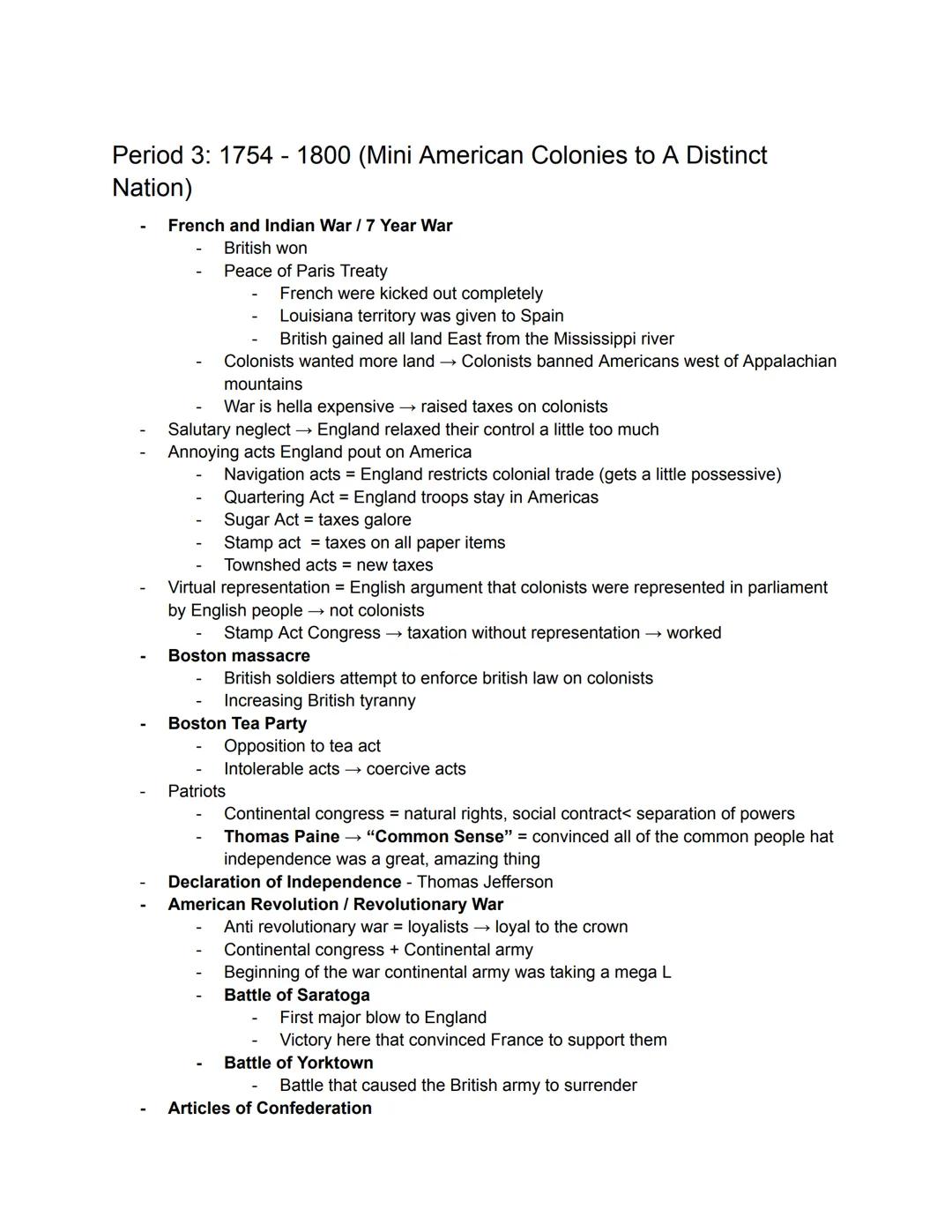
From Colonies to Revolution
The French and Indian War (1754-1763) changed everything for American colonists. When Britain won, they gained all land east of the Mississippi River through the Peace of Paris Treaty, while Spain received the Louisiana Territory. But this victory came with problems—Britain banned colonists from moving west of the Appalachian Mountains and raised taxes to pay for the expensive war.
Britain tightened control through several unpopular measures. The Navigation Acts restricted colonial trade, the Quartering Act forced colonists to house British soldiers, and various tax acts (Sugar Act, Stamp Act, Townshend Acts) angered Americans. Colonists rejected Britain's argument of "virtual representation" in Parliament, forming the Stamp Act Congress to protest "taxation without representation."
Tensions exploded with events like the Boston Massacre (British soldiers clashing with colonists) and the Boston Tea Party (colonists protesting the Tea Act). Britain responded with the harsh Intolerable Acts, pushing colonists toward independence. Thomas Paine's pamphlet "Common Sense" convinced ordinary people that independence was necessary, while Thomas Jefferson drafted the Declaration of Independence.
Remember this! The American Revolution wasn't just about taxes—it represented a fundamental shift in how people viewed government power and their own rights as citizens.
During the Revolutionary War, the Continental Army struggled initially but secured crucial victories at the Battle of Saratoga (convincing France to support the American cause) and the Battle of Yorktown (forcing British surrender). The colonies had successfully broken away from the world's greatest power.
2
of 2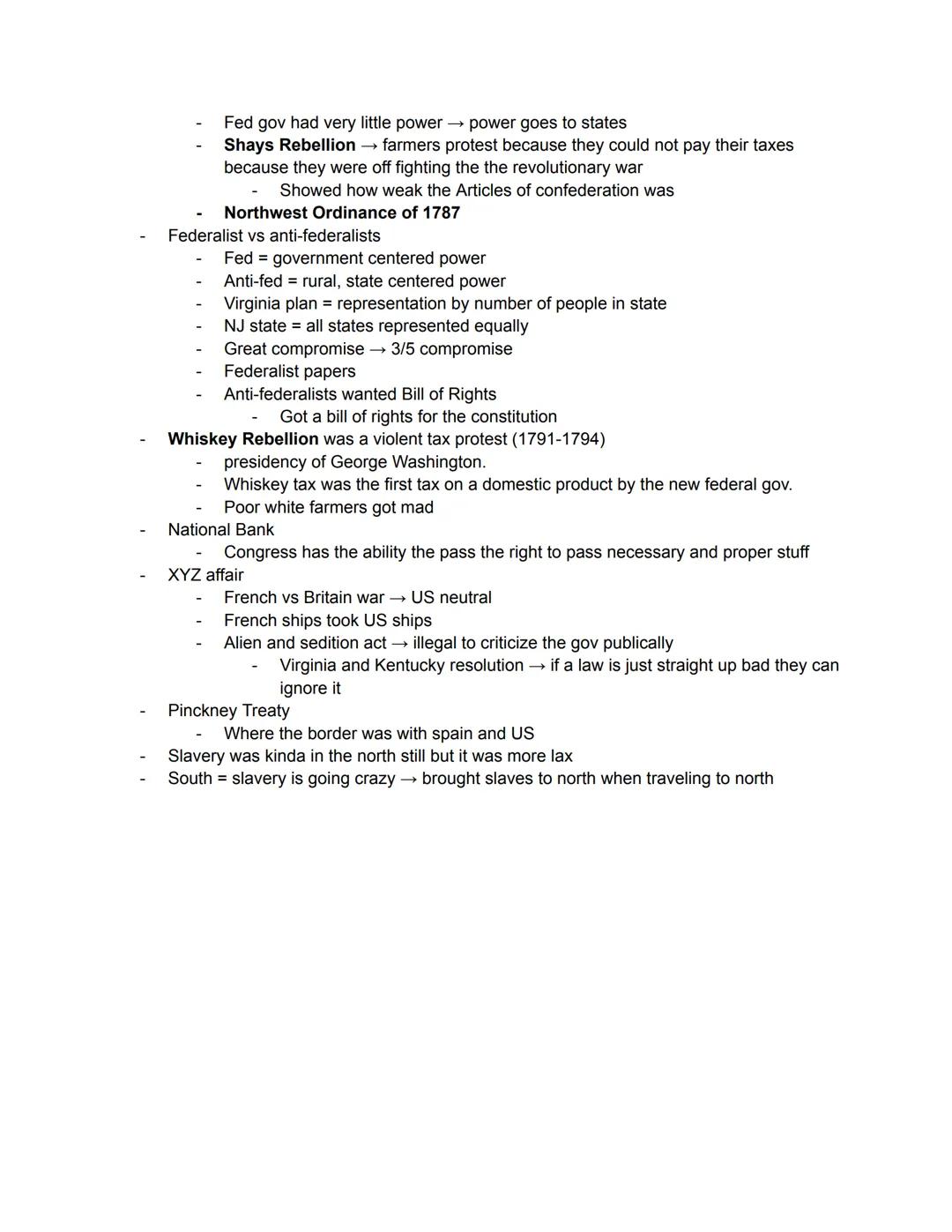
Building a New Nation
After independence, America's first government system—the Articles of Confederation—proved too weak. The federal government had minimal power while states held most authority. Shays' Rebellion, where farmers protested taxes they couldn't pay after fighting in the war, exposed the government's inability to maintain order.
This weakness led to the Constitutional Convention, where delegates debated how to strengthen the government while protecting individual liberties. The Virginia Plan (representation based on population) and New Jersey Plan (equal representation for all states) were resolved through the Great Compromise, which created our two-house legislature. The controversial 3/5 Compromise counted enslaved people as partial persons for representation purposes.
The debate continued between Federalists (who wanted strong central government) and Anti-Federalists (who preferred state power). The Federalists won support for the Constitution by promising to add a Bill of Rights protecting individual liberties. Early challenges included the Whiskey Rebellion, where farmers protested the first federal tax on a domestic product, and the XYZ Affair that strained relations with France.
Why this matters: The political debates from this period—about government power, state rights, and individual liberties—continue to shape American politics today!
The new nation also established its geographic boundaries through the Pinckney Treaty with Spain and dealt with divisions over slavery. While the North began moving toward a more relaxed approach to slavery, the institution became increasingly entrenched in the South, setting the stage for future conflicts.
We thought you’d never ask...
What is the Knowunity AI companion?
Our AI companion is specifically built for the needs of students. Based on the millions of content pieces we have on the platform we can provide truly meaningful and relevant answers to students. But its not only about answers, the companion is even more about guiding students through their daily learning challenges, with personalised study plans, quizzes or content pieces in the chat and 100% personalisation based on the students skills and developments.
Where can I download the Knowunity app?
You can download the app in the Google Play Store and in the Apple App Store.
Is Knowunity really free of charge?
That's right! Enjoy free access to study content, connect with fellow students, and get instant help – all at your fingertips.
Similar Content
Most popular content: Revolutionary War
2Most popular content in AP US History
9O
AP US HistoryOrigins and Dynamics of the Columbian Exchange
Analyze the ecological and economic motivations behind the initial transfer of goods, people, and diseases between the Old and New Worlds.
9th3,1280
I
AP US HistoryIntroduction to Early Cultural Interactions
Analyze the initial social and religious encounters between Europeans, Africans, and Indigenous peoples in the colonial Americas.
9th2,7730
M
AP US HistoryMotivations for European Exploration
Analyze the economic, religious, and political factors that drove European powers to the Americas during the 15th and 16th centuries.
9th1,7780
I
AP US HistoryIntroduction to Native American Societies
Examine the diverse social, political, and economic structures of North American indigenous groups prior to European contact.
9th1,1100
I
AP US HistoryIntroduction to the Spanish Encomienda System
Explore the fundamental economic and social structures of the Spanish colonial system, focusing on the encomienda and the casta social hierarchy.
9th8890
M
AP US HistoryMotivations for European Colonization
Analyze the differing economic, religious, and social goals that drove Spanish, French, Dutch, and British expansion in the New World.
9th7570
W
AP US HistoryWeaknesses of the Articles of Confederation
Analyze the structural deficiencies of the first national government, focusing on fiscal instability and the lack of executive authority.
9th7700
I
AP US HistoryInitial Native-European Contacts and Perceptions
Analyze primary sources from the 15th and 16th centuries to compare Spanish, French, and English initial interactions with indigenous populations.
9th6370
AP US HistoryUnit 1: Apush
1491-1607
11th1,0059
Most popular content
9O
AP US HistoryOrigins and Dynamics of the Columbian Exchange
Analyze the ecological and economic motivations behind the initial transfer of goods, people, and diseases between the Old and New Worlds.
9th3,1280
I
AP US HistoryIntroduction to Early Cultural Interactions
Analyze the initial social and religious encounters between Europeans, Africans, and Indigenous peoples in the colonial Americas.
9th2,7730
O
 AP World History
Origins of Ancient River Civilizations
Analyze the environmental factors and technological innovations that led to the rise of early states in Mesopotamia, Egypt, and the Indus Valley.
9th3,1870
M
AP US HistoryMotivations for European Exploration
Analyze the economic, religious, and political factors that drove European powers to the Americas during the 15th and 16th centuries.
9th1,7780
F
 AP Psychology
Foundations of Ethical Guidelines in Research
Practice the core principles of the APA ethical code including informed consent, debriefing, and the role of Institutional Review Boards.
9th1,3360
I
AP US HistoryIntroduction to Native American Societies
Examine the diverse social, political, and economic structures of North American indigenous groups prior to European contact.
9th1,1100
I
 AP Biology
Introduction to Biological Elements of Life
Practice identifying the essential elements including carbon, nitrogen, phosphorus, and sulfur that compose biological macromolecules.
9th1,7390
I
AP US HistoryIntroduction to the Spanish Encomienda System
Explore the fundamental economic and social structures of the Spanish colonial system, focusing on the encomienda and the casta social hierarchy.
9th8890
O
AP World HistoryOrigins and Continuity of the Byzantine Empire
Analyze the political and cultural transitions from the Roman Empire to the Byzantine Empire, focusing on the reign of Justinian I and his code.
9th1,6320
Can't find what you're looking for? Explore other subjects.
Students love us — and so will you.
4.6/5App Store
4.7/5Google Play
The app is very easy to use and well designed. I have found everything I was looking for so far and have been able to learn a lot from the presentations! I will definitely use the app for a class assignment! And of course it also helps a lot as an inspiration.
Stefan SiOS user
This app is really great. There are so many study notes and help [...]. My problem subject is French, for example, and the app has so many options for help. Thanks to this app, I have improved my French. I would recommend it to anyone.
Samantha KlichAndroid user
Wow, I am really amazed. I just tried the app because I've seen it advertised many times and was absolutely stunned. This app is THE HELP you want for school and above all, it offers so many things, such as workouts and fact sheets, which have been VERY helpful to me personally.
AnnaiOS user
AP US History218 views·Updated Jun 10, 2026·2 pagesAPUSH Unit 3: From Colonies to Nation Complete Notes
Tiya@tiya_2006
Take a journey through a pivotal period in American history from 1754-1800, when the colonies transformed into an independent nation. This era saw intense conflicts with Britain, revolutionary ideas spreading, and the challenging early days of creating a new government...
1
of 2
Sign up to see the content. It's free!
- Access to all documents
- Improve your grades
- Join milions of students
From Colonies to Revolution
The French and Indian War (1754-1763) changed everything for American colonists. When Britain won, they gained all land east of the Mississippi River through the Peace of Paris Treaty, while Spain received the Louisiana Territory. But this victory came with problems—Britain banned colonists from moving west of the Appalachian Mountains and raised taxes to pay for the expensive war.
Britain tightened control through several unpopular measures. The Navigation Acts restricted colonial trade, the Quartering Act forced colonists to house British soldiers, and various tax acts (Sugar Act, Stamp Act, Townshend Acts) angered Americans. Colonists rejected Britain's argument of "virtual representation" in Parliament, forming the Stamp Act Congress to protest "taxation without representation."
Tensions exploded with events like the Boston Massacre (British soldiers clashing with colonists) and the Boston Tea Party (colonists protesting the Tea Act). Britain responded with the harsh Intolerable Acts, pushing colonists toward independence. Thomas Paine's pamphlet "Common Sense" convinced ordinary people that independence was necessary, while Thomas Jefferson drafted the Declaration of Independence.
Remember this! The American Revolution wasn't just about taxes—it represented a fundamental shift in how people viewed government power and their own rights as citizens.
During the Revolutionary War, the Continental Army struggled initially but secured crucial victories at the Battle of Saratoga (convincing France to support the American cause) and the Battle of Yorktown (forcing British surrender). The colonies had successfully broken away from the world's greatest power.
2
of 2Sign up to see the content. It's free!
- Access to all documents
- Improve your grades
- Join milions of students
Building a New Nation
After independence, America's first government system—the Articles of Confederation—proved too weak. The federal government had minimal power while states held most authority. Shays' Rebellion, where farmers protested taxes they couldn't pay after fighting in the war, exposed the government's inability to maintain order.
This weakness led to the Constitutional Convention, where delegates debated how to strengthen the government while protecting individual liberties. The Virginia Plan (representation based on population) and New Jersey Plan (equal representation for all states) were resolved through the Great Compromise, which created our two-house legislature. The controversial 3/5 Compromise counted enslaved people as partial persons for representation purposes.
The debate continued between Federalists (who wanted strong central government) and Anti-Federalists (who preferred state power). The Federalists won support for the Constitution by promising to add a Bill of Rights protecting individual liberties. Early challenges included the Whiskey Rebellion, where farmers protested the first federal tax on a domestic product, and the XYZ Affair that strained relations with France.
Why this matters: The political debates from this period—about government power, state rights, and individual liberties—continue to shape American politics today!
The new nation also established its geographic boundaries through the Pinckney Treaty with Spain and dealt with divisions over slavery. While the North began moving toward a more relaxed approach to slavery, the institution became increasingly entrenched in the South, setting the stage for future conflicts.
We thought you’d never ask...
What is the Knowunity AI companion?
Our AI companion is specifically built for the needs of students. Based on the millions of content pieces we have on the platform we can provide truly meaningful and relevant answers to students. But its not only about answers, the companion is even more about guiding students through their daily learning challenges, with personalised study plans, quizzes or content pieces in the chat and 100% personalisation based on the students skills and developments.
Where can I download the Knowunity app?
You can download the app in the Google Play Store and in the Apple App Store.
Is Knowunity really free of charge?
That's right! Enjoy free access to study content, connect with fellow students, and get instant help – all at your fingertips.
Similar Content
Most popular content: Revolutionary War
2Most popular content in AP US History
9O
AP US HistoryOrigins and Dynamics of the Columbian Exchange
Analyze the ecological and economic motivations behind the initial transfer of goods, people, and diseases between the Old and New Worlds.
9th3,1280
I
AP US HistoryIntroduction to Early Cultural Interactions
Analyze the initial social and religious encounters between Europeans, Africans, and Indigenous peoples in the colonial Americas.
9th2,7730
M
AP US HistoryMotivations for European Exploration
Analyze the economic, religious, and political factors that drove European powers to the Americas during the 15th and 16th centuries.
9th1,7780
I
AP US HistoryIntroduction to Native American Societies
Examine the diverse social, political, and economic structures of North American indigenous groups prior to European contact.
9th1,1100
I
AP US HistoryIntroduction to the Spanish Encomienda System
Explore the fundamental economic and social structures of the Spanish colonial system, focusing on the encomienda and the casta social hierarchy.
9th8890
M
AP US HistoryMotivations for European Colonization
Analyze the differing economic, religious, and social goals that drove Spanish, French, Dutch, and British expansion in the New World.
9th7570
W
AP US HistoryWeaknesses of the Articles of Confederation
Analyze the structural deficiencies of the first national government, focusing on fiscal instability and the lack of executive authority.
9th7700
I
AP US HistoryInitial Native-European Contacts and Perceptions
Analyze primary sources from the 15th and 16th centuries to compare Spanish, French, and English initial interactions with indigenous populations.
9th6370
AP US HistoryUnit 1: Apush
1491-1607
11th1,0059
Most popular content
9O
AP US HistoryOrigins and Dynamics of the Columbian Exchange
Analyze the ecological and economic motivations behind the initial transfer of goods, people, and diseases between the Old and New Worlds.
9th3,1280
I
AP US HistoryIntroduction to Early Cultural Interactions
Analyze the initial social and religious encounters between Europeans, Africans, and Indigenous peoples in the colonial Americas.
9th2,7730
O
AP World HistoryOrigins of Ancient River Civilizations
Analyze the environmental factors and technological innovations that led to the rise of early states in Mesopotamia, Egypt, and the Indus Valley.
9th3,1870
M
AP US HistoryMotivations for European Exploration
Analyze the economic, religious, and political factors that drove European powers to the Americas during the 15th and 16th centuries.
9th1,7780
F
AP PsychologyFoundations of Ethical Guidelines in Research
Practice the core principles of the APA ethical code including informed consent, debriefing, and the role of Institutional Review Boards.
9th1,3360
I
AP US HistoryIntroduction to Native American Societies
Examine the diverse social, political, and economic structures of North American indigenous groups prior to European contact.
9th1,1100
I
AP BiologyIntroduction to Biological Elements of Life
Practice identifying the essential elements including carbon, nitrogen, phosphorus, and sulfur that compose biological macromolecules.
9th1,7390
I
AP US HistoryIntroduction to the Spanish Encomienda System
Explore the fundamental economic and social structures of the Spanish colonial system, focusing on the encomienda and the casta social hierarchy.
9th8890
O
AP World HistoryOrigins and Continuity of the Byzantine Empire
Analyze the political and cultural transitions from the Roman Empire to the Byzantine Empire, focusing on the reign of Justinian I and his code.
9th1,6320
Can't find what you're looking for? Explore other subjects.
Students love us — and so will you.
4.6/5App Store
4.7/5Google Play
The app is very easy to use and well designed. I have found everything I was looking for so far and have been able to learn a lot from the presentations! I will definitely use the app for a class assignment! And of course it also helps a lot as an inspiration.
Stefan SiOS user
This app is really great. There are so many study notes and help [...]. My problem subject is French, for example, and the app has so many options for help. Thanks to this app, I have improved my French. I would recommend it to anyone.
Samantha KlichAndroid user
Wow, I am really amazed. I just tried the app because I've seen it advertised many times and was absolutely stunned. This app is THE HELP you want for school and above all, it offers so many things, such as workouts and fact sheets, which have been VERY helpful to me personally.
AnnaiOS user