

The APUSH Unit 1 summarycovers Native American societies before...
 AP US History287 views·Updated Jun 12, 2026·1 page
APUSH Unit 1 Review: Native Americans to European Colonization
1
of 1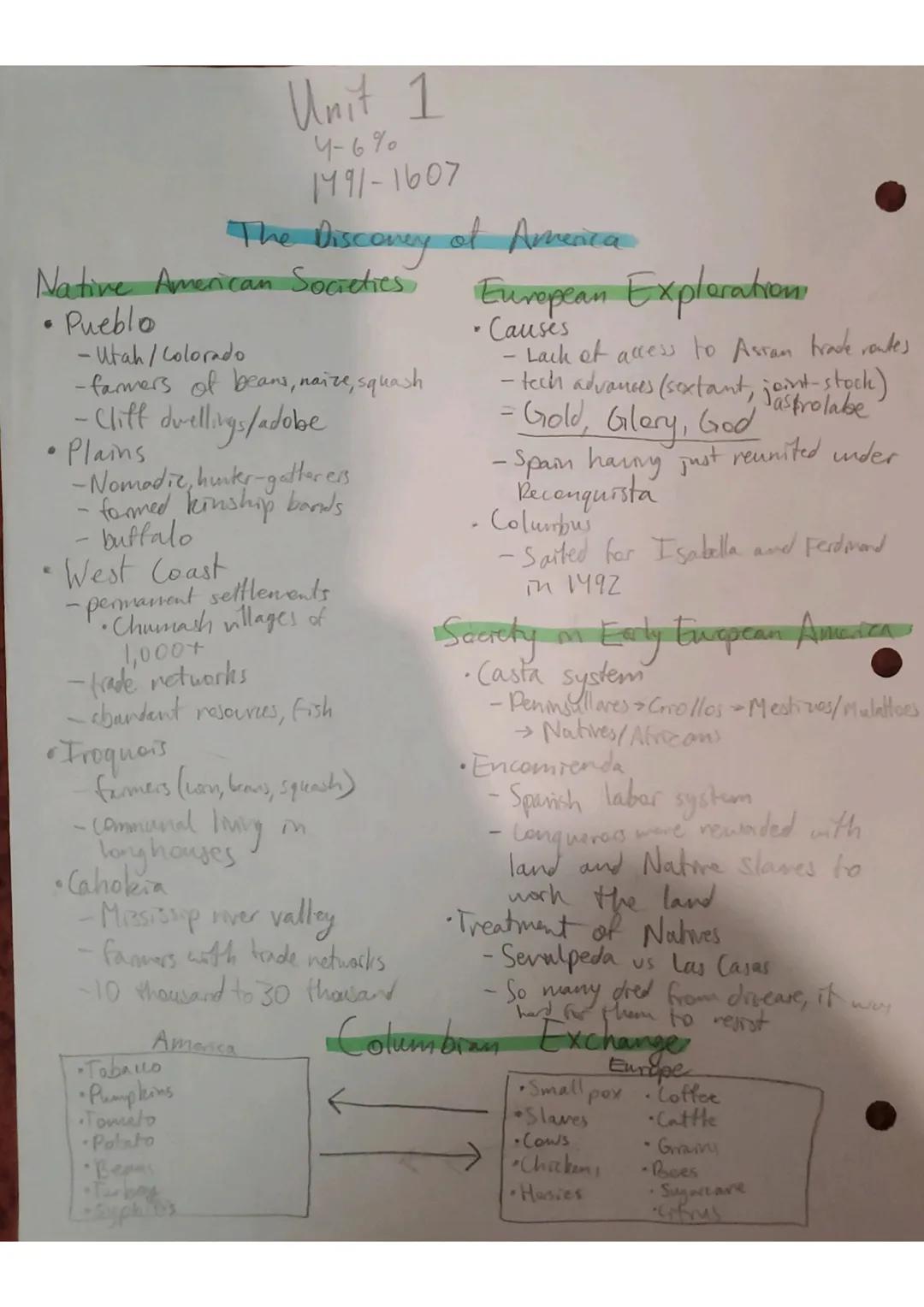
Native American Societies and European Exploration
This page provides an overview of Native American societies before European contact APUSH and the early stages of European exploration and colonization in the Americas.
The document begins by outlining various Native American societies across different regions of North America:
The Iroquois, known for their communal living in longhouses, were skilled farmers.
Highlight: The Iroquois cultivated the "Three Sisters" - corn, beans, and squash.
The Pueblo people, located in Utah and Colorado, were farmers who constructed impressive cliff dwellings and adobe structures.
Plains tribes were primarily nomadic hunter-gatherers who formed kinship bands and relied heavily on buffalo.
West Coast Native Americans established permanent settlements, with some Chumash villages housing over 1,000 people. They developed extensive trade networks and utilized abundant coastal resources, particularly fish.
Example: The Cahokia civilization in the Mississippi River Valley was a large, complex society with a population ranging from 10,000 to 30,000 people.
The document then transitions to discuss European exploration of the Americas:
Vocabulary: The "Columbian Exchange" refers to the widespread transfer of plants, animals, culture, human populations, technology, and diseases between the Old and New Worlds following Columbus's voyages.
European exploration was motivated by several factors:
- Lack of access to Asian trade routes
- Technological advancements such as the sextant and astrolabe
- The pursuit of "Gold, Glory, and God"
- Spain's recent unification under the Reconquista
Definition: The Reconquista was the period of history during which Christian kingdoms in the Iberian Peninsula reconquered territories from Muslim rule.
Christopher Columbus sailed for Isabella and Ferdinand of Spain in 1492, marking the beginning of sustained European contact with the Americas.
The document also touches on early European colonial society in the Americas:
Vocabulary: The Casta system was a hierarchical racial classification system used in Spanish America.
The Casta system ranked people as follows: Peninsulares → Criollos → Mestizos/Mulattoes → Natives/Africans
Definition: The Encomienda system was a Spanish labor system where conquerors were rewarded with land and Native slaves to work the land.
The treatment of Native Americans by European colonizers was a contentious issue, as evidenced by the debate between Sepúlveda and Las Casas.
Highlight: Native American populations were devastated by European diseases, making resistance to colonization difficult.
Finally, the document lists some of the key elements exchanged during the Columbian Exchange, including:
From Europe to the Americas: Smallpox, slaves, cows, chickens, horses, coffee, cattle, grains, bees, and sugar cane.
From the Americas to Europe: Tobacco, pumpkins, tomatoes, and potatoes.
Highlight: The Columbian Exchange APUSH had significant and lasting impacts on both hemispheres, reshaping ecosystems, agriculture, and human societies.
We thought you’d never ask...
What is the Knowunity AI companion?
Our AI companion is specifically built for the needs of students. Based on the millions of content pieces we have on the platform we can provide truly meaningful and relevant answers to students. But its not only about answers, the companion is even more about guiding students through their daily learning challenges, with personalised study plans, quizzes or content pieces in the chat and 100% personalisation based on the students skills and developments.
Where can I download the Knowunity app?
You can download the app in the Google Play Store and in the Apple App Store.
Is Knowunity really free of charge?
That's right! Enjoy free access to study content, connect with fellow students, and get instant help – all at your fingertips.
Similar Content
Most popular content: Spanish Exploration
3Most popular content in AP US History
9O
AP US HistoryOrigins and Dynamics of the Columbian Exchange
Analyze the ecological and economic motivations behind the initial transfer of goods, people, and diseases between the Old and New Worlds.
9th3,1280
I
AP US HistoryIntroduction to Early Cultural Interactions
Analyze the initial social and religious encounters between Europeans, Africans, and Indigenous peoples in the colonial Americas.
9th2,7730
M
AP US HistoryMotivations for European Exploration
Analyze the economic, religious, and political factors that drove European powers to the Americas during the 15th and 16th centuries.
9th1,7780
I
AP US HistoryIntroduction to Native American Societies
Examine the diverse social, political, and economic structures of North American indigenous groups prior to European contact.
9th1,1100
I
AP US HistoryIntroduction to the Spanish Encomienda System
Explore the fundamental economic and social structures of the Spanish colonial system, focusing on the encomienda and the casta social hierarchy.
9th8890
M
AP US HistoryMotivations for European Colonization
Analyze the differing economic, religious, and social goals that drove Spanish, French, Dutch, and British expansion in the New World.
9th7570
W
AP US HistoryWeaknesses of the Articles of Confederation
Analyze the structural deficiencies of the first national government, focusing on fiscal instability and the lack of executive authority.
9th7700
I
AP US HistoryInitial Native-European Contacts and Perceptions
Analyze primary sources from the 15th and 16th centuries to compare Spanish, French, and English initial interactions with indigenous populations.
9th6370
AP US HistoryUnit 1: Apush
1491-1607
11th1,0059
Most popular content
9O
AP US HistoryOrigins and Dynamics of the Columbian Exchange
Analyze the ecological and economic motivations behind the initial transfer of goods, people, and diseases between the Old and New Worlds.
9th3,1280
I
AP US HistoryIntroduction to Early Cultural Interactions
Analyze the initial social and religious encounters between Europeans, Africans, and Indigenous peoples in the colonial Americas.
9th2,7730
O
 AP World History
Origins of Ancient River Civilizations
Analyze the environmental factors and technological innovations that led to the rise of early states in Mesopotamia, Egypt, and the Indus Valley.
9th3,1870
M
AP US HistoryMotivations for European Exploration
Analyze the economic, religious, and political factors that drove European powers to the Americas during the 15th and 16th centuries.
9th1,7780
F
 AP Psychology
Foundations of Ethical Guidelines in Research
Practice the core principles of the APA ethical code including informed consent, debriefing, and the role of Institutional Review Boards.
9th1,3360
I
AP US HistoryIntroduction to Native American Societies
Examine the diverse social, political, and economic structures of North American indigenous groups prior to European contact.
9th1,1100
I
 AP Biology
Introduction to Biological Elements of Life
Practice identifying the essential elements including carbon, nitrogen, phosphorus, and sulfur that compose biological macromolecules.
9th1,7390
I
AP US HistoryIntroduction to the Spanish Encomienda System
Explore the fundamental economic and social structures of the Spanish colonial system, focusing on the encomienda and the casta social hierarchy.
9th8890
O
AP World HistoryOrigins and Continuity of the Byzantine Empire
Analyze the political and cultural transitions from the Roman Empire to the Byzantine Empire, focusing on the reign of Justinian I and his code.
9th1,6320
Can't find what you're looking for? Explore other subjects.
Students love us — and so will you.
4.6/5App Store
4.7/5Google Play
The app is very easy to use and well designed. I have found everything I was looking for so far and have been able to learn a lot from the presentations! I will definitely use the app for a class assignment! And of course it also helps a lot as an inspiration.
Stefan SiOS user
This app is really great. There are so many study notes and help [...]. My problem subject is French, for example, and the app has so many options for help. Thanks to this app, I have improved my French. I would recommend it to anyone.
Samantha KlichAndroid user
Wow, I am really amazed. I just tried the app because I've seen it advertised many times and was absolutely stunned. This app is THE HELP you want for school and above all, it offers so many things, such as workouts and fact sheets, which have been VERY helpful to me personally.
AnnaiOS user
AP US History287 views·Updated Jun 12, 2026·1 pageAPUSH Unit 1 Review: Native Americans to European Colonization
The APUSH Unit 1 summary covers Native American societies before European contact and early European exploration and colonization. It highlights diverse indigenous cultures, European motivations for exploration, and the significant impacts of the Columbian Exchange.
- Native American societiesvaried greatly...
1
of 1
Sign up to see the content. It's free!
- Access to all documents
- Improve your grades
- Join milions of students
Native American Societies and European Exploration
This page provides an overview of Native American societies before European contact APUSH and the early stages of European exploration and colonization in the Americas.
The document begins by outlining various Native American societies across different regions of North America:
The Iroquois, known for their communal living in longhouses, were skilled farmers.
Highlight: The Iroquois cultivated the "Three Sisters" - corn, beans, and squash.
The Pueblo people, located in Utah and Colorado, were farmers who constructed impressive cliff dwellings and adobe structures.
Plains tribes were primarily nomadic hunter-gatherers who formed kinship bands and relied heavily on buffalo.
West Coast Native Americans established permanent settlements, with some Chumash villages housing over 1,000 people. They developed extensive trade networks and utilized abundant coastal resources, particularly fish.
Example: The Cahokia civilization in the Mississippi River Valley was a large, complex society with a population ranging from 10,000 to 30,000 people.
The document then transitions to discuss European exploration of the Americas:
Vocabulary: The "Columbian Exchange" refers to the widespread transfer of plants, animals, culture, human populations, technology, and diseases between the Old and New Worlds following Columbus's voyages.
European exploration was motivated by several factors:
- Lack of access to Asian trade routes
- Technological advancements such as the sextant and astrolabe
- The pursuit of "Gold, Glory, and God"
- Spain's recent unification under the Reconquista
Definition: The Reconquista was the period of history during which Christian kingdoms in the Iberian Peninsula reconquered territories from Muslim rule.
Christopher Columbus sailed for Isabella and Ferdinand of Spain in 1492, marking the beginning of sustained European contact with the Americas.
The document also touches on early European colonial society in the Americas:
Vocabulary: The Casta system was a hierarchical racial classification system used in Spanish America.
The Casta system ranked people as follows: Peninsulares → Criollos → Mestizos/Mulattoes → Natives/Africans
Definition: The Encomienda system was a Spanish labor system where conquerors were rewarded with land and Native slaves to work the land.
The treatment of Native Americans by European colonizers was a contentious issue, as evidenced by the debate between Sepúlveda and Las Casas.
Highlight: Native American populations were devastated by European diseases, making resistance to colonization difficult.
Finally, the document lists some of the key elements exchanged during the Columbian Exchange, including:
From Europe to the Americas: Smallpox, slaves, cows, chickens, horses, coffee, cattle, grains, bees, and sugar cane.
From the Americas to Europe: Tobacco, pumpkins, tomatoes, and potatoes.
Highlight: The Columbian Exchange APUSH had significant and lasting impacts on both hemispheres, reshaping ecosystems, agriculture, and human societies.
We thought you’d never ask...
What is the Knowunity AI companion?
Our AI companion is specifically built for the needs of students. Based on the millions of content pieces we have on the platform we can provide truly meaningful and relevant answers to students. But its not only about answers, the companion is even more about guiding students through their daily learning challenges, with personalised study plans, quizzes or content pieces in the chat and 100% personalisation based on the students skills and developments.
Where can I download the Knowunity app?
You can download the app in the Google Play Store and in the Apple App Store.
Is Knowunity really free of charge?
That's right! Enjoy free access to study content, connect with fellow students, and get instant help – all at your fingertips.
Similar Content
Most popular content: Spanish Exploration
3Most popular content in AP US History
9O
AP US HistoryOrigins and Dynamics of the Columbian Exchange
Analyze the ecological and economic motivations behind the initial transfer of goods, people, and diseases between the Old and New Worlds.
9th3,1280
I
AP US HistoryIntroduction to Early Cultural Interactions
Analyze the initial social and religious encounters between Europeans, Africans, and Indigenous peoples in the colonial Americas.
9th2,7730
M
AP US HistoryMotivations for European Exploration
Analyze the economic, religious, and political factors that drove European powers to the Americas during the 15th and 16th centuries.
9th1,7780
I
AP US HistoryIntroduction to Native American Societies
Examine the diverse social, political, and economic structures of North American indigenous groups prior to European contact.
9th1,1100
I
AP US HistoryIntroduction to the Spanish Encomienda System
Explore the fundamental economic and social structures of the Spanish colonial system, focusing on the encomienda and the casta social hierarchy.
9th8890
M
AP US HistoryMotivations for European Colonization
Analyze the differing economic, religious, and social goals that drove Spanish, French, Dutch, and British expansion in the New World.
9th7570
W
AP US HistoryWeaknesses of the Articles of Confederation
Analyze the structural deficiencies of the first national government, focusing on fiscal instability and the lack of executive authority.
9th7700
I
AP US HistoryInitial Native-European Contacts and Perceptions
Analyze primary sources from the 15th and 16th centuries to compare Spanish, French, and English initial interactions with indigenous populations.
9th6370
AP US HistoryUnit 1: Apush
1491-1607
11th1,0059
Most popular content
9O
AP US HistoryOrigins and Dynamics of the Columbian Exchange
Analyze the ecological and economic motivations behind the initial transfer of goods, people, and diseases between the Old and New Worlds.
9th3,1280
I
AP US HistoryIntroduction to Early Cultural Interactions
Analyze the initial social and religious encounters between Europeans, Africans, and Indigenous peoples in the colonial Americas.
9th2,7730
O
AP World HistoryOrigins of Ancient River Civilizations
Analyze the environmental factors and technological innovations that led to the rise of early states in Mesopotamia, Egypt, and the Indus Valley.
9th3,1870
M
AP US HistoryMotivations for European Exploration
Analyze the economic, religious, and political factors that drove European powers to the Americas during the 15th and 16th centuries.
9th1,7780
F
AP PsychologyFoundations of Ethical Guidelines in Research
Practice the core principles of the APA ethical code including informed consent, debriefing, and the role of Institutional Review Boards.
9th1,3360
I
AP US HistoryIntroduction to Native American Societies
Examine the diverse social, political, and economic structures of North American indigenous groups prior to European contact.
9th1,1100
I
AP BiologyIntroduction to Biological Elements of Life
Practice identifying the essential elements including carbon, nitrogen, phosphorus, and sulfur that compose biological macromolecules.
9th1,7390
I
AP US HistoryIntroduction to the Spanish Encomienda System
Explore the fundamental economic and social structures of the Spanish colonial system, focusing on the encomienda and the casta social hierarchy.
9th8890
O
AP World HistoryOrigins and Continuity of the Byzantine Empire
Analyze the political and cultural transitions from the Roman Empire to the Byzantine Empire, focusing on the reign of Justinian I and his code.
9th1,6320
Can't find what you're looking for? Explore other subjects.
Students love us — and so will you.
4.6/5App Store
4.7/5Google Play
The app is very easy to use and well designed. I have found everything I was looking for so far and have been able to learn a lot from the presentations! I will definitely use the app for a class assignment! And of course it also helps a lot as an inspiration.
Stefan SiOS user
This app is really great. There are so many study notes and help [...]. My problem subject is French, for example, and the app has so many options for help. Thanks to this app, I have improved my French. I would recommend it to anyone.
Samantha KlichAndroid user
Wow, I am really amazed. I just tried the app because I've seen it advertised many times and was absolutely stunned. This app is THE HELP you want for school and above all, it offers so many things, such as workouts and fact sheets, which have been VERY helpful to me personally.
AnnaiOS user