
Categorical data allows us to organize and analyze information that...
 AP Statistics61 views·Updated Jun 9, 2026·2 pages
Understanding Categorical Data: AP Statistics Insights

Julie L@jewelsljulie
1
of 2
Analyzing Categorical Data: Tables and Basic Graphs
When analyzing categories of information, frequency tables show the number of individuals in each category, while relative frequency tables show the proportion or percent. These are foundational tools for organizing categorical data before visualization.
Visual displays bring data to life. Bar graphs represent categories as bars with heights showing frequencies, making comparisons easy at a glance. Pie charts display each category as a slice of the whole, making it simple to see proportional relationships between parts.
Creating an effective bar graph involves three key steps: draw and label both axes, scale the axes appropriately, and draw bars above each category name. Remember that our eyes interpret bar graphs by their height, so accurate scaling is crucial.
Pro Tip: Always ensure pie charts include all categories that make up the whole! If any category is missing, the visualization will be misleading to your audience.
Two-way tables organize data showing the relationship between two categorical variables. This more advanced display method lets you analyze how different categories interact with each other, setting the foundation for deeper analysis techniques.
2
of 2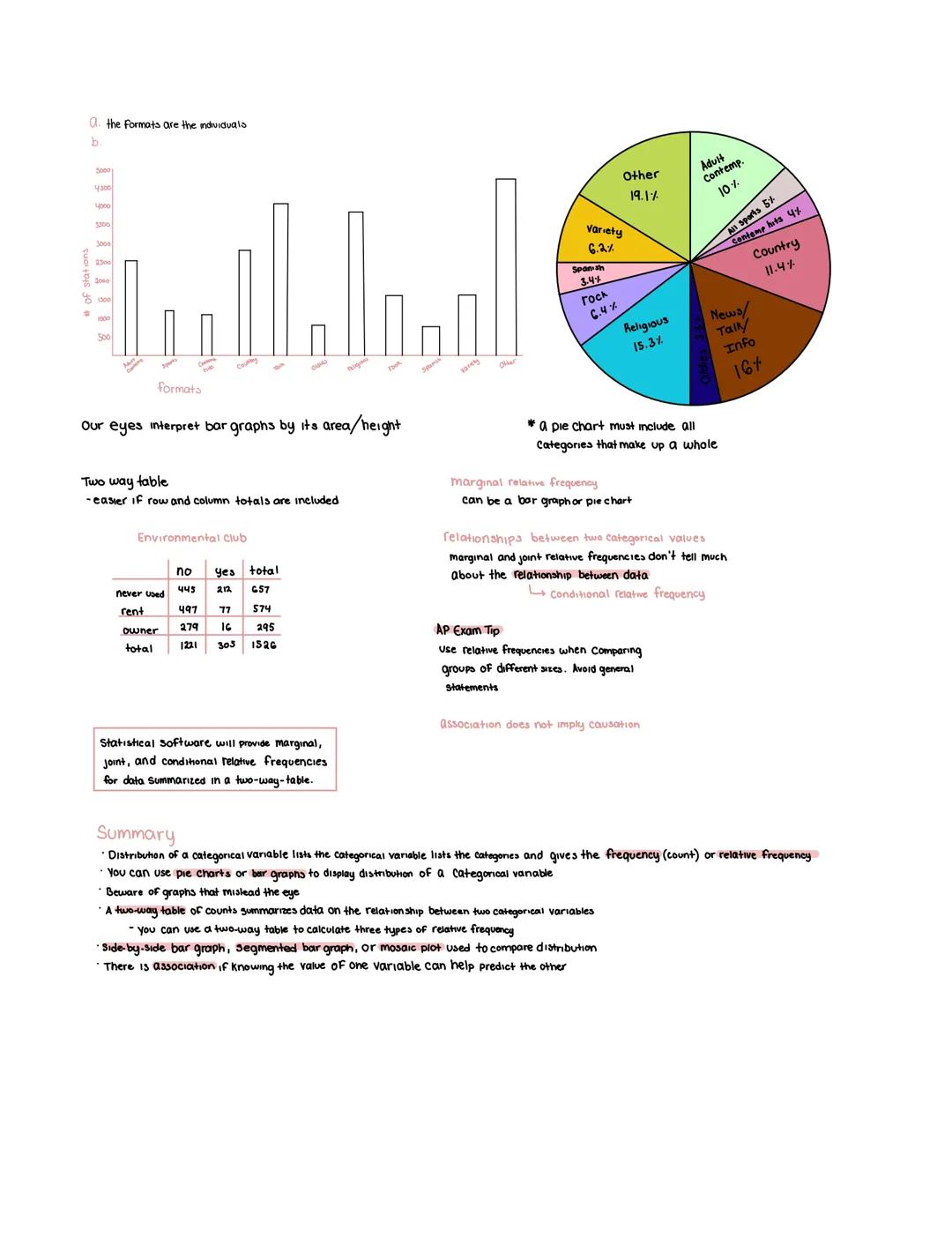
Advanced Analysis of Categorical Data
Two-way tables become powerful analytical tools when you understand the different types of relative frequencies they reveal. Marginal relative frequency shows the proportion for one variable, joint relative frequency shows the proportion for two specific variable values together, and conditional relative frequency examines proportions within a subset.
When comparing groups of different sizes, always use relative frequencies rather than raw counts. This approach gives you a fair comparison and helps avoid misleading conclusions about your data.
Visual comparisons between categories can be displayed using side-by-side bar graphs (grouped bars), segmented bar graphs (stacked bars showing percentages), or mosaic plots (modified segmented graphs where width varies by group size). Each visualization method highlights different aspects of the relationships between categories.
Test Prep Alert: On the AP Exam, be careful to avoid making general statements without evidence. Statistical software can calculate marginal, joint, and conditional relative frequencies, but you need to interpret what these values actually mean about relationships in the data.
An association exists when knowing the value of one variable helps predict another. However, remember that association doesn't imply causation—this is a fundamental concept in statistics that prevents misinterpreting relationships in your data.
We thought you’d never ask...
What is the Knowunity AI companion?
Our AI companion is specifically built for the needs of students. Based on the millions of content pieces we have on the platform we can provide truly meaningful and relevant answers to students. But its not only about answers, the companion is even more about guiding students through their daily learning challenges, with personalised study plans, quizzes or content pieces in the chat and 100% personalisation based on the students skills and developments.
Where can I download the Knowunity app?
You can download the app in the Google Play Store and in the Apple App Store.
Is Knowunity really free of charge?
That's right! Enjoy free access to study content, connect with fellow students, and get instant help – all at your fingertips.
Most popular content in AP Statistics
3I
AP StatisticsIntroduction to Bivariate Quantitative Data
Students will practice identifying explanatory and response variables and interpreting scatterplots for direction, form, strength, and outliers.
9th3180
AP StatisticsHypothesis Testing Project
statistics project using null and alternative hypotheses and how they can be interpreted
20111
AP StatisticsStandard Deviation
How to calculate standard deviation
23214
Most popular content
9O
 AP US History
Origins and Dynamics of the Columbian Exchange
Analyze the ecological and economic motivations behind the initial transfer of goods, people, and diseases between the Old and New Worlds.
9th3,1280
I
AP US HistoryIntroduction to Early Cultural Interactions
Analyze the initial social and religious encounters between Europeans, Africans, and Indigenous peoples in the colonial Americas.
9th2,7730
O
 AP World History
Origins of Ancient River Civilizations
Analyze the environmental factors and technological innovations that led to the rise of early states in Mesopotamia, Egypt, and the Indus Valley.
9th3,1870
M
AP US HistoryMotivations for European Exploration
Analyze the economic, religious, and political factors that drove European powers to the Americas during the 15th and 16th centuries.
9th1,7780
F
 AP Psychology
Foundations of Ethical Guidelines in Research
Practice the core principles of the APA ethical code including informed consent, debriefing, and the role of Institutional Review Boards.
9th1,3360
I
AP US HistoryIntroduction to Native American Societies
Examine the diverse social, political, and economic structures of North American indigenous groups prior to European contact.
9th1,1100
I
 AP Biology
Introduction to Biological Elements of Life
Practice identifying the essential elements including carbon, nitrogen, phosphorus, and sulfur that compose biological macromolecules.
9th1,7390
I
AP US HistoryIntroduction to the Spanish Encomienda System
Explore the fundamental economic and social structures of the Spanish colonial system, focusing on the encomienda and the casta social hierarchy.
9th8890
O
AP World HistoryOrigins and Continuity of the Byzantine Empire
Analyze the political and cultural transitions from the Roman Empire to the Byzantine Empire, focusing on the reign of Justinian I and his code.
9th1,6320
Can't find what you're looking for? Explore other subjects.
Students love us — and so will you.
4.6/5App Store
4.7/5Google Play
The app is very easy to use and well designed. I have found everything I was looking for so far and have been able to learn a lot from the presentations! I will definitely use the app for a class assignment! And of course it also helps a lot as an inspiration.
Stefan SiOS user
This app is really great. There are so many study notes and help [...]. My problem subject is French, for example, and the app has so many options for help. Thanks to this app, I have improved my French. I would recommend it to anyone.
Samantha KlichAndroid user
Wow, I am really amazed. I just tried the app because I've seen it advertised many times and was absolutely stunned. This app is THE HELP you want for school and above all, it offers so many things, such as workouts and fact sheets, which have been VERY helpful to me personally.
AnnaiOS user
AP Statistics61 views·Updated Jun 9, 2026·2 pagesUnderstanding Categorical Data: AP Statistics Insights
Julie L@jewelsljulie
Categorical data allows us to organize and analyze information that falls into distinct categories rather than numerical values. This section covers how to effectively display and interpret categorical data using various graphs and tables, essential skills for understanding statistics and...
1
of 2
Sign up to see the content. It's free!
- Access to all documents
- Improve your grades
- Join milions of students
Analyzing Categorical Data: Tables and Basic Graphs
When analyzing categories of information, frequency tables show the number of individuals in each category, while relative frequency tables show the proportion or percent. These are foundational tools for organizing categorical data before visualization.
Visual displays bring data to life. Bar graphs represent categories as bars with heights showing frequencies, making comparisons easy at a glance. Pie charts display each category as a slice of the whole, making it simple to see proportional relationships between parts.
Creating an effective bar graph involves three key steps: draw and label both axes, scale the axes appropriately, and draw bars above each category name. Remember that our eyes interpret bar graphs by their height, so accurate scaling is crucial.
Pro Tip: Always ensure pie charts include all categories that make up the whole! If any category is missing, the visualization will be misleading to your audience.
Two-way tables organize data showing the relationship between two categorical variables. This more advanced display method lets you analyze how different categories interact with each other, setting the foundation for deeper analysis techniques.
2
of 2Sign up to see the content. It's free!
- Access to all documents
- Improve your grades
- Join milions of students
Advanced Analysis of Categorical Data
Two-way tables become powerful analytical tools when you understand the different types of relative frequencies they reveal. Marginal relative frequency shows the proportion for one variable, joint relative frequency shows the proportion for two specific variable values together, and conditional relative frequency examines proportions within a subset.
When comparing groups of different sizes, always use relative frequencies rather than raw counts. This approach gives you a fair comparison and helps avoid misleading conclusions about your data.
Visual comparisons between categories can be displayed using side-by-side bar graphs (grouped bars), segmented bar graphs (stacked bars showing percentages), or mosaic plots (modified segmented graphs where width varies by group size). Each visualization method highlights different aspects of the relationships between categories.
Test Prep Alert: On the AP Exam, be careful to avoid making general statements without evidence. Statistical software can calculate marginal, joint, and conditional relative frequencies, but you need to interpret what these values actually mean about relationships in the data.
An association exists when knowing the value of one variable helps predict another. However, remember that association doesn't imply causation—this is a fundamental concept in statistics that prevents misinterpreting relationships in your data.
We thought you’d never ask...
What is the Knowunity AI companion?
Our AI companion is specifically built for the needs of students. Based on the millions of content pieces we have on the platform we can provide truly meaningful and relevant answers to students. But its not only about answers, the companion is even more about guiding students through their daily learning challenges, with personalised study plans, quizzes or content pieces in the chat and 100% personalisation based on the students skills and developments.
Where can I download the Knowunity app?
You can download the app in the Google Play Store and in the Apple App Store.
Is Knowunity really free of charge?
That's right! Enjoy free access to study content, connect with fellow students, and get instant help – all at your fingertips.
Most popular content in AP Statistics
3I
AP StatisticsIntroduction to Bivariate Quantitative Data
Students will practice identifying explanatory and response variables and interpreting scatterplots for direction, form, strength, and outliers.
9th3180
AP StatisticsHypothesis Testing Project
statistics project using null and alternative hypotheses and how they can be interpreted
20111
AP StatisticsStandard Deviation
How to calculate standard deviation
23214
Most popular content
9O
AP US HistoryOrigins and Dynamics of the Columbian Exchange
Analyze the ecological and economic motivations behind the initial transfer of goods, people, and diseases between the Old and New Worlds.
9th3,1280
I
AP US HistoryIntroduction to Early Cultural Interactions
Analyze the initial social and religious encounters between Europeans, Africans, and Indigenous peoples in the colonial Americas.
9th2,7730
O
AP World HistoryOrigins of Ancient River Civilizations
Analyze the environmental factors and technological innovations that led to the rise of early states in Mesopotamia, Egypt, and the Indus Valley.
9th3,1870
M
AP US HistoryMotivations for European Exploration
Analyze the economic, religious, and political factors that drove European powers to the Americas during the 15th and 16th centuries.
9th1,7780
F
AP PsychologyFoundations of Ethical Guidelines in Research
Practice the core principles of the APA ethical code including informed consent, debriefing, and the role of Institutional Review Boards.
9th1,3360
I
AP US HistoryIntroduction to Native American Societies
Examine the diverse social, political, and economic structures of North American indigenous groups prior to European contact.
9th1,1100
I
AP BiologyIntroduction to Biological Elements of Life
Practice identifying the essential elements including carbon, nitrogen, phosphorus, and sulfur that compose biological macromolecules.
9th1,7390
I
AP US HistoryIntroduction to the Spanish Encomienda System
Explore the fundamental economic and social structures of the Spanish colonial system, focusing on the encomienda and the casta social hierarchy.
9th8890
O
AP World HistoryOrigins and Continuity of the Byzantine Empire
Analyze the political and cultural transitions from the Roman Empire to the Byzantine Empire, focusing on the reign of Justinian I and his code.
9th1,6320
Can't find what you're looking for? Explore other subjects.
Students love us — and so will you.
4.6/5App Store
4.7/5Google Play
The app is very easy to use and well designed. I have found everything I was looking for so far and have been able to learn a lot from the presentations! I will definitely use the app for a class assignment! And of course it also helps a lot as an inspiration.
Stefan SiOS user
This app is really great. There are so many study notes and help [...]. My problem subject is French, for example, and the app has so many options for help. Thanks to this app, I have improved my French. I would recommend it to anyone.
Samantha KlichAndroid user
Wow, I am really amazed. I just tried the app because I've seen it advertised many times and was absolutely stunned. This app is THE HELP you want for school and above all, it offers so many things, such as workouts and fact sheets, which have been VERY helpful to me personally.
AnnaiOS user