
Dive into how your body communicates with itself through two...
 AP Psychology48 views·Updated Jun 12, 2026·2 pages
Understanding the Nervous System and Endocrine System

Kabita Phuyel@lubvrhea
1
of 2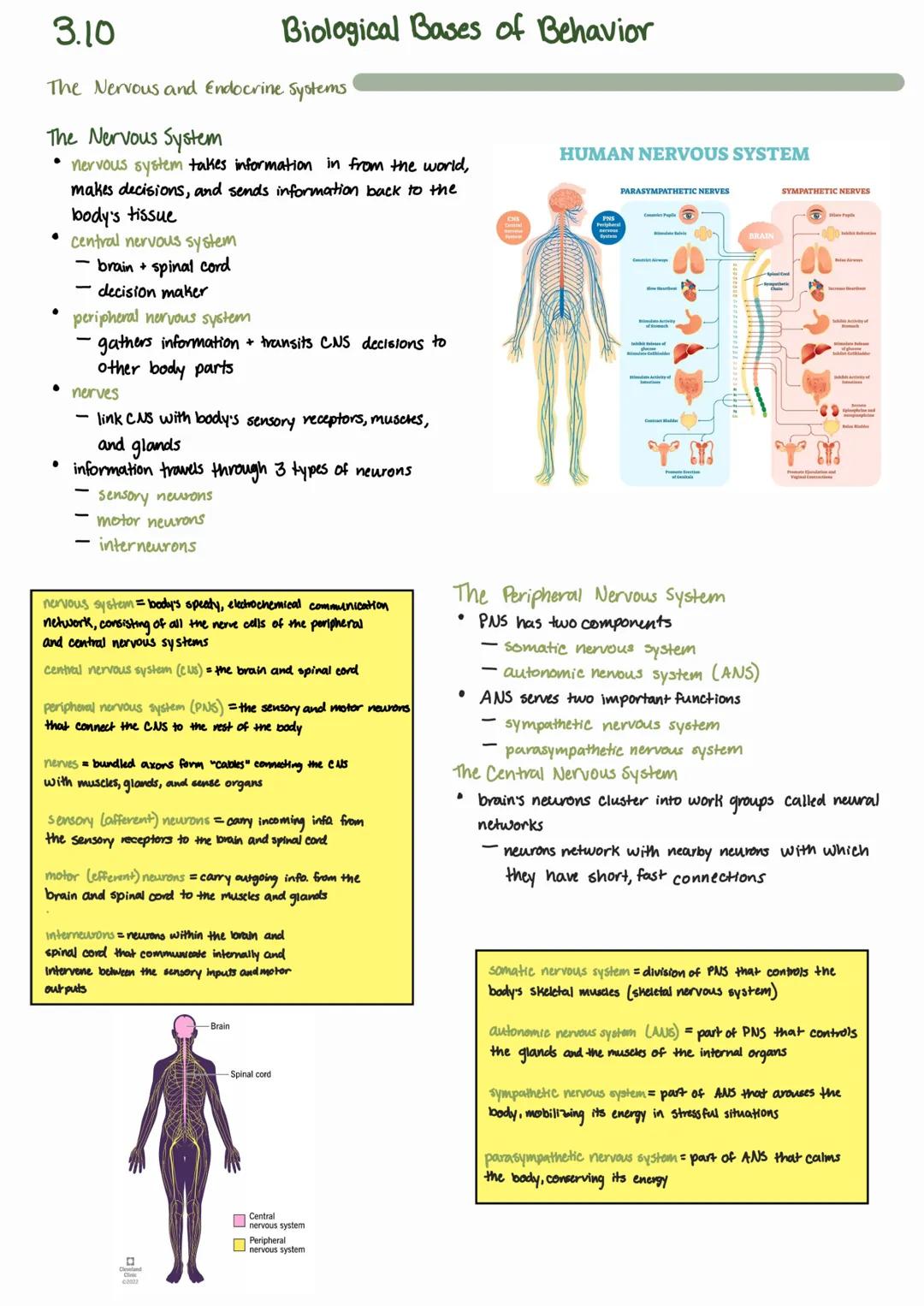
The Nervous System: Your Body's Command Center
Your nervous system acts like your body's electrical wiring, constantly taking in information, making decisions, and sending commands to different body parts. It's divided into two main parts: the central nervous system (brain and spinal cord) which makes the decisions, and the peripheral nervous system which gathers information and delivers commands to the rest of your body.
Information travels through your nervous system via three types of neurons (nerve cells). Sensory neurons carry information from your senses to your brain, motor neurons send commands from your brain to your muscles and glands, and interneurons connect everything within your brain and spinal cord.
The peripheral nervous system has two divisions with different jobs. The somatic nervous system controls your voluntary movements through skeletal muscles (like moving your arm), while the autonomic nervous system manages your involuntary functions (like digestion and heart rate).
💡 Your autonomic nervous system has two opposing but complementary parts: the sympathetic nervous system ("fight or flight") which energizes your body during stress, and the parasympathetic nervous system ("rest and digest") which calms you down afterward.
In your brain, neurons form neural networks - specialized work groups that communicate with nearby neurons through fast connections, allowing for complex thoughts and behaviors.
2
of 2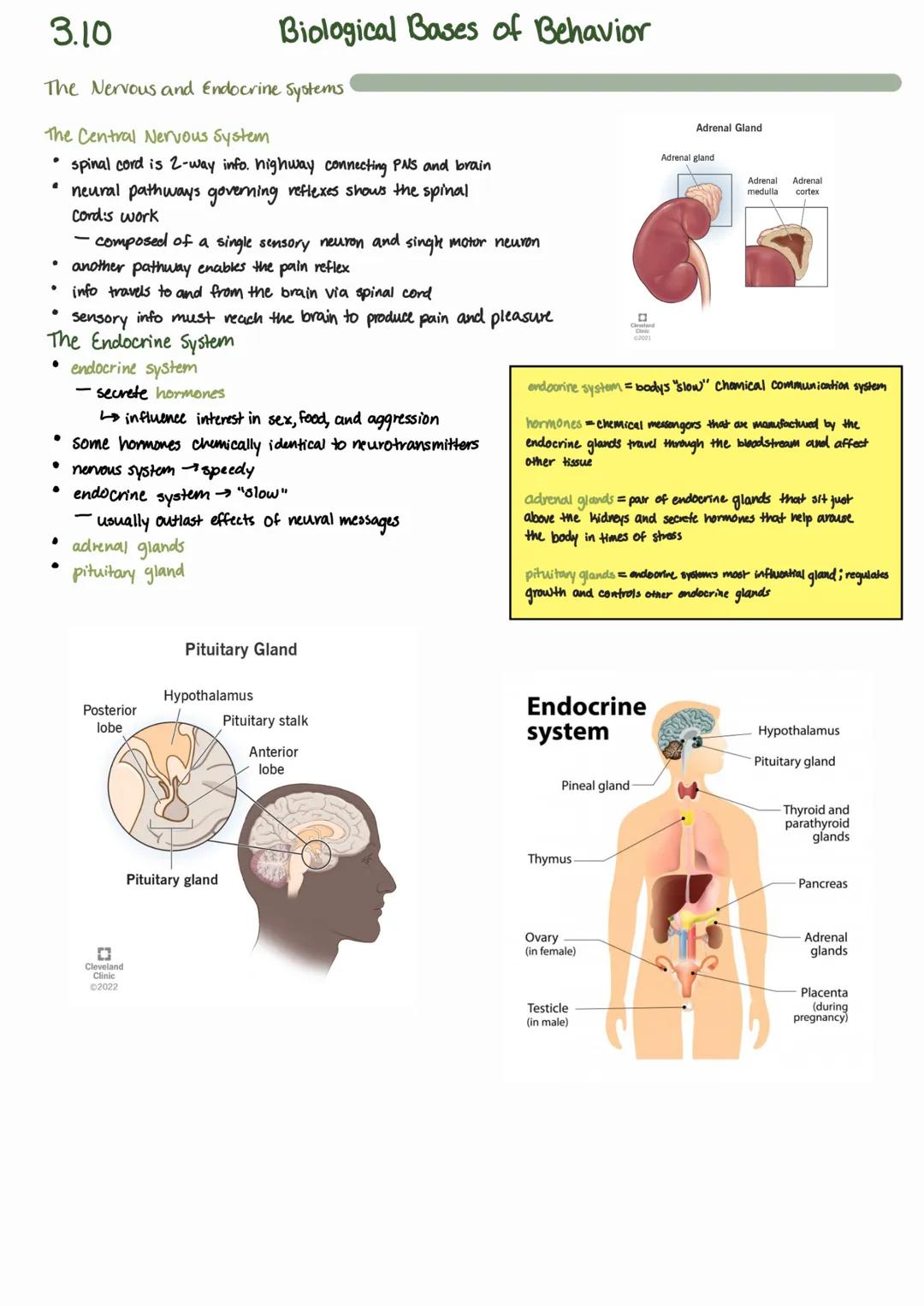
Communication Highways: From Spinal Cord to Hormones
Your spinal cord serves as a two-way information highway connecting your brain with the rest of your body. Many simple reactions, called reflexes, are processed directly in the spinal cord without needing your brain's input - like automatically pulling your hand away from something hot.
While your nervous system handles rapid communication, your endocrine system provides slower, longer-lasting chemical messaging through hormones. These chemical messengers travel through your bloodstream to influence everything from your appetite and growth to your stress responses and sexual development.
Key players in your endocrine system include the adrenal glands, which sit above your kidneys and produce stress hormones, and the pituitary gland, often called the "master gland" because it controls many other glands and regulates growth.
🔑 The nervous and endocrine systems work as partners: your nervous system provides immediate responses (like jumping away from danger), while your endocrine system creates longer-lasting states (like remaining alert after a frightening experience).
Interestingly, some hormones are chemically identical to neurotransmitters (the chemicals neurons use to communicate), showing how interconnected these two communication systems really are.
We thought you’d never ask...
What is the Knowunity AI companion?
Our AI companion is specifically built for the needs of students. Based on the millions of content pieces we have on the platform we can provide truly meaningful and relevant answers to students. But its not only about answers, the companion is even more about guiding students through their daily learning challenges, with personalised study plans, quizzes or content pieces in the chat and 100% personalisation based on the students skills and developments.
Where can I download the Knowunity app?
You can download the app in the Google Play Store and in the Apple App Store.
Is Knowunity really free of charge?
That's right! Enjoy free access to study content, connect with fellow students, and get instant help – all at your fingertips.
Most popular content in AP Psychology
9F
AP PsychologyFoundations of Ethical Guidelines in Research
Practice the core principles of the APA ethical code including informed consent, debriefing, and the role of Institutional Review Boards.
9th1,3360
F
AP PsychologyFoundations of Research Design and Methodology
Practice distinguishing between different research methods including experiments, correlations, and case studies while identifying key variables.
9th6670
H
AP PsychologyHistorical Foundations of Psychology
Practice distinguishing between structuralism, functionalism, and the early philosophical roots of psychological science.
9th1,0920
I
AP PsychologyIntroduction to Descriptive Statistics
Practice identifying and calculating measures of central tendency and variation to summarize psychological data sets.
9th7010
I
AP PsychologyIntroduction to Auditory System Structures
Practice identifying the anatomical structures of the ear and their specific roles in converting sound waves into neural impulses.
9th6000
H
AP PsychologyHemispheric Specialization and Brain Structures
Practice identifying how specific structures like the corpus callosum and cerebral cortex coordinate complex human behaviors and sensory input.
9th3330
P
AP PsychologyParts of the brain and their functions quiz
Quick quiz on parts of the brain and their functions
10th1450
AP PsychologyAP psych
literally 103 pages of psych notes i took
10th1223
AP PsychologyThe Best AP Psychology Cram Sheet
cram sheet for AP Psych
10th95568
Most popular content
9O
 AP US History
Origins and Dynamics of the Columbian Exchange
Analyze the ecological and economic motivations behind the initial transfer of goods, people, and diseases between the Old and New Worlds.
9th3,1280
I
AP US HistoryIntroduction to Early Cultural Interactions
Analyze the initial social and religious encounters between Europeans, Africans, and Indigenous peoples in the colonial Americas.
9th2,7730
O
 AP World History
Origins of Ancient River Civilizations
Analyze the environmental factors and technological innovations that led to the rise of early states in Mesopotamia, Egypt, and the Indus Valley.
9th3,1870
M
AP US HistoryMotivations for European Exploration
Analyze the economic, religious, and political factors that drove European powers to the Americas during the 15th and 16th centuries.
9th1,7780
F
AP PsychologyFoundations of Ethical Guidelines in Research
Practice the core principles of the APA ethical code including informed consent, debriefing, and the role of Institutional Review Boards.
9th1,3360
I
AP US HistoryIntroduction to Native American Societies
Examine the diverse social, political, and economic structures of North American indigenous groups prior to European contact.
9th1,1100
I
 AP Biology
Introduction to Biological Elements of Life
Practice identifying the essential elements including carbon, nitrogen, phosphorus, and sulfur that compose biological macromolecules.
9th1,7390
I
AP US HistoryIntroduction to the Spanish Encomienda System
Explore the fundamental economic and social structures of the Spanish colonial system, focusing on the encomienda and the casta social hierarchy.
9th8890
O
AP World HistoryOrigins and Continuity of the Byzantine Empire
Analyze the political and cultural transitions from the Roman Empire to the Byzantine Empire, focusing on the reign of Justinian I and his code.
9th1,6320
Can't find what you're looking for? Explore other subjects.
Students love us — and so will you.
4.6/5App Store
4.7/5Google Play
The app is very easy to use and well designed. I have found everything I was looking for so far and have been able to learn a lot from the presentations! I will definitely use the app for a class assignment! And of course it also helps a lot as an inspiration.
Stefan SiOS user
This app is really great. There are so many study notes and help [...]. My problem subject is French, for example, and the app has so many options for help. Thanks to this app, I have improved my French. I would recommend it to anyone.
Samantha KlichAndroid user
Wow, I am really amazed. I just tried the app because I've seen it advertised many times and was absolutely stunned. This app is THE HELP you want for school and above all, it offers so many things, such as workouts and fact sheets, which have been VERY helpful to me personally.
AnnaiOS user
AP Psychology48 views·Updated Jun 12, 2026·2 pagesUnderstanding the Nervous System and Endocrine System
Kabita Phuyel@lubvrhea
Dive into how your body communicates with itself through two remarkable systems: the nervous system and endocrine system. These biological communication networks control everything from your reflexes to your emotions, working together to keep you functioning properly.
1
of 2
Sign up to see the content. It's free!
- Access to all documents
- Improve your grades
- Join milions of students
The Nervous System: Your Body's Command Center
Your nervous system acts like your body's electrical wiring, constantly taking in information, making decisions, and sending commands to different body parts. It's divided into two main parts: the central nervous system (brain and spinal cord) which makes the decisions, and the peripheral nervous system which gathers information and delivers commands to the rest of your body.
Information travels through your nervous system via three types of neurons (nerve cells). Sensory neurons carry information from your senses to your brain, motor neurons send commands from your brain to your muscles and glands, and interneurons connect everything within your brain and spinal cord.
The peripheral nervous system has two divisions with different jobs. The somatic nervous system controls your voluntary movements through skeletal muscles (like moving your arm), while the autonomic nervous system manages your involuntary functions (like digestion and heart rate).
💡 Your autonomic nervous system has two opposing but complementary parts: the sympathetic nervous system ("fight or flight") which energizes your body during stress, and the parasympathetic nervous system ("rest and digest") which calms you down afterward.
In your brain, neurons form neural networks - specialized work groups that communicate with nearby neurons through fast connections, allowing for complex thoughts and behaviors.
2
of 2Sign up to see the content. It's free!
- Access to all documents
- Improve your grades
- Join milions of students
Communication Highways: From Spinal Cord to Hormones
Your spinal cord serves as a two-way information highway connecting your brain with the rest of your body. Many simple reactions, called reflexes, are processed directly in the spinal cord without needing your brain's input - like automatically pulling your hand away from something hot.
While your nervous system handles rapid communication, your endocrine system provides slower, longer-lasting chemical messaging through hormones. These chemical messengers travel through your bloodstream to influence everything from your appetite and growth to your stress responses and sexual development.
Key players in your endocrine system include the adrenal glands, which sit above your kidneys and produce stress hormones, and the pituitary gland, often called the "master gland" because it controls many other glands and regulates growth.
🔑 The nervous and endocrine systems work as partners: your nervous system provides immediate responses (like jumping away from danger), while your endocrine system creates longer-lasting states (like remaining alert after a frightening experience).
Interestingly, some hormones are chemically identical to neurotransmitters (the chemicals neurons use to communicate), showing how interconnected these two communication systems really are.
We thought you’d never ask...
What is the Knowunity AI companion?
Our AI companion is specifically built for the needs of students. Based on the millions of content pieces we have on the platform we can provide truly meaningful and relevant answers to students. But its not only about answers, the companion is even more about guiding students through their daily learning challenges, with personalised study plans, quizzes or content pieces in the chat and 100% personalisation based on the students skills and developments.
Where can I download the Knowunity app?
You can download the app in the Google Play Store and in the Apple App Store.
Is Knowunity really free of charge?
That's right! Enjoy free access to study content, connect with fellow students, and get instant help – all at your fingertips.
Most popular content in AP Psychology
9F
AP PsychologyFoundations of Ethical Guidelines in Research
Practice the core principles of the APA ethical code including informed consent, debriefing, and the role of Institutional Review Boards.
9th1,3360
F
AP PsychologyFoundations of Research Design and Methodology
Practice distinguishing between different research methods including experiments, correlations, and case studies while identifying key variables.
9th6670
H
AP PsychologyHistorical Foundations of Psychology
Practice distinguishing between structuralism, functionalism, and the early philosophical roots of psychological science.
9th1,0920
I
AP PsychologyIntroduction to Descriptive Statistics
Practice identifying and calculating measures of central tendency and variation to summarize psychological data sets.
9th7010
I
AP PsychologyIntroduction to Auditory System Structures
Practice identifying the anatomical structures of the ear and their specific roles in converting sound waves into neural impulses.
9th6000
H
AP PsychologyHemispheric Specialization and Brain Structures
Practice identifying how specific structures like the corpus callosum and cerebral cortex coordinate complex human behaviors and sensory input.
9th3330
P
AP PsychologyParts of the brain and their functions quiz
Quick quiz on parts of the brain and their functions
10th1450
AP PsychologyAP psych
literally 103 pages of psych notes i took
10th1223
AP PsychologyThe Best AP Psychology Cram Sheet
cram sheet for AP Psych
10th95568
Most popular content
9O
AP US HistoryOrigins and Dynamics of the Columbian Exchange
Analyze the ecological and economic motivations behind the initial transfer of goods, people, and diseases between the Old and New Worlds.
9th3,1280
I
AP US HistoryIntroduction to Early Cultural Interactions
Analyze the initial social and religious encounters between Europeans, Africans, and Indigenous peoples in the colonial Americas.
9th2,7730
O
AP World HistoryOrigins of Ancient River Civilizations
Analyze the environmental factors and technological innovations that led to the rise of early states in Mesopotamia, Egypt, and the Indus Valley.
9th3,1870
M
AP US HistoryMotivations for European Exploration
Analyze the economic, religious, and political factors that drove European powers to the Americas during the 15th and 16th centuries.
9th1,7780
F
AP PsychologyFoundations of Ethical Guidelines in Research
Practice the core principles of the APA ethical code including informed consent, debriefing, and the role of Institutional Review Boards.
9th1,3360
I
AP US HistoryIntroduction to Native American Societies
Examine the diverse social, political, and economic structures of North American indigenous groups prior to European contact.
9th1,1100
I
AP BiologyIntroduction to Biological Elements of Life
Practice identifying the essential elements including carbon, nitrogen, phosphorus, and sulfur that compose biological macromolecules.
9th1,7390
I
AP US HistoryIntroduction to the Spanish Encomienda System
Explore the fundamental economic and social structures of the Spanish colonial system, focusing on the encomienda and the casta social hierarchy.
9th8890
O
AP World HistoryOrigins and Continuity of the Byzantine Empire
Analyze the political and cultural transitions from the Roman Empire to the Byzantine Empire, focusing on the reign of Justinian I and his code.
9th1,6320
Can't find what you're looking for? Explore other subjects.
Students love us — and so will you.
4.6/5App Store
4.7/5Google Play
The app is very easy to use and well designed. I have found everything I was looking for so far and have been able to learn a lot from the presentations! I will definitely use the app for a class assignment! And of course it also helps a lot as an inspiration.
Stefan SiOS user
This app is really great. There are so many study notes and help [...]. My problem subject is French, for example, and the app has so many options for help. Thanks to this app, I have improved my French. I would recommend it to anyone.
Samantha KlichAndroid user
Wow, I am really amazed. I just tried the app because I've seen it advertised many times and was absolutely stunned. This app is THE HELP you want for school and above all, it offers so many things, such as workouts and fact sheets, which have been VERY helpful to me personally.
AnnaiOS user