
Social Psychology explores how we interact with and understand others....
 AP Psychology197 views·Updated Jun 8, 2026·6 pages
Understanding Social Psychology Concepts
1 / 6
1
of 6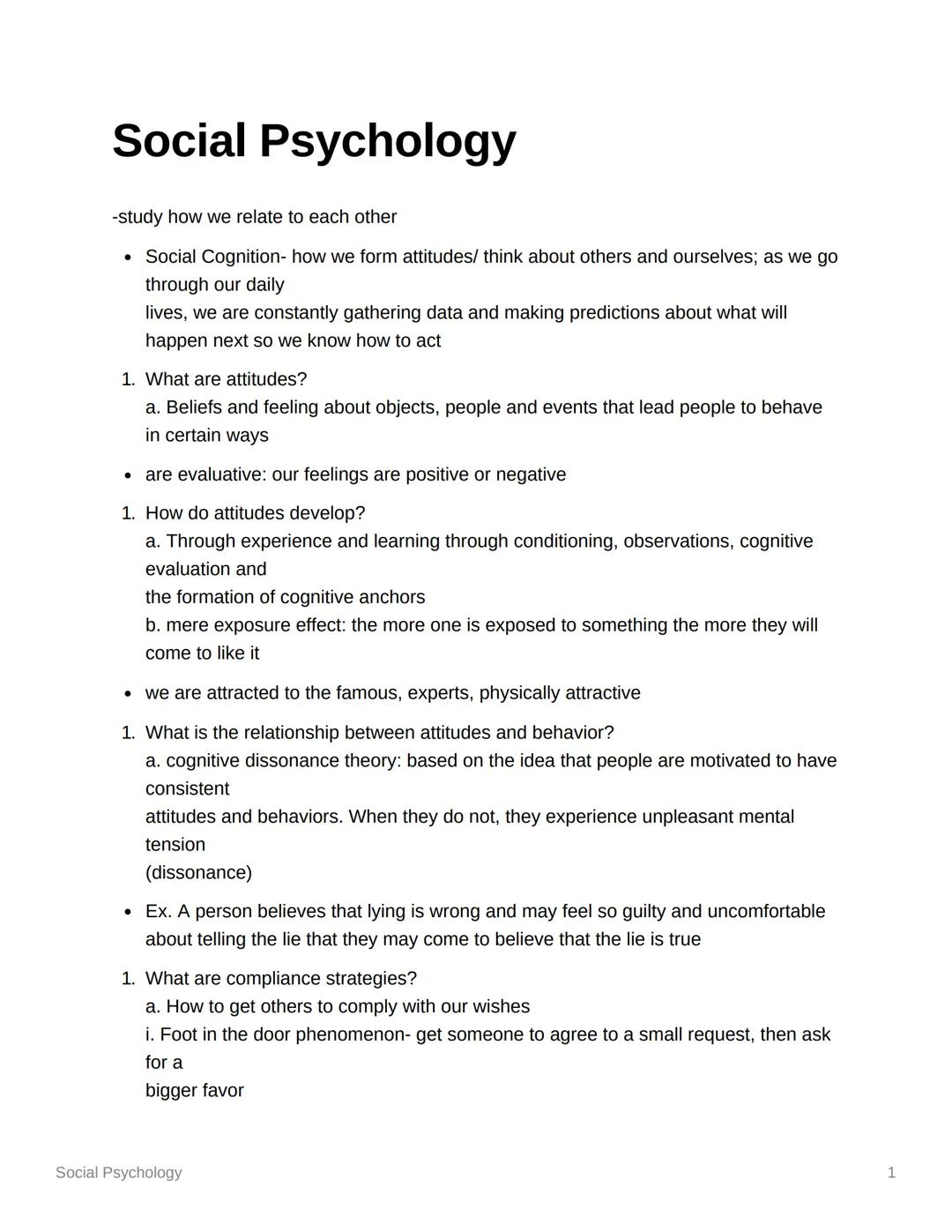
Understanding Social Attitudes
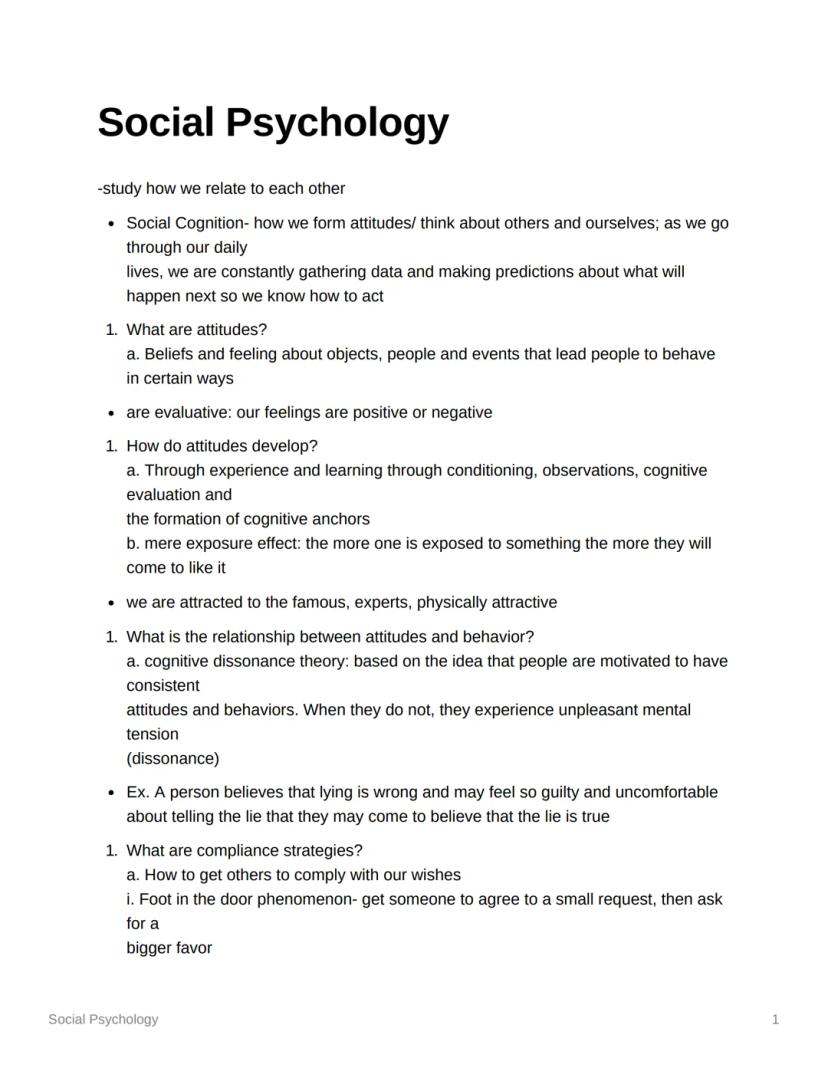
Ever wonder why you like certain things or people? Attitudes are beliefs and feelings that influence how we behave toward others. These evaluations develop through our experiences, conditioning, and observations—the more we're exposed to something (the mere exposure effect), the more likely we are to like it!
When our attitudes and behaviors don't match, we experience cognitive dissonance—that uncomfortable mental tension that pushes us to resolve the inconsistency. For example, if you believe lying is wrong but tell a lie anyway, you might feel so uncomfortable that you convince yourself the lie is actually true.
We all use compliance strategies to get others to do what we want. The foot in the door technique involves starting with a small request before asking for something bigger. Alternatively, the door in face approach starts with a large request that will likely be refused, making a smaller follow-up request seem more reasonable.
Try This! Next time you need a favor, experiment with the "foot in the door" technique—start by asking for something small and then work your way up to what you really want.
2
of 6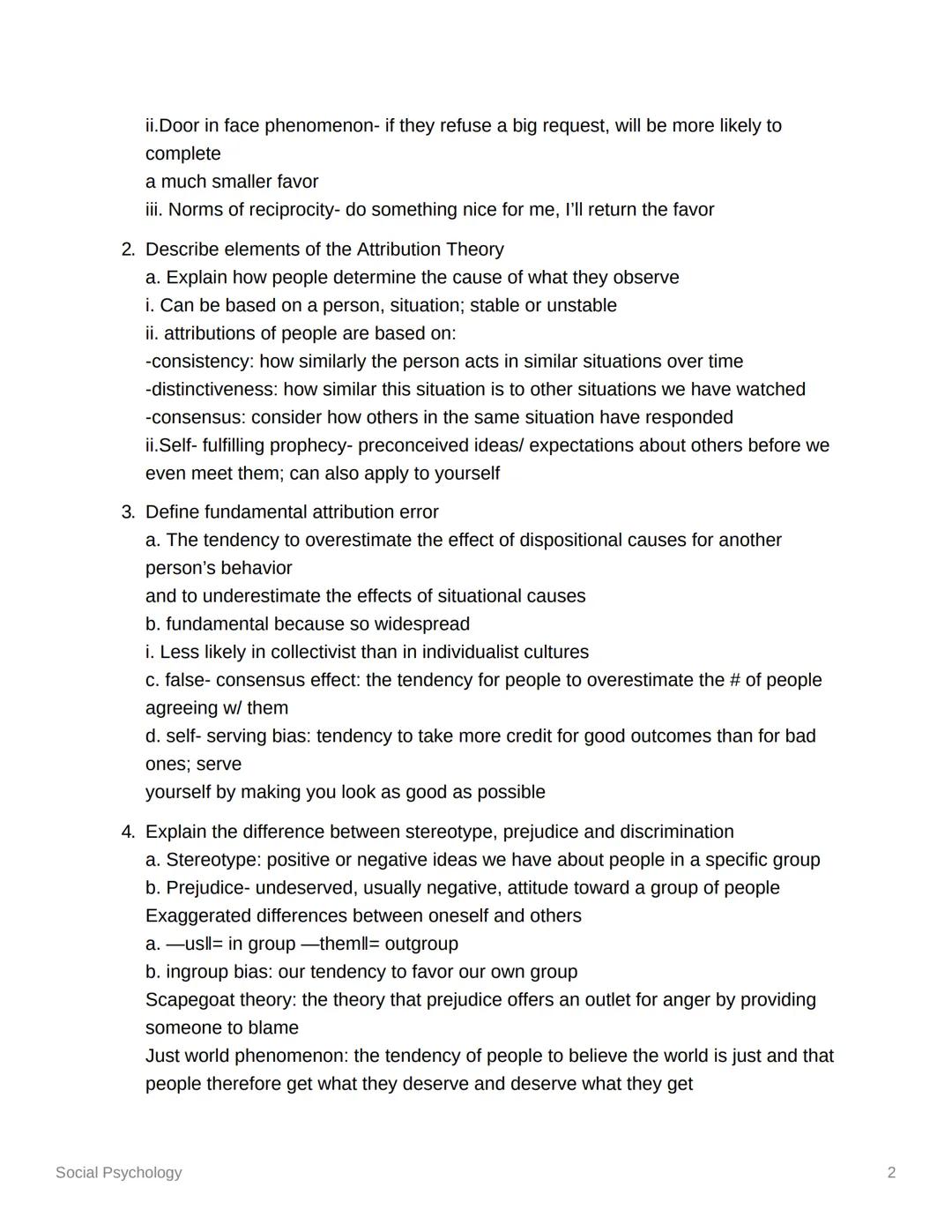
Attribution and Prejudice
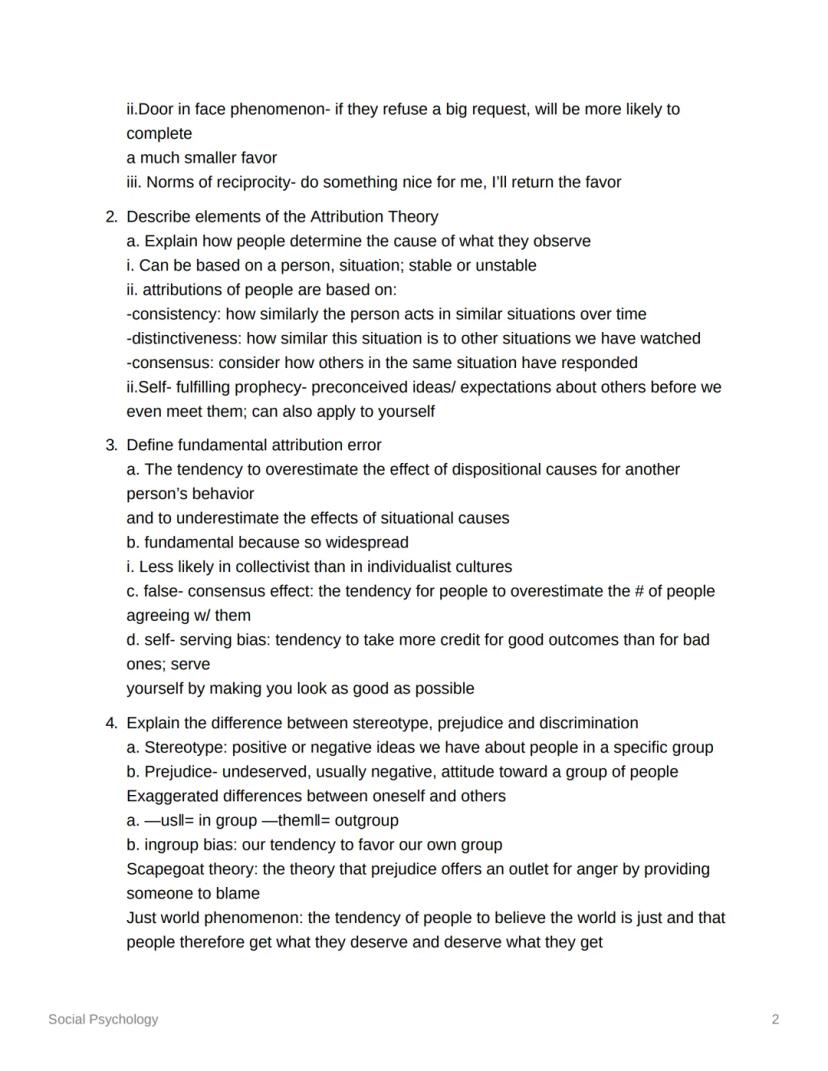
When something happens, how do you figure out why? Attribution theory explains how we determine causes for what we observe. We consider consistency (does the person always act this way?), distinctiveness (is this situation unusual?), and consensus (how do others react in the same situation?).
We often make a mistake called the fundamental attribution error—blaming people's personalities rather than their situations when explaining their behavior. For instance, if someone cuts you off in traffic, you might think "what a jerk!" instead of considering they might be rushing to an emergency.
Stereotypes are generalized ideas about groups, while prejudice is an undeserved negative attitude toward a group. Discrimination takes this further as unfair treatment based on group membership. We tend to favor our own groups (ingroup bias) and sometimes blame victims through the just world phenomenon—the belief that people get what they deserve.
Remember: We all have biases. Becoming aware of your own tendency to make the fundamental attribution error can help you judge others more fairly and accurately.
3
of 6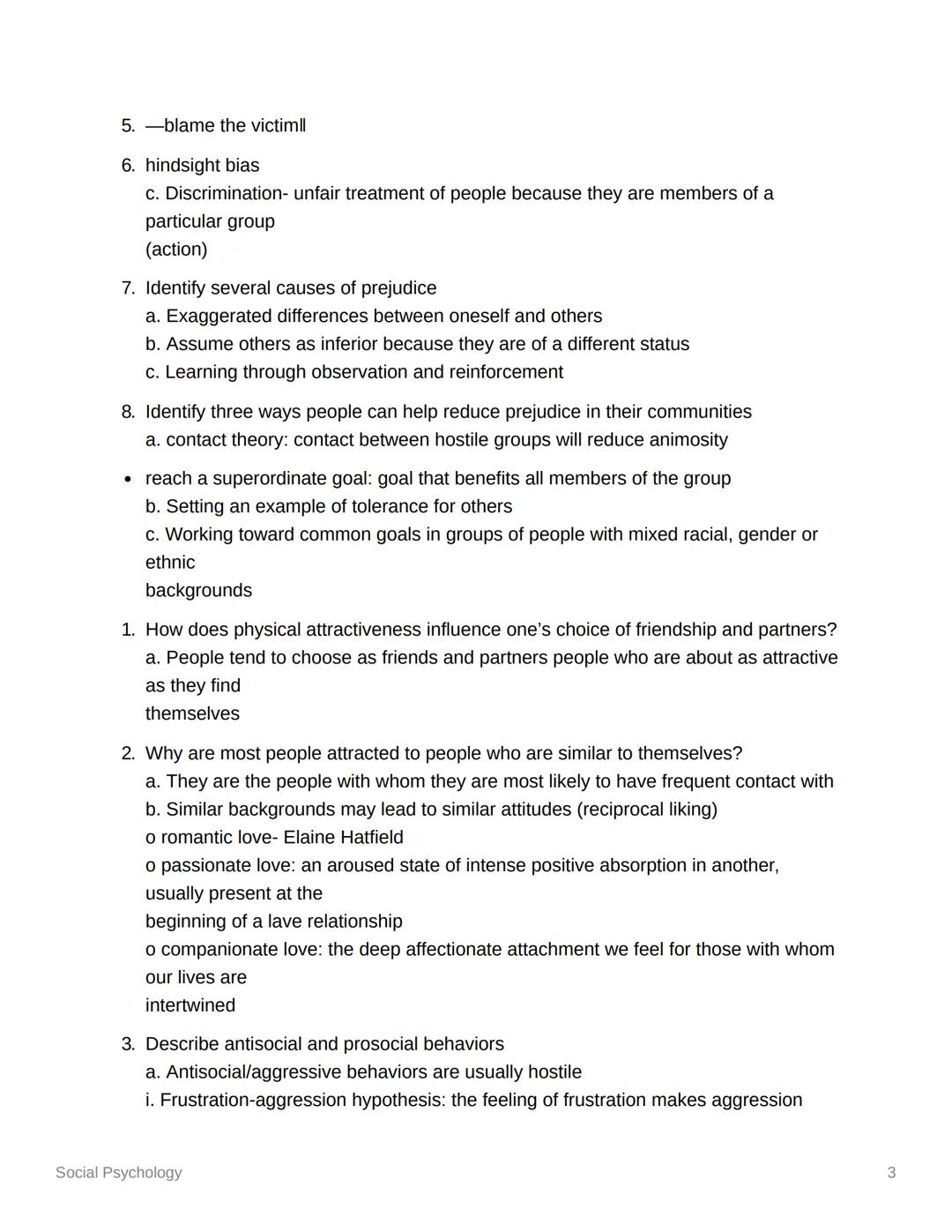
Reducing Prejudice and Understanding Attraction
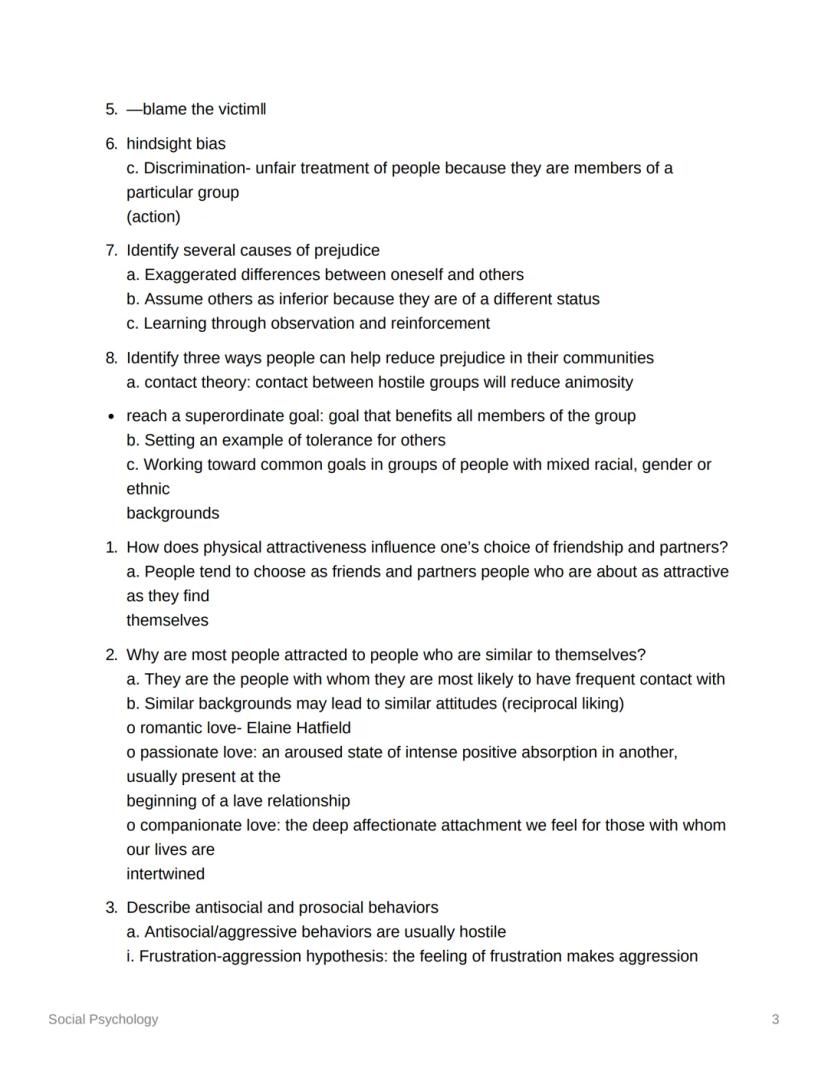
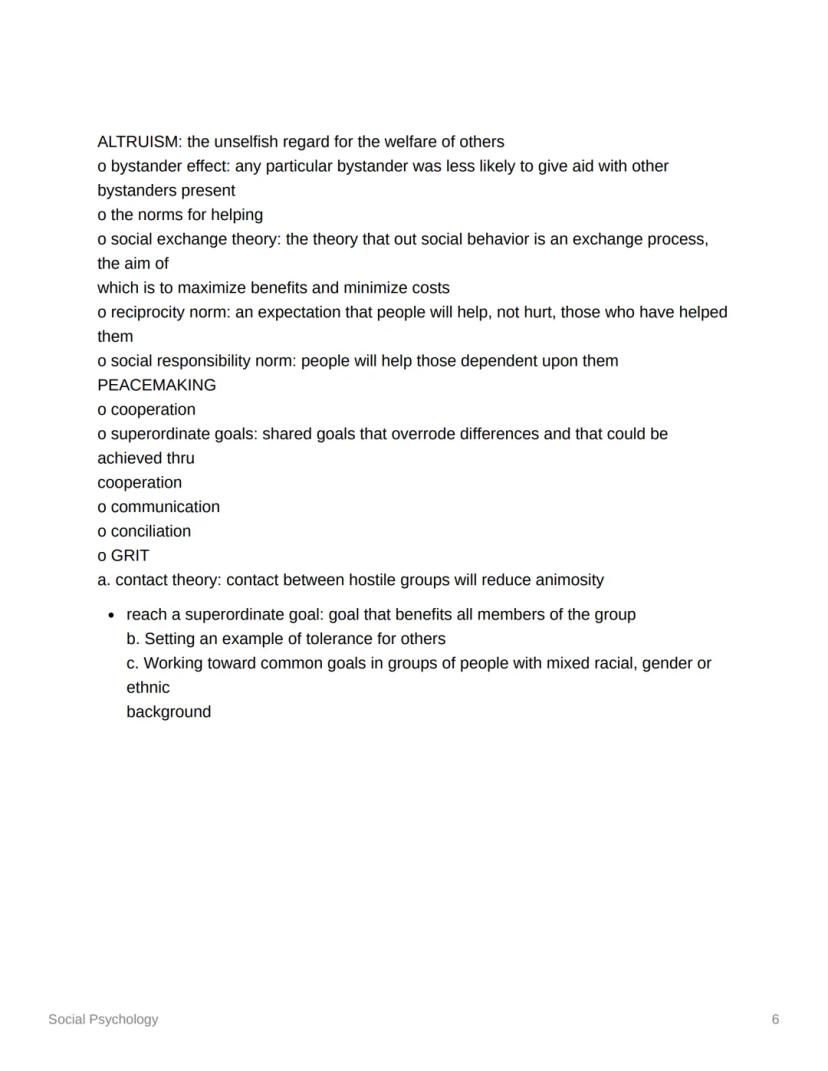
Prejudice develops from exaggerating differences between groups, assuming others are inferior, and learning biased views through observation. Luckily, we can reduce prejudice through contact theory—bringing hostile groups together to work on superordinate goals that benefit everyone.
Physical attractiveness plays a surprising role in our relationships. Most people choose friends and partners who match their own level of attractiveness. We're also drawn to people similar to ourselves because we're more likely to encounter them regularly and share similar attitudes (reciprocal liking).
Love evolves in relationships too. Passionate love is that intense feeling of absorption at the beginning of a relationship, while companionate love is the deep attachment that develops between people whose lives are intertwined over time.
Interesting Fact: Working toward common goals with people from different backgrounds is one of the most effective ways to reduce prejudice. The shared success creates bonds that can overcome previously held biases.
4
of 6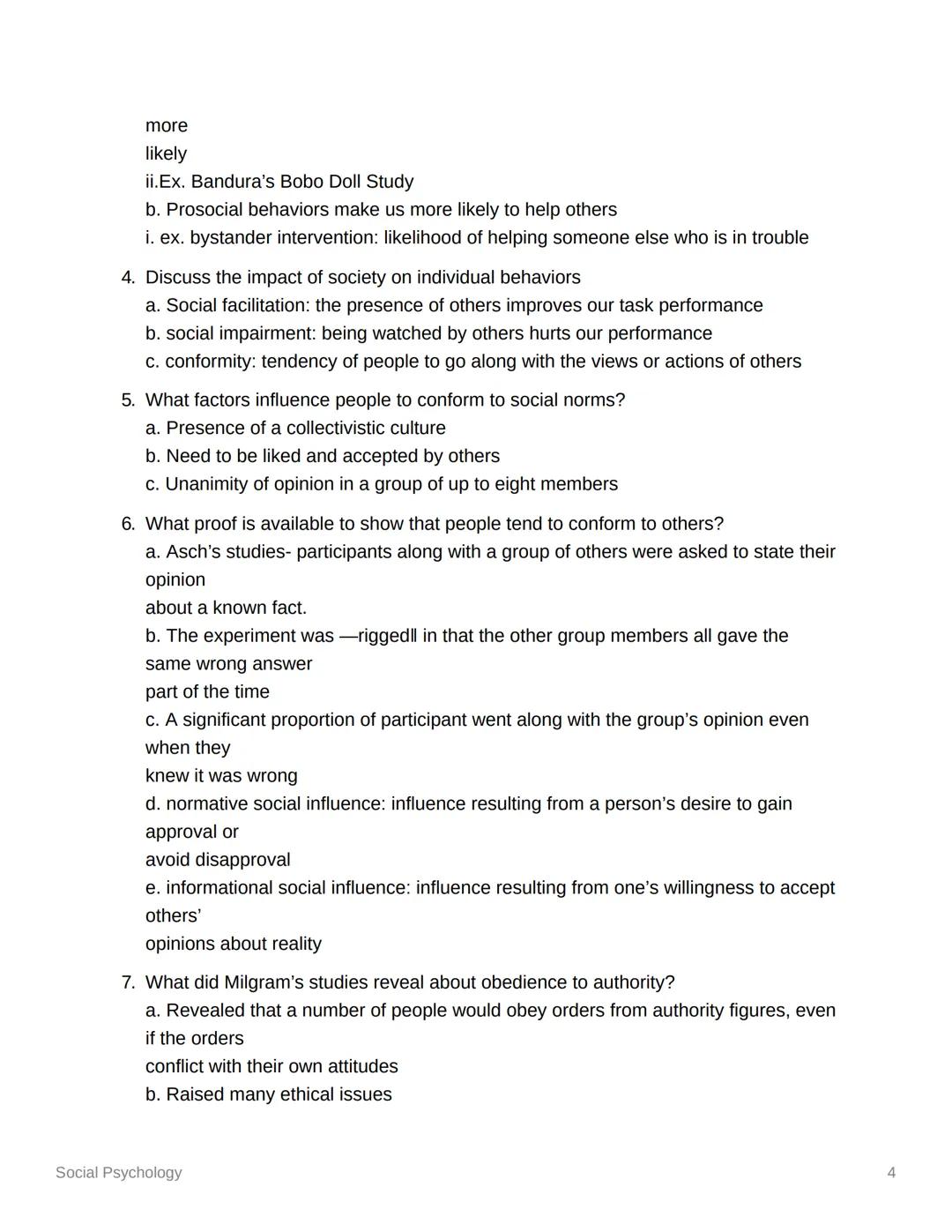
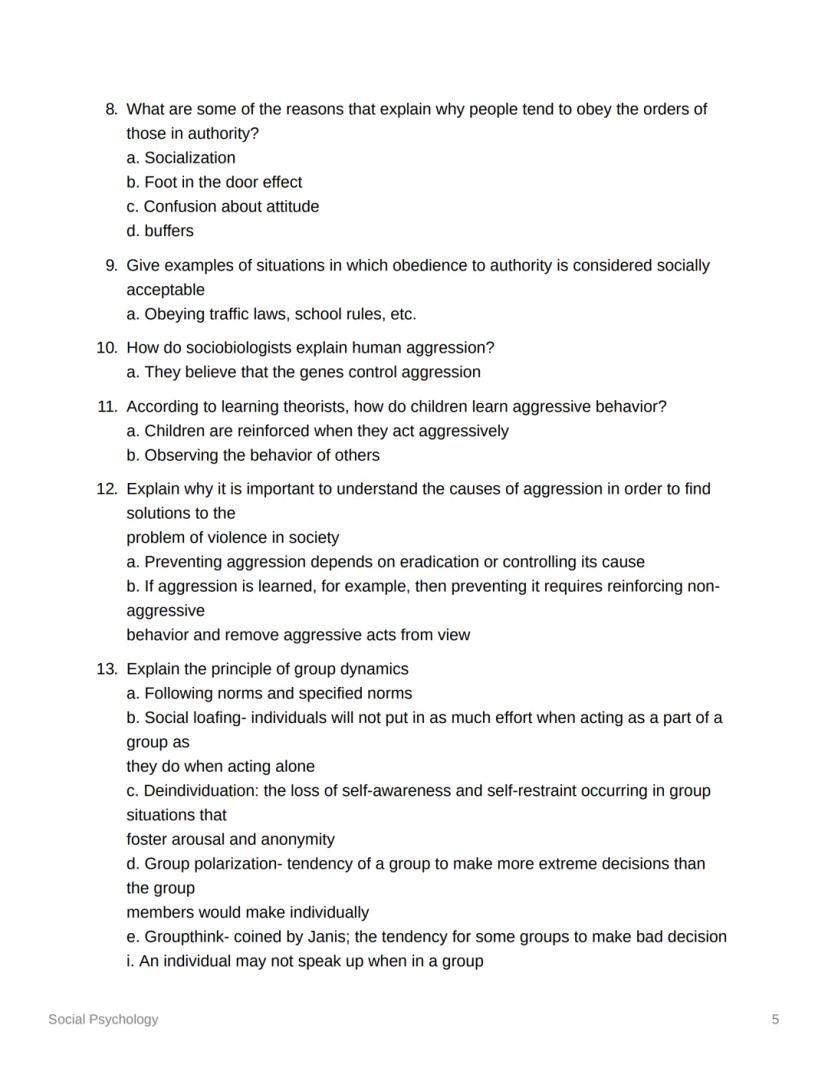
Social Influence on Behavior
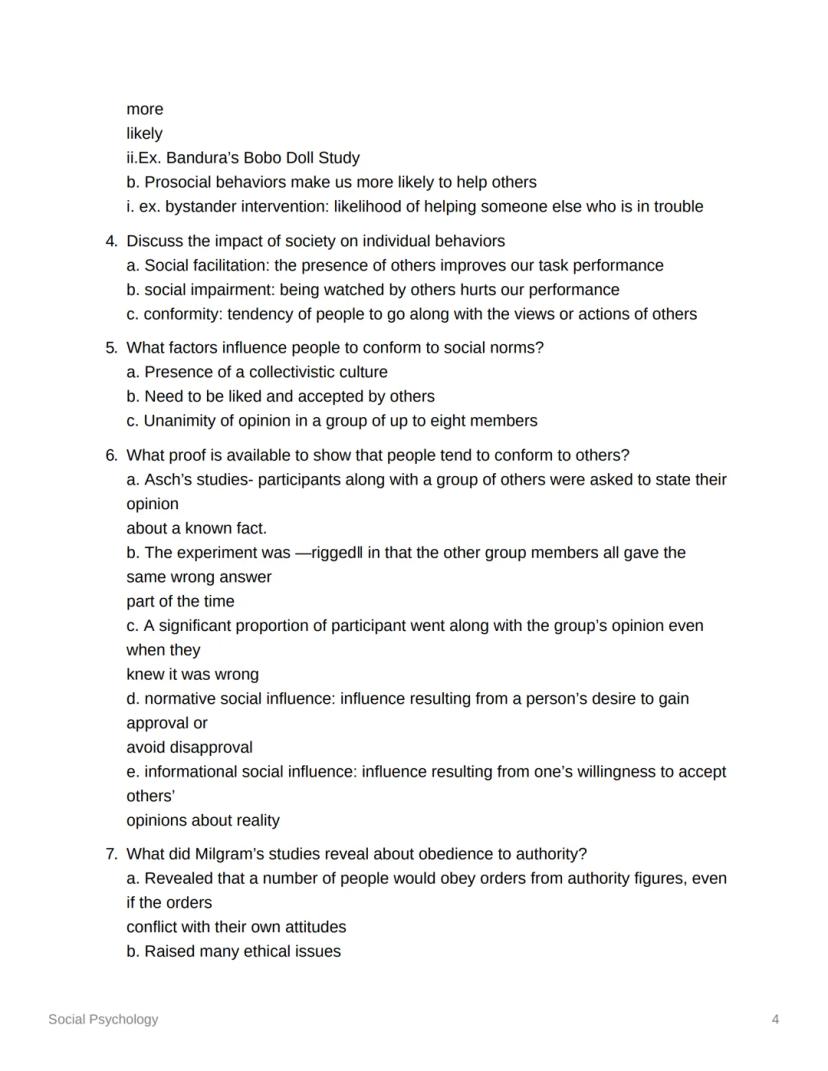
Have you noticed you perform differently when others are watching? Sometimes the presence of others improves our performance (social facilitation), but other times it makes us do worse (social impairment)—especially when the task is difficult.
People tend to conform to the views or actions of others, as demonstrated in Asch's famous studies. Participants would often give obviously wrong answers just to match what the group was saying! This happens due to normative social influence (wanting approval) and informational social influence (assuming others know better).
Milgram's shocking obedience studies revealed how far people will go when following orders from authorities. Many participants continued delivering what they thought were painful electric shocks simply because an authority figure told them to. People obey due to socialization, gradual commitment , and emotional distance (buffers) from the consequences of their actions.
Think About It: Would you stand up against a group that's clearly wrong? Research shows only about 25% of people consistently resist group pressure when the answer is obviously incorrect.
5
of 6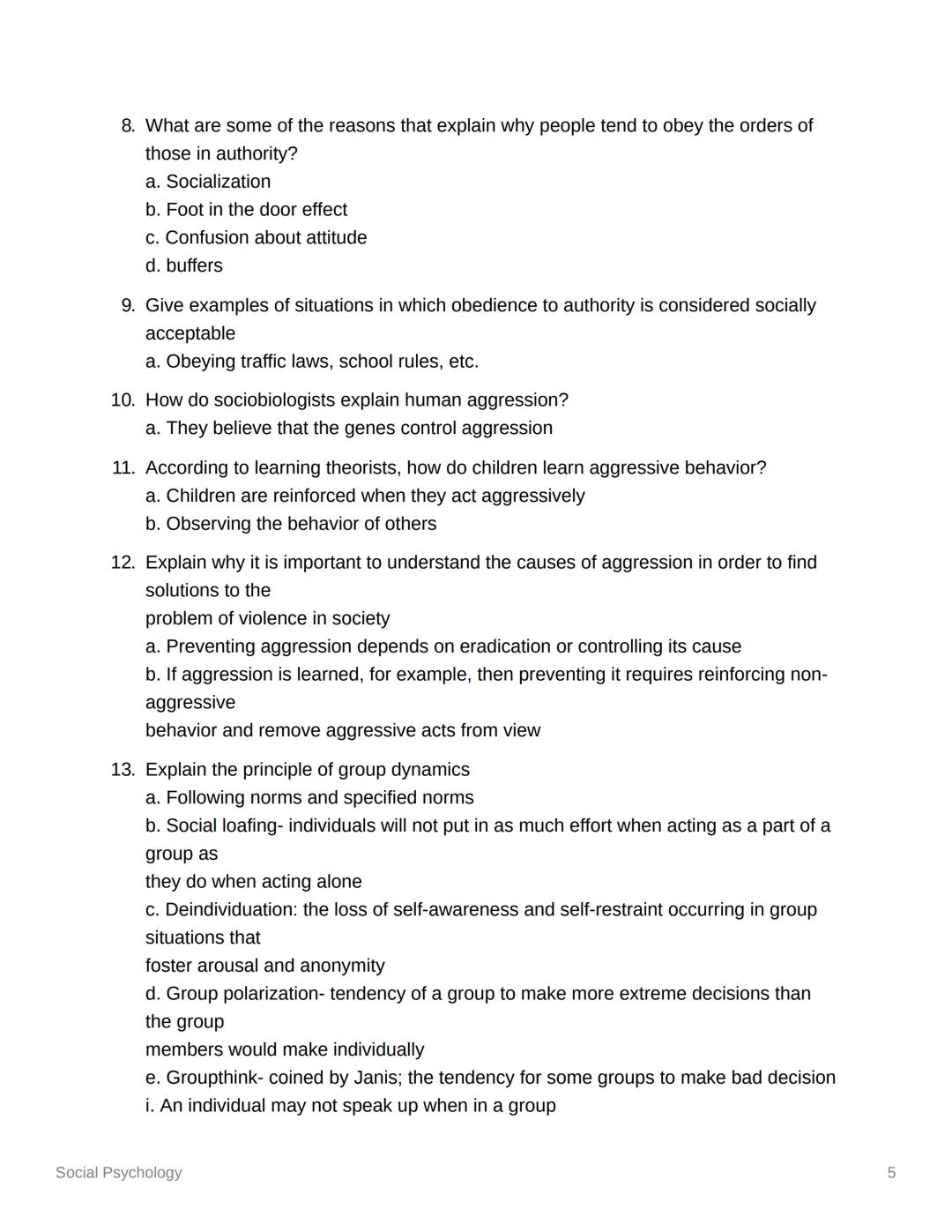
Aggression and Group Dynamics
Where does aggression come from? While sociobiologists point to genetic factors, learning theorists emphasize how children learn aggressive behavior through reinforcement and observation. Understanding these causes is crucial for addressing violence in society—if aggression is learned, we can prevent it by reinforcing non-aggressive behaviors.
Groups dramatically change how we behave. Social loafing happens when we put in less effort as part of a group than when working alone. In crowds, we might experience deindividuation—losing self-awareness and restraint, especially in anonymous situations. Groups also tend toward polarization, making more extreme decisions than individuals would, and can fall prey to groupthink where bad decisions result from pressure to conform.
The principle of group dynamics explains why we follow norms and how our behavior changes in groups. These principles help us understand everything from workplace team behavior to crowd psychology.
Warning Sign: If you're in a group where everyone seems to agree too quickly and alternative viewpoints aren't being discussed, you might be experiencing groupthink. Try playing devil's advocate to introduce different perspectives.
6
of 6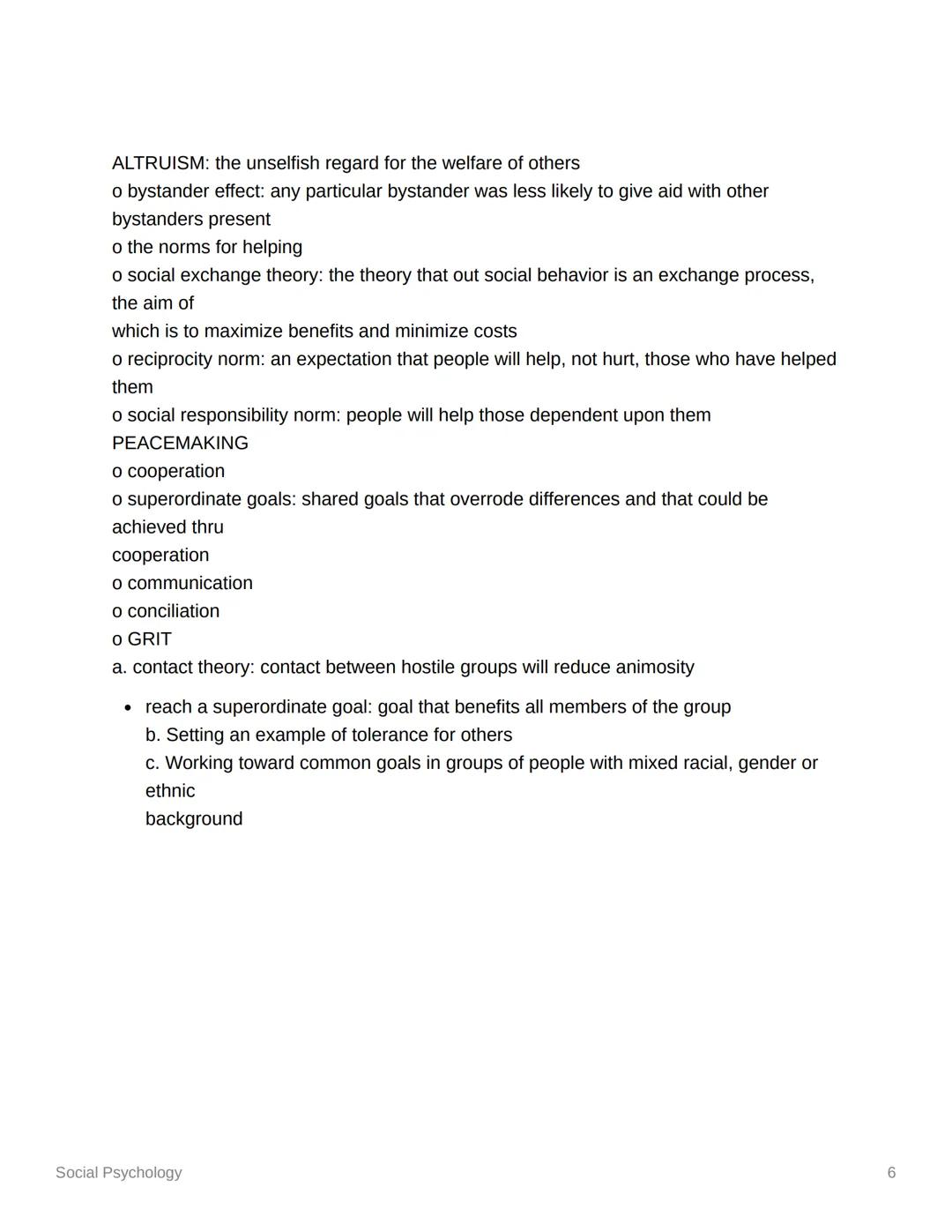
Altruism and Peacemaking
Why do people help others? Altruism is unselfish concern for others' welfare. Interestingly, the bystander effect shows people are less likely to help someone in trouble when others are present—everyone assumes someone else will step in.
Our helping behavior follows certain norms. Social exchange theory suggests we weigh benefits against costs when deciding to help. The reciprocity norm means we help those who have helped us, while the social responsibility norm pushes us to assist those dependent on us.
Creating peace between conflicting groups requires several key elements: cooperation toward superordinate goals (shared objectives that override differences), open communication, and conciliation efforts. The contact theory suggests that bringing hostile groups together under positive circumstances reduces animosity.
Make a Difference: Want to reduce prejudice in your community? Organize activities where diverse groups work together toward common goals. Sports teams, community service projects, and collaborative art initiatives all create opportunities for meaningful contact.
We thought you’d never ask...
What is the Knowunity AI companion?
Our AI companion is specifically built for the needs of students. Based on the millions of content pieces we have on the platform we can provide truly meaningful and relevant answers to students. But its not only about answers, the companion is even more about guiding students through their daily learning challenges, with personalised study plans, quizzes or content pieces in the chat and 100% personalisation based on the students skills and developments.
Where can I download the Knowunity app?
You can download the app in the Google Play Store and in the Apple App Store.
Is Knowunity really free of charge?
That's right! Enjoy free access to study content, connect with fellow students, and get instant help – all at your fingertips.
Similar Content
 Psychology
Most popular content in AP Psychology
9F
AP PsychologyFoundations of Ethical Guidelines in Research
Practice the core principles of the APA ethical code including informed consent, debriefing, and the role of Institutional Review Boards.
9th1,3360
F
AP PsychologyFoundations of Research Design and Methodology
Practice distinguishing between different research methods including experiments, correlations, and case studies while identifying key variables.
9th6670
H
AP PsychologyHistorical Foundations of Psychology
Practice distinguishing between structuralism, functionalism, and the early philosophical roots of psychological science.
9th1,0920
I
AP PsychologyIntroduction to Descriptive Statistics
Practice identifying and calculating measures of central tendency and variation to summarize psychological data sets.
9th7010
I
AP PsychologyIntroduction to Auditory System Structures
Practice identifying the anatomical structures of the ear and their specific roles in converting sound waves into neural impulses.
9th6000
H
AP PsychologyHemispheric Specialization and Brain Structures
Practice identifying how specific structures like the corpus callosum and cerebral cortex coordinate complex human behaviors and sensory input.
9th3330
P
AP PsychologyParts of the brain and their functions quiz
Quick quiz on parts of the brain and their functions
10th1450
AP PsychologyAP psych
literally 103 pages of psych notes i took
10th1223
AP PsychologyThe Best AP Psychology Cram Sheet
cram sheet for AP Psych
10th95568
Most popular content
9O
 AP US History
Origins and Dynamics of the Columbian Exchange
Analyze the ecological and economic motivations behind the initial transfer of goods, people, and diseases between the Old and New Worlds.
9th3,1280
I
AP US HistoryIntroduction to Early Cultural Interactions
Analyze the initial social and religious encounters between Europeans, Africans, and Indigenous peoples in the colonial Americas.
9th2,7730
O
 AP World History
Origins of Ancient River Civilizations
Analyze the environmental factors and technological innovations that led to the rise of early states in Mesopotamia, Egypt, and the Indus Valley.
9th3,1870
M
AP US HistoryMotivations for European Exploration
Analyze the economic, religious, and political factors that drove European powers to the Americas during the 15th and 16th centuries.
9th1,7780
F
AP PsychologyFoundations of Ethical Guidelines in Research
Practice the core principles of the APA ethical code including informed consent, debriefing, and the role of Institutional Review Boards.
9th1,3360
I
AP US HistoryIntroduction to Native American Societies
Examine the diverse social, political, and economic structures of North American indigenous groups prior to European contact.
9th1,1100
I
 AP Biology
Introduction to Biological Elements of Life
Practice identifying the essential elements including carbon, nitrogen, phosphorus, and sulfur that compose biological macromolecules.
9th1,7390
I
AP US HistoryIntroduction to the Spanish Encomienda System
Explore the fundamental economic and social structures of the Spanish colonial system, focusing on the encomienda and the casta social hierarchy.
9th8890
O
AP World HistoryOrigins and Continuity of the Byzantine Empire
Analyze the political and cultural transitions from the Roman Empire to the Byzantine Empire, focusing on the reign of Justinian I and his code.
9th1,6320
Can't find what you're looking for? Explore other subjects.
Students love us — and so will you.
4.6/5App Store
4.7/5Google Play
The app is very easy to use and well designed. I have found everything I was looking for so far and have been able to learn a lot from the presentations! I will definitely use the app for a class assignment! And of course it also helps a lot as an inspiration.
Stefan SiOS user
This app is really great. There are so many study notes and help [...]. My problem subject is French, for example, and the app has so many options for help. Thanks to this app, I have improved my French. I would recommend it to anyone.
Samantha KlichAndroid user
Wow, I am really amazed. I just tried the app because I've seen it advertised many times and was absolutely stunned. This app is THE HELP you want for school and above all, it offers so many things, such as workouts and fact sheets, which have been VERY helpful to me personally.
AnnaiOS user
AP Psychology197 views·Updated Jun 8, 2026·6 pagesUnderstanding Social Psychology Concepts
Social Psychology explores how we interact with and understand others. It examines the attitudes we form, how we perceive people around us, and what drives our social behaviors. This field helps explain why we act differently in groups than when...
1
of 6
Sign up to see the content. It's free!
- Access to all documents
- Improve your grades
- Join milions of students
Understanding Social Attitudes
Ever wonder why you like certain things or people? Attitudes are beliefs and feelings that influence how we behave toward others. These evaluations develop through our experiences, conditioning, and observations—the more we're exposed to something (the mere exposure effect), the more likely we are to like it!
When our attitudes and behaviors don't match, we experience cognitive dissonance—that uncomfortable mental tension that pushes us to resolve the inconsistency. For example, if you believe lying is wrong but tell a lie anyway, you might feel so uncomfortable that you convince yourself the lie is actually true.
We all use compliance strategies to get others to do what we want. The foot in the door technique involves starting with a small request before asking for something bigger. Alternatively, the door in face approach starts with a large request that will likely be refused, making a smaller follow-up request seem more reasonable.
Try This! Next time you need a favor, experiment with the "foot in the door" technique—start by asking for something small and then work your way up to what you really want.
2
of 6Sign up to see the content. It's free!
- Access to all documents
- Improve your grades
- Join milions of students
Attribution and Prejudice
When something happens, how do you figure out why? Attribution theory explains how we determine causes for what we observe. We consider consistency (does the person always act this way?), distinctiveness (is this situation unusual?), and consensus (how do others react in the same situation?).
We often make a mistake called the fundamental attribution error—blaming people's personalities rather than their situations when explaining their behavior. For instance, if someone cuts you off in traffic, you might think "what a jerk!" instead of considering they might be rushing to an emergency.
Stereotypes are generalized ideas about groups, while prejudice is an undeserved negative attitude toward a group. Discrimination takes this further as unfair treatment based on group membership. We tend to favor our own groups (ingroup bias) and sometimes blame victims through the just world phenomenon—the belief that people get what they deserve.
Remember: We all have biases. Becoming aware of your own tendency to make the fundamental attribution error can help you judge others more fairly and accurately.
3
of 6Sign up to see the content. It's free!
- Access to all documents
- Improve your grades
- Join milions of students
Reducing Prejudice and Understanding Attraction
Prejudice develops from exaggerating differences between groups, assuming others are inferior, and learning biased views through observation. Luckily, we can reduce prejudice through contact theory—bringing hostile groups together to work on superordinate goals that benefit everyone.
Physical attractiveness plays a surprising role in our relationships. Most people choose friends and partners who match their own level of attractiveness. We're also drawn to people similar to ourselves because we're more likely to encounter them regularly and share similar attitudes (reciprocal liking).
Love evolves in relationships too. Passionate love is that intense feeling of absorption at the beginning of a relationship, while companionate love is the deep attachment that develops between people whose lives are intertwined over time.
Interesting Fact: Working toward common goals with people from different backgrounds is one of the most effective ways to reduce prejudice. The shared success creates bonds that can overcome previously held biases.
4
of 6Sign up to see the content. It's free!
- Access to all documents
- Improve your grades
- Join milions of students
Social Influence on Behavior
Have you noticed you perform differently when others are watching? Sometimes the presence of others improves our performance (social facilitation), but other times it makes us do worse (social impairment)—especially when the task is difficult.
People tend to conform to the views or actions of others, as demonstrated in Asch's famous studies. Participants would often give obviously wrong answers just to match what the group was saying! This happens due to normative social influence (wanting approval) and informational social influence (assuming others know better).
Milgram's shocking obedience studies revealed how far people will go when following orders from authorities. Many participants continued delivering what they thought were painful electric shocks simply because an authority figure told them to. People obey due to socialization, gradual commitment , and emotional distance (buffers) from the consequences of their actions.
Think About It: Would you stand up against a group that's clearly wrong? Research shows only about 25% of people consistently resist group pressure when the answer is obviously incorrect.
5
of 6Sign up to see the content. It's free!
- Access to all documents
- Improve your grades
- Join milions of students
Aggression and Group Dynamics
Where does aggression come from? While sociobiologists point to genetic factors, learning theorists emphasize how children learn aggressive behavior through reinforcement and observation. Understanding these causes is crucial for addressing violence in society—if aggression is learned, we can prevent it by reinforcing non-aggressive behaviors.
Groups dramatically change how we behave. Social loafing happens when we put in less effort as part of a group than when working alone. In crowds, we might experience deindividuation—losing self-awareness and restraint, especially in anonymous situations. Groups also tend toward polarization, making more extreme decisions than individuals would, and can fall prey to groupthink where bad decisions result from pressure to conform.
The principle of group dynamics explains why we follow norms and how our behavior changes in groups. These principles help us understand everything from workplace team behavior to crowd psychology.
Warning Sign: If you're in a group where everyone seems to agree too quickly and alternative viewpoints aren't being discussed, you might be experiencing groupthink. Try playing devil's advocate to introduce different perspectives.
6
of 6Sign up to see the content. It's free!
- Access to all documents
- Improve your grades
- Join milions of students
Altruism and Peacemaking
Why do people help others? Altruism is unselfish concern for others' welfare. Interestingly, the bystander effect shows people are less likely to help someone in trouble when others are present—everyone assumes someone else will step in.
Our helping behavior follows certain norms. Social exchange theory suggests we weigh benefits against costs when deciding to help. The reciprocity norm means we help those who have helped us, while the social responsibility norm pushes us to assist those dependent on us.
Creating peace between conflicting groups requires several key elements: cooperation toward superordinate goals (shared objectives that override differences), open communication, and conciliation efforts. The contact theory suggests that bringing hostile groups together under positive circumstances reduces animosity.
Make a Difference: Want to reduce prejudice in your community? Organize activities where diverse groups work together toward common goals. Sports teams, community service projects, and collaborative art initiatives all create opportunities for meaningful contact.
We thought you’d never ask...
What is the Knowunity AI companion?
Our AI companion is specifically built for the needs of students. Based on the millions of content pieces we have on the platform we can provide truly meaningful and relevant answers to students. But its not only about answers, the companion is even more about guiding students through their daily learning challenges, with personalised study plans, quizzes or content pieces in the chat and 100% personalisation based on the students skills and developments.
Where can I download the Knowunity app?
You can download the app in the Google Play Store and in the Apple App Store.
Is Knowunity really free of charge?
That's right! Enjoy free access to study content, connect with fellow students, and get instant help – all at your fingertips.
Similar Content
Most popular content in AP Psychology
9F
AP PsychologyFoundations of Ethical Guidelines in Research
Practice the core principles of the APA ethical code including informed consent, debriefing, and the role of Institutional Review Boards.
9th1,3360
F
AP PsychologyFoundations of Research Design and Methodology
Practice distinguishing between different research methods including experiments, correlations, and case studies while identifying key variables.
9th6670
H
AP PsychologyHistorical Foundations of Psychology
Practice distinguishing between structuralism, functionalism, and the early philosophical roots of psychological science.
9th1,0920
I
AP PsychologyIntroduction to Descriptive Statistics
Practice identifying and calculating measures of central tendency and variation to summarize psychological data sets.
9th7010
I
AP PsychologyIntroduction to Auditory System Structures
Practice identifying the anatomical structures of the ear and their specific roles in converting sound waves into neural impulses.
9th6000
H
AP PsychologyHemispheric Specialization and Brain Structures
Practice identifying how specific structures like the corpus callosum and cerebral cortex coordinate complex human behaviors and sensory input.
9th3330
P
AP PsychologyParts of the brain and their functions quiz
Quick quiz on parts of the brain and their functions
10th1450
AP PsychologyAP psych
literally 103 pages of psych notes i took
10th1223
AP PsychologyThe Best AP Psychology Cram Sheet
cram sheet for AP Psych
10th95568
Most popular content
9O
AP US HistoryOrigins and Dynamics of the Columbian Exchange
Analyze the ecological and economic motivations behind the initial transfer of goods, people, and diseases between the Old and New Worlds.
9th3,1280
I
AP US HistoryIntroduction to Early Cultural Interactions
Analyze the initial social and religious encounters between Europeans, Africans, and Indigenous peoples in the colonial Americas.
9th2,7730
O
AP World HistoryOrigins of Ancient River Civilizations
Analyze the environmental factors and technological innovations that led to the rise of early states in Mesopotamia, Egypt, and the Indus Valley.
9th3,1870
M
AP US HistoryMotivations for European Exploration
Analyze the economic, religious, and political factors that drove European powers to the Americas during the 15th and 16th centuries.
9th1,7780
F
AP PsychologyFoundations of Ethical Guidelines in Research
Practice the core principles of the APA ethical code including informed consent, debriefing, and the role of Institutional Review Boards.
9th1,3360
I
AP US HistoryIntroduction to Native American Societies
Examine the diverse social, political, and economic structures of North American indigenous groups prior to European contact.
9th1,1100
I
AP BiologyIntroduction to Biological Elements of Life
Practice identifying the essential elements including carbon, nitrogen, phosphorus, and sulfur that compose biological macromolecules.
9th1,7390
I
AP US HistoryIntroduction to the Spanish Encomienda System
Explore the fundamental economic and social structures of the Spanish colonial system, focusing on the encomienda and the casta social hierarchy.
9th8890
O
AP World HistoryOrigins and Continuity of the Byzantine Empire
Analyze the political and cultural transitions from the Roman Empire to the Byzantine Empire, focusing on the reign of Justinian I and his code.
9th1,6320
Can't find what you're looking for? Explore other subjects.
Students love us — and so will you.
4.6/5App Store
4.7/5Google Play
The app is very easy to use and well designed. I have found everything I was looking for so far and have been able to learn a lot from the presentations! I will definitely use the app for a class assignment! And of course it also helps a lot as an inspiration.
Stefan SiOS user
This app is really great. There are so many study notes and help [...]. My problem subject is French, for example, and the app has so many options for help. Thanks to this app, I have improved my French. I would recommend it to anyone.
Samantha KlichAndroid user
Wow, I am really amazed. I just tried the app because I've seen it advertised many times and was absolutely stunned. This app is THE HELP you want for school and above all, it offers so many things, such as workouts and fact sheets, which have been VERY helpful to me personally.
AnnaiOS user