
Clinical psychology is a branch of psychology focused on assessing,...
 AP Psychology135 views·Updated Jun 6, 2026·4 pages
Understanding Clinical Psychology: Key Concepts for Students
1 / 4
1
of 4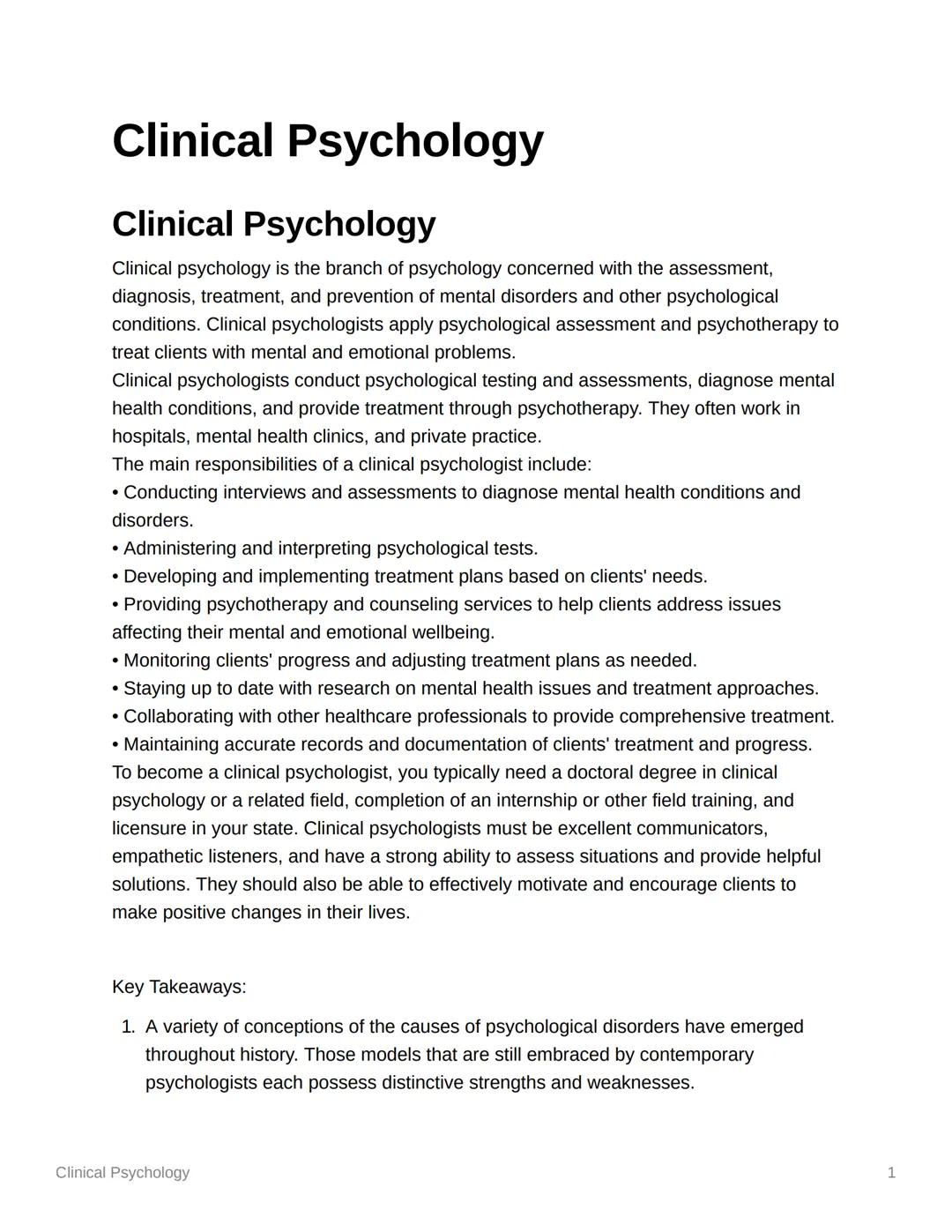
Understanding Clinical Psychology
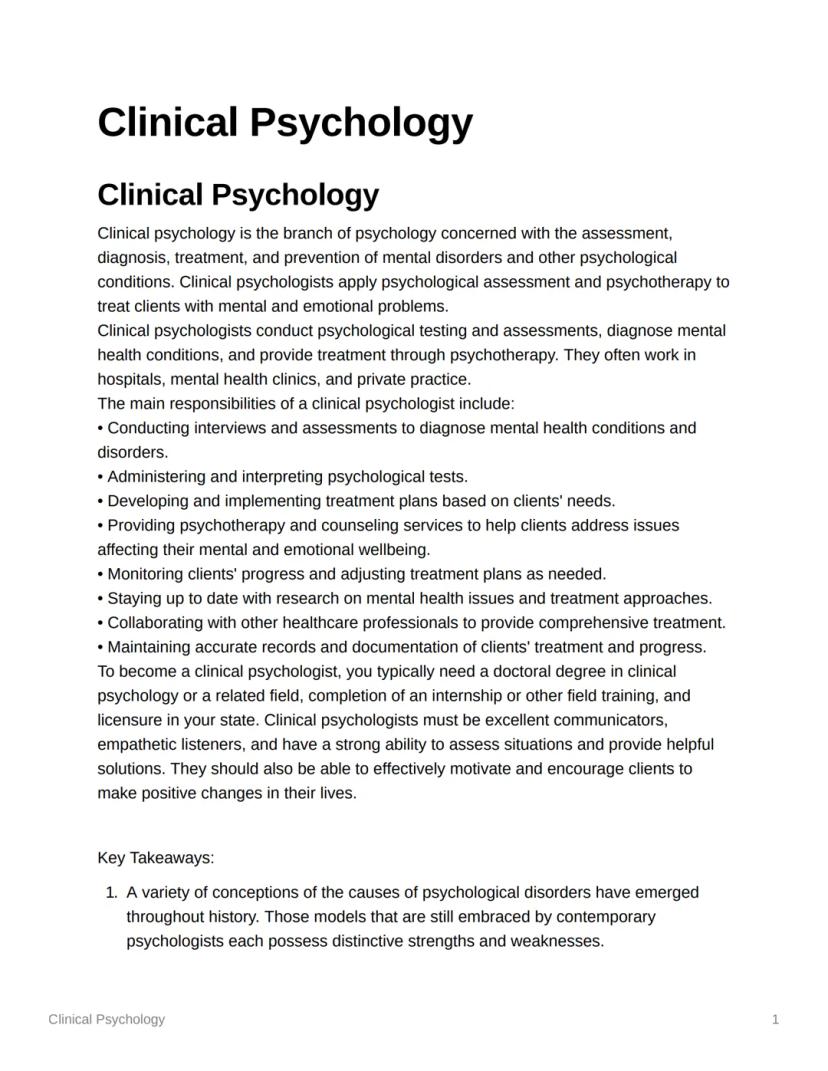
Clinical psychologists are mental health professionals who help people with psychological difficulties through assessment, diagnosis, and treatment. They work in various settings including hospitals, clinics, and private practice to support people facing mental health challenges.
The core responsibilities of clinical psychologists include conducting assessments to diagnose mental health conditions, developing personalized treatment plans, and providing psychotherapy. They also monitor client progress, collaborate with other healthcare professionals, and stay current with the latest research on effective treatments.
Becoming a clinical psychologist requires extensive education—typically a doctoral degree in clinical psychology, completed internship training, and state licensure. Successful clinical psychologists combine strong assessment skills with empathy and communication abilities to help clients make positive life changes.
Did you know? Throughout history, different models of understanding psychological disorders have emerged. Today's psychologists draw from multiple perspectives, each with unique strengths and limitations when explaining mental health conditions.
2
of 4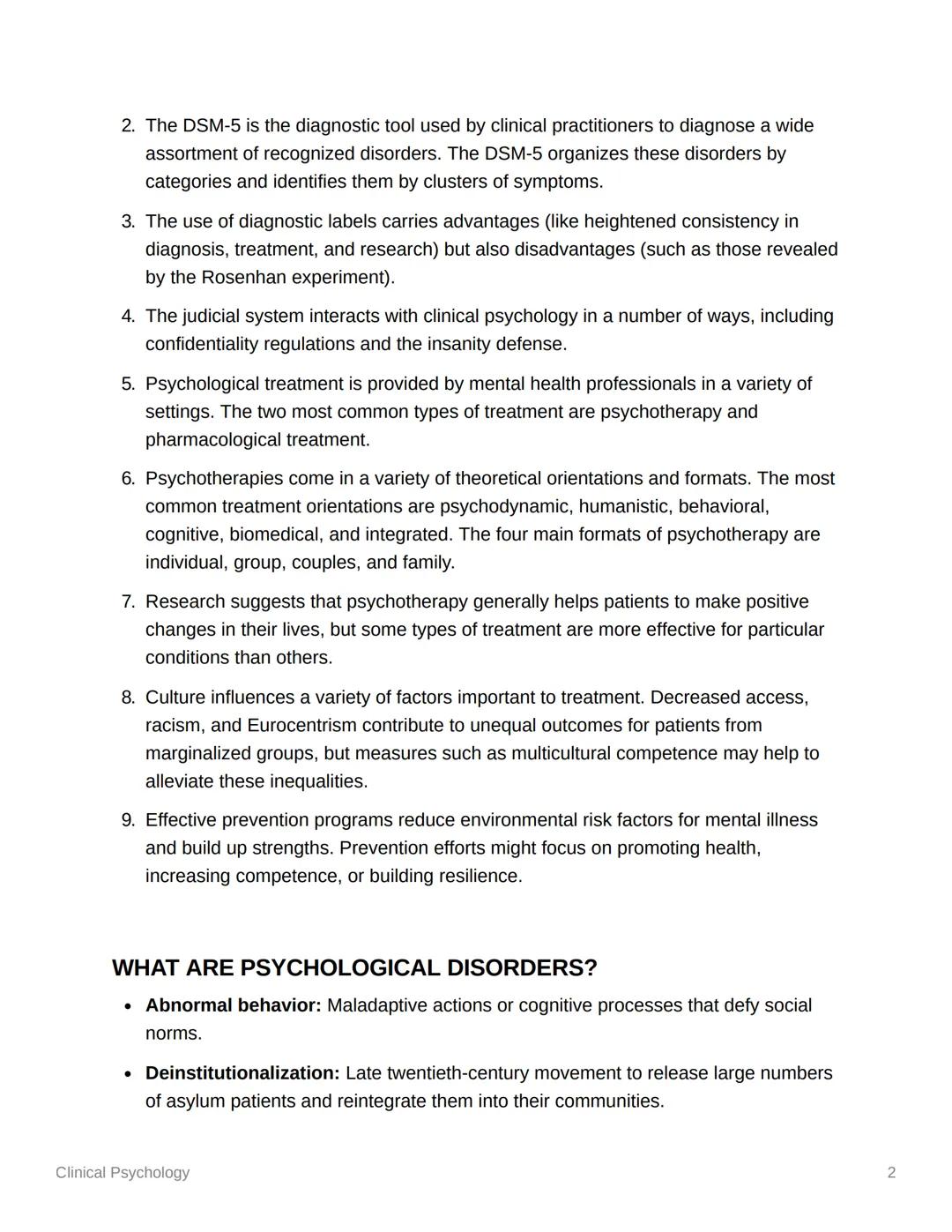
Diagnosis and Treatment Approaches
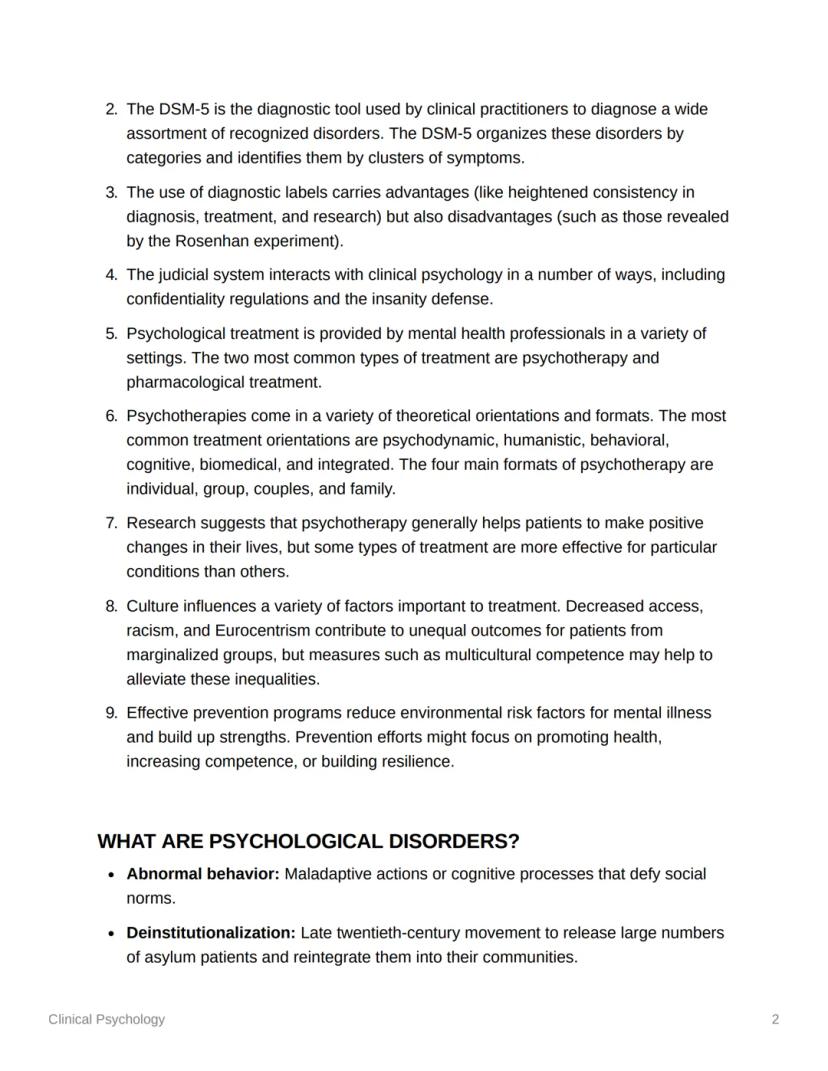
The Diagnostic and Statistical Manual of Mental Disorders is the main tool clinical psychologists use to diagnose mental health conditions. It organizes disorders by categories and symptom clusters, helping professionals identify specific conditions and develop appropriate treatment plans.
Using diagnostic labels has both benefits and drawbacks. On one hand, labels promote consistency in diagnosis, treatment planning, and research. On the other hand, as demonstrated by the Rosenhan experiment, labels can sometimes lead to harmful stereotyping or misdiagnosis.
Psychological treatment typically takes one of two main forms: psychotherapy (talk therapy) or pharmacological treatment (medication). Psychotherapy comes in several theoretical orientations including psychodynamic, humanistic, behavioral, cognitive, biomedical, and integrated approaches. These can be delivered in individual, group, couples, or family formats.
Important insight: Research shows that psychotherapy generally helps people make positive life changes, though certain types of therapy work better for specific conditions than others. Finding the right match between problem, therapy type, and therapist is key to successful treatment.
3
of 4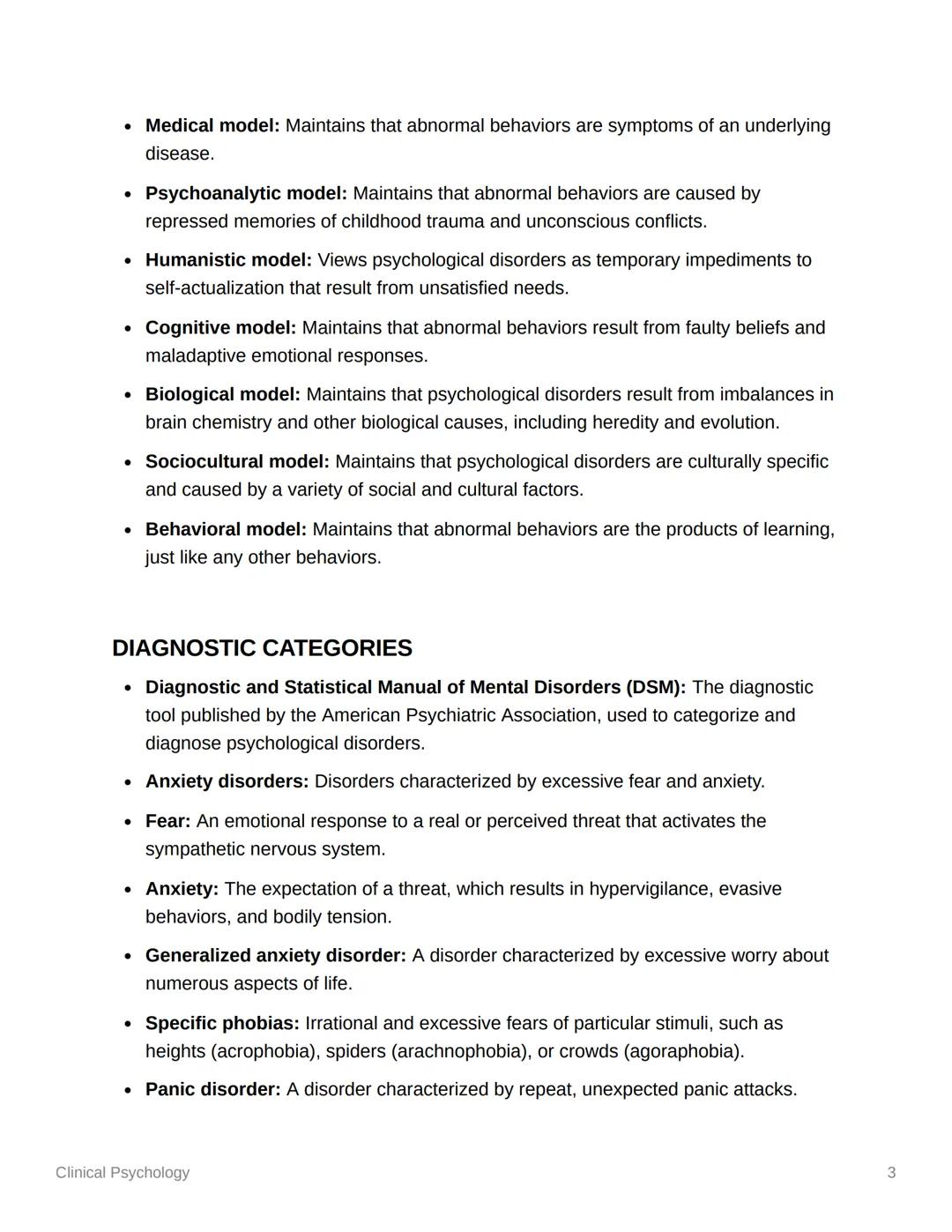
Models of Psychological Disorders
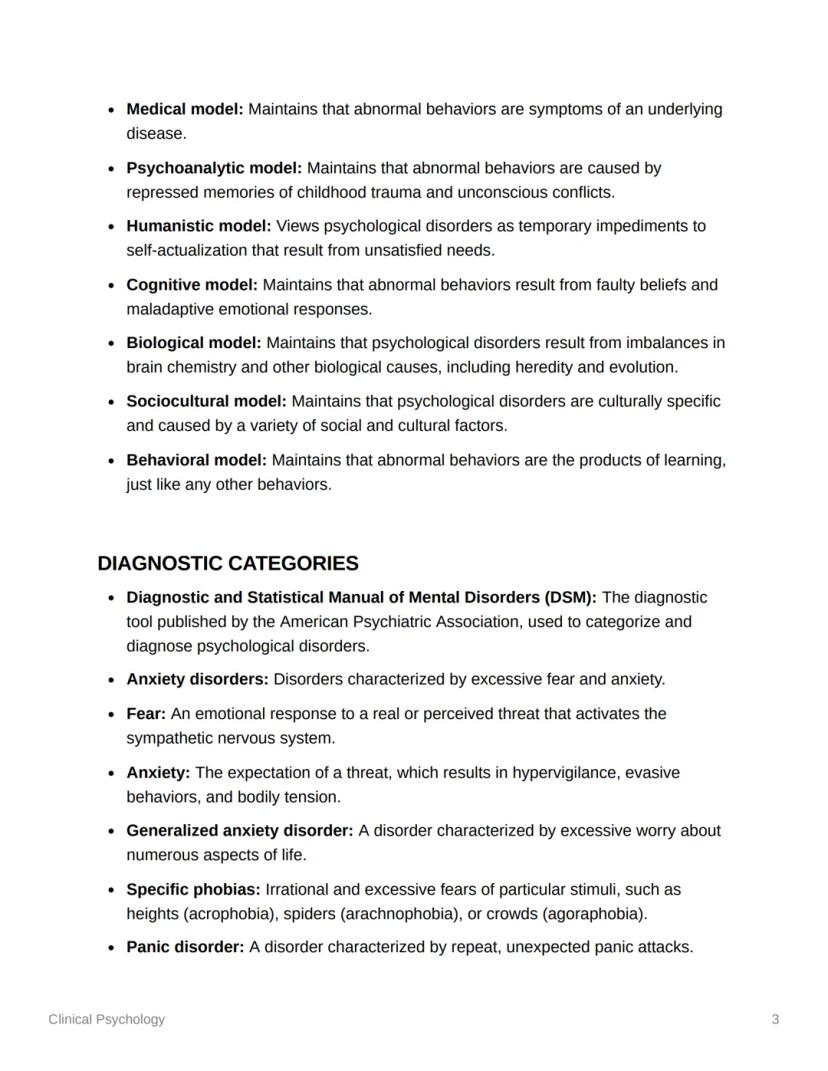
Psychologists understand abnormal behavior—maladaptive actions that defy social norms—through several different models. The medical model views abnormal behaviors as symptoms of underlying disease, while the psychoanalytic model attributes them to repressed memories and unconscious conflicts.
Other important perspectives include the humanistic model, which sees disorders as temporary barriers to self-actualization, and the cognitive model, which focuses on how faulty beliefs lead to psychological problems. The biological model emphasizes brain chemistry and genetics, while the sociocultural model examines how cultural factors influence mental health.
The behavioral model takes a different approach, suggesting that abnormal behaviors are learned responses just like any other behaviors. Each model offers unique insights into why psychological problems develop and how they might be treated.
Remember: No single model explains all psychological disorders perfectly. Modern clinical psychologists often integrate multiple perspectives to understand and treat mental health conditions effectively.
4
of 4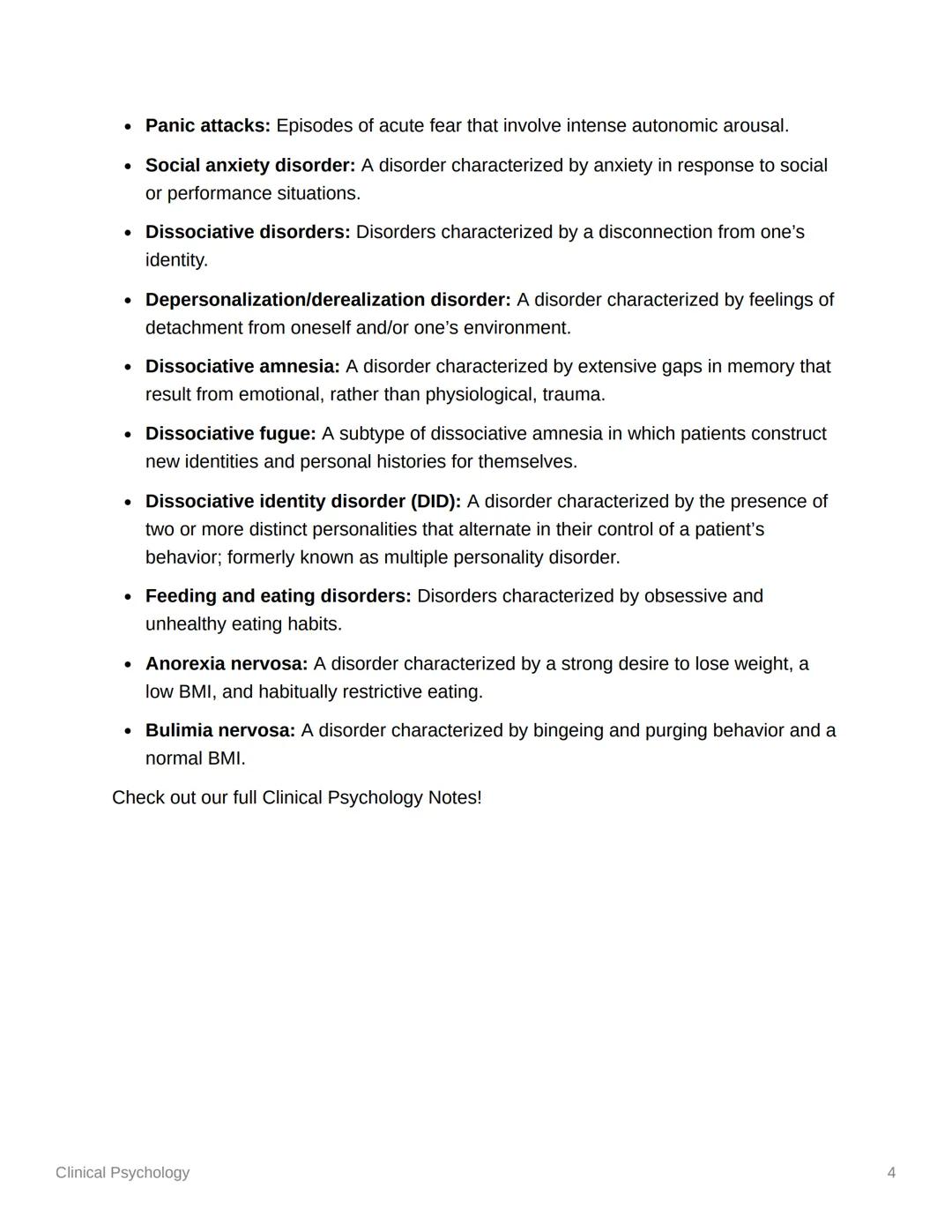
Common Psychological Disorders
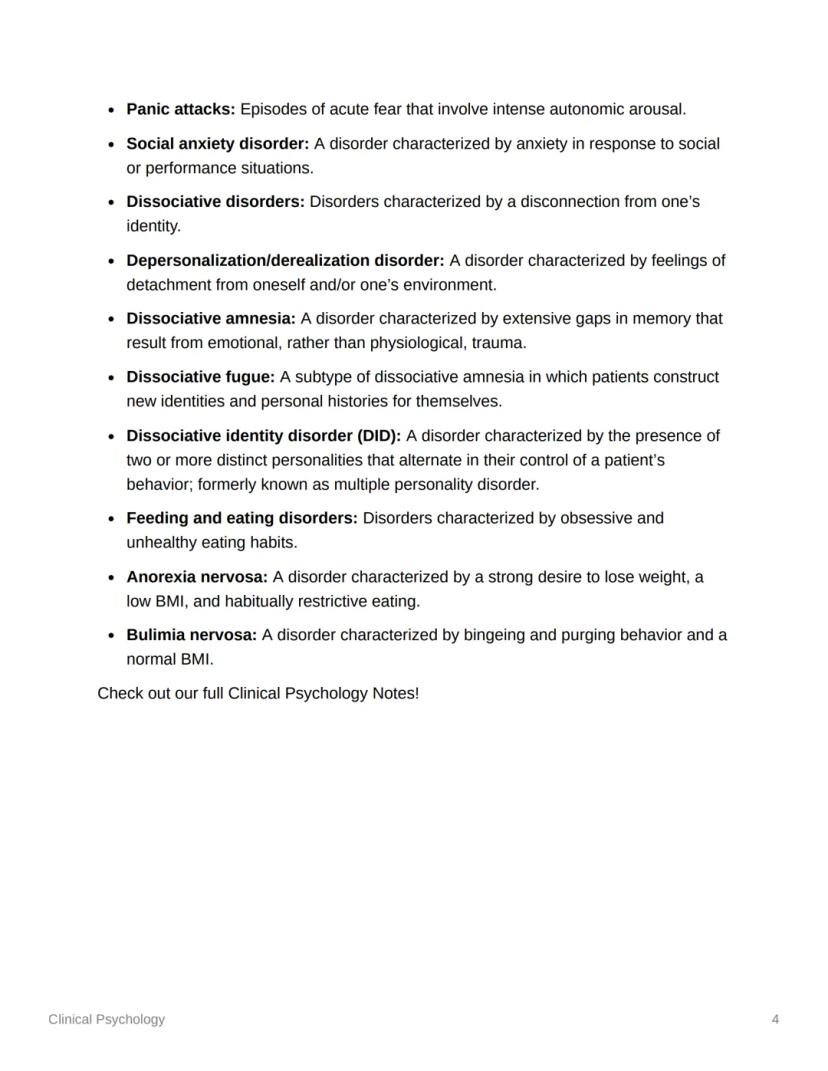
Anxiety disorders represent one major category of psychological problems, characterized by excessive fear (emotional response to threats) and anxiety (expectation of threats). These include generalized anxiety disorder (excessive worrying), specific phobias (irrational fears of particular things), panic disorder (repeated panic attacks), and social anxiety disorder (fear of social situations).
Dissociative disorders involve disconnection from one's identity and include conditions like depersonalization/derealization disorder (feeling detached from oneself or reality), dissociative amnesia (memory gaps due to emotional trauma), and dissociative identity disorder (presence of multiple personalities).
Feeding and eating disorders involve unhealthy relationships with food and body image. The two most common forms are anorexia nervosa (restrictive eating and low body weight) and bulimia nervosa (cycles of binging and purging).
Study tip: When learning about psychological disorders, focus on understanding the main symptoms rather than memorizing every detail. This approach will help you recognize patterns and better understand how different conditions affect people's lives.
We thought you’d never ask...
What is the Knowunity AI companion?
Our AI companion is specifically built for the needs of students. Based on the millions of content pieces we have on the platform we can provide truly meaningful and relevant answers to students. But its not only about answers, the companion is even more about guiding students through their daily learning challenges, with personalised study plans, quizzes or content pieces in the chat and 100% personalisation based on the students skills and developments.
Where can I download the Knowunity app?
You can download the app in the Google Play Store and in the Apple App Store.
Is Knowunity really free of charge?
That's right! Enjoy free access to study content, connect with fellow students, and get instant help – all at your fingertips.
Similar Content
 Psychology
 Psychology
Most popular content in AP Psychology
9F
AP PsychologyFoundations of Ethical Guidelines in Research
Practice the core principles of the APA ethical code including informed consent, debriefing, and the role of Institutional Review Boards.
9th1,3360
F
AP PsychologyFoundations of Research Design and Methodology
Practice distinguishing between different research methods including experiments, correlations, and case studies while identifying key variables.
9th6670
H
AP PsychologyHistorical Foundations of Psychology
Practice distinguishing between structuralism, functionalism, and the early philosophical roots of psychological science.
9th1,0920
I
AP PsychologyIntroduction to Descriptive Statistics
Practice identifying and calculating measures of central tendency and variation to summarize psychological data sets.
9th7010
I
AP PsychologyIntroduction to Auditory System Structures
Practice identifying the anatomical structures of the ear and their specific roles in converting sound waves into neural impulses.
9th6000
H
AP PsychologyHemispheric Specialization and Brain Structures
Practice identifying how specific structures like the corpus callosum and cerebral cortex coordinate complex human behaviors and sensory input.
9th3330
P
AP PsychologyParts of the brain and their functions quiz
Quick quiz on parts of the brain and their functions
10th1450
AP PsychologyAP psych
literally 103 pages of psych notes i took
10th1223
AP PsychologyThe Best AP Psychology Cram Sheet
cram sheet for AP Psych
10th95568
Most popular content
9O
 AP US History
Origins and Dynamics of the Columbian Exchange
Analyze the ecological and economic motivations behind the initial transfer of goods, people, and diseases between the Old and New Worlds.
9th3,1280
I
AP US HistoryIntroduction to Early Cultural Interactions
Analyze the initial social and religious encounters between Europeans, Africans, and Indigenous peoples in the colonial Americas.
9th2,7730
O
 AP World History
Origins of Ancient River Civilizations
Analyze the environmental factors and technological innovations that led to the rise of early states in Mesopotamia, Egypt, and the Indus Valley.
9th3,1870
M
AP US HistoryMotivations for European Exploration
Analyze the economic, religious, and political factors that drove European powers to the Americas during the 15th and 16th centuries.
9th1,7780
F
AP PsychologyFoundations of Ethical Guidelines in Research
Practice the core principles of the APA ethical code including informed consent, debriefing, and the role of Institutional Review Boards.
9th1,3360
I
AP US HistoryIntroduction to Native American Societies
Examine the diverse social, political, and economic structures of North American indigenous groups prior to European contact.
9th1,1100
I
 AP Biology
Introduction to Biological Elements of Life
Practice identifying the essential elements including carbon, nitrogen, phosphorus, and sulfur that compose biological macromolecules.
9th1,7390
I
AP US HistoryIntroduction to the Spanish Encomienda System
Explore the fundamental economic and social structures of the Spanish colonial system, focusing on the encomienda and the casta social hierarchy.
9th8890
O
AP World HistoryOrigins and Continuity of the Byzantine Empire
Analyze the political and cultural transitions from the Roman Empire to the Byzantine Empire, focusing on the reign of Justinian I and his code.
9th1,6320
Can't find what you're looking for? Explore other subjects.
Students love us — and so will you.
4.6/5App Store
4.7/5Google Play
The app is very easy to use and well designed. I have found everything I was looking for so far and have been able to learn a lot from the presentations! I will definitely use the app for a class assignment! And of course it also helps a lot as an inspiration.
Stefan SiOS user
This app is really great. There are so many study notes and help [...]. My problem subject is French, for example, and the app has so many options for help. Thanks to this app, I have improved my French. I would recommend it to anyone.
Samantha KlichAndroid user
Wow, I am really amazed. I just tried the app because I've seen it advertised many times and was absolutely stunned. This app is THE HELP you want for school and above all, it offers so many things, such as workouts and fact sheets, which have been VERY helpful to me personally.
AnnaiOS user
AP Psychology135 views·Updated Jun 6, 2026·4 pagesUnderstanding Clinical Psychology: Key Concepts for Students
Clinical psychology is a branch of psychology focused on assessing, diagnosing, treating, and preventing mental disorders. Clinical psychologists work with clients experiencing mental and emotional problems, using psychological testing and psychotherapy to help them improve their wellbeing. Understanding this field...
1
of 4
Sign up to see the content. It's free!
- Access to all documents
- Improve your grades
- Join milions of students
Understanding Clinical Psychology
Clinical psychologists are mental health professionals who help people with psychological difficulties through assessment, diagnosis, and treatment. They work in various settings including hospitals, clinics, and private practice to support people facing mental health challenges.
The core responsibilities of clinical psychologists include conducting assessments to diagnose mental health conditions, developing personalized treatment plans, and providing psychotherapy. They also monitor client progress, collaborate with other healthcare professionals, and stay current with the latest research on effective treatments.
Becoming a clinical psychologist requires extensive education—typically a doctoral degree in clinical psychology, completed internship training, and state licensure. Successful clinical psychologists combine strong assessment skills with empathy and communication abilities to help clients make positive life changes.
Did you know? Throughout history, different models of understanding psychological disorders have emerged. Today's psychologists draw from multiple perspectives, each with unique strengths and limitations when explaining mental health conditions.
2
of 4Sign up to see the content. It's free!
- Access to all documents
- Improve your grades
- Join milions of students
Diagnosis and Treatment Approaches
The Diagnostic and Statistical Manual of Mental Disorders is the main tool clinical psychologists use to diagnose mental health conditions. It organizes disorders by categories and symptom clusters, helping professionals identify specific conditions and develop appropriate treatment plans.
Using diagnostic labels has both benefits and drawbacks. On one hand, labels promote consistency in diagnosis, treatment planning, and research. On the other hand, as demonstrated by the Rosenhan experiment, labels can sometimes lead to harmful stereotyping or misdiagnosis.
Psychological treatment typically takes one of two main forms: psychotherapy (talk therapy) or pharmacological treatment (medication). Psychotherapy comes in several theoretical orientations including psychodynamic, humanistic, behavioral, cognitive, biomedical, and integrated approaches. These can be delivered in individual, group, couples, or family formats.
Important insight: Research shows that psychotherapy generally helps people make positive life changes, though certain types of therapy work better for specific conditions than others. Finding the right match between problem, therapy type, and therapist is key to successful treatment.
3
of 4Sign up to see the content. It's free!
- Access to all documents
- Improve your grades
- Join milions of students
Models of Psychological Disorders
Psychologists understand abnormal behavior—maladaptive actions that defy social norms—through several different models. The medical model views abnormal behaviors as symptoms of underlying disease, while the psychoanalytic model attributes them to repressed memories and unconscious conflicts.
Other important perspectives include the humanistic model, which sees disorders as temporary barriers to self-actualization, and the cognitive model, which focuses on how faulty beliefs lead to psychological problems. The biological model emphasizes brain chemistry and genetics, while the sociocultural model examines how cultural factors influence mental health.
The behavioral model takes a different approach, suggesting that abnormal behaviors are learned responses just like any other behaviors. Each model offers unique insights into why psychological problems develop and how they might be treated.
Remember: No single model explains all psychological disorders perfectly. Modern clinical psychologists often integrate multiple perspectives to understand and treat mental health conditions effectively.
4
of 4Sign up to see the content. It's free!
- Access to all documents
- Improve your grades
- Join milions of students
Common Psychological Disorders
Anxiety disorders represent one major category of psychological problems, characterized by excessive fear (emotional response to threats) and anxiety (expectation of threats). These include generalized anxiety disorder (excessive worrying), specific phobias (irrational fears of particular things), panic disorder (repeated panic attacks), and social anxiety disorder (fear of social situations).
Dissociative disorders involve disconnection from one's identity and include conditions like depersonalization/derealization disorder (feeling detached from oneself or reality), dissociative amnesia (memory gaps due to emotional trauma), and dissociative identity disorder (presence of multiple personalities).
Feeding and eating disorders involve unhealthy relationships with food and body image. The two most common forms are anorexia nervosa (restrictive eating and low body weight) and bulimia nervosa (cycles of binging and purging).
Study tip: When learning about psychological disorders, focus on understanding the main symptoms rather than memorizing every detail. This approach will help you recognize patterns and better understand how different conditions affect people's lives.
We thought you’d never ask...
What is the Knowunity AI companion?
Our AI companion is specifically built for the needs of students. Based on the millions of content pieces we have on the platform we can provide truly meaningful and relevant answers to students. But its not only about answers, the companion is even more about guiding students through their daily learning challenges, with personalised study plans, quizzes or content pieces in the chat and 100% personalisation based on the students skills and developments.
Where can I download the Knowunity app?
You can download the app in the Google Play Store and in the Apple App Store.
Is Knowunity really free of charge?
That's right! Enjoy free access to study content, connect with fellow students, and get instant help – all at your fingertips.
Similar Content
Most popular content in AP Psychology
9F
AP PsychologyFoundations of Ethical Guidelines in Research
Practice the core principles of the APA ethical code including informed consent, debriefing, and the role of Institutional Review Boards.
9th1,3360
F
AP PsychologyFoundations of Research Design and Methodology
Practice distinguishing between different research methods including experiments, correlations, and case studies while identifying key variables.
9th6670
H
AP PsychologyHistorical Foundations of Psychology
Practice distinguishing between structuralism, functionalism, and the early philosophical roots of psychological science.
9th1,0920
I
AP PsychologyIntroduction to Descriptive Statistics
Practice identifying and calculating measures of central tendency and variation to summarize psychological data sets.
9th7010
I
AP PsychologyIntroduction to Auditory System Structures
Practice identifying the anatomical structures of the ear and their specific roles in converting sound waves into neural impulses.
9th6000
H
AP PsychologyHemispheric Specialization and Brain Structures
Practice identifying how specific structures like the corpus callosum and cerebral cortex coordinate complex human behaviors and sensory input.
9th3330
P
AP PsychologyParts of the brain and their functions quiz
Quick quiz on parts of the brain and their functions
10th1450
AP PsychologyAP psych
literally 103 pages of psych notes i took
10th1223
AP PsychologyThe Best AP Psychology Cram Sheet
cram sheet for AP Psych
10th95568
Most popular content
9O
AP US HistoryOrigins and Dynamics of the Columbian Exchange
Analyze the ecological and economic motivations behind the initial transfer of goods, people, and diseases between the Old and New Worlds.
9th3,1280
I
AP US HistoryIntroduction to Early Cultural Interactions
Analyze the initial social and religious encounters between Europeans, Africans, and Indigenous peoples in the colonial Americas.
9th2,7730
O
AP World HistoryOrigins of Ancient River Civilizations
Analyze the environmental factors and technological innovations that led to the rise of early states in Mesopotamia, Egypt, and the Indus Valley.
9th3,1870
M
AP US HistoryMotivations for European Exploration
Analyze the economic, religious, and political factors that drove European powers to the Americas during the 15th and 16th centuries.
9th1,7780
F
AP PsychologyFoundations of Ethical Guidelines in Research
Practice the core principles of the APA ethical code including informed consent, debriefing, and the role of Institutional Review Boards.
9th1,3360
I
AP US HistoryIntroduction to Native American Societies
Examine the diverse social, political, and economic structures of North American indigenous groups prior to European contact.
9th1,1100
I
AP BiologyIntroduction to Biological Elements of Life
Practice identifying the essential elements including carbon, nitrogen, phosphorus, and sulfur that compose biological macromolecules.
9th1,7390
I
AP US HistoryIntroduction to the Spanish Encomienda System
Explore the fundamental economic and social structures of the Spanish colonial system, focusing on the encomienda and the casta social hierarchy.
9th8890
O
AP World HistoryOrigins and Continuity of the Byzantine Empire
Analyze the political and cultural transitions from the Roman Empire to the Byzantine Empire, focusing on the reign of Justinian I and his code.
9th1,6320
Can't find what you're looking for? Explore other subjects.
Students love us — and so will you.
4.6/5App Store
4.7/5Google Play
The app is very easy to use and well designed. I have found everything I was looking for so far and have been able to learn a lot from the presentations! I will definitely use the app for a class assignment! And of course it also helps a lot as an inspiration.
Stefan SiOS user
This app is really great. There are so many study notes and help [...]. My problem subject is French, for example, and the app has so many options for help. Thanks to this app, I have improved my French. I would recommend it to anyone.
Samantha KlichAndroid user
Wow, I am really amazed. I just tried the app because I've seen it advertised many times and was absolutely stunned. This app is THE HELP you want for school and above all, it offers so many things, such as workouts and fact sheets, which have been VERY helpful to me personally.
AnnaiOS user