

Social development shapes how children build relationships, understand social norms,...
 AP Psychology33 views·Updated Jun 7, 2026·7 pages
Understanding Social Development in Childhood - AP Psychology
1 / 7
1
of 7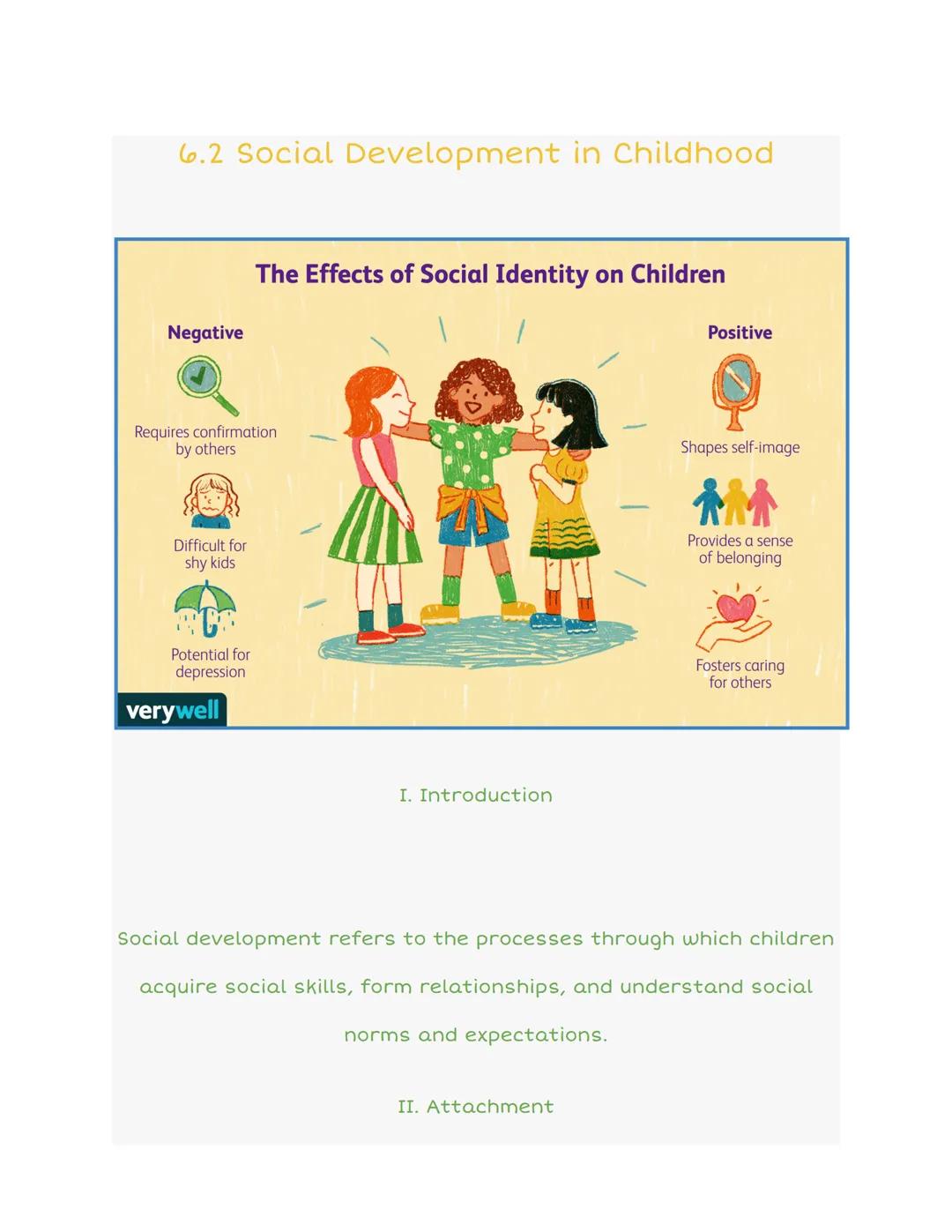
Understanding Social Development
Social development is how children learn to interact with others and understand social expectations. It's a foundation that affects nearly everything in their lives—from making friends to succeeding in school.
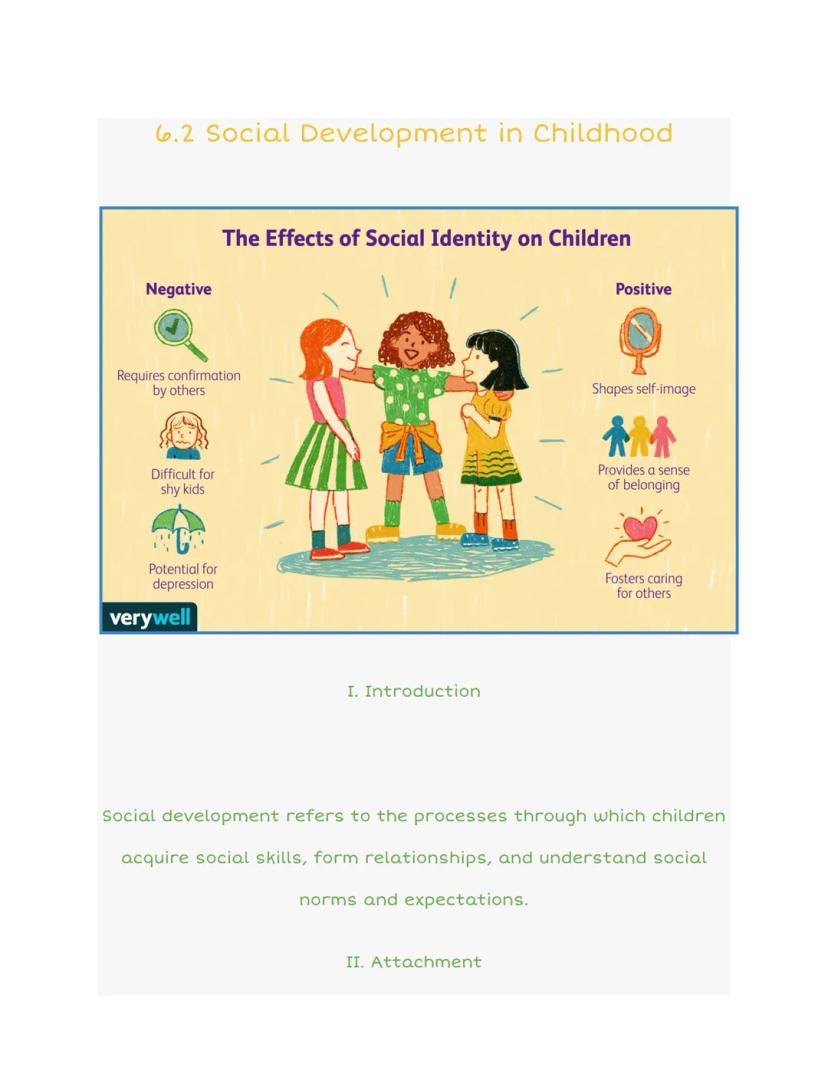
Your social identity has both positive and negative effects. On the positive side, it shapes your self-image, gives you a sense of belonging, and helps you develop empathy for others. However, it can also cause problems when it depends too much on others' approval, makes life difficult for shy children, or contributes to depression when social connections are weak.
Think About It: Notice how your own social identity affects how you feel about yourself. Do you depend too much on others' opinions, or have you developed a strong sense of who you are?
Social development begins with the bonds we form as babies and continues to evolve throughout childhood as we learn to understand others.
2
of 7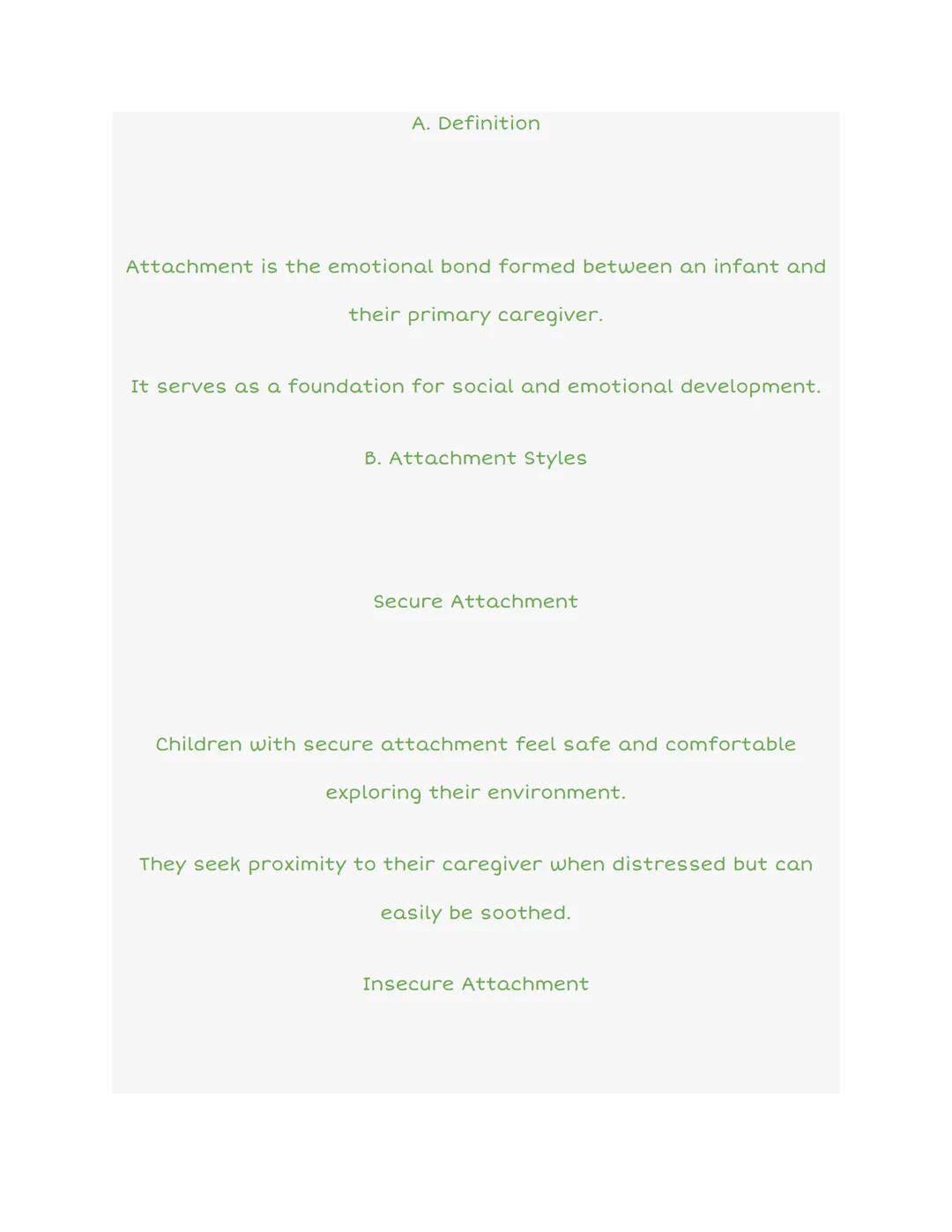
Attachment: Your First Relationship
Attachment is the emotional bond between a baby and their primary caregiver. Think of it as your first relationship—one that sets the pattern for all your future connections.
When children have secure attachment, they feel confident exploring their world because they know their caregiver will be there if needed. They might get upset when separated from their caregiver, but they're easily comforted when reunited. This healthy pattern helps build confidence and independence.
Not all attachment is secure, though. Insecure attachment happens when the caregiver-child bond is inconsistent or problematic, affecting how children approach relationships throughout life.
Remember: Your early attachments influence but don't determine your future. Many people overcome difficult early experiences with supportive relationships later in life.
3
of 7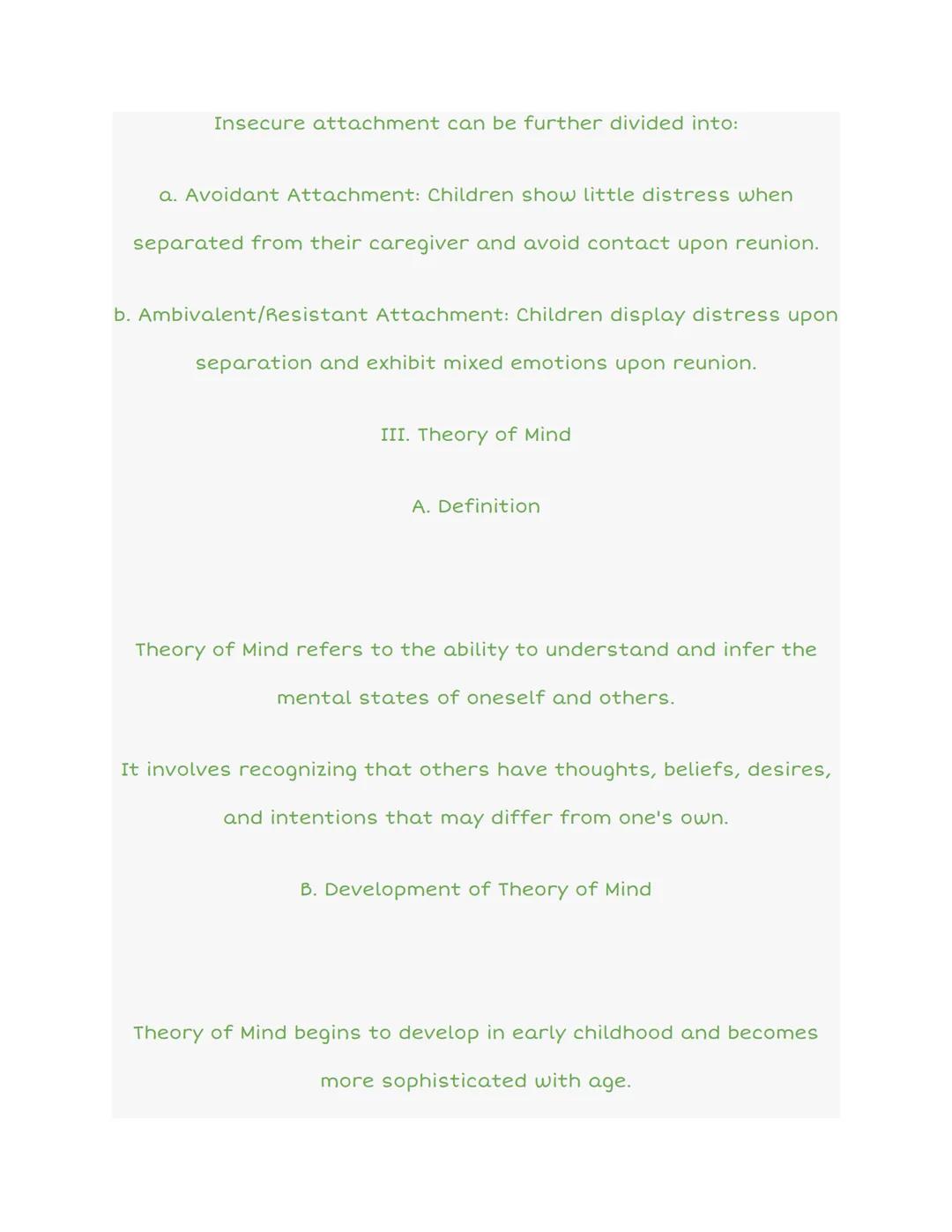
Types of Insecure Attachment & Theory of Mind
Children with avoidant attachment show little distress when separated from caregivers and may avoid contact when reunited. Those with ambivalent/resistant attachment become very upset during separation but display mixed emotions (seeking comfort while also resisting it) when caregivers return.
As children grow, they develop Theory of Mind—the ability to understand that others have thoughts and feelings different from their own. This crucial skill helps you recognize that everyone has their own perspective, which is essential for empathy and social success.
Theory of Mind begins developing in early childhood. Around age 4-5, kids start to understand that others can have beliefs that don't match reality (like believing there are cookies in a jar when you know they're gone).
Quick Check: Next time you disagree with a friend, try to imagine exactly what they're thinking. This exercise strengthens your Theory of Mind skills!
4
of 7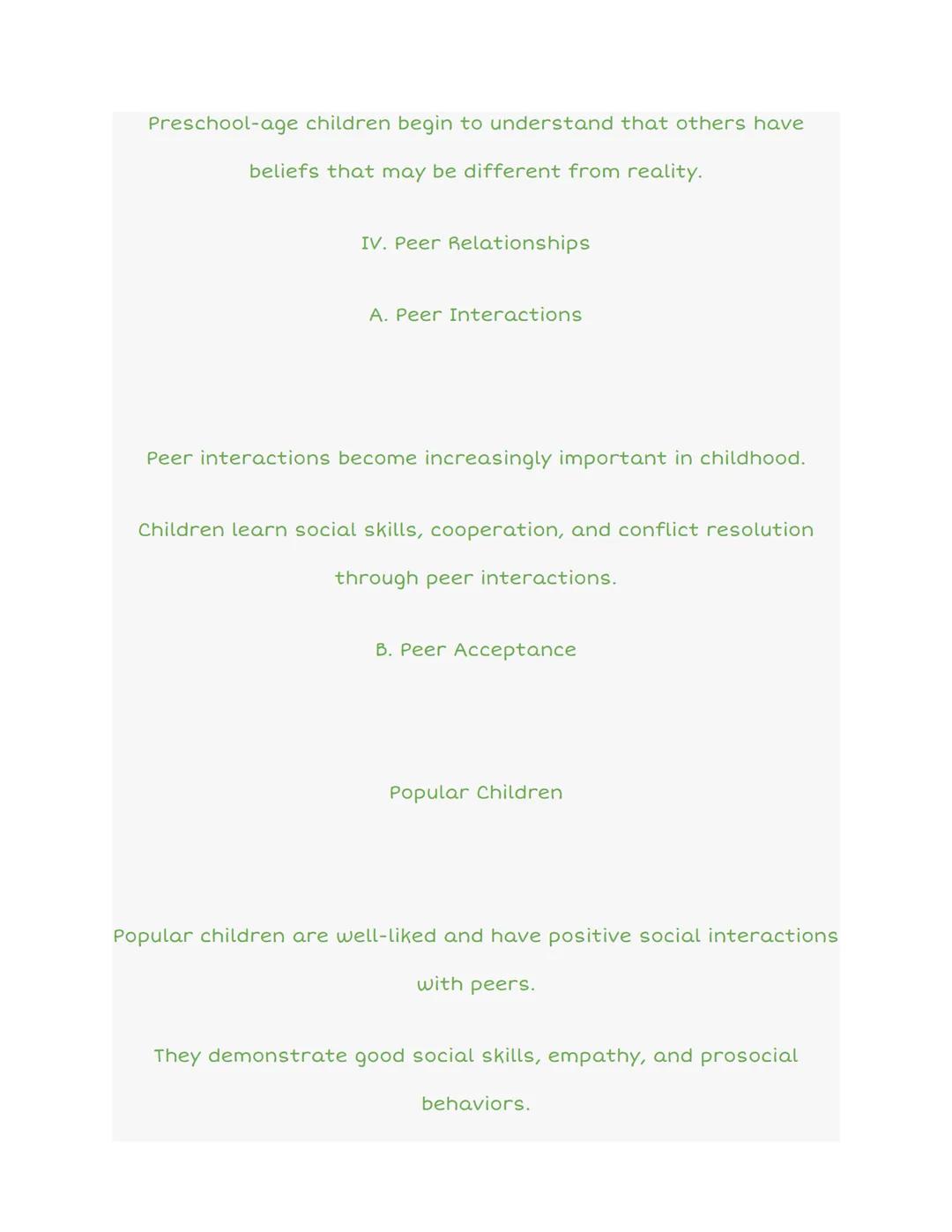
Navigating Peer Relationships
As you grow older, relationships with friends become increasingly important. These peer interactions teach you essential social skills like sharing, cooperation, and resolving conflicts.
Peer acceptance greatly impacts your social development. Popular children typically have good social skills, show empathy, and engage in helpful behaviors. They're well-liked because they make others feel good when they're around.
Different children have different social statuses among their peers. Understanding these patterns can help you navigate your own social world more effectively.
Social Skill Tip: Notice what popular kids in your group do differently. Do they listen well? Include others? Resolve conflicts calmly? These are skills anyone can learn with practice.
5
of 7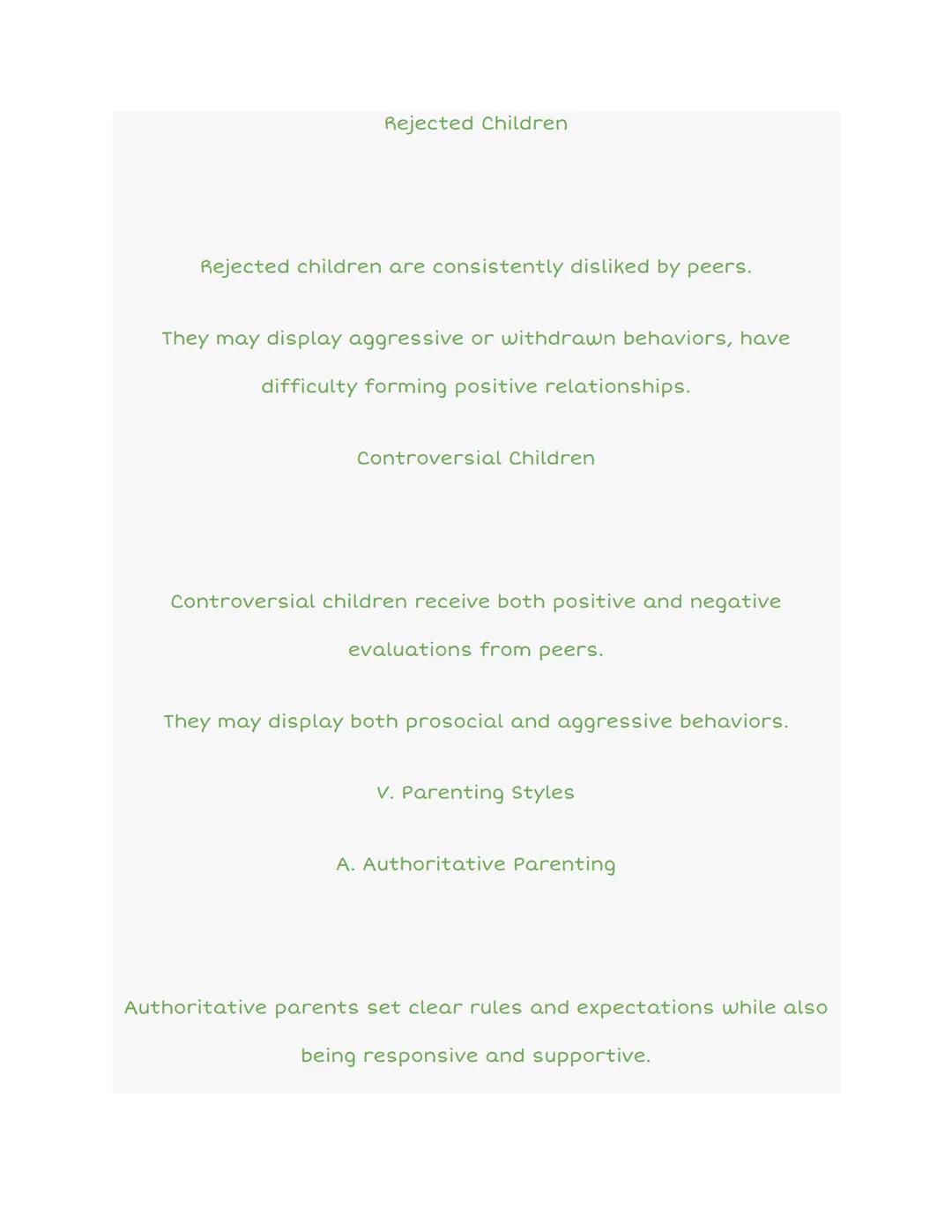
Understanding Social Status
Rejected children consistently have trouble fitting in with peers. They might act aggressively or withdraw from social situations, making it harder to form positive relationships. Without help developing better social skills, this pattern can continue for years.
Controversial children receive mixed reactions—some kids like them while others don't. They might show both positive behaviors (like leadership) and negative ones .
Your parents' approach to raising you also significantly affects your social development. Parenting styles create the environment where you first learn about relationships and social expectations.
Growth Mindset: If you struggle with peer relationships, remember that social skills can be learned just like any other skill. Small improvements can make a big difference in how others respond to you.
6
of 7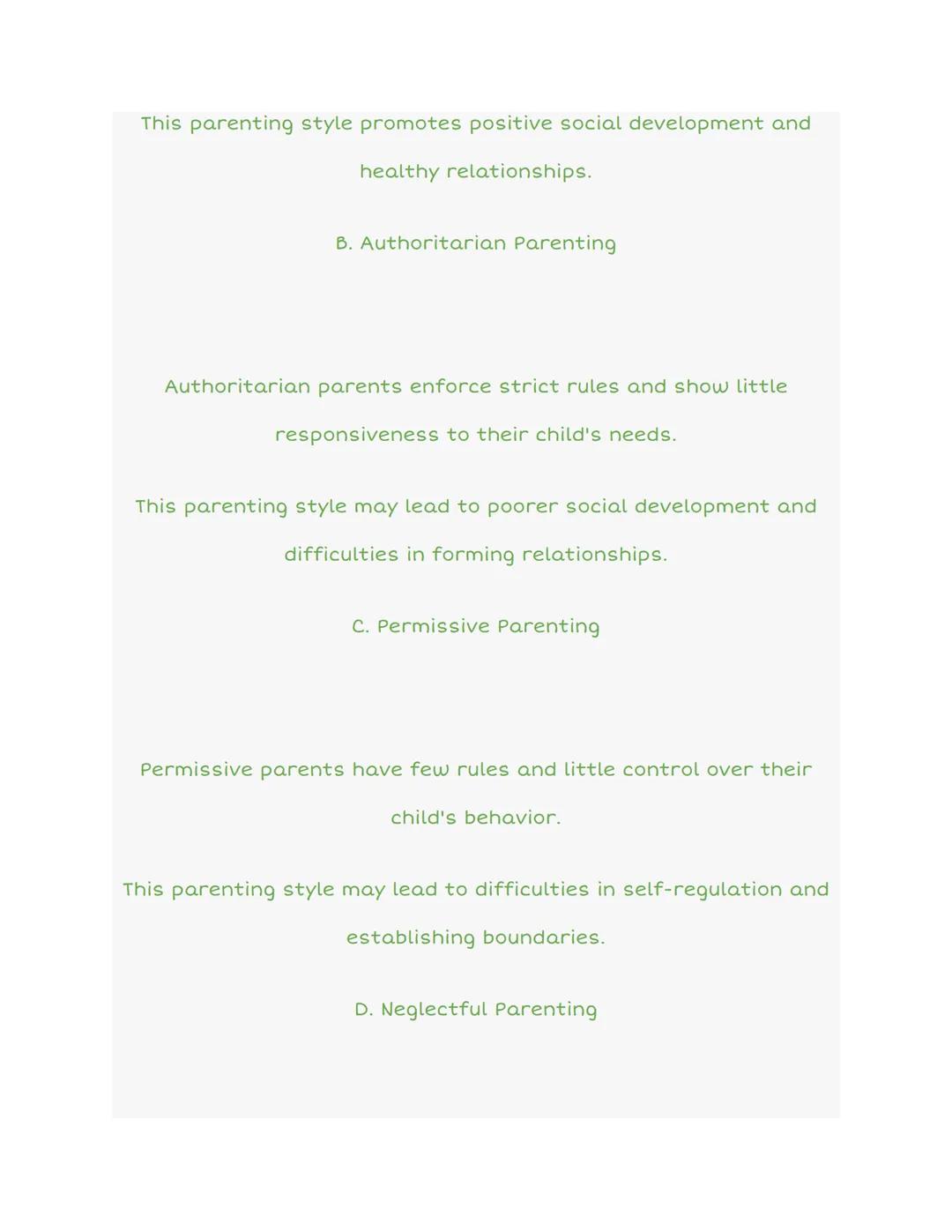
How Parenting Styles Affect You
Authoritative parents set clear rules while also being warm and responsive to your needs. This balanced approach helps kids develop good social skills, emotional regulation, and healthy relationships. Children of authoritative parents typically feel respected and secure.
Authoritarian parents focus on strict rules and obedience with less warmth and responsiveness. Growing up in this environment can make it harder to develop social confidence and independence, as children may focus more on following rules than understanding social nuances.
Permissive parents have few consistent rules and exercise little control over behavior. While this might feel good in the moment, it can lead to difficulties with self-control and understanding boundaries—important skills for maintaining friendships.
Perspective Check: No parenting style is perfect, and most parents use a mix of approaches. Understanding these patterns helps you recognize influences on your own social development.
7
of 7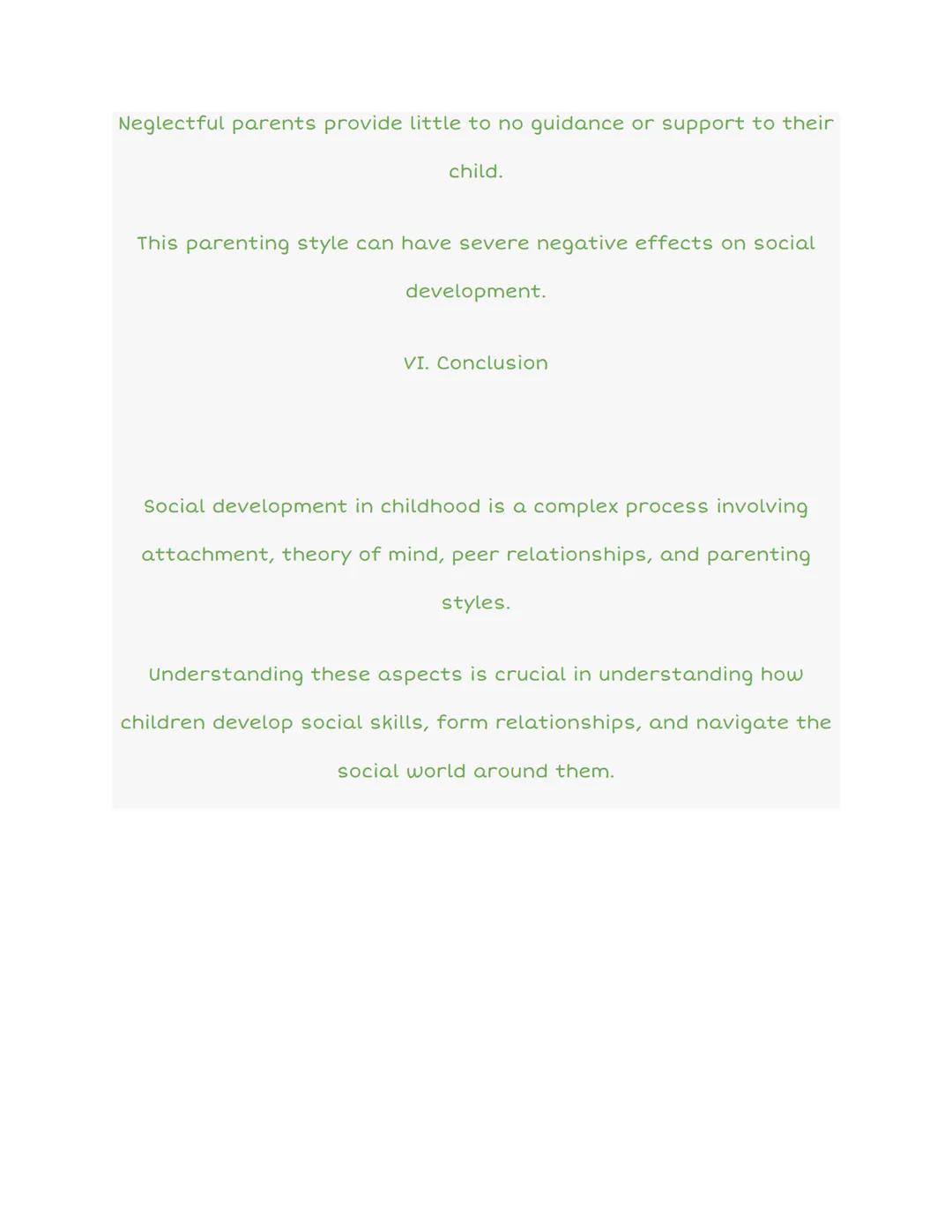
Impact of Parenting and Moving Forward
Neglectful parenting, where children receive minimal guidance or emotional support, can severely impact social development. Children in these situations often miss out on learning basic social skills and struggle to form healthy attachments.
Your social development journey involves many connected elements: the attachment you formed as a baby, your growing ability to understand others' perspectives, your experiences with friends, and your family environment. Each piece contributes to how you navigate relationships.
The good news is that social development continues throughout your life. No matter your early experiences, you can always improve your social understanding and skills. Recognizing patterns in your own social behavior is the first step toward positive change.
Remember: Social skills are like muscles—they get stronger with practice. Even small improvements in how you listen, express yourself, or manage conflicts can transform your social experiences.
We thought you’d never ask...
What is the Knowunity AI companion?
Our AI companion is specifically built for the needs of students. Based on the millions of content pieces we have on the platform we can provide truly meaningful and relevant answers to students. But its not only about answers, the companion is even more about guiding students through their daily learning challenges, with personalised study plans, quizzes or content pieces in the chat and 100% personalisation based on the students skills and developments.
Where can I download the Knowunity app?
You can download the app in the Google Play Store and in the Apple App Store.
Is Knowunity really free of charge?
That's right! Enjoy free access to study content, connect with fellow students, and get instant help – all at your fingertips.
Similar Content
 Psychology
 Psychology
Most popular content in AP Psychology
9F
AP PsychologyFoundations of Ethical Guidelines in Research
Practice the core principles of the APA ethical code including informed consent, debriefing, and the role of Institutional Review Boards.
9th1,3360
F
AP PsychologyFoundations of Research Design and Methodology
Practice distinguishing between different research methods including experiments, correlations, and case studies while identifying key variables.
9th6670
H
AP PsychologyHistorical Foundations of Psychology
Practice distinguishing between structuralism, functionalism, and the early philosophical roots of psychological science.
9th1,0920
I
AP PsychologyIntroduction to Descriptive Statistics
Practice identifying and calculating measures of central tendency and variation to summarize psychological data sets.
9th7010
I
AP PsychologyIntroduction to Auditory System Structures
Practice identifying the anatomical structures of the ear and their specific roles in converting sound waves into neural impulses.
9th6000
H
AP PsychologyHemispheric Specialization and Brain Structures
Practice identifying how specific structures like the corpus callosum and cerebral cortex coordinate complex human behaviors and sensory input.
9th3330
P
AP PsychologyParts of the brain and their functions quiz
Quick quiz on parts of the brain and their functions
10th1450
AP PsychologyAP psych
literally 103 pages of psych notes i took
10th1223
AP PsychologyThe Best AP Psychology Cram Sheet
cram sheet for AP Psych
10th95568
Most popular content
9O
 AP US History
Origins and Dynamics of the Columbian Exchange
Analyze the ecological and economic motivations behind the initial transfer of goods, people, and diseases between the Old and New Worlds.
9th3,1280
I
AP US HistoryIntroduction to Early Cultural Interactions
Analyze the initial social and religious encounters between Europeans, Africans, and Indigenous peoples in the colonial Americas.
9th2,7730
O
 AP World History
Origins of Ancient River Civilizations
Analyze the environmental factors and technological innovations that led to the rise of early states in Mesopotamia, Egypt, and the Indus Valley.
9th3,1870
M
AP US HistoryMotivations for European Exploration
Analyze the economic, religious, and political factors that drove European powers to the Americas during the 15th and 16th centuries.
9th1,7780
F
AP PsychologyFoundations of Ethical Guidelines in Research
Practice the core principles of the APA ethical code including informed consent, debriefing, and the role of Institutional Review Boards.
9th1,3360
I
AP US HistoryIntroduction to Native American Societies
Examine the diverse social, political, and economic structures of North American indigenous groups prior to European contact.
9th1,1100
I
 AP Biology
Introduction to Biological Elements of Life
Practice identifying the essential elements including carbon, nitrogen, phosphorus, and sulfur that compose biological macromolecules.
9th1,7390
I
AP US HistoryIntroduction to the Spanish Encomienda System
Explore the fundamental economic and social structures of the Spanish colonial system, focusing on the encomienda and the casta social hierarchy.
9th8890
O
AP World HistoryOrigins and Continuity of the Byzantine Empire
Analyze the political and cultural transitions from the Roman Empire to the Byzantine Empire, focusing on the reign of Justinian I and his code.
9th1,6320
Can't find what you're looking for? Explore other subjects.
Students love us — and so will you.
4.6/5App Store
4.7/5Google Play
The app is very easy to use and well designed. I have found everything I was looking for so far and have been able to learn a lot from the presentations! I will definitely use the app for a class assignment! And of course it also helps a lot as an inspiration.
Stefan SiOS user
This app is really great. There are so many study notes and help [...]. My problem subject is French, for example, and the app has so many options for help. Thanks to this app, I have improved my French. I would recommend it to anyone.
Samantha KlichAndroid user
Wow, I am really amazed. I just tried the app because I've seen it advertised many times and was absolutely stunned. This app is THE HELP you want for school and above all, it offers so many things, such as workouts and fact sheets, which have been VERY helpful to me personally.
AnnaiOS user
AP Psychology33 views·Updated Jun 7, 2026·7 pagesUnderstanding Social Development in Childhood - AP Psychology
Social development shapes how children build relationships, understand social norms, and develop crucial interpersonal skills. This process influences how kids see themselves, interact with others, and navigate their world as they grow.
1
of 7
Sign up to see the content. It's free!
- Access to all documents
- Improve your grades
- Join milions of students
Understanding Social Development
Social development is how children learn to interact with others and understand social expectations. It's a foundation that affects nearly everything in their lives—from making friends to succeeding in school.
Your social identity has both positive and negative effects. On the positive side, it shapes your self-image, gives you a sense of belonging, and helps you develop empathy for others. However, it can also cause problems when it depends too much on others' approval, makes life difficult for shy children, or contributes to depression when social connections are weak.
Think About It: Notice how your own social identity affects how you feel about yourself. Do you depend too much on others' opinions, or have you developed a strong sense of who you are?
Social development begins with the bonds we form as babies and continues to evolve throughout childhood as we learn to understand others.
2
of 7Sign up to see the content. It's free!
- Access to all documents
- Improve your grades
- Join milions of students
Attachment: Your First Relationship
Attachment is the emotional bond between a baby and their primary caregiver. Think of it as your first relationship—one that sets the pattern for all your future connections.
When children have secure attachment, they feel confident exploring their world because they know their caregiver will be there if needed. They might get upset when separated from their caregiver, but they're easily comforted when reunited. This healthy pattern helps build confidence and independence.
Not all attachment is secure, though. Insecure attachment happens when the caregiver-child bond is inconsistent or problematic, affecting how children approach relationships throughout life.
Remember: Your early attachments influence but don't determine your future. Many people overcome difficult early experiences with supportive relationships later in life.
3
of 7Sign up to see the content. It's free!
- Access to all documents
- Improve your grades
- Join milions of students
Types of Insecure Attachment & Theory of Mind
Children with avoidant attachment show little distress when separated from caregivers and may avoid contact when reunited. Those with ambivalent/resistant attachment become very upset during separation but display mixed emotions (seeking comfort while also resisting it) when caregivers return.
As children grow, they develop Theory of Mind—the ability to understand that others have thoughts and feelings different from their own. This crucial skill helps you recognize that everyone has their own perspective, which is essential for empathy and social success.
Theory of Mind begins developing in early childhood. Around age 4-5, kids start to understand that others can have beliefs that don't match reality (like believing there are cookies in a jar when you know they're gone).
Quick Check: Next time you disagree with a friend, try to imagine exactly what they're thinking. This exercise strengthens your Theory of Mind skills!
4
of 7Sign up to see the content. It's free!
- Access to all documents
- Improve your grades
- Join milions of students
Navigating Peer Relationships
As you grow older, relationships with friends become increasingly important. These peer interactions teach you essential social skills like sharing, cooperation, and resolving conflicts.
Peer acceptance greatly impacts your social development. Popular children typically have good social skills, show empathy, and engage in helpful behaviors. They're well-liked because they make others feel good when they're around.
Different children have different social statuses among their peers. Understanding these patterns can help you navigate your own social world more effectively.
Social Skill Tip: Notice what popular kids in your group do differently. Do they listen well? Include others? Resolve conflicts calmly? These are skills anyone can learn with practice.
5
of 7Sign up to see the content. It's free!
- Access to all documents
- Improve your grades
- Join milions of students
Understanding Social Status
Rejected children consistently have trouble fitting in with peers. They might act aggressively or withdraw from social situations, making it harder to form positive relationships. Without help developing better social skills, this pattern can continue for years.
Controversial children receive mixed reactions—some kids like them while others don't. They might show both positive behaviors (like leadership) and negative ones .
Your parents' approach to raising you also significantly affects your social development. Parenting styles create the environment where you first learn about relationships and social expectations.
Growth Mindset: If you struggle with peer relationships, remember that social skills can be learned just like any other skill. Small improvements can make a big difference in how others respond to you.
6
of 7Sign up to see the content. It's free!
- Access to all documents
- Improve your grades
- Join milions of students
How Parenting Styles Affect You
Authoritative parents set clear rules while also being warm and responsive to your needs. This balanced approach helps kids develop good social skills, emotional regulation, and healthy relationships. Children of authoritative parents typically feel respected and secure.
Authoritarian parents focus on strict rules and obedience with less warmth and responsiveness. Growing up in this environment can make it harder to develop social confidence and independence, as children may focus more on following rules than understanding social nuances.
Permissive parents have few consistent rules and exercise little control over behavior. While this might feel good in the moment, it can lead to difficulties with self-control and understanding boundaries—important skills for maintaining friendships.
Perspective Check: No parenting style is perfect, and most parents use a mix of approaches. Understanding these patterns helps you recognize influences on your own social development.
7
of 7Sign up to see the content. It's free!
- Access to all documents
- Improve your grades
- Join milions of students
Impact of Parenting and Moving Forward
Neglectful parenting, where children receive minimal guidance or emotional support, can severely impact social development. Children in these situations often miss out on learning basic social skills and struggle to form healthy attachments.
Your social development journey involves many connected elements: the attachment you formed as a baby, your growing ability to understand others' perspectives, your experiences with friends, and your family environment. Each piece contributes to how you navigate relationships.
The good news is that social development continues throughout your life. No matter your early experiences, you can always improve your social understanding and skills. Recognizing patterns in your own social behavior is the first step toward positive change.
Remember: Social skills are like muscles—they get stronger with practice. Even small improvements in how you listen, express yourself, or manage conflicts can transform your social experiences.
We thought you’d never ask...
What is the Knowunity AI companion?
Our AI companion is specifically built for the needs of students. Based on the millions of content pieces we have on the platform we can provide truly meaningful and relevant answers to students. But its not only about answers, the companion is even more about guiding students through their daily learning challenges, with personalised study plans, quizzes or content pieces in the chat and 100% personalisation based on the students skills and developments.
Where can I download the Knowunity app?
You can download the app in the Google Play Store and in the Apple App Store.
Is Knowunity really free of charge?
That's right! Enjoy free access to study content, connect with fellow students, and get instant help – all at your fingertips.
Similar Content
Most popular content in AP Psychology
9F
AP PsychologyFoundations of Ethical Guidelines in Research
Practice the core principles of the APA ethical code including informed consent, debriefing, and the role of Institutional Review Boards.
9th1,3360
F
AP PsychologyFoundations of Research Design and Methodology
Practice distinguishing between different research methods including experiments, correlations, and case studies while identifying key variables.
9th6670
H
AP PsychologyHistorical Foundations of Psychology
Practice distinguishing between structuralism, functionalism, and the early philosophical roots of psychological science.
9th1,0920
I
AP PsychologyIntroduction to Descriptive Statistics
Practice identifying and calculating measures of central tendency and variation to summarize psychological data sets.
9th7010
I
AP PsychologyIntroduction to Auditory System Structures
Practice identifying the anatomical structures of the ear and their specific roles in converting sound waves into neural impulses.
9th6000
H
AP PsychologyHemispheric Specialization and Brain Structures
Practice identifying how specific structures like the corpus callosum and cerebral cortex coordinate complex human behaviors and sensory input.
9th3330
P
AP PsychologyParts of the brain and their functions quiz
Quick quiz on parts of the brain and their functions
10th1450
AP PsychologyAP psych
literally 103 pages of psych notes i took
10th1223
AP PsychologyThe Best AP Psychology Cram Sheet
cram sheet for AP Psych
10th95568
Most popular content
9O
AP US HistoryOrigins and Dynamics of the Columbian Exchange
Analyze the ecological and economic motivations behind the initial transfer of goods, people, and diseases between the Old and New Worlds.
9th3,1280
I
AP US HistoryIntroduction to Early Cultural Interactions
Analyze the initial social and religious encounters between Europeans, Africans, and Indigenous peoples in the colonial Americas.
9th2,7730
O
AP World HistoryOrigins of Ancient River Civilizations
Analyze the environmental factors and technological innovations that led to the rise of early states in Mesopotamia, Egypt, and the Indus Valley.
9th3,1870
M
AP US HistoryMotivations for European Exploration
Analyze the economic, religious, and political factors that drove European powers to the Americas during the 15th and 16th centuries.
9th1,7780
F
AP PsychologyFoundations of Ethical Guidelines in Research
Practice the core principles of the APA ethical code including informed consent, debriefing, and the role of Institutional Review Boards.
9th1,3360
I
AP US HistoryIntroduction to Native American Societies
Examine the diverse social, political, and economic structures of North American indigenous groups prior to European contact.
9th1,1100
I
AP BiologyIntroduction to Biological Elements of Life
Practice identifying the essential elements including carbon, nitrogen, phosphorus, and sulfur that compose biological macromolecules.
9th1,7390
I
AP US HistoryIntroduction to the Spanish Encomienda System
Explore the fundamental economic and social structures of the Spanish colonial system, focusing on the encomienda and the casta social hierarchy.
9th8890
O
AP World HistoryOrigins and Continuity of the Byzantine Empire
Analyze the political and cultural transitions from the Roman Empire to the Byzantine Empire, focusing on the reign of Justinian I and his code.
9th1,6320
Can't find what you're looking for? Explore other subjects.
Students love us — and so will you.
4.6/5App Store
4.7/5Google Play
The app is very easy to use and well designed. I have found everything I was looking for so far and have been able to learn a lot from the presentations! I will definitely use the app for a class assignment! And of course it also helps a lot as an inspiration.
Stefan SiOS user
This app is really great. There are so many study notes and help [...]. My problem subject is French, for example, and the app has so many options for help. Thanks to this app, I have improved my French. I would recommend it to anyone.
Samantha KlichAndroid user
Wow, I am really amazed. I just tried the app because I've seen it advertised many times and was absolutely stunned. This app is THE HELP you want for school and above all, it offers so many things, such as workouts and fact sheets, which have been VERY helpful to me personally.
AnnaiOS user