

Language is the powerful tool that lets us communicate with...
 AP Psychology27 views·Updated Jun 17, 2026·6 pages
Understanding Components of Language Acquisition - AP Psychology Notes

1 / 6
1
of 6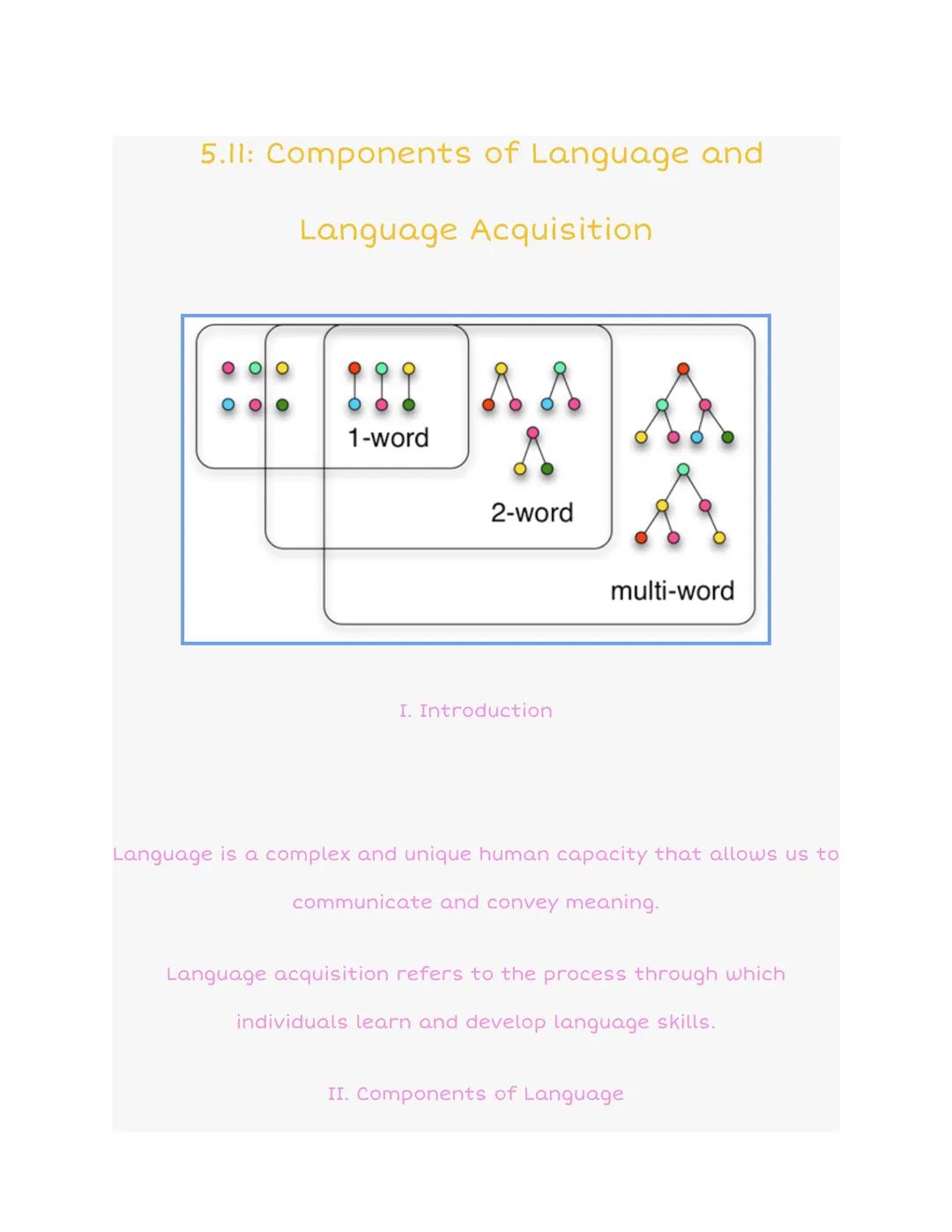
Components of Language and Language Acquisition
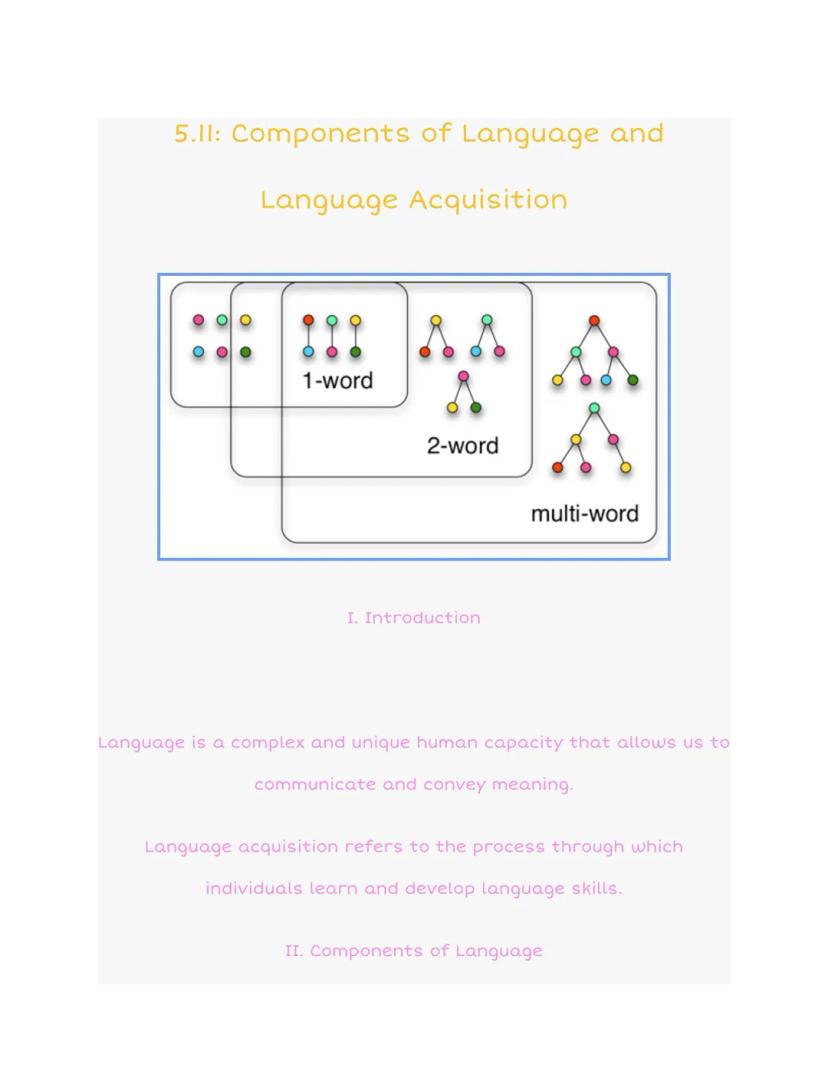
Ever wonder how you learned to speak without even trying? Language is uniquely human and incredibly complex. When we talk about language, we're looking at two main things: the components that make up language itself and how we actually learn it.
Language has several building blocks that work together to create meaning. These components range from the sounds we make to how we understand context in a conversation.
The way we acquire language—from babbling as babies to speaking in full sentences—follows certain patterns based on our natural abilities and experiences with others.
Learning Highlight: Even though language seems simple when you use it every day, it's actually one of the most complex skills humans develop!
2
of 6
Phonology and Morphology
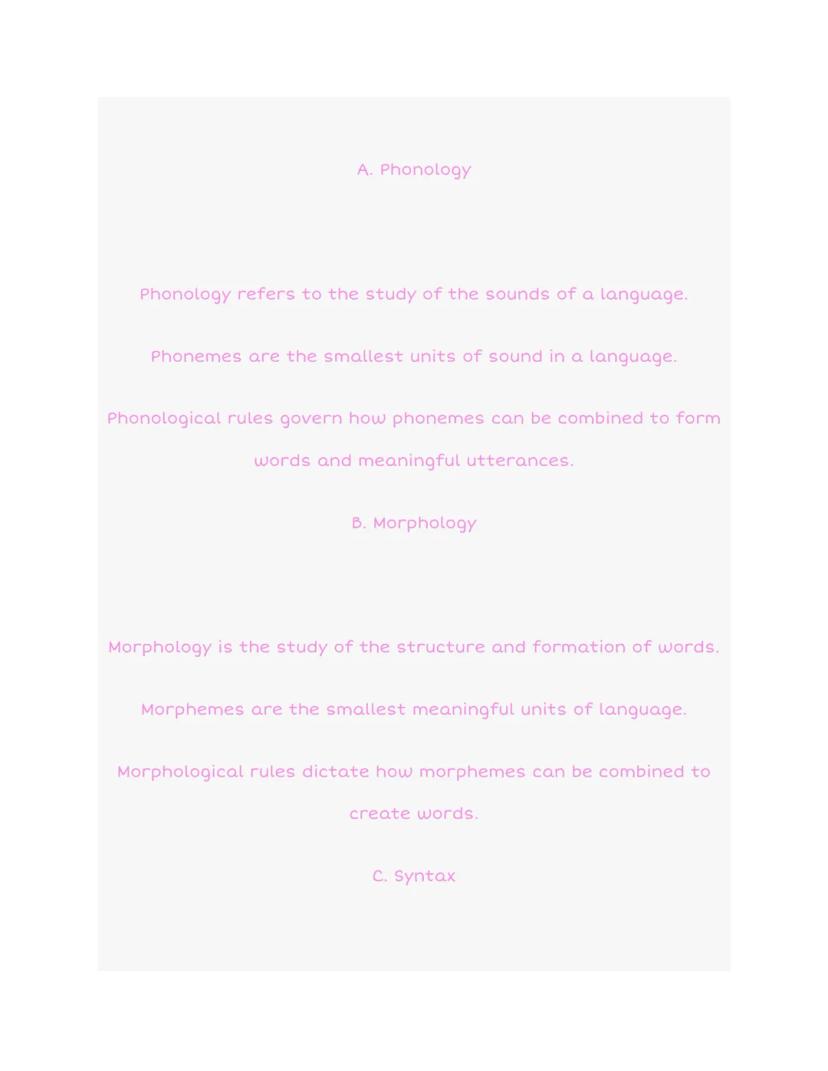
The sounds of language make up what linguists call phonology. Every language has its own set of phonemes—those are the smallest units of sound that distinguish one word from another. Think about how changing one sound can create a completely different word (like "cat" vs. "bat").
Words themselves are built from morphemes, which are the smallest meaningful units in language. For example, the word "unhappy" has two morphemes: "un-" and "happy." Understanding morphology helps us see how words are formed and how adding prefixes or suffixes changes meaning.
These rules might seem complicated, but you mastered them as a child without even realizing it! Your brain naturally picked up on these patterns as you listened to people around you.
Think About It: English has about 44 phonemes (sound units), but other languages may have more or fewer. Hawaiian has only 13 phonemes, while some languages have over 100!
3
of 6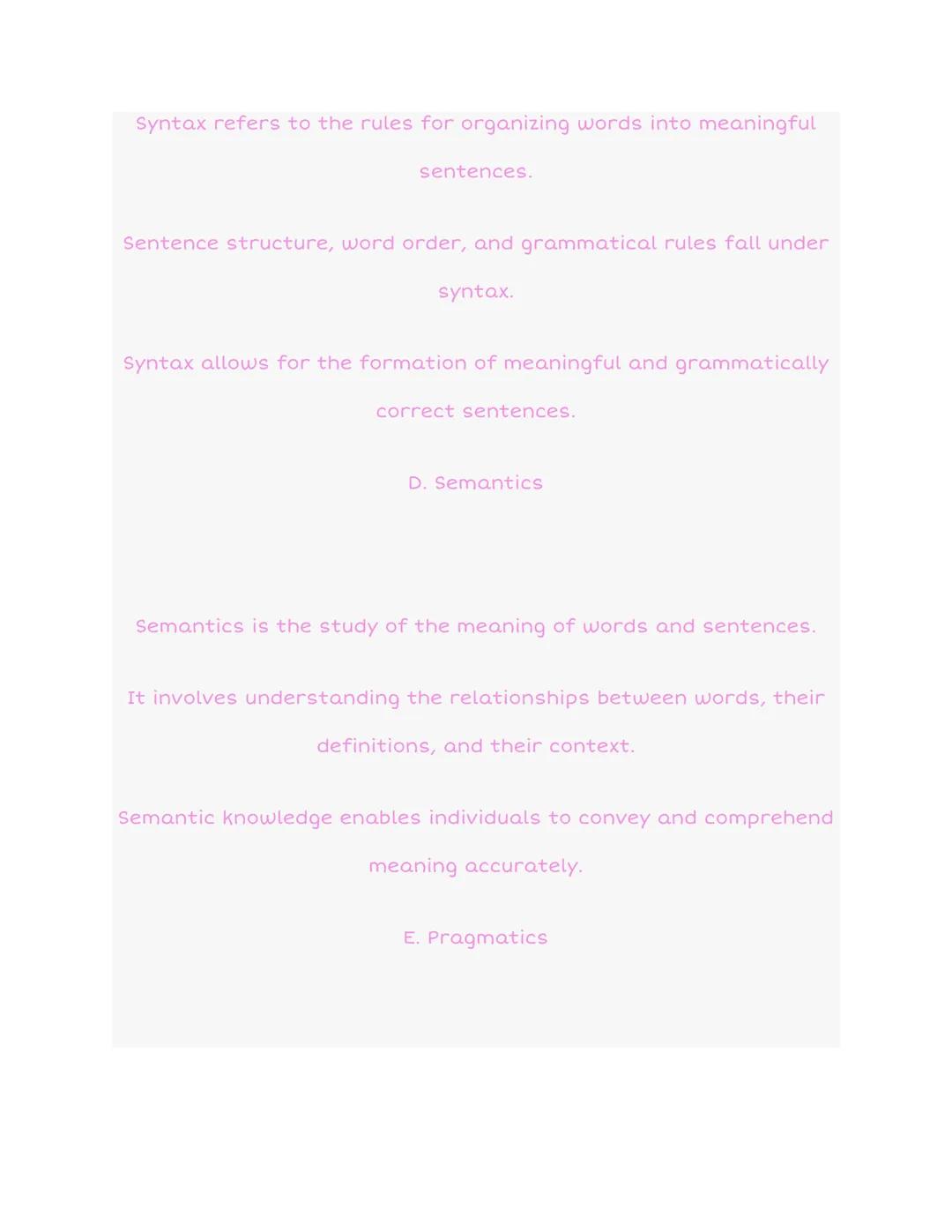
Syntax and Semantics
Syntax is like the grammar rulebook for language. It governs how we organize words into sentences that make sense. Without syntax, we'd just have random words thrown together! Your ability to recognize when a sentence sounds "wrong" shows your knowledge of syntax.
Semantics deals with meaning in language. It's not just about what words mean individually, but how they relate to each other and create meaning in context. This is why we can understand metaphors, jokes, and subtle differences between similar words.
When you interpret the meaning of "I'm dying to see that movie," you know the person isn't literally dying—that's your semantic knowledge at work!
Pro Tip: When writing essays, paying attention to syntax (sentence structure) can make your arguments clearer and more persuasive.
4
of 6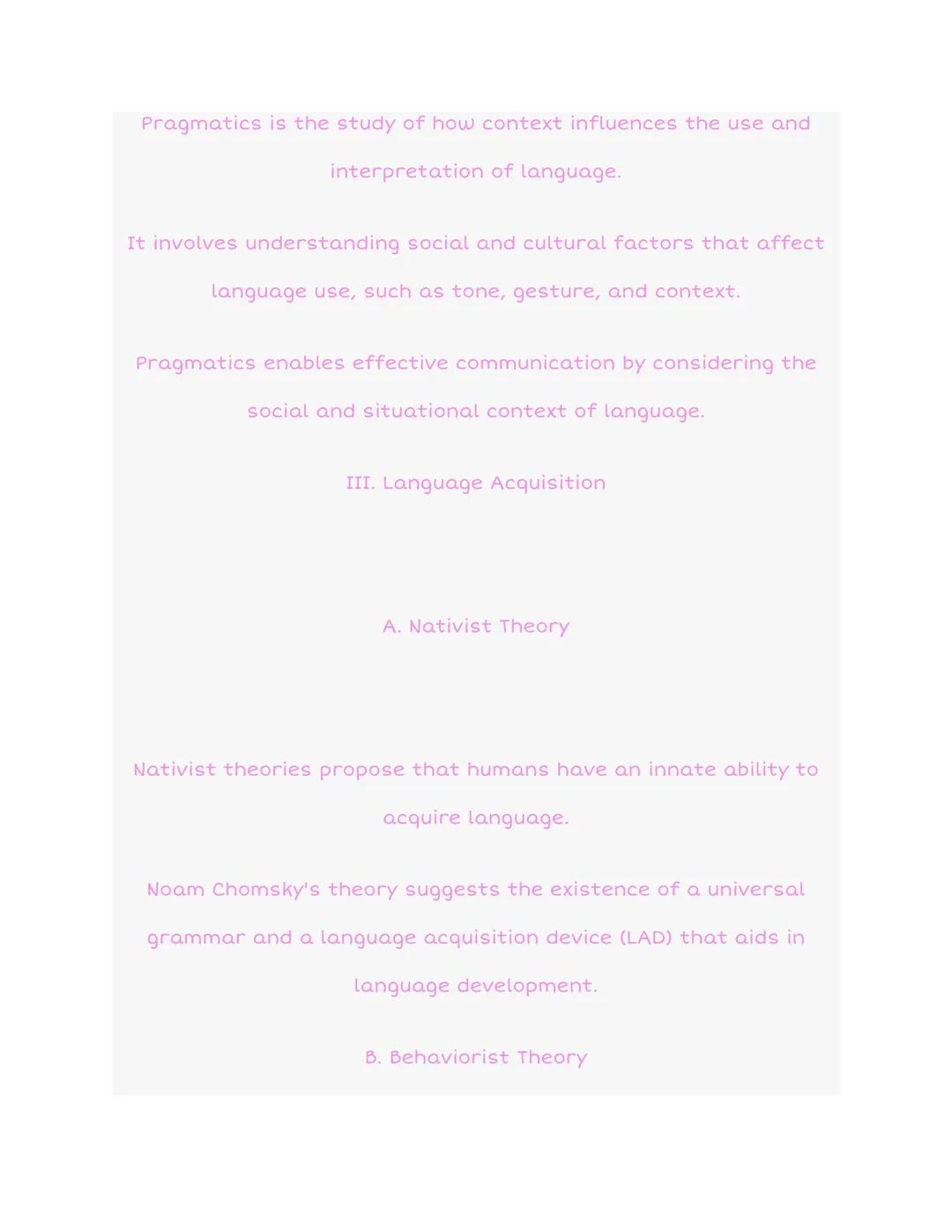
Pragmatics and Language Acquisition Theories
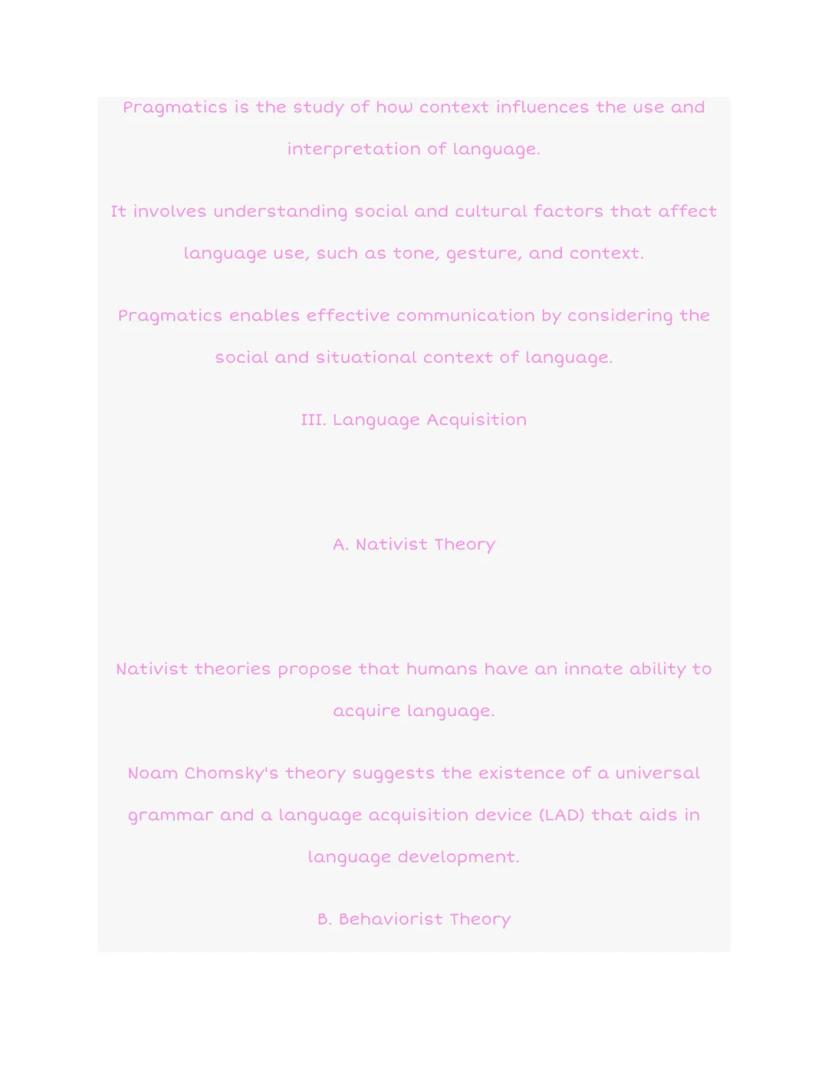
Pragmatics focuses on how we use language in social situations. It's about understanding tone, gestures, and unspoken rules. Have you noticed how you speak differently to friends versus teachers? That's pragmatics in action!
How we learn language has been explained through different theories. Nativist theory, developed by Noam Chomsky, suggests we're born with a built-in capacity for language. According to this view, humans have a natural "language acquisition device" in our brains that helps us learn any language we're exposed to.
The behaviorist theory, on the other hand, believes language is learned through reinforcement and imitation. When you said something correctly as a toddler and got positive reactions, this theory suggests that reinforced your language development.
Fascinating Fact: Babies can distinguish between all speech sounds in all languages until about 6 months old. After that, they start specializing in the sounds they hear regularly in their environment.
5
of 6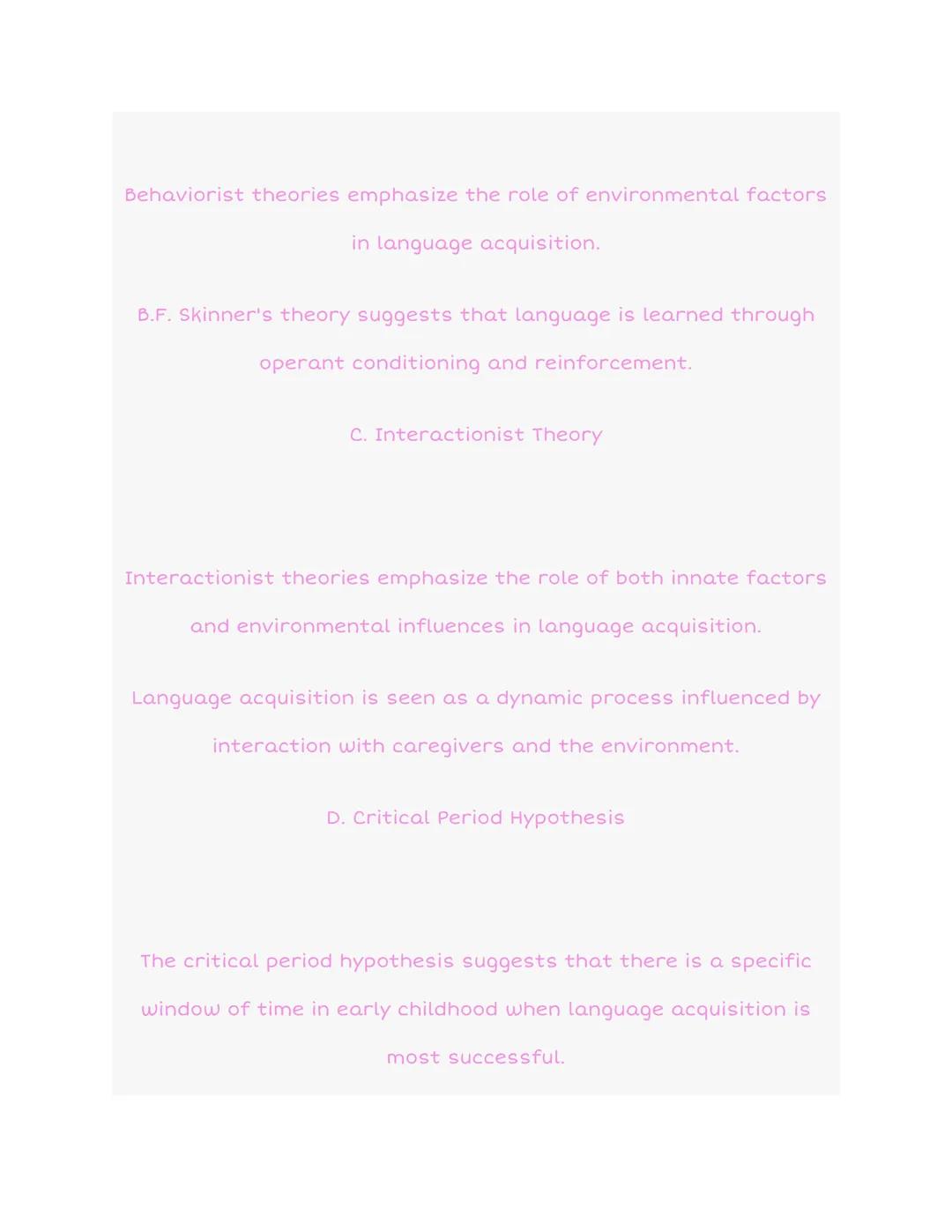
More Language Acquisition Theories
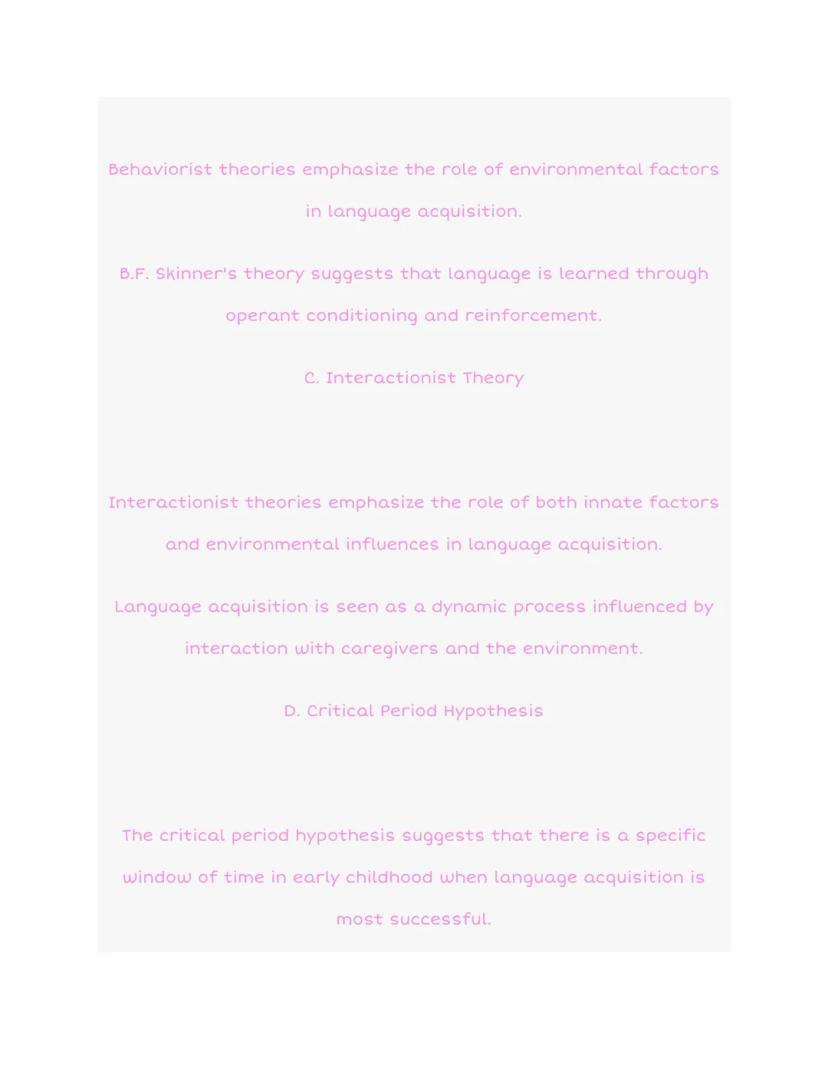
The interactionist theory takes a middle ground approach. It says that both our natural abilities and our social interactions are crucial for language development. This theory emphasizes how conversations with caregivers shape language skills.
Have you ever noticed how adults often speak differently to babies? This "baby talk" or "motherese" actually helps highlight language patterns and makes it easier for infants to pick up on language rules.
The critical period hypothesis suggests that there's a specific window of time (usually early childhood) when learning language comes naturally. After this period closes, learning a language becomes much more challenging. This is why learning a new language as a teenager or adult often feels harder than learning your first language as a child.
Challenge Yourself: If you're learning a second language, try to mimic how children learn naturally—through conversation, songs, and stories rather than just memorizing vocabulary lists.
6
of 6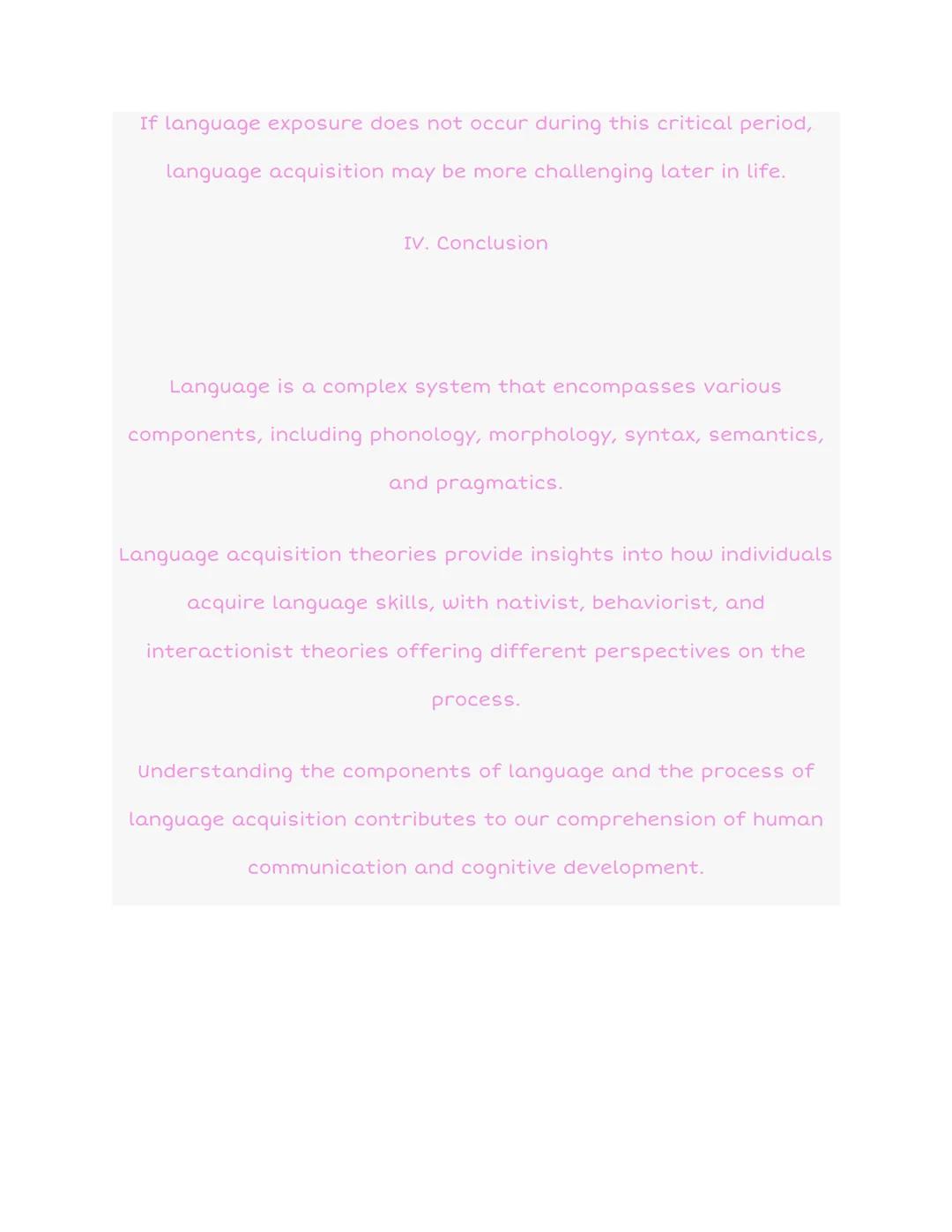
Understanding Language Development
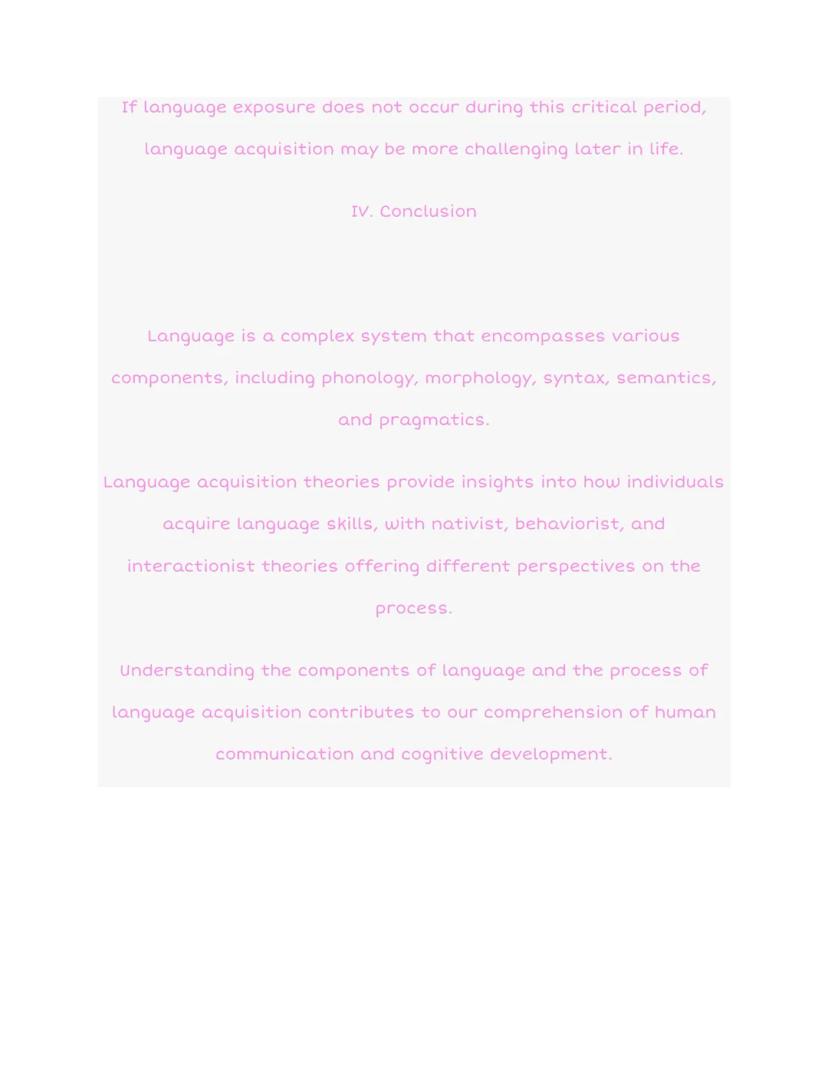
If someone misses exposure to language during the critical period, they might face significant challenges in becoming fully fluent later. This has been observed in rare cases of children who were isolated from language during their early years.
Language shapes how we think, communicate, and understand the world around us. Each component—from the sounds we make to how we use language in different situations—plays a vital role in our ability to connect with others.
The theories about how we acquire language help explain the amazing fact that most children naturally develop complex language skills without formal instruction. By age 5 or 6, most kids have mastered the basic structure of their native language!
Remember: You've already accomplished one of the most complex human achievements—learning a language! The language skills you take for granted actually represent an incredible feat of human cognition.
We thought you’d never ask...
What is the Knowunity AI companion?
Our AI companion is specifically built for the needs of students. Based on the millions of content pieces we have on the platform we can provide truly meaningful and relevant answers to students. But its not only about answers, the companion is even more about guiding students through their daily learning challenges, with personalised study plans, quizzes or content pieces in the chat and 100% personalisation based on the students skills and developments.
Where can I download the Knowunity app?
You can download the app in the Google Play Store and in the Apple App Store.
Is Knowunity really free of charge?
That's right! Enjoy free access to study content, connect with fellow students, and get instant help – all at your fingertips.
Similar Content
 Psychology
 Psychology
Most popular content in AP Psychology
9F
AP PsychologyFoundations of Ethical Guidelines in Research
Practice the core principles of the APA ethical code including informed consent, debriefing, and the role of Institutional Review Boards.
9th1,3360
F
AP PsychologyFoundations of Research Design and Methodology
Practice distinguishing between different research methods including experiments, correlations, and case studies while identifying key variables.
9th6670
H
AP PsychologyHistorical Foundations of Psychology
Practice distinguishing between structuralism, functionalism, and the early philosophical roots of psychological science.
9th1,0920
I
AP PsychologyIntroduction to Descriptive Statistics
Practice identifying and calculating measures of central tendency and variation to summarize psychological data sets.
9th7010
I
AP PsychologyIntroduction to Auditory System Structures
Practice identifying the anatomical structures of the ear and their specific roles in converting sound waves into neural impulses.
9th6000
H
AP PsychologyHemispheric Specialization and Brain Structures
Practice identifying how specific structures like the corpus callosum and cerebral cortex coordinate complex human behaviors and sensory input.
9th3330
P
AP PsychologyParts of the brain and their functions quiz
Quick quiz on parts of the brain and their functions
10th1450
AP PsychologyAP psych
literally 103 pages of psych notes i took
10th1223
AP PsychologyThe Best AP Psychology Cram Sheet
cram sheet for AP Psych
10th95568
Most popular content
9O
 AP US History
Origins and Dynamics of the Columbian Exchange
Analyze the ecological and economic motivations behind the initial transfer of goods, people, and diseases between the Old and New Worlds.
9th3,1280
I
AP US HistoryIntroduction to Early Cultural Interactions
Analyze the initial social and religious encounters between Europeans, Africans, and Indigenous peoples in the colonial Americas.
9th2,7730
O
 AP World History
Origins of Ancient River Civilizations
Analyze the environmental factors and technological innovations that led to the rise of early states in Mesopotamia, Egypt, and the Indus Valley.
9th3,1870
M
AP US HistoryMotivations for European Exploration
Analyze the economic, religious, and political factors that drove European powers to the Americas during the 15th and 16th centuries.
9th1,7780
F
AP PsychologyFoundations of Ethical Guidelines in Research
Practice the core principles of the APA ethical code including informed consent, debriefing, and the role of Institutional Review Boards.
9th1,3360
I
AP US HistoryIntroduction to Native American Societies
Examine the diverse social, political, and economic structures of North American indigenous groups prior to European contact.
9th1,1100
I
 AP Biology
Introduction to Biological Elements of Life
Practice identifying the essential elements including carbon, nitrogen, phosphorus, and sulfur that compose biological macromolecules.
9th1,7390
I
AP US HistoryIntroduction to the Spanish Encomienda System
Explore the fundamental economic and social structures of the Spanish colonial system, focusing on the encomienda and the casta social hierarchy.
9th8890
O
AP World HistoryOrigins and Continuity of the Byzantine Empire
Analyze the political and cultural transitions from the Roman Empire to the Byzantine Empire, focusing on the reign of Justinian I and his code.
9th1,6320
Can't find what you're looking for? Explore other subjects.
Students love us — and so will you.
4.6/5App Store
4.7/5Google Play
The app is very easy to use and well designed. I have found everything I was looking for so far and have been able to learn a lot from the presentations! I will definitely use the app for a class assignment! And of course it also helps a lot as an inspiration.
Stefan SiOS user
This app is really great. There are so many study notes and help [...]. My problem subject is French, for example, and the app has so many options for help. Thanks to this app, I have improved my French. I would recommend it to anyone.
Samantha KlichAndroid user
Wow, I am really amazed. I just tried the app because I've seen it advertised many times and was absolutely stunned. This app is THE HELP you want for school and above all, it offers so many things, such as workouts and fact sheets, which have been VERY helpful to me personally.
AnnaiOS user
AP Psychology27 views·Updated Jun 17, 2026·6 pagesUnderstanding Components of Language Acquisition - AP Psychology Notes
Language is the powerful tool that lets us communicate with others and express our thoughts. It's made up of different components that work together, and we acquire these language skills through a fascinating developmental process. Understanding how language works helps...
1
of 6
Sign up to see the content. It's free!
- Access to all documents
- Improve your grades
- Join milions of students
Components of Language and Language Acquisition
Ever wonder how you learned to speak without even trying? Language is uniquely human and incredibly complex. When we talk about language, we're looking at two main things: the components that make up language itself and how we actually learn it.
Language has several building blocks that work together to create meaning. These components range from the sounds we make to how we understand context in a conversation.
The way we acquire language—from babbling as babies to speaking in full sentences—follows certain patterns based on our natural abilities and experiences with others.
Learning Highlight: Even though language seems simple when you use it every day, it's actually one of the most complex skills humans develop!
2
of 6Sign up to see the content. It's free!
- Access to all documents
- Improve your grades
- Join milions of students
Phonology and Morphology
The sounds of language make up what linguists call phonology. Every language has its own set of phonemes—those are the smallest units of sound that distinguish one word from another. Think about how changing one sound can create a completely different word (like "cat" vs. "bat").
Words themselves are built from morphemes, which are the smallest meaningful units in language. For example, the word "unhappy" has two morphemes: "un-" and "happy." Understanding morphology helps us see how words are formed and how adding prefixes or suffixes changes meaning.
These rules might seem complicated, but you mastered them as a child without even realizing it! Your brain naturally picked up on these patterns as you listened to people around you.
Think About It: English has about 44 phonemes (sound units), but other languages may have more or fewer. Hawaiian has only 13 phonemes, while some languages have over 100!
3
of 6Sign up to see the content. It's free!
- Access to all documents
- Improve your grades
- Join milions of students
Syntax and Semantics
Syntax is like the grammar rulebook for language. It governs how we organize words into sentences that make sense. Without syntax, we'd just have random words thrown together! Your ability to recognize when a sentence sounds "wrong" shows your knowledge of syntax.
Semantics deals with meaning in language. It's not just about what words mean individually, but how they relate to each other and create meaning in context. This is why we can understand metaphors, jokes, and subtle differences between similar words.
When you interpret the meaning of "I'm dying to see that movie," you know the person isn't literally dying—that's your semantic knowledge at work!
Pro Tip: When writing essays, paying attention to syntax (sentence structure) can make your arguments clearer and more persuasive.
4
of 6Sign up to see the content. It's free!
- Access to all documents
- Improve your grades
- Join milions of students
Pragmatics and Language Acquisition Theories
Pragmatics focuses on how we use language in social situations. It's about understanding tone, gestures, and unspoken rules. Have you noticed how you speak differently to friends versus teachers? That's pragmatics in action!
How we learn language has been explained through different theories. Nativist theory, developed by Noam Chomsky, suggests we're born with a built-in capacity for language. According to this view, humans have a natural "language acquisition device" in our brains that helps us learn any language we're exposed to.
The behaviorist theory, on the other hand, believes language is learned through reinforcement and imitation. When you said something correctly as a toddler and got positive reactions, this theory suggests that reinforced your language development.
Fascinating Fact: Babies can distinguish between all speech sounds in all languages until about 6 months old. After that, they start specializing in the sounds they hear regularly in their environment.
5
of 6Sign up to see the content. It's free!
- Access to all documents
- Improve your grades
- Join milions of students
More Language Acquisition Theories
The interactionist theory takes a middle ground approach. It says that both our natural abilities and our social interactions are crucial for language development. This theory emphasizes how conversations with caregivers shape language skills.
Have you ever noticed how adults often speak differently to babies? This "baby talk" or "motherese" actually helps highlight language patterns and makes it easier for infants to pick up on language rules.
The critical period hypothesis suggests that there's a specific window of time (usually early childhood) when learning language comes naturally. After this period closes, learning a language becomes much more challenging. This is why learning a new language as a teenager or adult often feels harder than learning your first language as a child.
Challenge Yourself: If you're learning a second language, try to mimic how children learn naturally—through conversation, songs, and stories rather than just memorizing vocabulary lists.
6
of 6Sign up to see the content. It's free!
- Access to all documents
- Improve your grades
- Join milions of students
Understanding Language Development
If someone misses exposure to language during the critical period, they might face significant challenges in becoming fully fluent later. This has been observed in rare cases of children who were isolated from language during their early years.
Language shapes how we think, communicate, and understand the world around us. Each component—from the sounds we make to how we use language in different situations—plays a vital role in our ability to connect with others.
The theories about how we acquire language help explain the amazing fact that most children naturally develop complex language skills without formal instruction. By age 5 or 6, most kids have mastered the basic structure of their native language!
Remember: You've already accomplished one of the most complex human achievements—learning a language! The language skills you take for granted actually represent an incredible feat of human cognition.
We thought you’d never ask...
What is the Knowunity AI companion?
Our AI companion is specifically built for the needs of students. Based on the millions of content pieces we have on the platform we can provide truly meaningful and relevant answers to students. But its not only about answers, the companion is even more about guiding students through their daily learning challenges, with personalised study plans, quizzes or content pieces in the chat and 100% personalisation based on the students skills and developments.
Where can I download the Knowunity app?
You can download the app in the Google Play Store and in the Apple App Store.
Is Knowunity really free of charge?
That's right! Enjoy free access to study content, connect with fellow students, and get instant help – all at your fingertips.
Similar Content
Most popular content in AP Psychology
9F
AP PsychologyFoundations of Ethical Guidelines in Research
Practice the core principles of the APA ethical code including informed consent, debriefing, and the role of Institutional Review Boards.
9th1,3360
F
AP PsychologyFoundations of Research Design and Methodology
Practice distinguishing between different research methods including experiments, correlations, and case studies while identifying key variables.
9th6670
H
AP PsychologyHistorical Foundations of Psychology
Practice distinguishing between structuralism, functionalism, and the early philosophical roots of psychological science.
9th1,0920
I
AP PsychologyIntroduction to Descriptive Statistics
Practice identifying and calculating measures of central tendency and variation to summarize psychological data sets.
9th7010
I
AP PsychologyIntroduction to Auditory System Structures
Practice identifying the anatomical structures of the ear and their specific roles in converting sound waves into neural impulses.
9th6000
H
AP PsychologyHemispheric Specialization and Brain Structures
Practice identifying how specific structures like the corpus callosum and cerebral cortex coordinate complex human behaviors and sensory input.
9th3330
P
AP PsychologyParts of the brain and their functions quiz
Quick quiz on parts of the brain and their functions
10th1450
AP PsychologyAP psych
literally 103 pages of psych notes i took
10th1223
AP PsychologyThe Best AP Psychology Cram Sheet
cram sheet for AP Psych
10th95568
Most popular content
9O
AP US HistoryOrigins and Dynamics of the Columbian Exchange
Analyze the ecological and economic motivations behind the initial transfer of goods, people, and diseases between the Old and New Worlds.
9th3,1280
I
AP US HistoryIntroduction to Early Cultural Interactions
Analyze the initial social and religious encounters between Europeans, Africans, and Indigenous peoples in the colonial Americas.
9th2,7730
O
AP World HistoryOrigins of Ancient River Civilizations
Analyze the environmental factors and technological innovations that led to the rise of early states in Mesopotamia, Egypt, and the Indus Valley.
9th3,1870
M
AP US HistoryMotivations for European Exploration
Analyze the economic, religious, and political factors that drove European powers to the Americas during the 15th and 16th centuries.
9th1,7780
F
AP PsychologyFoundations of Ethical Guidelines in Research
Practice the core principles of the APA ethical code including informed consent, debriefing, and the role of Institutional Review Boards.
9th1,3360
I
AP US HistoryIntroduction to Native American Societies
Examine the diverse social, political, and economic structures of North American indigenous groups prior to European contact.
9th1,1100
I
AP BiologyIntroduction to Biological Elements of Life
Practice identifying the essential elements including carbon, nitrogen, phosphorus, and sulfur that compose biological macromolecules.
9th1,7390
I
AP US HistoryIntroduction to the Spanish Encomienda System
Explore the fundamental economic and social structures of the Spanish colonial system, focusing on the encomienda and the casta social hierarchy.
9th8890
O
AP World HistoryOrigins and Continuity of the Byzantine Empire
Analyze the political and cultural transitions from the Roman Empire to the Byzantine Empire, focusing on the reign of Justinian I and his code.
9th1,6320
Can't find what you're looking for? Explore other subjects.
Students love us — and so will you.
4.6/5App Store
4.7/5Google Play
The app is very easy to use and well designed. I have found everything I was looking for so far and have been able to learn a lot from the presentations! I will definitely use the app for a class assignment! And of course it also helps a lot as an inspiration.
Stefan SiOS user
This app is really great. There are so many study notes and help [...]. My problem subject is French, for example, and the app has so many options for help. Thanks to this app, I have improved my French. I would recommend it to anyone.
Samantha KlichAndroid user
Wow, I am really amazed. I just tried the app because I've seen it advertised many times and was absolutely stunned. This app is THE HELP you want for school and above all, it offers so many things, such as workouts and fact sheets, which have been VERY helpful to me personally.
AnnaiOS user