
Kinematics and 2D motion are fundamental concepts in physics that...
 AP Physics 173 views·Updated Jun 7, 2026·5 pages
Understanding Kinematics and 2D Motion - AP Physics 1 Guide

Eushra Rahman@eushrarahman_mvbn
1 / 5
1
of 5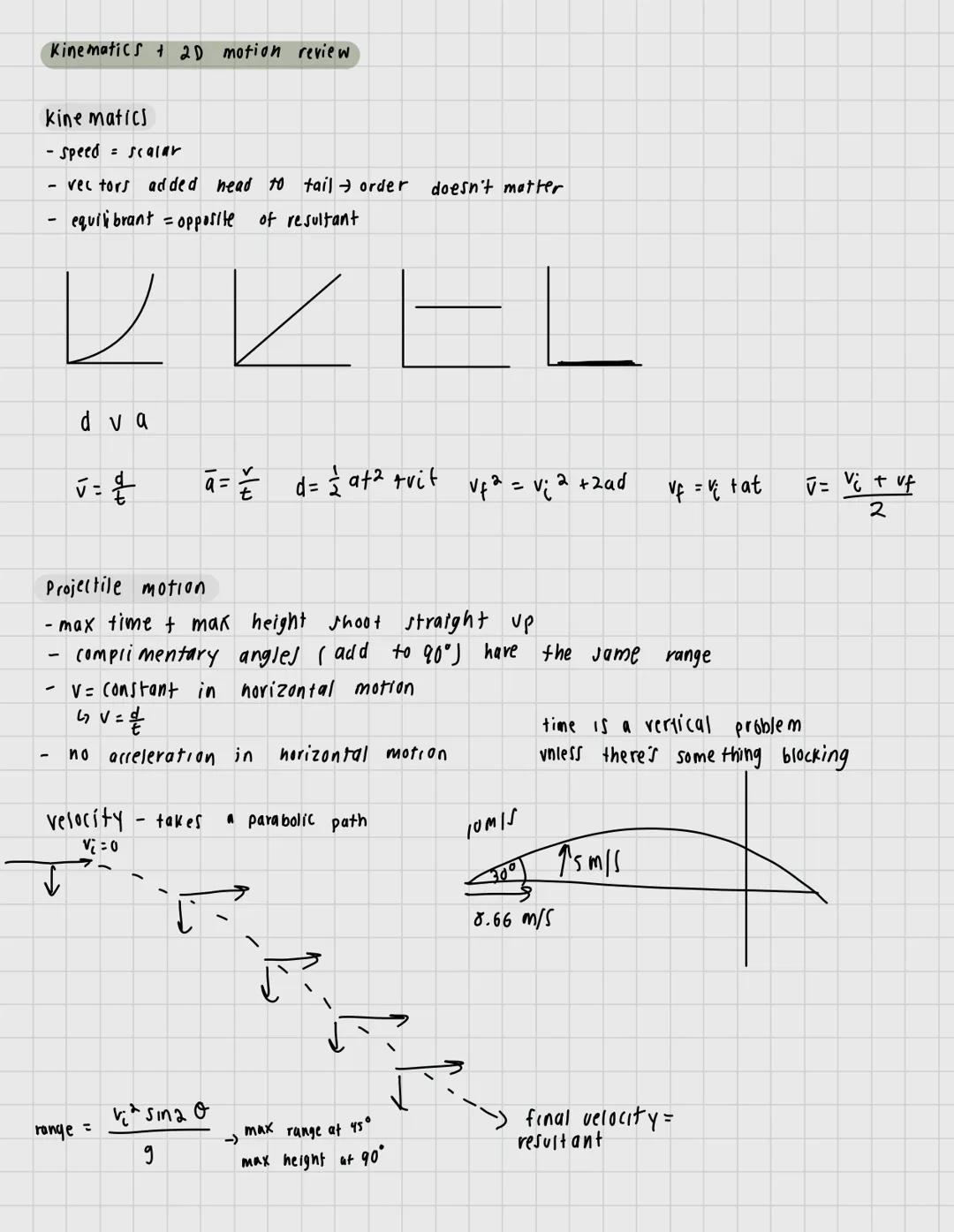
Kinematics Fundamentals
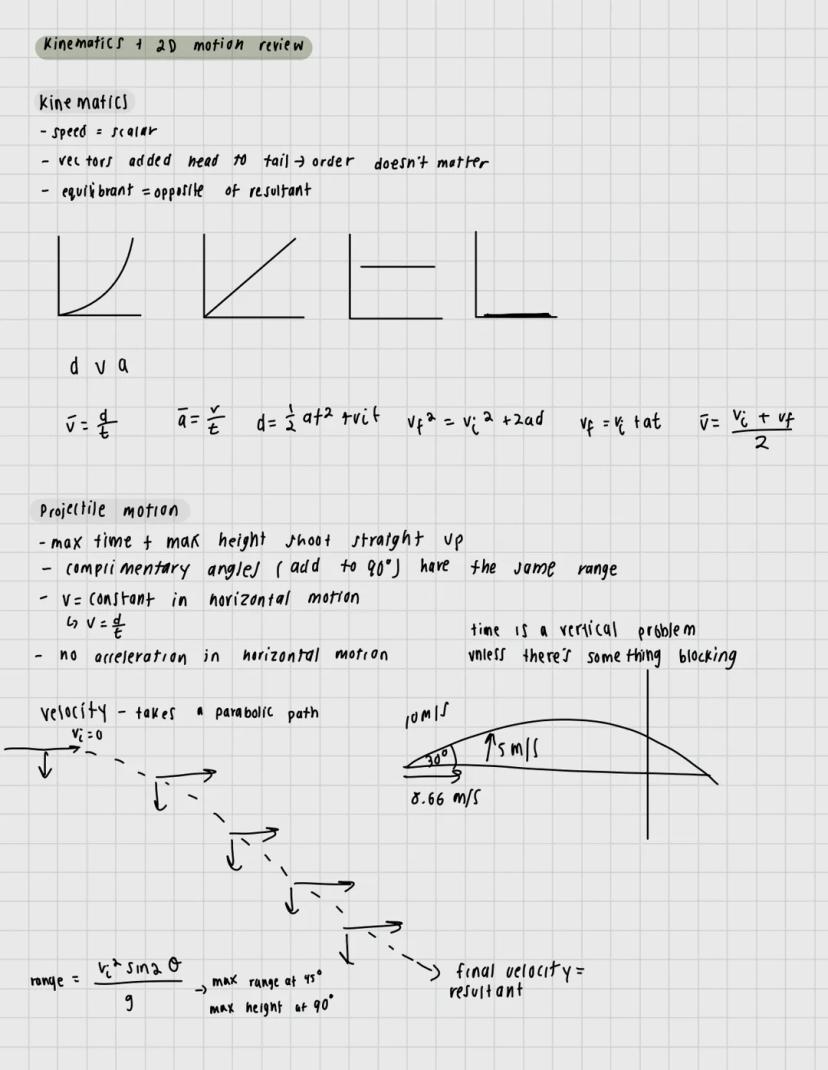
Kinematics deals with the mathematics of motion without considering forces. Remember that speed is a scalar quantity (magnitude only), while velocity is a vector (has both magnitude and direction). Vectors are added head-to-tail, and the order doesn't matter.
The essential kinematic equations you need to know are:
- Average velocity: v̄ = d/t
- Average acceleration: ā = v/t
- Distance with acceleration: d = ½at² + vᵢt
- Final velocity squared: vf² = vᵢ² + 2ad
- Final velocity: vf = vᵢ + at
- Average velocity: v̄ = /2
In projectile motion, remember that horizontal and vertical motions are independent. There's constant velocity in the horizontal direction (no acceleration) and constant acceleration due to gravity in the vertical direction. The path of a projectile forms a parabola, with maximum range occurring at a 45° angle.
💡 For projectile problems, always separate horizontal and vertical components! The horizontal velocity remains constant while the vertical velocity changes due to gravity.
The range equation for projectile motion is: range = (vᵢ²sin2θ)/g
2
of 5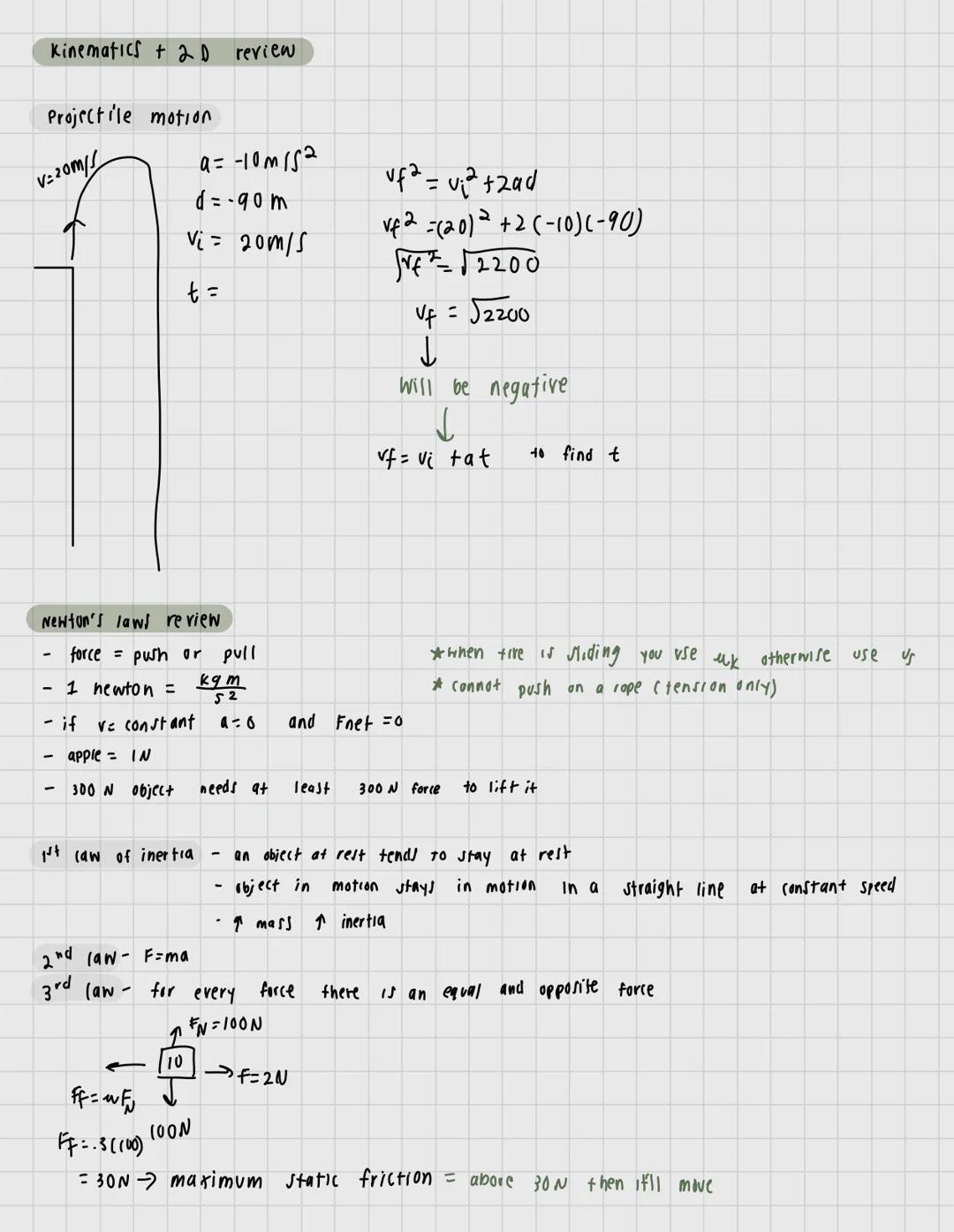
Newton's Laws and Friction
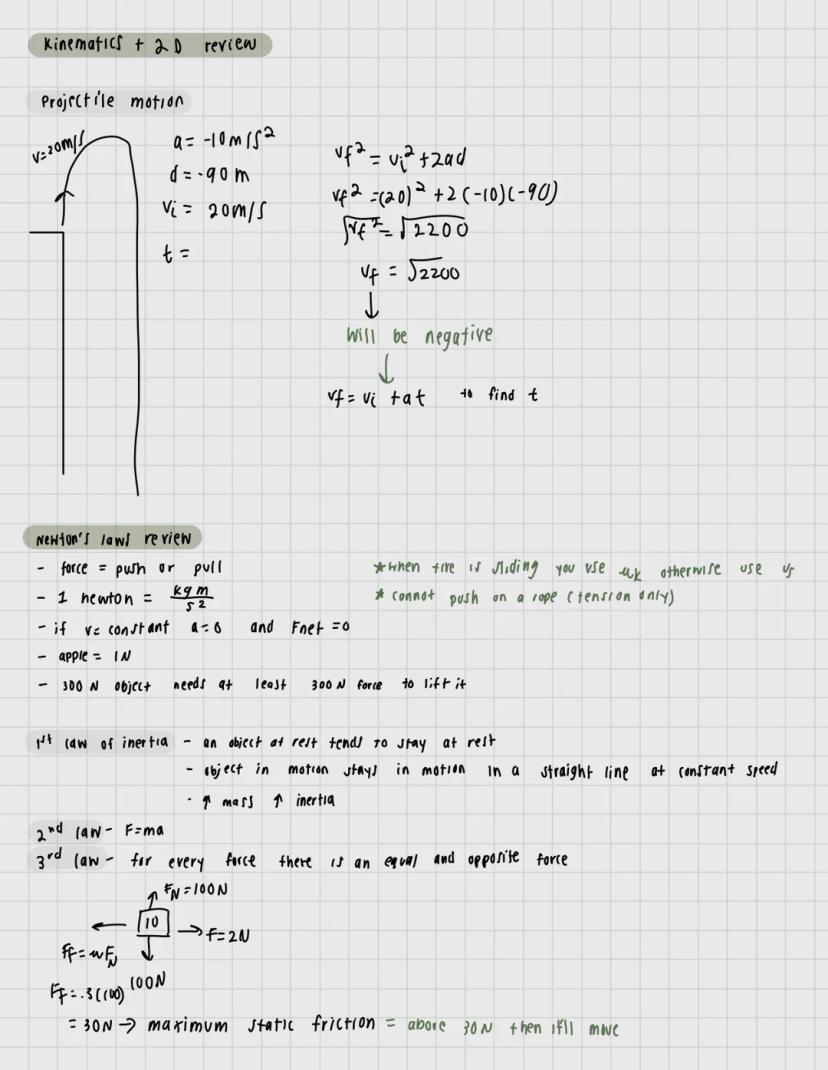
Newton's laws describe the relationship between forces and motion. Force is simply a push or pull, measured in newtons . An interesting fact: an apple weighs approximately 1 N!
The three fundamental laws are:
- 1st Law (Inertia): Objects at rest stay at rest, and objects in motion stay in motion at constant speed in a straight line unless acted upon by a force. The greater the mass, the greater the inertia.
- 2nd Law: F = ma (Force equals mass times acceleration)
- 3rd Law: For every action, there's an equal and opposite reaction
When dealing with friction problems, remember that static friction (μₛ) applies when an object isn't moving, while kinetic friction (μₖ) applies when it's sliding. The maximum static friction is calculated as Fₛ = μₛFₙ, where Fₙ is the normal force.
💡 If an object has constant velocity, the net force must be zero ! This is a direct application of Newton's 1st law and can simplify many problems.
For an object to start moving, you need to apply a force greater than the maximum static friction. Once moving, the friction force decreases to kinetic friction.
3
of 5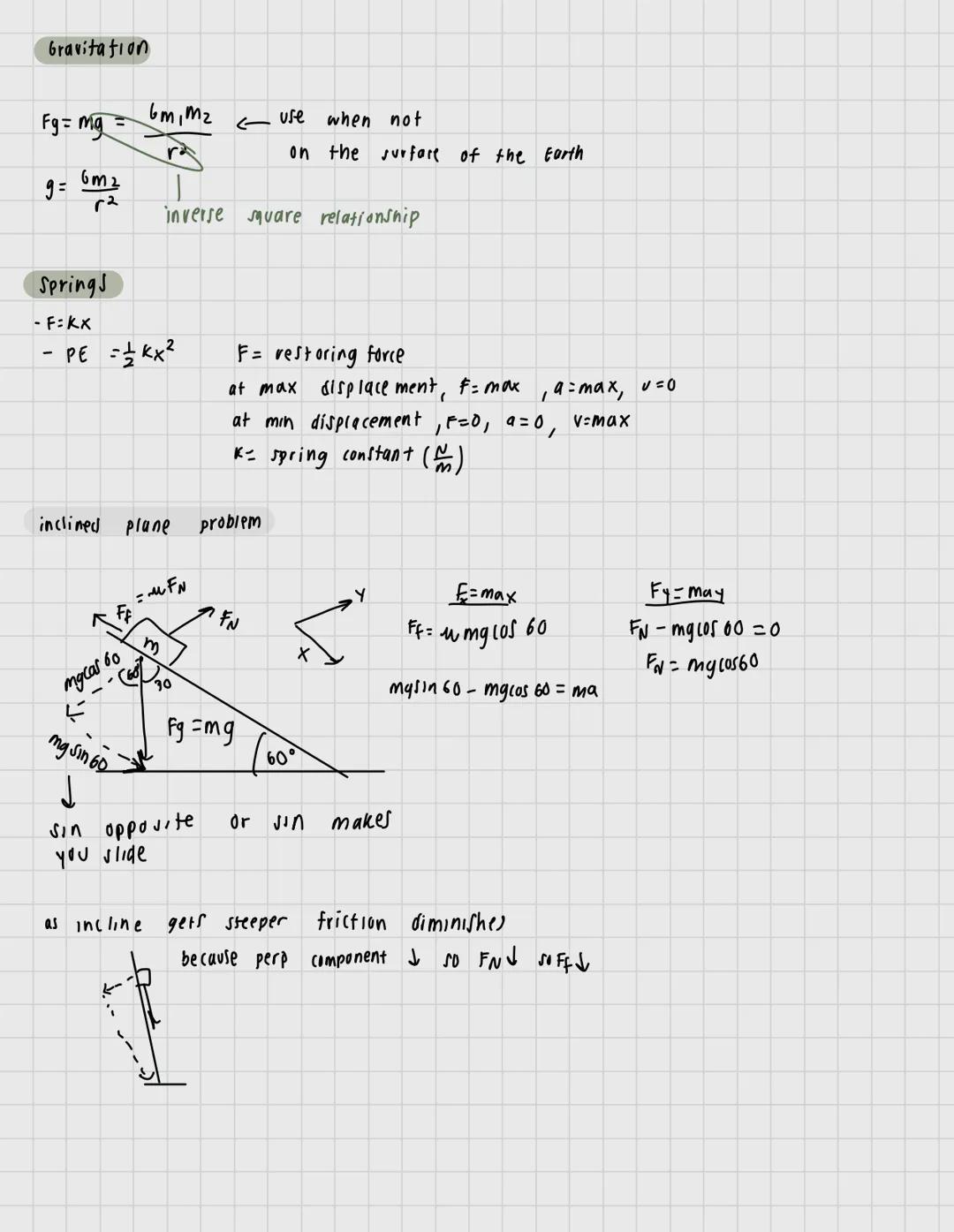
Gravitation and Springs
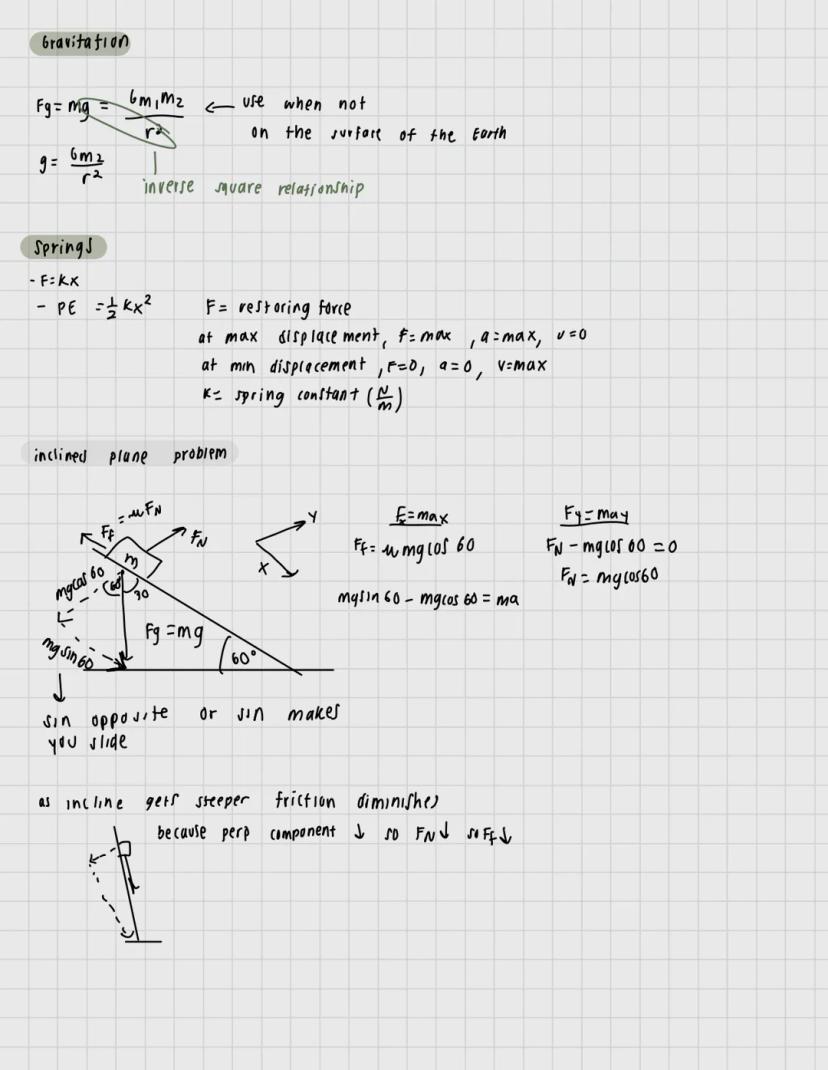
The force of gravity between two objects is given by Fg = Gm₁m₂/r² where G is the gravitational constant, m₁ and m₂ are the masses, and r is the distance between them. On Earth's surface, we simplify this to Fg = mg. Gravity follows an inverse square relationship - double the distance, and the force becomes ¼ as strong.
Spring force is described by Hooke's Law: F = kx, where k is the spring constant and x is the displacement from equilibrium. The potential energy stored in a spring is PE = ½kx². Understanding the relationship between force, displacement, and velocity in a spring is crucial:
- At maximum displacement: force is maximum, acceleration is maximum, but velocity is zero
- At equilibrium position: force is zero, acceleration is zero, but velocity is maximum
When solving inclined plane problems, remember to break forces into components. As the incline gets steeper, the normal force decreases, which reduces friction. The component of gravity parallel to the slope (mgsinθ) causes objects to slide, while the perpendicular component (mgcosθ) creates the normal force.
💡 When analyzing forces on an inclined plane, the sine component (mgsinθ) makes things slide while the cosine component (mgcosθ) determines the normal force and friction!
4
of 5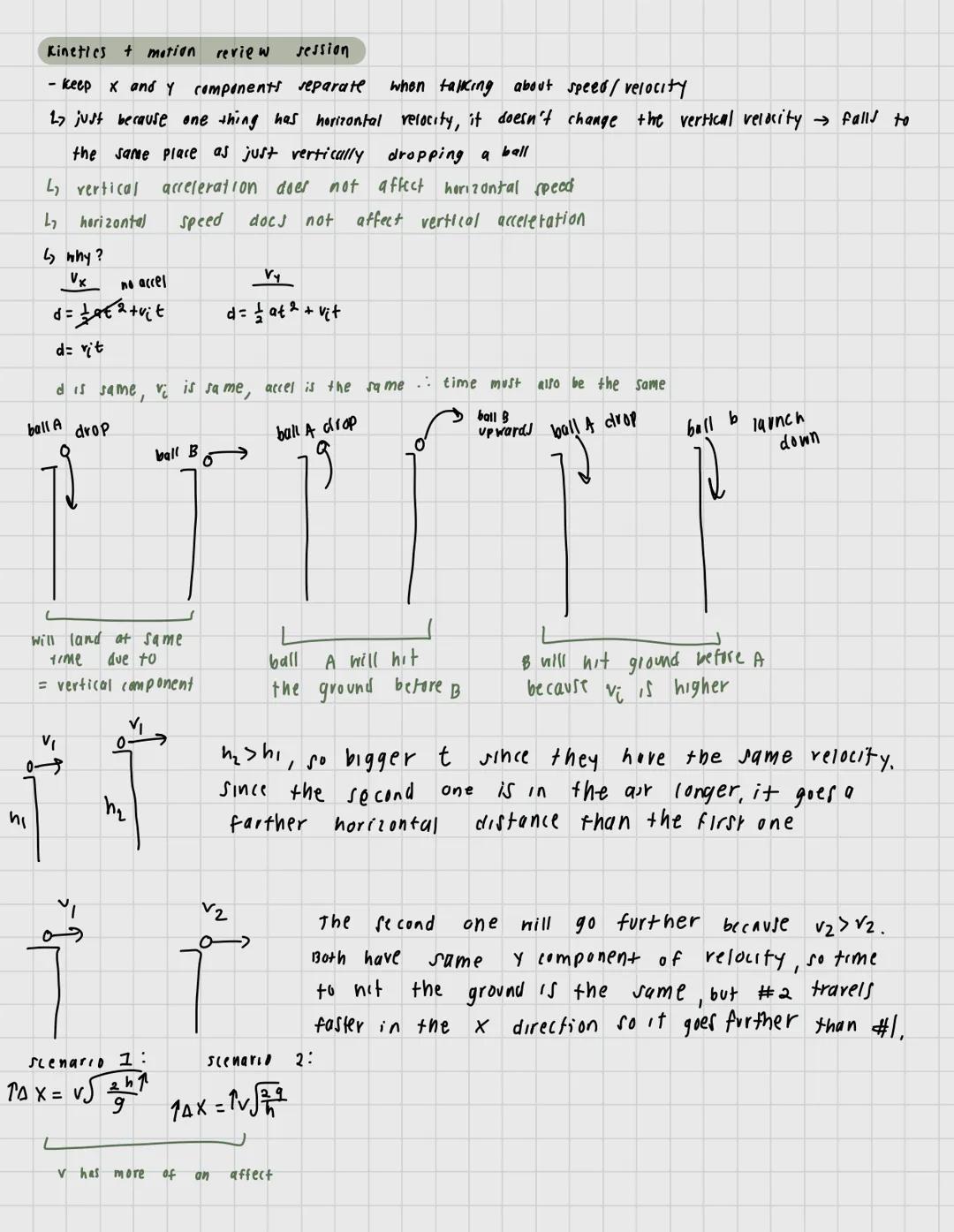
Key Concepts in 2D Motion
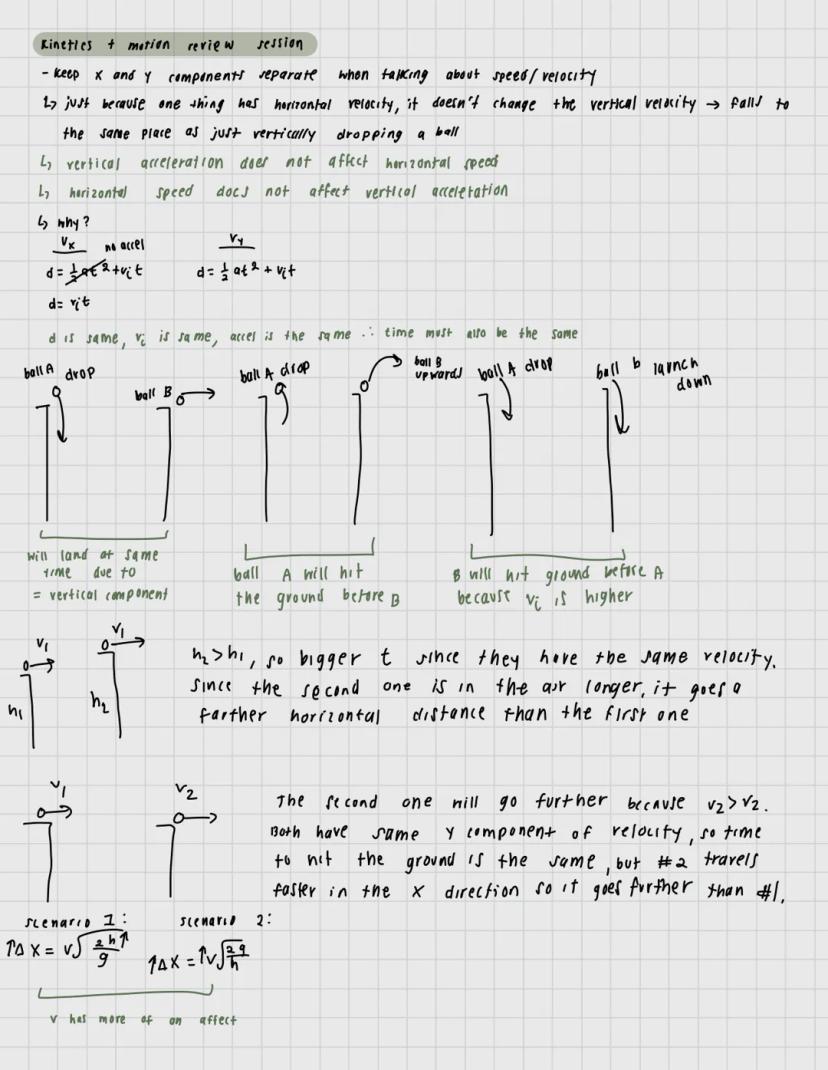
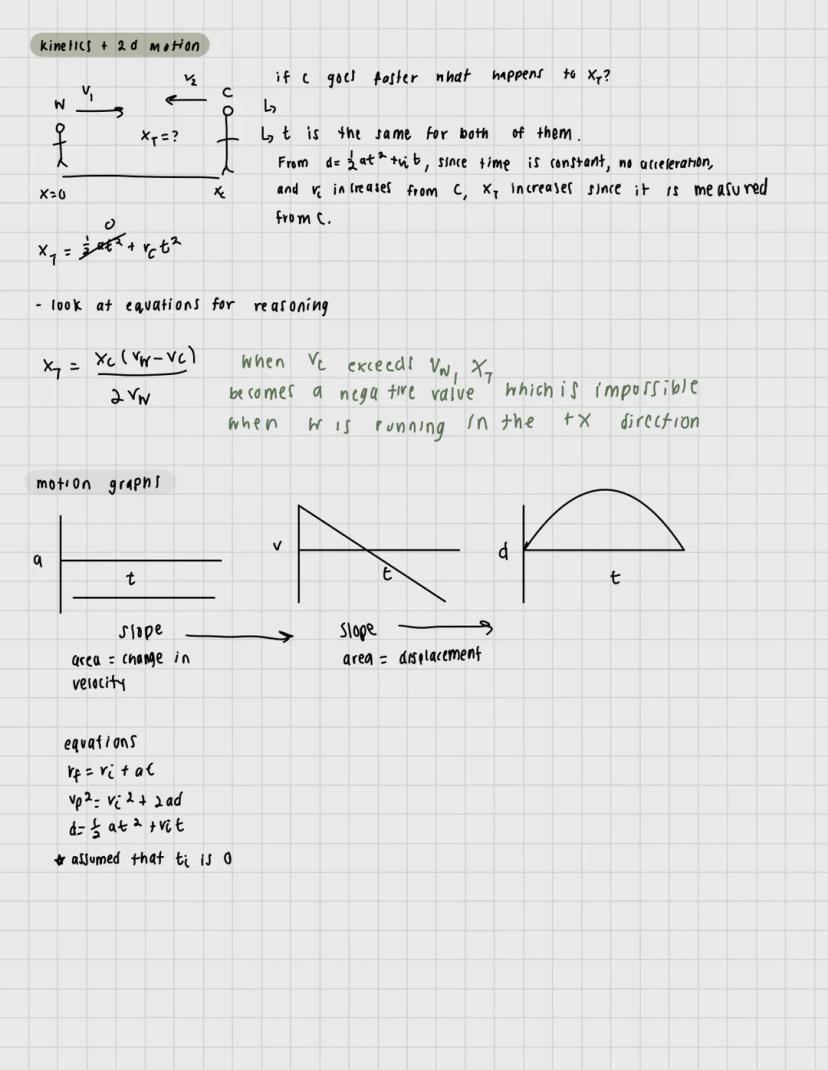
In 2D motion, it's crucial to keep horizontal (x) and vertical (y) components separate. Even though they're happening simultaneously, they don't affect each other. Vertical acceleration does not affect horizontal speed, and horizontal speed does not affect vertical acceleration.
This explains why two objects - one dropped straight down and one projected horizontally - will hit the ground at the same time if dropped from the same height. The horizontal motion doesn't change the fact that gravity pulls both objects down at the same rate.
When comparing projectiles with different initial velocities:
- Objects with the same vertical component but different horizontal components will land at the same time
- Objects launched from the same height with different initial velocities will travel different horizontal distances
- The horizontal distance traveled can be calculated as Δx = v√ for horizontal launches
💡 The horizontal distance a projectile travels depends more on its velocity than on height! This is why increasing the speed of a projectile has a greater effect on range than increasing its height.
Remember that the time an object is in the air depends only on its vertical motion, but the distance it travels horizontally depends on both its horizontal velocity and that time.
5
of 5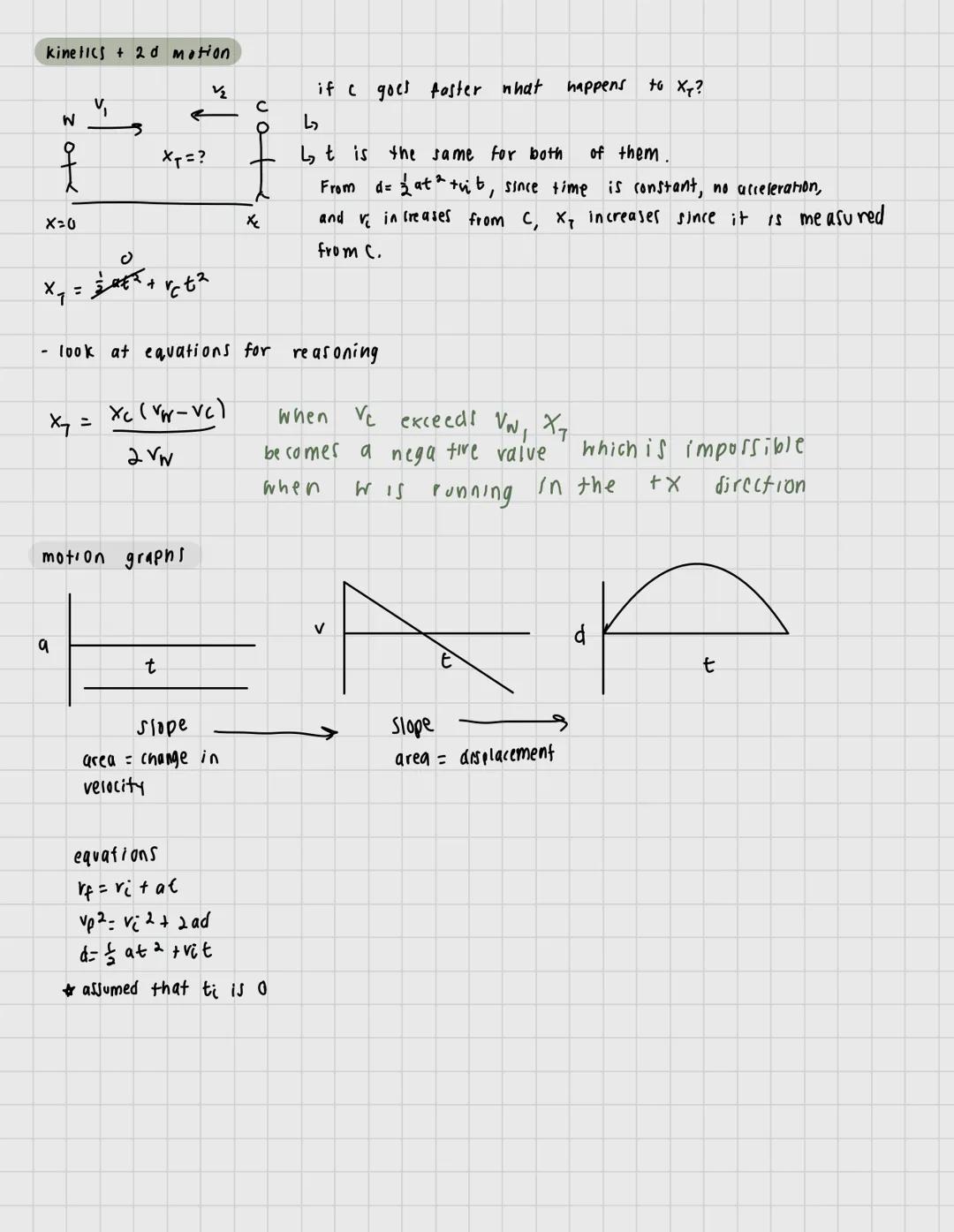
Motion Graphs and Problem-Solving
Motion graphs provide visual representations of position, velocity, and acceleration. For these graphs:
- The slope of a position-time graph gives velocity
- The area under a velocity-time graph gives displacement
- The slope of a velocity-time graph gives acceleration
When solving problems involving relative motion (like objects moving in flowing water), remember that the total velocity is the vector sum of the individual velocities. For an object in a flowing medium: vₜₒₜₐₗ = vₒbⱼₑcₜ + vₘₑdᵢᵤₘ
The key kinematic equations for problem-solving are:
- vf = vi + at
- vf² = vi² + 2ad
- d = ½at² + vit (These equations assume initial time is zero)
💡 When in doubt about which approach to use for a physics problem, write down what you know, identify what you're looking for, and select the equation that connects them with the fewest unknown variables!
For any motion problem, start by clearly identifying the known variables and what you're solving for, then select the appropriate kinematic equation that will get you to the answer most efficiently.
We thought you’d never ask...
What is the Knowunity AI companion?
Our AI companion is specifically built for the needs of students. Based on the millions of content pieces we have on the platform we can provide truly meaningful and relevant answers to students. But its not only about answers, the companion is even more about guiding students through their daily learning challenges, with personalised study plans, quizzes or content pieces in the chat and 100% personalisation based on the students skills and developments.
Where can I download the Knowunity app?
You can download the app in the Google Play Store and in the Apple App Store.
Is Knowunity really free of charge?
That's right! Enjoy free access to study content, connect with fellow students, and get instant help – all at your fingertips.
Most popular content: Projectile Motion
1Most popular content in AP Physics 1
9I
AP Physics 1Introduction to One-Dimensional Motion
Practice defining and distinguishing between scalar and vector quantities like distance, displacement, speed, and velocity in linear scenarios.
9th6620
I
AP Physics 1Introduction to Kinematic Equations
Practice identifying variables and selecting the appropriate kinematic equation for objects moving with constant acceleration in one dimension.
9th5670
AP Physics 1Newton's Second Law of Motion
A detailed explanation of Concept of Newton's Second Law of Motion, Examples, Formulas, and Sample Problems with solution.
36613
AP Physics 1AP Physics 1: Unit 1 Kinematics
Notes for the first unit of AP Physics I
10th1,58460
AP Physics 1AP Physics 1 | Kinematics Unit Notes
Notes on the first unit of APP1: Kinematics. This describes how things move, including the concepts of displacement, velocity, and acceleration.
70637
AP Physics 1Force and Energy
This includes a discussion about force, types of forces, mass vs. weight, work and simple machines.
1369
AP Physics 1Electric Charge
Transfer of Electric Charge-Concepts, Definitions and Examples.
912
AP Physics 1Moment of Inertia
A catalog of common shapes and their moment of inertia.
10th1181
AP Physics 1Acceleration
This outlines one of the basic concepts of physics - acceleration. Acceleration has many applications in physics. It can found in numerous equations seen in this note page.
1312
Most popular content
9O
 AP US History
Origins and Dynamics of the Columbian Exchange
Analyze the ecological and economic motivations behind the initial transfer of goods, people, and diseases between the Old and New Worlds.
9th3,1280
I
AP US HistoryIntroduction to Early Cultural Interactions
Analyze the initial social and religious encounters between Europeans, Africans, and Indigenous peoples in the colonial Americas.
9th2,7730
O
 AP World History
Origins of Ancient River Civilizations
Analyze the environmental factors and technological innovations that led to the rise of early states in Mesopotamia, Egypt, and the Indus Valley.
9th3,1870
M
AP US HistoryMotivations for European Exploration
Analyze the economic, religious, and political factors that drove European powers to the Americas during the 15th and 16th centuries.
9th1,7780
F
 AP Psychology
Foundations of Ethical Guidelines in Research
Practice the core principles of the APA ethical code including informed consent, debriefing, and the role of Institutional Review Boards.
9th1,3360
I
AP US HistoryIntroduction to Native American Societies
Examine the diverse social, political, and economic structures of North American indigenous groups prior to European contact.
9th1,1100
I
 AP Biology
Introduction to Biological Elements of Life
Practice identifying the essential elements including carbon, nitrogen, phosphorus, and sulfur that compose biological macromolecules.
9th1,7390
I
AP US HistoryIntroduction to the Spanish Encomienda System
Explore the fundamental economic and social structures of the Spanish colonial system, focusing on the encomienda and the casta social hierarchy.
9th8890
O
AP World HistoryOrigins and Continuity of the Byzantine Empire
Analyze the political and cultural transitions from the Roman Empire to the Byzantine Empire, focusing on the reign of Justinian I and his code.
9th1,6320
Can't find what you're looking for? Explore other subjects.
Students love us — and so will you.
4.6/5App Store
4.7/5Google Play
The app is very easy to use and well designed. I have found everything I was looking for so far and have been able to learn a lot from the presentations! I will definitely use the app for a class assignment! And of course it also helps a lot as an inspiration.
Stefan SiOS user
This app is really great. There are so many study notes and help [...]. My problem subject is French, for example, and the app has so many options for help. Thanks to this app, I have improved my French. I would recommend it to anyone.
Samantha KlichAndroid user
Wow, I am really amazed. I just tried the app because I've seen it advertised many times and was absolutely stunned. This app is THE HELP you want for school and above all, it offers so many things, such as workouts and fact sheets, which have been VERY helpful to me personally.
AnnaiOS user
AP Physics 173 views·Updated Jun 7, 2026·5 pagesUnderstanding Kinematics and 2D Motion - AP Physics 1 Guide
Eushra Rahman@eushrarahman_mvbn
Kinematics and 2D motion are fundamental concepts in physics that describe how objects move. This summary covers the essential principles of kinematics, projectile motion, Newton's laws, springs, and various motion scenarios that will help you understand these topics for tests...
1
of 5
Sign up to see the content. It's free!
- Access to all documents
- Improve your grades
- Join milions of students
Kinematics Fundamentals
Kinematics deals with the mathematics of motion without considering forces. Remember that speed is a scalar quantity (magnitude only), while velocity is a vector (has both magnitude and direction). Vectors are added head-to-tail, and the order doesn't matter.
The essential kinematic equations you need to know are:
- Average velocity: v̄ = d/t
- Average acceleration: ā = v/t
- Distance with acceleration: d = ½at² + vᵢt
- Final velocity squared: vf² = vᵢ² + 2ad
- Final velocity: vf = vᵢ + at
- Average velocity: v̄ = /2
In projectile motion, remember that horizontal and vertical motions are independent. There's constant velocity in the horizontal direction (no acceleration) and constant acceleration due to gravity in the vertical direction. The path of a projectile forms a parabola, with maximum range occurring at a 45° angle.
💡 For projectile problems, always separate horizontal and vertical components! The horizontal velocity remains constant while the vertical velocity changes due to gravity.
The range equation for projectile motion is: range = (vᵢ²sin2θ)/g
2
of 5Sign up to see the content. It's free!
- Access to all documents
- Improve your grades
- Join milions of students
Newton's Laws and Friction
Newton's laws describe the relationship between forces and motion. Force is simply a push or pull, measured in newtons . An interesting fact: an apple weighs approximately 1 N!
The three fundamental laws are:
- 1st Law (Inertia): Objects at rest stay at rest, and objects in motion stay in motion at constant speed in a straight line unless acted upon by a force. The greater the mass, the greater the inertia.
- 2nd Law: F = ma (Force equals mass times acceleration)
- 3rd Law: For every action, there's an equal and opposite reaction
When dealing with friction problems, remember that static friction (μₛ) applies when an object isn't moving, while kinetic friction (μₖ) applies when it's sliding. The maximum static friction is calculated as Fₛ = μₛFₙ, where Fₙ is the normal force.
💡 If an object has constant velocity, the net force must be zero ! This is a direct application of Newton's 1st law and can simplify many problems.
For an object to start moving, you need to apply a force greater than the maximum static friction. Once moving, the friction force decreases to kinetic friction.
3
of 5Sign up to see the content. It's free!
- Access to all documents
- Improve your grades
- Join milions of students
Gravitation and Springs
The force of gravity between two objects is given by Fg = Gm₁m₂/r² where G is the gravitational constant, m₁ and m₂ are the masses, and r is the distance between them. On Earth's surface, we simplify this to Fg = mg. Gravity follows an inverse square relationship - double the distance, and the force becomes ¼ as strong.
Spring force is described by Hooke's Law: F = kx, where k is the spring constant and x is the displacement from equilibrium. The potential energy stored in a spring is PE = ½kx². Understanding the relationship between force, displacement, and velocity in a spring is crucial:
- At maximum displacement: force is maximum, acceleration is maximum, but velocity is zero
- At equilibrium position: force is zero, acceleration is zero, but velocity is maximum
When solving inclined plane problems, remember to break forces into components. As the incline gets steeper, the normal force decreases, which reduces friction. The component of gravity parallel to the slope (mgsinθ) causes objects to slide, while the perpendicular component (mgcosθ) creates the normal force.
💡 When analyzing forces on an inclined plane, the sine component (mgsinθ) makes things slide while the cosine component (mgcosθ) determines the normal force and friction!
4
of 5Sign up to see the content. It's free!
- Access to all documents
- Improve your grades
- Join milions of students
Key Concepts in 2D Motion
In 2D motion, it's crucial to keep horizontal (x) and vertical (y) components separate. Even though they're happening simultaneously, they don't affect each other. Vertical acceleration does not affect horizontal speed, and horizontal speed does not affect vertical acceleration.
This explains why two objects - one dropped straight down and one projected horizontally - will hit the ground at the same time if dropped from the same height. The horizontal motion doesn't change the fact that gravity pulls both objects down at the same rate.
When comparing projectiles with different initial velocities:
- Objects with the same vertical component but different horizontal components will land at the same time
- Objects launched from the same height with different initial velocities will travel different horizontal distances
- The horizontal distance traveled can be calculated as Δx = v√ for horizontal launches
💡 The horizontal distance a projectile travels depends more on its velocity than on height! This is why increasing the speed of a projectile has a greater effect on range than increasing its height.
Remember that the time an object is in the air depends only on its vertical motion, but the distance it travels horizontally depends on both its horizontal velocity and that time.
5
of 5Sign up to see the content. It's free!
- Access to all documents
- Improve your grades
- Join milions of students
Motion Graphs and Problem-Solving
Motion graphs provide visual representations of position, velocity, and acceleration. For these graphs:
- The slope of a position-time graph gives velocity
- The area under a velocity-time graph gives displacement
- The slope of a velocity-time graph gives acceleration
When solving problems involving relative motion (like objects moving in flowing water), remember that the total velocity is the vector sum of the individual velocities. For an object in a flowing medium: vₜₒₜₐₗ = vₒbⱼₑcₜ + vₘₑdᵢᵤₘ
The key kinematic equations for problem-solving are:
- vf = vi + at
- vf² = vi² + 2ad
- d = ½at² + vit (These equations assume initial time is zero)
💡 When in doubt about which approach to use for a physics problem, write down what you know, identify what you're looking for, and select the equation that connects them with the fewest unknown variables!
For any motion problem, start by clearly identifying the known variables and what you're solving for, then select the appropriate kinematic equation that will get you to the answer most efficiently.
We thought you’d never ask...
What is the Knowunity AI companion?
Our AI companion is specifically built for the needs of students. Based on the millions of content pieces we have on the platform we can provide truly meaningful and relevant answers to students. But its not only about answers, the companion is even more about guiding students through their daily learning challenges, with personalised study plans, quizzes or content pieces in the chat and 100% personalisation based on the students skills and developments.
Where can I download the Knowunity app?
You can download the app in the Google Play Store and in the Apple App Store.
Is Knowunity really free of charge?
That's right! Enjoy free access to study content, connect with fellow students, and get instant help – all at your fingertips.
Most popular content: Projectile Motion
1Most popular content in AP Physics 1
9I
AP Physics 1Introduction to One-Dimensional Motion
Practice defining and distinguishing between scalar and vector quantities like distance, displacement, speed, and velocity in linear scenarios.
9th6620
I
AP Physics 1Introduction to Kinematic Equations
Practice identifying variables and selecting the appropriate kinematic equation for objects moving with constant acceleration in one dimension.
9th5670
AP Physics 1Newton's Second Law of Motion
A detailed explanation of Concept of Newton's Second Law of Motion, Examples, Formulas, and Sample Problems with solution.
36613
AP Physics 1AP Physics 1: Unit 1 Kinematics
Notes for the first unit of AP Physics I
10th1,58460
AP Physics 1AP Physics 1 | Kinematics Unit Notes
Notes on the first unit of APP1: Kinematics. This describes how things move, including the concepts of displacement, velocity, and acceleration.
70637
AP Physics 1Force and Energy
This includes a discussion about force, types of forces, mass vs. weight, work and simple machines.
1369
AP Physics 1Electric Charge
Transfer of Electric Charge-Concepts, Definitions and Examples.
912
AP Physics 1Moment of Inertia
A catalog of common shapes and their moment of inertia.
10th1181
AP Physics 1Acceleration
This outlines one of the basic concepts of physics - acceleration. Acceleration has many applications in physics. It can found in numerous equations seen in this note page.
1312
Most popular content
9O
AP US HistoryOrigins and Dynamics of the Columbian Exchange
Analyze the ecological and economic motivations behind the initial transfer of goods, people, and diseases between the Old and New Worlds.
9th3,1280
I
AP US HistoryIntroduction to Early Cultural Interactions
Analyze the initial social and religious encounters between Europeans, Africans, and Indigenous peoples in the colonial Americas.
9th2,7730
O
AP World HistoryOrigins of Ancient River Civilizations
Analyze the environmental factors and technological innovations that led to the rise of early states in Mesopotamia, Egypt, and the Indus Valley.
9th3,1870
M
AP US HistoryMotivations for European Exploration
Analyze the economic, religious, and political factors that drove European powers to the Americas during the 15th and 16th centuries.
9th1,7780
F
AP PsychologyFoundations of Ethical Guidelines in Research
Practice the core principles of the APA ethical code including informed consent, debriefing, and the role of Institutional Review Boards.
9th1,3360
I
AP US HistoryIntroduction to Native American Societies
Examine the diverse social, political, and economic structures of North American indigenous groups prior to European contact.
9th1,1100
I
AP BiologyIntroduction to Biological Elements of Life
Practice identifying the essential elements including carbon, nitrogen, phosphorus, and sulfur that compose biological macromolecules.
9th1,7390
I
AP US HistoryIntroduction to the Spanish Encomienda System
Explore the fundamental economic and social structures of the Spanish colonial system, focusing on the encomienda and the casta social hierarchy.
9th8890
O
AP World HistoryOrigins and Continuity of the Byzantine Empire
Analyze the political and cultural transitions from the Roman Empire to the Byzantine Empire, focusing on the reign of Justinian I and his code.
9th1,6320
Can't find what you're looking for? Explore other subjects.
Students love us — and so will you.
4.6/5App Store
4.7/5Google Play
The app is very easy to use and well designed. I have found everything I was looking for so far and have been able to learn a lot from the presentations! I will definitely use the app for a class assignment! And of course it also helps a lot as an inspiration.
Stefan SiOS user
This app is really great. There are so many study notes and help [...]. My problem subject is French, for example, and the app has so many options for help. Thanks to this app, I have improved my French. I would recommend it to anyone.
Samantha KlichAndroid user
Wow, I am really amazed. I just tried the app because I've seen it advertised many times and was absolutely stunned. This app is THE HELP you want for school and above all, it offers so many things, such as workouts and fact sheets, which have been VERY helpful to me personally.
AnnaiOS user