
Ever wondered why it matters that an asteroid is moving...
 AP Physics 1187 views·Updated Jun 19, 2026·15 pages
Understanding Displacement and Distance: Key Differences and Examples
L
Lucy Styles@lucystyles_htpt
1 / 10
1
of 10
Understanding Vectors and Scalars
When describing quantities in physics, we use two main types of measurements: vectors and scalars. Each serves a specific purpose in helping us understand the physical world.
By the end of this lesson, you'll be able to identify whether a measurement is a vector or scalar quantity. This skill is essential for solving physics problems correctly.
💡 Think of scalars as "how much" and vectors as "how much AND which way" measurements.
2
of 10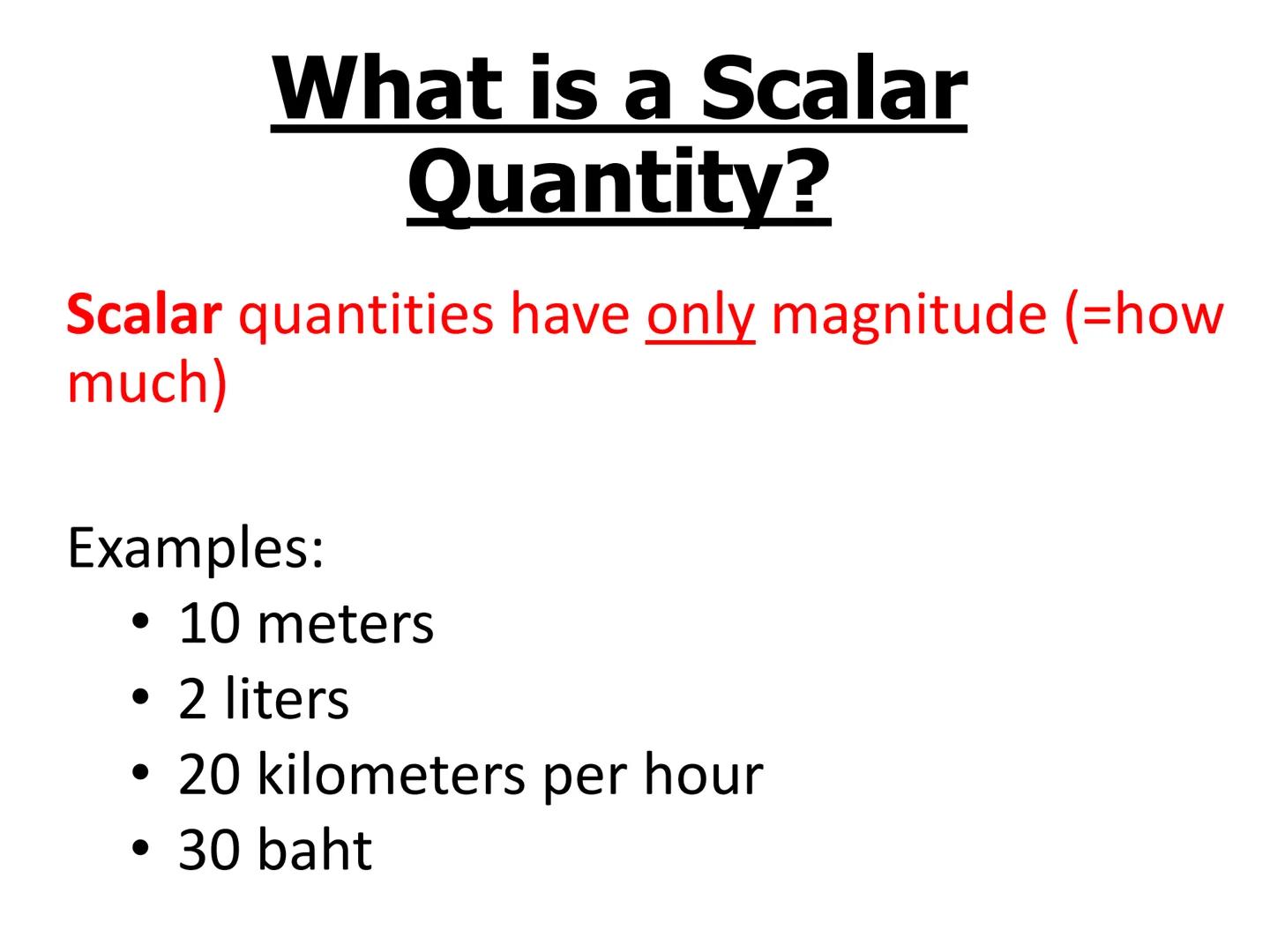
What is a Scalar Quantity?
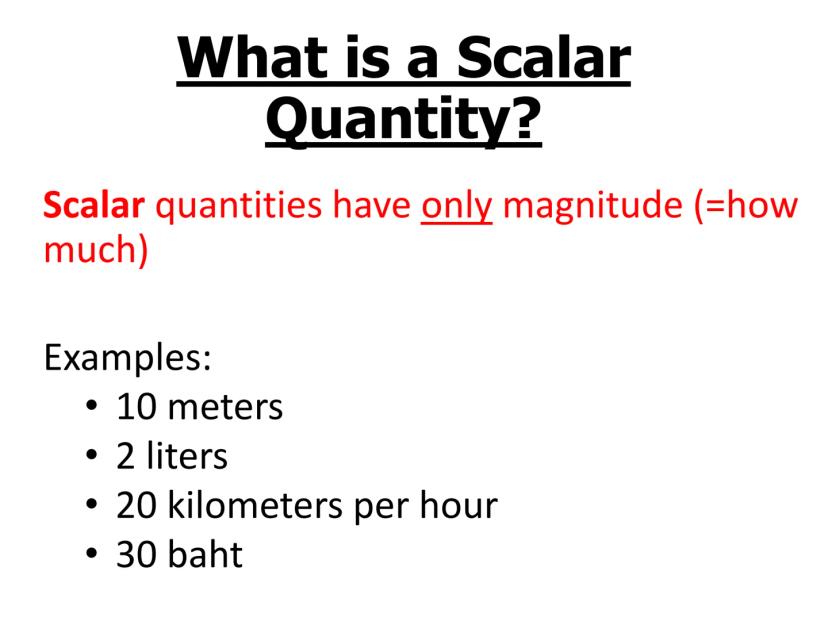
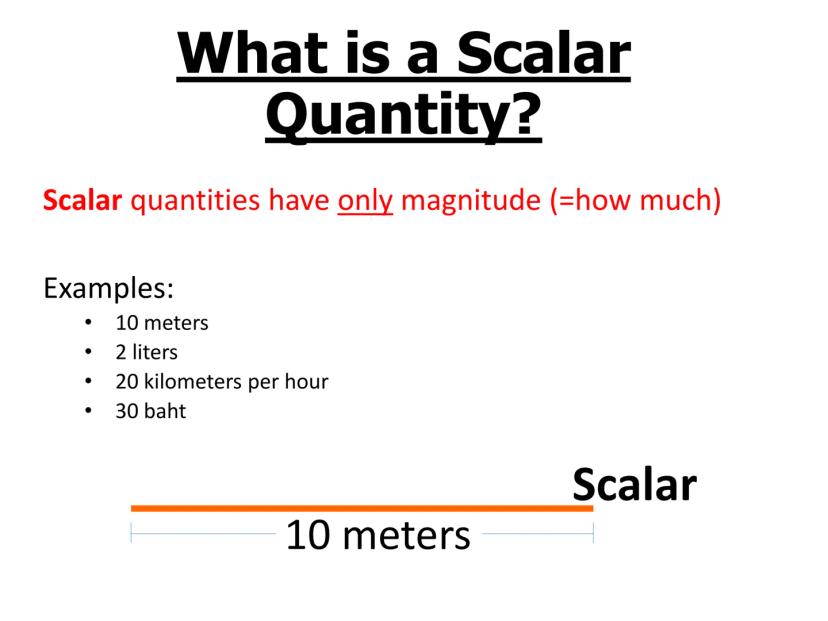
Scalar quantities tell us only about magnitude—how much of something exists—without any directional information. When you see a number with just a unit, it's typically a scalar.
Common examples of scalar quantities include:
- 10 meters (distance)
- 2 liters (volume)
- 20 kilometers per hour (speed)
- 30 baht (money)
These measurements give us valuable information about amount, but they don't tell us anything about direction.
3
of 10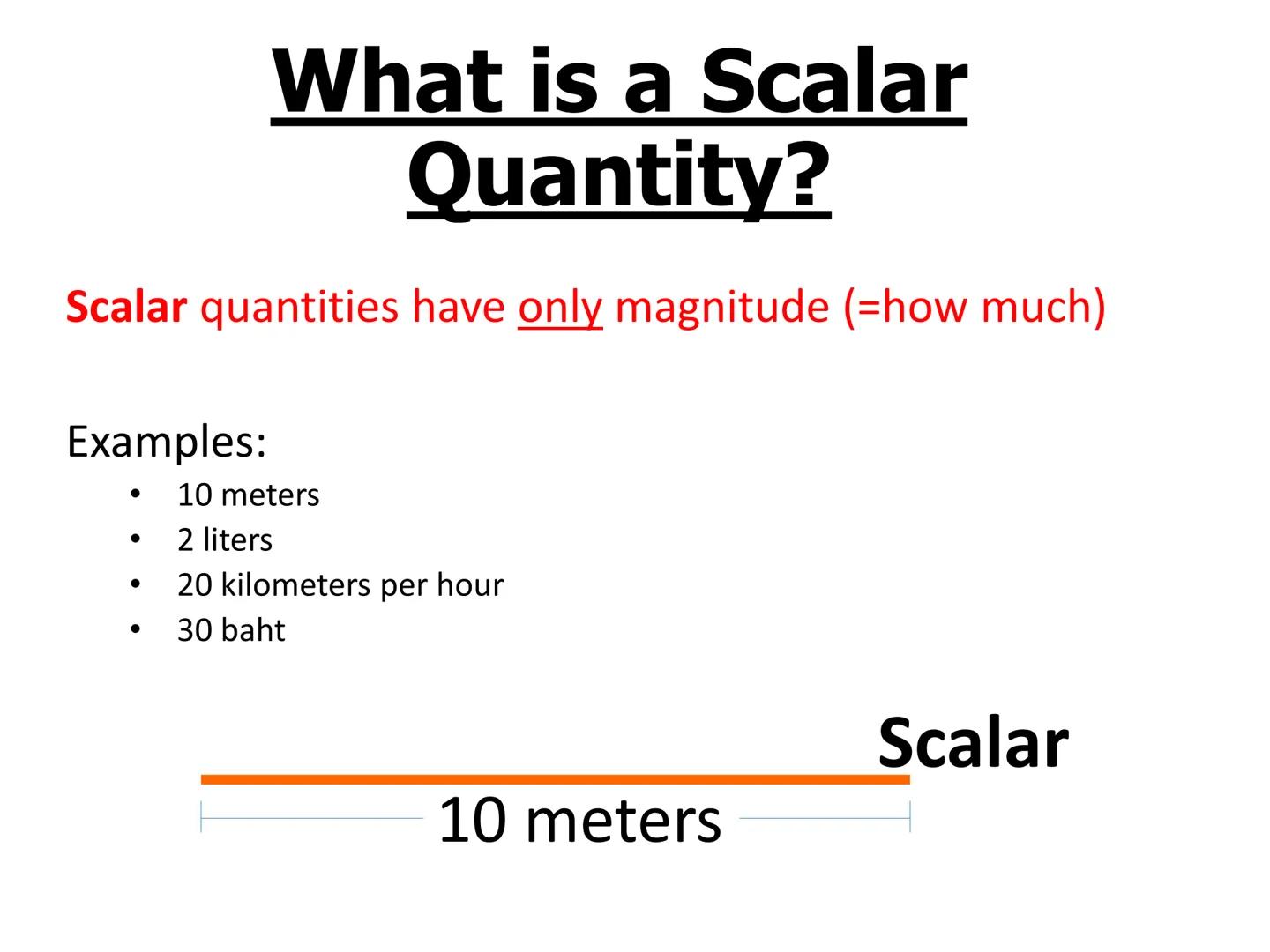
Scalar Quantity Examples
Scalar quantities are straightforward measurements that answer "how much" questions. When someone tells you a room is 10 meters long, that's a scalar—it has magnitude but no direction.
Other common scalar quantities include:
- Time (15 seconds)
- Temperature (98.6°F)
- Mass (50 kilograms)
- Energy (100 joules)
Scalar quantities can be added, subtracted, multiplied, or divided using ordinary arithmetic since they don't have directional components to consider.
🔑 Remember: If you can answer a measurement with just a number and unit (without needing to specify direction), it's probably a scalar.
4
of 10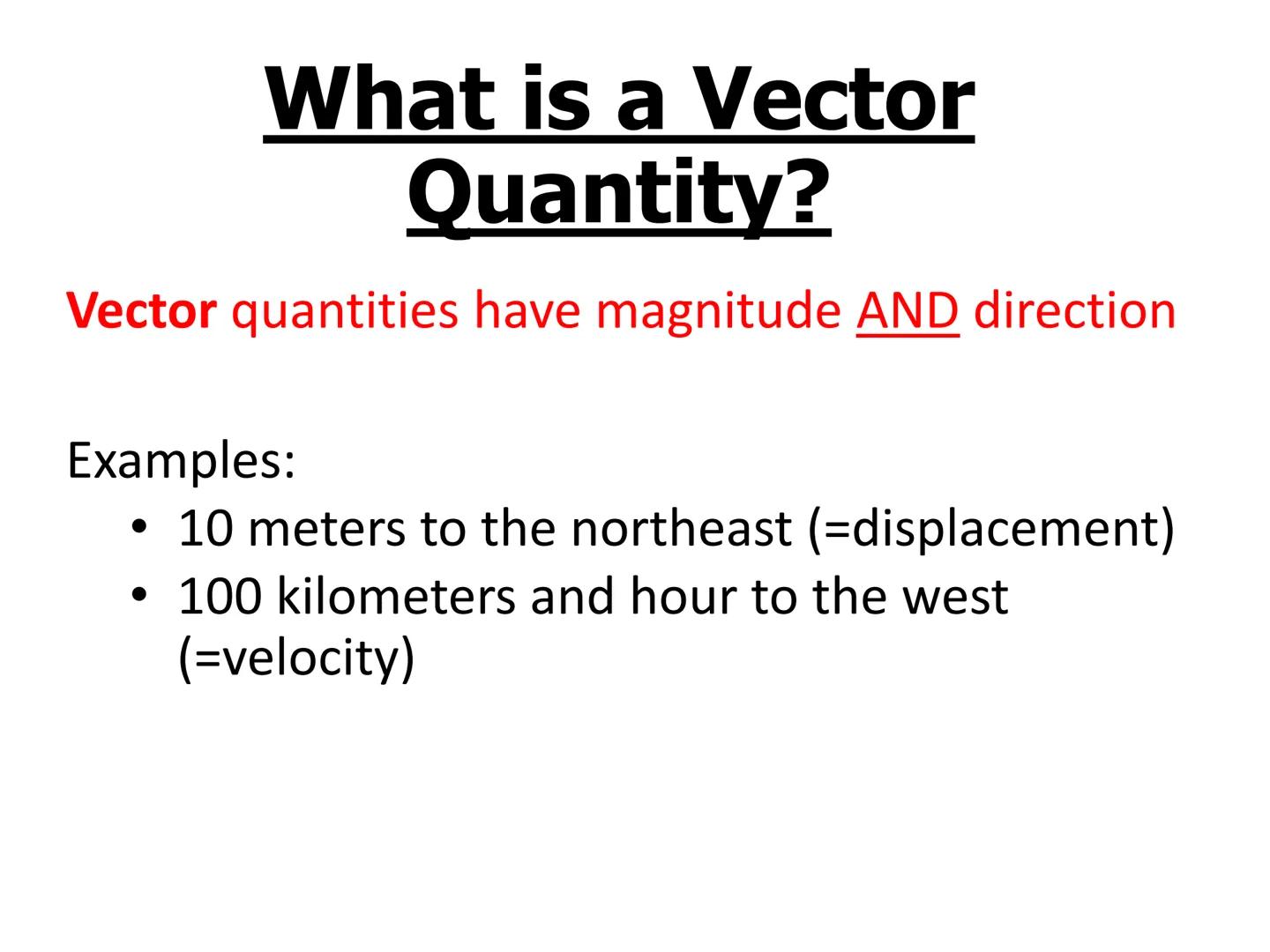
What is a Vector Quantity?
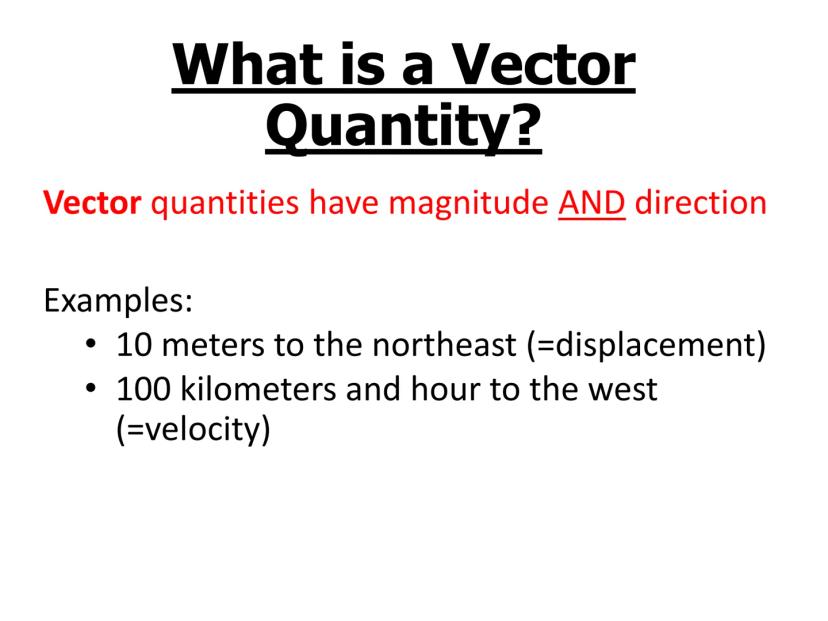
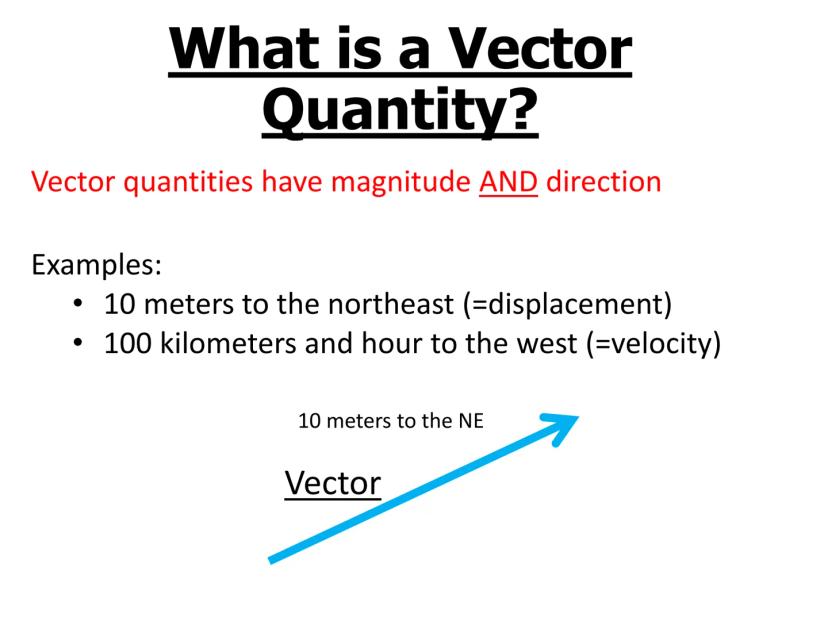
Vector quantities have both magnitude AND direction. This combination gives us much more complete information about physical situations.
Unlike scalars, vectors tell us not just how much, but which way. For example, "10 meters to the northeast" is a vector quantity called displacement.
Another common vector is velocity—like "100 kilometers per hour to the west." Notice how both examples include direction information, making them vectors.
5
of 10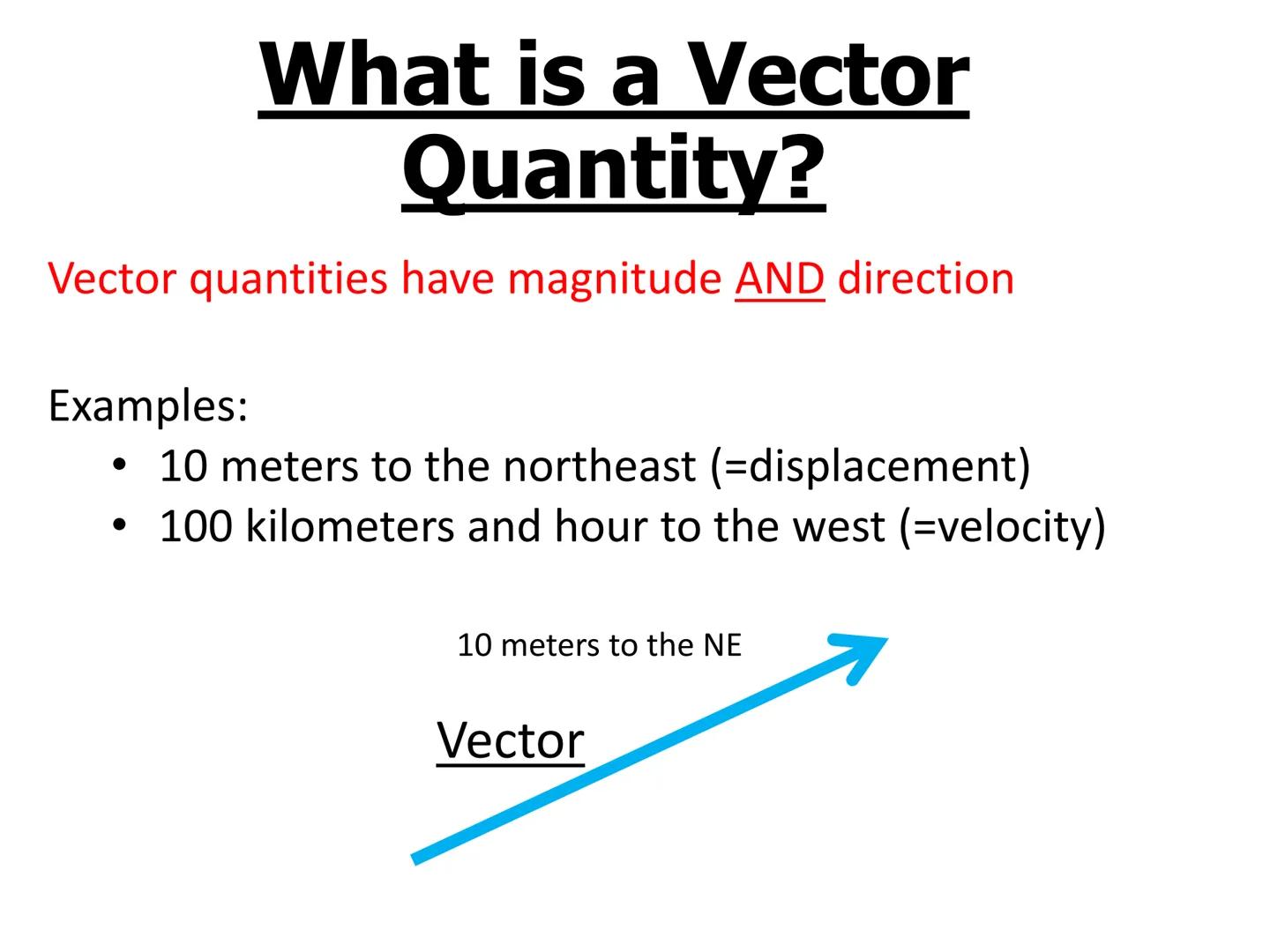
Vector Quantity Examples
Vectors give us a complete picture of physical quantities by including direction. When we say "10 meters to the northeast," we know exactly where something ended up relative to its starting position.
In physics, vectors are often represented by arrows. The length of the arrow shows magnitude (how much), while the arrow's direction indicates, well, the direction!
Common vector quantities include:
- Force (15 Newtons upward)
- Acceleration
- Momentum
🚀 The next time you see an arrow on a weather map showing wind direction and speed, remember—that's a vector!
6
of 10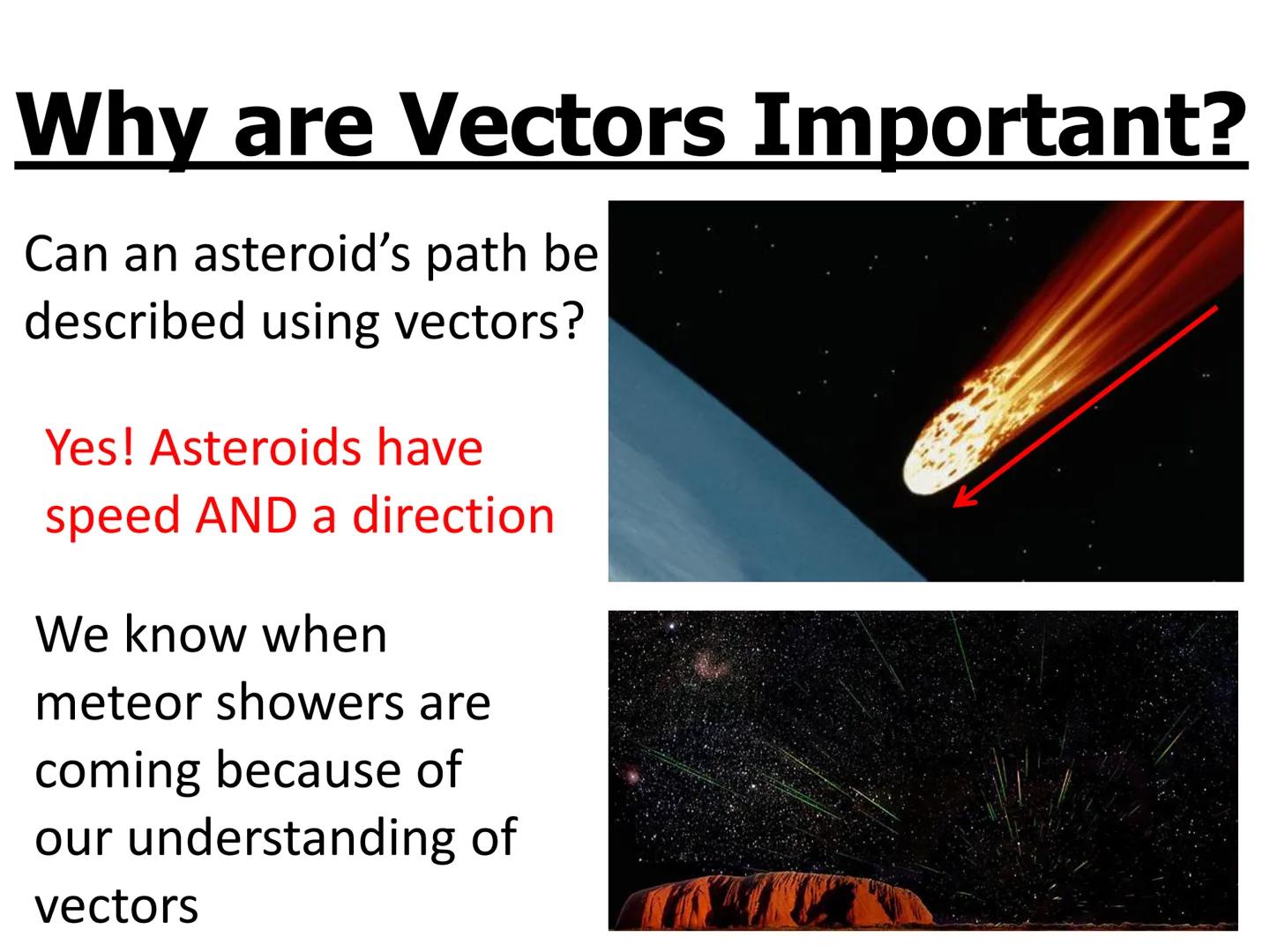
Why Vectors Matter in Real Life
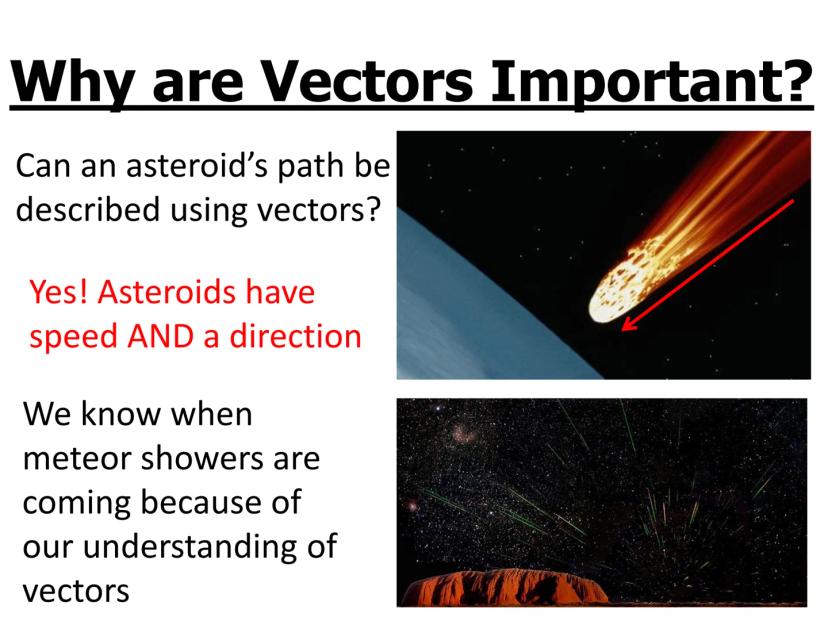
Vectors aren't just classroom concepts—they're crucial for understanding our world! Take asteroids, for instance. Scientists track their path using vectors because they need to know both speed AND direction.
Without vectors, we couldn't predict meteor showers or calculate whether an asteroid might collide with Earth. The combination of magnitude and direction allows astronomers to map precise trajectories through space.
Vectors also help engineers design bridges, pilots navigate airplanes, and meteorologists predict weather patterns. Any situation where "which way" matters requires vectors to describe it properly.
7
of 10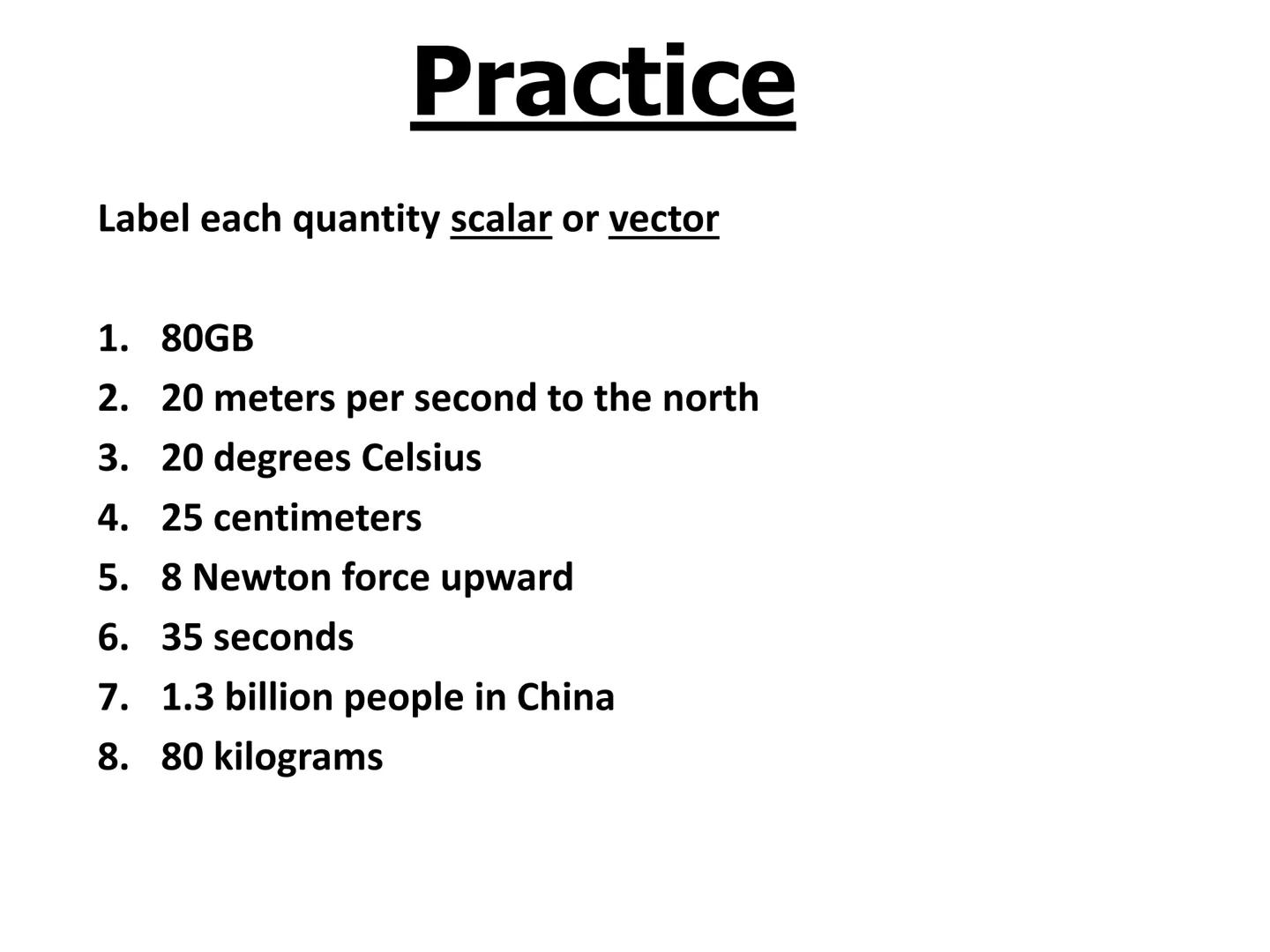
Practice Identifying Vectors and Scalars
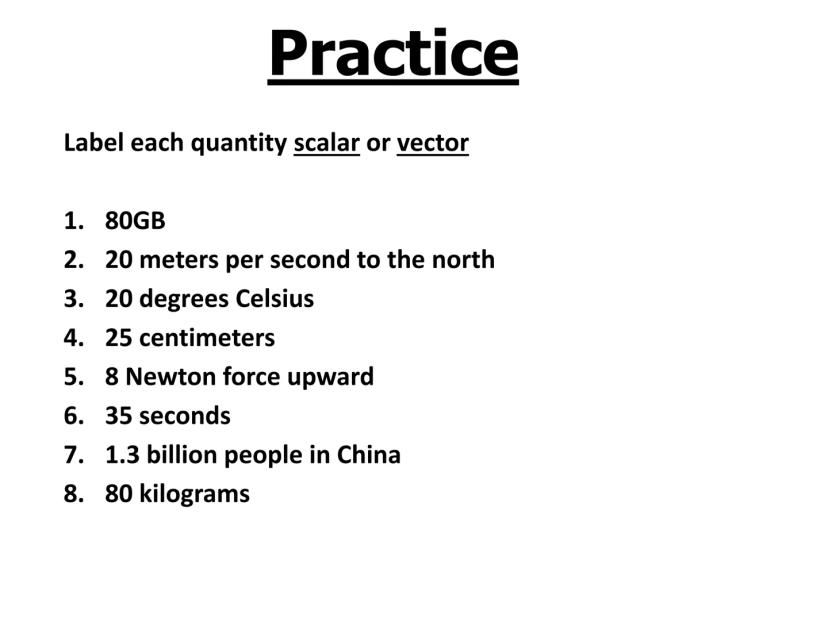
Time to test your knowledge! Can you identify which of these quantities are vectors and which are scalars?
- 80GB (computer storage) - Scalar (just an amount)
- 20 meters per second to the north - Vector (has direction)
- 20 degrees Celsius - Scalar (temperature amount only)
- 25 centimeters - Scalar (length with no direction)
- 8 Newton force upward - Vector (has direction)
- 35 seconds - Scalar (time amount only)
- 1.3 billion people - Scalar (population count)
- 80 kilograms - Scalar (mass amount only)
✅ Quick tip: If you can answer the question "which way?" about a measurement, it's definitely a vector!
8
of 10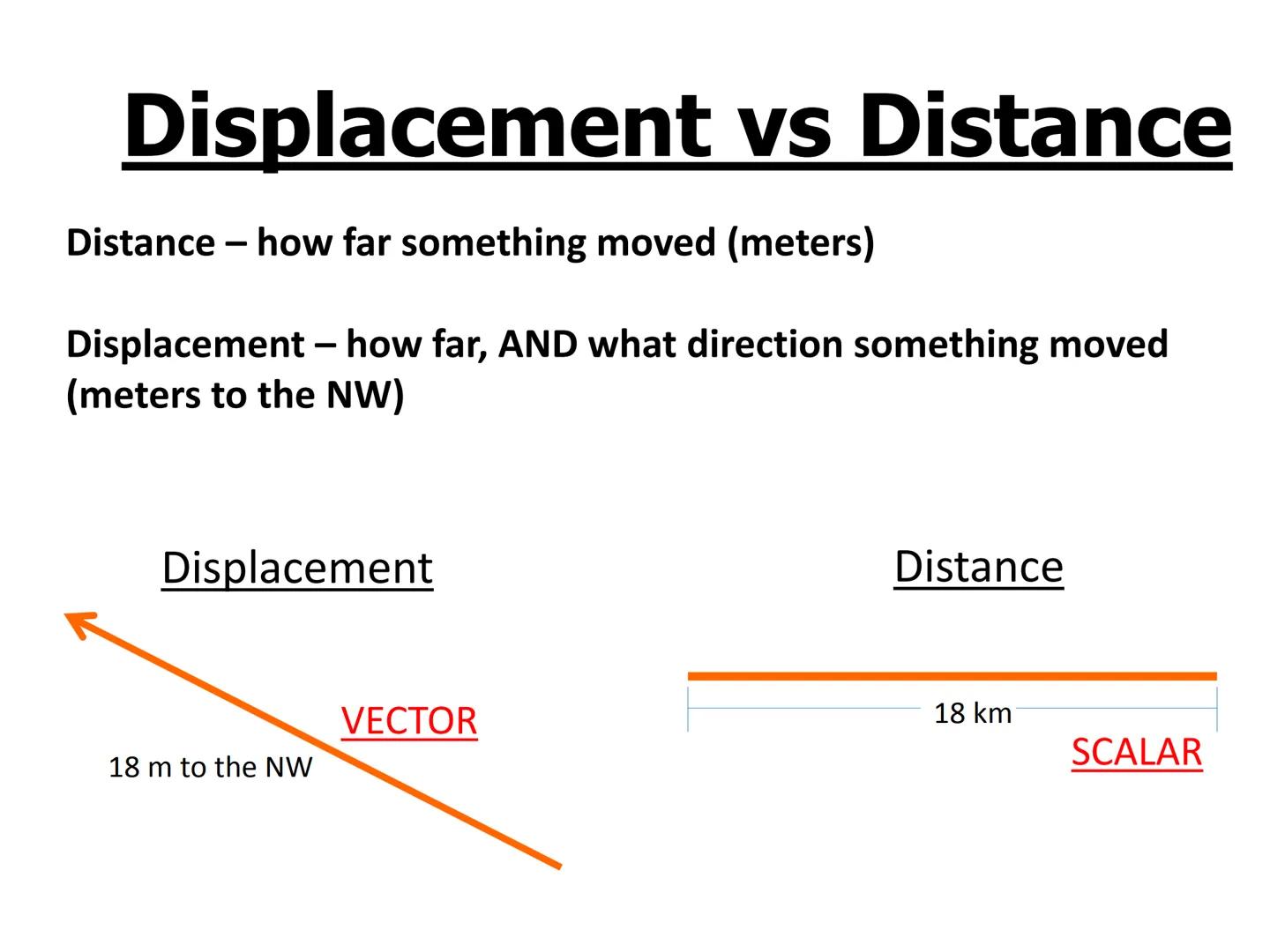
Displacement vs Distance
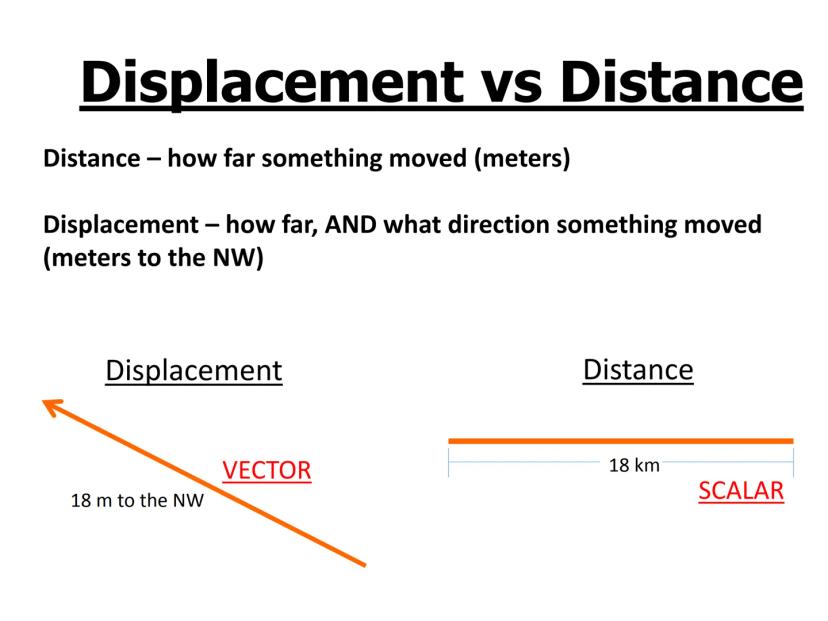
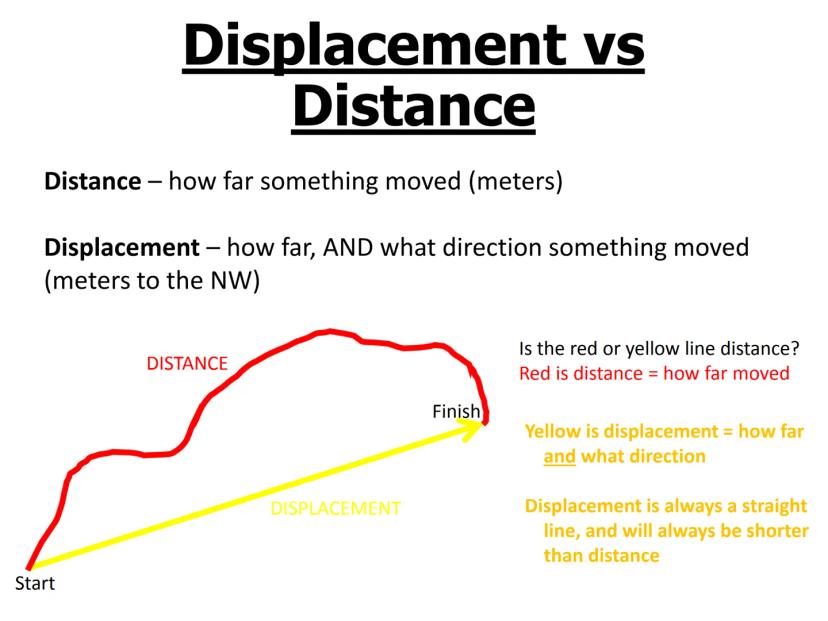
Distance and displacement are often confused, but they're actually different types of measurements. Distance tells us how far something moved (scalar), while displacement tells us how far AND in what direction (vector).
For example, if you travel 18 km along a winding road, your distance is 18 km (scalar). However, if you end up 18 km northwest of your starting point, your displacement is "18 km to the northwest" (vector).
The key difference? Distance describes the total path length, while displacement is like drawing a straight line from start to finish—it's about the final position relative to the starting point.
9
of 10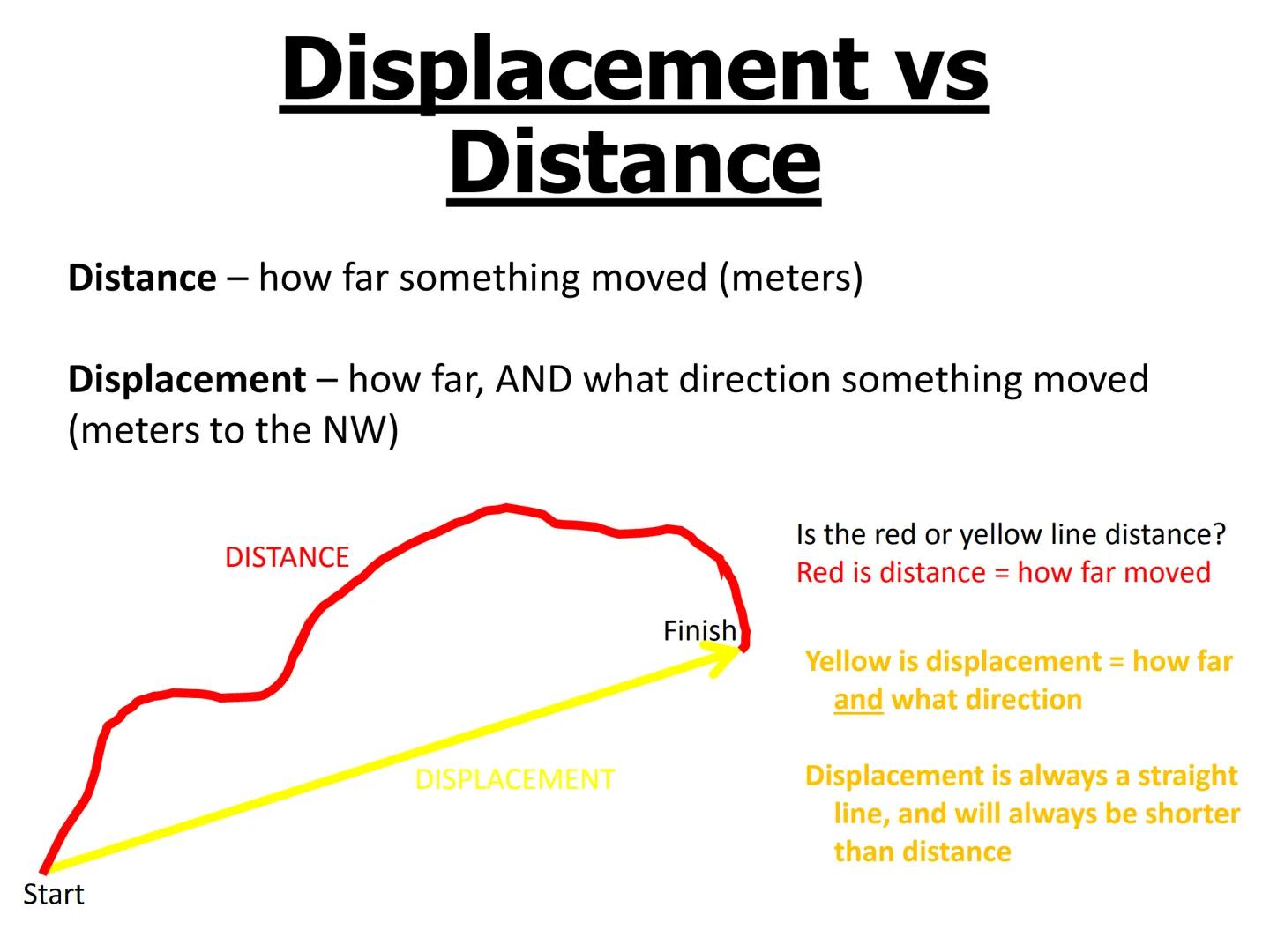
Understanding Path vs. Direct Line
When you follow a winding path, the distance you travel (red line) will always be greater than or equal to your displacement (yellow line). That's because displacement is always the straight-line path between start and finish points.
Think about walking around your school. If you walk from your classroom, through the hallways, to the cafeteria and back, your distance might be 400 meters. But your displacement would be zero—you ended up right where you started!
🧭 Remember: Displacement is always measured as a straight line from start to finish, regardless of the actual path taken.
10
of 10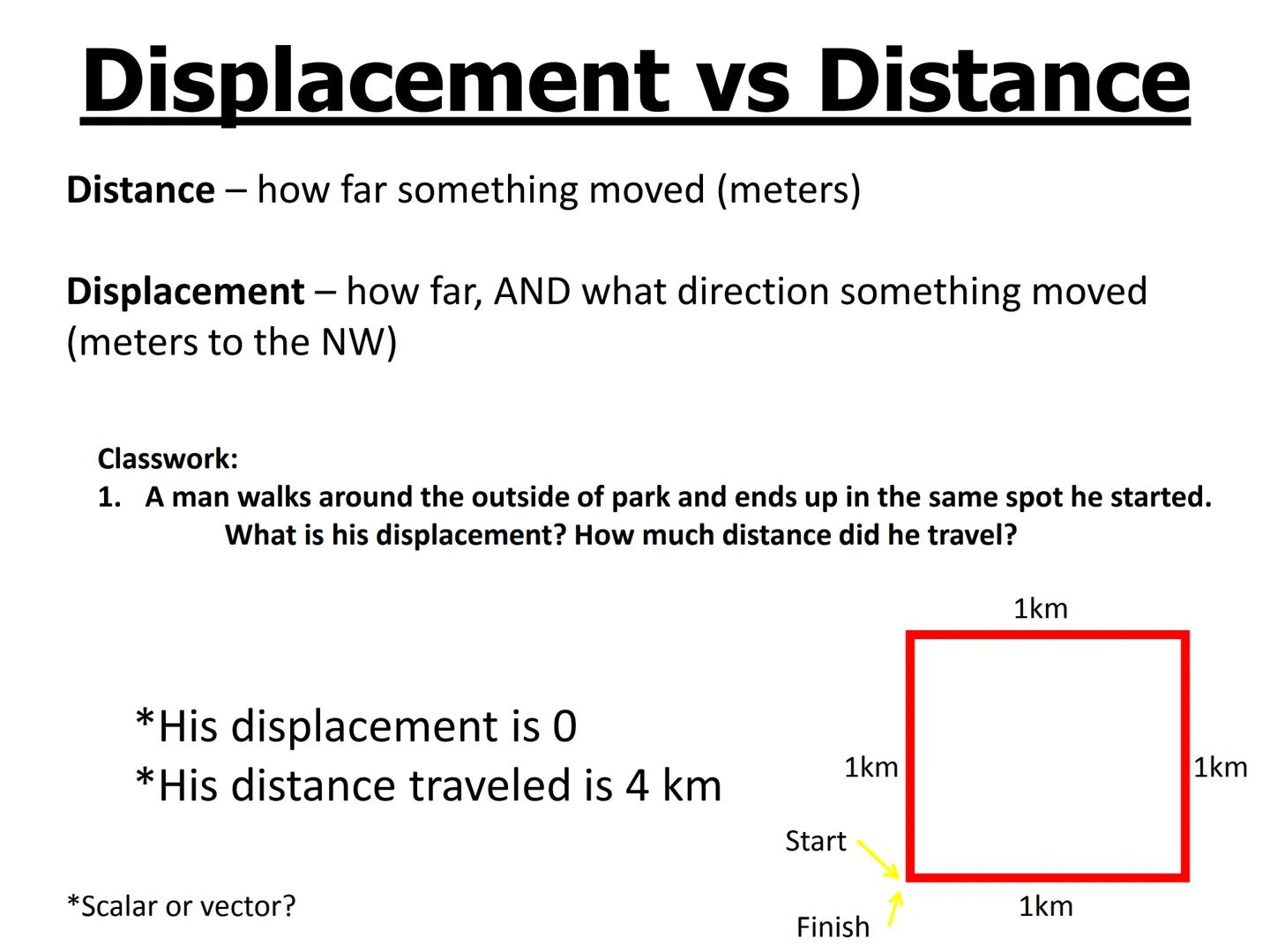
Practical Displacement Examples
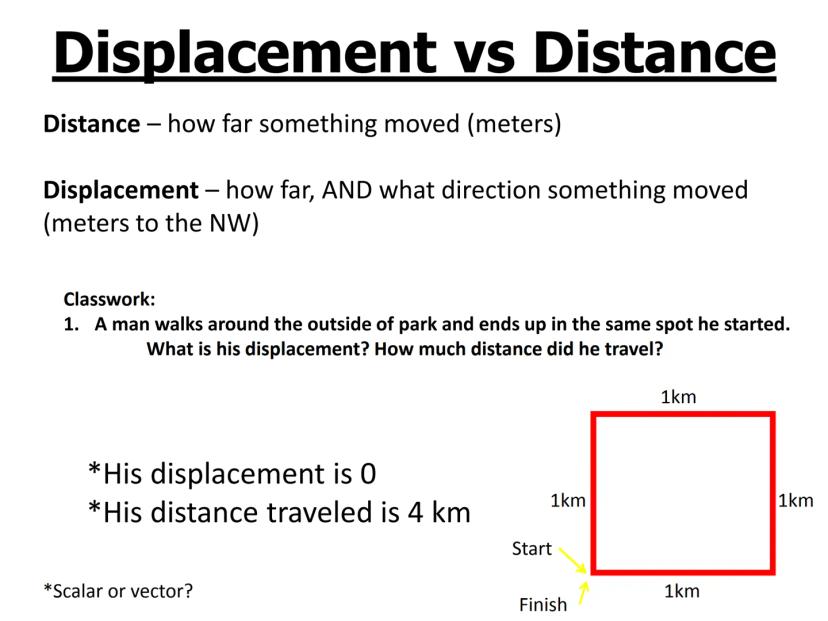
Let's look at a real example: A man walks completely around a square park that has 1 km sides. What's his displacement and distance?
His distance is 4 km—the total length of path he walked (1 km × 4 sides). This is a scalar quantity because it only tells us how far he walked.
His displacement is 0 km—he ended up exactly where he started! Even though he walked quite far, his final position relative to his starting point hasn't changed at all.
This example shows why understanding the difference matters. A GPS might show you traveled 4 km (distance), but if you're trying to figure out how far you are from home (displacement), that's a completely different measurement.
We thought you’d never ask...
What is the Knowunity AI companion?
Our AI companion is specifically built for the needs of students. Based on the millions of content pieces we have on the platform we can provide truly meaningful and relevant answers to students. But its not only about answers, the companion is even more about guiding students through their daily learning challenges, with personalised study plans, quizzes or content pieces in the chat and 100% personalisation based on the students skills and developments.
Where can I download the Knowunity app?
You can download the app in the Google Play Store and in the Apple App Store.
Is Knowunity really free of charge?
That's right! Enjoy free access to study content, connect with fellow students, and get instant help – all at your fingertips.
Similar Content
Most popular content: Displacement
1Most popular content in AP Physics 1
9I
AP Physics 1Introduction to One-Dimensional Motion
Practice defining and distinguishing between scalar and vector quantities like distance, displacement, speed, and velocity in linear scenarios.
9th6620
I
AP Physics 1Introduction to Kinematic Equations
Practice identifying variables and selecting the appropriate kinematic equation for objects moving with constant acceleration in one dimension.
9th5670
AP Physics 1Newton's Second Law of Motion
A detailed explanation of Concept of Newton's Second Law of Motion, Examples, Formulas, and Sample Problems with solution.
36613
AP Physics 1AP Physics 1: Unit 1 Kinematics
Notes for the first unit of AP Physics I
10th1,58460
AP Physics 1AP Physics 1 | Kinematics Unit Notes
Notes on the first unit of APP1: Kinematics. This describes how things move, including the concepts of displacement, velocity, and acceleration.
70637
AP Physics 1Force and Energy
This includes a discussion about force, types of forces, mass vs. weight, work and simple machines.
1369
AP Physics 1Electric Charge
Transfer of Electric Charge-Concepts, Definitions and Examples.
912
AP Physics 1Kinematics and 2D review
Review of concepts of kinematics and 2d motion for AP Physics 1
11th730
AP Physics 1Moment of Inertia
A catalog of common shapes and their moment of inertia.
10th1181
Most popular content
9O
 AP US History
Origins and Dynamics of the Columbian Exchange
Analyze the ecological and economic motivations behind the initial transfer of goods, people, and diseases between the Old and New Worlds.
9th3,1280
I
AP US HistoryIntroduction to Early Cultural Interactions
Analyze the initial social and religious encounters between Europeans, Africans, and Indigenous peoples in the colonial Americas.
9th2,7730
O
 AP World History
Origins of Ancient River Civilizations
Analyze the environmental factors and technological innovations that led to the rise of early states in Mesopotamia, Egypt, and the Indus Valley.
9th3,1870
M
AP US HistoryMotivations for European Exploration
Analyze the economic, religious, and political factors that drove European powers to the Americas during the 15th and 16th centuries.
9th1,7780
F
 AP Psychology
Foundations of Ethical Guidelines in Research
Practice the core principles of the APA ethical code including informed consent, debriefing, and the role of Institutional Review Boards.
9th1,3360
I
AP US HistoryIntroduction to Native American Societies
Examine the diverse social, political, and economic structures of North American indigenous groups prior to European contact.
9th1,1100
I
 AP Biology
Introduction to Biological Elements of Life
Practice identifying the essential elements including carbon, nitrogen, phosphorus, and sulfur that compose biological macromolecules.
9th1,7390
I
AP US HistoryIntroduction to the Spanish Encomienda System
Explore the fundamental economic and social structures of the Spanish colonial system, focusing on the encomienda and the casta social hierarchy.
9th8890
O
AP World HistoryOrigins and Continuity of the Byzantine Empire
Analyze the political and cultural transitions from the Roman Empire to the Byzantine Empire, focusing on the reign of Justinian I and his code.
9th1,6320
Can't find what you're looking for? Explore other subjects.
Students love us — and so will you.
4.6/5App Store
4.7/5Google Play
The app is very easy to use and well designed. I have found everything I was looking for so far and have been able to learn a lot from the presentations! I will definitely use the app for a class assignment! And of course it also helps a lot as an inspiration.
Stefan SiOS user
This app is really great. There are so many study notes and help [...]. My problem subject is French, for example, and the app has so many options for help. Thanks to this app, I have improved my French. I would recommend it to anyone.
Samantha KlichAndroid user
Wow, I am really amazed. I just tried the app because I've seen it advertised many times and was absolutely stunned. This app is THE HELP you want for school and above all, it offers so many things, such as workouts and fact sheets, which have been VERY helpful to me personally.
AnnaiOS user
AP Physics 1187 views·Updated Jun 19, 2026·15 pagesUnderstanding Displacement and Distance: Key Differences and Examples
L
Lucy Styles@lucystyles_htpt
Ever wondered why it matters that an asteroid is moving at 30,000 mph toward Earthrather than just knowing its speed? This is where vectors and scalars come in! These fundamental physics concepts help us describe the physical world with...
1
of 10
Sign up to see the content. It's free!
- Access to all documents
- Improve your grades
- Join milions of students
Understanding Vectors and Scalars
When describing quantities in physics, we use two main types of measurements: vectors and scalars. Each serves a specific purpose in helping us understand the physical world.
By the end of this lesson, you'll be able to identify whether a measurement is a vector or scalar quantity. This skill is essential for solving physics problems correctly.
💡 Think of scalars as "how much" and vectors as "how much AND which way" measurements.
2
of 10Sign up to see the content. It's free!
- Access to all documents
- Improve your grades
- Join milions of students
What is a Scalar Quantity?
Scalar quantities tell us only about magnitude—how much of something exists—without any directional information. When you see a number with just a unit, it's typically a scalar.
Common examples of scalar quantities include:
- 10 meters (distance)
- 2 liters (volume)
- 20 kilometers per hour (speed)
- 30 baht (money)
These measurements give us valuable information about amount, but they don't tell us anything about direction.
3
of 10Sign up to see the content. It's free!
- Access to all documents
- Improve your grades
- Join milions of students
Scalar Quantity Examples
Scalar quantities are straightforward measurements that answer "how much" questions. When someone tells you a room is 10 meters long, that's a scalar—it has magnitude but no direction.
Other common scalar quantities include:
- Time (15 seconds)
- Temperature (98.6°F)
- Mass (50 kilograms)
- Energy (100 joules)
Scalar quantities can be added, subtracted, multiplied, or divided using ordinary arithmetic since they don't have directional components to consider.
🔑 Remember: If you can answer a measurement with just a number and unit (without needing to specify direction), it's probably a scalar.
4
of 10Sign up to see the content. It's free!
- Access to all documents
- Improve your grades
- Join milions of students
What is a Vector Quantity?
Vector quantities have both magnitude AND direction. This combination gives us much more complete information about physical situations.
Unlike scalars, vectors tell us not just how much, but which way. For example, "10 meters to the northeast" is a vector quantity called displacement.
Another common vector is velocity—like "100 kilometers per hour to the west." Notice how both examples include direction information, making them vectors.
5
of 10Sign up to see the content. It's free!
- Access to all documents
- Improve your grades
- Join milions of students
Vector Quantity Examples
Vectors give us a complete picture of physical quantities by including direction. When we say "10 meters to the northeast," we know exactly where something ended up relative to its starting position.
In physics, vectors are often represented by arrows. The length of the arrow shows magnitude (how much), while the arrow's direction indicates, well, the direction!
Common vector quantities include:
- Force (15 Newtons upward)
- Acceleration
- Momentum
🚀 The next time you see an arrow on a weather map showing wind direction and speed, remember—that's a vector!
6
of 10Sign up to see the content. It's free!
- Access to all documents
- Improve your grades
- Join milions of students
Why Vectors Matter in Real Life
Vectors aren't just classroom concepts—they're crucial for understanding our world! Take asteroids, for instance. Scientists track their path using vectors because they need to know both speed AND direction.
Without vectors, we couldn't predict meteor showers or calculate whether an asteroid might collide with Earth. The combination of magnitude and direction allows astronomers to map precise trajectories through space.
Vectors also help engineers design bridges, pilots navigate airplanes, and meteorologists predict weather patterns. Any situation where "which way" matters requires vectors to describe it properly.
7
of 10Sign up to see the content. It's free!
- Access to all documents
- Improve your grades
- Join milions of students
Practice Identifying Vectors and Scalars
Time to test your knowledge! Can you identify which of these quantities are vectors and which are scalars?
- 80GB (computer storage) - Scalar (just an amount)
- 20 meters per second to the north - Vector (has direction)
- 20 degrees Celsius - Scalar (temperature amount only)
- 25 centimeters - Scalar (length with no direction)
- 8 Newton force upward - Vector (has direction)
- 35 seconds - Scalar (time amount only)
- 1.3 billion people - Scalar (population count)
- 80 kilograms - Scalar (mass amount only)
✅ Quick tip: If you can answer the question "which way?" about a measurement, it's definitely a vector!
8
of 10Sign up to see the content. It's free!
- Access to all documents
- Improve your grades
- Join milions of students
Displacement vs Distance
Distance and displacement are often confused, but they're actually different types of measurements. Distance tells us how far something moved (scalar), while displacement tells us how far AND in what direction (vector).
For example, if you travel 18 km along a winding road, your distance is 18 km (scalar). However, if you end up 18 km northwest of your starting point, your displacement is "18 km to the northwest" (vector).
The key difference? Distance describes the total path length, while displacement is like drawing a straight line from start to finish—it's about the final position relative to the starting point.
9
of 10Sign up to see the content. It's free!
- Access to all documents
- Improve your grades
- Join milions of students
Understanding Path vs. Direct Line
When you follow a winding path, the distance you travel (red line) will always be greater than or equal to your displacement (yellow line). That's because displacement is always the straight-line path between start and finish points.
Think about walking around your school. If you walk from your classroom, through the hallways, to the cafeteria and back, your distance might be 400 meters. But your displacement would be zero—you ended up right where you started!
🧭 Remember: Displacement is always measured as a straight line from start to finish, regardless of the actual path taken.
10
of 10Sign up to see the content. It's free!
- Access to all documents
- Improve your grades
- Join milions of students
Practical Displacement Examples
Let's look at a real example: A man walks completely around a square park that has 1 km sides. What's his displacement and distance?
His distance is 4 km—the total length of path he walked (1 km × 4 sides). This is a scalar quantity because it only tells us how far he walked.
His displacement is 0 km—he ended up exactly where he started! Even though he walked quite far, his final position relative to his starting point hasn't changed at all.
This example shows why understanding the difference matters. A GPS might show you traveled 4 km (distance), but if you're trying to figure out how far you are from home (displacement), that's a completely different measurement.
We thought you’d never ask...
What is the Knowunity AI companion?
Our AI companion is specifically built for the needs of students. Based on the millions of content pieces we have on the platform we can provide truly meaningful and relevant answers to students. But its not only about answers, the companion is even more about guiding students through their daily learning challenges, with personalised study plans, quizzes or content pieces in the chat and 100% personalisation based on the students skills and developments.
Where can I download the Knowunity app?
You can download the app in the Google Play Store and in the Apple App Store.
Is Knowunity really free of charge?
That's right! Enjoy free access to study content, connect with fellow students, and get instant help – all at your fingertips.
Similar Content
Most popular content: Displacement
1Most popular content in AP Physics 1
9I
AP Physics 1Introduction to One-Dimensional Motion
Practice defining and distinguishing between scalar and vector quantities like distance, displacement, speed, and velocity in linear scenarios.
9th6620
I
AP Physics 1Introduction to Kinematic Equations
Practice identifying variables and selecting the appropriate kinematic equation for objects moving with constant acceleration in one dimension.
9th5670
AP Physics 1Newton's Second Law of Motion
A detailed explanation of Concept of Newton's Second Law of Motion, Examples, Formulas, and Sample Problems with solution.
36613
AP Physics 1AP Physics 1: Unit 1 Kinematics
Notes for the first unit of AP Physics I
10th1,58460
AP Physics 1AP Physics 1 | Kinematics Unit Notes
Notes on the first unit of APP1: Kinematics. This describes how things move, including the concepts of displacement, velocity, and acceleration.
70637
AP Physics 1Force and Energy
This includes a discussion about force, types of forces, mass vs. weight, work and simple machines.
1369
AP Physics 1Electric Charge
Transfer of Electric Charge-Concepts, Definitions and Examples.
912
AP Physics 1Kinematics and 2D review
Review of concepts of kinematics and 2d motion for AP Physics 1
11th730
AP Physics 1Moment of Inertia
A catalog of common shapes and their moment of inertia.
10th1181
Most popular content
9O
AP US HistoryOrigins and Dynamics of the Columbian Exchange
Analyze the ecological and economic motivations behind the initial transfer of goods, people, and diseases between the Old and New Worlds.
9th3,1280
I
AP US HistoryIntroduction to Early Cultural Interactions
Analyze the initial social and religious encounters between Europeans, Africans, and Indigenous peoples in the colonial Americas.
9th2,7730
O
AP World HistoryOrigins of Ancient River Civilizations
Analyze the environmental factors and technological innovations that led to the rise of early states in Mesopotamia, Egypt, and the Indus Valley.
9th3,1870
M
AP US HistoryMotivations for European Exploration
Analyze the economic, religious, and political factors that drove European powers to the Americas during the 15th and 16th centuries.
9th1,7780
F
AP PsychologyFoundations of Ethical Guidelines in Research
Practice the core principles of the APA ethical code including informed consent, debriefing, and the role of Institutional Review Boards.
9th1,3360
I
AP US HistoryIntroduction to Native American Societies
Examine the diverse social, political, and economic structures of North American indigenous groups prior to European contact.
9th1,1100
I
AP BiologyIntroduction to Biological Elements of Life
Practice identifying the essential elements including carbon, nitrogen, phosphorus, and sulfur that compose biological macromolecules.
9th1,7390
I
AP US HistoryIntroduction to the Spanish Encomienda System
Explore the fundamental economic and social structures of the Spanish colonial system, focusing on the encomienda and the casta social hierarchy.
9th8890
O
AP World HistoryOrigins and Continuity of the Byzantine Empire
Analyze the political and cultural transitions from the Roman Empire to the Byzantine Empire, focusing on the reign of Justinian I and his code.
9th1,6320
Can't find what you're looking for? Explore other subjects.
Students love us — and so will you.
4.6/5App Store
4.7/5Google Play
The app is very easy to use and well designed. I have found everything I was looking for so far and have been able to learn a lot from the presentations! I will definitely use the app for a class assignment! And of course it also helps a lot as an inspiration.
Stefan SiOS user
This app is really great. There are so many study notes and help [...]. My problem subject is French, for example, and the app has so many options for help. Thanks to this app, I have improved my French. I would recommend it to anyone.
Samantha KlichAndroid user
Wow, I am really amazed. I just tried the app because I've seen it advertised many times and was absolutely stunned. This app is THE HELP you want for school and above all, it offers so many things, such as workouts and fact sheets, which have been VERY helpful to me personally.
AnnaiOS user