

The 1918 Spanish Flu pandemic was one of history's deadliest...
 AP Human Geography72 views·Updated Jun 20, 2026·2 pages
Spanish Flu Overview for AP Human Geography
1
of 2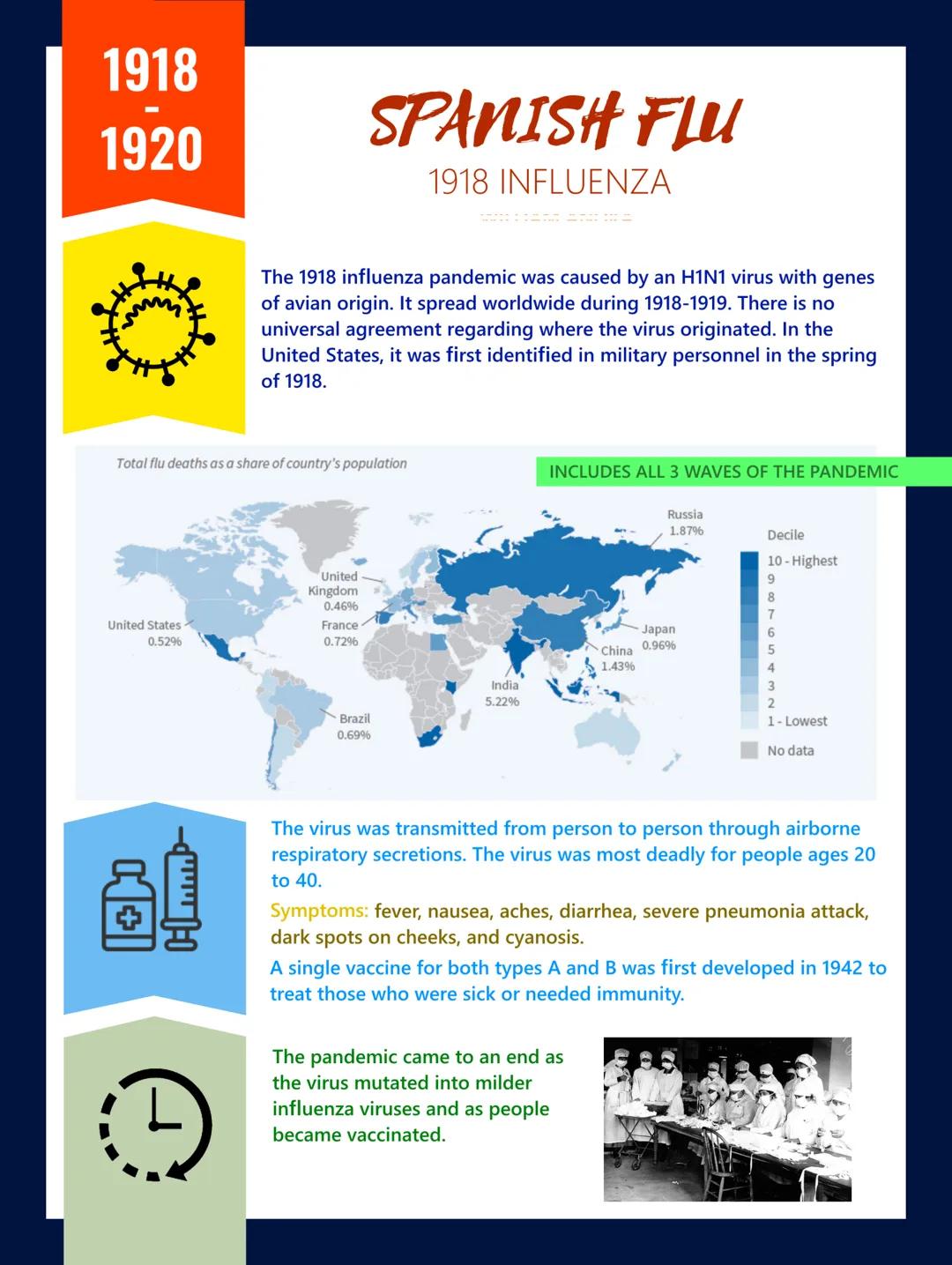
1918 Spanish Flu Pandemic
The 1918 influenza pandemic, caused by an H1N1 virus with avian genes, swept across the world in 1918-1919. While its exact origin remains debated, the virus was first identified in American military personnel in spring 1918. This wasn't your ordinary flu - it was exceptionally deadly.
Unlike typical influenza that primarily affects the very young and elderly, this pandemic was particularly deadly for people between 20 and 40 years old. The virus spread through airborne respiratory droplets, causing symptoms including fever, nausea, body aches, diarrhea, severe pneumonia, dark spots on cheeks, and cyanosis (bluish skin discoloration).
Different countries experienced vastly different mortality rates. India suffered the highest death rate at 5.22% of its population, while Russia lost 1.87% and China 1.43%. Western nations generally fared better, with the United States losing 0.52% and the United Kingdom 0.46% of their populations.
Did you know? The first single vaccine that protected against both influenza types A and B wasn't developed until 1942, long after the pandemic ended. The 1918 pandemic eventually subsided as the virus naturally mutated into milder forms and immunity developed in surviving populations.
2
of 2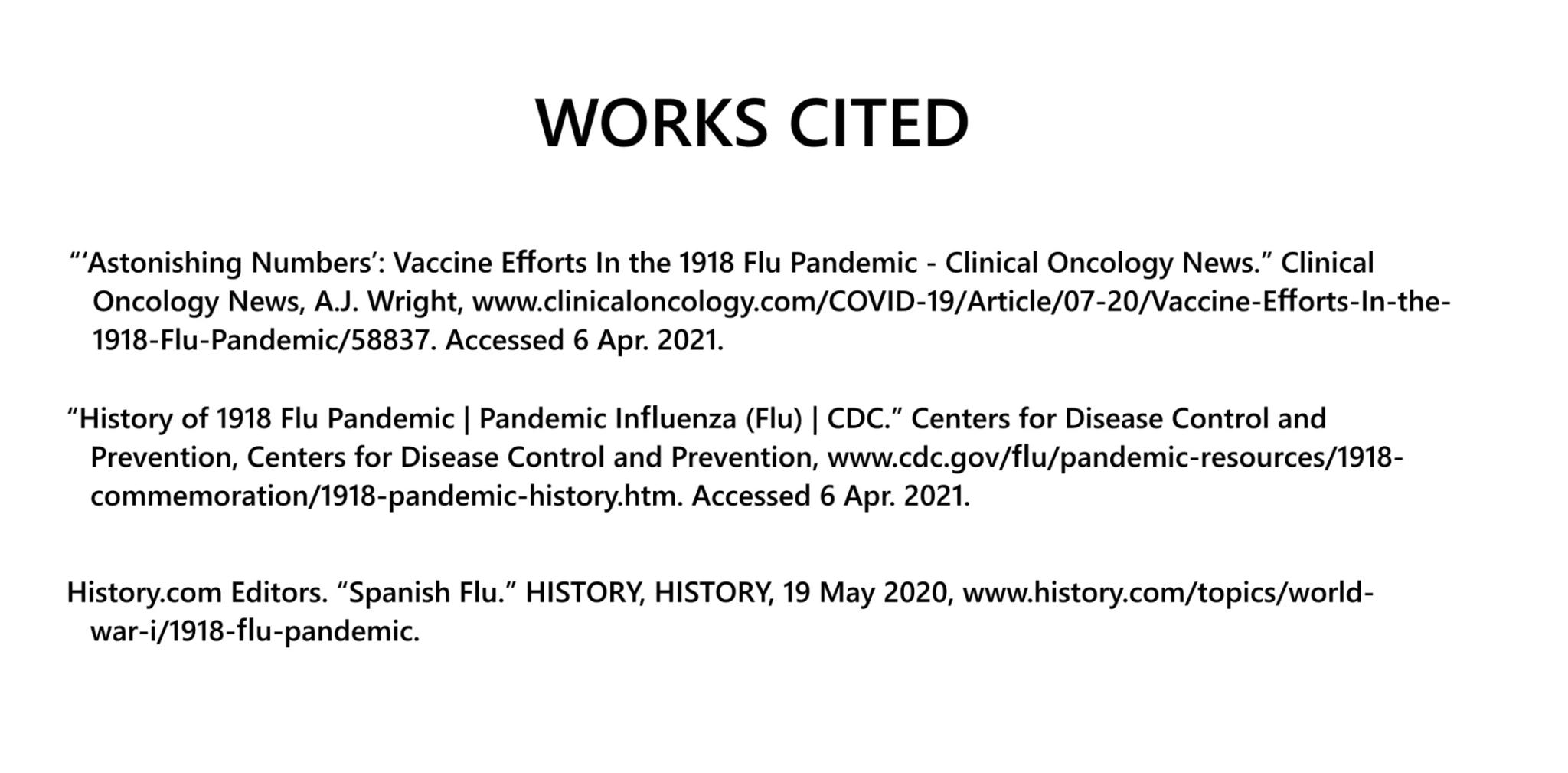
Sources and Additional Information
This information comes from several reputable historical and medical sources that have documented the 1918 influenza pandemic. These include research from the Centers for Disease Control and Prevention (CDC), which maintains extensive historical records of pandemic influenza.
Historical accounts from the era provide valuable insights into how the pandemic affected society, healthcare systems, and government responses. These primary sources help us understand the full impact of this devastating global health crisis.
Medical literature and vaccination history sources document early efforts to create influenza vaccines, including the breakthrough development of the first combined Type A and B influenza vaccine in 1942. Understanding the history of vaccine development helps us appreciate modern medical advances.
The pandemic's resolution through viral mutation and immunity development demonstrates important principles of how infectious disease outbreaks naturally evolve and eventually subside - a pattern seen in many subsequent pandemics.
We thought you’d never ask...
What is the Knowunity AI companion?
Our AI companion is specifically built for the needs of students. Based on the millions of content pieces we have on the platform we can provide truly meaningful and relevant answers to students. But its not only about answers, the companion is even more about guiding students through their daily learning challenges, with personalised study plans, quizzes or content pieces in the chat and 100% personalisation based on the students skills and developments.
Where can I download the Knowunity app?
You can download the app in the Google Play Store and in the Apple App Store.
Is Knowunity really free of charge?
That's right! Enjoy free access to study content, connect with fellow students, and get instant help – all at your fingertips.
Similar Content
Most popular content in AP Human Geography
9I
AP Human GeographyIntroduction to Geographic Data
Practice identifying types of geographic data, including qualitative and quantitative sources like census data and satellite imagery.
9th5500
I
AP Human GeographyIntroduction to Human-Environmental Interaction
Practice the foundational concepts of environmental determinism and possibilism and their influence on early geographic thought.
9th4520
I
AP Human GeographyIntroduction to Map Properties and Scale
Practice identifying types of map distortion and calculating map scale to understand how physical reality is represented on a flat surface.
9th2860
P
AP Human GeographyPopulation: quiz #1!
Master the fundamentals of population with these easy flashcards designed for high school students. Explore key concepts, terms, and examples to ace your exams!
9th1890
A
AP Human GeographyAP HUG UNIT 1
This is a little test to help you practice for AP HUG
10th1890
U
AP Human GeographyUnit 2 Measuring Population Density quiz
Measuring Population Density
9th1720
I
AP Human GeographyIntroduction to Geographic Data Scales
Practice identifying and differentiating between local, regional, national, and global scales of analysis using maps and data sets.
9th1810
A
AP Human GeographyAPHUG Unit 1
10 questions just general info you should know if you have listened in your class :D
9th1580
AP Human GeographyFull Year APHG (Human Geography) Notes
My full Freshman year’s APHG notes compiled on a document.
9th1,915236
Most popular content
9O
 AP US History
Origins and Dynamics of the Columbian Exchange
Analyze the ecological and economic motivations behind the initial transfer of goods, people, and diseases between the Old and New Worlds.
9th3,1280
I
AP US HistoryIntroduction to Early Cultural Interactions
Analyze the initial social and religious encounters between Europeans, Africans, and Indigenous peoples in the colonial Americas.
9th2,7730
O
 AP World History
Origins of Ancient River Civilizations
Analyze the environmental factors and technological innovations that led to the rise of early states in Mesopotamia, Egypt, and the Indus Valley.
9th3,1870
M
AP US HistoryMotivations for European Exploration
Analyze the economic, religious, and political factors that drove European powers to the Americas during the 15th and 16th centuries.
9th1,7780
F
AP PsychologyFoundations of Ethical Guidelines in Research
Practice the core principles of the APA ethical code including informed consent, debriefing, and the role of Institutional Review Boards.
9th1,3360
I
AP US HistoryIntroduction to Native American Societies
Examine the diverse social, political, and economic structures of North American indigenous groups prior to European contact.
9th1,1100
I
 AP Biology
Introduction to Biological Elements of Life
Practice identifying the essential elements including carbon, nitrogen, phosphorus, and sulfur that compose biological macromolecules.
9th1,7390
I
AP US HistoryIntroduction to the Spanish Encomienda System
Explore the fundamental economic and social structures of the Spanish colonial system, focusing on the encomienda and the casta social hierarchy.
9th8890
O
AP World HistoryOrigins and Continuity of the Byzantine Empire
Analyze the political and cultural transitions from the Roman Empire to the Byzantine Empire, focusing on the reign of Justinian I and his code.
9th1,6320
Can't find what you're looking for? Explore other subjects.
Students love us — and so will you.
4.6/5App Store
4.7/5Google Play
The app is very easy to use and well designed. I have found everything I was looking for so far and have been able to learn a lot from the presentations! I will definitely use the app for a class assignment! And of course it also helps a lot as an inspiration.
Stefan SiOS user
This app is really great. There are so many study notes and help [...]. My problem subject is French, for example, and the app has so many options for help. Thanks to this app, I have improved my French. I would recommend it to anyone.
Samantha KlichAndroid user
Wow, I am really amazed. I just tried the app because I've seen it advertised many times and was absolutely stunned. This app is THE HELP you want for school and above all, it offers so many things, such as workouts and fact sheets, which have been VERY helpful to me personally.
AnnaiOS user
AP Human Geography72 views·Updated Jun 20, 2026·2 pagesSpanish Flu Overview for AP Human Geography
The 1918 Spanish Flu pandemic was one of history's deadliest disease outbreaks, killing millions worldwide. This H1N1 virus with avian origins spread rapidly across the globe, affecting countries differently and showing unusual patterns of mortality compared to typical influenza outbreaks.
1
of 2
Sign up to see the content. It's free!
- Access to all documents
- Improve your grades
- Join milions of students
1918 Spanish Flu Pandemic
The 1918 influenza pandemic, caused by an H1N1 virus with avian genes, swept across the world in 1918-1919. While its exact origin remains debated, the virus was first identified in American military personnel in spring 1918. This wasn't your ordinary flu - it was exceptionally deadly.
Unlike typical influenza that primarily affects the very young and elderly, this pandemic was particularly deadly for people between 20 and 40 years old. The virus spread through airborne respiratory droplets, causing symptoms including fever, nausea, body aches, diarrhea, severe pneumonia, dark spots on cheeks, and cyanosis (bluish skin discoloration).
Different countries experienced vastly different mortality rates. India suffered the highest death rate at 5.22% of its population, while Russia lost 1.87% and China 1.43%. Western nations generally fared better, with the United States losing 0.52% and the United Kingdom 0.46% of their populations.
Did you know? The first single vaccine that protected against both influenza types A and B wasn't developed until 1942, long after the pandemic ended. The 1918 pandemic eventually subsided as the virus naturally mutated into milder forms and immunity developed in surviving populations.
2
of 2Sign up to see the content. It's free!
- Access to all documents
- Improve your grades
- Join milions of students
Sources and Additional Information
This information comes from several reputable historical and medical sources that have documented the 1918 influenza pandemic. These include research from the Centers for Disease Control and Prevention (CDC), which maintains extensive historical records of pandemic influenza.
Historical accounts from the era provide valuable insights into how the pandemic affected society, healthcare systems, and government responses. These primary sources help us understand the full impact of this devastating global health crisis.
Medical literature and vaccination history sources document early efforts to create influenza vaccines, including the breakthrough development of the first combined Type A and B influenza vaccine in 1942. Understanding the history of vaccine development helps us appreciate modern medical advances.
The pandemic's resolution through viral mutation and immunity development demonstrates important principles of how infectious disease outbreaks naturally evolve and eventually subside - a pattern seen in many subsequent pandemics.
We thought you’d never ask...
What is the Knowunity AI companion?
Our AI companion is specifically built for the needs of students. Based on the millions of content pieces we have on the platform we can provide truly meaningful and relevant answers to students. But its not only about answers, the companion is even more about guiding students through their daily learning challenges, with personalised study plans, quizzes or content pieces in the chat and 100% personalisation based on the students skills and developments.
Where can I download the Knowunity app?
You can download the app in the Google Play Store and in the Apple App Store.
Is Knowunity really free of charge?
That's right! Enjoy free access to study content, connect with fellow students, and get instant help – all at your fingertips.
Similar Content
Most popular content in AP Human Geography
9I
AP Human GeographyIntroduction to Geographic Data
Practice identifying types of geographic data, including qualitative and quantitative sources like census data and satellite imagery.
9th5500
I
AP Human GeographyIntroduction to Human-Environmental Interaction
Practice the foundational concepts of environmental determinism and possibilism and their influence on early geographic thought.
9th4520
I
AP Human GeographyIntroduction to Map Properties and Scale
Practice identifying types of map distortion and calculating map scale to understand how physical reality is represented on a flat surface.
9th2860
P
AP Human GeographyPopulation: quiz #1!
Master the fundamentals of population with these easy flashcards designed for high school students. Explore key concepts, terms, and examples to ace your exams!
9th1890
A
AP Human GeographyAP HUG UNIT 1
This is a little test to help you practice for AP HUG
10th1890
U
AP Human GeographyUnit 2 Measuring Population Density quiz
Measuring Population Density
9th1720
I
AP Human GeographyIntroduction to Geographic Data Scales
Practice identifying and differentiating between local, regional, national, and global scales of analysis using maps and data sets.
9th1810
A
AP Human GeographyAPHUG Unit 1
10 questions just general info you should know if you have listened in your class :D
9th1580
AP Human GeographyFull Year APHG (Human Geography) Notes
My full Freshman year’s APHG notes compiled on a document.
9th1,915236
Most popular content
9O
AP US HistoryOrigins and Dynamics of the Columbian Exchange
Analyze the ecological and economic motivations behind the initial transfer of goods, people, and diseases between the Old and New Worlds.
9th3,1280
I
AP US HistoryIntroduction to Early Cultural Interactions
Analyze the initial social and religious encounters between Europeans, Africans, and Indigenous peoples in the colonial Americas.
9th2,7730
O
AP World HistoryOrigins of Ancient River Civilizations
Analyze the environmental factors and technological innovations that led to the rise of early states in Mesopotamia, Egypt, and the Indus Valley.
9th3,1870
M
AP US HistoryMotivations for European Exploration
Analyze the economic, religious, and political factors that drove European powers to the Americas during the 15th and 16th centuries.
9th1,7780
F
AP PsychologyFoundations of Ethical Guidelines in Research
Practice the core principles of the APA ethical code including informed consent, debriefing, and the role of Institutional Review Boards.
9th1,3360
I
AP US HistoryIntroduction to Native American Societies
Examine the diverse social, political, and economic structures of North American indigenous groups prior to European contact.
9th1,1100
I
AP BiologyIntroduction to Biological Elements of Life
Practice identifying the essential elements including carbon, nitrogen, phosphorus, and sulfur that compose biological macromolecules.
9th1,7390
I
AP US HistoryIntroduction to the Spanish Encomienda System
Explore the fundamental economic and social structures of the Spanish colonial system, focusing on the encomienda and the casta social hierarchy.
9th8890
O
AP World HistoryOrigins and Continuity of the Byzantine Empire
Analyze the political and cultural transitions from the Roman Empire to the Byzantine Empire, focusing on the reign of Justinian I and his code.
9th1,6320
Can't find what you're looking for? Explore other subjects.
Students love us — and so will you.
4.6/5App Store
4.7/5Google Play
The app is very easy to use and well designed. I have found everything I was looking for so far and have been able to learn a lot from the presentations! I will definitely use the app for a class assignment! And of course it also helps a lot as an inspiration.
Stefan SiOS user
This app is really great. There are so many study notes and help [...]. My problem subject is French, for example, and the app has so many options for help. Thanks to this app, I have improved my French. I would recommend it to anyone.
Samantha KlichAndroid user
Wow, I am really amazed. I just tried the app because I've seen it advertised many times and was absolutely stunned. This app is THE HELP you want for school and above all, it offers so many things, such as workouts and fact sheets, which have been VERY helpful to me personally.
AnnaiOS user