
A comprehensive comparison of population policies between Bangladesh and France...
 AP Human Geography278 views·Updated Jun 17, 2026·2 pages
Bangladesh vs France: How Their Population Plans Stack Up

Sofie@sofie_us
1
of 2
France's Pro-Natalist Policy
France implemented a pro-natalist policy to encourage population growth and increase fertility rates. The policy offered various incentives for families to have three or more children.
Highlight: France's pro-natalist policy resulted in a modest increase in fertility rates from 1.67 to 1.87.
Key components of France's policy included:
- Monthly cash reward of £675 for mothers staying home for a year after their third child
- Significant reductions on train fares
- Tax reductions based on the number of children in a family
- Three years of paid parental leave
- Government subsidies for daycares and full-time schools
While an exact cost estimate is not available, France's direct spending on families as a percentage of GDP is the second-highest among High-Income Countries (HICs), at 4%.
Definition: Pro-natalist policy - A population policy designed to encourage higher birth rates and population growth.
Positive side effects of the policy included:
- Reduced need for multiple children to care for aging parents
- Financial benefits for some families, particularly those in poverty
- A slight increase in fertility rates
However, the policy also faced challenges:
- High annual costs with limited desired effects
- Exclusion of couples unable to have three children from certain benefits
Quote: "France has input a plethora of its funds every year, and it's seeming that they are not getting the effect they initially wanted."
In evaluating the effectiveness of both policies, Bangladesh's anti-natalist approach appears more successful in achieving its goals, with a significant decrease in fertility rates and lower implementation costs compared to France's pro-natalist strategy.
2
of 2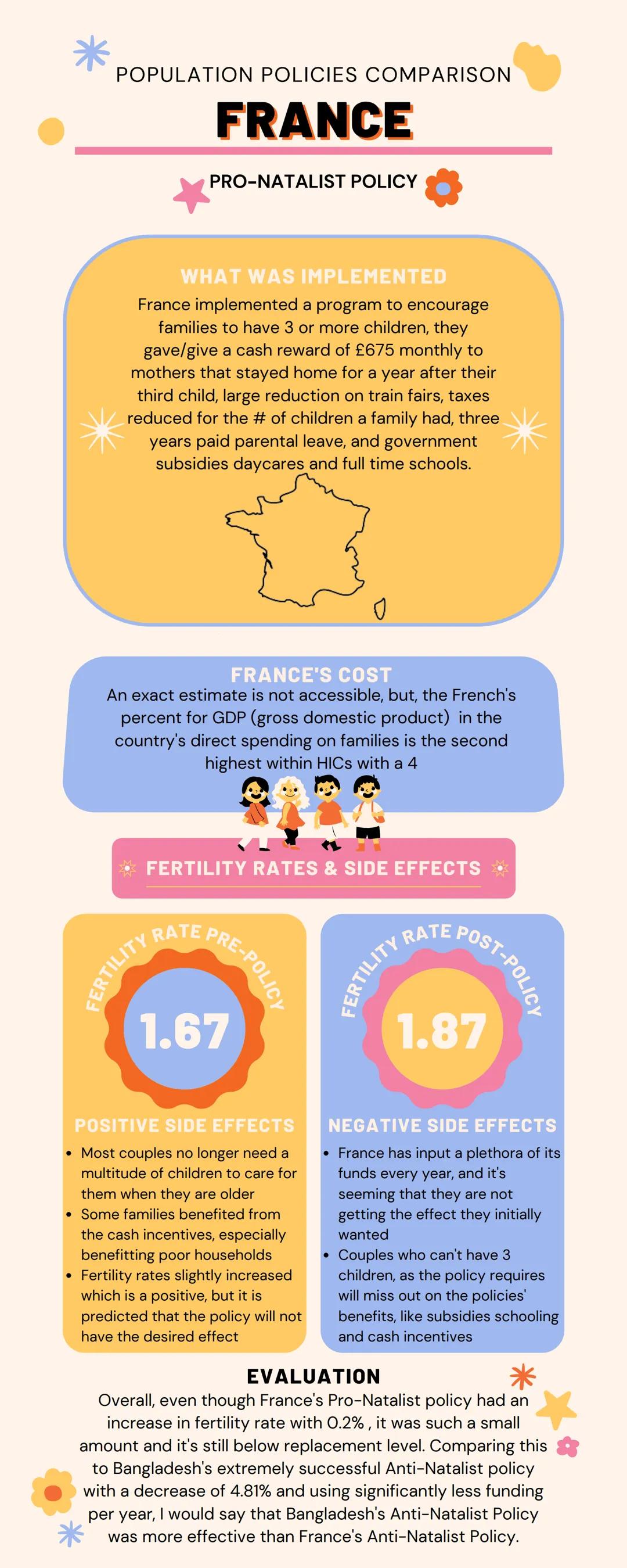
Bangladesh's Anti-Natalist Policy
Bangladesh implemented an anti-natalist policy to control its rapidly growing population. The policy focused on a nationwide outreach program to educate and provide resources for family planning.
Highlight: Bangladesh's anti-natalist policy led to a dramatic decrease in fertility rates from 6.82 to 2.01.
The policy's main components included:
- Door-to-door information dissemination by female workers
- Motivation for families to have fewer children
- Provision of contraceptives to prevent pregnancies
The cost of the program ranged from $100 million to $150 million per year, with most funding coming from external donors.
Example: The use of contraceptives among married women in Bangladesh increased from 8% to 60% in just over 30 years.
Positive side effects of the policy included:
- Widespread knowledge of family planning methods among women
- Significant increase in contraceptive use
- Improved primary school enrollment for both boys and girls
Vocabulary: Anti-natalist policy - A population policy aimed at reducing birth rates and slowing population growth.
However, the policy also had potential drawbacks:
- Limited sustainability, as information dissemination can reach a saturation point
- Lack of forced compliance, allowing women to continue having children if desired
Quote: "Bangladesh's policy isn't sustainable, as giving people information can only be done so much, so if they had another spike in fertility rates they would need a new policy."
We thought you’d never ask...
What is the Knowunity AI companion?
Our AI companion is specifically built for the needs of students. Based on the millions of content pieces we have on the platform we can provide truly meaningful and relevant answers to students. But its not only about answers, the companion is even more about guiding students through their daily learning challenges, with personalised study plans, quizzes or content pieces in the chat and 100% personalisation based on the students skills and developments.
Where can I download the Knowunity app?
You can download the app in the Google Play Store and in the Apple App Store.
Is Knowunity really free of charge?
That's right! Enjoy free access to study content, connect with fellow students, and get instant help – all at your fingertips.
Most popular content: Anti-natalist Policies
1Most popular content in AP Human Geography
9I
AP Human GeographyIntroduction to Geographic Data
Practice identifying types of geographic data, including qualitative and quantitative sources like census data and satellite imagery.
9th5500
I
AP Human GeographyIntroduction to Human-Environmental Interaction
Practice the foundational concepts of environmental determinism and possibilism and their influence on early geographic thought.
9th4520
I
AP Human GeographyIntroduction to Map Properties and Scale
Practice identifying types of map distortion and calculating map scale to understand how physical reality is represented on a flat surface.
9th2860
P
AP Human GeographyPopulation: quiz #1!
Master the fundamentals of population with these easy flashcards designed for high school students. Explore key concepts, terms, and examples to ace your exams!
9th1890
A
AP Human GeographyAP HUG UNIT 1
This is a little test to help you practice for AP HUG
10th1890
U
AP Human GeographyUnit 2 Measuring Population Density quiz
Measuring Population Density
9th1720
I
AP Human GeographyIntroduction to Geographic Data Scales
Practice identifying and differentiating between local, regional, national, and global scales of analysis using maps and data sets.
9th1810
A
AP Human GeographyAPHUG Unit 1
10 questions just general info you should know if you have listened in your class :D
9th1580
AP Human GeographyFull Year APHG (Human Geography) Notes
My full Freshman year’s APHG notes compiled on a document.
9th1,915236
Most popular content
9O
 AP US History
Origins and Dynamics of the Columbian Exchange
Analyze the ecological and economic motivations behind the initial transfer of goods, people, and diseases between the Old and New Worlds.
9th3,1280
I
AP US HistoryIntroduction to Early Cultural Interactions
Analyze the initial social and religious encounters between Europeans, Africans, and Indigenous peoples in the colonial Americas.
9th2,7730
O
 AP World History
Origins of Ancient River Civilizations
Analyze the environmental factors and technological innovations that led to the rise of early states in Mesopotamia, Egypt, and the Indus Valley.
9th3,1870
M
AP US HistoryMotivations for European Exploration
Analyze the economic, religious, and political factors that drove European powers to the Americas during the 15th and 16th centuries.
9th1,7780
F
AP PsychologyFoundations of Ethical Guidelines in Research
Practice the core principles of the APA ethical code including informed consent, debriefing, and the role of Institutional Review Boards.
9th1,3360
I
AP US HistoryIntroduction to Native American Societies
Examine the diverse social, political, and economic structures of North American indigenous groups prior to European contact.
9th1,1100
I
 AP Biology
Introduction to Biological Elements of Life
Practice identifying the essential elements including carbon, nitrogen, phosphorus, and sulfur that compose biological macromolecules.
9th1,7390
I
AP US HistoryIntroduction to the Spanish Encomienda System
Explore the fundamental economic and social structures of the Spanish colonial system, focusing on the encomienda and the casta social hierarchy.
9th8890
O
AP World HistoryOrigins and Continuity of the Byzantine Empire
Analyze the political and cultural transitions from the Roman Empire to the Byzantine Empire, focusing on the reign of Justinian I and his code.
9th1,6320
Can't find what you're looking for? Explore other subjects.
Students love us — and so will you.
4.6/5App Store
4.7/5Google Play
The app is very easy to use and well designed. I have found everything I was looking for so far and have been able to learn a lot from the presentations! I will definitely use the app for a class assignment! And of course it also helps a lot as an inspiration.
Stefan SiOS user
This app is really great. There are so many study notes and help [...]. My problem subject is French, for example, and the app has so many options for help. Thanks to this app, I have improved my French. I would recommend it to anyone.
Samantha KlichAndroid user
Wow, I am really amazed. I just tried the app because I've seen it advertised many times and was absolutely stunned. This app is THE HELP you want for school and above all, it offers so many things, such as workouts and fact sheets, which have been VERY helpful to me personally.
AnnaiOS user
AP Human Geography278 views·Updated Jun 17, 2026·2 pagesBangladesh vs France: How Their Population Plans Stack Up
Sofie@sofie_us
A comprehensive comparison of population policies between Bangladesh and France, highlighting their contrasting approaches to managing population growth and fertility rates. Bangladesh implemented an anti-natalist policy, while France adopted a pro-natalist strategy. The comparison explores the methods, costs, and...
1
of 2
Sign up to see the content. It's free!
- Access to all documents
- Improve your grades
- Join milions of students
France's Pro-Natalist Policy
France implemented a pro-natalist policy to encourage population growth and increase fertility rates. The policy offered various incentives for families to have three or more children.
Highlight: France's pro-natalist policy resulted in a modest increase in fertility rates from 1.67 to 1.87.
Key components of France's policy included:
- Monthly cash reward of £675 for mothers staying home for a year after their third child
- Significant reductions on train fares
- Tax reductions based on the number of children in a family
- Three years of paid parental leave
- Government subsidies for daycares and full-time schools
While an exact cost estimate is not available, France's direct spending on families as a percentage of GDP is the second-highest among High-Income Countries (HICs), at 4%.
Definition: Pro-natalist policy - A population policy designed to encourage higher birth rates and population growth.
Positive side effects of the policy included:
- Reduced need for multiple children to care for aging parents
- Financial benefits for some families, particularly those in poverty
- A slight increase in fertility rates
However, the policy also faced challenges:
- High annual costs with limited desired effects
- Exclusion of couples unable to have three children from certain benefits
Quote: "France has input a plethora of its funds every year, and it's seeming that they are not getting the effect they initially wanted."
In evaluating the effectiveness of both policies, Bangladesh's anti-natalist approach appears more successful in achieving its goals, with a significant decrease in fertility rates and lower implementation costs compared to France's pro-natalist strategy.
2
of 2Sign up to see the content. It's free!
- Access to all documents
- Improve your grades
- Join milions of students
Bangladesh's Anti-Natalist Policy
Bangladesh implemented an anti-natalist policy to control its rapidly growing population. The policy focused on a nationwide outreach program to educate and provide resources for family planning.
Highlight: Bangladesh's anti-natalist policy led to a dramatic decrease in fertility rates from 6.82 to 2.01.
The policy's main components included:
- Door-to-door information dissemination by female workers
- Motivation for families to have fewer children
- Provision of contraceptives to prevent pregnancies
The cost of the program ranged from $100 million to $150 million per year, with most funding coming from external donors.
Example: The use of contraceptives among married women in Bangladesh increased from 8% to 60% in just over 30 years.
Positive side effects of the policy included:
- Widespread knowledge of family planning methods among women
- Significant increase in contraceptive use
- Improved primary school enrollment for both boys and girls
Vocabulary: Anti-natalist policy - A population policy aimed at reducing birth rates and slowing population growth.
However, the policy also had potential drawbacks:
- Limited sustainability, as information dissemination can reach a saturation point
- Lack of forced compliance, allowing women to continue having children if desired
Quote: "Bangladesh's policy isn't sustainable, as giving people information can only be done so much, so if they had another spike in fertility rates they would need a new policy."
We thought you’d never ask...
What is the Knowunity AI companion?
Our AI companion is specifically built for the needs of students. Based on the millions of content pieces we have on the platform we can provide truly meaningful and relevant answers to students. But its not only about answers, the companion is even more about guiding students through their daily learning challenges, with personalised study plans, quizzes or content pieces in the chat and 100% personalisation based on the students skills and developments.
Where can I download the Knowunity app?
You can download the app in the Google Play Store and in the Apple App Store.
Is Knowunity really free of charge?
That's right! Enjoy free access to study content, connect with fellow students, and get instant help – all at your fingertips.
Most popular content: Anti-natalist Policies
1Most popular content in AP Human Geography
9I
AP Human GeographyIntroduction to Geographic Data
Practice identifying types of geographic data, including qualitative and quantitative sources like census data and satellite imagery.
9th5500
I
AP Human GeographyIntroduction to Human-Environmental Interaction
Practice the foundational concepts of environmental determinism and possibilism and their influence on early geographic thought.
9th4520
I
AP Human GeographyIntroduction to Map Properties and Scale
Practice identifying types of map distortion and calculating map scale to understand how physical reality is represented on a flat surface.
9th2860
P
AP Human GeographyPopulation: quiz #1!
Master the fundamentals of population with these easy flashcards designed for high school students. Explore key concepts, terms, and examples to ace your exams!
9th1890
A
AP Human GeographyAP HUG UNIT 1
This is a little test to help you practice for AP HUG
10th1890
U
AP Human GeographyUnit 2 Measuring Population Density quiz
Measuring Population Density
9th1720
I
AP Human GeographyIntroduction to Geographic Data Scales
Practice identifying and differentiating between local, regional, national, and global scales of analysis using maps and data sets.
9th1810
A
AP Human GeographyAPHUG Unit 1
10 questions just general info you should know if you have listened in your class :D
9th1580
AP Human GeographyFull Year APHG (Human Geography) Notes
My full Freshman year’s APHG notes compiled on a document.
9th1,915236
Most popular content
9O
AP US HistoryOrigins and Dynamics of the Columbian Exchange
Analyze the ecological and economic motivations behind the initial transfer of goods, people, and diseases between the Old and New Worlds.
9th3,1280
I
AP US HistoryIntroduction to Early Cultural Interactions
Analyze the initial social and religious encounters between Europeans, Africans, and Indigenous peoples in the colonial Americas.
9th2,7730
O
AP World HistoryOrigins of Ancient River Civilizations
Analyze the environmental factors and technological innovations that led to the rise of early states in Mesopotamia, Egypt, and the Indus Valley.
9th3,1870
M
AP US HistoryMotivations for European Exploration
Analyze the economic, religious, and political factors that drove European powers to the Americas during the 15th and 16th centuries.
9th1,7780
F
AP PsychologyFoundations of Ethical Guidelines in Research
Practice the core principles of the APA ethical code including informed consent, debriefing, and the role of Institutional Review Boards.
9th1,3360
I
AP US HistoryIntroduction to Native American Societies
Examine the diverse social, political, and economic structures of North American indigenous groups prior to European contact.
9th1,1100
I
AP BiologyIntroduction to Biological Elements of Life
Practice identifying the essential elements including carbon, nitrogen, phosphorus, and sulfur that compose biological macromolecules.
9th1,7390
I
AP US HistoryIntroduction to the Spanish Encomienda System
Explore the fundamental economic and social structures of the Spanish colonial system, focusing on the encomienda and the casta social hierarchy.
9th8890
O
AP World HistoryOrigins and Continuity of the Byzantine Empire
Analyze the political and cultural transitions from the Roman Empire to the Byzantine Empire, focusing on the reign of Justinian I and his code.
9th1,6320
Can't find what you're looking for? Explore other subjects.
Students love us — and so will you.
4.6/5App Store
4.7/5Google Play
The app is very easy to use and well designed. I have found everything I was looking for so far and have been able to learn a lot from the presentations! I will definitely use the app for a class assignment! And of course it also helps a lot as an inspiration.
Stefan SiOS user
This app is really great. There are so many study notes and help [...]. My problem subject is French, for example, and the app has so many options for help. Thanks to this app, I have improved my French. I would recommend it to anyone.
Samantha KlichAndroid user
Wow, I am really amazed. I just tried the app because I've seen it advertised many times and was absolutely stunned. This app is THE HELP you want for school and above all, it offers so many things, such as workouts and fact sheets, which have been VERY helpful to me personally.
AnnaiOS user