
Renaissance Art marked a revolutionary shift from Medieval traditions, introducing...
 AP European History66 views·Updated Jun 11, 2026·2 pages
Exploring Renaissance Art: Key Themes and Impact

Shreeya Ram@shreeyaram_iuea
1
of 2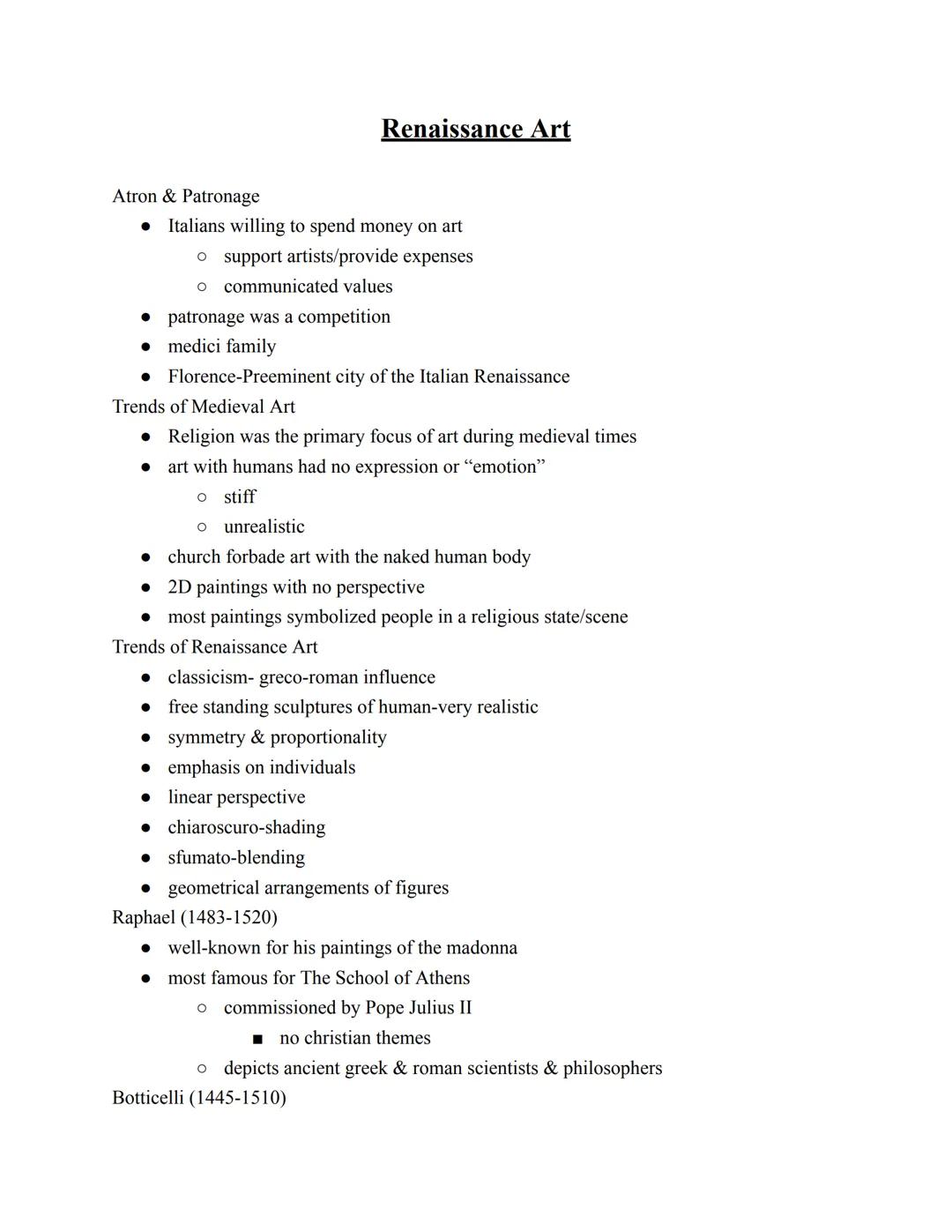
Renaissance Art: Breaking from Medieval Traditions
Medieval art focused primarily on religious themes with stiff, emotionless human figures painted in two dimensions without perspective. The Church strictly prohibited depicting naked human bodies, resulting in symbolic rather than realistic representations of people in religious scenes.
Renaissance artists dramatically departed from these traditions by embracing classicism with its Greco-Roman influences. They created realistic, free-standing human sculptures and paintings with linear perspective, giving their work depth and dimension. Artists mastered techniques like chiaroscuro (shading) and sfumato (blending) to create lifelike images with geometric figure arrangements.
Wealthy Italian families and institutions became eager patrons of the arts, with the powerful Medici family leading this cultural investment in Florence. Patronage became a form of competition among the elite, who used art to communicate their values and elevate their status in society.
Try This! Next time you see Renaissance artwork, look for linear perspective—notice how parallel lines appear to converge at a "vanishing point" in the distance, creating the illusion of depth.
Notable Renaissance masters included Raphael, famous for his Madonna paintings and "The School of Athens" commissioned by Pope Julius II, and Botticelli, whose work often featured secular and mythological themes rather than strictly religious subjects.
2
of 2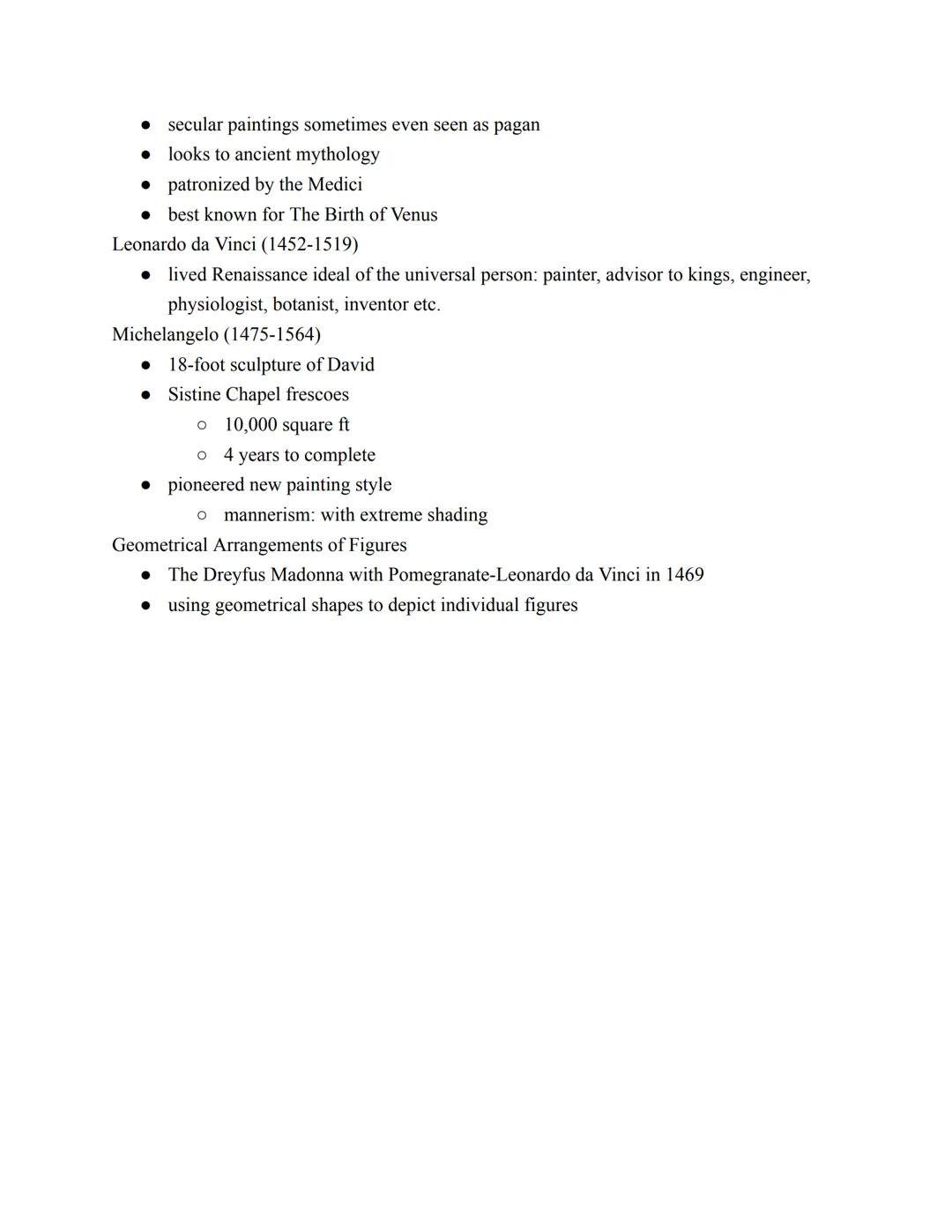
Renaissance Masters and Techniques
Botticelli (1445-1510) pushed boundaries with secular paintings that sometimes appeared almost pagan, drawing inspiration from ancient mythology. With support from his Medici patrons, he created masterpieces like "The Birth of Venus" that showcased the Renaissance's reconnection with classical themes.
Leonardo da Vinci (1452-1519) embodied the Renaissance ideal of the universal person. Far more than just a painter, he worked as an advisor to kings, an engineer, physiologist, botanist, and inventor. His work, like "The Dreyfus Madonna with Pomegranate," pioneered the use of geometrical arrangements to organize figures within compositions.
Michelangelo (1475-1564) demonstrated unparalleled skill across different artistic mediums. His 18-foot sculpture of David showcases perfect anatomical understanding, while his Sistine Chapel frescoes—covering an astonishing 10,000 square feet and taking four years to complete—represent one of humanity's greatest artistic achievements. He later developed mannerism, a style characterized by extreme shading and somewhat exaggerated proportions.
Remember This: Renaissance artists weren't just talented painters—they were innovators who studied anatomy, mathematics, and engineering to improve their art. This well-rounded approach to learning can still inspire us today!
We thought you’d never ask...
What is the Knowunity AI companion?
Our AI companion is specifically built for the needs of students. Based on the millions of content pieces we have on the platform we can provide truly meaningful and relevant answers to students. But its not only about answers, the companion is even more about guiding students through their daily learning challenges, with personalised study plans, quizzes or content pieces in the chat and 100% personalisation based on the students skills and developments.
Where can I download the Knowunity app?
You can download the app in the Google Play Store and in the Apple App Store.
Is Knowunity really free of charge?
That's right! Enjoy free access to study content, connect with fellow students, and get instant help – all at your fingertips.
Most popular content in AP European History
9O
AP European HistoryOrigins of European Colonial Expansion
Analyze the technological, religious, and economic motivations that drove 15th and 16th-century European maritime exploration and empire building.
9th9330
O
AP European HistoryOrigins and Motives of the Age of Exploration
Examine the technological, economic, and religious factors that drove European maritime expansion during the 15th and 16th centuries.
9th4890
O
AP European HistoryOrigins of the Italian Renaissance
Explore the economic and political conditions in Italian city-states that fostered the rise of humanism and the rebirth of classical learning.
9th4040
O
AP European HistoryOrigins of New Monarchies
Explore the fundamental shift from fragmented feudal authority to the centralized power of early modern European sovereigns.
9th3370
O
AP European HistoryOrigins and Values of the Northern Renaissance
Explore the fundamental shift from Italian to Northern Humanism, focusing on Christian Humanism and the works of Erasmus and Thomas More.
9th2150
O
AP European HistoryOrigins and Spread of the Printing Press
Analyze the technological innovations and social conditions that allowed the printing press to transform European communication and literacy.
9th1780
I
AP European HistoryIntroduction to 18th-Century Global Rivalries
Explore the fundamental causes of conflict between Britain and France, focusing on mercantilism and the shift toward global dynastic competition.
9th1980
I
AP European HistoryIntroduction to Mannerism and Baroque Art
Explore the fundamental shift from Renaissance order to the distortion of Mannerism and the grandiosity of the Baroque style.
9th1800
AP European HistoryAP Euro: Wars
a description of all of the wars in the syllabus of collegeboard for AP Euro. in chronology
68748
Most popular content
9O
 AP US History
Origins and Dynamics of the Columbian Exchange
Analyze the ecological and economic motivations behind the initial transfer of goods, people, and diseases between the Old and New Worlds.
9th3,1280
I
AP US HistoryIntroduction to Early Cultural Interactions
Analyze the initial social and religious encounters between Europeans, Africans, and Indigenous peoples in the colonial Americas.
9th2,7730
O
 AP World History
Origins of Ancient River Civilizations
Analyze the environmental factors and technological innovations that led to the rise of early states in Mesopotamia, Egypt, and the Indus Valley.
9th3,1870
M
AP US HistoryMotivations for European Exploration
Analyze the economic, religious, and political factors that drove European powers to the Americas during the 15th and 16th centuries.
9th1,7780
F
 AP Psychology
Foundations of Ethical Guidelines in Research
Practice the core principles of the APA ethical code including informed consent, debriefing, and the role of Institutional Review Boards.
9th1,3360
I
AP US HistoryIntroduction to Native American Societies
Examine the diverse social, political, and economic structures of North American indigenous groups prior to European contact.
9th1,1100
I
 AP Biology
Introduction to Biological Elements of Life
Practice identifying the essential elements including carbon, nitrogen, phosphorus, and sulfur that compose biological macromolecules.
9th1,7390
I
AP US HistoryIntroduction to the Spanish Encomienda System
Explore the fundamental economic and social structures of the Spanish colonial system, focusing on the encomienda and the casta social hierarchy.
9th8890
O
AP World HistoryOrigins and Continuity of the Byzantine Empire
Analyze the political and cultural transitions from the Roman Empire to the Byzantine Empire, focusing on the reign of Justinian I and his code.
9th1,6320
Can't find what you're looking for? Explore other subjects.
Students love us — and so will you.
4.6/5App Store
4.7/5Google Play
The app is very easy to use and well designed. I have found everything I was looking for so far and have been able to learn a lot from the presentations! I will definitely use the app for a class assignment! And of course it also helps a lot as an inspiration.
Stefan SiOS user
This app is really great. There are so many study notes and help [...]. My problem subject is French, for example, and the app has so many options for help. Thanks to this app, I have improved my French. I would recommend it to anyone.
Samantha KlichAndroid user
Wow, I am really amazed. I just tried the app because I've seen it advertised many times and was absolutely stunned. This app is THE HELP you want for school and above all, it offers so many things, such as workouts and fact sheets, which have been VERY helpful to me personally.
AnnaiOS user
AP European History66 views·Updated Jun 11, 2026·2 pagesExploring Renaissance Art: Key Themes and Impact
Shreeya Ram@shreeyaram_iuea
Renaissance Art marked a revolutionary shift from Medieval traditions, introducing innovative techniques and perspectives that transformed European artistic expression. This period saw wealthy Italian patrons competing to support artists, with Florence emerging as the cultural epicenter of this artistic rebirth.
1
of 2
Sign up to see the content. It's free!
- Access to all documents
- Improve your grades
- Join milions of students
Renaissance Art: Breaking from Medieval Traditions
Medieval art focused primarily on religious themes with stiff, emotionless human figures painted in two dimensions without perspective. The Church strictly prohibited depicting naked human bodies, resulting in symbolic rather than realistic representations of people in religious scenes.
Renaissance artists dramatically departed from these traditions by embracing classicism with its Greco-Roman influences. They created realistic, free-standing human sculptures and paintings with linear perspective, giving their work depth and dimension. Artists mastered techniques like chiaroscuro (shading) and sfumato (blending) to create lifelike images with geometric figure arrangements.
Wealthy Italian families and institutions became eager patrons of the arts, with the powerful Medici family leading this cultural investment in Florence. Patronage became a form of competition among the elite, who used art to communicate their values and elevate their status in society.
Try This! Next time you see Renaissance artwork, look for linear perspective—notice how parallel lines appear to converge at a "vanishing point" in the distance, creating the illusion of depth.
Notable Renaissance masters included Raphael, famous for his Madonna paintings and "The School of Athens" commissioned by Pope Julius II, and Botticelli, whose work often featured secular and mythological themes rather than strictly religious subjects.
2
of 2Sign up to see the content. It's free!
- Access to all documents
- Improve your grades
- Join milions of students
Renaissance Masters and Techniques
Botticelli (1445-1510) pushed boundaries with secular paintings that sometimes appeared almost pagan, drawing inspiration from ancient mythology. With support from his Medici patrons, he created masterpieces like "The Birth of Venus" that showcased the Renaissance's reconnection with classical themes.
Leonardo da Vinci (1452-1519) embodied the Renaissance ideal of the universal person. Far more than just a painter, he worked as an advisor to kings, an engineer, physiologist, botanist, and inventor. His work, like "The Dreyfus Madonna with Pomegranate," pioneered the use of geometrical arrangements to organize figures within compositions.
Michelangelo (1475-1564) demonstrated unparalleled skill across different artistic mediums. His 18-foot sculpture of David showcases perfect anatomical understanding, while his Sistine Chapel frescoes—covering an astonishing 10,000 square feet and taking four years to complete—represent one of humanity's greatest artistic achievements. He later developed mannerism, a style characterized by extreme shading and somewhat exaggerated proportions.
Remember This: Renaissance artists weren't just talented painters—they were innovators who studied anatomy, mathematics, and engineering to improve their art. This well-rounded approach to learning can still inspire us today!
We thought you’d never ask...
What is the Knowunity AI companion?
Our AI companion is specifically built for the needs of students. Based on the millions of content pieces we have on the platform we can provide truly meaningful and relevant answers to students. But its not only about answers, the companion is even more about guiding students through their daily learning challenges, with personalised study plans, quizzes or content pieces in the chat and 100% personalisation based on the students skills and developments.
Where can I download the Knowunity app?
You can download the app in the Google Play Store and in the Apple App Store.
Is Knowunity really free of charge?
That's right! Enjoy free access to study content, connect with fellow students, and get instant help – all at your fingertips.
Most popular content in AP European History
9O
AP European HistoryOrigins of European Colonial Expansion
Analyze the technological, religious, and economic motivations that drove 15th and 16th-century European maritime exploration and empire building.
9th9330
O
AP European HistoryOrigins and Motives of the Age of Exploration
Examine the technological, economic, and religious factors that drove European maritime expansion during the 15th and 16th centuries.
9th4890
O
AP European HistoryOrigins of the Italian Renaissance
Explore the economic and political conditions in Italian city-states that fostered the rise of humanism and the rebirth of classical learning.
9th4040
O
AP European HistoryOrigins of New Monarchies
Explore the fundamental shift from fragmented feudal authority to the centralized power of early modern European sovereigns.
9th3370
O
AP European HistoryOrigins and Values of the Northern Renaissance
Explore the fundamental shift from Italian to Northern Humanism, focusing on Christian Humanism and the works of Erasmus and Thomas More.
9th2150
O
AP European HistoryOrigins and Spread of the Printing Press
Analyze the technological innovations and social conditions that allowed the printing press to transform European communication and literacy.
9th1780
I
AP European HistoryIntroduction to 18th-Century Global Rivalries
Explore the fundamental causes of conflict between Britain and France, focusing on mercantilism and the shift toward global dynastic competition.
9th1980
I
AP European HistoryIntroduction to Mannerism and Baroque Art
Explore the fundamental shift from Renaissance order to the distortion of Mannerism and the grandiosity of the Baroque style.
9th1800
AP European HistoryAP Euro: Wars
a description of all of the wars in the syllabus of collegeboard for AP Euro. in chronology
68748
Most popular content
9O
AP US HistoryOrigins and Dynamics of the Columbian Exchange
Analyze the ecological and economic motivations behind the initial transfer of goods, people, and diseases between the Old and New Worlds.
9th3,1280
I
AP US HistoryIntroduction to Early Cultural Interactions
Analyze the initial social and religious encounters between Europeans, Africans, and Indigenous peoples in the colonial Americas.
9th2,7730
O
AP World HistoryOrigins of Ancient River Civilizations
Analyze the environmental factors and technological innovations that led to the rise of early states in Mesopotamia, Egypt, and the Indus Valley.
9th3,1870
M
AP US HistoryMotivations for European Exploration
Analyze the economic, religious, and political factors that drove European powers to the Americas during the 15th and 16th centuries.
9th1,7780
F
AP PsychologyFoundations of Ethical Guidelines in Research
Practice the core principles of the APA ethical code including informed consent, debriefing, and the role of Institutional Review Boards.
9th1,3360
I
AP US HistoryIntroduction to Native American Societies
Examine the diverse social, political, and economic structures of North American indigenous groups prior to European contact.
9th1,1100
I
AP BiologyIntroduction to Biological Elements of Life
Practice identifying the essential elements including carbon, nitrogen, phosphorus, and sulfur that compose biological macromolecules.
9th1,7390
I
AP US HistoryIntroduction to the Spanish Encomienda System
Explore the fundamental economic and social structures of the Spanish colonial system, focusing on the encomienda and the casta social hierarchy.
9th8890
O
AP World HistoryOrigins and Continuity of the Byzantine Empire
Analyze the political and cultural transitions from the Roman Empire to the Byzantine Empire, focusing on the reign of Justinian I and his code.
9th1,6320
Can't find what you're looking for? Explore other subjects.
Students love us — and so will you.
4.6/5App Store
4.7/5Google Play
The app is very easy to use and well designed. I have found everything I was looking for so far and have been able to learn a lot from the presentations! I will definitely use the app for a class assignment! And of course it also helps a lot as an inspiration.
Stefan SiOS user
This app is really great. There are so many study notes and help [...]. My problem subject is French, for example, and the app has so many options for help. Thanks to this app, I have improved my French. I would recommend it to anyone.
Samantha KlichAndroid user
Wow, I am really amazed. I just tried the app because I've seen it advertised many times and was absolutely stunned. This app is THE HELP you want for school and above all, it offers so many things, such as workouts and fact sheets, which have been VERY helpful to me personally.
AnnaiOS user